


1 Samuel 7:11
Bible text: King James Version (1769 Blayney text) · Public domain
Bible text: Berean Standard Bible · Public domain
Bible text: American Standard Version (1901) · Public domain
Bible text: World English Bible, Messianic edition · Public domain
Bible text: Geneva Bible (1599) · Public domain
Bible text: Young's Literal Translation · Public domain
- וַיֵּצְאוּvai·Ye·tze·'Uand they went outH3318Conj-w ¦ V-Qal-ConsecImperf-3mpVerb Qal Consecutive Imperfect 3rd Plural Masculineוַandיֵּצְאוּthey went out
- אַנְשֵׁי'an·Shei[the] men ofH582N-mpcNoun Plural Masculine Construct
- יִשְׂרָאֵלYis·ra·'ElIsraelH3478N-properNoun Proper Location
- מִןminfromH4480PrepPreposition
- הַמִּצְפָּהha·mitz·Pah<the> MizpahH4709Art ¦ N-properNoun Proper Locationהַ<the>מִּצְפָּהMizpah
- וַיִּרְדְּפוּvai·yir·de·Fuand they pursuedH7291Conj-w ¦ V-Qal-ConsecImperf-3mpVerb Qal Consecutive Imperfect 3rd Plural Masculineוַandיִּרְדְּפוּthey pursued
- אֶת'et<obj.>H853DirObjMParticle Object Indicator
- פְּלִשְׁתִּיםpe·lish·Tim[the] PhilistinesH6430N-mpNoun Gentilic Plural Masculine Absolute
- וַיַּכּוּםvai·ya·Kumand they struck down themH5221Conj-w ¦ V-Hiphil-ConsecImperf-3mp ¦ 3mpVerb Hiphil Consecutive Imperfect 3rd Plural Masculineוַandיַּכּוּthey struck downםthem
- עַד'adtoH5704PrepPreposition
- מִתַּחַתmi·Ta·chatfrom belowH8478Prep-m ¦ N-mscNoun Singular Masculine Constructמִfromתַּחַתbelow
- לְבֵיתle·Veitto BethH1033Prep-l ¦ N-properNoun Proper LocationלְtoבֵיתBeth
- כָּרKarCarH1033N-properNoun Proper Location
English is a literal word-by-word gloss of the Hebrew, not the KJV's wording. Why?
This is the original text the KJV's translators worked from — each Hebrew word with its own literal English meaning in this verse, prepared by scholars at Tyndale House, Cambridge. The KJV translates whole sentences, not word by word, so its wording differs: one Hebrew word can become several English words, and the KJV may choose “the LORD” where the gloss reads “Yahweh”. Both are faithful — they answer different questions. For the KJV's own rendering, switch to the KJV text.
Details
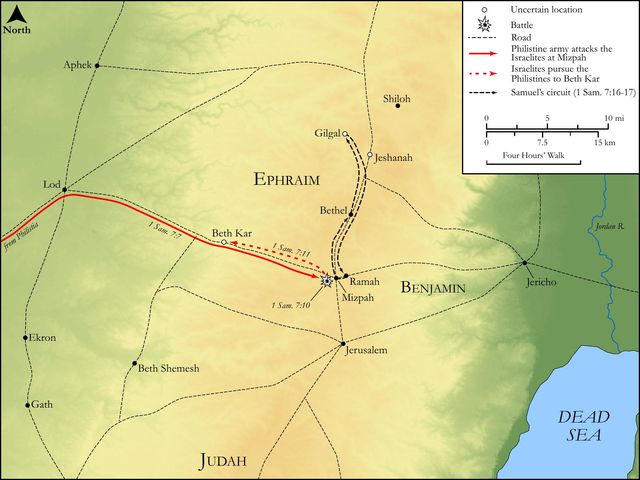
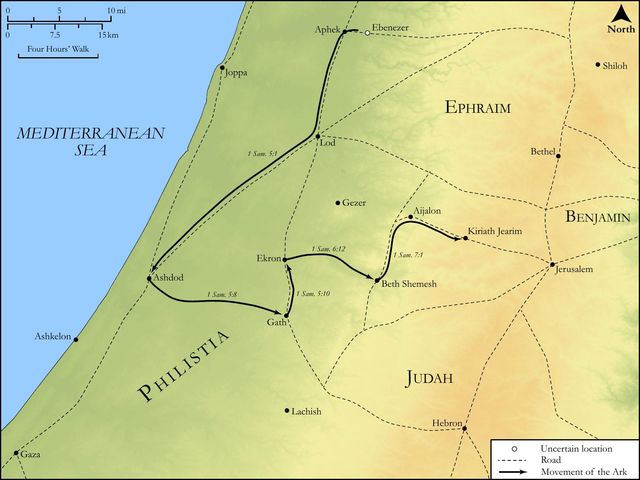
See on the biblical-era maps
Study this verse
Public-domain commentary
Matthew Henry
From his Commentary on the Whole Bible. Henry comments on passages, not single verses — this entry covers 1 Samuel 7:7–12. His two-level outline is real structure in the source text, so it is rendered as structure.
Here, I. The Philistines invade Israel (Sa1 7:7), taking umbrage from that general meeting for repentance and prayer as if it had been a rendezvous for war, and, if so, they thought it prudent to keep the war out of their own country. They had no just cause for this suspicion; but those that seek to do mischief to others will be forward to imagine that others design mischief to them. Now see here, 1. How evil sometimes seems to come out of good. The religious meeting of the Israelites at Mizpeh brought trouble upon them from the Philistines, which perhaps tempted them to wish they had staid at home and to blame Samuel for calling them together. But we may be in God's way and yet meet with distress; nay, when sinners begin to repent and reform, they must expect that Satan will muster all his force against them, and set his instruments on work to the utmost to oppose and discourage them. But, 2. How good is, at length, brought out of that evil. Israel could never be threatened more seasonably than at this time, when they were repenting and praying, nor could they have been better prepared to receive the enemy; nor could the Philistines have acted more impolitely for themselves than to make war upon Israel at this time, when they were making their peace with God. But God permitted them to do it, that he might have an opportunity immediately of crowning his people's reformation with tokens of his favour, and of confirming the words of his messenger, who had assured them that if they repented God would deliver them out of the hand of the Philistines. Thus he makes man's wrath to praise him, and serves the purposes of his grace to his people even by the malicious designs of their enemies against them, Mic 4:11, Mic 4:12.
II.Israel cleaves closely to Samuel, as their best friend, under God, in this distress; though he was no military man, nor ever celebrated as a mighty man of valour, yet, being afraid of the Philistines, for whom they thought themselves an unequal match, they engaged Samuel's prayers for them: Cease not to cry unto the Lord our God for us, Sa1 7:8. They were here unarmed, unprepared for war, come together to fast and pray, not to fight; prayers and tears therefore being all the weapons many of them are now furnished with, to these they have recourse. And, knowing Samuel to have a great interest in heaven, they earnestly beg of him to improve it for them. They had reason to expect it, because he had promised to pray for them (Sa1 7:5), had promised them deliverance from the Philistines (Sa1 7:3), and they had been observant of him in all that which he had spoken to them from the Lord. Thus those who sincerely submit to Christ, as their lawgiver and judge, need not doubt of their interest in his intercession. They were very solicitous that Samuel should not cease to pray for them: what military preparations were to be made they would undertake them, but let him continue instant in prayer, perhaps remembering that when Moses did but let down his hand ever so little Amalek prevailed. O what a comfort is it to all believers that our great intercessor above never ceases, is never silent, for he always appears in the presence of God for us!
III.Samuel intercedes with God for them, and does it by sacrifice, Sa1 7:9.
He took a sucking lamb, and offered it for a burnt-offering, a whole burnt-offering, to the Lord, and, while the sacrifice was in burning, with the smoke of it his prayers ascended up to heaven for Israel. Observe,
1.He made intercession with a sacrifice. Christ intercedes in the virtue of his satisfaction, and in all our prayers we must have an eye to his great oblation, depending upon that for audience and acceptance. Samuel's sacrifice without his prayer would have been an empty shadow, his prayer without the sacrifice would not have been so prevalent, but both together teach us what great things we may expect from God in answer to those prayers which are made with faith in Christ's sacrifice.
2.It was a burnt-offering, which was offered purely for the glory of God, so intimating that the great plea he relied on in his prayer was taken from the honour of God. "Lord, help thy people now for thy name's sake." When we endeavour to give glory to God we may hope he will, in answer to our prayers, work for his own glory.
3.It was but one sucking lamb that he offered; for it is the integrity and intention of the heart that God looks at, more than the bulk or number of the offerings. This one lamb (typifying the Lamb of God) was more acceptable than thousands of rams or bullocks would have been without faith and prayer. Samuel was no priest, but he was a Levite and a prophet; the case was extraordinary, and what he did was by special direction, and therefore was accepted of God. And justly was this reproach put upon the priests because they had corrupted themselves.
IV.God gave a gracious answer to Samuel's prayer (Sa1 7:9):
The Lord heard him. He was himself a Samuel, asked of God, and many a Samuel, many a mercy in answer to prayer, God gave him. Sons of prayer should be famous for praying, as Samuel was among those that call upon his name, Psa 99:6. The answer was a real answer: the Philistines were discomfited (Sa1 7:10, Sa1 7:11), totally routed, and that in such a manner as highly magnified the prayer of Samuel, the power of God, and the valour of Israel.
1.The prayer of Samuel was honoured; for at the very time when he was offering up his sacrifice, and his prayer with it, the battle began, and turned immediately against the Philistines. Thus while he was yet speaking God heard, and answered in thunder, Isa 65:24. God showed that it was Samuel's prayer and sacrifice that he had respect to, and hereby let Israel know that as in a former engagement with the Philistines he had justly chastised their presumptuous confidence in the presence of the ark, on the shoulders of two profane priests, so now he graciously accepted their humble dependence upon the prayer of faith from the mouth and heart of a pious prophet.
2.The power of God was greatly honoured; for he took the work into his own hand, and discomfited them, not with great hail-stones, which would kill them (as Jos 10:11), but with a great thunder, which frightened them and put them into such terror and consternation that they fainted away, and became a very easy prey to the sword of Israel, before whom, being thus confounded, they were smitten. Josephus adds that the earth quaked under them when first they made the onset and in many places opened and swallowed them up, and that, besides the terror of the thunder, their faces and hands were burnt with lightning, which obliged them to shift for themselves by flight. And, being thus driven to their heels by the immediate hand of God (whom they feared not so much as they had feared his ark, Sa1 4:7), then,
3.Honour was put upon the hosts of Israel; they were made use of for the completing of the victory, and had the pleasure of triumphing over their oppressors: They pursued the Philistines, and smote them. How soon did they find the benefit of their repentance, and reformation, and return to God! Now that they have thus engaged him for them none of their enemies can stand before them.
V.Samuel erected a thankful memorial of this victory, to the glory of God and for the encouragement of Israel, Sa1 7:12.
He set up an Eben-ezer, the stone of help. If ever the people's hard hearts should lose the impressions of this providence, this stone would either revive the remembrance of it, and make them thankful, or remain a standing witness against them for their unthankfulness.
1.The place where this memorial was set up was the same where, twenty years before, the Israelites were smitten before the Philistines, for that was beside Eben-ezer, Sa1 4:1. The sin which procured that defeat formerly being pardoned upon their repentance, the pardon was sealed by this glorious victory in the very same place where they then suffered loss; see Hos 1:10.
2.Samuel himself took care to set up this monument. He had been instrumental by prayer to obtain the mercy, and therefore he thought himself in a special manner obliged to make this grateful acknowledgement of it.
3.The reason he gives for the name is, Hitherto the Lord hath helped us, in which he speaks thankfully of what was past, giving the glory of the victory to God only, who had added this to all his former favours; and yet he speaks somewhat doubtfully for the future: "Hitherto things have done well, but what God may yet do with us we know not, that we refer to him; but let us praise him for what he has done." Note, The beginnings of mercy and deliverance are to be acknowledged by us with thankfulness so far as they go, though they be not completely finished, nay, though the issue seem uncertain. Having obtained help from God, I continue hitherto, says blessed Paul, Act 26:22.
Historical interpretation
Historical reception
1 surviving comment on this verse from the historical church.
The men of Israel went out from Mizpah and pursued the Philistines, etc. The apostles went out from Mizpah, that is, the watchtower of their peaceful way of life, pursued the impious by reproving them; and struck them from their ancient, that is, impious life, gradually removing them with the sword of the word, until they led them to the fellowship of the Church, which is founded upon Christ. For Bethcar, which is interpreted as the house of the lamb, or the house of recognition, certainly signifies him, who, having innocently died in humanity, powerfully reveals the paternal secrets in divinity. Upon which house of divine recognition he found a place of beloved residence, who said: “Lord, to whom shall we go? You have the words of eternal life” (John VI). Which he desired to enter, who humbly knocking, asked: "Lord, show us the Father, and it suffices us" (John XIV). For they had learned from him because no one knows the Son, except the Father: nor does anyone know the Father, except the Son, and to whom the Son will reveal (Luke X). And therefore, rightly it is called the house of recognition, through whom he alone and the Father are revealed.
Continue studying 1 Samuel 7:11 across the web’s major study libraries — every link below opens this exact verse, chapter, or book on the destination site.
Read & Compare
 BibleGatewayThis verse in more than 200 translations and 70 languages.
 Bible.comThe YouVersion reader — hundreds of translations, reading plans, and highlights.
 ESV.orgCrossway's official English Standard Version reader.
 NET BibleThe NET translation with 60,000+ translators' notes on every rendering decision.
 STEP BibleTyndale House's free study tool — original text, vocabulary, and scholarly resources.
 BibliaLogos Bible Software's free web reader.
 USCCBThe New American Bible (Revised Edition) with the U.S. bishops' study notes.
Commentaries
 BibleHub CommentariesDozens of classic commentaries on this verse, gathered on one page.
 StudyLightMore than 100 commentary sets — the largest collection on the web.
 BibleRefPlain-English commentary on what this verse means, verse by verse.
 Enduring WordDavid Guzik's free commentary on this chapter, widely used by Bible teachers.
 Bible Study ToolsVerse commentary alongside Greek and Hebrew study aids.
Original Language & Research
- BibleHub InterlinearThe verse word by word — original language, transliteration, and English.
- BibleHub LexiconEvery word's original-language definition and Strong's entry.
 Blue Letter BibleDeep-study tools — Strong's numbers, concordance, and word studies.
 SefariaThe Hebrew text with Rashi and centuries of Jewish commentary.
Sermons, Hymns & Audio


TrulyRandomVerse is not affiliated with these sites and doesn’t control their content. They’re linked because they’re genuinely useful.
Summary
1 Samuel 7:11 details the decisive human response to a miraculous divine intervention, as the men of Israel, emboldened by God's thunderous rout of the Philistines, vigorously pursued and thoroughly defeated their long-standing oppressors, driving them back to Bethcar. This pivotal moment underscores the synergy between divine enablement and human obedience, marking a significant turning point in Israel's history of deliverance from Philistine subjugation.
Context
ShowHideLiterary Context
This verse is the immediate follow-up to God's dramatic intervention described in 1 Samuel 7:10. Prior to this, the narrative in 1 Samuel 7 establishes Israel's deep repentance and return to the Lord under Samuel's leadership at Mizpeh, a sacred assembly point. The Philistines, ever vigilant, saw this gathering as a threat and launched a preemptive strike. However, as Samuel offered a burnt offering and interceded, the Lord responded with a powerful display of thunder, throwing the Philistine army into utter confusion and panic. Verse 11 then describes Israel's active participation in the victory, transforming the divine rout into a complete military triumph. The subsequent verses, leading up to 1 Samuel 7:13, depict the lasting peace and territorial restoration that resulted from this decisive victory, culminating in Samuel's setting up of the Ebenezer stone as a memorial to God's help.
Historical & Cultural Context
For decades leading up to this event, Israel had suffered under severe Philistine oppression, marked by military defeats, economic subjugation, and even the capture of the Ark of the Covenant, as recounted in 1 Samuel 4:11. The Philistines were a formidable, technologically superior (iron weaponry) maritime people who had settled on the coastal plain and exerted control over much of Israelite territory. Mizpeh, a strategic high point in Benjamin, served as a significant gathering place for national assemblies and religious rites, making it a natural target for the Philistines. The act of pursuing a defeated enemy was common in ancient warfare, aimed at maximizing casualties and preventing regrouping, thus securing a decisive victory and asserting dominance. This victory at Mizpeh marked the end of a long period of Philistine domination, ushering in a time of relative peace and restored Israelite sovereignty under Samuel's judgeship, as detailed in 1 Samuel 7:13-14.
Key Themes
ShowHide1 Samuel 7:11 powerfully illustrates the theme of Divine Empowerment and Human Action. While God initiated the victory through a supernatural intervention, Israel was not passive; they actively pursued and "smote" the disoriented enemy, demonstrating their faith and obedience. This highlights the biblical principle that divine grace often calls for human responsibility and participation, as seen in passages like James 2:26. Another crucial theme is the Fruit of Repentance. The victory was a direct consequence of Israel's collective repentance and their turning away from idolatry to serve the Lord alone, as described in 1 Samuel 7:3-6. This demonstrates that national or individual spiritual renewal can lead to tangible deliverance and blessing, echoing the promise in 2 Chronicles 7:14. Finally, the verse underscores Decisive Deliverance, emphasizing the completeness of the rout. The pursuit "until [they came] under Bethcar" signifies a thorough and overwhelming defeat for the Philistines, securing a period of peace and restored territory for Israel, as further elaborated in 1 Samuel 7:13.
Exposition and Analysis
ShowHideKey Word Analysis
ShowHideThis primitive root signifies "to run after (usually with hostile intent); figuratively (of time) gone by." In this context, it describes Israel's vigorous, active chase of the fleeing Philistines. It implies a relentless follow-up, emphasizing Israel's initiative and determination to capitalize on the Philistines' divine disarray, ensuring their defeat was complete and not just a temporary retreat. This pursuit was crucial for transforming a supernatural rout into a comprehensive military triumph.
A primitive root meaning "to strike (lightly or severely, literally or figuratively)." It encompasses actions like beating, wounding, or killing. Here, it indicates a forceful and decisive blow, signifying the slaughter and thorough defeat of the Philistine army. The intensity of "smote" underscores the severity of the Philistine loss and the completeness of Israel's victory, confirming that Israel inflicted heavy casualties, not merely pushing them back.
Derived from "house" and "pasture," meaning "house of pasture." Bethcar is a geographical marker indicating the extent of the pursuit. While its exact location is debated, it signifies a point far enough from Mizpeh to confirm a comprehensive rout. The phrase "until [they came] under Bethcar" implies that the Philistines were driven all the way to this point, signifying the full extent of their defeat and Israel's regained control over the territory, marking a decisive end to the engagement.
Verse Breakdown
ShowHide"And the men of Israel went out of Mizpeh"
This clause establishes the starting point of Israel's action. Having gathered at Mizpeh for repentance and prayer, and witnessing God's miraculous intervention, the Israelite army now mobilizes. This movement signifies their readiness to act in response to God's deliverance, transitioning from a posture of supplication to one of military engagement, demonstrating their faith through action.
"and pursued the Philistines"
This highlights Israel's active role in the victory. After the divine confusion of the Philistines, Israel did not remain passive. They seized the moment, engaging in a vigorous chase to capitalize on the enemy's disarray. This pursuit was crucial for turning a divine rout into a military triumph, demonstrating their commitment to securing the deliverance God had initiated and ensuring the enemy could not regroup.
"and smote them"
This emphasizes the destructive and decisive nature of Israel's engagement. The pursuit was not merely to scare the Philistines away but to inflict heavy casualties and ensure their defeat. This action confirms the completeness of the victory, signifying a thorough military engagement that broke the Philistine power in the region and secured Israel's dominance.
"until [they came] under Bethcar"
This geographical marker denotes the full extent of the pursuit and the comprehensiveness of the Philistine defeat. Driving the enemy back to a specific, likely distant, point signifies that the Philistines were not just repelled but utterly routed and chased far from Israelite territory, securing a significant and lasting peace and demonstrating the thoroughness of God's deliverance through Israel's obedient action.
Literary Devices
ShowHideThe narrative of 1 Samuel 7:11 employs several literary devices to emphasize the nature of this pivotal victory. Narrative progression is evident as the verse swiftly moves from Israel's mobilization ("went out of Mizpeh") to their active engagement ("pursued") and ultimate triumph ("smote them"). This rapid sequence highlights the immediacy and decisiveness of their response to God's intervention. The use of strong verbs like "pursued" and "smote" creates a sense of dynamic action and military intensity, vividly portraying the Israelites' vigorous and destructive assault on the fleeing Philistines. Furthermore, the geographical marker "under Bethcar" serves as a form of merism, signifying the full and complete extent of the rout, implying that the Philistines were driven a considerable distance and thoroughly defeated, marking the boundary of Israel's reasserted control. This dramatic portrayal underscores the profound shift in power and the completeness of God's deliverance through human agency.
Theological and Thematic Connections
ShowHide1 Samuel 7:11 stands as a powerful testament to the principle of divine-human synergy in the unfolding of God's redemptive purposes. While the preceding verse clearly attributes the initial victory to God's supernatural intervention, this verse emphasizes Israel's indispensable role in actualizing that victory on the ground. It illustrates that God's deliverance often requires human participation, obedience, and active engagement. This is not a contradiction but a demonstration of God empowering His people to carry out His will, transforming a spiritual victory into a tangible reality. The event underscores the profound impact of national repentance and turning back to God, showing that when a people humble themselves and seek the Lord, He responds with mighty acts of deliverance, enabling them to overcome seemingly insurmountable foes. This victory was not merely a military success but a spiritual triumph, reaffirming God's covenant faithfulness to a repentant people.
Reflection and Application
ShowHideThe account in 1 Samuel 7:11 offers profound lessons for the contemporary believer, illustrating the dynamic interplay between divine grace and human responsibility. Just as God initiated the victory over the Philistines with a supernatural display of power, He often provides the spiritual breakthrough in our lives, whether it be freedom from sin, healing, or guidance. However, we are not called to be passive recipients; rather, we are invited to actively participate in the victory He has already secured. This means responding to His grace with obedience, courage, and diligent effort. If God has disoriented the "Philistines" in our lives – be they spiritual strongholds, destructive habits, or oppressive circumstances – we are called to "pursue" and "smite" them, actively engaging in the process of sanctification and spiritual warfare. This requires perseverance, reliance on the Holy Spirit, and a commitment to living out the repentance that opens the door for God's powerful intervention. Our active participation solidifies the victory and ensures its lasting impact, transforming moments of divine help into enduring freedom and flourishing.
Questions for Reflection
ShowHideFAQ
ShowHideWhat was the significance of Mizpeh in this narrative?
ShowHideMizpeh served as a crucial gathering point for the people of Israel. It was a place of national assembly, repentance, and spiritual renewal. In 1 Samuel 7:5-6, Israel gathered there to confess their sins, fast, and pour out water before the Lord, signifying their renewed commitment to Him under Samuel's leadership. This act of corporate repentance and turning back to God was foundational to the subsequent divine intervention and victory over the Philistines. It symbolized a spiritual turning point for the nation, moving from idolatry to renewed covenant faithfulness.
How did God intervene to help Israel before they pursued the Philistines?
ShowHideAccording to 1 Samuel 7:10, while Samuel was offering a burnt offering and interceding for Israel, the Philistines drew near to battle. At that moment, "the Lord thundered with a great thunder on that day upon the Philistines, and discomfited them; and they were smitten before Israel." This divine, supernatural intervention caused panic and confusion among the Philistine ranks, effectively routing them before Israel even fully engaged, setting the stage for Israel's successful pursuit and decisive victory.
What does "smote them, until [they came] under Bethcar" imply about the victory?
ShowHideThe phrase "smote them, until [they came] under Bethcar" signifies the completeness and decisiveness of Israel's victory. "Smote" (Hebrew nakah) implies a thorough defeat, inflicting heavy casualties, not just a minor skirmish. The pursuit "until [they came] under Bethcar" indicates that the Philistines were driven a considerable distance, far from Mizpeh, and were utterly routed. This was not a partial victory but a comprehensive rout that broke Philistine power in the region for a significant period, leading to peace and the restoration of Israelite territory, as described in 1 Samuel 7:13-14.
Christ-Centered Fulfillment
ShowHideThe victory described in 1 Samuel 7:11, where Israel actively pursues and "smotes" their disoriented enemies after a divine intervention, powerfully prefigures the ultimate victory secured by Jesus Christ. Just as God confused the Philistines, Jesus, through His death and resurrection, utterly disarmed and triumphed over the spiritual powers of darkness, making a public spectacle of them (as seen in Colossians 2:15). He is the true and greater Samuel, the ultimate intercessor and sacrifice, whose offering on the cross secured a definitive victory over sin, death, and the devil. We, as believers, are called to participate in this already-won victory, not by earning it, but by living out its implications. We are to "pursue" the enemy of our souls by resisting temptation, fleeing from sin, and actively engaging in spiritual warfare, putting on the full armor of God (as exhorted in Ephesians 6:11-12). The "smoting" of the Philistines finds its fulfillment in our ongoing sanctification, where we put to death the deeds of the flesh (as commanded in Romans 8:13) and walk in the newness of life, empowered by the Spirit of Christ. This Old Testament narrative, therefore, serves as a shadow of the glorious reality that through Christ, we are more than conquerors (as declared in Romans 8:37), called to actively live out the victory He has already achieved on our behalf.