


Joshua 10:10
Bible text: King James Version (1769 Blayney text) · Public domain
Bible text: King James Version with Strong's numbers · Public domain
Bible text: Berean Standard Bible · Public domain
Bible text: American Standard Version (1901) · Public domain
Bible text: World English Bible, Messianic edition · Public domain
Bible text: Geneva Bible (1599) · Public domain
Bible text: Young's Literal Translation · Public domain
- וַיְהֻמֵּםvay·hu·Memand he routed themH2000Conj-w ¦ V-Qal-ConsecImperf-3ms ¦ 3mpVerb Qal Consecutive Imperfect 3rd Singular Masculineוַandיְהֻמֵּhe routedםthem
- יְהוָהYah·wehYahwehH3068N-properNoun Proper Title
- לִפְנֵיlif·Nei<to> beforeH6440Prep-l ¦ N-mpcNoun Plural Masculine Constructלִ<to>פְנֵיbefore
- יִשְׂרָאֵלYis·ra·'ElIsraelH3478N-properNoun Proper Location
- וַיַּכֵּםvai·ya·Kemand he struck down themH5221Conj-w ¦ V-Hiphil-ConsecImperf-3ms ¦ 3mpVerb Hiphil Consecutive Imperfect 3rd Singular Masculineוַandיַּכֵּhe struck downםthem
- מַכָּהma·kaha defeatH4347N-fsNoun Singular Feminine Absolute
- גְדוֹלָהge·do·LahgreatH1419Adj-fsAdjective Singular Feminine Absolute
- בְּגִבְעוֹןbe·giv·'onat GibeonH1391Prep-b ¦ N-properNoun Proper LocationבְּatגִבְעוֹןGibeon
- וַיִּרְדְּפֵםvai·yir·de·Femand he pursued themH7291Conj-w ¦ V-Qal-ConsecImperf-3ms ¦ 3mpVerb Qal Consecutive Imperfect 3rd Singular Masculineוַandיִּרְדְּפֵhe pursuedםthem
- דֶּרֶךְDe·rekh[the] direction ofH1870N-cscNoun Singular common gender Construct
- מַעֲלֵהma·'a·Leh[the] ascent ofH4608N-mscNoun Singular Masculine Construct
- בֵיתveitBethH1032N-properNoun Proper Location
- חוֹרֹןcho·RonHoronH1032N-properNoun Proper Location
- וַיַּכֵּםvai·ya·Kemand he struck down themH5221Conj-w ¦ V-Hiphil-ConsecImperf-3ms ¦ 3mpVerb Hiphil Consecutive Imperfect 3rd Singular Masculineוַandיַּכֵּhe struck downםthem
- עַד'adtoH5704PrepPreposition
- עֲזֵקָה'a·ze·KahAzekahH5825N-properNoun Proper Location
- וְעַדve·'adand toH5704Conj-w ¦ PrepPrepositionוְandעַדto
- מַקֵּדָהma·ke·DahMakkedahH4719N-properNoun Proper Location
English is a literal word-by-word gloss of the Hebrew, not the KJV's wording. Why?
This is the original text the KJV's translators worked from — each Hebrew word with its own literal English meaning in this verse, prepared by scholars at Tyndale House, Cambridge. The KJV translates whole sentences, not word by word, so its wording differs: one Hebrew word can become several English words, and the KJV may choose “the LORD” where the gloss reads “Yahweh”. Both are faithful — they answer different questions. For the KJV's own rendering, switch to the KJV text.
Details
See on the biblical-era maps
Study this verse
Public-domain commentary
Matthew Henry
From his Commentary on the Whole Bible. Henry comments on passages, not single verses — this entry covers Joshua 10:7–14. His four-level outline is real structure in the source text, so it is rendered as structure.
Here, I. Joshua resolves to assist the Gibeonites, and God encourages him in this resolve. 1. He ascended from Gilgal (Jos 10:7), that is, he designed, determined, and prepared for, this expedition to relieve Gibeon, for it is probable it was before he stirred a step that God spoke to him to encourage him. It was generous and just in Joshua to help his new allies, though perhaps the king of Jerusalem, when he attacked them, little thought that Joshua would be so ready to help them, but expected he would abandon them as Canaanites, the rather because they had obtained their league with him by fraud; therefore he speaks with assurance (Jos 10:4) of smiting Gibeon. But Joshua knew that his promise to let them live obliged him, not only not to slay them himself, but not to stand by and see them slain when it was in the power of his hand to prevent it, Pro 24:11, Pro 24:12. He knew that when they embraced the faith and worship of the God of Israel they came to trust under the shadow of his wings (Rut 2:12), and therefore, as his servants, he was bound to protect them. 2. God animated him for his undertaking, (Jos 10:8): Fear not, that is, (1.) "Doubt not of the goodness of thy cause and the clearness of thy call; though it be to assist Gibeonites, thou art in the way of duty, and God is with thee of a truth." (2.) "Dread not the power of the enemy; though so many kings are confederate against thee, and are resolved to make their utmost efforts for the reduction of Gibeon, and it may be will fight desperately in a desperate cause, yet let not this discourage thee, I have delivered them into thy hand;" and those can make neither resistance nor escape whom God has marked for destruction.
II.Joshua applies himself to execute this resolve, and God assists him in the execution. Here we have,
1.The great industry of Joshua, and the power of God working with it for the defeat of the enemy. In this action,
(1.)Joshua showed his good-will in the haste he made for the relief of Gibeon (Jos 10:9): He came unto them suddenly, for the extremity was such as would not admit delay. If one of the tribes of Israel had been in danger, he could not have shown more care or zeal for its relief than here for Gibeon, remembering in this, as in other cases, there must be one law for the stranger that was proselyted and for him that was born in the land. Scarcely had the confederate princes got their forces together, and sat down before Gibeon, when Joshua was upon them, the surprise of which would put them into the greatest confusion. Now that the enemy were actually drawn up into a body, which had all as it were but one neck, despatch was as serviceable to his cause as before delay was, while he waited for this general rendezvous; and now that things were ripe for execution no man more expeditious than Joshua, who before had seemed slow. Now it shall never be said, He left that to be done tomorrow which he could do today. When Joshua found he could not reach Gibeon in a day, lest he should lose any real advantages against the enemy, or so much as seem to come short or to neglect his new allies, he marched all night, resolving not to give sleep to his eyes, nor slumber to his eye-lids, till he had accomplished this enterprise. It was well the forces he took with him were mighty men of valour, not only able-bodied men, but men of spirit and resolution, and hearty in the cause, else they neither could nor would have borne this fatigue, but would have murmured at their leader and would have asked, "Is this the rest we were promised in Canaan?" But they well considered that the present toil was in order to a happy settlement, and therefore were reconciled to it. Let the good soldiers of Jesus Christ learn hence to endure hardness, in following the Lamb whithersoever he goes, and not think themselves undone if their religion lose them now and then a night's sleep; it will be enough to rest when we come to heaven. But why needed Joshua to put himself and his men so much to the stretch? Had not God promised him that without fail he would deliver the enemies into his hand? It is true he had; but God's promises are intended, not to slacken and supersede, but to quicken and encourage our endeavours. He that believeth doth not make haste to anticipate providence, but doth make haste to attend it, with a diligent, not a distrustful, speed.
(2.)God showed his great power in defeating the enemies whom Joshua so vigorously attacked, Jos 10:10, Jos 10:11. Joshua had a very numerous and powerful army with him, hands enough to despatch a dispirited enemy, so that the enemy might have been scattered by the ordinary fate of war; but God himself would appear in this great and decisive battle, and draw up the artillery of heaven against the Canaanites, to demonstrate to this people that they got not this land in possession by their own sword, neither did their own arm save them, but God's right hand and his arm, Psa 44:3. The Lord discomfited them before Israel. Israel did what they could, and yet God did all.
[1.]It must needs be a very great terror and confusion to the enemy to perceive that heaven itself fought against them; for who can contest with, flee from, or fence against, the powers of heaven? They had affronted the true God and robbed him of his honour by worshipping the host of heaven, giving that worship to the creature which is due to the Creator only; and now the host of heaven fights against them, and even that part of the creation which they had idolized is at war with them, and even triumphs in their ruin, Jer 8:2. There is no way of making any creature propitious to us, no, not by sacrifice nor offering, but only by making our peace with God and keeping ourselves in his love. This had been enough to make them an easy prey to the victorious Israelites, yet this was not all.
[2.]Besides the terror struck upon them, there was a great slaughter made of them by hail-stones, which were so large, and came down with such a force, that more were killed by the hail-stones than by the sword of the Israelites, though no doubt they were busy. God himself speaks to Job of treasures, or magazines, of snow and hail, which he has reserved for the day of battle and war (Job 38:22, Job 38:23), and here they are made use of to destroy the Canaanites. Here was hail, shot from God's great ordnance, that, against whomsoever it was directed, was sure to hit (and never glanced upon the Israelites mixed with them), and wherever it hit was sure to kill. See here how miserable those are that have God for their enemy, and how sure to perish; it is a fearful thing to fall into his hands, for there is no fleeing out of them. Some observe that Beth-horon lay north of Gibeon, Azekah and Makkedah lay south, so that they fled each way but, which way soever they fled, the hail-stones pursued them, and met them at every turn.
2.The great faith of Joshua, and the power of God crowning it with the miraculous arrest of the sun, that the day of Israel's victories might be prolonged, and so the enemy totally defeated. The hail-stones had their rise no higher than the clouds, but, to show that Israel's help came from above the clouds, the sun itself, who by his constant motion serves the whole earth, by halting when there was occasion served the Israelites, and did them a kindness. The sun and moon stood still in their habitation, at the light of thy arrows which gave the signal, Hab 3:11.
(1.)Here is the prayer of Joshua that the sun might stand still. I call it his prayer, because it is said (Jos 10:12) he spoke to the Lord; as Elijah, though we read (Kg1 17:1) only of his prophesying of the drought, yet is said (Jam 5:17) to pray for it. Observe,
[1.]An instance of Joshua's unwearied activity in the service of God and Israel, that though he had marched all night and fought all day, and, one might expect, would be inclined to repose himself and get a little sleep, and give his army some time to rest - that, like the hireling, he would earnestly desire the shadow, and bid the night welcome, when he had done such a good day's work - yet, instead of this, he wishes for nothing so much as the prolonging of the day. Note, Those that wait on the Lord and work for him shall renew their strength, shall run and not be weary, shall walk and not faint, Isa 40:31.
[2.]An instance of his great faith in the almighty power of God, as above the power of nature, and able to control and alter the usual course of it. No doubt Joshua had an extraordinary impulse or impression upon his spirit, which he knew to be of divine origin, prompting him to desire that this miracle might be wrought upon this occasion, else it would have been presumption in him to desire or expect; the prayer would not have been granted by the divine power, if it had not been dictated by the divine grace. God wrought this faith in him, and then said, "According to thy faith, and thy prayer of faith, be it unto thee." It cannot be imagined, however, that such a thing as this should have entered into his mind if God had not put it there; a man would have had a thousand projects in his head for the completing of the victory before he would have thought of desiring the sun to stand still; but even in the Old Testament saints the Spirit made intercession according to the will of God. What God will give he inclines the hearts of his praying people to ask, and for what he will do he will be enquired of, Eze 36:37. Now, First, It looked great for Joshua to say, Sun, stand thou still. His ancestor Joseph had indeed dreamed that the sun and moon did homage to him; but who would have thought that, after it had been fulfilled in the figure, it should be again fulfilled in the letter to one of his posterity? The prayer is thus expressed with authority, because it was not an ordinary prayer, such as is directed and supported only by God's common providence or promise, but the prayer of a prophet at this time divinely inspired for this purpose; and yet it intimates to us the prevalency of prayer in general, so far as it is regulated by the word of God, and may remind us of that honour put upon prayer (Isa 45:11), Concerning the work of my hands command you me. He bids the sun stand still upon Gibeon, the place of action and the seat of war, intimating that what he designed in this request was the advantage of Israel against their enemies; it is probable that the sun was now declining, and that he did not call for the lengthening out of the day until he observed it hastening towards it period. He does likewise, in the name of the King of kings, arrest the moon, perhaps because it was requisite for the preserving of the harmony and good order of the spheres that the course of the rest of the heavenly bodies should be stayed likewise, otherwise, while the sun shone, he needed not the moon; and here he mentions the valley of Ajalon, which was near to Gibeon, because there he was at that time. Secondly, It was bold indeed to say so before Israel, and argues a very strong assurance of faith. If the event had not answered the demand, nothing could have been a greater slur upon him; the Israelites would have concluded he was certainly going mad, or he would never have talked so extravagantly. But he knew very well God would own and answer a petition which he himself directed to be drawn up and presented, and therefore was not afraid to say before all Israel, calling them to observe this work of wonder, Sun, stand thou still, for he was confident in him whom he had trusted. He believed the almighty power of God, else he could not have expected that the sun, going on in its strength, driving in a full career, and rejoicing as a strong man to run a race, should be stopped in an instant. He believed the sovereignty of God in the kingdom of nature, else he could not have expected that the established law and course of nature should be changed and interrupted, the ordinances of heaven, and the constant usage according to these ordinances, broken in upon. And he believed God's particular favour to Israel above all people under the sun, else he could not have expected that, to favour them upon an emergency with a double day, he should (which must follow of course) amaze and terrify so great a part of the terrestrial globe with a double night at the same time. It is true, he causeth the sun to shine upon the just and the unjust; but for this once the unjust shall wait for it beyond the usual time, while, in favour to righteous Israel, it stands still.
(2.)The wonderful answer to this prayer. No sooner said than done (Jos 10:13): The sun stood still, and the moon staid. Notwithstanding the vast distance between the earth and the sun, at the word of Joshua the sun stopped immediately; for the same God that rules in heaven above rules at the same time on this earth, and, when he pleases, even the heavens shall hear the earth, as here. Concerning this great miracle it is here said,
[1.]That it continued a whole day, that is, the sun continued as long again above the horizon as otherwise it would have done. It is commonly supposed to have been about the middle of summer that this happened, when, in that country, it was about fourteen hours between sun and sun, so that this day was about twenty-eight hours long; yet, if we suppose it to have been at that time of the year when the days are at the shortest, it will be the more probable that Joshua should desire and pray for the prolonging of the day.
[2.]That hereby the people had full time to avenge themselves of their enemies, and to give them a total defeat. We often read in history of battles which the night put an end to, the shadows of which favoured the retreat of the conquered; to prevent this advantage to the enemy in their flight, the day was doubled, that the hand of Israel might find out all their enemies; but the eye and hand of God can find them out without the help of the sun's light, for to him the night shineth as the day, Psa 139:12. Note, Sometimes God completes a great salvation in a little time, and makes but one day's work of it. Perhaps this miracle is alluded to Zac 14:6, Zac 14:7, where the day of God's fighting against the nations is said to be one day, and that at evening time it shall be light, as here. And,
[3.]That there was never any day like it, before or since, in which God put such an honour upon faith and prayer, and upon Israel's cause; never did he so wonderfully comply with the request of a man, nor so wonderfully fight for his people.
[4.]This is said to be written in the book of Jasher, a collection of state-poems, in which the poem made upon this occasion was preserved among the rest; probably the same with that book of the wars of the Lord (Num 21:14), which afterwards was continued and carried on by one Jasher. Those words, Sun, stand thou still upon Gibeon, and thou moon in the valley of Ajalon, sounding metrical, are supposed to be taken from the narrative of this event as it was found in the book of Jasher. Not that the divine testimony of the book of Joshua needed confirmation from the book of Jasher, a human composition; but to those who had that book in their hands it would be of use to compare this history with it, which warrants the appeals the learned make to profane history for corroborating the proofs of the truth of sacred history.
[5.]But surely this stupendous miracle of the standing still of the sun was intended for something more than merely to give Israel so much the more time to find out and kill their enemies, which, without this, might have been done the next day. First, God would hereby magnify Joshua (Jos 3:7), as a particular favourite, and one whom he did delight to honour, being a type of him who has all power both in heaven and in earth and whom the winds and the seas obey. Secondly, He would hereby notify to all the world what he was doing for his people Israel here in Canaan; the sun, the eye of the world, must be fixed for some hours upon Gibeon and the valley of Ajalon, as if to contemplate the great works of God there for Israel, and so to engage the children of men to look that way, and to enquire of this wonder done in the land, Ch2 32:31. Proclamation was hereby made to all the neighbouring nations. Come, behold the works of the Lord (Psa 46:8), and say, What nation is there so great as Israel is, who has God so nigh unto them? One would have supposed that this would bring such real ambassadors as the Gibeonites pretended to be from a very far country, to court the friendship of Israel because of the name of the Lord their God. Thirdly, He would hereby convince and confound those idolaters that worshipped the sun and moon and gave divine honours to them, by demonstrating that they were subject to the command of the God of Israel, and that, as high as they were, he was above them; and thus he would fortify his people against temptations to this idolatry, which he foresaw they would be addicted to (Deu 4:19), and which, notwithstanding this, they afterwards corrupted themselves with. Fourthly, This miracle signified (it is the learned bishop Pierson's notion) that in the latter days, when the light of the world was tending towards a light of darkness, the Sun of righteousness, even our Joshua, should arise (Mal 4:2), give check to the approaching night, and be the true light. To which let me add that when Christ conquered our spiritual enemies upon the cross the miracle wrought on the sun was the reverse of this; it was then darkened as if it had gone down at noon, for Christ needed not the light of the sun to carry on his victories: he then made darkness his pavilion. And, Lastly, The arresting of the sun and moon in this day of battle prefigured the turning of the sun into darkness, and the moon into blood, in the last great and terrible day of the Lord.
Continue studying Joshua 10:10 across the web’s major study libraries — every link below opens this exact verse, chapter, or book on the destination site.
Read & Compare
 BibleGatewayThis verse in more than 200 translations and 70 languages.
 Bible.comThe YouVersion reader — hundreds of translations, reading plans, and highlights.
 ESV.orgCrossway's official English Standard Version reader.
 NET BibleThe NET translation with 60,000+ translators' notes on every rendering decision.
 STEP BibleTyndale House's free study tool — original text, vocabulary, and scholarly resources.
 BibliaLogos Bible Software's free web reader.
 USCCBThe New American Bible (Revised Edition) with the U.S. bishops' study notes.
Commentaries
 BibleHub CommentariesDozens of classic commentaries on this verse, gathered on one page.
 StudyLightMore than 100 commentary sets — the largest collection on the web.
 BibleRefPlain-English commentary on what this verse means, verse by verse.
 Enduring WordDavid Guzik's free commentary on this chapter, widely used by Bible teachers.
 Bible Study ToolsVerse commentary alongside Greek and Hebrew study aids.
Original Language & Research
- BibleHub InterlinearThe verse word by word — original language, transliteration, and English.
- BibleHub LexiconEvery word's original-language definition and Strong's entry.
 Blue Letter BibleDeep-study tools — Strong's numbers, concordance, and word studies.
 SefariaThe Hebrew text with Rashi and centuries of Jewish commentary.
Sermons, Hymns & Audio


TrulyRandomVerse is not affiliated with these sites and doesn’t control their content. They’re linked because they’re genuinely useful.
Summary
Joshua 10:10 vividly recounts the Lord's decisive and direct intervention in the pivotal battle between Israel and the Amorite coalition. This verse details the divinely orchestrated rout of the enemy, where God Himself instilled panic and confusion, leading to a massive and relentless slaughter. It describes the comprehensive pursuit of the fleeing Amorites across significant geographical landmarks in the southern campaign, from Gibeon to Bethhoron, Azekah, and Makkedah, underscoring God's active role as a divine warrior who secures a complete victory for His people.
Context
ShowHideLiterary Context
This verse is strategically placed within the larger narrative of Israel's conquest of Canaan, specifically detailing the crucial southern campaign in the Book of Joshua. The immediate preceding events involve the Gibeonites, who, through cunning deception, secured a covenant with Israel, much to the dismay of the surrounding Canaanite kings. In response, a powerful coalition of five Amorite kings, led by Adoni-zedek of Jerusalem, formed an alliance to punish Gibeon for its defection and to halt Israelite expansion. When Gibeon, under siege, appealed to Joshua for aid, he honored the treaty, swiftly marching his forces from Gilgal for an overnight surprise attack, bolstered by the Lord's explicit promise of victory found in Joshua 10:8. Joshua 10:10 then details the initial, divinely orchestrated phase of this monumental battle, setting the stage for the subsequent miraculous intervention of hailstones and the sun standing still, as described in Joshua 10:11-14.
Historical & Cultural Context
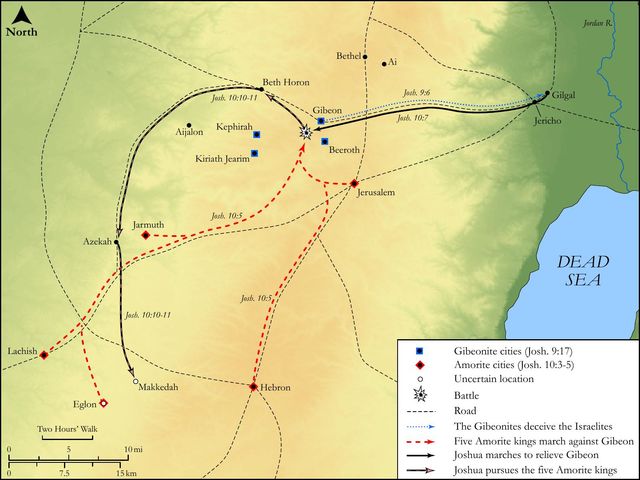
The conquest of Canaan took place in the days of Joshua, when the land was a mosaic of independent city-states and shifting alliances. The Amorites were a prominent Semitic-speaking people group, often depicted in biblical texts as formidable inhabitants of the land. The geographical locations mentioned—Gibeon, Bethhoron, Azekah, and Makkedah—trace a significant and strategically vital route. This path descends from the central highlands (Gibeon) through the ascent of Bethhoron, into the Shephelah (foothills) at Azekah, and further westward to Makkedah. This pursuit route highlights the challenging and diverse terrain, making the enemy's flight even more perilous. Culturally, this era was marked by pervasive polytheistic worship among the Canaanites, often involving abhorrent practices such as child sacrifice and cultic prostitution, which the Israelites were commanded to eradicate as part of God's judgment upon the land. The battle itself involved surprise attacks, relentless pursuit, and the total annihilation of enemy forces, though in this narrative, human military efforts are emphatically overshadowed by divine intervention.
Key Themes
ShowHideJoshua 10:10 powerfully contributes to several overarching theological and narrative themes within the Book of Joshua and the broader Old Testament. Central to this verse is the theme of Divine Intervention and Faithfulness, where God actively fights on behalf of His covenant people, fulfilling His ancient promises to grant them the land of Canaan and protect them from their adversaries. The explicit declaration that "the LORD discomfited them before Israel" unequivocally attributes the victory to God's direct hand, not merely Israel's military prowess. This underscores God's Overwhelming Power and Sovereignty over creation and human affairs, a theme further amplified by the subsequent miraculous events of the hailstones and the sun standing still (Joshua 10:11-14). The battle also serves as a crucial moment in the Fulfillment of Prophecy, as God continues to drive out the inhabitants of the land before Israel, enabling them to possess the Promised Land, a promise first made to Abraham in Genesis 15:18. Furthermore, the narrative highlights the importance of Obedience and Covenant Loyalty, as Joshua's commitment to the Gibeonite treaty, despite its questionable origins, directly precedes and facilitates God's powerful intervention.
Exposition and Analysis
ShowHideKey Word Analysis
ShowHideThis verb (H2000) signifies "to throw into confusion," "to rout," or "to disturb with a great noise," often implying a divinely induced terror or mental disarray. It describes a supernatural act that causes an enemy to lose composure, cohesion, and the will to fight effectively, leading to their utter defeat. This is not merely a human military maneuver but a direct, supernatural disarming of the enemy's resolve. This same word is used elsewhere to describe God's intervention against Egypt at the Red Sea (Exodus 14:24), emphasizing that the victory was fundamentally God's doing.
This adjective (H1419) means "great" in any sense, often denoting magnitude, importance, or intensity. When combined with "slaughter," as in "great slaughter," it emphasizes the devastating and comprehensive nature of the defeat. It signifies an overwhelming loss of life and a decisive victory, underscoring the totality of the destruction inflicted upon the enemy by divine power.
This noun (H4347) means "a blow," "a strike," or "a defeat," often referring to a severe military defeat or a great loss of life in battle. Its use here, especially in conjunction with "great," denotes a catastrophic and comprehensive defeat, emphasizing the totality of the destruction inflicted upon the enemy. It underscores the overwhelming nature of God's judgment and the completeness of Israel's victory.
Verse Breakdown
ShowHide"And the LORD discomfited them before Israel"
This opening clause immediately establishes the divine agency behind the victory. The "them" refers to the Amorite kings and their allied armies. The Lord Himself, Yahweh, not merely Israel's military might or strategic acumen, caused their confusion and panic. This divine intervention occurred "before Israel," meaning Israel was the direct beneficiary and witness of God's direct, supernatural action, powerfully reinforcing His covenant faithfulness and active presence.
"and slew them with a great slaughter at Gibeon"
Following the initial divine discomfiture, the physical destruction commenced. The "great slaughter" indicates a decisive and devastating defeat of the Amorite forces at the initial point of conflict, Gibeon. This was not a minor skirmish but a catastrophic loss for the enemy, setting the tone for the entire pursuit and demonstrating the immediate and tangible result of God's intervention.
"and chased them along the way that goeth up to Bethhoron"
The battle transitioned from a static engagement to a relentless, unceasing pursuit. The "way that goeth up to Bethhoron" refers to a strategic ascent from Gibeon, indicating that the enemy was fleeing southwestward. This phrase emphasizes the sustained pressure and the complete rout of the enemy, who were not merely defeated but actively pursued without respite, preventing any opportunity for regrouping.
"and smote them to Azekah, and unto Makkedah"
This final phrase details the extensive geographical reach of the pursuit and the continued destruction of the enemy. Azekah and Makkedah are locations further to the southwest, situated in the Shephelah region. The use of "smote" (a general term for striking, killing, or defeating) reinforces the ongoing and widespread nature of the slaughter. The mention of these specific, distant locations highlights the completeness of the victory, as the enemy was pursued and destroyed over a significant distance, leaving no opportunity for regrouping or escape and demonstrating the utter devastation inflicted.
Literary Devices
ShowHideJoshua 10:10 masterfully employs several literary devices to convey its powerful theological message and dramatic narrative. The most prominent is Divine Intervention, where the text explicitly attributes the victory to "the LORD" who "discomfited them." This highlights God's active, supernatural role as the primary agent of Israel's success, rather than solely human military prowess. The phrase "great slaughter" can be seen as a form of Hyperbole, emphasizing the overwhelming and complete nature of the defeat rather than a literal numerical count, underscoring the totality of God's judgment and the devastating impact on the enemy. The verse also utilizes Geographical Progression, meticulously tracing the enemy's desperate flight from Gibeon, through the strategic ascent of Bethhoron, to Azekah, and finally to Makkedah. This detailed geographical description not only provides a vivid sense of the battle's immense scope but also emphasizes the relentless, far-reaching, and comprehensive nature of the pursuit and destruction. Finally, the repeated use of strong verbs denoting violent and decisive action—"discomfited," "slew," "chased," "smote"—creates a sense of Climax and Intensification, building towards the ultimate annihilation of the enemy forces and powerfully reinforcing the decisive nature of God's victory.
Theological and Thematic Connections
ShowHideJoshua 10:10 serves as a profound testament to God's unwavering covenant faithfulness and His identity as a divine warrior who actively fights for His people. The victory is not attributed to Israel's military might or strategic genius, but unequivocally to the Lord's direct, supernatural intervention. This highlights the foundational theological truth that true victory, especially in the face of overwhelming odds, comes from God alone. It underscores His absolute sovereignty over nations, His unwavering commitment to fulfilling His promises, particularly the promise to give Israel the land of Canaan, and His power to overcome any adversary. This event foreshadows God's ongoing work throughout redemptive history, demonstrating that when His people walk in obedience and trust, He is powerfully at work on their behalf, often in miraculous and unexpected ways. It is a timeless reminder that God's power is not limited by human limitations or the strength of any earthly adversary.
Reflection and Application
ShowHideJoshua 10:10 offers profound encouragement and a powerful call to faith for believers today, reminding us that the battles we face, whether spiritual, emotional, or practical, are ultimately fought and won by God. Just as the Lord "discomfited" Israel's formidable enemies, He is capable of bringing confusion, disarray, and ultimate defeat to the forces that oppose us. This verse calls us to cultivate a deep, unwavering trust in God's sovereignty and omnipotence, recognizing that our own strength, wisdom, or resources are utterly insufficient for the challenges of life. It urges us to walk in courageous obedience, as Joshua did in honoring the Gibeonite covenant, knowing that our faithfulness, even in seemingly inconvenient or perilous circumstances, often opens the door for God's miraculous and overwhelming intervention. When we feel overwhelmed, outnumbered, or caught in seemingly insurmountable struggles, this passage assures us that the Lord is a mighty warrior who stands with His people, ensuring His divine purposes are fulfilled and His glory is revealed. Our vital role is to remain faithful, to pray fervently, and to step out in obedience, allowing Him to fight the battles we cannot.
Questions for Reflection
ShowHideFAQ
ShowHideWhat does it mean that "the LORD discomfited them"?
ShowHideThe Hebrew word for "discomfited" (הָמַם, hāmām', H2000) implies that God supernaturally threw the Amorite armies into a state of panic, confusion, and utter disarray. This was not merely a result of Israel's military strategy or prowess but a direct, divine intervention that caused the enemy to lose their composure, their will to fight, and their ability to organize effectively. It signifies a divinely induced terror that led to their rout and ultimate defeat. This concept is seen elsewhere in the Old Testament, such as when God "discomfited" the Egyptians at the Red Sea, causing their chariots to become bogged down and their army to be thrown into chaos (Exodus 14:24). It powerfully highlights that the victory was fundamentally God's doing, not Israel's human effort.
Why is the geographical detail important in this verse?
ShowHideThe meticulous mention of specific locations—Gibeon, Bethhoron, Azekah, and Makkedah—is crucial for several profound reasons. Firstly, it provides historical and geographical authenticity to the narrative, allowing readers to trace the actual, extensive path of the battle and relentless pursuit. Secondly, it powerfully emphasizes the immense scale, comprehensive nature, and devastating completeness of the victory. The enemy was not merely defeated at a single point but relentlessly pursued and destroyed over a significant distance, from the central highlands down into the Shephelah. This extensive pursuit demonstrates the totality of God's judgment and the comprehensive nature of Israel's triumph, leaving no opportunity for the enemy to regroup or escape. It underscores that this was a decisive, overwhelming, and divinely orchestrated victory, leaving no doubt about the Lord's power and commitment to His covenant.
Christ-Centered Fulfillment
ShowHideJoshua 10:10, with its vivid depiction of the Lord as a divine warrior who discomfits and slays His enemies, finds its ultimate and most profound fulfillment in the person and work of Jesus Christ. While Joshua led Israel in a physical conquest of a promised earthly land, Jesus leads His people in a far greater spiritual conquest, overcoming the ultimate enemies of humanity: sin, death, and the devil. The "discomfiture" of the Amorites by God's direct hand foreshadows Christ's decisive and complete victory over the spiritual powers of darkness. Through His sacrificial death on the cross and His glorious resurrection, Jesus "disarmed the rulers and authorities and put them to open shame, by triumphing over them in Him" (Colossians 2:15). He is the true Lamb of God who takes away the sin of the world (John 1:29), and the Lion of Judah who has conquered decisively (Revelation 5:5). The "great slaughter" of the Amorites points to the final and complete annihilation of evil that Christ will accomplish, culminating in His glorious return when every enemy will be put under His feet (1 Corinthians 15:25-26). Believers today do not fight with carnal weapons but stand firm in the victory already secured by Christ, knowing that He has overcome the world (John 16:33) and provides the true rest and eternal inheritance that the land of Canaan merely symbolized (Hebrews 4:8-10).