


2 Thessalonians 2:8
Bible text: King James Version (1769 Blayney text) · Public domain
Bible text: King James Version with Strong's numbers · Public domain
Bible text: Berean Standard Bible · Public domain
Bible text: American Standard Version (1901) · Public domain
Bible text: World English Bible, Messianic edition · Public domain
Bible text: Geneva Bible (1599) · Public domain
Bible text: Young's Literal Translation · Public domain
- καὶkaiAndG2532CONJConjunction
- τότεtotethenG5119ADVAdverb
- ἀποκαλυφθήσεταιapokaluphthēsetaiwill be revealedG601V-FPI-3SVerb Future Passive Indicative 3rd Singular
- ὁhotheG3588T-NSMDefinite article Nominative Singular Masculine
- ἄνομοςanomoslawless [one]G459A-NSMAdjective Nominative Singular Masculine
- ὃνhonwhomG3739R-ASMRelative pronoun Accusative Singular Masculine
- ὁhotheG3588T-NSMDefinite article Nominative Singular Masculine
- κύριοςkuriosLordG2962N-NSM-TNoun Nominative Singular Masculine Title
- ἀνελεῖaneleiwill executeG337V-2FAI-3SVerb 2nd Future Active Indicative 3rd Singular
- τῷtōwith theG3588T-DSNDefinite article Dative Singular Neuter
- πνεύματιpneumatibreathG4151N-DSNNoun Dative Singular Neuter
- τοῦtouof theG3588T-GSNDefinite article Genitive Singular Neuter
- στόματοςstomatosmouthG4750N-GSNNoun Genitive Singular Neuter
- αὐτοῦautouof HimG846P-GSMPersonal pronoun Genitive Singular Masculine
- καὶkaiandG2532CONJConjunction
- καταργήσειkatargēseiwill annulG2673V-FAI-3SVerb Future Active Indicative 3rd Singular
- τῇtēaby theG3588T-DSFDefinite article Dative Singular Feminine
- ἐπιφανείᾳepiphaneiaappearingG2015N-DSFNoun Dative Singular Feminine
- τῆςtēsof theG3588T-GSFDefinite article Genitive Singular Feminine
- παρουσίαςparousiascomingG3952N-GSFNoun Genitive Singular Feminine
- αὐτοῦ·autouof HimG846P-GSMPersonal pronoun Genitive Singular Masculine
English is a literal word-by-word gloss of the Greek, not the KJV's wording. Why?
This is the original text the KJV's translators worked from — each Greek word with its own literal English meaning in this verse, prepared by scholars at Tyndale House, Cambridge. The KJV translates whole sentences, not word by word, so its wording differs: one Greek word can become several English words, and the KJV may choose “charity” where the gloss reads “love”. Both are faithful — they answer different questions. For the KJV's own rendering, switch to the KJV text.
Details
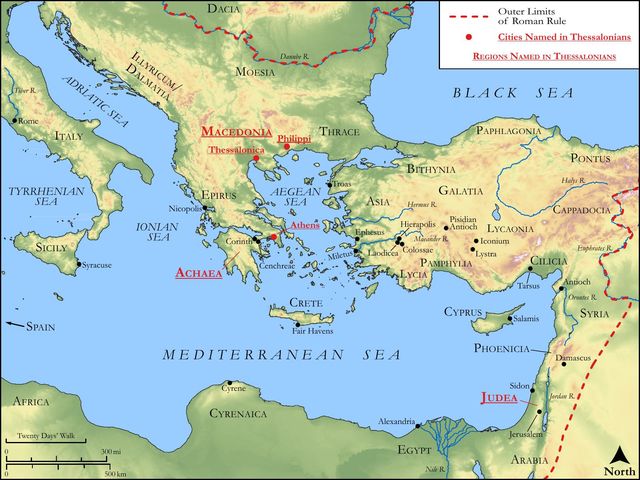
See on the biblical-era maps

Study this verse
Public-domain commentary
Matthew Henry
From his Commentary on the Whole Bible. Henry comments on passages, not single verses — this entry covers 2 Thessalonians 2:3–12. His three-level outline is real structure in the source text, so it is rendered as structure.
In these words the apostle confutes the error against which he had cautioned them, and gives the reasons why they should not expect the coming of Christ as just at hand. There were several events previous to the second coming of Christ; in particular, he tells them there would be,
I.A general apostasy, there would come a falling away first, Th2 2:3.
By this apostasy we are not to understand a defection in the state, or from civil government, but in spiritual or religious matters, from sound doctrine, instituted worship and church government, and a holy life. The apostle speaks of some very great apostasy, not only of some converted Jews or Gentiles, but such as should be very general, though gradual, and should give occasion to the revelation of rise of antichrist, that man of sin. This, he says (Th2 2:5), he had told them of when he was with them, with design, no doubt, that they should not take offence nor be stumbled at it. And let us observe that no sooner was Christianity planted and rooted in the world than there began to be a defection in the Christian church. It was so in the Old Testament church; presently after any considerable advance made in religion there followed a defection: soon after the promise there was revolting; for example, soon after men began to call upon the name of the Lord all flesh corrupted their way, - soon after the covenant with Noah the Babel-builders bade defiance to heaven, - soon after the covenant with Abraham his seed degenerated in Egypt, - soon after the Israelites were planted in Canaan, when the first generation was worn off, they forsook God and served Baal, - soon after God's covenant with David his seed revolted, and served other gods, - soon after the return out of captivity there was a general decay of piety, as appears by the story of Ezra and Nehemiah; and therefore it was no strange thing that after the planting of Christianity there should come a falling away.
II.A revelation of that man of sin, that is (Th2 2:3), antichrist would take his rise from this general apostasy.
The apostle afterwards speaks of the revelation of that wicked one (Th2 2:8), intimating the discovery which should be made of his wickedness, in order to his ruin: here he seems to speak of his rise, which should be occasioned by the general apostasy he had mentioned, and to intimate that all sorts of false doctrines and corruptions should centre in him. Great disputes have been as to who or what is intended by this man of sin and son of perdition: and, if it be not certain that the papal power and tyranny are principally or only intended, yet this is plain, What is here said does very exactly agree thereto. For observe,
1.The names of this person, or rather the state and power here spoken of. He is called the man of sin, to denote his egregious wickedness; not only is he addicted to, and practises, wickedness himself, but he also promotes, countenances, and commands sin and wickedness in others; and he is the son of perdition, because he himself is devoted to certain destruction, and is the instrument of destroying many others both in soul and body. These names may properly be applied, for these reasons, to the papal state; and thereto agree also,
2.The characters here given, Th2 2:4.
(1.)That he opposes and exalts himself above all that is called God, or is worshipped; and thus have the bishops of Rome not only opposed God's authority, and that of the civil magistrates, who are called gods, but have exalted themselves above God and earthly governors, in demanding greater regard to their commands than to the commands of God or the magistrate.
(2.)As God, he sits in the temple of God, showing himself that he is God. As God was in the temple of old, and worshipped there, and is in and with his church now, so the antichrist here mentioned is some usurper of God's authority in the Christian church, who claims divine honours; and to whom can this better apply than to the bishops of Rome, to whom the most blasphemous titles have been given, as Dominus Deus noster papa - Our Lord God the pope; Deus alter in terr - Another God on earth; Idem est dominium Dei et papae - The dominion of God and the pope is the same?
3.His rise is mentioned, Th2 2:6, Th2 2:7. Concerning this we are to observe two things: - (1.) There was something that hindered or withheld, or let, until it was taken away. This is supposed to be the power of the Roman empire, which the apostle did not think fit to mention more plainly at that time; and it is notorious that, while this power continued, it prevented the advances of the bishops of Rome to that height of tyranny to which soon afterwards they arrived. (2.) This mystery of iniquity was gradually to arrive at its height; and so it was in effect that the universal corruption of doctrine and worship in the Romish church came in by degrees, and the usurpation of the bishops of Rome was gradual, not all at once; and thus the mystery of iniquity did the more easily, and almost insensibly, prevail. The apostle justly calls it a mystery of iniquity, because wicked designs and actions were concealed under false shows and pretences, at least they were concealed from the common view and observation. By pretended devotion, superstition and idolatry were advanced; and, by a pretended zeal for God and his glory, bigotry and persecution were promoted. And he tells us that this mystery of iniquity did even then begin, or did already work. While the apostles were yet living, the enemy came, and sowed tares; there were then the deeds of the Nicolaitans, persons who pretended zeal for Christ, but really opposed him. Pride, ambition, and worldly interest of church-pastors and church-rulers, as in Diotrephes and others, were the early working of the mystery of iniquity, which, by degrees, came to that prodigious height which has been visible in the church of Rome.
4.The fall or ruin of the antichristian state is declared, Th2 2:8. The head of this antichristian kingdom is called that wicked one, or that lawless person who sets up a human power in competition with, and contradiction to, the divine dominion and power of the Lord Jesus Christ; but, as he would thus manifest himself to be the man of sin, so the revelation or discovery of this to the world would be the sure presage and the means of his ruin. The apostle assures the Thessalonians that the Lord would consume and destroy him; the consuming of him precedes his final destruction, and that is by the Spirit of his mouth, by his word of command; the pure word of God, accompanied with the Spirit of God, will discover this mystery of iniquity, and make the power of antichrist to consume and waste away; and in due time it will be totally and finally destroyed, and this will be by the brightness of Christ's coming. Note, The coming of Christ to destroy the wicked will be with peculiar glory and eminent lustre and brightness.
5.The apostle further describes the reign and rule of this man of sin. Here we are to observe,
(1.)The manner of his coming, or ruling, and working: in general, that it is after the example of Satan, the grand enemy of souls, the great adversary of God and man. He is the great patron of error and lies, the sworn enemy of the truth as it is in Jesus and all the faithful followers of Jesus. More particularly, it is with Satanical power and deceit. A divine power is pretended for the support of this kingdom, but it is only after the working of Satan. Signs and wonders, visions and miracles, are pretended; by these the papal kingdom was first set up, and has all along been kept up, but they have false signs to support false doctrines; and lying wonders, or only pretended miracles that have served their cause, things false in fact, or fraudulently managed, to impose upon the people: and the diabolical deceits with which the antichristian state has been supported are notorious. The apostle calls it all deceivableness of unrighteousness, Th2 2:10. Others may call them pious frauds, but the apostle called them unrighteous and wicked frauds; and, indeed, all fraud (which is contrary to truth) is an impious thing. Many are the subtle artifices the man of sin has used, and various are the plausible pretences by which he had beguiled unwary and unstable souls to embrace false doctrines, and submit to his usurped dominion.
(2.)The persons are described who are his willing subjects, or most likely to become such, Th2 2:10. They are such as love not the truth that they may be saved. They heard the truth (it may be), but they did not love it; they could not bear sound doctrine, and therefore easily imbibed false doctrines; they had some notional knowledge of what was true, but they indulged some powerful prejudices, and so became a prey to seducers. Had they loved the truth, they would have persevered in it, and been preserved by it; but no wonder if they easily parted with what they never had any love to. And of these persons it is said that they perish or are lost; they are in a lost condition, and in danger to be lost for ever. For,
6.We have the sin and ruin of the subjects of antichrist's kingdom declared, Th2 2:11, Th2 2:12.
(1.)Their sin is this: They believed not the truth, but had pleasure in unrighteousness: they did not love the truth, and therefore they did not believe it; and, because they did not believe the truth, therefore they had pleasure in unrighteousness, or in wicked actions, and were pleased with false notions. Note, An erroneous mind and vicious life often go together and help forward one another.
(2.)Their ruin is thus expressed: God shall send them strong delusions, to believe a lie. Thus he will punish men for their unbelief, and for their dislike of the truth and love to sin and wickedness; not that God is the author of sin, but in righteousness he sometimes withdraws his grace from such sinners as are here mentioned; he gives them over to Satan, or leaves them to be deluded by his instruments; he gives them up to their own hearts' lusts, and leaves them to themselves, and then sin will follow of course, yea, the worst of wickedness, that shall end at last in eternal damnation. God is just when he inflicts spiritual judgments here, and eternal punishments hereafter, upon those who have no love to the truths of the gospel, who will not believe them, nor live suitably to them, but indulge false doctrines in their minds, and wicked practices in their lives and conversations.
Historical interpretation
Nine Centuries of Reception
13 surviving comments on this verse. Each one is dated, so this reads as a timeline rather than a list.
Select a marker to jump to its quote. Markers stagger vertically where authors wrote within a few decades of each other.
With the presence of his coming; .
And therefore God will send them the working of error, that they may believe a lie; that they all may be judged who did not believe the truth, but gave consent to iniquity"
What obstacle is there but the Roman state, the falling away of which, by being scattered into ten kingdoms, shall introduce Antichrist upon (its own ruins)? "And then shall be revealed the wicked one, whom the Lord shall consume with the spirit of His mouth, and shall destroy with the brightness of His coming: even him whose coming is after the working of Satan, with all power, and signs, and lying wonders, and with all deceivableness of unrighteousness in them that perish."
Now just as it is said that the task of the Word is to judge with justice, so also the Word’s task is to fight with justice, that by thus fighting the soul’s enemies with reason and justice, he may dwell in the soul, justifying it when the irrational elements and injustices are destroyed. He casts out the hostile elements from that soul which, if I may speak in this way, has been taken captive by Christ for salvation. The war that the Word wages is seen even more clearly when we compare it to the war waged by he who pretends to be the Word. This one proclaims himself the truth when he is not the truth but a lie, declaring that he is the truth. For then the Word, having fully armed himself against the lie, “destroys it with the breath of his mouth and annihilates it by the appearance of his presence.”
"And out of His mouth was issuing a sharp two-edged sword." By the twice-sharpened sword going forth out of His mouth is shown, that it is He Himself who has both now declared the word of the Gospel, and previously by Moses declared the knowledge of the law to the whole world. But because from the same word, as well of the New as of the Old Testament, He will assert Himself upon the whole human race, therefore He is spoken of as two-edged. For the sword arms the soldier, the sword slays the enemy, the sword punishes the deserter. And that He might show to the apostles that He was announcing judgment, He says: "I came not to send peace, but a sword." And after He had completed His parables, He says to them: "Have ye understood all these things? And they said, We have. And He added, Therefore is every scribe instructed in the kingdom of God like unto a man that is a father of a family, bringing forth from his treasure things new and old," -the new, the evangelical words of the apostles; the old, the precepts of the law and the prophets: and He testified that these proceeded out of His mouth. Moreover, He also says to Peter: "Go thou to the sea, and cast a hook, and take up the fish that shall first come up; and having opened its mouth, thou shalt find a stater (that is, two denarii), and thou shalt give it for me and for thee." And similarly David says by the Spirit: "God spake once, twice I have heard the same." Because God once decreed from the beginning what shall be even to the end. Finally, as He Himself is the Judge appointed by the Father. on account of His assumption of humanity, wishing to show that men shall be judged by the word that He had declared, He says: "Think ye that I will judge you at the last day? Nay, but the word," says He, "which I have spoken unto you, that shall judge you in the last day." And Paul, speaking of Antichrist to the Thessalonians, says: "Whom the Lord Jesus will slay by the breath of His mouth." And Isaiah says: "By the breath of His lips He shall slay the wicked." This, therefore, is the two-edged sword issuing out of His mouth.
For in the last days false prophets shall be multiplied, and such as corrupt the word; and the sheep shall be changed into wolves, and love into hatred: for through the abounding of iniquity the love of many shall wax cold. For men shall hate, and persecute, and betray one another. And then shall appear the deceiver of the world, the enemy of the truth, the prince of lies, [2 Thessalonians 2:3-12] whom the Lord Jesus "shall destroy with the spirit of His mouth, who takes away the wicked with His lips; and many shall be offended at Him. But they that endure to the end, the same shall be saved. And then shall appear the sign of the Son of man in heaven;" [Isaiah 11:4; Matthew 24:1-51] and afterwards shall be the voice of a trumpet by the archangel; and in that interval shall be the revival of those that were asleep. And then shall the Lord come, and all His saints with Him, with a great concussion above the clouds, with the angels of His power, [Matthew 16:27] in the throne of His kingdom, to condemn the devil, the deceiver of the world, and to render to every one according to his deeds. "Then shall the wicked go away into everlasting punishment, but the righteous shall go into life eternal," [Matthew 25:46] to inherit those things "which eye has not seen, nor ear heard, nor have entered into the heart of man, such things as God has prepared for them that love Him;" [1 Corinthians 2:9] and they shall rejoice in the kingdom of God, which is in Christ Jesus.
The Antichrist just mentioned by Paul will come when the destined period of the Roman Empire has run its course and the subsequent end of the world is drawing near. Ten claimants to the empire will arise simultaneously, I suppose in different parts, but all wearing the purple at the same time. Antichrist will form an eleventh after them, having seized the imperial power by the use of magic arts. He will humble three of those who came to power before him and cause the remaining seven to be Caesars under him. At first he will feign mildness and will appear to be a learned and understanding man, with pretended prudence and kindness. Then he will take in the Jews, by making them suppose him to be their expected Messiah, by false signs and wonders produced by magical trickery. And afterwards his character will be written large in evil deeds of inhumanity and lawlessness of every kind, so as to outdo all wicked and godless men that were before him. He will display a murderous, most absolute, pitiless and unstable temper toward all people, but especially toward us Christians. He will act insolently for only three and a half years. Then he will be defeated by the second glorious coming from heaven of the only-begotten Son of God, our Lord and Savior Jesus, the true Christ. He will destroy Antichrist “with the spirit of his mouth” and commit him to the flames of hell.
We have heard that the Lord Jesus not only judges but also punishes in the Spirit. For neither would he punish Antichrist, whom, as we read, “the Lord Jesus shall slay with the Spirit of his mouth,” unless he had already judged him as fit for punishment … but the unity of the divine action remains undivided, since Christ cannot be separated from the Spirit, nor the Spirit act apart from Christ. For the unity of the divine nature cannot be divided.
"And then," he says, "shall be revealed the lawless one." And what after this? The consolation is at hand. "Whom the Lord Jesus shall slay with the breath of His mouth, and bring to nought by the manifestation of His coming, even he whose coming is according to the working of Satan."
For as fire merely coming on even before its arrival makes torpid and consumes the little animals that are afar off; so also Christ, by His commandment only, and Coming. It is enough for Him to be present, and all these things are destroyed. He will put a stop to the deceit, by only appearing. Then who is this, whose coming is after the working of Satan, "With all power," but nothing true, but for deceit. "And lying wonders," he says, that is, false, or leading to falsehood.
“To the one a savor from death to death, to the other a savor from life to life.” For this sweet savor some so receive that they are saved, others so that they perish. If any one is lost, it is his own fault.… Light (as I have already observed) blinds the weak. Such is the nature of good things. They not only correct things similar to them but also destroy their opposite. In this way their power is most clearly displayed. Fire displays its unique power when it gives light and when it purifies gold. The same is true when it consumes thorns. In all these cases it demonstrates itself to be fire. Christ, too, in the same way will display his own majesty when he “shall consume” Antichrist “with the breath of his mouth and overcome him with the manifestation of his coming.”
Then even this is not the last judgment of the wicked; but the last judgment is that which they shall suffer when the bodily resurrection has taken place.
at the brightness of his return
because His coming will be in a flash of lightning, as that passage says, "just as a flash of lightning goes forth from the east." Mt.24:27
The Devil and the Antichrist, together with the kings who march with them, will make war against the Lord and His divine angels, but will be defeated more quickly than a word. Isaiah says, "Let the impious one be done away with, that he may not see the glory of the Lord." (Is. 26:10) What could be quicker than breathing and blowing a breath against His enemies?
For the coming of Christ needs no one to point it out, but it will be utterly clear to all, like lightning. For just as the lightning is sudden and seen by all, so too will the Lord’s coming be visible to everyone on earth.
Continue studying 2 Thessalonians 2:8 across the web’s major study libraries — every link below opens this exact verse, chapter, or book on the destination site.
Read & Compare
 BibleGatewayThis verse in more than 200 translations and 70 languages.
 Bible.comThe YouVersion reader — hundreds of translations, reading plans, and highlights.
 ESV.orgCrossway's official English Standard Version reader.
 NET BibleThe NET translation with 60,000+ translators' notes on every rendering decision.
 STEP BibleTyndale House's free study tool — original text, vocabulary, and scholarly resources.
 BibliaLogos Bible Software's free web reader.
 USCCBThe New American Bible (Revised Edition) with the U.S. bishops' study notes.
Commentaries
 BibleHub CommentariesDozens of classic commentaries on this verse, gathered on one page.
 StudyLightMore than 100 commentary sets — the largest collection on the web.
 BibleRefPlain-English commentary on what this verse means, verse by verse.
 Enduring WordDavid Guzik's free commentary on this chapter, widely used by Bible teachers.
 Bible Study ToolsVerse commentary alongside Greek and Hebrew study aids.
Original Language & Research
- BibleHub InterlinearThe verse word by word — original language, transliteration, and English.
- BibleHub LexiconEvery word's original-language definition and Strong's entry.
 Blue Letter BibleDeep-study tools — Strong's numbers, concordance, and word studies.
 CNTR CollationThe earliest Greek manuscripts of this verse, collated letter by letter.
Sermons, Hymns & Audio


TrulyRandomVerse is not affiliated with these sites and doesn’t control their content. They’re linked because they’re genuinely useful.
Summary
Second Thessalonians 2:8 presents a powerful declaration of Christ's ultimate triumph over the "Man of Lawlessness," a figure of profound rebellion and deception who will be revealed before the Lord's return. This verse assures believers that despite the adversary's temporary power, the Lord Jesus will effortlessly annihilate him with the mere breath of His mouth and utterly destroy him by the glorious manifestation of His coming, underscoring the absolute sovereignty and irresistible power of Christ in the eschatological drama.
Context
ShowHideLiterary Context
This verse is situated within Paul's second letter to the church in Thessalonica, specifically addressing their anxieties and misunderstandings concerning the "day of the Lord" and the timing of Christ's return. Some believers were distressed, believing that this day had already arrived, perhaps due to false teachings or forged letters (2 Thessalonians 2:2). Paul's primary aim in 2 Thessalonians 2 is to correct this misconception by outlining a sequence of events that must precede the Lord's glorious appearing. These include a great "falling away" or apostasy and the revelation of "the man of lawlessness," also referred to as the "son of destruction" (2 Thessalonians 2:3). Verse 8 serves as the climactic resolution to the narrative of this wicked figure, emphasizing Christ's decisive victory over him.
Historical & Cultural Context
The Thessalonian believers were facing persecution (2 Thessalonians 1:4) and were susceptible to eschatological confusion, a common issue in early Christian communities. The concept of a powerful, anti-God figure was not entirely new, drawing on Old Testament prophecies (e.g., Daniel's "little horn" in Daniel 7:8) and contemporary Jewish apocalyptic expectations. In the Roman world, emperor worship was a pervasive cultural and political reality, setting a precedent for a figure who would exalt himself above all that is called God (2 Thessalonians 2:4). Paul's description of the "Man of Lawlessness" and his ultimate destruction by Christ would have provided immense comfort and clarity to a church grappling with present suffering and future uncertainties, assuring them that divine justice would prevail over all forms of human and spiritual rebellion.
Key Themes
ShowHideThis verse powerfully contributes to several key themes within 2 Thessalonians and broader biblical theology. Foremost is the theme of Divine Sovereignty and Ultimate Victory, asserting that despite the rise of profound evil, Christ remains in absolute control and will decisively triumph over all opposition. It also highlights the theme of Eschatological Certainty, providing a clear, albeit mysterious, outline of end-time events that assures believers of the Lord's imminent and glorious return, which will culminate in the Judgment of Wickedness. The revelation of "that Wicked" underscores the theme of Spiritual Warfare and the Nature of Evil, portraying an ultimate embodiment of rebellion against God, whose very character is "lawlessness." Finally, the verse implicitly fosters Hope and Perseverance for believers, encouraging them to remain steadfast in the face of deception and persecution, knowing that their Lord's victory is assured.
Exposition and Analysis
ShowHideKey Word Analysis
ShowHideThis term literally means "lawless" or "without law." It describes a person who not only disregards divine law but actively opposes it, embodying rebellion and an utter contempt for God's moral order. In this context, it points to the ultimate embodiment of human rebellion against God, a figure characterized by an absolute rejection of divine authority and a promotion of moral anarchy.
Derived from a verb meaning "to use up" or "to destroy," this word implies a complete and utter destruction, a wasting away or annihilation. It suggests that the Lord's action against the Man of Lawlessness will be so decisive and overwhelming that the wicked one will be utterly rendered null and void, leaving no trace of his power or influence.
This term refers to a "manifestation" or "appearing," specifically denoting the glorious advent or visible presence of Christ. It conveys the idea of a sudden, brilliant, and overwhelming display of divine glory and power. The "brightness" signifies the sheer, uncontainable radiance and majesty of Christ's return, which is inherently destructive to all that is evil, much like darkness vanishes before light.
Verse Breakdown
ShowHide"And then shall that Wicked be revealed"
This clause signifies the culmination of the "mystery of iniquity" (2 Thessalonians 2:7), indicating a specific point in time when the ultimate adversary, the "Man of Lawlessness," will be fully unveiled to the world. His revelation is not merely an emergence but a full disclosure of his true character and intentions, preceding the Lord's return.
"whom the Lord shall consume with the spirit of his mouth"
This powerful phrase describes the effortless and absolute destruction of the Wicked One by Christ. "The spirit of his mouth" is a vivid metaphor for the Lord's authoritative word or command, indicating that Christ's mere utterance, His divine decree, is sufficient to utterly annihilate His adversary. It suggests a swift, decisive, and overwhelming act of divine power, requiring no physical struggle.
"and shall destroy with the brightness of his coming"
This second phrase reinforces and expands upon the first, emphasizing the completeness of the Wicked One's demise. "The brightness of his coming" refers to the glorious and overwhelming presence (Greek: parousía) of Christ at His return. This metaphor portrays Christ's advent as a blinding, irresistible light that obliterates all darkness and evil, rendering the Wicked One powerless and bringing him to nothing. It highlights the inherent incompatibility of Christ's holy presence with the nature of lawlessness.
Literary Devices
ShowHideThe verse employs several potent literary devices to convey its profound theological message. Metaphor is prominently used in "the spirit of his mouth" and "the brightness of his coming," which are not literal physical attributes but powerful symbolic representations of Christ's irresistible word and glorious presence. These metaphors evoke images of effortless divine power that annihilates evil. Antithesis is also evident, contrasting the temporary, deceptive power of "that Wicked" with the absolute, inherent power of the Lord. The verse sets up a stark opposition between the forces of lawlessness and the divine order embodied in Christ. Furthermore, the description of Christ's actions ("consume," "destroy") uses hyperbole to emphasize the totality and ease of the victory, suggesting an overwhelming triumph that leaves no doubt about the outcome.
Theological and Thematic Connections
ShowHideThis verse stands as a cornerstone of biblical eschatology, affirming the ultimate triumph of God's righteous rule over all forms of evil and rebellion. It assures believers that the seemingly overwhelming power of lawlessness, embodied in the "Man of Lawlessness," is utterly insignificant in the face of Christ's divine authority. The swift and complete destruction of this adversary by Christ's mere word and glorious presence underscores the absolute sovereignty of God and the certainty of His final judgment. This truth provides immense comfort and a steadfast hope for the church, reminding them that the present struggles with evil are temporary and that a glorious, decisive victory awaits at the Lord's return. It connects to the broader biblical narrative of God's ongoing war against evil, culminating in Christ's definitive victory.
Reflection and Application
ShowHideFor believers today, 2 Thessalonians 2:8 offers a profound source of hope and a call to discerning living. In a world increasingly marked by lawlessness and moral decay, this verse reminds us that evil, no matter how pervasive or powerful it appears, has a finite lifespan and a divinely appointed end. It encourages us to fix our gaze not on the rising tide of wickedness, but on the glorious and certain return of our Lord. This truth should embolden us to stand firm in our faith, to resist the allure of ungodliness, and to live with integrity and hope. It calls us to be vigilant against deception, to cling to sound doctrine, and to actively pursue righteousness, knowing that our ultimate vindication and deliverance come from Christ alone. We are to live as people of the light, anticipating the "brightness of His coming" that will dispel all darkness.
Questions for Reflection
ShowHideFAQ
ShowHideWho is "that Wicked" referred to in 2 Thessalonians 2:8?
ShowHide"That Wicked" (Greek: ho anomos, "the lawless one") refers to the "Man of Lawlessness" or "son of destruction" introduced earlier in 2 Thessalonians 2:3. This figure is an ultimate embodiment of rebellion against God, who will exalt himself above all that is called God and perform deceptive signs and wonders (2 Thessalonians 2:4 and 2 Thessalonians 2:9-10). While his exact identity remains a subject of theological discussion, he represents the culmination of anti-Christian forces that will precede Christ's second coming, serving as a tool for Satan's deception. He is often associated with the Antichrist figure mentioned in other New Testament writings (e.g., 1 John 2:18).
Christ-Centered Fulfillment
ShowHideSecond Thessalonians 2:8 finds its profound Christ-centered fulfillment in the absolute and undeniable supremacy of Jesus Christ over all opposing powers, both spiritual and earthly. The "Man of Lawlessness," representing the pinnacle of human and demonic rebellion, is utterly powerless before the Lord. Christ's victory is not achieved through struggle or prolonged conflict, but by the sheer emanation of His divine being: "the spirit of his mouth" and "the brightness of his coming." This echoes the creative power of God's word in Genesis 1:3 and the prophetic portrayal of the Messiah in Isaiah 11:4, who "shall strike the earth with the rod of his mouth, and with the breath of his lips he shall slay the wicked." This demonstrates that the same divine authority that spoke all creation into existence will effortlessly dismantle all that opposes God's righteous rule. Furthermore, the "brightness of his coming" (Greek: epipháneia and parousía) points directly to Christ's glorious Second Advent, the ultimate manifestation of His divine majesty and power, which will usher in the full establishment of His eternal kingdom (Revelation 19:11-16). Thus, this verse is a powerful declaration that Christ, who triumphed over sin and death on the cross (Colossians 2:15) and rose victorious from the grave (Romans 6:9-10), will ultimately and definitively vanquish all remaining evil, securing His eternal reign as Lord of all (Philippians 2:9-11).