


2 Thessalonians 2:6
Bible text: King James Version (1769 Blayney text) · Public domain
Bible text: Berean Standard Bible · Public domain
Bible text: American Standard Version (1901) · Public domain
Bible text: World English Bible, Messianic edition · Public domain
Bible text: Geneva Bible (1599) · Public domain
Bible text: Young's Literal Translation · Public domain
- καὶkaiAndG2532CONJConjunction
- νῦνnunnowG3568ADVAdverb
- τὸtothat whichG3588T-ASNDefinite article Accusative Singular Neuter
- κατέχονkatechonis restrainingG2722V-PAP-ASNVerb Present Active Participle Accusative Singular Neuter
- οἴδατεoidateyou knowG1492V-RAI-2PVerb Perfect Active Indicative 2nd Plural
- εἰςeisforG1519PREPPreposition
- τὸto<the>G3588T-ASNDefinite article Accusative Singular Neuter
- ἀποκαλυφθῆναιapokaluphthēnaito be revealedG601V-APNVerb Aorist Passive Infinitive
- αὐτὸνautonhimG846P-ASMPersonal pronoun Accusative Singular Masculine
- ἐνeninG1722PREPPreposition
- τῷtō<the>G3588T-DSMDefinite article Dative Singular Masculine
- ἑαυτοῦhe'autouhis ownG1438F-3GSMReflexive pronoun Genitive 3rd Singular Masculine
- καιρῷkairōtimeG2540N-DSMNoun Dative Singular Masculine
English is a literal word-by-word gloss of the Greek, not the KJV's wording. Why?
This is the original text the KJV's translators worked from — each Greek word with its own literal English meaning in this verse, prepared by scholars at Tyndale House, Cambridge. The KJV translates whole sentences, not word by word, so its wording differs: one Greek word can become several English words, and the KJV may choose “charity” where the gloss reads “love”. Both are faithful — they answer different questions. For the KJV's own rendering, switch to the KJV text.
Details
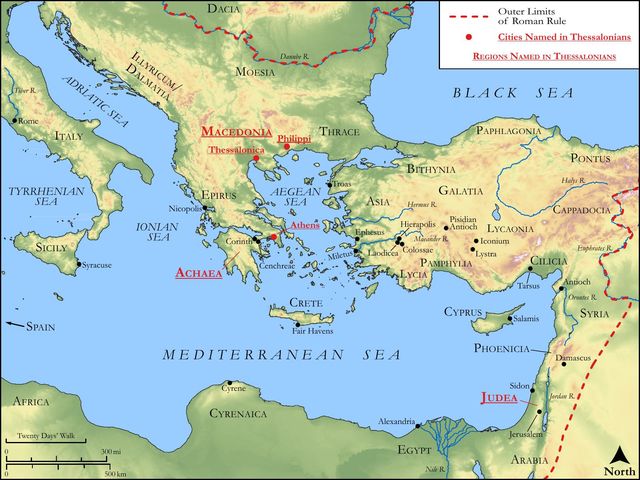
See on the biblical-era maps

Study this verse
Public-domain commentary
Matthew Henry
From his Commentary on the Whole Bible. Henry comments on passages, not single verses — this entry covers 2 Thessalonians 2:3–12. His three-level outline is real structure in the source text, so it is rendered as structure.
In these words the apostle confutes the error against which he had cautioned them, and gives the reasons why they should not expect the coming of Christ as just at hand. There were several events previous to the second coming of Christ; in particular, he tells them there would be,
I.A general apostasy, there would come a falling away first, Th2 2:3.
By this apostasy we are not to understand a defection in the state, or from civil government, but in spiritual or religious matters, from sound doctrine, instituted worship and church government, and a holy life. The apostle speaks of some very great apostasy, not only of some converted Jews or Gentiles, but such as should be very general, though gradual, and should give occasion to the revelation of rise of antichrist, that man of sin. This, he says (Th2 2:5), he had told them of when he was with them, with design, no doubt, that they should not take offence nor be stumbled at it. And let us observe that no sooner was Christianity planted and rooted in the world than there began to be a defection in the Christian church. It was so in the Old Testament church; presently after any considerable advance made in religion there followed a defection: soon after the promise there was revolting; for example, soon after men began to call upon the name of the Lord all flesh corrupted their way, - soon after the covenant with Noah the Babel-builders bade defiance to heaven, - soon after the covenant with Abraham his seed degenerated in Egypt, - soon after the Israelites were planted in Canaan, when the first generation was worn off, they forsook God and served Baal, - soon after God's covenant with David his seed revolted, and served other gods, - soon after the return out of captivity there was a general decay of piety, as appears by the story of Ezra and Nehemiah; and therefore it was no strange thing that after the planting of Christianity there should come a falling away.
II.A revelation of that man of sin, that is (Th2 2:3), antichrist would take his rise from this general apostasy.
The apostle afterwards speaks of the revelation of that wicked one (Th2 2:8), intimating the discovery which should be made of his wickedness, in order to his ruin: here he seems to speak of his rise, which should be occasioned by the general apostasy he had mentioned, and to intimate that all sorts of false doctrines and corruptions should centre in him. Great disputes have been as to who or what is intended by this man of sin and son of perdition: and, if it be not certain that the papal power and tyranny are principally or only intended, yet this is plain, What is here said does very exactly agree thereto. For observe,
1.The names of this person, or rather the state and power here spoken of. He is called the man of sin, to denote his egregious wickedness; not only is he addicted to, and practises, wickedness himself, but he also promotes, countenances, and commands sin and wickedness in others; and he is the son of perdition, because he himself is devoted to certain destruction, and is the instrument of destroying many others both in soul and body. These names may properly be applied, for these reasons, to the papal state; and thereto agree also,
2.The characters here given, Th2 2:4.
(1.)That he opposes and exalts himself above all that is called God, or is worshipped; and thus have the bishops of Rome not only opposed God's authority, and that of the civil magistrates, who are called gods, but have exalted themselves above God and earthly governors, in demanding greater regard to their commands than to the commands of God or the magistrate.
(2.)As God, he sits in the temple of God, showing himself that he is God. As God was in the temple of old, and worshipped there, and is in and with his church now, so the antichrist here mentioned is some usurper of God's authority in the Christian church, who claims divine honours; and to whom can this better apply than to the bishops of Rome, to whom the most blasphemous titles have been given, as Dominus Deus noster papa - Our Lord God the pope; Deus alter in terr - Another God on earth; Idem est dominium Dei et papae - The dominion of God and the pope is the same?
3.His rise is mentioned, Th2 2:6, Th2 2:7. Concerning this we are to observe two things: - (1.) There was something that hindered or withheld, or let, until it was taken away. This is supposed to be the power of the Roman empire, which the apostle did not think fit to mention more plainly at that time; and it is notorious that, while this power continued, it prevented the advances of the bishops of Rome to that height of tyranny to which soon afterwards they arrived. (2.) This mystery of iniquity was gradually to arrive at its height; and so it was in effect that the universal corruption of doctrine and worship in the Romish church came in by degrees, and the usurpation of the bishops of Rome was gradual, not all at once; and thus the mystery of iniquity did the more easily, and almost insensibly, prevail. The apostle justly calls it a mystery of iniquity, because wicked designs and actions were concealed under false shows and pretences, at least they were concealed from the common view and observation. By pretended devotion, superstition and idolatry were advanced; and, by a pretended zeal for God and his glory, bigotry and persecution were promoted. And he tells us that this mystery of iniquity did even then begin, or did already work. While the apostles were yet living, the enemy came, and sowed tares; there were then the deeds of the Nicolaitans, persons who pretended zeal for Christ, but really opposed him. Pride, ambition, and worldly interest of church-pastors and church-rulers, as in Diotrephes and others, were the early working of the mystery of iniquity, which, by degrees, came to that prodigious height which has been visible in the church of Rome.
4.The fall or ruin of the antichristian state is declared, Th2 2:8. The head of this antichristian kingdom is called that wicked one, or that lawless person who sets up a human power in competition with, and contradiction to, the divine dominion and power of the Lord Jesus Christ; but, as he would thus manifest himself to be the man of sin, so the revelation or discovery of this to the world would be the sure presage and the means of his ruin. The apostle assures the Thessalonians that the Lord would consume and destroy him; the consuming of him precedes his final destruction, and that is by the Spirit of his mouth, by his word of command; the pure word of God, accompanied with the Spirit of God, will discover this mystery of iniquity, and make the power of antichrist to consume and waste away; and in due time it will be totally and finally destroyed, and this will be by the brightness of Christ's coming. Note, The coming of Christ to destroy the wicked will be with peculiar glory and eminent lustre and brightness.
5.The apostle further describes the reign and rule of this man of sin. Here we are to observe,
(1.)The manner of his coming, or ruling, and working: in general, that it is after the example of Satan, the grand enemy of souls, the great adversary of God and man. He is the great patron of error and lies, the sworn enemy of the truth as it is in Jesus and all the faithful followers of Jesus. More particularly, it is with Satanical power and deceit. A divine power is pretended for the support of this kingdom, but it is only after the working of Satan. Signs and wonders, visions and miracles, are pretended; by these the papal kingdom was first set up, and has all along been kept up, but they have false signs to support false doctrines; and lying wonders, or only pretended miracles that have served their cause, things false in fact, or fraudulently managed, to impose upon the people: and the diabolical deceits with which the antichristian state has been supported are notorious. The apostle calls it all deceivableness of unrighteousness, Th2 2:10. Others may call them pious frauds, but the apostle called them unrighteous and wicked frauds; and, indeed, all fraud (which is contrary to truth) is an impious thing. Many are the subtle artifices the man of sin has used, and various are the plausible pretences by which he had beguiled unwary and unstable souls to embrace false doctrines, and submit to his usurped dominion.
(2.)The persons are described who are his willing subjects, or most likely to become such, Th2 2:10. They are such as love not the truth that they may be saved. They heard the truth (it may be), but they did not love it; they could not bear sound doctrine, and therefore easily imbibed false doctrines; they had some notional knowledge of what was true, but they indulged some powerful prejudices, and so became a prey to seducers. Had they loved the truth, they would have persevered in it, and been preserved by it; but no wonder if they easily parted with what they never had any love to. And of these persons it is said that they perish or are lost; they are in a lost condition, and in danger to be lost for ever. For,
6.We have the sin and ruin of the subjects of antichrist's kingdom declared, Th2 2:11, Th2 2:12.
(1.)Their sin is this: They believed not the truth, but had pleasure in unrighteousness: they did not love the truth, and therefore they did not believe it; and, because they did not believe the truth, therefore they had pleasure in unrighteousness, or in wicked actions, and were pleased with false notions. Note, An erroneous mind and vicious life often go together and help forward one another.
(2.)Their ruin is thus expressed: God shall send them strong delusions, to believe a lie. Thus he will punish men for their unbelief, and for their dislike of the truth and love to sin and wickedness; not that God is the author of sin, but in righteousness he sometimes withdraws his grace from such sinners as are here mentioned; he gives them over to Satan, or leaves them to be deluded by his instruments; he gives them up to their own hearts' lusts, and leaves them to themselves, and then sin will follow of course, yea, the worst of wickedness, that shall end at last in eternal damnation. God is just when he inflicts spiritual judgments here, and eternal punishments hereafter, upon those who have no love to the truths of the gospel, who will not believe them, nor live suitably to them, but indulge false doctrines in their minds, and wicked practices in their lives and conversations.
Historical interpretation
Six Centuries of Reception
8 surviving comments on this verse. Each one is dated, so this reads as a timeline rather than a list.
Select a marker to jump to its quote. Markers stagger vertically where authors wrote within a few decades of each other.
There is also another, even greater, obligation for us to pray for the emperors; yes, even for the continuance of the empire in general and for Roman interests. We realize that the tremendous force which is hanging over the whole world, and the very end of the world with its threat of dreadful afflictions, is arrested for a time by the continued existence of the Roman Empire. This event we have no desire to experience and, in praying that it may be deferred, we favor the continuance of Rome. APOLOGY 32.Chrysostom: One may naturally inquire what is that which restrains the man of lawlessness, and in addition, why Paul expresses it so obscurely. What then is it that holds back, that is, that hinders the revealing of, the Antichrist? Some indeed say, the grace of the Spirit, but others the Roman Empire. I agree with the latter position. Why? Because if Paul meant to say the Spirit, he would not have spoken obscurely but plainly, that even now the grace of the Spirit, that is the gifts, hold back the Antichrist. If not, he should have come by now, if his coming was to occur with the cessation of the gifts of the Spirit; for they have long since ceased. But because Paul said this of the Roman Empire, he merely touched the topic, understandably speaking covertly and darkly. For he had no need to create unnecessary enemies and useless dangers.… “For the mystery of lawlessness does already work.” He speaks here of Nero, as if he were the type of the Antichrist.
Now, if good order with its attendant harmony is characteristic of those who look to one source of authority and are subject to one king, then universal disorder and disharmony are a sign that leadership is lacking. By the same token, if we discover in our midst such discord as I have mentioned, both with regard to one another and with respect to the Lord’s commands, it would either be an indictment or our rejection of the true king. That agrees with the scriptural saying, “only that he who now holds back does so until he is taken out of the way,” or of denial of him according to the psalmist, “The fool has said in his heart: There is no God.”
For in the last days false prophets shall be multiplied, and such as corrupt the word; and the sheep shall be changed into wolves, and love into hatred: for through the abounding of iniquity the love of many shall wax cold. For men shall hate, and persecute, and betray one another. And then shall appear the deceiver of the world, the enemy of the truth, the prince of lies, [2 Thessalonians 2:3-12] whom the Lord Jesus "shall destroy with the spirit of His mouth, who takes away the wicked with His lips; and many shall be offended at Him. But they that endure to the end, the same shall be saved. And then shall appear the sign of the Son of man in heaven;" [Isaiah 11:4; Matthew 24:1-51] and afterwards shall be the voice of a trumpet by the archangel; and in that interval shall be the revival of those that were asleep. And then shall the Lord come, and all His saints with Him, with a great concussion above the clouds, with the angels of His power, [Matthew 16:27] in the throne of His kingdom, to condemn the devil, the deceiver of the world, and to render to every one according to his deeds. "Then shall the wicked go away into everlasting punishment, but the righteous shall go into life eternal," [Matthew 25:46] to inherit those things "which eye has not seen, nor ear heard, nor have entered into the heart of man, such things as God has prepared for them that love Him;" [1 Corinthians 2:9] and they shall rejoice in the kingdom of God, which is in Christ Jesus.
"And now ye know that which restraineth, to the end that he may be revealed in his own season. For the mystery of lawlessness doth already work: only there is one that restraineth now, until he be taken out of the way."
One may naturally enquire, what is that which withholdeth, and after that would know, why Paul expresses it so obscurely. What then is it that withholdeth, that is, hindereth him from being revealed? Some indeed say, the grace of the Spirit, but others the Roman empire, to whom I most of all accede. Wherefore? Because if he meant to say the Spirit, he would not have spoken obscurely, but plainly, that even now the grace of the Spirit, that is the gifts, withhold him. And otherwise he ought now to have come, if he was about to come when the gifts ceased; for they have long since ceased. But because he said this of the Roman empire, he naturally glanced at it, and speaks covertly and darkly. For he did not wish to bring upon himself superfluous enmities, and useless dangers. For if he had said that after a little while the Roman empire would be dissolved, they would have warred against him. And he did not say that it will be quickly, although he is always saying it-but what? "that he may be revealed in his own season," he says,
"For the mystery of lawlessness doth already work." He speaks here of Nero, as if he were the type of Antichrist. For he too wished to be thought a god. And he has well said, "the mystery"; that is, it worketh not openly, as the other, nor without shame. For if there was found a man before that time, he means, who was not much behind Antichrist in wickedness, what wonder, if there shall now be one? But he did not also wish to point him out plainly: and this not from cowardice, but instructing us not to bring upon ourselves unnecessary enmities, when there is nothing to call for it. So indeed he also says here. "Only there is one that restraineth now, until he be taken out of the way," that is, when the Roman empire is taken out of the way, then he shall come. And naturally. For as long as the fear of this empire lasts, no one will willingly exalt himself, but when that is dissolved, he will attack the anarchy, and endeavor to seize upon the government both of man and of God. For as the kingdoms before this were destroyed, for example, that of the Medes by the Babylonians, that of the Babylonians by the Persians, that of the Persians by the Macedonians, that of the Macedonians by the Romans: so will this also be by the Antichrist, and he by Christ, and it will no longer withhold. And these things Daniel delivered to us with great clearness.
That which restrains and prevents the coming of the lawless one is the Holy Spirit. Paul says this to show that the mystery of iniquity is already beginning in the heresies that have arisen since apostolic times. The Manichaeans say that the devil is the God of the law, and the Marcionites say that the father of Christ is not the God of the law.
And now you know
They show that he was unwilling to make an explicit statement, because he said that they knew. And thus we who have not their knowledge wish and are not able even with pains to understand what the apostle referred to, especially as his meaning is made still more obscure by what he adds.
what it is that holds him back
I frankly confess I do not know what he means. I will nevertheless mention such conjectures as I have heard or read. Some say it refers to the Roman empire, as if it were said, “Only he who now reigneth, let him reign until he be taken out of the way.” Some refer it only to the wicked and the hypocrites who are in the Church, until they reach a number so great as to furnish Antichrist with a great people, and that this is the mystery of iniquity, because it seems hidden;
Indeed, the God of the universe has decreed that this figure shall himself appear during the time of consummation, and thus it is God’s own decree that actually detains him until that appearance. What this means is as follows. When the divine apostle taught that the Lord had instructed him to preach the gospel among all the Gentiles, and then the end would come, and when he saw the worship of idols flourishing in connection with this, he spoke in obedience to the Lord’s teaching. He said that superstition would be openly overturned and that when divine preaching would shine forth, then the adversary of the truth would appear.… Some say that the mystery of iniquity is Nero, that the master of impiety has already lived. But I think that the apostle indicates the heresies that have since arisen.
so that he may be revealed in his own time: That is, the proper time set by God.
Continue studying 2 Thessalonians 2:6 across the web’s major study libraries — every link below opens this exact verse, chapter, or book on the destination site.
Read & Compare
 BibleGatewayThis verse in more than 200 translations and 70 languages.
 Bible.comThe YouVersion reader — hundreds of translations, reading plans, and highlights.
 ESV.orgCrossway's official English Standard Version reader.
 NET BibleThe NET translation with 60,000+ translators' notes on every rendering decision.
 STEP BibleTyndale House's free study tool — original text, vocabulary, and scholarly resources.
 BibliaLogos Bible Software's free web reader.
 USCCBThe New American Bible (Revised Edition) with the U.S. bishops' study notes.
Commentaries
 BibleHub CommentariesDozens of classic commentaries on this verse, gathered on one page.
 StudyLightMore than 100 commentary sets — the largest collection on the web.
 BibleRefPlain-English commentary on what this verse means, verse by verse.
 Enduring WordDavid Guzik's free commentary on this chapter, widely used by Bible teachers.
 Bible Study ToolsVerse commentary alongside Greek and Hebrew study aids.
Original Language & Research
- BibleHub InterlinearThe verse word by word — original language, transliteration, and English.
- BibleHub LexiconEvery word's original-language definition and Strong's entry.
 Blue Letter BibleDeep-study tools — Strong's numbers, concordance, and word studies.
 CNTR CollationThe earliest Greek manuscripts of this verse, collated letter by letter.
Sermons, Hymns & Audio


TrulyRandomVerse is not affiliated with these sites and doesn’t control their content. They’re linked because they’re genuinely useful.
Summary
Second Thessalonians 2:6 is a crucial verse within Paul's eschatological discourse, revealing that a specific entity or force is currently restraining the full manifestation of the "man of lawlessness" (Antichrist). Paul reminds the Thessalonian believers of this truth, which he had previously taught them, emphasizing that this powerful individual cannot be revealed until God's appointed time and until the restraining influence is removed or steps aside. This verse underscores God's sovereign control over the timing of prophetic events, even in the face of impending evil.
Context
ShowHideLiterary Context
Paul's second letter to the Thessalonians primarily addresses their distress concerning the "Day of the Lord." Some believers had been shaken by false teachings, perhaps even forged letters, suggesting that this Day had already arrived, leading to confusion and anxiety. In 2 Thessalonians 2:1-2, Paul reassures them, stating that two major events must precede the Day of the Lord: first, a great "falling away" or apostasy, and second, the revelation of "the man of lawlessness" (2 Thessalonians 2:3). This "man of lawlessness" will oppose God, exalt himself, and perform deceptive signs and wonders (2 Thessalonians 2:4-9). Verse 6 then introduces the critical concept of a "restrainer," an entity or force that is actively preventing the full manifestation of this wicked individual. It sets the stage for the subsequent verse, 2 Thessalonians 2:7, which further clarifies the nature of this restraint by shifting from a neuter "what withholdeth" to a masculine "he who now letteth," implying both a principle and a person.
Historical & Cultural Context
The Thessalonian church was relatively young, founded by Paul during his second missionary journey. They had faced persecution from both Jewish and Gentile opposition (1 Thessalonians 2:14-16). Their strong faith was commendable, but their eschatological understanding was a point of vulnerability. The Roman Empire, in Paul's time, provided a degree of law and order (the Pax Romana), which could be seen as a restraining force against chaos. Early Christians lived under the authority of Roman law, which, despite its imperfections and occasional persecution, maintained civil society. The concept of a prevailing order, whether divine or human, that holds back ultimate chaos would have resonated in a world where imperial power was a tangible presence. Furthermore, the Thessalonians' distress suggests a genuine concern for the timing of Christ's return and the unfolding of prophetic events, making Paul's clarification concerning the restrainer and the man of lawlessness highly relevant to their immediate context and anxieties.
Key Themes
ShowHideThis verse contributes significantly to several major theological and narrative themes within 2 Thessalonians and broader biblical eschatology. One prominent theme is Divine Sovereignty and Timing, emphasizing that even the revelation of ultimate evil is not random or uncontrolled, but occurs precisely "in his time," according to God's predetermined plan. This provides comfort and assurance that God remains in control, even amidst the rise of wickedness, as seen in Psalm 103:19. Another crucial theme is the Nature of Evil and Antichrist, underscoring that while the "mystery of lawlessness" is already at work (2 Thessalonians 2:7), its full, unrestrained manifestation is being held back by a powerful, divinely appointed force. This highlights the progressive nature of evil's revelation. Finally, the Identity of the Restrainer itself becomes a key theme, though left ambiguous by Paul. This ambiguity has led to much theological discussion, with common interpretations including the Holy Spirit, the Church, human government, or a divine decree, all of which point to God's active involvement in restraining evil until the appointed hour. This theme reinforces the idea that God's grace and patience are at work, preventing the full unleashing of chaos until His purposes are fulfilled.
Exposition and Analysis
ShowHideKey Word Analysis
ShowHideA primary verb meaning "to see (literally or figuratively); by implication, (in the perfect tense only) to know." In this context, it implies a deep, experiential knowledge that the Thessalonians possessed, likely from Paul's oral teaching. They "knew" what the restrainer was, indicating a specific, shared understanding between Paul and the church, which is now lost to us through the brevity of the text.
Meaning "to hold down (fast), in various applications (literally or figuratively):--have, hold (fast), keep (in memory), let, X make toward, possess, retain, seize on, stay, take, withhold." The neuter participle "what withholdeth" (τὸ κατέχον, to katechon) signifies an active, ongoing process of restraint or hindrance. It implies a powerful and effective force that is currently preventing something from happening.
Meaning "to take off the cover, i.e. disclose:--reveal." This word emphasizes the public, unmistakable manifestation of the "man of lawlessness." The restrainer's purpose is to prevent this full disclosure until the divinely appointed moment. It speaks to a dramatic unveiling, not a gradual emergence.
Verse Breakdown
ShowHide"And now ye know"
This opening phrase establishes a shared understanding between Paul and the Thessalonians. It indicates that Paul is not introducing a new concept but reminding them of something he had previously taught them in person. The knowledge is specific and foundational to their understanding of eschatological events.
"what withholdeth"
This refers to an active, ongoing restraining force or entity. The Greek word is neuter (τὸ κατέχον, to katechon), suggesting it could be an impersonal force (like law, order, or divine decree) or a collective entity. This restraint is crucial, as it prevents the immediate manifestation of the man of lawlessness.
"that he might be revealed in his time"
This clause clarifies the purpose of the restraint: to prevent the premature revelation of the "man of lawlessness" until God's appointed moment. The phrase "in his time" (ἐν τῷ καιρῷ αὐτοῦ, en tō kairō autou) underscores divine sovereignty over the timing of prophetic events. The Antichrist cannot appear until the restrainer is removed and God's sovereign timetable permits.
Literary Devices
ShowHideThe verse employs several significant literary devices. Enigma or Mystery is perhaps the most prominent, as Paul refers to the restrainer with a vague "what withholdeth" (and later "he who now letteth" in 2 Thessalonians 2:7), implying a knowledge shared with his audience but not explicitly stated in the letter. This creates a sense of intrigue and has fueled centuries of theological debate. The use of Eschatological Language is central, placing the verse firmly within the discourse of end-time events and the unfolding of God's prophetic plan. There is also an element of Foreshadowing, as the verse points forward to the eventual revelation of the man of lawlessness, even while emphasizing the present restraint. This builds anticipation for future events while simultaneously offering comfort through the assurance of divine control.
Theological and Thematic Connections
ShowHideThe concept of a divine restraint on evil is a profound theological truth woven throughout Scripture. It speaks to God's active involvement in human history, not merely as an observer but as a sovereign orchestrator who limits the full expression of sin and chaos until His purposes are complete. This restraint is an act of divine patience and grace, allowing time for repentance and the spread of the Gospel. It assures believers that even in the face of escalating wickedness, God remains in ultimate control, preventing the premature unleashing of ultimate evil. The "mystery of lawlessness" is indeed at work, but it is not yet fully revealed because God, through His chosen means, is holding it back, demonstrating His power and sovereignty over all things, including the forces of darkness.
Reflection and Application
ShowHideIn a world that often feels increasingly chaotic and morally adrift, 2 Thessalonians 2:6 offers profound comfort and a call to steadfastness. It reminds us that no matter how pervasive evil seems, God remains sovereignly in control, actively restraining the full manifestation of lawlessness until His appointed time. This truth should alleviate anxiety and foster a deep sense of peace, knowing that there is no panic in heaven and that God's plan is unfolding precisely as He intends. For believers, this means we are called to live with both vigilance and hope. We are to be discerning, recognizing the "mystery of lawlessness" at work in various forms around us, yet we are also to be filled with hope, knowing that God's purposes for redemption and ultimate triumph will prevail. Our mission to proclaim the Gospel and live righteously continues, empowered by the Spirit, even as the world moves towards its appointed end. We are not to be paralyzed by fear of the future but motivated by the certainty of God's unwavering control and the ultimate victory of Christ.
Questions for Reflection
ShowHideFAQ
ShowHideWhat is the most widely accepted identity of "what withholdeth" (the restrainer) in 2 Thessalonians 2:6?
ShowHideThe identity of the "restrainer" (τὸ κατέχον, to katechon, in verse 6, and ὁ κατέχων, ho katechon, in verse 7) is one of the most debated topics in New Testament eschatology, and there is no single widely accepted answer. Paul intentionally leaves the identity ambiguous, likely because the Thessalonians already knew from his oral teaching. However, the primary interpretations fall into a few categories:
Ultimately, while the specific identity remains a mystery to us, the critical takeaway is that a powerful, divinely ordained force is actively preventing the full manifestation of evil, underscoring God's absolute sovereignty over all end-time events.
Christ-Centered Fulfillment
ShowHideSecond Thessalonians 2:6, while focusing on the restraint of evil, ultimately points to the supreme sovereignty of Christ over all things, including the timing and revelation of lawlessness. It is through Christ that God exercises His ultimate control, ensuring that the "man of lawlessness" cannot be revealed until "his time," which is ultimately God's time. Christ, in His first coming, already triumphed over the powers of darkness, disarming them on the cross (Colossians 2:15), and He continues to restrain evil through His Spirit, His Church, and His providential rule in the world. The "mystery of lawlessness" is indeed at work, but it is held in check by the one who has "all authority in heaven and on earth" (Matthew 28:18). The ultimate fulfillment of this verse lies in Christ's second coming, when He will definitively "consume with the spirit of his mouth, and shall destroy with the brightness of his coming" the lawless one (2 Thessalonians 2:8). Thus, the temporary restraint described in verse 6 serves to highlight the glorious, final revelation of Christ, who will utterly vanquish all evil and establish His eternal kingdom, fulfilling the promise that Jesus "appeared to destroy the works of the devil" (1 John 3:8).