


2 Thessalonians 2:2
Bible text: King James Version (1769 Blayney text) · Public domain
Bible text: King James Version with Strong's numbers · Public domain
Bible text: Berean Standard Bible · Public domain
Bible text: American Standard Version (1901) · Public domain
Bible text: World English Bible, Messianic edition · Public domain
Bible text: Geneva Bible (1599) · Public domain
Bible text: Young's Literal Translation · Public domain
- εἰςeisforG1519PREPPreposition
- τὸto<the>G3588T-ASNDefinite article Accusative Singular Neuter
- μὴmēnotG3361PRT-NNegative Particle Negative
- ταχέωςtacheōssoonG5030ADVAdverb
- σαλευθῆναιsaleuthēnaito be shakenG4531V-APNVerb Aorist Passive Infinitive
- ὑμᾶςhumasyouG4771P-2APPersonal pronoun Accusative 2nd Plural
- ἀπὸapoinG575PREPPreposition
- τοῦtou<the>G3588T-GSMDefinite article Genitive Singular Masculine
- νοὸςnoosmindG3563N-GSMNoun Genitive Singular Masculine
- μηδὲmēdenorG3366CONJ-NConjunction Negative
- θροεῖσθαιthroeisthaito be troubledG2360V-PPNVerb Present Passive Infinitive
- μήτεmēteneitherG3383CONJ-NConjunction Negative
- διὰdiathroughG1223PREPPreposition
- πνεύματοςpneumatosspiritG4151N-GSNNoun Genitive Singular Neuter
- μήτεmētenorG3383CONJ-NConjunction Negative
- διὰdiathroughG1223PREPPreposition
- λόγουlogouwordG3056N-GSMNoun Genitive Singular Masculine
- μήτεmētenorG3383CONJ-NConjunction Negative
- δι᾽di᾽throughG1223PREPPreposition
- ἐπιστολῆςepistolēsletterG1992N-GSFNoun Genitive Singular Feminine
- ὡςhōsas ifG5613PRTParticle or Disjunctive
- δι᾽di᾽throughG1223PREPPreposition
- ἡμῶνhēmōnusG3165P-1GPPersonal pronoun Genitive 1st Plural
- ὡςhōsasG5613PRTParticle or Disjunctive
- ὅτιhotithatG3754CONJConjunction
- ἐνέστηκενenestēkenhas been presentG1764V-RAI-3SVerb Perfect Active Indicative 3rd Singular
- ἡhētheG3588T-NSFDefinite article Nominative Singular Feminine
- ἡμέραhēmeradayG2250N-NSFNoun Nominative Singular Feminine
- τοῦtouof theG3588T-GSMDefinite article Genitive Singular Masculine
- κυρίουkuriouLordG2962N-GSM-TNoun Genitive Singular Masculine Title
English is a literal word-by-word gloss of the Greek, not the KJV's wording. Why?
This is the original text the KJV's translators worked from — each Greek word with its own literal English meaning in this verse, prepared by scholars at Tyndale House, Cambridge. The KJV translates whole sentences, not word by word, so its wording differs: one Greek word can become several English words, and the KJV may choose “charity” where the gloss reads “love”. Both are faithful — they answer different questions. For the KJV's own rendering, switch to the KJV text.
Details
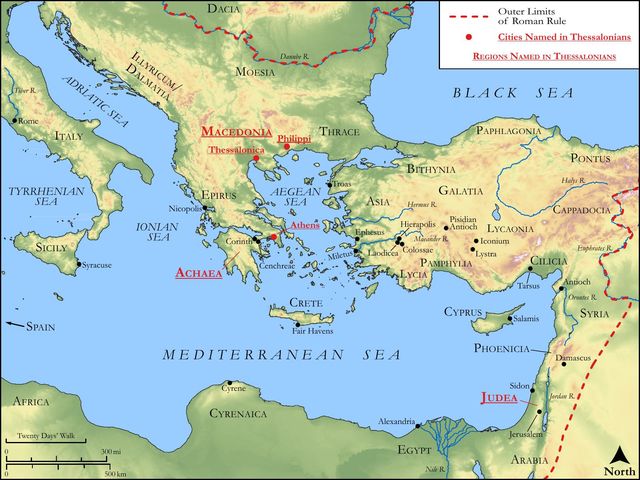
See on the biblical-era maps

Study this verse
Public-domain commentary
Matthew Henry
From his Commentary on the Whole Bible. Henry comments on passages, not single verses — this entry covers 2 Thessalonians 2:1–2. His three-level outline is real structure in the source text, so it is rendered as structure.
From these words it appears that some among the Thessalonians had mistaken the apostle's meaning, in what he had written in his former epistle about the coming of Christ, by thinking that it was near at hand, - that Christ was just ready to appear and come to judgment. Or, it may be, some among them pretended that they had the knowledge of this by particular revelation from the Spirit, or from some words they had heard from the apostle, when he was with them, or some letter he had written or they pretended he had written to them or some other person: and hereupon the apostle is careful to rectify this mistake, and to prevent the spreading of this error. Observe, If errors and mistakes arise among Christians, we should take the first opportunity to rectify them, and hinder the spreading thereof; and good men will be especially careful to suppress errors that may arise from a mistake of their words and actions, though that which was spoken or done was ever so innocent or well. We have a subtle adversary, who watches all opportunities to do mischief, and will sometimes promote errors even by means of the words of scripture. Observe,
I.How very earnest and solicitous this apostle was to prevent mistakes:
We beseech you, brethren, etc., Th2 2:1. He entreats them as brethren who might have charged them as a father charges his children: he shows great kindness and condescension, and insinuates himself into their affections. And this is the best way to deal with men when we would preserve or recover them from errors, to deal gently and affectionately with them: rough and rigorous treatment will but exasperate their spirits, and prejudice them against the reasons we may offer. He obtests and even conjures them in the most solemn manner: By the coming of Christ, etc. The words are in the form of an oath; and his meaning is that if they believed Christ would come, and if they desired he would come, and rejoiced in the hope of his coming, they should be careful to avoid the error, and the evil consequences of it, against which he was now cautioning them. From this form of obtestation used by the apostle, we may observe,
1.It is most certain that the Lord Jesus Christ will come to judge the world, that he will come in all the pomp and power of the upper world in the last day, to execute judgment upon all. Whatever uncertainty we are at, or whatever mistakes may arise about the time of his coming, his coming itself is certain. This has been the faith and hope of all Christians in all ages of the church; nay, it was the faith and hope of the Old Testament saints, ever since Enoch the seventh from Adam, who said, Behold, the Lord cometh, etc., Jde 1:14.
2.At the second coming of Christ all the saints will be gathered together to him; and this mention of the gathering of the saints together unto Christ at his coming shows that the apostle speaks of Christ's coming to judgment day, and not of his coming to destroy Jerusalem. He speaks of a proper, and not a metaphorical advent: and, as it will be part of Christ's honour in that day, so it will be the completing of the happiness of his saints.
(1.)That they all shall be gathered together. There will then be a general meeting of all the saints, and none but saints; all the Old Testament saints, who got acquaintance with Christ by the dark shadows of the law, and saw this day at a distance; and all the New Testament saints, to whom life and immortality were brought to light by the gospel; they will all be gathered together. There will then come from the four winds of heaven all that are, or ever were, or ever shall be, from the beginning to the end of time. All shall be gathered together.
(2.)That they shall be gathered together to Christ. He will be the great centre of their unity. They shall be gathered together to him, to be attendants on him, to be assessors with him, to be presented by him to the Father, to be with him for ever, and altogether happy in his presence to all eternity.
(3.)The doctrine of Christ's coming and our gathering together to him is of a great moment and importance to Christians; otherwise it would not be the proper matter of the apostle's obtestation. We ought therefore not only to believe these things, but highly to account of them also, and look upon them as things we are greatly concerned in and should be much affected with.
II.The thing itself against which the apostle cautions the Thessalonians is that they should not be deceived about the time of Christ's coming, and so be shaken in mind, or be troubled. Note, Errors in the mind tend greatly to weaken our faith, and cause us trouble; and such as are weak in faith and of troubled minds are oftentimes apt to be deceived, and fall a prey to seducers.
1.The apostle would not have them be deceived: Let no man deceive you by any means, Th2 2:3. There are many who lie in wait to deceive, and they have many ways of deceiving; we have reason therefore to be cautious and stand upon our guard. Some deceivers will pretend new revelations, others misinterpret scripture, and others will be guilty of gross forgeries; divers means and artifices of deceit men will use; but we must be careful that no man deceive us by any means. The particular matter in which the apostle cautions them not to be deceived is about the near approach of Christ's coming, as if it was to have been in the apostle's days; and harmless as this error might seem to many, yet, because it was indeed an error, it would have proved of bad consequences to many persons. Therefore,
2.He gives them warning, and would not have them be soon shaken in mind, nor be troubled.
(1.)He would not have their faith weakened. We should firmly believe the second coming of Christ, and be settled and established in the faith of this; but there was danger lest the Thessalonians, if they apprehended the coming of Christ was just at hand, upon finding that they, or others whom they too much regarded, were mistaken as to the time, should thereupon question the truth or certainty of the thing itself; whereas they ought not to waver in their minds as to this great thing, which is the faith and hope of all the saints. False doctrines are like winds, that toss the water to and fro, and they are apt to unsettle the minds of men, who are sometimes as unstable as water. Then,
(2.)He would not have their comforts lessened, that they should not be troubled nor affrighted with false alarms. It is probable that the coming of Christ was represented in so much terror as to trouble many serious Christians among them, though in itself it should be matter of the believer's hope and joy; or else many might be troubled with the thought how surprising this day would be, or with the fear of their unpreparedness, or upon the reflection on their mistake about the time of Christ's coming: we should always watch and pray, but must not be discouraged nor uncomfortable at the thought of Christ's coming.
Historical interpretation
Three Centuries of Reception
6 surviving comments on this verse. Each one is dated, so this reads as a timeline rather than a list.
Select a marker to jump to its quote. Markers stagger vertically where authors wrote within a few decades of each other.
Now I am aware that your teachers, sirs, admit the whole of the words of this passage to refer to Christ; and I am likewise aware that they maintain He has not yet come; or if they say that He has come, they assert that it is not known who He is; but when He shall become manifest and glorious, then it shall be known who He is. And then, they say, the events mentioned in this passage shall happen, just as if there was no fruit as yet from the words of the prophecy. O unreasoning men! understanding not what has been proved by all these passages, that two advents of Christ have been announced: the one, in which He is set forth as suffering, inglorious, dishonoured, and crucified; but the other, in which He shall come from heaven with glory, when the man of apostasy, who speaks strange things against the Most High, shall venture to do unlawful deeds on the earth against us the Christians, who, having learned the true worship of God from the law, and the word which went forth from Jerusalem by means of the apostles of Jesus, have fled for safety to the God of Jacob and God of Israel; and we who were filled with war, and mutual slaughter, and every wickedness, have each through the whole earth changed our warlike weapons — our swords into ploughshares, and our spears into implements of tillage— and we cultivate piety, righteousness, philanthropy, faith, and hope, which we have from the Father Himself through Him who was crucified; and sitting each under his vine, i.e., each man possessing his own married wife.
Deceivers have a way of counterfeiting letters under the name of some well-known person in order to mislead, so that the authority of the name may recommend something which would never be accepted on its own.
"That ye be not quickly shaken," he says, "nor yet be troubled, either by spirit, or by word, or by epistle as from us, as that the day of the Lord is now present."
Here he seems to me to intimate that certain persons went about having forged an Epistle, as if from Paul, and showing this, said that the Day of the Lord is at hand, that thence they might lead many into error. Therefore that they might not be deceived, Paul gives security by the things he writes, and says, "be not troubled, either by spirit or by word": and this is the meaning of what he says: Though any one having the spirit of prophecy should say this, believe it not. For when I was with you I told you these things, so that you ought not to change your persuasion from the things which you were taught. Or thus, "by spirit": so he calls the false prophet, speaking what they spoke by an unclean spirit. For these men, willing the more to be believed, not only endeavored to deceive by persuasive words, (for this he shows, saying, "or by word,") but they also showed a forged letter, as from Paul, declaring the same thing. Wherefore pointing out this also, he has added, "or by letter as from us." Having therefore secured them on every side, he thus sets forth his own doctrine.
And, what was worse than all, some attempted merely to report words as if they were said by Paul, but others even to forge Epistles as written by him. On this account, cutting off all access for them, he says, "Be not quickly shaken from your mind, nor yet be troubled, either by spirit, or by word, or by epistle as from us." "Neither by spirit" he says, glancing at the false prophets.
Therefore, not to know the times is something different from moral decay and the love of vice. For when the apostle Paul said, “Don’t be easily shaken in your mind nor be frightened, neither by word nor by epistle as sent from us, as if the day of the Lord were at hand,” he obviously did not want them to believe those who thought the coming of the Lord was already at hand. Neither, moreover, did he want them to be like the wicked servant and say, “My Lord will not be coming for a long time,” and deliver themselves over to destruction by pride and immoral behavior. Thus, Paul’s desire that they should not listen to false rumors about the imminent approach of the last day was consistent with his wish that they should await the coming of their Lord fully prepared and ready for the journey, with lamps burning.
All this you repeat with great piety and truth, praising the happiness of those who love the coming of the Lord. But those to whom the apostle said, “Be not easily moved from your mind as if the day of the Lord were at hand,” evidently loved the Lord’s coming. The purpose of the doctor of the Gentiles in saying this was not to break them away from the love which burned in them. Rather, he did not want them to put their faith in those from whom they heard that the day of the Lord was at hand, lest, perhaps, when the time had passed when they thought he would come and they realized that he had not come, they might think that the other promises made to them were also false and might despair of the mercy of faith itself. Therefore, it is not the one who asserts that he is near nor the one who asserts that he is not near who loves the coming of the Lord but the one who rightly waits for him, whether he be near or far, with sincere faith, firm hope and ardent love.
Continue studying 2 Thessalonians 2:2 across the web’s major study libraries — every link below opens this exact verse, chapter, or book on the destination site.
Read & Compare
 BibleGatewayThis verse in more than 200 translations and 70 languages.
 Bible.comThe YouVersion reader — hundreds of translations, reading plans, and highlights.
 ESV.orgCrossway's official English Standard Version reader.
 NET BibleThe NET translation with 60,000+ translators' notes on every rendering decision.
 STEP BibleTyndale House's free study tool — original text, vocabulary, and scholarly resources.
 BibliaLogos Bible Software's free web reader.
 USCCBThe New American Bible (Revised Edition) with the U.S. bishops' study notes.
Commentaries
 BibleHub CommentariesDozens of classic commentaries on this verse, gathered on one page.
 StudyLightMore than 100 commentary sets — the largest collection on the web.
 BibleRefPlain-English commentary on what this verse means, verse by verse.
 Enduring WordDavid Guzik's free commentary on this chapter, widely used by Bible teachers.
 Bible Study ToolsVerse commentary alongside Greek and Hebrew study aids.
Original Language & Research
- BibleHub InterlinearThe verse word by word — original language, transliteration, and English.
- BibleHub LexiconEvery word's original-language definition and Strong's entry.
 Blue Letter BibleDeep-study tools — Strong's numbers, concordance, and word studies.
 CNTR CollationThe earliest Greek manuscripts of this verse, collated letter by letter.
Sermons, Hymns & Audio


TrulyRandomVerse is not affiliated with these sites and doesn’t control their content. They’re linked because they’re genuinely useful.
Summary
In 2 Thessalonians 2:2, the Apostle Paul urgently warns the Thessalonian believers against being mentally disturbed or troubled by false teachings concerning the timing of the "Day of Christ." He specifically addresses three potential sources of misinformation—purported prophetic utterances ("spirit"), unverified oral traditions ("word"), or forged letters falsely attributed to the apostolic team ("letter as from us")—all of which erroneously claimed that the Lord's return had already occurred or was immediately imminent, thereby causing undue anxiety and confusion among the church members.
Context
ShowHideLiterary Context
This verse is a pivotal point in Paul's second letter to the Thessalonians, immediately following his opening exhortation in 2 Thessalonians 2:1 regarding "the coming of our Lord Jesus Christ and our gathering together to Him." The Thessalonians were suffering persecution (2 Thessalonians 1:4) and were particularly susceptible to eschatological confusion, perhaps interpreting their current afflictions as signs that they had entered or even missed the "Day of the Lord." Paul's primary aim in this chapter is to correct this misunderstanding by clarifying the sequence of events that must precede Christ's return, specifically detailing the "rebellion" and the revelation of the "man of lawlessness" in 2 Thessalonians 2:3-4. Verse 2, therefore, serves as a direct, compassionate warning against being swayed by any source that contradicts the true prophetic timeline he is about to lay out.
Historical & Cultural Context
The early church, including the Thessalonian believers, lived with a vibrant expectation of Christ's imminent return. This hope, while foundational, also made them vulnerable to misinterpretations and deceptive teachings. In the Roman Empire, various cults and philosophical schools offered their own eschatological narratives, and within early Christianity, there were undoubtedly individuals who, whether sincerely or maliciously, spread erroneous information about the end times. The mention of "spirit," "word," and "letter" reflects the common modes of communication and potential for deception in that day: charismatic prophecies, oral traditions passed by word of mouth, and written correspondence, which could be genuine or forged. The Thessalonians' suffering likely intensified their longing for deliverance, making them particularly vulnerable to any message that promised immediate relief or explained their distress through an incorrect eschatological framework.
Key Themes
ShowHideA central theme in this verse, and indeed in 2 Thessalonians 2, is Spiritual Stability and Discernment. Paul desires that the believers "be not soon shaken in mind, or be troubled," emphasizing the importance of mental and spiritual steadfastness in the face of unsettling claims. This directly relates to the theme of Eschatological Clarity, as Paul seeks to correct their understanding of the "Day of Christ" by providing a reliable prophetic framework. The verse also highlights the pervasive threat of False Teaching, identifying its various forms (prophetic utterances, oral traditions, forged letters) and underscoring the need for believers to test all things, as Paul advises in 1 Thessalonians 5:21. Ultimately, Paul's concern is for the Peace and Assurance of the believers, ensuring that their hope in Christ's return is grounded in truth, not in fear or confusion.
Exposition and Analysis
ShowHideKey Word Analysis
ShowHideThis word, derived from G4531, means "to waver," "to agitate," or "to be moved from a fixed position." In this context, it vividly portrays the mental and emotional instability caused by the false teaching. It suggests a loss of equilibrium, a state where one's convictions or peace are being violently disturbed, much like a ship tossed by a storm.
From G2360, this term means "to wail," "to clamor," or "to frighten." It conveys a sense of alarm, terror, or being thrown into confusion. It speaks to a deeper emotional distress than "shaken," indicating a state of being greatly disturbed, perhaps even terrified, by the mistaken belief that they had missed the Day of the Lord or were already experiencing its judgments.
Derived from G1764, this word signifies "to place on hand," "to impend," "to be present," or "to have arrived." This is a crucial term in the verse, as Paul directly refutes the idea that the Day of Christ had already begun or was immediately imminent. The false teachers claimed it was "present" or "had arrived," while Paul asserts that certain events must first unfold before its actual arrival.
Verse Breakdown
ShowHide"That ye be not soon shaken in mind, or be troubled"
Paul's primary pastoral concern is the mental and emotional well-being of the Thessalonian believers. He desires to prevent them from becoming unstable or distressed. The phrase "shaken in mind" refers to a loss of mental equilibrium and firm conviction, while "troubled" indicates a state of alarm, fear, or confusion. This opening clause sets the tone, revealing the pastoral heart behind the doctrinal correction.
"neither by spirit, nor by word, nor by letter as from us"
Here, Paul identifies the three primary channels through which false teaching about the Day of Christ might be disseminated. "By spirit" likely refers to purported prophetic utterances or charismatic claims that were not genuinely from the Holy Spirit. "By word" points to unverified oral traditions, rumors, or unauthoritative teachings spread by individuals. "By letter as from us" warns against forged epistles or letters falsely attributed to Paul, Silas, or Timothy, highlighting the cunning and deceptive nature of the false teachers.
"as that the day of Christ is at hand"
This final clause specifies the content of the false teaching that was causing such distress. The erroneous claim was that "the day of Christ" (often synonymous with the "Day of the Lord," referring to the period of God's judgment and Christ's return) had already arrived or was immediately imminent. Paul's subsequent teaching in 2 Thessalonians 2:3-12 directly refutes this, explaining that specific events, such as the great apostasy and the revelation of the man of lawlessness, must precede that Day.
Literary Devices
ShowHidePaul employs several literary devices in this verse to convey his urgent warning. The use of Negative Commands ("be not soon shaken," "nor be troubled") immediately establishes the imperative nature of his admonition, highlighting the danger of the false teaching. He uses a Triad ("by spirit, nor by word, nor by letter") to comprehensively cover the various forms of deceptive communication, emphasizing the pervasive nature of the threat. The phrase "shaken in mind" is a powerful Metaphor, depicting the mind as something that can be destabilized or dislodged from its firm foundation, illustrating the psychological and spiritual impact of misinformation. Furthermore, the verse functions as a Warning, serving as a crucial prelude to the detailed eschatological instruction that follows, preparing the readers to receive the truth by first discrediting the falsehoods.
Theological and Thematic Connections
ShowHideThis verse profoundly underscores the critical importance of sound doctrine, particularly in eschatology, for the spiritual stability and peace of believers. Paul's concern that the Thessalonians not be "shaken in mind, or be troubled" reveals a pastoral theology that values inner peace and mental steadfastness, which are directly impacted by one's understanding of God's unfolding plan. The identification of various sources of false teaching—spiritual claims, oral traditions, and forged documents—highlights the ongoing need for discernment within the church and the authoritative role of apostolic teaching. The "Day of Christ" represents God's ultimate triumph and judgment, and a distorted understanding of its timing or nature can lead to either reckless abandon or paralyzing fear, rather than the "blessed hope" that should characterize Christian living.
Reflection and Application
ShowHideIn an age saturated with information and misinformation, Paul's warning in 2 Thessalonians 2:2 resonates powerfully with believers today. The call not to be "shaken in mind, or be troubled" by sensational or unbiblical claims about the future is a timeless directive for maintaining spiritual equilibrium. We are constantly bombarded with various "spirits," "words," and "letters"—from social media prophecies to unverified online articles and charismatic pronouncements—all claiming to reveal insights into end-time events. This verse reminds us that true peace comes not from chasing every new theory, but from anchoring our hope firmly in the unchanging truth of God's inspired Word. It calls us to cultivate a robust spiritual discernment, to "test everything" (1 Thessalonians 5:21) against the full counsel of Scripture, and to prioritize sound doctrine over speculative sensationalism. Our focus should remain on faithful living, evangelism, and patient endurance, rather than being consumed by anxiety over the precise timing of future events, which God has reserved for Himself (Acts 1:7).
Questions for Reflection
ShowHideFAQ
ShowHideWhat does "the day of Christ is at hand" mean, and why was it a problem?
ShowHide"The day of Christ" (or "Day of the Lord") refers to a future period of God's decisive intervention in history, encompassing Christ's return, the judgment of the wicked, and the establishment of His kingdom. The phrase "at hand" (Greek enístēmi) means "is present" or "has arrived." The problem was that false teachers were claiming this Day had already begun or was imminently present, causing the Thessalonian believers to be "shaken in mind" and "troubled." They might have feared they had missed Christ's return, or that their current suffering was the judgment of the Day of the Lord, leading to despair or even abandoning their daily responsibilities, as implied in 2 Thessalonians 3:11. Paul corrects this by explaining that specific events, like the great apostasy and the revelation of the man of lawlessness, must precede this Day (2 Thessalonians 2:3-4).
Christ-Centered Fulfillment
ShowHideWhile 2 Thessalonians 2:2 primarily serves as a warning against eschatological deception, its Christ-centered fulfillment lies in the person of Jesus Himself as the ultimate truth and the source of our stability. The "Day of Christ" is entirely defined by His coming, and any teaching that distorts its nature or timing ultimately distorts the character of the One who comes. Christ, as the "way, the truth, and the life" (John 14:6), stands in stark contrast to the "spirit," "word," and "letter" of deception. He is the authentic message, the true prophetic voice, and the living Word of God (John 1:1). Our peace and stability are found not in speculative timelines or sensational claims, but in the unwavering faithfulness of Christ, who promised His return and will execute it in His perfect timing (Matthew 24:36). Therefore, to avoid being "shaken" or "troubled" is to fix our gaze on Christ, the author and perfecter of our faith (Hebrews 12:2), rather than on the shifting sands of false prophecy.