


2 Thessalonians 2:1
- ἘρωτῶμενErōtōmenWe imploreG2065V-PAI-1PVerb Present Active Indicative 1st Plural
- δὲdenowG1161CONJConjunction
- ὑμᾶςhumasyouG4771P-2APPersonal pronoun Accusative 2nd Plural
- ἀδελφοίadelphoibrothersG80N-VPMNoun Vocative Plural Masculine
- ὑπὲρhuperbyG5228PREPPreposition
- τῆςtēstheG3588T-GSFDefinite article Genitive Singular Feminine
- παρουσίαςparousiascomingG3952N-GSFNoun Genitive Singular Feminine
- τοῦtouof theG3588T-GSMDefinite article Genitive Singular Masculine
- κυρίουkuriouLordG2962N-GSM-TNoun Genitive Singular Masculine Title
- ἡμῶνhēmōnof usG3165P-1GPPersonal pronoun Genitive 1st Plural
- ἸησοῦIēsouJesusG2424N-GSM-PNoun Genitive Singular Masculine Individual
- ΧριστοῦChristouChristG5547N-GSM-TNoun Genitive Singular Masculine Title
- καὶkaiandG2532CONJConjunction
- ἡμῶνhēmōnourG3165P-1GPPersonal pronoun Genitive 1st Plural
- ἐπισυναγωγῆςepisunagōgēsgathering togetherG1997N-GSFNoun Genitive Singular Feminine
- ἐπ᾽ep᾽untoG1909PREPPreposition
- αὐτὸνautonHimG846P-ASMPersonal pronoun Accusative Singular Masculine
English is a literal word-by-word gloss of the Greek, not the KJV's wording. Why?
This is the original text the KJV's translators worked from — each Greek word with its own literal English meaning in this verse, prepared by scholars at Tyndale House, Cambridge. The KJV translates whole sentences, not word by word, so its wording differs: one Greek word can become several English words, and the KJV may choose “charity” where the gloss reads “love”. Both are faithful — they answer different questions. For the KJV's own rendering, switch to the KJV text.
Details
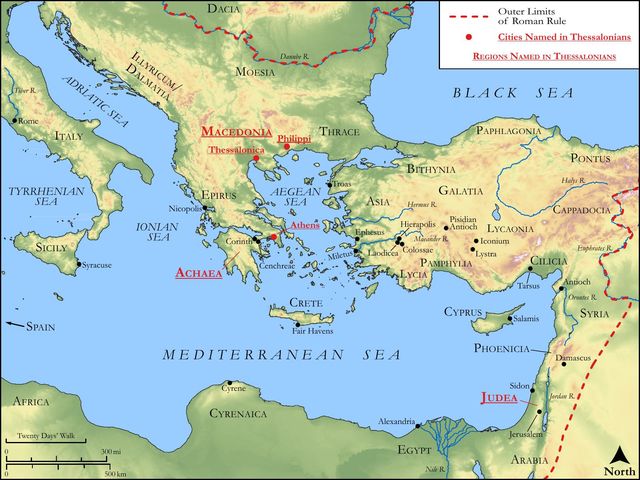
See on the biblical-era map

Study this verse
Public-domain commentary
Matthew Henry
From his Commentary on the Whole Bible. Henry comments on passages, not single verses — this entry covers 2 Thessalonians 2:1–2. His three-level outline is real structure in the source text, so it is rendered as structure.
From these words it appears that some among the Thessalonians had mistaken the apostle's meaning, in what he had written in his former epistle about the coming of Christ, by thinking that it was near at hand, - that Christ was just ready to appear and come to judgment. Or, it may be, some among them pretended that they had the knowledge of this by particular revelation from the Spirit, or from some words they had heard from the apostle, when he was with them, or some letter he had written or they pretended he had written to them or some other person: and hereupon the apostle is careful to rectify this mistake, and to prevent the spreading of this error. Observe, If errors and mistakes arise among Christians, we should take the first opportunity to rectify them, and hinder the spreading thereof; and good men will be especially careful to suppress errors that may arise from a mistake of their words and actions, though that which was spoken or done was ever so innocent or well. We have a subtle adversary, who watches all opportunities to do mischief, and will sometimes promote errors even by means of the words of scripture. Observe,
I.How very earnest and solicitous this apostle was to prevent mistakes:
We beseech you, brethren, etc., Th2 2:1. He entreats them as brethren who might have charged them as a father charges his children: he shows great kindness and condescension, and insinuates himself into their affections. And this is the best way to deal with men when we would preserve or recover them from errors, to deal gently and affectionately with them: rough and rigorous treatment will but exasperate their spirits, and prejudice them against the reasons we may offer. He obtests and even conjures them in the most solemn manner: By the coming of Christ, etc. The words are in the form of an oath; and his meaning is that if they believed Christ would come, and if they desired he would come, and rejoiced in the hope of his coming, they should be careful to avoid the error, and the evil consequences of it, against which he was now cautioning them. From this form of obtestation used by the apostle, we may observe,
1.It is most certain that the Lord Jesus Christ will come to judge the world, that he will come in all the pomp and power of the upper world in the last day, to execute judgment upon all. Whatever uncertainty we are at, or whatever mistakes may arise about the time of his coming, his coming itself is certain. This has been the faith and hope of all Christians in all ages of the church; nay, it was the faith and hope of the Old Testament saints, ever since Enoch the seventh from Adam, who said, Behold, the Lord cometh, etc., Jde 1:14.
2.At the second coming of Christ all the saints will be gathered together to him; and this mention of the gathering of the saints together unto Christ at his coming shows that the apostle speaks of Christ's coming to judgment day, and not of his coming to destroy Jerusalem. He speaks of a proper, and not a metaphorical advent: and, as it will be part of Christ's honour in that day, so it will be the completing of the happiness of his saints.
(1.)That they all shall be gathered together. There will then be a general meeting of all the saints, and none but saints; all the Old Testament saints, who got acquaintance with Christ by the dark shadows of the law, and saw this day at a distance; and all the New Testament saints, to whom life and immortality were brought to light by the gospel; they will all be gathered together. There will then come from the four winds of heaven all that are, or ever were, or ever shall be, from the beginning to the end of time. All shall be gathered together.
(2.)That they shall be gathered together to Christ. He will be the great centre of their unity. They shall be gathered together to him, to be attendants on him, to be assessors with him, to be presented by him to the Father, to be with him for ever, and altogether happy in his presence to all eternity.
(3.)The doctrine of Christ's coming and our gathering together to him is of a great moment and importance to Christians; otherwise it would not be the proper matter of the apostle's obtestation. We ought therefore not only to believe these things, but highly to account of them also, and look upon them as things we are greatly concerned in and should be much affected with.
II.The thing itself against which the apostle cautions the Thessalonians is that they should not be deceived about the time of Christ's coming, and so be shaken in mind, or be troubled. Note, Errors in the mind tend greatly to weaken our faith, and cause us trouble; and such as are weak in faith and of troubled minds are oftentimes apt to be deceived, and fall a prey to seducers.
1.The apostle would not have them be deceived: Let no man deceive you by any means, Th2 2:3. There are many who lie in wait to deceive, and they have many ways of deceiving; we have reason therefore to be cautious and stand upon our guard. Some deceivers will pretend new revelations, others misinterpret scripture, and others will be guilty of gross forgeries; divers means and artifices of deceit men will use; but we must be careful that no man deceive us by any means. The particular matter in which the apostle cautions them not to be deceived is about the near approach of Christ's coming, as if it was to have been in the apostle's days; and harmless as this error might seem to many, yet, because it was indeed an error, it would have proved of bad consequences to many persons. Therefore,
2.He gives them warning, and would not have them be soon shaken in mind, nor be troubled.
(1.)He would not have their faith weakened. We should firmly believe the second coming of Christ, and be settled and established in the faith of this; but there was danger lest the Thessalonians, if they apprehended the coming of Christ was just at hand, upon finding that they, or others whom they too much regarded, were mistaken as to the time, should thereupon question the truth or certainty of the thing itself; whereas they ought not to waver in their minds as to this great thing, which is the faith and hope of all the saints. False doctrines are like winds, that toss the water to and fro, and they are apt to unsettle the minds of men, who are sometimes as unstable as water. Then,
(2.)He would not have their comforts lessened, that they should not be troubled nor affrighted with false alarms. It is probable that the coming of Christ was represented in so much terror as to trouble many serious Christians among them, though in itself it should be matter of the believer's hope and joy; or else many might be troubled with the thought how surprising this day would be, or with the fear of their unpreparedness, or upon the reflection on their mistake about the time of Christ's coming: we should always watch and pray, but must not be discouraged nor uncomfortable at the thought of Christ's coming.
Historical interpretation
Three Centuries of Reception
9 surviving comments on this verse. Each one is dated, so this reads as a timeline rather than a list.
Select a marker to jump to its quote. Markers stagger vertically where authors wrote within a few decades of each other.
Now I am aware that your teachers, sirs, admit the whole of the words of this passage to refer to Christ; and I am likewise aware that they maintain He has not yet come; or if they say that He has come, they assert that it is not known who He is; but when He shall become manifest and glorious, then it shall be known who He is. And then, they say, the events mentioned in this passage shall happen, just as if there was no fruit as yet from the words of the prophecy. O unreasoning men! understanding not what has been proved by all these passages, that two advents of Christ have been announced: the one, in which He is set forth as suffering, inglorious, dishonoured, and crucified; but the other, in which He shall come from heaven with glory, when the man of apostasy, who speaks strange things against the Most High, shall venture to do unlawful deeds on the earth against us the Christians, who, having learned the true worship of God from the law, and the word which went forth from Jerusalem by means of the apostles of Jesus, have fled for safety to the God of Jacob and God of Israel; and we who were filled with war, and mutual slaughter, and every wickedness, have each through the whole earth changed our warlike weapons — our swords into ploughshares, and our spears into implements of tillage— and we cultivate piety, righteousness, philanthropy, faith, and hope, which we have from the Father Himself through Him who was crucified; and sitting each under his vine, i.e., each man possessing his own married wife.
For the mystery of iniquity doth already work; only he who now hinders must hinder, until he be taken out of the way." What obstacle is there but the Roman state, the falling away of which, by being scattered into ten kingdoms, shall introduce Antichrist upon (its own ruins)? "And then shall be revealed the wicked one, whom the Lord shall consume with the spirit of His mouth, and shall destroy with the brightness of His coming: even him whose coming is after the working of Satan, with all power, and signs, and lying wonders, and with all deceivableness of unrighteousness in them that perish.
And the blessed Apostle Paul, writing to the Thessalonians, says: "Now we beseech you, brethren, concerning the coming of our Lord Jesus Christ, and our gathering together at it, that ye be not soon shaken in mind, or be troubled, neither by spirit, nor by word, nor by letters as from us, as that the day of the Lord is at hand. Let no man deceive you by any means; for (that day shall not come) except there come the falling away first, and that man of sin be revealed, the son of perdition, who opposeth and exalteth himself above all that is called God, or that is worshipped: so that he sitteth in the temple of God, showing himself that he is God. Remember ye not, that when I was yet with you, I told you these things? And now ye know what withholdeth, that he might be revealed in his time. For the mystery of iniquity doth already work; only he who now letteth (will let), until he be taken out of the way. And then shall that wicked be revealed, whom the Lord Jesus shall consume with the Spirit of His mouth, and shall destroy with the brightness of His coming: (even him) whose coming is after the working of Satan, with all power, and signs, and lying wonders, and with all deceivableness of unrighteousness in them that perish; because they received not the love of the truth. And for this cause God shall send them strong delusion, that they should believe a lie: that they all might be damned who believed not the truth, but had pleasure in unrighteousness." And Esaias says, "Let the wicked be cut off, that he behold not the glory of the Lord."
At least, when the apostles were preaching and the eyewitnesses of Jesus were teaching his precepts, no minor dispute in the church took place among Jewish believers about those of the Gentiles who were converted to the faith; the question was whether they ought to keep the Jewish customs or if the burden of clean or unclean meats ought to be taken away so that it would not be a load upon those Gentiles who abandoned their traditional customs and believed in Jesus. Furthermore, in the epistles of Paul, who was contemporary with those who had seen Jesus, there are some statements to be found which concern certain disputes about the resurrection, and about the view that it had already occurred, and about the question whether the day of the Lord was already present or not.
And further, not to know when the end is, or when the day of the end will occur, is actually a good thing. If people knew the time of the end, they might begin to ignore the present time as they waited for the end days. They might well begin to argue that they should only focus on themselves. Therefore, God has also remained silent concerning the time of our death. If people knew the day of their death, they would immediately begin to neglect themselves for the greater part of their lifetime. The Word, then, has concealed both the end of all things and the time of our own death from us, for in the end of all is the end of each, and in the end of each the end of all is comprehended. This is so that, when things remain uncertain and always in prospect, we advance day by day as if summoned, reaching forward to the things before us and forgetting the things behind. … The Lord, then, knowing what is good for us beyond ourselves, thus stabilized the disciples in a correct understanding. They, being taught, set right those of Thessalonica, who were likely to err on the very same point.
Now it is right and necessary, as in all divine Scripture, so here, faithfully to explain the time of which the apostle wrote, and the person and the point. This is so that the reader will not from ignorance miss either these or any similar particular and thus miss the true sense of the text. This was what the inquiring eunuch understood when he asked Philip, “I ask you, of whom does the prophet speak this? Of himself, or of someone else?” He feared lest, having explained the lesson unsuitably to the person, he should wander from the right sense. And the disciples, wishing to learn the time of what was predicted, implored the Lord: “Tell us,” they said, “when shall these things be? And what is the sign of your coming?” And again, hearing from the Savior the events of the end, they desired to learn the time of it, that they might be kept from error themselves. They also wished to be able to teach others, just as, when they had learned, they set right the Thessalonians, who were going wrong. When, then, one understands these points properly, knows properly these points, his understanding of the faith is right and healthy. But if he fails to understand, he immediately falls into heresy. Thus, Hymenaeus and Alexander and their followers were beside the time when they said that the resurrection had already taken place. The Galatians, too, were after the time in continuing to think circumcision was an important issue.
"Now we beseech you, brethren, touching the coming of our Lord Jesus Christ, and our gathering together unto Him; to the end that ye be not quickly shaken from your mind."
When the Ressurection will be, he has not said, but that it will not be now, he has said. "And our gathering together unto Him." This also is no little matter. See how the exhortation also is again accompanied with commendation and encouragement, in that He and all the Saints will certainly appear with us. Here he is discoursing concerning the resurrection and our gathering together. For these things will happen at the same time. He raises up their minds.
For that he did not depart, we may conjecture from hence: for he says in this Epistle, "We beseech you by the coming of our Lord Jesus Christ." For in his first Epistle he said, "Concerning the times and the seasons ye have no need that aught be written unto you." So that if he had gone, there would have been no need of his writing. But since the question was deferred, on this account he adds this Epistle, as in his Epistle to Timothy he says, "They subvert the faith of some, saying that the Resurrection is already past"; that the faithful henceforth hoping for nothing great or splendid, might faint under their sufferings.
For since that hope supported them, and did not allow them to yield to the present evils, the devil wishing to cut it off, as being a kind of anchor, when he was not able to persuade them that the things to come were false, went to work another way, and having suborned certain pestilential men, endeavored to deceive those who believed into a persuasion that those great and splendid things had received their fulfillment. Accordingly these men then said that the Resurrection was already past. But now they said that the Judgment and the coming of Christ were at hand, that they might involve even Christ in a falsehood, and having pointed out to them that there is hereafter no retribution, nor judgment-seat, nor punishment and vengeance for those who had done them evil, they might both render these more bold, and those more dispirited.
To what has been said it must also be added that we must not affirm that after the ascension the Lord Christ is not Christ but only the begotten Son. The divine Gospels and the history of the Acts and the epistles of the apostle himself were, as we know, written after the ascension. It is after the ascension that the divine Paul exclaims “Seeing then that we have a great high priest that is passed into the heavens, Jesus the Son of God, let us hold fast our profession.” … And again when writing to the same a second time, he says, “Now we beseech you, brothers, by the coming of our Lord Jesus Christ, and by our gathering together unto him.”
Continue studying 2 Thessalonians 2:1 across the web’s major study libraries — every link below opens this exact verse, chapter, or book on the destination site.
Read & Compare
 BibleGatewayThis verse in more than 200 translations and 70 languages.
 Bible.comThe YouVersion reader — hundreds of translations, reading plans, and highlights.
 ESV.orgCrossway's official English Standard Version reader.
 NET BibleThe NET translation with 60,000+ translators' notes on every rendering decision.
 STEP BibleTyndale House's free study tool — original text, vocabulary, and scholarly resources.
 BibliaLogos Bible Software's free web reader.
 USCCBThe New American Bible (Revised Edition) with the U.S. bishops' study notes.
Commentaries
 BibleHub CommentariesDozens of classic commentaries on this verse, gathered on one page.
 StudyLightMore than 100 commentary sets — the largest collection on the web.
 BibleRefPlain-English commentary on what this verse means, verse by verse.
 Enduring WordDavid Guzik's free commentary on this chapter, widely used by Bible teachers.
 Bible Study ToolsVerse commentary alongside Greek and Hebrew study aids.
Original Language & Research
- BibleHub InterlinearThe verse word by word — original language, transliteration, and English.
- BibleHub LexiconEvery word's original-language definition and Strong's entry.
 Blue Letter BibleDeep-study tools — Strong's numbers, concordance, and word studies.
 CNTR CollationThe earliest Greek manuscripts of this verse, collated letter by letter.
Sermons, Hymns & Audio


TrulyRandomVerse is not affiliated with these sites and doesn’t control their content. They’re linked because they’re genuinely useful.
Summary
In 2 Thessalonians 2:1, the Apostle Paul initiates a solemn appeal to the Thessalonian believers, grounding his subsequent teaching on eschatological matters in the foundational truths of Christ's return and the ultimate gathering of His people. This verse serves as a crucial transition, setting the stage for Paul to correct misunderstandings and quell anxieties that had arisen concerning the timing and nature of the Day of the Lord, reassuring them by invoking the very events that form the bedrock of their Christian hope.
Context
ShowHideLiterary Context
This verse marks a pivotal shift in Paul's second letter to the Thessalonians. In 1 Thessalonians, Paul had already addressed the topic of Christ's return and the resurrection of believers, offering comfort (e.g., 1 Thessalonians 4:13-18). However, it appears that subsequent misinterpretations, possibly fueled by false letters or teachers, led some in the Thessalonian church to believe that the "Day of the Lord" had already commenced, causing significant distress and confusion (as implied by 2 Thessalonians 2:2). Paul's opening plea in 2 Thessalonians 2:1 serves as a pastoral introduction to his detailed correction of these erroneous views, emphasizing the certainty of Christ's future coming and the believers' gathering to Him before delving into the signs that must precede that day.
Historical & Cultural Context
The Thessalonian church was a relatively young congregation, founded by Paul during his second missionary journey. They were predominantly Gentile converts, living in a bustling Roman port city, and were facing significant persecution (as noted in 2 Thessalonians 1:4). This persecution, combined with a fervent expectation of Christ's imminent return, made them particularly susceptible to eschatological error. The concept of a "Day of the Lord" was rooted in Old Testament prophetic tradition, signifying a time of divine judgment and salvation, but its application to the Christian era needed careful explanation. The cultural milieu would have included various mystery religions and philosophical schools, some of which offered their own eschatological narratives or spiritual experiences, making clear, apostolic teaching all the more vital to prevent syncretism or confusion.
Key Themes
ShowHideThe overarching theme of 2 Thessalonians is the clarification of eschatology and the encouragement of steadfastness amidst persecution and false teaching. This verse specifically introduces the themes of the Parousia (Christ's Coming) and the gathering of believers, which are central to the church's hope and understanding of future events. Paul seeks to instill pastoral comfort and doctrinal correction, ensuring that the Thessalonians' hope is rightly placed and their understanding of end-time events is accurate. The emphasis on "our Lord Jesus Christ" also reinforces the Lordship of Christ over all history and future events, providing a stable anchor for their faith.
Exposition and Analysis
ShowHideKey Word Analysis
ShowHideThis word, G2065, indicates a strong appeal or earnest request. It's more than a mere suggestion; it conveys a sense of urgency and deep concern on Paul's part. He is not simply informing them but pleading with them, highlighting the gravity and importance of the truth he is about to convey regarding Christ's return and their ultimate union with Him.
parousía, is a crucial term in New Testament eschatology. While it can mean "presence" or "arrival" generally, in this context, it specifically refers to the personal, visible, and glorious advent of Christ. It denotes a royal visitation, emphasizing not just an event but the actual presence of the Lord. This term is consistently used to describe the Second Coming of Jesus, signifying His return in power and glory.
episynagōgḗ, signifies a complete collection or assembling. It refers to the definitive and comprehensive assembly of believers with Christ. This term strongly echoes the event described in 1 Thessalonians 4:17, where believers are "caught up together" to meet the Lord. It underscores the corporate nature of this future event, where all of God's people will be united with Him.
Verse Breakdown
ShowHide"Now we beseech you, brethren"
Paul opens with a direct and earnest appeal, addressing the believers as "brethren," emphasizing their shared spiritual family and the pastoral nature of his communication. The "Now" (G1161, dé) serves as a transition, signaling the commencement of a new, critical topic. This phrase establishes the tone of urgency and deep concern for their spiritual well-being, setting the stage for the correction of their eschatological errors.
"by the coming of our Lord Jesus Christ"
This clause introduces the first of two foundational truths upon which Paul bases his appeal. The "coming" (Greek, parousía) refers to the future, personal, and glorious return of Jesus. Paul invokes this central tenet of Christian hope as the very authority or ground for his plea, reminding them of the certain and blessed event that defines their future. It is "our Lord Jesus Christ," emphasizing His divine authority and saving work.
"and [by] our gathering together unto him"
This second clause specifies the glorious consequence of Christ's coming for believers. It refers to the definitive "gathering together" (Greek, episynagōgḗ) of all believers to Christ, an event often associated with the rapture or resurrection. Paul uses this collective experience as the second pillar of his appeal, reinforcing the corporate hope and destiny of the church. This phrase directly links to the comfort Paul provided in 1 Thessalonians 4:17, reminding them of their secure future with the Lord.
Literary Devices
ShowHidePaul employs several literary devices in this concise verse. The use of Apostrophe is evident as he directly addresses the "brethren," creating an immediate and personal connection with his audience, underscoring the pastoral nature of his message. The phrase "we beseech you" is a form of Earnest Appeal or Supplication, conveying the profound urgency and gravity of the topic. The structure of the verse, linking "the coming of our Lord Jesus Christ" and "our gathering together unto him" with the conjunction "and," is an example of Parallelism, highlighting two interconnected and equally foundational aspects of their future hope. This also functions as a form of Synecdoche, where these two key events stand for the broader scope of end-time prophecy that Paul is about to clarify.
Theological and Thematic Connections
ShowHidePaul's appeal in 2 Thessalonians 2:1 firmly anchors the Thessalonian believers' hope in the future, personal return of Jesus Christ and the subsequent gathering of His church to Him. This foundational truth serves as a bulwark against the anxieties and false teachings that had infiltrated their community. The "coming" (parousia) of Christ is not merely an abstract doctrine but a concrete, promised event that validates the entire Christian worldview, assuring believers of God's ultimate triumph and the consummation of His redemptive plan. The "gathering together unto him" speaks to the ultimate unity and security of the church, emphasizing that despite present trials, their destiny is to be eternally with their Lord. This verse therefore underscores the importance of sound eschatology as a source of comfort, motivation for holy living, and a safeguard against deception.
Reflection and Application
ShowHideThe profound truth of 2 Thessalonians 2:1 calls believers today to a renewed focus on the blessed hope of Christ's return and our ultimate union with Him. In a world often characterized by uncertainty, fear, and conflicting narratives, Paul's earnest appeal reminds us that our ultimate security and comfort are found not in temporal circumstances but in the unchanging promise of our Lord's coming. This verse challenges us to cultivate a discerning spirit, to be firmly rooted in biblical truth, and to resist being swayed by sensationalism or false teachings concerning end-time events. It encourages us to live with an eternal perspective, allowing the anticipation of Christ's return and our gathering to Him to shape our priorities, purify our lives, and fuel our mission. Our hope is not merely an escape from this world, but a confident expectation of the glorious consummation of God's plan, culminating in our eternal presence with Christ.
Questions for Reflection
ShowHideFAQ
ShowHideWhat is the significance of Paul using the phrase "we beseech you" in this context?
ShowHidePaul's use of "we beseech you" (Greek, erōtáō) signifies a deeply earnest and urgent appeal, rather than a mere instruction or suggestion. It conveys his profound pastoral concern for the Thessalonians, who were experiencing distress and confusion due to misunderstandings about the Day of the Lord. By pleading with them, Paul underscores the critical importance of the truths he is about to present, aiming to provide comfort and correct their erroneous beliefs. This solemn appeal highlights the gravity of theological accuracy, especially concerning core Christian hopes like the return of Christ.
Christ-Centered Fulfillment
ShowHideWhile 2 Thessalonians 2:1 directly speaks of the future coming of Christ, its profound Christ-centered fulfillment lies in the very person and redemptive work of Jesus, which makes such a "coming" and "gathering" possible. The "Lord Jesus Christ" is not merely a figure of prophecy but the one who, through His incarnation, sinless life, atoning death on the cross, and glorious resurrection, secured the salvation and eternal destiny of all who believe. His first coming, as the Lamb of God who takes away the sin of the world, inaugurated the new covenant and established the church. The "gathering together unto him" is the ultimate culmination of His work, bringing His redeemed people into His eternal presence, fulfilling His promise to prepare a place for them. Thus, the hope expressed in this verse is entirely dependent on the historical and theological reality of who Jesus is and what He has accomplished, making Him the central figure and the ultimate fulfillment of all divine promises, from creation to consummation.