


Mark 13:7
- ὅτανhotanWhenG3752CONJConjunction
- δὲdethenG1161CONJConjunction
- ἀκούσητεakousēteyou may hear ofG191V-AAS-2PVerb Aorist Active Subjunctive 2nd Plural
- πολέμουςpolemouswarsG4171N-APMNoun Accusative Plural Masculine
- καὶkaiandG2532CONJConjunction
- ἀκοὰςakoasrumorsG189N-APFNoun Accusative Plural Feminine
- πολέμωνpolemōnof warsG4171N-GPMNoun Genitive Plural Masculine
- μὴmēnotG3361PRT-NNegative Particle Negative
- θροεῖσθε·throeisthedo be disturbedG2360V-PPM-2PVerb Present Passive Imperative 2nd Plural
- δεῖdeiit mustG1163V-PAI-3SVerb Present Active Indicative 3rd Singular
- γὰρgarforG1063CONJConjunction
- γενέσθαιgenesthaicome to passG1096V-2ADNVerb 2nd Aorist Middle Deponent Infinitive
- ἀλλ᾽all᾽butG235CONJConjunction
- οὔπωoupōnot yet [is]G3768ADV-NAdverb or adverb and particle combined Negative
- τὸtotheG3588T-NSNDefinite article Nominative Singular Neuter
- τέλοςtelosendG5056N-NSNNoun Nominative Singular Neuter
English is a literal word-by-word gloss of the Greek, not the KJV's wording. Why?
This is the original text the KJV's translators worked from — each Greek word with its own literal English meaning in this verse, prepared by scholars at Tyndale House, Cambridge. The KJV translates whole sentences, not word by word, so its wording differs: one Greek word can become several English words, and the KJV may choose “charity” where the gloss reads “love”. Both are faithful — they answer different questions. For the KJV's own rendering, switch to the KJV text.
Details
See on the biblical-era map
Study this verse
Public-domain commentary
Matthew Henry
From his Commentary on the Whole Bible. Henry comments on passages, not single verses — this entry covers Mark 13:5–13. His three-level outline is real structure in the source text, so it is rendered as structure.
Our Lord Jesus, in reply to their question, sets himself, not so much to satisfy their curiosity as to direct their consciences; leaves them still in the dark concerning the times and seasons, which the father has kept in his own power, and which it was not for them to know; but gives them the cautions which were needful, with reference to the events that should now shortly come to pass.
I.They must take heed that they be not deceived by the seducers and imposters that should now shortly arise (Mar 13:5, Mar 13:6); "Take heed lest any man deceive you, lest, having found the true Messiah, you lose him again in the crowd of pretenders, or be inveigled to embrace others in rivalship with him. Many shall come in my name (not in the name of Jesus), but saying, I am the Christ, and so claiming the dignities which I only an entitled to." After the Jews had rejected the true Christ, they were imposed upon, and so exposed by many false Christs, but never before; those false Christs deceived many; Therefore take heed lest they deceive you. Note, When many are deceived, we should thereby be awakened to look to ourselves.
II.They must take heed that they be not disturbed at the noise of wars, which they should be alarmed with, Mar 13:7, Mar 13:8.
Sin introduced wars, and they come from men's lusts. But at some times the nations are more distracted and wasted with wars than at other times; so it shall be now; Christ was born into the world when there was a general peace, but soon after he went out of the world there were general wars; Nation shall rise against nation, and kingdom against kingdom. And what will become of them then who are to preach the gospel to every nation? Inter arma silent leges - Amidst the clash of arms, the voice of law is not heard. "But be not troubled at it." 1. "Let it be no surprise to you; you are bid to expect it, and such things must needs be, for God has appointed them, in order to further accomplishment of his purposes, and by the wars of the Jews" (which Josephus has given us a large account of) "God will punish the wickedness of the Jews." 2. "Let it be no terror to you, as if your interest were in danger of being overthrown, or your work obstructed by these wars; you have no concern in them, and therefore need not be apprehensive of any damage by them." Note, Those that despise the smiles of the world, and do not court and covet them, may despise the frowns of the world, and need not fear them. If we seek not to rise with them that rise in the world, why should we dread falling with them that fall in the world? 3. "Let it not be looked upon as an omen of the approaching period of the world, for the end is not yet, Mar 13:7. Think not that these wars will bring the world to a period; no, there are other intermediate counsels to be fulfilled betwixt that end and the end of all things, which are designed to prepare you for the end, but not to hasten it out of due time." 4. "Let it not be looked upon as if in them God has done his worst; no, he has more arrows in his quiver, and they are ordained against the persecutors; be not troubled at the wars you shall hear of, for they are but the beginnings of sorrows, and therefore, instead of being disturbed at them, you ought to prepare for worse; for there shall also be earthquakes in divers places, which shall bury multitudes in the ruins of their own houses, and there shall be famines, by which many of the poor shall perish for want of bread, and troubles and commotions; so that there shall be no peace to him that goes out or comes in. The world shall be full of troubles, but be not ye troubled; without are fightings, within are fears, but fear not ye their fear." Note, The disciples of Christ, if it be not their own fault, may enjoy a holy security and serenity of mind, when all about them is in the greatest disorder.
III.They must take heed that they be not drawn away from Christ, and from their duty to him, by the sufferings they should meet with for Christ's sake. Again, he saith, "Take heed to yourselves, Mar 13:9. Though you may escape the sword of war, better than some of your neighbours, because you interest not yourselves in the public quarrels, yet be not secure; you will be exposed to the sword of justice more than others, and the parties that contend with one another, will unite against you. Take heed therefore lest you deceive yourselves with the hopes of outward prosperity, and such a temporal kingdom as you have been dreaming of, when it is through many tribulations that you must enter into the kingdom of God. Take heed lest you needlessly expose yourselves to trouble, and pull it upon your own head. Take heed what you say and do, for you will have many eyes upon you." Observe,
1.What the trouble is which they must expect.
(1.)They shall be hated of all men; trouble enough! The thoughts of being hated are grievous to a tender spirit, and the fruits of that hatred must needs be a constant vexation; those that are malicious, will be mischievous. It was not for any thing amiss in them, or done amiss by them, that they were hated, but for Christ's name sake, because they were called by his name, called upon his name, preached his name, and wrought miracles in his name. The world hated them because he loved them.
(2.)Their own relations shall betray them, those to whom they were most nearly allied, and on whom therefore they depended for protection; "They shall betray you, shall inform against you, and be your prosecutors." If a father has a child that is a Christian, he shall become void of natural affection, it shall be swallowed up in bigotry, and he shall betray his own child to the persecutors, as if he were a worshipper of other gods, Deu 13:6-10.
(3.)Their church-rulers shall inflict their censures upon them; "You shall be delivered up to the great Sanhedrim at Jerusalem, and to the inferior courts and consistories in other cities, and shall be beaten in the synagogues with forty stripes at a time, as offenders against the law which was read in the synagogue." It is no new thing for the church's artillery, through the treachery of its officers, to be turned against some of its best friends.
(4.)Governors and kings shall use their power against them. Because the Jews have not power to put them to death, they shall incense the Roman powers against them, as they did Herod against James and Peter; and they shall cause you to be put to death, as enemies to the empire. They must resist unto blood, and still resist.
2.What they shall have to comfort themselves with, in the midst of these great and sore troubles.
(1.)That the work they were called to should be carried on and prosper, notwithstanding all this opposition which they should meet with in it (Mar 13:10); "The gospel shall, for all this, be published among all nations, and before the destruction of Jerusalem the sound of it shall go forth into all the earth; not only through all the nation of the Jews, but to all the nations of the earth." It is comfort to those who suffer for the gospel, that, though they may be crushed and borne down, the gospel cannot; it shall keep its ground, and carry the day.
(2.)That their sufferings, instead of obstructing their work, should forward it; "Your being brought before governors and kings shall be for a testimony of them (so some read it, Mar 13:9); it shall give you an opportunity of preaching the gospel to those before whom you are brought as criminals, to whom otherwise you could not have access." Thus St. Paul's being brought before Felix, and Festus, and Agrippa, and Nero, was a testimony to them concerning Christ and his gospel. Or, as we read it, It shall be for a testimony against them, against both the judges and the prosecutors, who pursue those with the utmost rage that appear, upon examination, to be not only innocent but excellent persons. The gospel is a testimony to us concerning Christ and heaven. If we receive it, it will be a testimony for us: it will justify and save us; if not, it will be a testimony against us in the great day.
(3.)That, when they were brought before kings and governors for Christ's sake, they should have special assistance from heaven, to plead Christ's cause and their own (Mar 13:11); "Take no thought before-hand what he shall speak, be not solicitous how to address yourselves to great men, so as to obtain their favour; your cause is just and glorious, and needs not be supported by premeditated speeches and harangues; but whatsoever shall be given you in that hour, whatsoever shall be suggested to you, and put into your minds, and into your mouths" (pro re nat - on the spur of the occasion), "that speak ye, and fear not the success of it, because it is off-hand, for it is not ye that speak, purely by the strength of your own wisdom, consideration, and resolution, but it is the Holy Ghost." Note, Those whom Christ calls out to be advocates for him, shall be furnished with full instructions: and when we are engaged in the service of Christ, we may depend upon the aids of the Spirit of Christ.
(4.)That heaven at last would make amends for all; "You will meet with a great deal of hardship in your way, but have a good heart on it, your warfare will be accomplished, and your testimony finished, and he that shall endure to the end, the same shall be saved," Mar 13:13. Perseverance gains the crown. The salvation here promised is more than a deliverance from evil, it is an everlasting blessedness, which shall be an abundant recompence for all their services and sufferings. All this we have, Mat 10:17, etc.
Historical interpretation
Seven Centuries of Reception
5 surviving comments on this verse. Each one is dated, so this reads as a timeline rather than a list.
Select a marker to jump to its quote. Markers stagger vertically where authors wrote within a few decades of each other.
(Epist. cxcix. 9.) In answer to the disciples, the Lord tells them of things which were from that time forth to have their course; whether He meant the destruction of Jerusalem which occasioned their question, or His own coming through the Church, (in which He ever comes even unto the end, for we know that He comes in His own, when His members are born day by day,) or the end itself, in which He will appear to judge the quick and the dead.
Our Lord and Redeemer announces beforehand the evils that precede the perishing world, so that the things to come may disturb us less because they have been foreknown. For missiles that are foreseen strike less forcefully; and we endure the evils of the world more tolerably if we are fortified against them by the shield of foreknowledge. For behold he says: "When you hear of wars and seditions, do not be terrified; for these things must happen first, but the end is not yet at once." The words of our Redeemer must be weighed carefully, through which he announces that we will suffer one thing internally, another externally. For wars indeed pertain to enemies, seditions to citizens. Therefore, to indicate that we are troubled both internally and externally, he declares that we suffer one thing from enemies, another from brothers.
But when you hear of wars and rumors of wars, do not be troubled. For such things must happen, but the end is not yet. Wars pertain to enemies, seditions to citizens. Both of these abounded abundantly from the time of the Lord's Passion among the people of the Jews, who chose a seditious robber for themselves instead of the Savior Christ. However, the apostles, as these events draw near, are warned not to be terrified, not to abandon Jerusalem and Judea, because evidently the end, which should rather be deferred until the fortieth year, namely the desolation of the province and the ultimate destruction of the city and temple, is to follow.
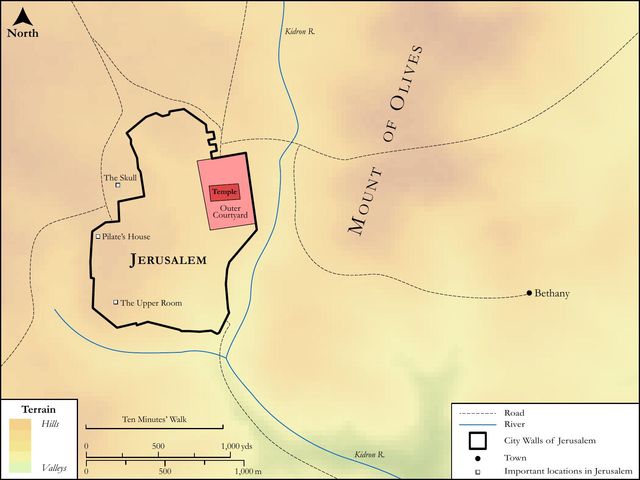
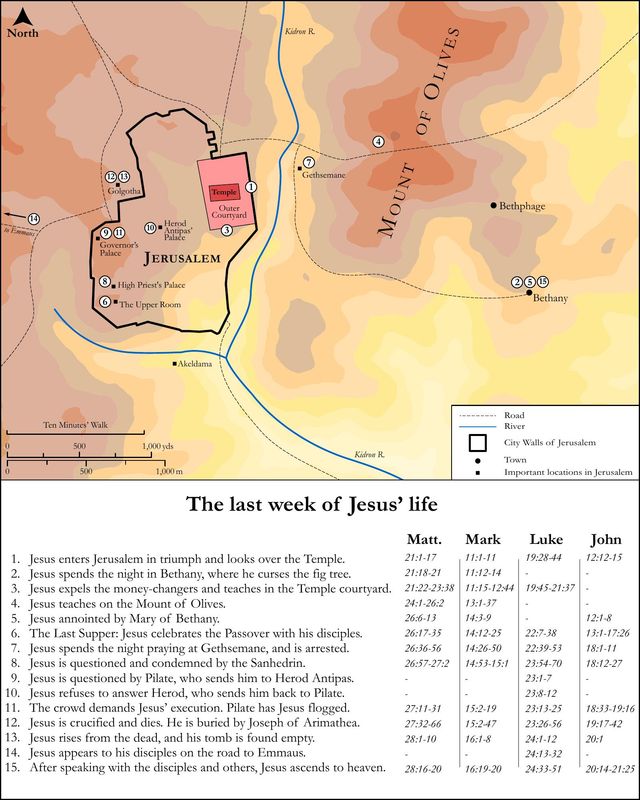
(ubi sup.) Because the Lord, when some were praising the buildings of the temple, had plainly answered that all these were to be destroyed, the disciples privately enquired about the time and the signs of the destruction which was foretold; wherefore it is said: And as he sat upon the mount of Olives, over against the temple, Peter and James and John and Andrew asked him privately, Tell us when shall these things be? and what shall be the sign when all these things shall be fulfilled. The Lord sits upon the mount of Olives, over against the temple, when He discourses upon the ruin and destruction of the temple, so that even His bodily position may be in accordance with the words which He speaks, pointing out mystically that, abiding in peace with the saints, He hates the madness of the proud. For the mount of Olives marks the fruitful sublimity of the Holy Church.
(ubi sup.) For many came forward, when destruction was hanging over Jerusalem, saying that they were Christs, and that the time of freedom was now approaching. Many teachers of heresy also arose in the Church even in the time of the Apostles; and many Antichrists came in the name of Christ, the first of whom was Simon Magus, to whom the Samaritans, as we read in the Acts of the Apostles, listened, saying, This man is the great power of God: wherefore also it is added here, And shall deceive many. (Acts 8:10) Now from the time of the Passion of our Lord there ceased not amongst the Jewish people, who chose the seditious robber and rejected Christ the Saviour, either external wars or civil discord; wherefore it goes on: And when ye shall hear of wars and rumours of wars, be ye not troubled. And when these come, the Apostles are warned not to be afraid, or to leave Jerusalem and Judæa, because the end was not to come at once, nay was to be put off for forty years. And this is what is added: for such things must needs be; but the end shall not be yet, that is, the desolation of the province, and the last destruction of the city and temple. It goes on: For nation shall rise against nation, and kingdom against kingdom.
(ubi sup.) Now it is on record that this literally took place at the time of the Jewish rebellion. But kingdom against kingdom, the pestilence of those whose word spreads as a canker, dearth of the word of God, the commotion of the whole earth, and the separation from the true faith, may all rather be understood of heretics who, by fighting one against the other, bring about the triumph of the Church.
But before answering their question, He strengthens their minds that they may not be deceived, wherefore there follows: And Jesus answering them began to say, Take heed lest any man deceive you? And this He says, because when the sufferings of the Jews began, some arose professing to be teachers, wherefore there follows: For many shall come in my name, saying, I am Christ; and shall deceive many.
That is, the Romans against the Jews, which Josephus relates happened before the destruction of Jerusalem. For when the Jews refused to pay tribute, the Romans arose, in anger; but because at that time they were merciful they took indeed their spoils, but did not destroy Jerusalem. What follows shows that God fought against the Jews, for it is said, And there shall be earthquakes in divers places, and there shall be famines.
Continue studying Mark 13:7 across the web’s major study libraries — every link below opens this exact verse, chapter, or book on the destination site.
Read & Compare
 BibleGatewayThis verse in more than 200 translations and 70 languages.
 Bible.comThe YouVersion reader — hundreds of translations, reading plans, and highlights.
 ESV.orgCrossway's official English Standard Version reader.
 NET BibleThe NET translation with 60,000+ translators' notes on every rendering decision.
 STEP BibleTyndale House's free study tool — original text, vocabulary, and scholarly resources.
 BibliaLogos Bible Software's free web reader.
 USCCBThe New American Bible (Revised Edition) with the U.S. bishops' study notes.
Commentaries
 BibleHub CommentariesDozens of classic commentaries on this verse, gathered on one page.
 StudyLightMore than 100 commentary sets — the largest collection on the web.
 BibleRefPlain-English commentary on what this verse means, verse by verse.
 Enduring WordDavid Guzik's free commentary on this chapter, widely used by Bible teachers.
 Bible Study ToolsVerse commentary alongside Greek and Hebrew study aids.
Original Language & Research
- BibleHub InterlinearThe verse word by word — original language, transliteration, and English.
- BibleHub LexiconEvery word's original-language definition and Strong's entry.
 Blue Letter BibleDeep-study tools — Strong's numbers, concordance, and word studies.
 CNTR CollationThe earliest Greek manuscripts of this verse, collated letter by letter.
Sermons, Hymns & Audio


TrulyRandomVerse is not affiliated with these sites and doesn’t control their content. They’re linked because they’re genuinely useful.
Summary
Mark 13:7, embedded within Jesus' Olivet Discourse, serves as a crucial prophetic statement to His disciples regarding the signs preceding His return and the culmination of the age. In this verse, Jesus foretells the inevitability of global conflicts and widespread reports of war, yet He emphatically commands His followers not to be alarmed. He clarifies that these tumultuous events are divinely ordained precursors, necessary steps in God's sovereign plan, but they do not signify the immediate arrival of the ultimate end. This passage offers both a sober warning about future global unrest and a profound call to peace and trust for believers.
Context
ShowHideLiterary Context
Mark 13:7 is an integral part of Jesus' prophetic discourse, often paralleled in Matthew 24 and Luke 21. This discourse, delivered on the Mount of Olives, is Jesus' direct response to the disciples' questions in Mark 13:4 concerning the timing of the temple's destruction and the signs of His coming and the end of the age. Jesus begins by warning against deception (Mark 13:5-6) before listing a series of escalating signs. Wars and rumors of wars are presented as the first category of these signs, explicitly distinguished from the "end" itself, serving as "the beginning of sorrows" or "birth pangs" as also noted in Matthew 24:8. This verse sets the tone for understanding that while significant, these initial disturbances are not the final act but rather indicators of a larger, unfolding divine drama.
Historical & Cultural Context
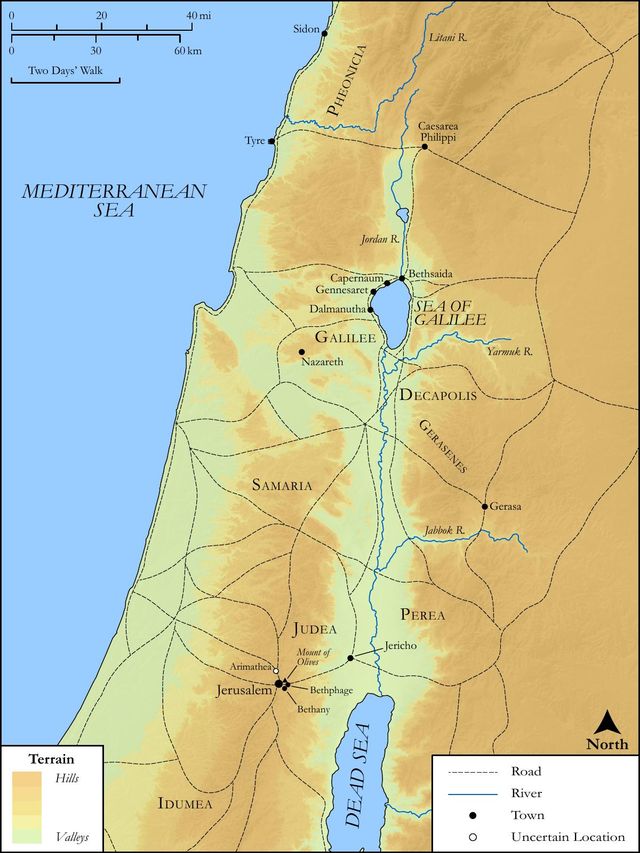
Jesus' discourse was given to His disciples in the context of first-century Judea, a region under Roman occupation, frequently experiencing political instability, revolts, and the constant threat of military conflict. The disciples, steeped in Old Testament prophetic traditions, would have been familiar with prophecies of coming judgment and messianic deliverance, often associated with cosmic and geopolitical upheaval. The concept of "wars and rumors of wars" would resonate deeply with their lived experience and historical memory, which included the recent Roman subjugation of Judea and ongoing tensions. Furthermore, the Jewish expectation of a Messiah who would bring immediate, decisive judgment upon the nations and establish His kingdom would make the disciples eager for signs of the "end." Jesus' teaching here recalibrates their expectations, emphasizing that the path to the ultimate end involves a period of ongoing, necessary global unrest, rather than an immediate, singular cataclysm.
Key Themes
ShowHideMark 13:7 contributes significantly to several key themes within the Olivet Discourse and the broader Gospel of Mark. Firstly, it underscores Divine Sovereignty and Necessity, highlighting that these events "must needs be" (Mark 13:7)—they are not random occurrences but part of God's predetermined plan, leading to His ultimate purposes. Secondly, it emphasizes Discernment and Steadfastness for believers. Amidst global turmoil, the command "be ye not troubled" (Mark 13:7) calls for a calm, faith-filled response rather than panic or fear, encouraging a posture of trust in God's control. Finally, the verse clearly establishes a Distinction Between Initial Signs and the Final End. By stating "but the end shall not be yet" (Mark 13:7), Jesus teaches patience and perseverance, warning against premature conclusions or speculative timelines, and redirecting focus from the signs themselves to the ultimate, certain return of the Son of Man (Mark 13:26).
Exposition and Analysis
ShowHideKey Word Analysis
ShowHideThis word (G2360) means to wail, to clamor, or by implication, to frighten. In this context, Jesus' command "be ye not troubled" directly addresses the disciples' potential for agitation, terror, or confusion in the face of disturbing news about wars. It is a call to maintain inner peace and composure, rather than succumbing to panic or emotional distress.
Derived from G1163, this term conveys a sense of divine obligation or necessity. It implies that these events are not accidental or random but are part of what is required to happen according to God's purpose and prophetic timeline. The phrase "must needs be" (δεῖ γενέσθαι, dei genesthai) indicates a divine imperative, a preordained sequence of events that God has determined will unfold.
This word (G5056) refers to the point aimed at as a limit, the conclusion of an act or state, or the ultimate result or purpose. In Mark 13:7, "the end" signifies the final culmination of the age, the ultimate prophetic event that marks the full establishment of God's kingdom and the return of Christ. Jesus clarifies that while wars are necessary precursors, they are not this ultimate conclusion.
Verse Breakdown
ShowHide"And when ye shall hear of wars and rumours of wars,"
This opening clause, introduced by "And" (G1161, dé), establishes the condition under which the subsequent instruction applies. "Wars" (G4171, pólemos) refers to actual military conflicts, while "rumours of wars" (G189, akoḗ of G4171, pólemos) denotes reports or widespread talk of impending or ongoing conflicts, even if not directly experienced. Jesus anticipates a global climate of conflict and apprehension, a continuous state of geopolitical unrest that will characterize the period leading up to His return.
"be ye not troubled:"
This is a direct imperative from Jesus, a command to His disciples. The Greek verb "troubled" (G2360, throéō) implies being agitated, terrified, or thrown into confusion. Jesus explicitly instructs His followers to resist succumbing to fear, panic, or emotional distress in response to these disturbing global events. This command underscores the importance of faith and trust in God's sovereignty amidst chaos.
"for such things must needs be;"
This clause provides the divine rationale for the preceding command. The conjunction "for" (G1063, gár) introduces the reason. The phrase "must needs be" (G1163, deî and G1096, gínomai) conveys a sense of divine necessity or inevitability. These wars and rumors of wars are not random or unforeseen; they are part of God's preordained plan, a necessary stage in the unfolding of His prophetic timeline. This understanding should provide comfort and stability to believers.
"but the end shall not be yet."
This final clause serves as a crucial clarification and warning against premature conclusions. The adversative conjunction "but" (G235, allá) highlights a contrast. While these events are necessary, they are not the ultimate "end" (G5056, télos), the final culmination of the age. The adverb "not yet" (G3768, oúpō) emphasizes that a period of time will elapse between these initial signs and the final, decisive events of Christ's return, teaching patience and vigilance rather than immediate expectation of the consummation.
Literary Devices
ShowHideMark 13:7 employs several literary devices to convey its profound message. The most prominent is Prophecy, as Jesus foretells future events—wars and rumors of wars—that will characterize the period leading up to His return. This prophetic utterance serves to both inform and prepare His disciples. There is also a clear use of Contrast in the verse, particularly in the shift from the expectation of global turmoil ("wars and rumours of wars") to the command for inner peace ("be ye not troubled"), and then again in distinguishing the necessary occurrence of these signs from the ultimate "end" ("but the end shall not be yet"). This contrast highlights the difference between earthly chaos and divine order, and between preliminary signs and final fulfillment. The phrase "must needs be" functions as a statement of Divine Necessity, underscoring the sovereign will of God behind these events, removing them from the realm of mere chance. Finally, the verse contains an Imperative ("be ye not troubled"), a direct command from Jesus that calls for a specific response of faith and composure from His followers in the face of distressing global circumstances.
Theological and Thematic Connections
ShowHideMark 13:7 profoundly shapes our understanding of God's sovereignty over history and the proper posture of believers in a turbulent world. It teaches that even the most chaotic human events, such as wars, are not outside of God's knowledge or control; rather, they are part of His predetermined plan, serving as necessary precursors to the ultimate culmination of His redemptive purposes. This divine necessity provides a theological anchor, preventing despair or panic by assuring believers that all things are working according to God's will. The command "be ye not troubled" underscores the New Testament emphasis on peace that transcends understanding, a peace rooted in trust in God's faithfulness amidst global unrest. It calls for spiritual resilience and a focus on the eternal rather than being consumed by temporal anxieties, while simultaneously fostering vigilance and discernment of the times without falling into speculative eschatology.
Reflection and Application
ShowHideMark 13:7 offers timeless guidance for believers navigating a world perpetually marked by conflict and uncertainty. In an age saturated with news of international tensions, regional wars, and political instability, Jesus' words serve as both a prophetic warning and a pastoral comfort. Instead of succumbing to fear, anxiety, or despair when confronted with such reports, we are called to a posture of unwavering faith and inner peace. This does not mean indifference to suffering or a lack of engagement with global issues, but rather an understanding that these events, while tragic, are not random but fit within God's overarching, sovereign plan. Our primary focus should not be on predicting exact timelines or becoming consumed by speculative eschatology, but on living faithfully, proclaiming the Gospel, and being prepared for the Lord's certain return. This verse encourages us to cultivate a deep trust in God's control, allowing His peace to guard our hearts and minds, enabling us to be instruments of hope and reconciliation in a troubled world.
Questions for Reflection
ShowHideFAQ
ShowHideDoes "wars and rumours of wars" mean that the end is always near, or that we should expect constant conflict until Jesus returns?
ShowHideJesus' statement in Mark 13:7 indicates that "wars and rumours of wars" are a recurring and necessary feature of the time leading up to His return, but they do not signify the immediate "end." He explicitly states, "but the end shall not be yet." This suggests that a period characterized by such conflicts will persist, serving as a general sign of the age, rather than each instance being a definitive marker of the immediate culmination. They are "birth pangs" (Matthew 24:8), indicating the beginning of a process, not its conclusion. Believers are called to be vigilant and discerning, understanding these as part of God's sovereign plan, but not to fall into panic or precise timeline predictions.
Christ-Centered Fulfillment
ShowHideWhile Mark 13:7 describes a future characterized by global conflict, its ultimate Christ-centered fulfillment lies not in the wars themselves, but in the steadfastness and ultimate triumph of Christ's kingdom amidst such turmoil. Jesus, the Prince of Peace (Isaiah 9:6), foretells these disturbances not to instill fear, but to prepare His followers for His certain return as the reigning King. The "must needs be" points to God's sovereign plan, culminating in Christ's final victory over all opposing powers, including war and strife (1 Corinthians 15:25). The command "be ye not troubled" echoes Jesus' repeated calls for peace in the New Testament, a peace He Himself bestows (John 14:27), a peace that transcends worldly understanding because it is rooted in His finished work on the cross and His resurrection power. Ultimately, the "end" that is "not yet" will usher in the new heavens and new earth where righteousness dwells (2 Peter 3:13), and where Christ will wipe away every tear, and there will be no more death, sorrow, crying, or pain (Revelation 21:4). Thus, Mark 13:7, while acknowledging present realities, directs our gaze to the glorious future consummation brought about by Christ, the Alpha and Omega (Revelation 1:8).