


2 Chronicles 13:21
- וַיִּתְחַזֵּקvai·yit·cha·Zekand he strengthened himselfH2388Conj-w ¦ V-Hithpael-ConsecImperf-3msVerb Hithpael Consecutive Imperfect 3rd Singular Masculineוַandיִּתְחַזֵּקhe strengthened himself
- אֲבִיָּהוּ'a·vi·Ya·huAbijahH29N-proper-mNoun Proper Masculine
- וַיִּשָּׂאvai·Yi·sa'and he tookH5375Conj-w ¦ V-Qal-ConsecImperf-3msVerb Qal Consecutive Imperfect 3rd Singular Masculineוַandיִּשָּׂאhe took
- לוֹlofor himselfPrep-l ¦ 3msSuffix Personal 3rd Singular Masculineלforוֹhimself
- נָשִׁיםna·ShimwivesH802N-mpNoun Plural Masculine Absolute
- אַרְבַּע'ar·Ba'four-H702N-csNoun Singular common gender Absolute
- עֶשְׂרֵה'es·RehteenH6240N-csNoun Singular common gender Absolute
- וַיּוֹלֶדvai·Yo·ledand he fatheredH3205Conj-w ¦ V-Hiphil-ConsecImperf-3msVerb Hiphil Consecutive Imperfect 3rd Singular Masculineוַandיּוֹלֶדhe fathered
- עֶשְׂרִים'es·RimtwentyH6242N-mpNoun Plural Masculine Absolute
- וּשְׁנַיִםu·she·Na·yimand twoH8147Conj-w ¦ N-cdNoun Dual common gender Absoluteוּandשְׁנַיִםtwo
- בָּנִיםba·NimsonsH1121N-mpNoun Plural Masculine Absolute
- וְשֵׁשׁve·Sheshand six-H8337Conj-w ¦ N-csNoun Singular common gender Absoluteוְandשֵׁשׁsix-
- עֶשְׂרֵה'es·RehteenH6240N-csNoun Singular common gender Absolute
- בָּנוֹתba·NotdaughtersH1323N-fpNoun Plural Feminine Absolute
English is a literal word-by-word gloss of the Hebrew, not the KJV's wording. Why?
This is the original text the KJV's translators worked from — each Hebrew word with its own literal English meaning in this verse, prepared by scholars at Tyndale House, Cambridge. The KJV translates whole sentences, not word by word, so its wording differs: one Hebrew word can become several English words, and the KJV may choose “the LORD” where the gloss reads “Yahweh”. Both are faithful — they answer different questions. For the KJV's own rendering, switch to the KJV text.
Details
See on the biblical-era map
Study this verse
Public-domain commentary
Matthew Henry
From his Commentary on the Whole Bible. Henry comments on passages, not single verses — this entry covers 2 Chronicles 13:13–22. His three-level outline is real structure in the source text, so it is rendered as structure.
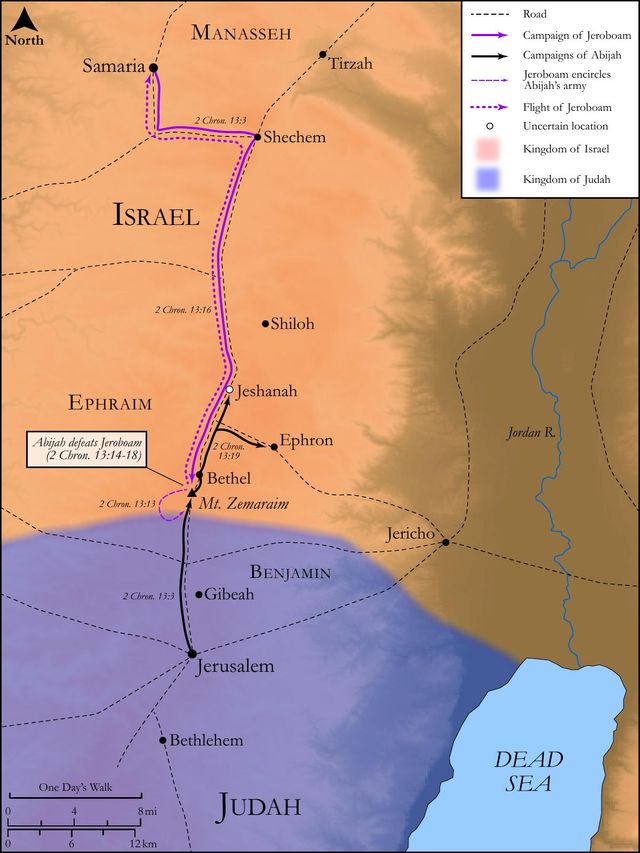
We do not find that Jeroboam offered to make any answer at all to Abijah's speech. Though it was much to the purpose, he resolved not to heed it, and therefore he heard it as though he heard it not. He came to fight, not to dispute. The longest sword, he thought, would determine the matter, not the better cause. Let us therefore see the issue, whether right and religion carried the day or no.
I.Jeroboam, who trusted to his politics, was beaten.
He was so far from fair reasoning that he was not for fair fighting. We may suppose that he felt a sovereign contempt for Abijah's harangue. "One stratagem," thinks he, "is worth twenty such speeches; we will soon give him an answer to all his arguments; he shall soon find himself overpowered with numbers, surrounded on every side with the instruments of death, and then let him boast of his religion and his title to the crown." A parley, it is probable, was agreed on, yet Jeroboam basely takes the advantage of it, and, while he was treating, laid his ambushment behind Judah, against all the laws of arms. What honour could be expected in a servant when he reigned? Abijah was for peace, but, when he spoke, they were for war, Psa 120:7.
II.Abijah and his people, who trusted in their God, came off conquerors, notwithstanding the disproportion of their strength and numbers.
1.They were brought into a great strait, put into a great fright, for the battle was before and behind. A good cause, and one which is designed to be victorious, may for a season be involved in embarrassment and distress. It was David's case. They compassed me about like bees, Psa 118:10-12.
2.In their distress, when danger was on every side, which way should they look but upwards for deliverance? It is an unspeakable comfort that no enemy (not the most powerful or politic), no stratagem or ambushment, can cut off our communication with heaven; our way thitherward is always open.
(1.)They cried unto the Lord, Ch2 13:14. We hope they did this before they engaged in this war, but the distress they were in made them renew their prayers and quickened them to be importunate. God brings his people into straits, that he may teach them to cry unto him. Earnest praying is crying.
(2.)They relied on the God of their fathers, depended upon his power to help them and committed themselves to him, Ch2 13:18. The prayer of faith is the prevailing prayer, and this is that by which we overcome the world, even our faith, Jo1 5:4.
(3.)The priests sounded the trumpets to animate them by giving them an assurance of God's presence with them. It was not only a martial but a sacred sound, and put life into their faith.
(4.)They shouted in confidence of victory: "The day is our own, for God is with us." To the cry of the prayer they added the shout of faith, and so became more than conquerors.
3.Thus they obtained a complete victory: As the men of Judah shouted for joy in God's salvation, God smote Jeroboam and his army with such terror and amazement that they could not strike a stroke, but fled with the greatest precipitation imaginable, and the conquerors gave no quarter, so that they put to the sword 500,000 chosen men (Ch2 13:17), more, it is said, than ever we read of in any history to have been killed in one battle; but the battle was the Lord's, who would thus chastise the idolatry of Israel and own the house of David. But see the sad effect of division: it was the blood of Israelites that was thus shed like water by Israelites, while the heathen, their neighbours, to whom the name of Israel had formerly been a terror, cried, Aha! so would we have it.
4.The consequence of this was that the children of Israel, though they were not brought back to the house of David (which by so great a blow surely they would have been had not the determinate counsel of God been otherwise), yet, for that time, were brought under, Ch2 13:18. Many cities were taken, and remained in the possession of the kings of Judah; as Bethel particularly, Ch2 13:19. What became of the golden calf there, when it came into the hands of the king of Judah, we are not told; perhaps it was removed to some place of greater safety, and at length to Samaria (Hos 8:5); yet in Jehu's time we find it at Bethel, Kg2 10:29. Perhaps Abijah, when it was in his power to demolish it, suffered it to stand, for his heart was not perfect with God; and, not improving what he had got for the honour of God, he soon lost it all again.
Lastly, The death of both of the conquered and of the conqueror, not long after. 1. Jeroboam never looked up after this defeat, though he survived it two or three years. He could not recover strength again, Ch2 13:20. The Lord struck him either with some bodily disease, of which he languished, or with melancholy and trouble of mind; his heart was broken, and vexation at his loss brought his head, probably by this time a hoary head, with sorrow to the grave. He escaped the sword of Abijah, but God struck him: and there is no escaping his sword. 2. Abijah waxed mighty upon it. What number of wives and children he had before does not appear; but now he multiplied his wives to fourteen in all, by whom he had thirty-eight children, Ch2 13:21. Happy is the man that hath his quiver full of those arrows. It seems, he had ways peculiar to himself, and sayings of his own, which were recorded with his acts in the history of those times, Ch2 13:22. But the number of his months was cut off in the midst, and, soon after his triumphs, death conquered the conqueror. Perhaps he was too much lifted up with his victories, and therefore God would not let him live long to enjoy the honour of them.
Continue studying 2 Chronicles 13:21 across the web’s major study libraries — every link below opens this exact verse, chapter, or book on the destination site.
Read & Compare
 BibleGatewayThis verse in more than 200 translations and 70 languages.
 Bible.comThe YouVersion reader — hundreds of translations, reading plans, and highlights.
 ESV.orgCrossway's official English Standard Version reader.
 NET BibleThe NET translation with 60,000+ translators' notes on every rendering decision.
 STEP BibleTyndale House's free study tool — original text, vocabulary, and scholarly resources.
 BibliaLogos Bible Software's free web reader.
 USCCBThe New American Bible (Revised Edition) with the U.S. bishops' study notes.
Commentaries
 BibleHub CommentariesDozens of classic commentaries on this verse, gathered on one page.
 StudyLightMore than 100 commentary sets — the largest collection on the web.
 BibleRefPlain-English commentary on what this verse means, verse by verse.
 Enduring WordDavid Guzik's free commentary on this chapter, widely used by Bible teachers.
 Bible Study ToolsVerse commentary alongside Greek and Hebrew study aids.
Original Language & Research
- BibleHub InterlinearThe verse word by word — original language, transliteration, and English.
- BibleHub LexiconEvery word's original-language definition and Strong's entry.
 Blue Letter BibleDeep-study tools — Strong's numbers, concordance, and word studies.
 SefariaThe Hebrew text with Rashi and centuries of Jewish commentary.
Sermons, Hymns & Audio


TrulyRandomVerse is not affiliated with these sites and doesn’t control their content. They’re linked because they’re genuinely useful.
Summary
2 Chronicles 13:21 offers a concise yet profound summary of King Abijah of Judah's post-victory flourishing and the consolidation of his royal authority. This verse highlights Abijah's increasing strength and influence, vividly demonstrated by his extensive family—fourteen wives, twenty-two sons, and sixteen daughters—which, in the ancient Near East, served as a powerful testament to divine blessing, immense wealth, and a secure dynastic future. It functions as a concluding statement on the prosperity and stability of his reign, immediately preceding the record of his death.
Context
ShowHideLiterary Context
This verse functions as a climactic summary of Abijah's reign, directly following the detailed and theologically significant account of his miraculous victory over Jeroboam I's numerically superior army in 2 Chronicles 13:3-19. The Chronicler emphatically attributes Judah's triumph to their reliance on the Lord God, as explicitly stated in 2 Chronicles 13:18. Verse 21, therefore, presents itself as a direct consequence and tangible testament to the divine favor bestowed upon Abijah and Judah after this pivotal act of faith. It effectively sets the stage for the subsequent record of Abijah's death and the peaceful succession of his son Asa, detailed in 2 Chronicles 13:22 and 2 Chronicles 14:1. The entire chapter 13 meticulously emphasizes the Chronicler's core theological agenda: unwavering obedience and reliance on God invariably lead to blessing and victory, while rebellion and idolatry inevitably result in defeat.
Historical & Cultural Context
Abijah's reign over the Southern Kingdom of Judah was marked by persistent tension and open conflict with the Northern Kingdom of Israel, which had seceded under Jeroboam I. In the ancient Near East, a monarch's power, success, and legitimacy were frequently gauged by a combination of military victories, the overall prosperity of his kingdom, and crucially, the size and vigor of his family. A large number of wives and children, particularly sons, was a clear and universally understood indicator of wealth, high social status, and the secure establishment of a dynasty. Such a prolific household ensured a robust line of succession, mitigating the risk of power vacuums or internal strife, and often facilitated political alliances through strategic marriages. While polygamy was a common practice among ancient monarchs, the Mosaic Law, specifically in Deuteronomy 17:17, cautioned kings against multiplying wives, recognizing the inherent potential for spiritual deviation and internal discord, a cautionary tale notably exemplified by King Solomon's reign.
Key Themes
ShowHideThe overarching theological framework of 2 Chronicles centers on the enduring Davidic covenant and the profound consequences—both positive and negative—of obedience or disobedience to God, particularly as manifested in the lives of Judah's kings. This verse significantly contributes to the theme of Divine Favor and Blessing, portraying Abijah's personal prosperity and numerous progeny as tangible, undeniable evidence of God's blessing, directly following Judah's faithful reliance on Him in battle. It powerfully underscores the theme of Dynastic Continuity and Strength, as a large family, especially one rich in sons, was absolutely crucial for securing the future and perpetuating the sacred Davidic line. Furthermore, it subtly yet effectively highlights the Contrast Between Judah and Israel, where Judah's steadfast reliance on God (as vividly depicted in 2 Chronicles 13:10-12) leads to miraculous divine intervention and subsequent prosperity, while Israel's persistent idolatry results in their defeat.
Exposition and Analysis
ShowHideKey Word Analysis
ShowHideThis Hebrew verb (חָזַק, H2388) signifies becoming strong, firm, bold, or courageous. In the context of 2 Chronicles 13:21, it denotes Abijah's increasing power, influence, and the overall stability of his rule. The term often carries the profound connotation of divine enablement or empowerment, especially when used in connection with kings or leaders whose success is explicitly attributed to God's favor. Following the miraculous victory where God Himself strengthened Judah against Israel, "waxed mighty" implies a divinely-granted consolidation of Abijah's reign and authority, signifying not merely human effort but divine backing.
This common Hebrew verb (יָלַד, H3205) means "to bear young, bring forth, or beget." Its inclusion in this verse is profoundly significant, extending beyond a mere biological fact to a powerful theological statement. In the ancient world, a king's ability to "beget" many children, particularly sons, was a paramount sign of virility, undeniable divine blessing, and the absolute assurance of dynastic continuity. This prolificacy directly connects to the foundational Abrahamic promise of numerous descendants, suggesting a tangible fulfillment of blessing for the Davidic line through Abijah, ensuring the perpetuation of the royal lineage.
This noun (אִשָּׁה, H802), meaning "woman" or "wife," is significant here in its plural form and large number. In ancient Near Eastern royal contexts, the multiplication of wives was a direct indicator of a king's wealth, status, and political reach. Each marriage could represent a political alliance or a means to expand the royal household and influence. The mention of "fourteen wives" underscores Abijah's elevated status and the vastness of his royal establishment, reflecting a period of significant prosperity and power.
Verse Breakdown
ShowHide"But Abijah waxed mighty"
This opening clause directly links Abijah's personal and political strengthening to the preceding divine intervention and the decisive victory over Jeroboam. The conjunction "but" (וְ, waw) functions here to indicate a direct consequence and continuation of the narrative, strongly implying that his might was a direct result of the Lord's favor and empowering hand. It speaks to his growing authority, enhanced military prowess, and the newfound stability and security of his kingdom following the decisive defeat of Israel.
"and married fourteen wives"
This specific detail profoundly highlights Abijah's elevated status, immense wealth, and expanding political influence. In ancient Near Eastern monarchies, the practice of marrying multiple wives was a common and accepted custom for kings, often serving strategic purposes such as forging new alliances, increasing royal prestige, and ensuring a large and influential royal household. The precise number "fourteen" underscores the extensive nature of his royal establishment and serves as a clear indicator of his perceived prosperity and power.
"and begat twenty and two sons, and sixteen daughters"
The meticulous enumeration of his children further emphasizes Abijah's flourishing reign and the robust, secure nature of his dynasty. A large number of sons was particularly crucial for securing the succession, preventing internal power struggles, and ensuring the continuity of the royal line, while daughters could be strategically used for diplomatic marriages to strengthen alliances. This prolific progeny was universally considered a profound and undeniable blessing from God, signifying the continuation, strength, and divine favor upon the Davidic line, a central theological concern for the Chronicler.
Literary Devices
ShowHideThe Chronicler masterfully employs Concise Summary in this verse, distilling a significant period of Abijah's reign into a single, impactful statement that encapsulates his success. The prominent use of Enumeration—specifically detailing "fourteen wives, twenty-two sons, and sixteen daughters"—provides precise, concrete details that lend credibility and powerfully emphasize the extraordinary extent of Abijah's prosperity and the vigorous nature of his lineage. This enumeration also functions as a form of Merism, where the comprehensive listing of wives and children represents the totality of his personal flourishing and dynastic security. Furthermore, the verse implicitly utilizes Cause and Effect, subtly but clearly linking Abijah's "waxing mighty" and subsequent family growth to the divine favor and intervention so dramatically demonstrated in the preceding battle, thereby reinforcing the Chronicler's overarching theological message that unwavering obedience and reliance on God inevitably lead to profound blessing and success.
Theological and Thematic Connections
ShowHideThis verse, while appearing to be a straightforward biographical detail, carries immense theological weight within the Chronicler's grand narrative. It powerfully reinforces the enduring biblical principle that God profoundly honors those who honor Him, demonstrating tangible blessings—in this case, augmented power, enhanced prestige, and abundant progeny—as a direct and undeniable outcome of Abijah's and Judah's faithful reliance on the Lord. The remarkable proliferation of the Davidic line through Abijah's many children underscores God's unwavering faithfulness to His sacred covenant promises, particularly the solemn assurance of a perpetual dynasty for David. While polygamy is presented here as a historical and cultural norm of the time without explicit condemnation in this specific verse, the broader biblical narrative frequently presents its inherent complexities and challenges. Ultimately, the verse serves as a profound affirmation of God's sovereign hand actively at work in the affairs of kings and nations, graciously granting strength and meticulously ensuring the continuation of His divinely chosen lineage.
Reflection and Application
ShowHideWhile the specific cultural markers of success in Abijah's ancient context—such as the sheer number of wives and children—are not directly applicable to contemporary Christian life, the underlying spiritual principles embedded in this narrative remain profoundly relevant and transformative. Abijah's remarkable prosperity is unequivocally presented as a direct consequence of Judah's turning to the Lord and experiencing powerful divine intervention in battle. This serves as a potent reminder that true strength, lasting influence, and genuine, enduring blessing ultimately flow from a right, consecrated relationship with God. Our "waxing mighty" in a spiritual sense involves a profound and continuous growth in faith, a deepening of Christ-like character, and an increasing effectiveness for the advancement of God's kingdom, rather than merely accumulating material wealth or achieving social status. This verse challenges us to critically examine where we place our ultimate trust and what we truly consider to be the authentic indicators of success in our lives. Are we earnestly seeking God's favor and relying wholeheartedly on His omnipotent power in the face of our challenges, confidently expecting Him to work mightily in and through us? Our "progeny" in the spiritual realm might manifest as spiritual descendants, the abundant fruit of our labor in the gospel, or the enduring legacy of faith and righteousness we diligently pass on to future generations. This verse profoundly encourages us to pursue a life characterized by unwavering faithfulness, trusting implicitly that God will provide, empower, and direct us according to His perfect and sovereign will.
Questions for Reflection
ShowHideFAQ
ShowHideDoes 2 Chronicles 13:21 endorse polygamy?
ShowHideNo, the verse does not endorse polygamy. It is a purely descriptive statement, recording a historical fact about King Abijah's life and the prevailing societal norms of his era. In ancient Near Eastern cultures, a large number of wives and children was indeed often regarded as a sign of a king's wealth, power, and divine blessing, serving to ensure dynastic continuity. However, the Bible's broader narrative, particularly the Mosaic Law in Deuteronomy 17:17, explicitly cautioned kings against multiplying wives, and numerous biblical examples (e.g., King Solomon) vividly illustrate the profound negative spiritual and social consequences of polygamy. The Chronicler's primary focus here is on Abijah's overall prosperity and the continuation of the Davidic line, which is presented as a direct result of God's favor following Judah's reliance on Him in battle.
Why does the Bible record details like the number of wives and children?
ShowHideSuch meticulous details were absolutely crucial in ancient genealogies and historical records for several significant reasons. Firstly, they served to establish the legitimacy, stability, and strength of a king's dynasty, thereby ensuring a clear and undisputed line of succession. A large family, especially one rich in sons, was a powerful indicator of the kingdom's stability and its future prosperity. Secondly, in a culture where children were universally seen as a profound blessing from God (Psalm 127:3), a prolific household was a tangible and undeniable sign of divine favor and prosperity. Thirdly, these detailed records often served to highlight the faithful fulfillment of God's covenant promises, such as the foundational promise to Abraham of numerous descendants (Genesis 12:2). For the Chronicler, these specific details underscore the remarkable flourishing of the Davidic line under God's providential blessing.
Christ-Centered Fulfillment
ShowHideWhile 2 Chronicles 13:21 meticulously describes the earthly prosperity and dynastic strength of King Abijah, it ultimately serves as a profound pointer to a far greater, spiritual fulfillment found supremely in Jesus Christ. Abijah's "waxing mighty" and his prolific progeny, which were potent symbols of an earthly king's power and the continuation of his physical lineage, find their ultimate, perfect, and eternal expression in Christ. Jesus is the true and eternal King of the Davidic line, whose kingdom is not merely of this world but is everlasting and transcends all earthly boundaries (John 18:36). His might is not measured by earthly wives or physical children, but by His unparalleled divine power over sin, death, and the grave, having triumphed over all spiritual powers and authorities (Colossians 2:15). The true "progeny" of Christ is His vast spiritual family—the church, composed of countless believers from every nation, tribe, and tongue, who are spiritually born again through Him (John 1:12-13). He is the one who truly "begets" a spiritual multitude, not through physical means, but through the regenerative power of the Holy Spirit, establishing an eternal spiritual lineage that will endure forever (1 Peter 1:3). Thus, Abijah's earthly success, though significant, foreshadows the infinitely greater, eternal, and spiritual dominion of the King of kings and Lord of lords, Jesus Christ, whose reign and spiritual "descendants" know no end.