


2 Chronicles 12:15
- וְדִבְרֵיve·div·Reiand [the] matters ofH1697Conj-w ¦ N-mpcNoun Plural Masculine Constructוְandדִבְרֵי[the] matters of
- רְחַבְעָםre·chav·'AmRehoboamH7346N-proper-mNoun Proper Masculine
- הָרִאשֹׁנִיםha·ri·sho·Nim<the> formerH7223Art ¦ Adj-mpAdjective Numerical Position Plural Masculine Absoluteהָ<the>רִאשֹׁנִיםformer
- וְהָאֲחַרוֹנִיםve·ha·'A·cha·ro·Nimand <the> latterH314Conj-w ¦ Art ¦ Adj-mpAdjective Plural Masculine Absoluteוְandהָ<the>אֲחַרוֹנִיםlatter
- הֲלֹאha·lo'¿ notH3808Interrog ¦ NegParticle Negativeהֲ¿לֹאnot
- הֵםhem[are] theyH1992Pro-3mpPronoun Personal 3rd Plural Masculine
- כְּתוּבִיםke·tu·VimwrittenH3789V-Qal-PassPrtcpl-mpVerb Qal Participle Passive Plural Masculine Absolute
- בְּדִבְרֵיbe·div·Reiin [the] words ofH1697Prep-b ¦ N-mpcNoun Plural Masculine Constructבְּinדִבְרֵי[the] words of
- שְׁמַעְיָהshe·ma'·YahShemaiahH8098N-proper-mNoun Proper Masculine
- הַנָּבִיאha·na·Vi'the prophetH5030Art ¦ N-msNoun Singular Masculine Absoluteהַtheנָּבִיאprophet
- וְעִדּוֹve·'i·Doand IddoH5714Conj-w ¦ N-proper-mNoun Proper MasculineוְandעִדּוֹIddo
- הַחֹזֶהha·cho·Zehthe seerH2374Art ¦ N-msNoun Singular Masculine Absoluteהַtheחֹזֶהseer
- לְהִתְיַחֵשׂle·hit·ya·Chesfor genealogical enrollmentH3187Prep-l ¦ V-Hithpael-InfVerb Hithpael Infinitive Constructלְforהִתְיַחֵשׂgenealogical enrollment
- וּמִלְחֲמוֹתu·mil·cha·Motand [the] wars ofH4421Conj-w ¦ N-fpcNoun Plural Feminine Constructוּandמִלְחֲמוֹת[the] wars of
- רְחַבְעָםre·chav·'AmRehoboamH7346N-proper-mNoun Proper Masculine
- וְיָרָבְעָםve·ya·ra·ve·'Amand JeroboamH3379Conj-w ¦ N-proper-mNoun Proper MasculineוְandיָרָבְעָםJeroboam
- כָּלkol[were] allH3605N-mscNoun Singular Masculine Construct
- הַיָּמִיםhai·ya·Mimthe daysH3117Art ¦ N-mpNoun Plural Masculine Absoluteהַtheיָּמִיםdays
English is a literal word-by-word gloss of the Hebrew, not the KJV's wording. Why?
This is the original text the KJV's translators worked from — each Hebrew word with its own literal English meaning in this verse, prepared by scholars at Tyndale House, Cambridge. The KJV translates whole sentences, not word by word, so its wording differs: one Hebrew word can become several English words, and the KJV may choose “the LORD” where the gloss reads “Yahweh”. Both are faithful — they answer different questions. For the KJV's own rendering, switch to the KJV text.
Details
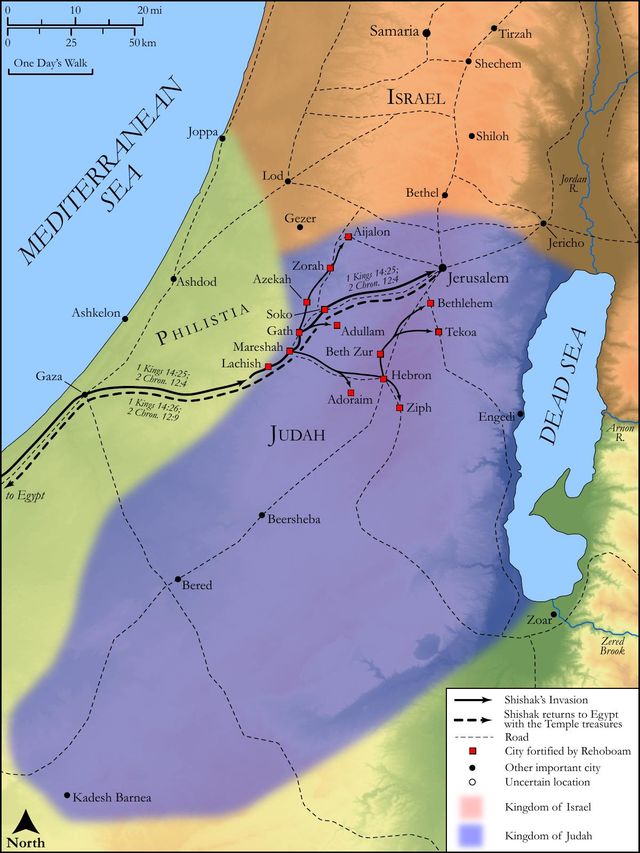
See on the biblical-era map
Study this verse
Public-domain commentary
Matthew Henry
From his Commentary on the Whole Bible. Henry comments on passages, not single verses — this entry covers 2 Chronicles 12:13–16.
The story of Rehoboam's reign is here concluded, much as the story of the other reigns concludes. Two things especially are observable here: - 1. That he was at length pretty well fixed in his kingdom, Ch2 12:13. His fenced cities in Judah did not answer his expectation, so he now strengthened himself in Jerusalem, which he made it his business to fortify, and there he reigned seventeen years, in the city which the Lord had chosen to put his name there. This intimates his honour and privilege, that he had his royal seat in the holy city, which yet was but an aggravation of his impiety - near the temple, but far from God. Frequent skirmishes there were between his subjects and Jeroboam's, such as amounted to continual wars, (Ch2 12:15), but he held his own, and reigned, and, as it should seem, did not so grossly forsake the law of God as he had done (Ch2 12:1) in his fourth year. 2. That he was never rightly fixed in his religion, Ch2 12:14. He never quite cast off God; and yet in this he did evil, that he prepared not, he engaged not, his heart to seek the Lord. See what the fault is laid upon. (1.) He did not serve the Lord because he did not seek the Lord. He did not pray, as Solomon did, for wisdom and grace. If we prayed better, we should be every way better. Or he did not consult the word of God, did not seek to that as his oracle, nor take directions from it. (2.) He made nothing of his religion because he did not set his heart to it, never minded it with any closeness of application, and never any hearty disposition to it, nor ever came up to a steady resolution in it. What little goodness he had was transient and passed away like the morning cloud. He did evil because he was never determined for that which is good. Those are easily drawn by Satan to any evil who are wavering and inconstant in that which is good and are never persuaded to make religion their business.
Continue studying 2 Chronicles 12:15 across the web’s major study libraries — every link below opens this exact verse, chapter, or book on the destination site.
Read & Compare
 BibleGatewayThis verse in more than 200 translations and 70 languages.
 Bible.comThe YouVersion reader — hundreds of translations, reading plans, and highlights.
 ESV.orgCrossway's official English Standard Version reader.
 NET BibleThe NET translation with 60,000+ translators' notes on every rendering decision.
 STEP BibleTyndale House's free study tool — original text, vocabulary, and scholarly resources.
 BibliaLogos Bible Software's free web reader.
 USCCBThe New American Bible (Revised Edition) with the U.S. bishops' study notes.
Commentaries
 BibleHub CommentariesDozens of classic commentaries on this verse, gathered on one page.
 StudyLightMore than 100 commentary sets — the largest collection on the web.
 BibleRefPlain-English commentary on what this verse means, verse by verse.
 Enduring WordDavid Guzik's free commentary on this chapter, widely used by Bible teachers.
 Bible Study ToolsVerse commentary alongside Greek and Hebrew study aids.
Original Language & Research
- BibleHub InterlinearThe verse word by word — original language, transliteration, and English.
- BibleHub LexiconEvery word's original-language definition and Strong's entry.
 Blue Letter BibleDeep-study tools — Strong's numbers, concordance, and word studies.
 SefariaThe Hebrew text with Rashi and centuries of Jewish commentary.
Sermons, Hymns & Audio


TrulyRandomVerse is not affiliated with these sites and doesn’t control their content. They’re linked because they’re genuinely useful.
Summary
2 Chronicles 12:15 serves as a concluding summary of King Rehoboam's reign over Judah, meticulously referencing the historical and prophetic sources that underpin the Chronicler's narrative. It specifically points to "the book of Shemaiah the prophet" and "Iddo the seer concerning genealogies," thereby validating the historical veracity and divine authority of the Chronicler's account. Beyond its historiographical function, the verse starkly highlights the persistent and tragic reality of "wars between Rehoboam and Jeroboam continually," underscoring the enduring division and conflict that plagued the early years of the separated kingdoms of Judah and Israel.
Context
ShowHideLiterary Context
This verse functions as a concluding summary for the reign of Rehoboam, a common structural element in both the books of Kings and Chronicles, signaling the end of one king's account and preparing for the next. It immediately follows the narrative of Shishak's invasion of Judah, Rehoboam's humbling before the Lord, and God's subsequent mercy in averting complete destruction, though imposing tribute. The Chronicler has just detailed Rehoboam's mixed spiritual record, noting his initial abandonment of God's Law and subsequent partial repentance. The explicit mention of historical sources is a characteristic Chronicler's device, not merely to authenticate his narrative but also to emphasize the divine oversight of history and the prophetic role in its documentation, providing a theological framework for understanding the events before transitioning to the reign of Abijah in the very next verse.
Historical & Cultural Context
The historical backdrop is the tumultuous period immediately following the division of the united monarchy after Solomon's death. Rehoboam's ill-advised and harsh response to the people's plea for lighter burdens led to the secession of ten northern tribes, forming the kingdom of Israel under Jeroboam, while Rehoboam retained control over Judah and Benjamin. This schism represented a profound turning point in Israelite history, initiating centuries of political rivalry, spiritual apostasy in the north, and often strained relations between the two kingdoms. In ancient Near Eastern cultures, the meticulous documentation of royal acts, decrees, and genealogies was a common and crucial practice for establishing legitimacy, ensuring proper succession, and preserving historical memory. Prophets and seers often held significant positions, serving not only as spiritual guides and divine spokespersons but also frequently as official court record-keepers, documenting significant events from a divinely informed perspective.
Key Themes
ShowHideThis verse significantly contributes to several overarching themes pervasive throughout 2 Chronicles. Firstly, it powerfully reinforces the reliability and divine authority of the historical record, emphasizing that the Chronicler's narrative is not merely human history but is grounded in verifiable, divinely inspired sources, many of which were prophetic. This aligns with the Chronicler's broader theological aim to present a divinely sanctioned history of the Davidic line, highlighting God's faithfulness to His covenant. Secondly, the verse starkly illustrates the consequences of national sin and disunity, as the "continual wars" between Rehoboam and Jeroboam are a direct, tragic outcome of the kingdom's division—itself a result of spiritual failure and pride, particularly on Rehoboam's part. This ongoing conflict stands in stark contrast to the ideal of a united people under God's covenant, foreshadowing the eventual exiles of both kingdoms. Finally, the specific mention of prophetic sources like Shemaiah and Iddo underscores the vital theme of prophetic guidance and accountability, reminding readers that God continually spoke to His people through His messengers, even in times of rebellion and strife, as seen when Shemaiah previously prevented Rehoboam from fighting against Israel, as recorded in 2 Chronicles 11:4. The Chronicler consistently highlights the importance of heeding prophetic counsel, whether for blessing or judgment, throughout the reigns of the kings of Judah, such as the prophet Azariah's message to King Asa in 2 Chronicles 15:1-7.
Exposition and Analysis
ShowHideKey Word Analysis
ShowHideFrom the root meaning "to speak," this multifaceted word encompasses more than mere actions; it refers to "a word," "a matter," "a thing," or "a cause." In this context, "acts" (H1697) signifies the entire scope of Rehoboam's affairs, deeds, decrees, and the significant events of his reign. It implies that everything spoken of or done by the king, from his decisions to the outcomes of his rule, was comprehensively recorded, underscoring the thoroughness of the historical documentation.
This term (H2374) denotes "a beholder in vision," emphasizing the direct, often visual, reception of divine revelation. While often used interchangeably with "prophet" (nâbîyʼ), a chôzeh specifically highlights the aspect of receiving divine insight through visions or direct spiritual perception. The Chronicler's use of this term for Iddo, alongside Shemaiah as "the prophet," underscores the multifaceted nature of divine communication and the comprehensive scope of the prophetic records that served as historical sources.
Derived from a root meaning "to be hot," this word (H3117) primarily means "day," but contextually, as used adverbially here, it signifies "daily," "always," or "perpetually." In this verse, "continually" emphasizes the enduring, unceasing nature of the wars between Rehoboam and Jeroboam. It conveys a sense of relentless, ongoing conflict that defined the relationship between the two kingdoms throughout this period, highlighting the tragic and persistent disunity.
Verse Breakdown
ShowHide"Now the acts of Rehoboam, first and last"
This phrase serves as a comprehensive summary, encompassing the entirety of Rehoboam's reign from its inception to its conclusion. The use of "first and last" is a merism, a literary device indicating totality, suggesting that all significant events, both early and late in his rule, were meticulously recorded and accessible. It assures the reader that the Chronicler's account, while selective, is a complete summary drawn from a much larger body of historical data.
"[are] they not written in the book of Shemaiah the prophet, and of Iddo the seer concerning genealogies?"
This is a rhetorical question, a common stylistic feature in biblical narrative, which expects an affirmative answer. Its purpose is not to solicit information but to validate the Chronicler's historical claims by appealing to external, authoritative, and presumably well-known sources. The mention of specific prophetic figures as authors of these historical records underscores the belief that God's hand was at work in the recording of Israel's history, not merely human historiography. The specific reference to Iddo "concerning genealogies" highlights the importance of lineage, especially for the Davidic dynasty, as a key element in God's covenant plan and a vital aspect of national identity and legitimacy.
"And [there were] wars between Rehoboam and Jeroboam continually."
This concluding statement provides a stark and somber reality check. Despite moments of repentance and divine intervention, the underlying political and spiritual schism between Judah and Israel persisted. The word "continually" emphasizes the enduring nature of this conflict, a tragic consequence of the kingdom's division and a constant reminder of the fractured state of God's people. It sets a tone for the subsequent history of both kingdoms, characterized by internal strife and external threats, serving as a poignant commentary on the cost of disobedience and disunity.
Literary Devices
ShowHideThe verse employs several significant literary devices to convey its message and reinforce its authority. The phrase "first and last" is a clear example of Merism, a figure of speech where two contrasting or complementary parts are used to represent the whole, effectively conveying the totality and comprehensive nature of Rehoboam's reign. The question, "are they not written...?" functions as a Rhetorical Question, which is posed not to elicit an answer but to affirm a known truth and assert the reliability and accessibility of the Chronicler's sources. This device actively engages the reader and strengthens the credibility of the historical account. Furthermore, the verse makes an Allusion to specific, recognized historical and prophetic records (Shemaiah's and Iddo's books), which, though now lost to us, were evidently familiar and authoritative to the Chronicler's original audience. This technique lends significant weight and authenticity to the narrative. Finally, the stark declaration of "wars... continually" serves as a powerful Summary Statement, concisely capturing the pervasive and tragic reality of the divided kingdom and its ongoing strife.
Theological and Thematic Connections
ShowHideThis verse powerfully affirms God's sovereignty over history and His commitment to preserving a faithful record of His dealings with humanity. The Chronicler's meticulous citation of sources, particularly prophetic ones, underscores the divine inspiration and reliability of the biblical narrative, demonstrating that God's truth is grounded in verifiable historical events, even those documented by human hands under divine guidance. The tragic reality of "continual wars" between Rehoboam and Jeroboam serves as a profound theological statement on the devastating consequences of sin, pride, and disunity—not merely on an individual level but on a national scale, fracturing God's chosen people. It highlights the importance of obedience to God's covenant as the foundation for peace and prosperity, and the painful cost of rebellion that leads to perpetual strife. This historical account serves as a timeless warning against division and a call to unity under God's righteous rule.
Reflection and Application
ShowHide2 Chronicles 12:15 invites us to reflect deeply on the enduring value of historical truth and the profound lessons embedded in the past. Just as the Chronicler meticulously recorded the "acts" of kings and cited reliable sources, we are called to engage with God's Word as the ultimate, divinely inspired historical record, learning from the triumphs and failures of those who came before us. The persistent conflict between Rehoboam and Jeroboam serves as a sobering reminder of the destructive nature of division, whether within nations, communities, or even families and churches. It challenges us to examine areas of strife in our own lives and relationships, urging us to pursue reconciliation, humility, and unity, recognizing that true peace is found not in earthly power struggles but in alignment with God's will. The verse also implicitly reminds us that God uses both faithful and unfaithful leaders, and even their documented "acts," to accomplish His overarching purposes and to teach future generations about His character and His ways. Our own "first and last" acts are also being recorded, not just in human history, but in the divine ledger, prompting us to live lives that honor God and promote His kingdom.
Questions for Reflection
ShowHideFAQ
ShowHideWhy does the Chronicler cite these specific sources, Shemaiah and Iddo?
ShowHideThe Chronicler cites Shemaiah and Iddo primarily to authenticate his narrative and demonstrate its historical veracity. In ancient Israel, prophets and seers were not only spiritual guides but often served as official chroniclers, documenting significant events from a divine perspective. By referencing these presumably well-known prophetic writings, the Chronicler reinforces the authority and reliability of his account, assuring his audience that the information is grounded in contemporary, divinely inspired records. This practice also highlights the Chronicler's theological emphasis on the crucial role of prophets in guiding and interpreting Israel's history, demonstrating God's active involvement in the unfolding story of His people.
What happened to "the book of Shemaiah the prophet" and "Iddo the seer concerning genealogies"? Are they part of the biblical canon?
ShowHideThese specific books are not part of the canonical Old Testament as we have it today. They were likely independent historical or prophetic records that were known and accessible to the Chronicler's original audience but have since been lost to history. While the physical books themselves are lost, their essential content relevant to God's redemptive plan and the history of His people has been preserved and incorporated into the inspired biblical narrative, particularly in the books of Kings and Chronicles. This demonstrates that God's inspired Word, the Bible, is a distillation of all necessary truth for faith and life, even if it draws upon other historical sources that were not themselves preserved as canonical Scripture.
What was the significance of "genealogies" in ancient Israel, as mentioned in relation to Iddo the seer?
ShowHideGenealogies were of immense importance in ancient Israel for several critical reasons. They established tribal identity, determined land inheritance (as land was allotted by tribal and family lines, as seen in Numbers 34), and, most significantly, validated the legitimacy of priests and kings. For the Davidic monarchy, the meticulous recording of genealogy was crucial for proving one's right to the throne and connecting to the covenant promises God made to David regarding an enduring dynasty. Iddo's specific focus on genealogies suggests his role in meticulously documenting these lineages, which would have been vital for maintaining social order, religious purity, and the integrity of the Davidic line, through which the Messiah would eventually come, as traced in Matthew 1 and Luke 3.
Christ-Centered Fulfillment
ShowHideThe continuous "wars between Rehoboam and Jeroboam continually" in 2 Chronicles 12:15 serve as a poignant reminder of the brokenness, disunity, and perpetual strife inherent in a world alienated from God. This persistent conflict between the two kingdoms foreshadows humanity's desperate need for a true King of Peace who can reconcile all things. The earthly kings, even those of the Davidic line like Rehoboam, proved incapable of bringing lasting unity or peace due to their own sin and the sin of the people. This sets the stage for the ultimate Davidic King, Jesus Christ, who is the true Prince of Peace. Unlike Rehoboam and Jeroboam, whose reigns were marked by division and bloodshed, Jesus, through His sacrificial death on the cross, breaks down the dividing walls of hostility, not just between Judah and Israel, but between God and humanity, and between Jew and Gentile (Ephesians 2:14-16). He is the ultimate "Seer" and "Prophet" who perfectly reveals the Father and brings the definitive word of God to humanity (Hebrews 1:1-2). His kingdom is not of this world, yet it overcomes the divisions of this world, establishing an eternal reign of righteousness, peace, and joy in the Holy Spirit for all who believe in Him (Romans 14:17). In Christ, the fractured "acts" of humanity find their ultimate purpose and reconciliation, as He gathers all things into Himself (Colossians 1:19-20).