


2 Chronicles 11:4
Bible text: King James Version (1769 Blayney text) · Public domain
Bible text: King James Version with Strong's numbers · Public domain
Bible text: Berean Standard Bible · Public domain
Bible text: American Standard Version (1901) · Public domain
Bible text: World English Bible, Messianic edition · Public domain
Bible text: Geneva Bible (1599) · Public domain
Bible text: Young's Literal Translation · Public domain
- כֹּהkohthusH3541AdvAdverb
- אָמַר'a·Marhe saysH559V-Qal-Perf-3msVerb Qal Perfect 3rd Singular Masculine
- יְהוָהYah·wehYahwehH3068N-properNoun Proper Title
- לֹאlo'notH3808NegParticle Negative
- תַעֲלוּta·'a·Luyou must go upH5927V-Qal-Imperf-2mpVerb Qal Imperfect 2nd Plural Masculine
- וְלֹאve·lo'and notH3808Conj-w ¦ NegParticle Negativeוְandלֹאnot
- תִלָּחֲמוּti·La·cha·Muyou must do battleH3898V-Niphal-Imperf-2mpVerb Niphal Imperfect 2nd Plural Masculine
- עִם'imwithH5973PrepPreposition
- אֲחֵיכֶם'a·chei·Khemyour countrymenH251N-mpc ¦ 2mpNoun Plural Masculine Constructאֲחֵיcountrymenכֶםyour
- שׁוּבוּShu·vureturnH7725V-Qal-Imp-2mpVerb Qal Imperative 2nd Plural Masculine
- אִישׁ'isheveryoneH376N-msNoun Singular Masculine Absolute
- לְבֵיתוֹle·vei·Toto his own houseH1004Prep-l ¦ N-msc ¦ 3msNoun Singular Masculine Constructלְtoבֵיתown houseוֹhis
- כִּיkiforH3588PrtParticle Conditional
- מֵאִתִּיme·'i·Tifrom with <the> meH854Prep-m ¦ Prep ¦ 1csPreposition Definiteמֵfromאִתִּwith <the>יme
- נִהְיָהnih·Yahit has occurredH1961V-Niphal-Perf-3msVerb Niphal Perfect 3rd Singular Masculine
- הַדָּבָרha·da·Varthe thingH1697Art ¦ N-msNoun Singular Masculine Absoluteהַtheדָּבָרthing
- הַזֶּהha·Zeh<the> thisH2088Art ¦ PrtParticle Demonstrativeהַ<the>זֶּהthis
- וַיִּשְׁמְעוּvai·yish·me·'Uand they obeyedH8085Conj-w ¦ V-Qal-ConsecImperf-3mpVerb Qal Consecutive Imperfect 3rd Plural Masculineוַandיִּשְׁמְעוּthey obeyed
- אֶת'et<obj.>H853DirObjMParticle Object Indicator
- דִּבְרֵיdiv·Rei[the] words ofH1697N-mpcNoun Plural Masculine Construct
- יְהוָהYah·wehYahwehH3068N-properNoun Proper Title
- וַיָּשֻׁבוּvai·ya·Shu·vuand they turned backH7725Conj-w ¦ V-Qal-ConsecImperf-3mpVerb Qal Consecutive Imperfect 3rd Plural Masculineוַandיָּשֻׁבוּthey turned back
- מִלֶּכֶתmi·Le·khetfrom goingH1980Prep-m ¦ V-Qal-InfVerb Qal Infinitive Constructמִfromלֶּכֶתgoing
- אֶל'elagainstH413PrepPreposition
- יָרָבְעָםya·ra·ve·'AmJeroboamH3379N-proper-mNoun Proper Masculine
English is a literal word-by-word gloss of the Hebrew, not the KJV's wording. Why?
This is the original text the KJV's translators worked from — each Hebrew word with its own literal English meaning in this verse, prepared by scholars at Tyndale House, Cambridge. The KJV translates whole sentences, not word by word, so its wording differs: one Hebrew word can become several English words, and the KJV may choose “the LORD” where the gloss reads “Yahweh”. Both are faithful — they answer different questions. For the KJV's own rendering, switch to the KJV text.
Details
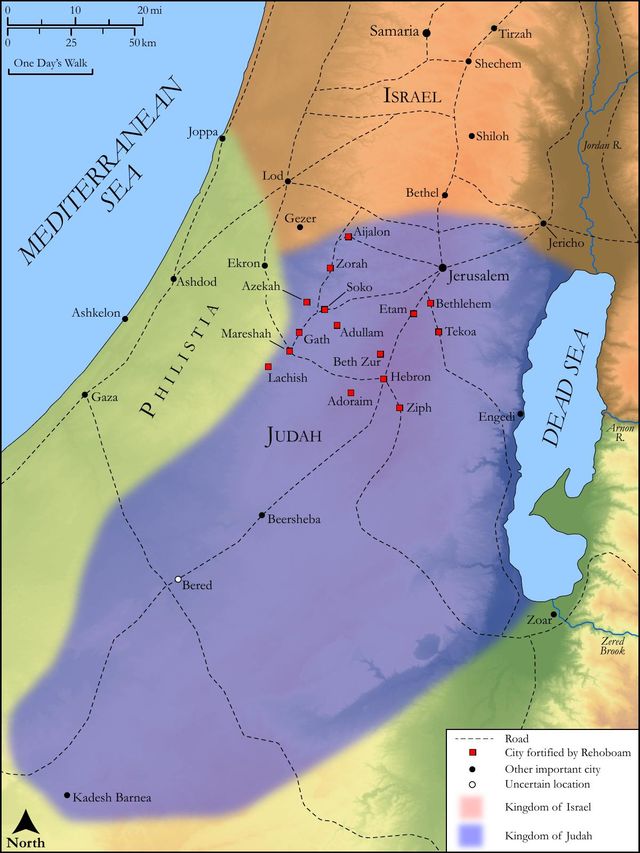
See on the biblical-era map
Study this verse
Public-domain commentary
Matthew Henry
From his Commentary on the Whole Bible. Henry comments on passages, not single verses — this entry covers 2 Chronicles 11:1–12.
How the ten tribes deserted the house of David we read in the foregoing chapter. They had formerly sat loose to that family (Sa2 20:1, Sa2 20:2), and now they quite threw it off, not considering how much it would weaken the common interest and take Israel down from that pitch of glory at which it had arrived in the last reign. But thus the kingdom must be corrected as well as the house of David. 1. Rehoboam at length, like a bold man, raises an army, with a design to reduce the revolters, Ch2 11:1. Judah and Benjamin were not only resolved to continue their allegiance to him, but ready to give him the best assistance they could for the recovery of his right. Judah was his own tribe, that owned him some years before the rest did; Benjamin was the tribe in which Jerusalem, or the greatest part of it, stood, which perhaps was one reason why that tribe clave to him. 2. Yet, like a conscientious man, when God forbade him to prosecute this design, in obedience to him he let it fall, either because he reverenced the divine authority or because he knew that he should not prosper if he should go contrary to God's command, but instead of retrieving what was lost would be in danger of losing what he had. It is dangerous undertaking any thing, but especially undertaking a war, contrary to the will of God. God calls him (Ch2 11:3), Rehoboam the son of Solomon, to intimate that this was determined for the sin of Solomon, and it would be to no purpose to oppose a decree that had gone forth. They obeyed the words of the Lord; and though it looked mean, and would turn to their reproach among their neighbours, yet, because God would have it so, they laid down their arms. 3. Like a discreet man, he fortified his own country. He saw it was to no purpose to think of reducing those that had revolted. A few good words might have prevented their defection, but now all the forces of his kingdom cannot bring them back. The think is done, and so it must rest; it is his wisdom to make the best of it. Perhaps the same young counsellors that had advised him to answer them roughly urged him to fight them, notwithstanding the divine inhibition; but he had paid dearly enough for being advised by them, and therefore now, we may suppose, his aged and experienced counsellors were hearkened to, and they advised him to submit to the will of God concerning what was lost, and to make it his business to keep what he had. It was probably by their advice that, (1.) He fortified his frontiers, and many of the principal cities of his kingdom, which, in Solomon's peaceable reign, no care had been taken for the defence of. (2.) He furnished them with good stores of victuals and arms, Ch2 11:11, Ch2 11:12. Because God forbade him to fight, he did not therefore sit down sullenly, and say that he would do nothing for the public safety if he might not do that, but prudently provided against an attack. Those that may not be conquerors, yet may be builders.
Continue studying 2 Chronicles 11:4 across the web’s major study libraries — every link below opens this exact verse, chapter, or book on the destination site.
Read & Compare
 BibleGatewayThis verse in more than 200 translations and 70 languages.
 Bible.comThe YouVersion reader — hundreds of translations, reading plans, and highlights.
 ESV.orgCrossway's official English Standard Version reader.
 NET BibleThe NET translation with 60,000+ translators' notes on every rendering decision.
 STEP BibleTyndale House's free study tool — original text, vocabulary, and scholarly resources.
 BibliaLogos Bible Software's free web reader.
 USCCBThe New American Bible (Revised Edition) with the U.S. bishops' study notes.
Commentaries
 BibleHub CommentariesDozens of classic commentaries on this verse, gathered on one page.
 StudyLightMore than 100 commentary sets — the largest collection on the web.
 BibleRefPlain-English commentary on what this verse means, verse by verse.
 Enduring WordDavid Guzik's free commentary on this chapter, widely used by Bible teachers.
 Bible Study ToolsVerse commentary alongside Greek and Hebrew study aids.
Original Language & Research
- BibleHub InterlinearThe verse word by word — original language, transliteration, and English.
- BibleHub LexiconEvery word's original-language definition and Strong's entry.
 Blue Letter BibleDeep-study tools — Strong's numbers, concordance, and word studies.
 SefariaThe Hebrew text with Rashi and centuries of Jewish commentary.
Sermons, Hymns & Audio


TrulyRandomVerse is not affiliated with these sites and doesn’t control their content. They’re linked because they’re genuinely useful.
Summary
Second Chronicles 11:4 chronicles a critical moment of divine intervention that prevented a devastating civil war between the newly formed kingdoms of Judah and Israel. Following the dramatic division of Solomon's kingdom, King Rehoboam of Judah had assembled a vast army to forcibly reclaim the northern tribes. However, the LORD, through the prophet Shemaiah, issued an unequivocal command forbidding the conflict, declaring that the kingdom's split was His sovereign doing. This verse powerfully illustrates God's active control over human affairs, even amidst political upheaval and human folly, and highlights the profound importance of immediate and unquestioning obedience to His revealed will.
Context
ShowHideLiterary Context
This verse is situated immediately after the tumultuous events of 2 Chronicles 10, which vividly describes the dramatic schism of the united kingdom of Israel. Upon the death of King Solomon, his son Rehoboam ascended the throne. When the people, led by Jeroboam, requested lighter burdens than those imposed by Solomon, Rehoboam, unwisely following the counsel of his young advisors, responded harshly. This precipitated the rebellion of ten tribes, who declared Jeroboam their king, leaving Rehoboam only with the tribes of Judah and Benjamin. Incensed and determined to reassert his authority, Rehoboam immediately mobilized a massive fighting force, setting the stage for an imminent and bloody confrontation. It is at this critical juncture, as Rehoboam's army is poised for battle, that the divine word recorded in 2 Chronicles 11:4 intervenes, preventing the conflict. The verses immediately following, 2 Chronicles 11:5-12, then detail Rehoboam's subsequent actions of fortifying cities in Judah, demonstrating his acceptance of God's command and the new reality.
Historical & Cultural Context
The division of the united monarchy was a monumental event in Israelite history, marking the end of an era of unprecedented national unity and power under David and Solomon. This split was not merely a political coup but carried profound theological implications, as it was understood to be a divine judgment for Solomon's idolatry, as prophesied in 1 Kings 11:11-13. For Rehoboam to attempt to forcibly reunite the kingdom would have been to fight directly against God's declared will. The term "brethren" (Hebrew: 'ach) is crucial here, emphasizing the shared lineage, covenant heritage, and religious identity of all twelve tribes, despite their political separation. Engaging in civil war, especially among those who shared a covenant relationship with Yahweh, was considered an egregious violation of communal solidarity and would have resulted in immense bloodshed and further spiritual fracturing. The intervention through a prophet like Shemaiah was a recognized and authoritative means of divine communication in ancient Israel, carrying absolute authority and demanding immediate obedience.
Key Themes
ShowHideThe primary theme highlighted in this verse is Divine Sovereignty and Intervention. God's explicit declaration, "this thing is done of me," unequivocally asserts His absolute control over human history, even over events that appear to be the result of human sin or political machinations. The division of the kingdom, though stemming from human failure, was ultimately orchestrated by God as part of His larger, often mysterious, plan, as seen in Isaiah 46:10. Secondly, the verse underscores the Prevention of Civil War and the preservation of a remnant. Despite the political schism, God still viewed the northern tribes as "brethren," indicating a desire to limit the damage and prevent total annihilation, thus protecting the lineage through which the Messiah would come. Finally, the narrative powerfully demonstrates the importance of Obedience to God's Word. Rehoboam and the people, despite their military readiness and strong desire for reunification, submit to the divine command. This act of submission exemplifies prioritizing God's revealed will over personal ambition or strategic advantage, echoing the principle found in 1 Samuel 15:22.
Exposition and Analysis
ShowHideKey Word Analysis
ShowHideThis primitive root signifies "to say" or "to speak," but in the context of "Thus saith the LORD," it carries immense weight, denoting a direct, authoritative, and unchallengeable declaration from God. It establishes the divine origin and absolute authority of the subsequent command, leaving no room for human negotiation or doubt regarding its source.
This word, meaning "brother" or "kinsman," is used in its widest sense to denote shared literal relationship and metaphorical affinity. Here, despite the political division, God refers to the northern tribes as "your brethren," emphasizing their shared ethnic, historical, and covenantal identity as descendants of Jacob (Israel). It highlights that internal conflict among God's covenant people is particularly grievous and contrary to His desire for their unity and well-being.
This primitive root means "to exist," "to be," or "to become," often with an emphatic sense of "come to pass." In the phrase "this thing is done of me," it asserts divine initiative and responsibility. It means that the division did not merely happen or was permitted by God, but that it actively originated from His sovereign will and agency, demonstrating His ultimate control over all history and human affairs.
Verse Breakdown
ShowHide"Thus saith the LORD, Ye shall not go up, nor fight against your brethren:"
The verse opens with an emphatic declaration of divine authority, immediately followed by a clear, negative command. The LORD directly forbids Rehoboam and his army from initiating military action against the northern tribes. The use of "your brethren" underscores the deep familial and covenantal ties that still bound the divided people, making the prospect of civil war particularly abhorrent in God's eyes.
"return every man to his house:"
This is the positive command, instructing the assembled army to disband and return peacefully to their homes. It is the practical implication of the preceding prohibition, demanding an immediate cessation of hostile intent and preparation. This command signifies a complete reversal of their aggressive posture, replacing military mobilization with peaceful dispersion.
"for this thing is done of me."
This clause provides the divine rationale for the command. God explicitly claims responsibility for the division of the kingdom. This powerful statement removes any human justification for war, as fighting to reunite the kingdom would be tantamount to fighting against God's sovereign decree. It reveals that the political schism, though painful, was part of God's larger, overarching plan for His people, a judgment for Solomon's sin.
"And they obeyed the words of the LORD, and returned from going against Jeroboam."
This final clause records the immediate and complete obedience of Rehoboam and the people. Despite their military readiness and apparent desire for vengeance or restoration, they heeded the divine word delivered through Shemaiah. This act of submission demonstrates a profound trust in God's authority and wisdom, choosing to prioritize His command over their own strategic or emotional inclinations, thus averting a national catastrophe.
Literary Devices
ShowHideThe passage employs several potent literary devices that amplify its theological message. Foremost is Divine Command, delivered through the classic prophetic formula "Thus saith the LORD," which imbues the subsequent words with absolute authority and undeniable truth. This is immediately followed by a Sovereign Declaration in "this thing is done of me," a powerful statement of divine agency that recontextualizes the entire political upheaval as part of God's overarching plan, emphasizing His active role rather than mere permission. There is also an element of Dramatic Irony, as Rehoboam's human ambition and the might of his assembled army are rendered utterly impotent by a single divine word, highlighting the vast disparity between human power and divine omnipotence. The narrative also presents a stark Contrast between Rehoboam's initial foolishness in 2 Chronicles 10, which directly led to the division, and his surprising, albeit wise, obedience here, showcasing a moment of humility and submission to God's will.
Theological and Thematic Connections
ShowHideSecond Chronicles 11:4 serves as a profound theological statement on God's absolute sovereignty over human history and political affairs. It reveals that even the most disruptive and painful events, such as the division of a kingdom, are not outside of God's control but are often part of His divine plan and judgment. The verse underscores that God's purposes will ultimately prevail, regardless of human intentions or resistance. Furthermore, it highlights the immense value God places on peace and unity among His people, even when they are fractured, viewing them still as "brethren" bound by covenant. The immediate obedience of Rehoboam and the people provides a powerful example of faith, demonstrating that true wisdom lies in submitting to God's revealed will, even when it contradicts human logic, ambition, or perceived self-interest. This act of obedience prevented immense bloodshed and preserved a remnant of God's people, allowing His ongoing redemptive plan to unfold through the southern kingdom.
Reflection and Application
ShowHideThis powerful account from 2 Chronicles 11:4 offers profound lessons for believers today. It serves as a potent reminder that God is sovereign over all circumstances, even those that appear chaotic, unjust, or beyond our control. When faced with conflict, especially among those who are "brethren" in faith or within the broader human family, this passage calls for a pause and a diligent seeking of God's will rather than an immediate recourse to force, retaliation, or self-assertion. The remarkable obedience of Rehoboam and his army, despite having a massive, prepared force and a strong desire to restore what they believed was rightfully theirs, stands as a compelling example of trusting God's wisdom and timing. It encourages us to cultivate a spirit of humility and submission, recognizing that God's plans, though sometimes mysterious or counter-intuitive to our natural inclinations, are always ultimately for a greater, redemptive purpose. It challenges us to ask whether our actions align with God's revealed will, even when that will demands sacrificing our own desires, perceived rights, or strategic advantages.
Questions for Reflection
ShowHideFAQ
ShowHideWhy did God allow the kingdom to split if He prevented the war?
ShowHideThe division of the kingdom was a direct consequence of Solomon's idolatry and Rehoboam's foolishness, prophesied by God as a judgment (see 1 Kings 11:11-13). While God does not cause sin, He is sovereign over its consequences and can use them to fulfill His greater purposes. The split was a divine judgment, but God's prevention of civil war demonstrated His mercy and desire to preserve a remnant of His people. He allowed the political separation as a consequence of sin but prevented the complete destruction that would have resulted from internal conflict, thus protecting the lineage through which the Messiah would eventually come. This illustrates God's complex interaction with human free will and sin, always working toward His ultimate redemptive plan.
What was the significance of calling them "brethren" despite the division?
ShowHideThe term "brethren" (Hebrew: 'akheychem) is highly significant. It emphasizes that despite the political and geographical schism, the northern and southern tribes still shared a common heritage, a common covenant with Yahweh, and a common ancestry from Jacob (Israel). God's use of this term underscored that their familial and spiritual bond transcended their political separation. It was a divine reminder that internal conflict among God's covenant people was particularly grievous and contrary to His desire for their unity and well-being. It highlighted that even in judgment, God's underlying desire for the welfare of His people remained, and bloodshed among those bound by covenant was to be avoided, preserving the possibility of future reconciliation and the continuation of His redemptive purposes.
How does Rehoboam's obedience here contrast with his earlier actions?
ShowHideRehoboam's obedience in 2 Chronicles 11:4 stands in stark contrast to his earlier actions in 2 Chronicles 10. In chapter 10, Rehoboam rejected the wise counsel of the elders, who advised him to serve the people, and instead followed the harsh, prideful advice of his young companions. This led directly to the rebellion and the division of the kingdom. His initial response was characterized by arrogance, stubbornness, and a profound lack of wisdom. However, in chapter 11, when confronted with a direct, unambiguous word from the LORD through the prophet Shemaiah, Rehoboam surprisingly submits. This demonstrates a moment of humility and a recognition of a higher authority, preventing further catastrophe. It shows that even those who make grave mistakes can, by God's grace, choose to obey Him, illustrating the transformative power of divine intervention.
Christ-Centered Fulfillment
ShowHideThe divine intervention in 2 Chronicles 11:4, where God sovereignly prevents civil war among His people, powerfully foreshadows the ultimate peace and unity brought about through Jesus Christ. The declaration "this thing is done of me" points to God's meticulous orchestration of history, not merely for the preservation of an earthly kingdom, but for the unfolding of His grand redemptive plan culminating in Christ. While the earthly kingdom of Israel was divided by sin and folly, Christ comes as the true King who, through His sacrificial work on the cross, breaks down all dividing walls (as seen in Ephesians 2:14). He is the ultimate reconciler, uniting not just the estranged tribes of Israel but bringing together Jew and Gentile into one new humanity, the Church (as described in Ephesians 2:16). The obedience of Rehoboam and the people to God's word, though imperfect, reflects a dim anticipation of the perfect obedience of Christ, who came not to do His own will but the will of the Father who sent Him (as affirmed in John 6:38). Ultimately, Christ is the greater Shemaiah, the Word made flesh, who speaks peace to our warring hearts and brings us back to the Father's house, preventing the eternal separation that our sin would otherwise cause. His reign is one of true and lasting peace, uniting all who believe under His sovereign and gracious rule, fulfilling God's desire for a people who are truly "brethren" in Him (as prayed for in John 17:20-23).