


2 Chronicles 28:15
Bible text: King James Version (1769 Blayney text) · Public domain
Bible text: King James Version with Strong's numbers · Public domain
Bible text: Berean Standard Bible · Public domain
Bible text: American Standard Version (1901) · Public domain
Bible text: World English Bible, Messianic edition · Public domain
Bible text: Geneva Bible (1599) · Public domain
Bible text: Young's Literal Translation · Public domain
- וַיָּקֻמוּvai·ya·Ku·muand they aroseH6965Conj-w ¦ V-Qal-ConsecImperf-3mpVerb Qal Consecutive Imperfect 3rd Plural Masculineוַandיָּקֻמוּthey arose
- הָאֲנָשִׁיםha·'a·na·Shimthe menH582Art ¦ N-mpNoun Plural Masculine Absoluteהָtheאֲנָשִׁיםmen
- אֲשֶׁר'a·SherwhoH834RelParticle Relative
- נִקְּבוּni·ke·Vuthey had been designatedH5344V-Niphal-Perf-3cpVerb Niphal Perfect 3rd Plural common gender
- בְשֵׁמוֹתve·she·Motby namesH8034Prep-b ¦ N-fpNoun Plural Feminine Absoluteבְbyשֵׁמוֹתnames
- וַיַּחֲזִיקוּvai·ya·cha·Zi·kuand they took holdH2388Conj-w ¦ V-Hiphil-ConsecImperf-3mpVerb Hiphil Consecutive Imperfect 3rd Plural Masculineוַandיַּחֲזִיקוּthey took hold
- בַשִּׁבְיָהva·shiv·Yahon the group of captivesH7633Prep-b ¦ N-fsNoun Singular Feminine Absoluteבַon theשִּׁבְיָהgroup of captives
- וְכָלve·kholand allH3605Conj-w ¦ N-mscNoun Singular Masculine Constructוְandכָלall
- מַעֲרֻמֵּיהֶםma·'a·ru·mei·Hemtheir naked peopleH4636N-mpc ¦ 3mpNoun Plural Masculine Constructמַעֲרֻמֵּיnaked peopleהֶםtheir
- הִלְבִּישׁוּhil·Bi·shuthey clothedH3847V-Hiphil-Perf-3cpVerb Hiphil Perfect 3rd Plural common gender
- מִןminfromH4480PrepPreposition
- הַשָּׁלָלha·sha·Lalthe bootyH7998Art ¦ N-msNoun Singular Masculine Absoluteהַtheשָּׁלָלbooty
- וַיַּלְבִּשׁוּםvai·yal·bi·Shumand they clothed themH3847Conj-w ¦ V-Hiphil-ConsecImperf-3mp ¦ 3mpVerb Hiphil Consecutive Imperfect 3rd Plural Masculineוַandיַּלְבִּשׁוּthey clothedםthem
- וַיַּנְעִלוּםVai·yan·'i·lumand they shod themH5274Conj-w ¦ V-Hiphil-ConsecImperf-3mp ¦ 3mpVerb Hiphil Consecutive Imperfect 3rd Plural Masculineוַandיַּנְעִלוּthey shodםthem
- וַיַּאֲכִלוּםvai·ya·'a·khi·Lumand they fed themH398Conj-w ¦ V-Hiphil-ConsecImperf-3mp ¦ 3mpVerb Hiphil Consecutive Imperfect 3rd Plural Masculineוַandיַּאֲכִלוּthey fedםthem
- וַיַּשְׁקוּםvai·yash·Kumand they gave to drink themH8248Conj-w ¦ V-Hiphil-ConsecImperf-3mp ¦ 3mpVerb Hiphil Consecutive Imperfect 3rd Plural Masculineוַandיַּשְׁקוּthey gave to drinkםthem
- וַיְסֻכוּםvay·su·Khumand they anointed themH5480Conj-w ¦ V-Qal-ConsecImperf-3mp ¦ 3mpVerb Qal Consecutive Imperfect 3rd Plural Masculineוַandיְסֻכוּthey anointedםthem
- וַיְנַהֲלוּםvay·na·ha·Lumand they led themH5095Conj-w ¦ V-Piel-ConsecImperf-3mp ¦ 3mpVerb Piel Consecutive Imperfect 3rd Plural Masculineוַandיְנַהֲלוּthey ledםthem
- בַּחֲמֹרִיםba·cha·mo·Rimon donkeysH2543Prep-b ¦ N-cpNoun Plural common gender Absoluteבַּonחֲמֹרִיםdonkeys
- לְכָלle·khol<to> anyH3605Prep-l ¦ N-msNoun Singular Masculine Absoluteלְ<to>כָלany
- כּוֹשֵׁלko·Shel[one who] stumbledH3782V-Qal-Prtcpl-msVerb Qal Participle Singular Masculine Absolute
- וַיְבִיאוּםvay·vi·'Umand they brought themH935Conj-w ¦ V-Hiphil-ConsecImperf-3mp ¦ 3mpVerb Hiphil Consecutive Imperfect 3rd Plural Masculineוַandיְבִיאוּthey broughtםthem
- יְרֵחוֹye·re·ChoJerichoH3405N-properNoun Proper Location
- עִיר'ir[the] city ofH5899N-fscNoun Singular Feminine Construct
- הַתְּמָרִיםha·te·ma·Rimthe palm treesH5899Art ¦ N-mpNoun Plural Masculine Absoluteהַtheתְּמָרִיםpalm trees
- אֵצֶל'E·tzelbesideH681N-cscNoun Singular common gender Construct
- אֲחֵיהֶם'a·chei·Hemtheir relativesH251N-mpc ¦ 3mpNoun Plural Masculine Constructאֲחֵיrelativesהֶםtheir
- וַיָּשׁוּבוּvai·ya·Shu·vuand they returnedH7725Conj-w ¦ V-Qal-ConsecImperf-3mpVerb Qal Consecutive Imperfect 3rd Plural Masculineוַandיָּשׁוּבוּthey returned
- שֹׁמְרוֹןsho·me·RonSamariaH8111N-properNoun Proper Location
English is a literal word-by-word gloss of the Hebrew, not the KJV's wording. Why?
This is the original text the KJV's translators worked from — each Hebrew word with its own literal English meaning in this verse, prepared by scholars at Tyndale House, Cambridge. The KJV translates whole sentences, not word by word, so its wording differs: one Hebrew word can become several English words, and the KJV may choose “the LORD” where the gloss reads “Yahweh”. Both are faithful — they answer different questions. For the KJV's own rendering, switch to the KJV text.
Details
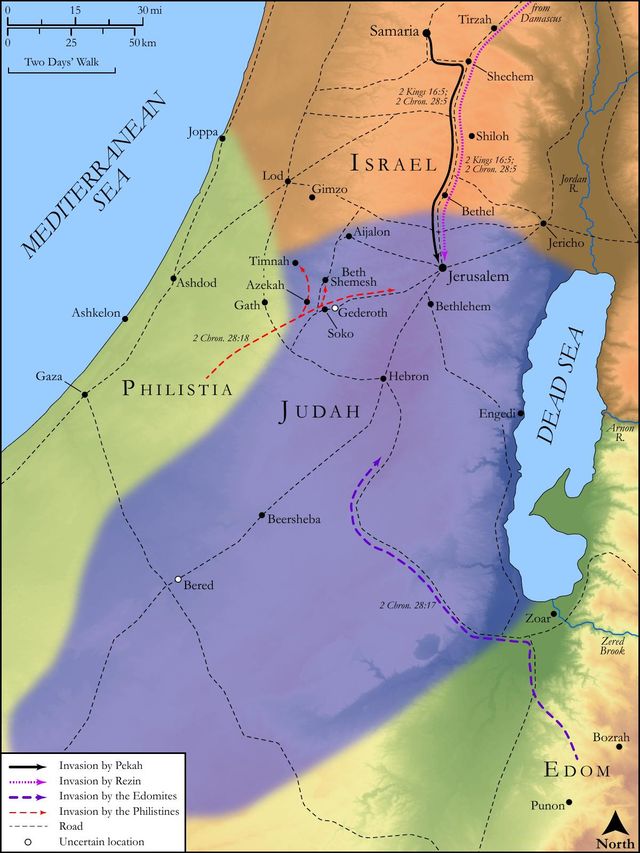
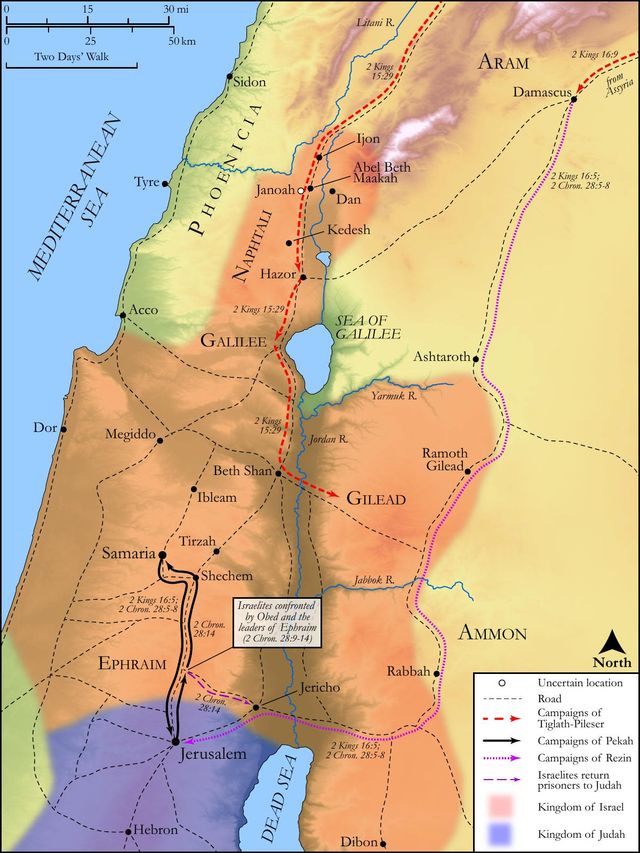
See on the biblical-era maps
Study this verse
Public-domain commentary
Matthew Henry
From his Commentary on the Whole Bible. Henry comments on passages, not single verses — this entry covers 2 Chronicles 28:6–15. His four-level outline is real structure in the source text, so it is rendered as structure.
We have here,
I.Treacherous Judah under the rebukes of God's providence, and they are very severe.
Never was such bloody work made among them since they were a kingdom, and by Israelites too. Ahaz walked in the ways of the kings of Israel, and the king of Israel was the instrument God made use of for his punishment. It is just with God to make those our plagues whom we make our patterns or make ourselves partners with in sin. A war broke out between Judah and Israel, in which Judah was worsted. For,
1.There was a great slaughter of men in the field of battle. Vast numbers (120,000 men, and valiant men too at other times) were slain (Ch2 28:6) and some of the first rank, the king's son for one. He had sacrificed some of this sons to Moloch; justly therefore is this sacrificed to the divine vengeance. Here is another that was next the king, his friend, the prime-minister of state, or perhaps next him in the battle, so that the king himself had a narrow escape, Ch2 28:7. The kingdom of Israel was not strong at this time, and yet strong enough to bring this great destruction upon Judah. But certainly so many men, great men, stout men, could not have been cut off in one day if they had not been strangely dispirited both by the consciousness of their own guilt and by the righteous hand of God upon them. Even valiant men were numbered as sheep for the slaughter, and became an easy prey to the enemy because they had forsaken the Lord God of their fathers, and he had therefore forsaken them.
2.There was a great captivity of women and children, Ch2 28:8. When the army in the field was routed, the cities, and towns, and country villages, were all easily stripped, the inhabitants taken for slaves, and their wealth for a prey.
II.Even victorious Israel under the rebuke of God's word for the bad principle they had gone upon in making war with Judah and the bad use they had made of their success, and the good effect of this rebuke. Here is,
1.The message which God sent them by a prophet, who went out to meet them, not to applaud their valour or congratulate them on their victory, though they returned laden with spoils and triumphs, but in God's name to tell them of their faults and warn them of the judgments of God.
(1.)He told them how they came by this victory of which they were so proud. It was not because God favoured them, or that they had merited it at his hand, but because he was wroth with Judah, and made them the rod of his indignation. Not for your righteousness, be it known to you, but for their wickedness (Deu 9:5) they are broken off; therefore be not you high-minded, but fear lest God also spare not you, Rom 11:20, Rom 11:21.
(2.)He charged them with the abuse of the power God had given them over their brethren. Those understand not what victory is who think it gives them authority to do what they will, and that the longest sword is the clearest claim to lives and estates (Jusque datum sceleri - might is right); no, as it is impolitic not to use a victory, so it is impious to abuse it. The conquerors are here reproved,
[1.]For the cruelty of the slaughter they had made in the field. They had indeed shed the blood of war in war; we suppose that to be lawful, but it turned into sin to them, because they did it from a bad principle of enmity to their brethren and after a bad manner, with a barbarous fury, a rage reaching up to heaven, that is, that cried to God for vengeance against such bloody men, that delighted in military execution. Those that serve God's justice, if they do it with rage and a spirit of revenge, make themselves obnoxious to it, and forfeit the honour of acting for him; for the wrath of man worketh not the righteousness of God.
[2.]For the imperious treatment they gave their prisoners. "You now purpose to keep them under, to use them or sell them as slaves, though they are your brethren and free-born Israelites." God takes notice of what men purpose, as well as of what they say and do.
(3.)He reminded them of their own sins, by which they also were obnoxious to the wrath of God: Are there not with you, even with you, sins against the Lord your God? Ch2 28:10. He appeals to their own consciences, and to the notorious evidence of the thing. "Though you are now made the instruments of correcting Judah for sin, yet do not think that you are therefore innocent yourselves; no, you also are guilty before God." This is intended as a check, [1.] To their triumph in their success. "You are sinners, and it ill becomes sinners to be proud; you have carried the day now, but be not secure, the wheel may ere long return upon yourselves, for, if judgment begin thus with those that have the house of God among them, what shall be the end of such as worship the calves?" [2.] To their severity towards their brethren. "You have now got them under, but you ought to show mercy to them, for you yourselves are undone if you do not find mercy with God. It ill becomes sinners to be cruel. You have transgressions enough to answer for already, and need not add this to the rest."
(4.)He commanded them to release the prisoners, and to send them home again carefully (Ch2 28:11); "for you having sinned, the fierce wrath of God is upon you, and there is no other way of escaping it than by showing mercy."
2.The resolution of the princes thereupon not to detain the prisoners. They stood up against those that came from the war, though flushed with victory, and told them plainly that they should not bring their captives into Samaria, Ch2 28:12, Ch2 28:13. They had sin enough already to answer for, and would have nothing done to add to their trespass. In this they discovered an obedient regard to the word of God by his prophet and a tender compassion towards their brethren, which was wrought in them by the tender mercy of God; for he regarded the affliction of this poor people, and hears their cry, and made them to be pitied of all those that carried them captive, Psa 106:44, Psa 106:46.
3.The compliance of the soldiers with the resolutions of the princes in this matter, and the dismission of the captives thereupon.
(1.)The armed men, though being armed they might be force have maintained their title to what they got by the sword, acquiesced, and left their captives and the spoil to the disposal of the princes (Ch2 28:14), and herein they showed more truly heroic bravery than they did in taking them. It is a great honour for any man to yield to the authority of reason and religion against his interest.
(2.)The princes very generously sent home the poor captives well accommodated, Ch2 28:15. Those that hope to find mercy with God must learn hence with what tenderness to carry themselves towards those that lie at their mercy. It is strange that these princes, who in this instance discovered such a deference to the word of God, and such an influence upon the people, had not so much grace as, in obedience to the calls of God by so many prophets, to root idolatry out of their kingdom, which, soon after this, was the ruin of it.
Continue studying 2 Chronicles 28:15 across the web’s major study libraries — every link below opens this exact verse, chapter, or book on the destination site.
Read & Compare
 BibleGatewayThis verse in more than 200 translations and 70 languages.
 Bible.comThe YouVersion reader — hundreds of translations, reading plans, and highlights.
 ESV.orgCrossway's official English Standard Version reader.
 NET BibleThe NET translation with 60,000+ translators' notes on every rendering decision.
 STEP BibleTyndale House's free study tool — original text, vocabulary, and scholarly resources.
 BibliaLogos Bible Software's free web reader.
 USCCBThe New American Bible (Revised Edition) with the U.S. bishops' study notes.
Commentaries
 BibleHub CommentariesDozens of classic commentaries on this verse, gathered on one page.
 StudyLightMore than 100 commentary sets — the largest collection on the web.
 BibleRefPlain-English commentary on what this verse means, verse by verse.
 Enduring WordDavid Guzik's free commentary on this chapter, widely used by Bible teachers.
 Bible Study ToolsVerse commentary alongside Greek and Hebrew study aids.
Original Language & Research
- BibleHub InterlinearThe verse word by word — original language, transliteration, and English.
- BibleHub LexiconEvery word's original-language definition and Strong's entry.
 Blue Letter BibleDeep-study tools — Strong's numbers, concordance, and word studies.
 SefariaThe Hebrew text with Rashi and centuries of Jewish commentary.
Sermons, Hymns & Audio


TrulyRandomVerse is not affiliated with these sites and doesn’t control their content. They’re linked because they’re genuinely useful.
Summary
2 Chronicles 28:15 vividly recounts an extraordinary act of compassion and obedience by specific leaders from the northern kingdom of Israel towards their Judean captives. Following a devastating war initiated by Judah's wicked King Ahaz, where Israel inflicted a severe defeat and took 200,000 captives, the prophet Oded intervened. He warned the victorious Israelites that their actions were excessive and against God's will, urging them to release their brethren. This verse records the remarkable response of named Ephraimite leaders who, heeding Oded's word, provided comprehensive humanitarian aid—clothing, food, drink, anointing, and transport—to the naked, hungry, and feeble captives, ensuring their safe return to Jericho, their homeland. This stands as a powerful testament to brotherly love and obedience to divine instruction, even amidst deep national division.
Context
ShowHideLiterary Context
This verse is a pivotal moment within 2 Chronicles 28, which primarily recounts the apostasy and disastrous reign of King Ahaz of Judah. Ahaz's wickedness led to divine judgment, manifested in military defeats by both the Arameans and the Israelites. The immediate preceding verses (2 Chronicles 28:5-8) describe the overwhelming victory of King Pekah of Israel over Judah, resulting in a massive slaughter and the capture of 200,000 women, sons, and daughters. Critically, 2 Chronicles 28:9-11 introduces the prophet Oded, who confronts the victorious Israelite army, condemning their excessive cruelty and reminding them that Judah's defeat was God's judgment, not an opportunity for Israel to further oppress their "brethren." Oded's stern warning, coupled with the support of several prominent Ephraimite leaders mentioned by name in 2 Chronicles 28:12, directly precedes and sets the stage for the compassionate actions described in 2 Chronicles 28:15. The verse thus represents a rare and significant instance of obedience to prophetic word and inter-Israelite compassion amidst a period of widespread apostasy and conflict.
Historical & Cultural Context
The period of the divided monarchy was marked by frequent conflicts between the northern kingdom of Israel and the southern kingdom of Judah, despite their shared ancestry and religious heritage. King Ahaz's reign (c. 735-715 BC) was particularly characterized by idolatry and political instability, leading to divine judgment. In the warfare of that day, the taking of captives and spoils was a standard practice, often involving brutal treatment, enslavement, and exploitation. However, the unique relationship between Israel and Judah, as "brethren" under the same covenant God, introduced a different moral dimension. The prophet Oded's intervention highlights a covenantal expectation of brotherly treatment, even in war, which transcended typical geopolitical norms. The actions described—clothing, feeding, anointing, and providing transport—were acts of profound hospitality and humanitarian aid, reflecting a standard of care that went far beyond what was customary for war captives. "Anointing them" (with oil) was a common practice for refreshment, healing, and hygiene, especially after a traumatic ordeal, signifying restoration and care. Jericho, known as "the city of palm trees," was a significant Judean city, making it a fitting and recognizable destination for the returning captives.
Key Themes
ShowHideThis verse powerfully illustrates several crucial themes within the broader narrative of 2 Chronicles and the Old Testament. Firstly, it highlights divine mercy and justice, demonstrating that while God uses nations as instruments of judgment (as seen in Israel's victory over Judah), He also holds His people accountable for their actions, even in victory. Oded's prophecy serves as a reminder that excessive cruelty is not condoned. Secondly, the passage underscores the theme of brotherly love and unity within the covenant community. Despite deep political and religious divisions, the recognition of the Judeans as "their brethren" (as also emphasized in 2 Chronicles 28:11) led to an act of profound compassion, transcending national enmity. This echoes the broader biblical call for God's people to love one another, as seen in the Law's commands to care for the vulnerable (e.g., Deuteronomy 15:7-8). Thirdly, the verse exemplifies obedience to the prophetic word. The willingness of the named leaders to heed Oded's unpopular message, prioritizing God's will over the spoils of war and nationalistic pride, stands as a beacon of faithfulness in a dark period. This act of restoration and reconciliation, by returning the captives to their homeland, symbolizes a desire for healing and peace, even if temporary, within the fractured nation.
Exposition and Analysis
ShowHideKey Word Analysis
ShowHideFrom the primitive root H5344, meaning "to puncture, literally (to perforate, with more or less violence) or figuratively (to specify, designate, libel)." In this context, it conveys that these men "were designated" or "were marked out" by name, emphasizing their specific appointment and public recognition for this compassionate task. It highlights that their actions were not random but deliberate and publicly acknowledged.
From the primitive root H3847, meaning "properly, wrap around, i.e. (by implication) to put on a garment or clothe (oneself, or another), literally or figuratively." This simple act of providing clothing was profoundly significant for the naked captives, restoring their dignity, providing warmth and protection, and signifying a return to human care after the dehumanizing experience of war and captivity.
From the primitive root H5480, meaning "properly, to smear over (with oil), i.e. anoint." In ancient Israel, anointing with oil was a common practice for hygiene, refreshment, healing, and hospitality. After a traumatic ordeal as captives, being "anointed" would have provided significant physical comfort, soothing aching muscles, cleansing skin, and aiding in the healing of minor abrasions or sunburn. It was a tangible act of care that went beyond basic sustenance, signifying restoration and well-being.
Verse Breakdown
ShowHide"And the men which were expressed by name rose up, and took the captives,"
This opening clause establishes the agency and specific identity of those who acted. It underscores that this was a deliberate, organized effort by individuals who had been publicly designated (as per 2 Chronicles 28:12). Their "rising up" signifies a proactive and decisive response to the prophetic word, indicating a departure from the typical treatment of war captives.
"and with the spoil clothed all that were naked among them, and arrayed them, and shod them,"
This details the first set of compassionate actions. The "spoil" (booty taken in war) was repurposed from an instrument of gain into a means of humanitarian aid. Providing clothing and shoes addressed fundamental needs for warmth, protection, and dignity, especially for those who would have been stripped or poorly clad during their captivity and forced march. "Arrayed them" suggests not just providing basic garments but perhaps dressing them properly, further restoring their human dignity.
"and gave them to eat and to drink, and anointed them,"
This continues the list of practical provisions, addressing hunger, thirst, and physical discomfort. Offering food and water was essential for survival and recovery. The act of "anointing them" (with oil) speaks to a deeper level of care, providing comfort, hygiene, and perhaps even a sense of healing after the trauma of war and captivity. It was a gesture of hospitality typically extended to guests, not enemies.
"and carried all the feeble of them upon asses,"
This demonstrates exceptional care for the most vulnerable among the captives. The "feeble" (weak, sick, or injured) would have been unable to make the journey on foot. Providing donkeys for transport highlights a commitment to ensuring that all the captives, regardless of their physical condition, could safely return, preventing abandonment or further suffering. This detail emphasizes the thoroughness and genuine nature of their compassion.
"and brought them to Jericho, the city of palm trees, to their brethren: then they returned to Samaria."
This final clause describes the successful completion of their mission. Jericho, a significant city in Judah known for its palm trees, served as a safe and familiar destination for the returning captives, emphasizing their return to their homeland and "their brethren." The phrase "then they returned to Samaria" indicates that the Israelite leaders completed their task fully and then went back to their own city, underscoring the selfless nature of their service, as they sought no personal gain from this act of mercy.
Literary Devices
ShowHideThe passage employs several effective literary devices to convey its powerful message. Enumeration is prominently used through the detailed list of actions taken by the Israelite leaders: clothing, arraying, shoeing, feeding, giving drink, anointing, and transporting. This comprehensive list emphasizes the thoroughness and holistic nature of their care, leaving no doubt about the extent of their compassion. Contrast is a key underlying device, highlighting the stark difference between the typical brutal treatment of war captives among the nations of that day and the extraordinary mercy shown here. This compassionate act stands in direct opposition to the violence and animosity that characterized the war between Israel and Judah, making it all the more remarkable. Furthermore, there is subtle Symbolism in the destination, "Jericho, the city of palm trees." Jericho, a fertile oasis and one of the first cities conquered by Israel upon entering the Promised Land, symbolizes a return to life, restoration, and a sense of home and belonging for the displaced Judeans, contrasting with the captivity and suffering they had endured.
Theological and Thematic Connections
ShowHide2 Chronicles 28:15 is a profound illustration of practical theology in action, demonstrating that true faith is not merely intellectual assent but finds expression in tangible acts of compassion and justice, especially towards those who might be considered enemies or rivals. It underscores the enduring biblical principle that God's people are called to a higher standard of conduct, one that reflects His own character of mercy and love, even when provoked or victorious. This passage challenges the common human tendency towards retribution and self-interest, instead advocating for a radical, God-inspired empathy that transcends nationalistic pride and historical grievances. It serves as a powerful reminder that all humanity, and especially those within the covenant community, are "brethren" deserving of dignity and care, reflecting God's heart for the vulnerable and oppressed.
Reflection and Application
ShowHideThis extraordinary account from 2 Chronicles 28:15 offers a timeless and challenging call to radical compassion and obedience. In a world still marked by conflict, division, and the suffering of displaced peoples, the actions of these Israelite leaders provide a powerful counter-narrative to the common human response of vengeance or indifference. It compels us to examine our own hearts and ask whether our faith translates into tangible acts of mercy, especially towards those with whom we may have historical, political, or social differences. The passage reminds us that true spiritual maturity involves prioritizing God's command to love and care for our neighbor, even when it means sacrificing personal gain or going against popular sentiment. It encourages us to be "expressed by name" individuals in our own contexts, willing to stand up for justice and mercy, and to use whatever resources we have—whether "spoil" or personal means—to alleviate suffering and restore dignity to the vulnerable. This narrative is a beacon of hope, demonstrating the transformative power of divine obedience and brotherly love in the midst of human brokenness.
Questions for Reflection
ShowHideFAQ
ShowHideWhy did the Israelite leaders show such compassion to their Judean captives, especially after a war?
ShowHideThe primary reason for this extraordinary act of compassion was the direct intervention of the prophet Oded, as recorded in 2 Chronicles 28:9-11. Oded confronted the victorious Israelite army, reminding them that while Judah's defeat was a result of God's judgment on King Ahaz's wickedness, Israel itself was also guilty of sin. He sternly warned them against enslaving their "brethren" from Judah, emphasizing that such an act would further provoke God's wrath. Four prominent Ephraimite leaders—Azariah, Berechiah, Jehizkiah, and Amasa, mentioned in 2 Chronicles 28:12—heeded this prophetic warning. Their actions demonstrate a rare and commendable obedience to God's word, prioritizing covenantal solidarity and divine mercy over the typical spoils and practices of ancient warfare. They recognized the Judeans not merely as captives but as fellow members of God's people, deserving of humane treatment.
What is the significance of Jericho being called "the city of palm trees" in this context?
ShowHideJericho was famously known as "the city of palm trees" (e.g., Deuteronomy 34:3 and Judges 1:16). This descriptive epithet highlights its lush, fertile nature, a stark contrast to the harshness of war and captivity. In this context, bringing the captives to Jericho signifies their return to a place of comfort, familiarity, and life. It was a well-known Judean city, making it a fitting and recognizable destination for the returning exiles. The detail underscores the thoroughness of the Israelite leaders' compassion, ensuring the captives were not just released but safely returned to a welcoming place within their own territory, signifying a restoration of their well-being and dignity.
Christ-Centered Fulfillment
ShowHideThe extraordinary compassion shown by the Israelite leaders in 2 Chronicles 28:15, driven by obedience to God's word and recognition of their shared brotherhood, powerfully foreshadows the ultimate and perfect compassion embodied in Jesus Christ. While these men repurposed the spoils of war for humanitarian aid, Christ Himself became the ultimate "spoil" for our salvation, offering His very life to clothe us in righteousness, feed us with the bread of life, and give us living water (John 6:35; John 4:10-14). He is the one who, seeing humanity naked in sin and feeble in its spiritual state, did not merely provide aid but bore our infirmities and carried our sorrows (Isaiah 53:4). Just as the captives were brought to Jericho, a place of rest and return, Christ leads His people out of the captivity of sin and death into His glorious kingdom, a new and eternal home (Colossians 1:13-14). The brotherly love demonstrated by the Ephraimite leaders finds its supreme expression in Christ's command to love one another, by which the world will know His disciples (John 13:34-35). Moreover, the obedience to the prophet Oded prefigures the perfect obedience of Christ, who perfectly fulfilled all righteousness and submitted to the Father's will, even to the point of death on a cross (Philippians 2:8). Through His sacrifice, Christ enables His followers to live lives of radical compassion, empowered by the Holy Spirit to care for the "least of these," thereby serving Him directly (Matthew 25:40).