


2 Chronicles 28:14
Bible text: King James Version (1769 Blayney text) · Public domain
Bible text: Berean Standard Bible · Public domain
Bible text: American Standard Version (1901) · Public domain
Bible text: World English Bible, Messianic edition · Public domain
Bible text: Geneva Bible (1599) · Public domain
Bible text: Young's Literal Translation · Public domain
- וַיַּעֲזֹבvai·ya·'a·Zoand he leftH5800Conj-w ¦ V-Qal-ConsecImperf-3msVerb Qal Consecutive Imperfect 3rd Singular Masculineוַandיַּעֲזֹבhe left
- הֶחָלוּץhe·cha·Lutzthe [man] equippedH2502Art ¦ V-Qal-PassPrtcpl-msVerb Qal Participle Passive Singular Masculine Absoluteהֶtheחָלוּץ[man] equipped
- אֶת'et<obj.>H853DirObjMParticle Object Indicator
- הַשִּׁבְיָהha·shiv·Yahthe group of captivesH7633Art ¦ N-fsNoun Singular Feminine Absoluteהַtheשִּׁבְיָהgroup of captives
- וְאֶתve·'Etand <obj.>H853Conj-w ¦ DirObjMParticle Object Indicatorוְandאֶת<obj.>
- הַבִּזָּהha·bi·Zahthe plunderH961Art ¦ N-fsNoun Singular Feminine Absoluteהַtheבִּזָּהplunder
- לִפְנֵיlif·Nei<to> beforeH6440Prep-l ¦ N-mpcNoun Plural Masculine Constructלִ<to>פְנֵיbefore
- הַשָּׂרִיםha·sa·Rimthe commandersH8269Art ¦ N-mpNoun Plural Masculine Absoluteהַtheשָּׂרִיםcommanders
- וְכָלve·kholand allH3605Conj-w ¦ N-mscNoun Singular Masculine Constructוְandכָלall
- הַקָּהָלha·ka·Halthe assemblyH6951Art ¦ N-msNoun Singular Masculine Absoluteהַtheקָּהָלassembly
English is a literal word-by-word gloss of the Hebrew, not the KJV's wording. Why?
This is the original text the KJV's translators worked from — each Hebrew word with its own literal English meaning in this verse, prepared by scholars at Tyndale House, Cambridge. The KJV translates whole sentences, not word by word, so its wording differs: one Hebrew word can become several English words, and the KJV may choose “the LORD” where the gloss reads “Yahweh”. Both are faithful — they answer different questions. For the KJV's own rendering, switch to the KJV text.
Details
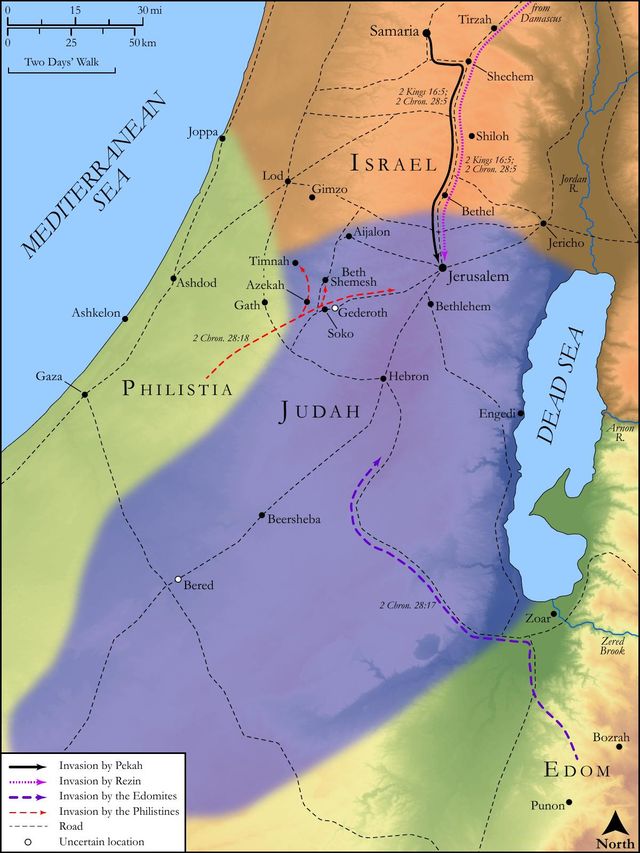
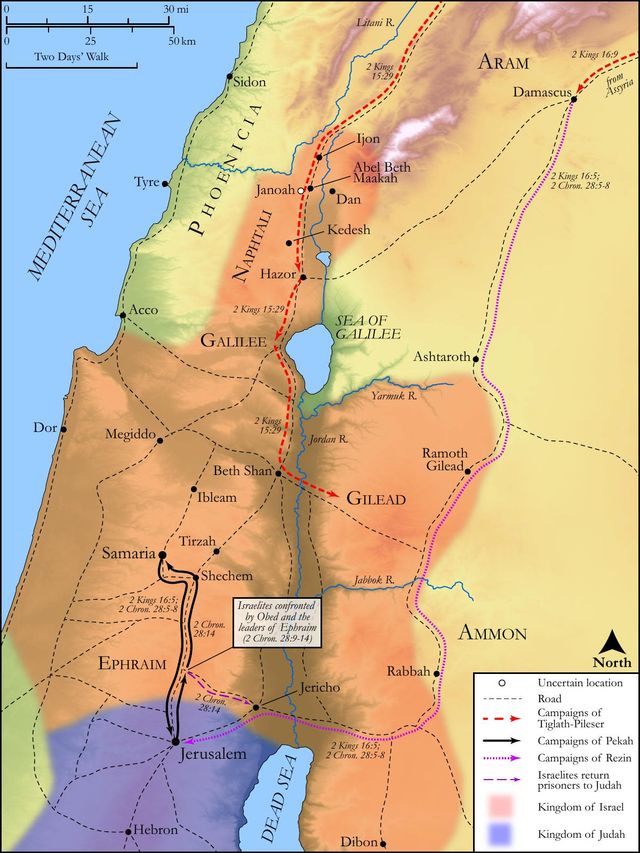
See on the biblical-era maps
Study this verse
Public-domain commentary
Matthew Henry
From his Commentary on the Whole Bible. Henry comments on passages, not single verses — this entry covers 2 Chronicles 28:6–15. His four-level outline is real structure in the source text, so it is rendered as structure.
We have here,
I.Treacherous Judah under the rebukes of God's providence, and they are very severe.
Never was such bloody work made among them since they were a kingdom, and by Israelites too. Ahaz walked in the ways of the kings of Israel, and the king of Israel was the instrument God made use of for his punishment. It is just with God to make those our plagues whom we make our patterns or make ourselves partners with in sin. A war broke out between Judah and Israel, in which Judah was worsted. For,
1.There was a great slaughter of men in the field of battle. Vast numbers (120,000 men, and valiant men too at other times) were slain (Ch2 28:6) and some of the first rank, the king's son for one. He had sacrificed some of this sons to Moloch; justly therefore is this sacrificed to the divine vengeance. Here is another that was next the king, his friend, the prime-minister of state, or perhaps next him in the battle, so that the king himself had a narrow escape, Ch2 28:7. The kingdom of Israel was not strong at this time, and yet strong enough to bring this great destruction upon Judah. But certainly so many men, great men, stout men, could not have been cut off in one day if they had not been strangely dispirited both by the consciousness of their own guilt and by the righteous hand of God upon them. Even valiant men were numbered as sheep for the slaughter, and became an easy prey to the enemy because they had forsaken the Lord God of their fathers, and he had therefore forsaken them.
2.There was a great captivity of women and children, Ch2 28:8. When the army in the field was routed, the cities, and towns, and country villages, were all easily stripped, the inhabitants taken for slaves, and their wealth for a prey.
II.Even victorious Israel under the rebuke of God's word for the bad principle they had gone upon in making war with Judah and the bad use they had made of their success, and the good effect of this rebuke. Here is,
1.The message which God sent them by a prophet, who went out to meet them, not to applaud their valour or congratulate them on their victory, though they returned laden with spoils and triumphs, but in God's name to tell them of their faults and warn them of the judgments of God.
(1.)He told them how they came by this victory of which they were so proud. It was not because God favoured them, or that they had merited it at his hand, but because he was wroth with Judah, and made them the rod of his indignation. Not for your righteousness, be it known to you, but for their wickedness (Deu 9:5) they are broken off; therefore be not you high-minded, but fear lest God also spare not you, Rom 11:20, Rom 11:21.
(2.)He charged them with the abuse of the power God had given them over their brethren. Those understand not what victory is who think it gives them authority to do what they will, and that the longest sword is the clearest claim to lives and estates (Jusque datum sceleri - might is right); no, as it is impolitic not to use a victory, so it is impious to abuse it. The conquerors are here reproved,
[1.]For the cruelty of the slaughter they had made in the field. They had indeed shed the blood of war in war; we suppose that to be lawful, but it turned into sin to them, because they did it from a bad principle of enmity to their brethren and after a bad manner, with a barbarous fury, a rage reaching up to heaven, that is, that cried to God for vengeance against such bloody men, that delighted in military execution. Those that serve God's justice, if they do it with rage and a spirit of revenge, make themselves obnoxious to it, and forfeit the honour of acting for him; for the wrath of man worketh not the righteousness of God.
[2.]For the imperious treatment they gave their prisoners. "You now purpose to keep them under, to use them or sell them as slaves, though they are your brethren and free-born Israelites." God takes notice of what men purpose, as well as of what they say and do.
(3.)He reminded them of their own sins, by which they also were obnoxious to the wrath of God: Are there not with you, even with you, sins against the Lord your God? Ch2 28:10. He appeals to their own consciences, and to the notorious evidence of the thing. "Though you are now made the instruments of correcting Judah for sin, yet do not think that you are therefore innocent yourselves; no, you also are guilty before God." This is intended as a check, [1.] To their triumph in their success. "You are sinners, and it ill becomes sinners to be proud; you have carried the day now, but be not secure, the wheel may ere long return upon yourselves, for, if judgment begin thus with those that have the house of God among them, what shall be the end of such as worship the calves?" [2.] To their severity towards their brethren. "You have now got them under, but you ought to show mercy to them, for you yourselves are undone if you do not find mercy with God. It ill becomes sinners to be cruel. You have transgressions enough to answer for already, and need not add this to the rest."
(4.)He commanded them to release the prisoners, and to send them home again carefully (Ch2 28:11); "for you having sinned, the fierce wrath of God is upon you, and there is no other way of escaping it than by showing mercy."
2.The resolution of the princes thereupon not to detain the prisoners. They stood up against those that came from the war, though flushed with victory, and told them plainly that they should not bring their captives into Samaria, Ch2 28:12, Ch2 28:13. They had sin enough already to answer for, and would have nothing done to add to their trespass. In this they discovered an obedient regard to the word of God by his prophet and a tender compassion towards their brethren, which was wrought in them by the tender mercy of God; for he regarded the affliction of this poor people, and hears their cry, and made them to be pitied of all those that carried them captive, Psa 106:44, Psa 106:46.
3.The compliance of the soldiers with the resolutions of the princes in this matter, and the dismission of the captives thereupon.
(1.)The armed men, though being armed they might be force have maintained their title to what they got by the sword, acquiesced, and left their captives and the spoil to the disposal of the princes (Ch2 28:14), and herein they showed more truly heroic bravery than they did in taking them. It is a great honour for any man to yield to the authority of reason and religion against his interest.
(2.)The princes very generously sent home the poor captives well accommodated, Ch2 28:15. Those that hope to find mercy with God must learn hence with what tenderness to carry themselves towards those that lie at their mercy. It is strange that these princes, who in this instance discovered such a deference to the word of God, and such an influence upon the people, had not so much grace as, in obedience to the calls of God by so many prophets, to root idolatry out of their kingdom, which, soon after this, was the ruin of it.
Continue studying 2 Chronicles 28:14 across the web’s major study libraries — every link below opens this exact verse, chapter, or book on the destination site.
Read & Compare
 BibleGatewayThis verse in more than 200 translations and 70 languages.
 Bible.comThe YouVersion reader — hundreds of translations, reading plans, and highlights.
 ESV.orgCrossway's official English Standard Version reader.
 NET BibleThe NET translation with 60,000+ translators' notes on every rendering decision.
 STEP BibleTyndale House's free study tool — original text, vocabulary, and scholarly resources.
 BibliaLogos Bible Software's free web reader.
 USCCBThe New American Bible (Revised Edition) with the U.S. bishops' study notes.
Commentaries
 BibleHub CommentariesDozens of classic commentaries on this verse, gathered on one page.
 StudyLightMore than 100 commentary sets — the largest collection on the web.
 BibleRefPlain-English commentary on what this verse means, verse by verse.
 Enduring WordDavid Guzik's free commentary on this chapter, widely used by Bible teachers.
 Bible Study ToolsVerse commentary alongside Greek and Hebrew study aids.
Original Language & Research
- BibleHub InterlinearThe verse word by word — original language, transliteration, and English.
- BibleHub LexiconEvery word's original-language definition and Strong's entry.
 Blue Letter BibleDeep-study tools — Strong's numbers, concordance, and word studies.
 SefariaThe Hebrew text with Rashi and centuries of Jewish commentary.
Sermons, Hymns & Audio


TrulyRandomVerse is not affiliated with these sites and doesn’t control their content. They’re linked because they’re genuinely useful.
Summary
Following the prophet Oded's bold rebuke and the compassionate counsel of Ephraimite leaders, the Israelite soldiers, having decisively defeated Judah, publicly and obediently relinquished their Judean captives and the vast plunder they had taken. This extraordinary act of mercy and adherence to God's word marked a profound reversal of the usual practices of warfare in that day, powerfully demonstrating the transformative power of divine intervention and the call to brotherly compassion even amidst inter-tribal conflict.
Context
ShowHideLiterary Context
This verse serves as the pivotal culmination of a dramatic narrative shift within 2 Chronicles 28. Immediately prior, King Pekah of Israel had inflicted a devastating defeat upon King Ahaz of Judah, resulting in the capture of 200,000 Judeans and immense spoil. The prophet Oded then boldly confronted the victorious Israelite army, warning them that their triumph, though divinely permitted due to Judah's sin, would incur God's wrath upon themselves if they oppressed their brethren. This prophetic warning, powerfully reinforced by prominent Ephraimite leaders who urged compassion and adherence to the Law, directly led to the remarkable decision described in this verse. The subsequent verses (e.g., 2 Chronicles 28:15) detail the humane care provided to the released captives, including clothing, food, drink, anointing, and transportation, emphasizing the complete and compassionate nature of the Israelites' actions.
Historical & Cultural Context
The recurring conflicts between the northern kingdom of Israel and the southern kingdom of Judah, despite their shared heritage, represent a tragic chapter in Israelite history. Among the nations of that day, the taking of captives and vast spoil was a standard and expected practice in warfare, often leading to enslavement, forced labor, or even ritual sacrifice. However, the prophet Oded's intervention appealed to a higher authority: the covenantal relationship between the tribes of Israel and the Mosaic Law. The Law explicitly mandated compassionate treatment of fellow Israelites, particularly the poor, vulnerable, and those in debt (e.g., Leviticus 25:39-43). The leaders of Ephraim, notably Azariah, Berechiah, Jehizkiah, and Amasa, demonstrated remarkable moral courage by prioritizing divine commands over the material gains of war, acting as a powerful internal check on the army's actions. This episode stands as a rare and profound exception to the brutal norms of ancient military conduct, showcasing a unique instance of inter-Israelite mercy and obedience to God's covenant.
Key Themes
ShowHide2 Chronicles 28:14 powerfully illustrates several core themes central to the Chronicler's theological agenda. Foremost is the theme of divine retribution and mercy: while Judah's devastating defeat was a direct consequence of King Ahaz's idolatry and unfaithfulness (as seen in 2 Chronicles 28:1-5), God, through His prophet, intervened to prevent Israel from compounding their own sin by oppressing their brethren. This highlights God's unwavering concern for His people, even when they are divided and disobedient. Another prominent theme is obedience to the prophetic word: the immediate and public compliance of the Israelite soldiers and leaders to Oded's warning (recounted in 2 Chronicles 28:9-11) underscores the profound authority of God's messengers and the transformative power of genuine repentance. Finally, the narrative emphasizes brotherly compassion and unity within the covenant community, reminding both Judah and Israel of their shared identity and the call to treat one another with mercy, echoing principles found throughout the Law and Prophets, such as in Deuteronomy 15:7-11 and Isaiah 58:6-7.
Exposition and Analysis
ShowHideKey Word Analysis
ShowHide(châlats), a primitive root meaning "to pull off; hence (intensively) to strip, (reflex.) to depart; by implication, to deliver, equip (for fight); present, strengthen; arm (self), (go, ready) armed ([idiom] man, soldier), deliver, draw out, make fat, loose, (ready) prepared, put off, take away, withdraw self." In this context, it refers to the Israelite soldiers, those equipped for war, who had just achieved a military victory. The use of this term emphasizes their martial capacity and the fact that they were the ones who had taken the captives and spoil. Their subsequent action of "leaving" or releasing was therefore a deliberate and significant reversal of their military gains and expectations, highlighting the profound impact of the prophetic word on hardened warriors.
(ʻâzab), a primitive root meaning "to loosen, i.e. relinquish, permit, etc.; commit self, fail, forsake, fortify, help, leave (destitute, off), refuse, [idiom] surely." This verb signifies a willing and active relinquishment of what they had acquired through conquest. It is not a passive act of abandonment but a decisive choice to release their claim and ownership over the captives and the plunder. This demonstrates their obedience to the prophetic word and the counsel of their leaders, prioritizing divine command over personal gain.
(bizzâh), feminine of H957 (baz), meaning "booty; prey, spoil." This term denotes the plunder, loot, or material gains taken in war. In ancient warfare, spoil was a significant part of the victor's reward, a source of wealth, and a tangible symbol of their triumph and power. The act of "leaving" the spoil, alongside the captives, underscores the profound nature of their obedience and compassion, as they forfeited substantial material wealth for the sake of righteousness and adherence to God's will.
Verse Breakdown
ShowHide"So the armed men"
This clause identifies the agents of the action—the Israelite soldiers who had just defeated Judah and taken captives and plunder. Their identity as "armed men" highlights the military context and the unexpected, counter-cultural nature of their subsequent compassionate act. It sets the stage for a remarkable display of moral transformation.
"left the captives and the spoil"
This is the core action of the verse, describing a deliberate and significant relinquishment. The verb "left" (Hebrew ʻâzab) implies an active release. The pairing of "captives" (human lives) and "spoil" (material wealth) emphasizes that both the human and material gains, typically seen as legitimate outcomes of ancient warfare, were intentionally given up. This act directly reverses the expected outcome of their military victory, demonstrating a profound obedience to the divine command and a radical shift in their priorities from self-interest to covenantal compassion.
"before the princes and all the congregation"
This specifies the audience and context of the release. It was a public, communal act, not a private or hidden one. The presence of "princes" (leaders) and "all the congregation" (the assembled community) underscores the transparency, official nature, and widespread acceptance of this decision. This public display reinforces its significance as a collective act of repentance, mercy, and adherence to God's righteous standards, making it an example for the entire nation.
Literary Devices
ShowHideThe narrative in 2 Chronicles 28:14 employs several literary devices to heighten its dramatic and theological impact. Contrast is central, pitting the typical brutality and self-interest of ancient warfare against an extraordinary act of compassion and obedience. The "armed men" (conquerors) are depicted as "leaving" (releasing) their "captives and spoil," a direct reversal of expected behavior. This creates a powerful irony, as the victors choose to forgo their spoils and release those they had enslaved, demonstrating a moral and spiritual victory far greater than their military one. The phrase "before the princes and all the congregation" emphasizes publicity and transparency, underscoring the communal nature of this decision and its significance as a collective act of repentance and adherence to God's will. The entire episode functions as an exemplum, providing a moral and theological example of the transformative power of prophetic counsel and the importance of brotherly love within the covenant community, even in the face of deep division.
Theological and Thematic Connections
ShowHideThe act described in 2 Chronicles 28:14 is a profound theological statement on God's desire for justice and mercy, even among His often-divided people. It underscores that true victory is not merely military conquest but moral and spiritual obedience to divine principles. The Israelites' willingness to release their captives and spoil demonstrates a remarkable understanding that their actions had spiritual consequences, and that God's wrath could turn against them for oppressing their brethren. This episode serves as a powerful reminder that God values compassion and righteousness over material gain and that He actively intervenes through His prophets to guide His people towards His righteous standards. It foreshadows the New Testament emphasis on love for one's neighbor and the radical call to self-sacrifice for the good of others, even enemies.
Reflection and Application
ShowHideThe narrative of the Israelite soldiers releasing their Judean captives and spoil offers profound lessons for believers today. It challenges us to examine our own hearts and priorities, asking whether we are willing to relinquish perceived gains or personal advantages for the sake of righteousness and compassion. In a world often driven by self-interest, the accumulation of wealth, or the pursuit of power, this act of self-denial for the good of others stands as a powerful counter-cultural example. It reminds us that true spiritual maturity involves not only hearing God's word but actively obeying it, even when it demands costly sacrifices. Furthermore, it highlights the importance of heeding godly counsel and the collective responsibility of the community to uphold ethical and spiritual standards, demonstrating mercy and justice in all our dealings, especially with those who might be considered "other" or even "enemy." This story calls us to embody the very heart of God, who desires mercy over sacrifice, and to prioritize the well-being of our fellow human beings, particularly those who are vulnerable or oppressed.
Questions for Reflection
ShowHideFAQ
ShowHideWhy did the Israelite soldiers release the captives and spoil, which was standard practice in warfare?
ShowHideThe release was a direct result of divine intervention through the prophet Oded and the courageous counsel of prominent Ephraimite leaders. Oded warned the Israelite army that their victory was permitted by God due to Judah's sin, but that holding their brethren captive would incur God's wrath upon themselves, as it constituted a great sin against the Lord (see 2 Chronicles 28:9-11). The leaders reinforced this message, appealing to their shared identity as Israelites and the principles of the Mosaic Law, which emphasized compassion and just treatment of fellow Hebrews (e.g., Deuteronomy 15:7-11). This unique act demonstrates a powerful instance where spiritual conviction and brotherly concern superseded the typical customs and gains of ancient warfare.
What was the significance of releasing the captives and spoil "before the princes and all the congregation"?
ShowHideReleasing the captives and spoil "before the princes and all the congregation" signified a public, official, and communal act of compliance and repentance. It was not a private or hidden decision but a transparent declaration of obedience to God's word and a commitment to righteousness. This public display underscored the gravity of the prophet's message and the collective responsibility of the Israelite community to uphold divine standards. It also ensured accountability and demonstrated a unified front in prioritizing spiritual principles over material gain, setting a powerful example for the entire nation, as detailed in 2 Chronicles 28:14.
Christ-Centered Fulfillment
ShowHideThe remarkable act of compassion and self-denial displayed by the Israelite soldiers in 2 Chronicles 28:14 finds its ultimate and most profound fulfillment in the person and work of Jesus Christ. While the Israelites released their brethren from physical captivity and material loss, Jesus came to release humanity from the far greater bondage of sin and spiritual death. He is the ultimate "armed man" who, though victorious over sin and death, did not cling to His divine prerogatives or the spoils of His triumph, but rather "emptied himself, by taking the form of a servant" (Philippians 2:7). Instead of taking spoil, He became the ultimate sacrifice, offering His own life as a ransom for many (Mark 10:45). The compassion shown by the Israelites, prompted by a prophet, foreshadows the boundless mercy of God incarnate in Christ, who, seeing our spiritual captivity, did not condemn but freely offered salvation, breaking the chains of sin and leading "captivity captive" (Ephesians 4:8). His act of relinquishing glory for our sake is the supreme demonstration of love, mercy, and obedience, inviting us into a new covenant where we are no longer captives but adopted sons and daughters, heirs to an eternal inheritance (Romans 8:15-17).