


2 Chronicles 11:3
Bible text: King James Version (1769 Blayney text) · Public domain
Bible text: Berean Standard Bible · Public domain
Bible text: American Standard Version (1901) · Public domain
Bible text: World English Bible, Messianic edition · Public domain
Bible text: Geneva Bible (1599) · Public domain
Bible text: Young's Literal Translation · Public domain
- אֱמֹר'e·MorsayH559V-Qal-Imp-2msVerb Qal Imperative 2nd Singular Masculine
- אֶל'eltoH413PrepPreposition
- רְחַבְעָםre·chav·'AmRehoboamH7346N-proper-mNoun Proper Masculine
- בֶּןben[the] son ofH1121N-mscNoun Singular Masculine Construct
- שְׁלֹמֹהshe·lo·MohSolomonH8010N-proper-mNoun Proper Masculine
- מֶלֶךְMe·lekh[the] king ofH4428N-mscNoun Singular Masculine Construct
- יְהוּדָהye·hu·DahJudahH3063N-properNoun Proper Location
- וְאֶלve·'Eland toH413Conj-w ¦ PrepPrepositionוְandאֶלto
- כָּלkolallH3605N-mscNoun Singular Masculine Construct
- יִשְׂרָאֵלYis·ra·'ElIsraelH3478N-properNoun Proper Location
- בִּיהוּדָהbi·hu·Dahin JudahH3063Prep-b ¦ N-properNoun Proper LocationבִּinיהוּדָהJudah
- וּבִנְיָמִןu·vin·ya·Minand BenjaminH1144Conj-w ¦ N-proper-mNoun Proper MasculineוּandבִנְיָמִןBenjamin
- לֵאמֹרle·Mor<to> sayingH559Prep-l ¦ V-Qal-InfVerb Qal Infinitive Constructלֵ<to>אמֹרsaying
English is a literal word-by-word gloss of the Hebrew, not the KJV's wording. Why?
This is the original text the KJV's translators worked from — each Hebrew word with its own literal English meaning in this verse, prepared by scholars at Tyndale House, Cambridge. The KJV translates whole sentences, not word by word, so its wording differs: one Hebrew word can become several English words, and the KJV may choose “the LORD” where the gloss reads “Yahweh”. Both are faithful — they answer different questions. For the KJV's own rendering, switch to the KJV text.
Details
See on the biblical-era map
Study this verse
Public-domain commentary
Matthew Henry
From his Commentary on the Whole Bible. Henry comments on passages, not single verses — this entry covers 2 Chronicles 11:1–12.
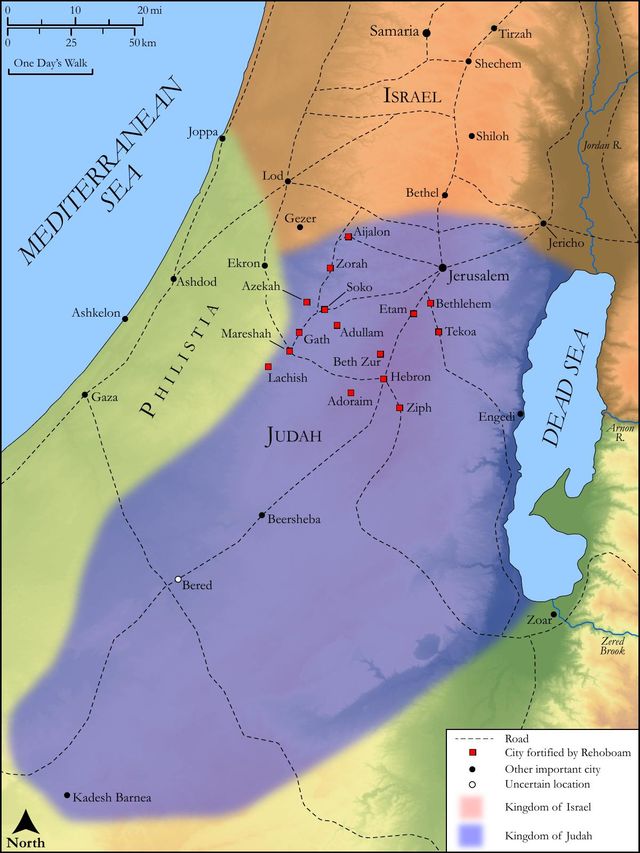
How the ten tribes deserted the house of David we read in the foregoing chapter. They had formerly sat loose to that family (Sa2 20:1, Sa2 20:2), and now they quite threw it off, not considering how much it would weaken the common interest and take Israel down from that pitch of glory at which it had arrived in the last reign. But thus the kingdom must be corrected as well as the house of David. 1. Rehoboam at length, like a bold man, raises an army, with a design to reduce the revolters, Ch2 11:1. Judah and Benjamin were not only resolved to continue their allegiance to him, but ready to give him the best assistance they could for the recovery of his right. Judah was his own tribe, that owned him some years before the rest did; Benjamin was the tribe in which Jerusalem, or the greatest part of it, stood, which perhaps was one reason why that tribe clave to him. 2. Yet, like a conscientious man, when God forbade him to prosecute this design, in obedience to him he let it fall, either because he reverenced the divine authority or because he knew that he should not prosper if he should go contrary to God's command, but instead of retrieving what was lost would be in danger of losing what he had. It is dangerous undertaking any thing, but especially undertaking a war, contrary to the will of God. God calls him (Ch2 11:3), Rehoboam the son of Solomon, to intimate that this was determined for the sin of Solomon, and it would be to no purpose to oppose a decree that had gone forth. They obeyed the words of the Lord; and though it looked mean, and would turn to their reproach among their neighbours, yet, because God would have it so, they laid down their arms. 3. Like a discreet man, he fortified his own country. He saw it was to no purpose to think of reducing those that had revolted. A few good words might have prevented their defection, but now all the forces of his kingdom cannot bring them back. The think is done, and so it must rest; it is his wisdom to make the best of it. Perhaps the same young counsellors that had advised him to answer them roughly urged him to fight them, notwithstanding the divine inhibition; but he had paid dearly enough for being advised by them, and therefore now, we may suppose, his aged and experienced counsellors were hearkened to, and they advised him to submit to the will of God concerning what was lost, and to make it his business to keep what he had. It was probably by their advice that, (1.) He fortified his frontiers, and many of the principal cities of his kingdom, which, in Solomon's peaceable reign, no care had been taken for the defence of. (2.) He furnished them with good stores of victuals and arms, Ch2 11:11, Ch2 11:12. Because God forbade him to fight, he did not therefore sit down sullenly, and say that he would do nothing for the public safety if he might not do that, but prudently provided against an attack. Those that may not be conquerors, yet may be builders.
Continue studying 2 Chronicles 11:3 across the web’s major study libraries — every link below opens this exact verse, chapter, or book on the destination site.
Read & Compare
 BibleGatewayThis verse in more than 200 translations and 70 languages.
 Bible.comThe YouVersion reader — hundreds of translations, reading plans, and highlights.
 ESV.orgCrossway's official English Standard Version reader.
 NET BibleThe NET translation with 60,000+ translators' notes on every rendering decision.
 STEP BibleTyndale House's free study tool — original text, vocabulary, and scholarly resources.
 BibliaLogos Bible Software's free web reader.
 USCCBThe New American Bible (Revised Edition) with the U.S. bishops' study notes.
Commentaries
 BibleHub CommentariesDozens of classic commentaries on this verse, gathered on one page.
 StudyLightMore than 100 commentary sets — the largest collection on the web.
 BibleRefPlain-English commentary on what this verse means, verse by verse.
 Enduring WordDavid Guzik's free commentary on this chapter, widely used by Bible teachers.
 Bible Study ToolsVerse commentary alongside Greek and Hebrew study aids.
Original Language & Research
- BibleHub InterlinearThe verse word by word — original language, transliteration, and English.
- BibleHub LexiconEvery word's original-language definition and Strong's entry.
 Blue Letter BibleDeep-study tools — Strong's numbers, concordance, and word studies.
 SefariaThe Hebrew text with Rashi and centuries of Jewish commentary.
Sermons, Hymns & Audio


TrulyRandomVerse is not affiliated with these sites and doesn’t control their content. They’re linked because they’re genuinely useful.
Summary
2 Chronicles 11:3 records God's direct and authoritative intervention through the prophet Shemaiah, commanding King Rehoboam of Judah and all the loyal tribes of Judah and Benjamin to refrain from waging war against the newly seceded northern tribes of Israel. This divine word, delivered at a critical juncture, prevented an imminent civil conflict, underscoring God's sovereign will in preserving the integrity of the Davidic dynasty and a remnant of His people, even amidst the profound national fragmentation.
Context
ShowHideLiterary Context
This verse is strategically placed immediately after the dramatic and tragic account of the kingdom's division in 2 Chronicles 10. Following Solomon's death, his son Rehoboam ascended the throne, but his arrogant refusal to alleviate the heavy burdens imposed by his father led to the rebellion of ten northern tribes, who then crowned Jeroboam as their king. This left Rehoboam ruling solely over the tribes of Judah and Benjamin, who remained loyal to the Davidic covenant and the Jerusalem temple. Incensed by this secession and determined to reclaim his full dominion, Rehoboam mobilized a formidable army of 180,000 chosen men. It is precisely at this critical moment, on the precipice of a devastating civil war, that 2 Chronicles 11:3 introduces the divine command given to the prophet Shemaiah, instructing him to intervene and halt Rehoboam's military campaign. The immediate next verse, 2 Chronicles 11:4, details Rehoboam's surprising obedience to this divine word, which successfully averted bloodshed. A parallel account, emphasizing the divine origin of this command, is found in 1 Kings 12:22-24.
Historical & Cultural Context
The historical backdrop is the immediate aftermath of the united monarchy's collapse, a period of immense political and religious upheaval for Israel. For centuries, Israel had been a unified nation under the leadership of figures like David and Solomon, with Jerusalem as its spiritual and political center. The division into two kingdoms—Israel (North) and Judah (South)—was a cataclysmic event, not merely a political schism but a profound theological crisis that challenged the Davidic covenant, which promised an eternal dynasty. Kings were expected to assert their authority, and military action to quell rebellion was a standard practice among the kings of that day. Rehoboam's decision to gather an army was entirely consistent with prevailing royal norms. However, the intervention of a prophet like Shemaiah, delivering a direct word from Yahweh, highlights the unique covenantal relationship between God and Israel, where divine will could supersede human political and military strategies. The tribes of Judah and Benjamin formed the core of the southern kingdom, maintaining the lineage of David and the centralized temple worship in Jerusalem.
Key Themes
ShowHideThis verse powerfully underscores several major themes within 2 Chronicles and the broader biblical narrative. Firstly, Divine Sovereignty and Intervention is paramount; despite the political turmoil and Rehoboam's human desire for vengeance and reunification, God actively steps in to prevent further bloodshed and to ensure His pre-ordained will for the divided kingdom is established. This demonstrates that God's plans transcend human ambition and conflict, even when human actions lead to division, as seen in the principle that the king's heart is in the hand of the Lord. Secondly, Obedience to God's Word is highlighted as crucial. The instruction to "Speak unto Rehoboam" emphasizes the vital importance of heeding prophetic counsel. God communicates His will through His chosen messengers, and the response of the king and the people to this divine word is paramount. Their obedience, as detailed in 2 Chronicles 11:4, averts a potentially devastating internal conflict within Israel. Thirdly, the Consequences of Disobedience are implicitly present. While not directly stated in this verse, the very need for God's intervention stems from Rehoboam's earlier pride and his rejection of wise counsel, which led to the division of the kingdom in the first place (2 Chronicles 10:14). God, in His mercy, prevents the full, destructive consequences of that initial disobedience, demonstrating His long-suffering nature even in judgment.
Exposition and Analysis
ShowHideKey Word Analysis
ShowHideThis verb (H559) is a primitive root meaning "to say," but used with great latitude, often implying a direct, authoritative, and formal communication, especially when referring to a divine message. In this context, it is not a mere suggestion or polite request but a clear, binding command from God, delivered through His prophet Shemaiah, to halt the military campaign. The imperative form emphasizes the urgency and non-negotiable nature of the divine instruction, leaving no room for misinterpretation or debate from Rehoboam.
This noun (H1121) literally means "son," but in a wider sense, it denotes one who "builds the family name." Here, "son of Solomon" emphasizes Rehoboam's direct lineage from the illustrious King Solomon and, by extension, from David. This highlights his inherited royal authority and the weight of the Davidic covenant that rested upon him, even as the kingdom fractured under his rule. It connects him directly to the legacy and failures of his predecessors.
This proper noun (H3478), meaning "he will rule as God," is a symbolic name for Jacob and, typically, for his posterity. In this verse, "all Israel in Judah and Benjamin" refers specifically to the remnant of the unified nation that remained loyal to the Davidic dynasty and the Jerusalem temple. While the broader term "Israel" often encompassed all twelve tribes, here it delineates the portion of the people over whom Rehoboam still held legitimate rule, distinguishing them from the northern tribes who had seceded. It underscores the tragic reality of the division while identifying the specific audience of God's message.
Verse Breakdown
ShowHide"Speak unto Rehoboam the son of Solomon, king of Judah"
This clause precisely identifies the primary recipient of the divine message. Rehoboam is named by his lineage ("son of Solomon"), emphasizing his royal heritage and the Davidic covenant, which is now under threat. His title, "king of Judah," clearly defines the scope of his current authority, acknowledging the already established division of the kingdom. The direct address underscores the personal nature of God's intervention in the affairs of kings and His recognition of the legitimate authority that remained with Rehoboam.
"and to all Israel in Judah and Benjamin"
This expands the audience beyond the king to include the entire populace of the southern kingdom. It signifies that the message is not just for the monarch but for all those under his rule, implying that their participation in the war would also be against God's will. This collective address highlights the unity of the remaining loyal tribes and the communal responsibility to heed God's command, emphasizing that the consequences of obedience or disobedience would affect the entire community.
"saying,"
This simple word introduces the content of the divine message that Shemaiah is commanded to deliver. It sets the stage for the specific prohibition against going to war against their brethren, which is detailed in the subsequent verses. It emphasizes that the prophet is merely a messenger, relaying a precise divine utterance, ensuring that the message's authority derives solely from God.
Literary Devices
ShowHideThe verse employs several significant literary devices that amplify its meaning and impact. Foremost is Divine Command, where God directly intervenes in human affairs through His chosen messenger, the prophet Shemaiah, to issue an authoritative directive. This highlights God's active sovereignty over political and military outcomes, demonstrating His control even in moments of human rebellion and conflict. There is also an element of Foreshadowing, as this command anticipates the peaceful resolution detailed in the very next verse, where Rehoboam and his army obey God's word, thus averting a civil war. This sets up a narrative arc of divine intervention leading to a positive outcome. Furthermore, the verse presents a subtle Contrast between human intent and divine will. Rehoboam's intention is to wage war and forcibly reunite the kingdom, driven by anger and a desire for control. God's will, however, is for peace and the acceptance of the kingdom's division as His sovereign act, demonstrating that His purposes often run counter to human desires and strategies.
Theological and Thematic Connections
ShowHideThis pivotal verse profoundly illustrates God's active and sovereign involvement in the affairs of nations and kings, even when those affairs are marked by human sin and division. It reveals that God's overarching plan for His people supersedes human political ambitions and military might. Despite the catastrophic schism of the kingdom, which was a consequence of Solomon's disobedience and Rehoboam's folly, God mercifully intervenes to prevent further, self-destructive bloodshed. This demonstrates His commitment to preserving a remnant and maintaining the Davidic line through which the Messiah would eventually come. The immediate obedience of Rehoboam and the people serves as a powerful testament to the authority of God's Word delivered through His prophets, underscoring that true wisdom and security lie in submission to divine counsel rather than reliance on human strength or vengeful impulses.
Reflection and Application
ShowHide2 Chronicles 11:3 serves as a powerful and enduring reminder that God is sovereign over all circumstances, even in times of intense political strife, deep division, and personal grievances. It challenges us to recognize that our natural inclinations, especially when fueled by anger, pride, or a desire for vindication, may lead us down paths of conflict and destruction. Just as God intervened to prevent a devastating civil war in ancient Israel, He often works in our lives to bring peace and order out of chaos, calling us to align our plans with His righteous and often counter-intuitive will. This verse encourages us to cultivate a posture of humility and discernment, actively seeking God's guidance through His Word and trusted spiritual counsel, especially when faced with difficult decisions or perceived injustices. Our willingness to listen to and obey divine counsel, even when it means sacrificing our own desires for control or retribution, can avert significant negative outcomes and lead to God's blessing, fostering reconciliation and peace where division once threatened.
Questions for Reflection
ShowHideFAQ
ShowHideWhy did God intervene to stop Rehoboam from fighting the northern tribes?
ShowHideGod intervened primarily to prevent a devastating civil war among His own people, which would have resulted in immense bloodshed and further weakened the nation. While the division of the kingdom itself was a judgment against Solomon's idolatry and a fulfillment of prophecy (1 Kings 11:11-13), God's purpose for the division was not to annihilate His people. He also sought to preserve the integrity of the Davidic line in Judah and Benjamin, through which the Messiah would eventually come. This intervention demonstrates God's sovereign control over history, His mercy, and His commitment to His covenant promises, even in the midst of human sin and political turmoil.
Who was Shemaiah, and what was his role?
ShowHideShemaiah was a prophet of God, specifically identified as a "man of God" in 2 Chronicles 11:2. His role was to serve as God's direct messenger, delivering the divine command to King Rehoboam and the people of Judah and Benjamin. Prophets in ancient Israel often acted as God's spokespersons, calling kings and the nation to repentance, declaring God's judgments, or, as in this case, revealing His specific will to prevent a disastrous course of action. Shemaiah's intervention underscores the authority of the prophetic word and God's active involvement in the political landscape of His people.
Was the division of the kingdom God's will, or a result of human failure?
ShowHideThe division of the kingdom was both a consequence of human failure (Solomon's idolatry and Rehoboam's pride) and a direct act of God's sovereign will and judgment. 1 Kings 11:11-13 explicitly states that God would tear the kingdom from Solomon's son because of his unfaithfulness, though He would leave one tribe for David's sake. Therefore, while human sin provided the occasion, God's divine purpose and judgment orchestrated the division. His intervention in 2 Chronicles 11:3 to prevent war confirms that the division was His doing, and He would not allow human efforts to undo what He had ordained.
Christ-Centered Fulfillment
ShowHideThe divine intervention in 2 Chronicles 11:3, where God's authoritative word prevents civil war and preserves a remnant, finds its ultimate fulfillment in Jesus Christ. This Old Testament account showcases God's sovereign control over human history and political affairs, a control perfectly embodied in Christ, the true King of kings and Lord of lords. Just as God sent His prophet Shemaiah to deliver a word of peace and avert destruction, He sent His Son, Jesus, as the ultimate Prince of Peace, whose coming brings reconciliation not only between God and humanity but also among divided peoples (Ephesians 2:14-16). Rehoboam's obedience to the divine command foreshadows the perfect obedience of Christ, who humbly submitted to the Father's will, even to the point of death on a cross (Philippians 2:8), thereby securing our salvation. The preservation of the Davidic line in Judah and Benjamin, ensured by God's command, was crucial for the eventual birth of the Messiah, Jesus, who is the "root of David" (Revelation 22:16). Ultimately, the peace God brought to a divided Israel points to the spiritual peace and unity found in the body of Christ, where all who believe are brought together, transcending earthly divisions, by the power of the Holy Spirit.