


2 Chronicles 10:14
Bible text: King James Version (1769 Blayney text) · Public domain
Bible text: King James Version with Strong's numbers · Public domain
Bible text: Berean Standard Bible · Public domain
Bible text: American Standard Version (1901) · Public domain
Bible text: World English Bible, Messianic edition · Public domain
Bible text: Geneva Bible (1599) · Public domain
Bible text: Young's Literal Translation · Public domain
- וַיְדַבֵּרvay·da·Berand he spokeH1696Conj-w ¦ V-Piel-ConsecImperf-3msVerb Piel Consecutive Imperfect 3rd Singular Masculineוַandיְדַבֵּרhe spoke
- אֲלֵהֶם'a·le·Hemto themH413Prep ¦ 3mpPrepositionאֲלֵtoהֶםthem
- כַּעֲצַתka·'a·Tzataccording to [the] counsel ofH6098Prep-k ¦ N-fscNoun Singular Feminine Constructכַּaccording toעֲצַת[the] counsel of
- הַיְלָדִיםhay·la·Dimthe young menH3206Art ¦ N-mpNoun Plural Masculine Absoluteהַtheיְלָדִיםyoung men
- לֵאמֹרle·Mor<to> sayingH559Prep-l ¦ V-Qal-InfVerb Qal Infinitive Constructלֵ<to>אמֹרsaying
- אַכְבִּיד'akh·BidI will make heavyH3513V-Hiphil-Imperf-1csVerb Hiphil Imperfect 1st Singular common gender
- אֶת'et<obj.>H853DirObjMParticle Object Indicator
- עֻלְּכֶם'u·le·Khemyour yokeH5923N-msc ¦ 2mpNoun Singular Masculine Constructעֻלְּyokeכֶםyour
- וַאֲנִיva·'a·Niand IH589Conj-w ¦ Pro-1csPronoun Personal 1st Singular common genderוַandאֲנִיI
- אֹסִיף'o·SifI will addH3254V-Hiphil-Imperf-1csVerb Hiphil Imperfect 1st Singular common gender
- עָלָיו'a·Lavto itH5921Prep ¦ 3msPrepositionעָלָיtoוit
- אָבִי'a·Vimy fatherH1N-msc ¦ 1csNoun Singular Masculine Constructאָבִfatherיmy
- יִסַּרyi·Sarhe disciplinedH3256V-Piel-Perf-3msVerb Piel Perfect 3rd Singular Masculine
- אֶתְכֶם'et·Khem<obj.> youH853DirObjM ¦ 2mpParticle Object Indicatorאֶתְ<obj.>כֶםyou
- בַּשּׁוֹטִיםba·sho·Timwith <the> whipsH7752Prep-b ¦ N-mpNoun Plural Masculine Absoluteבַּwith <the>שּׁוֹטִיםwhips
- וַאֲנִיva·'a·Niand IH589Conj-w ¦ Pro-1csPronoun Personal 1st Singular common genderוַandאֲנִיI
- בָּעֲקְרַבִּיםba·'ak·ra·Bimwith <the> scorpionsH6137Prep-b ¦ N-mpNoun Plural Masculine Absoluteבָּwith <the>עֲקְרַבִּיםscorpions
English is a literal word-by-word gloss of the Hebrew, not the KJV's wording. Why?
This is the original text the KJV's translators worked from — each Hebrew word with its own literal English meaning in this verse, prepared by scholars at Tyndale House, Cambridge. The KJV translates whole sentences, not word by word, so its wording differs: one Hebrew word can become several English words, and the KJV may choose “the LORD” where the gloss reads “Yahweh”. Both are faithful — they answer different questions. For the KJV's own rendering, switch to the KJV text.
Details
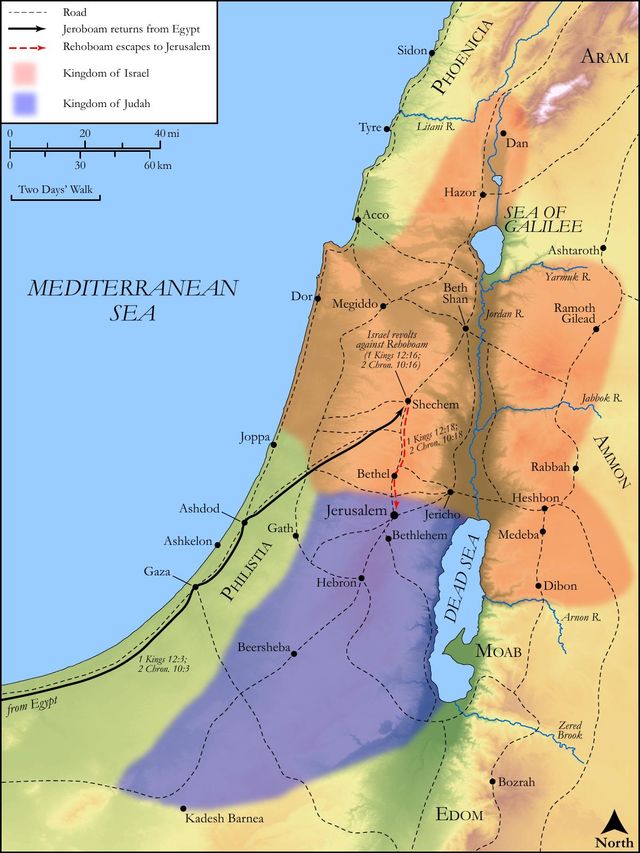
See on the biblical-era map
Study this verse
Public-domain commentary
Matthew Henry
From his Commentary on the Whole Bible. Henry comments on passages, not single verses — this entry covers 2 Chronicles 10:12–19.
We may learn here, 1. That when public affairs are in a ferment violent proceedings do but make bad worse. Rough answers (such as Rehoboam here gave) do but stir up anger and bring oil to the flames. The pilot has need to steer steadily in a storm. Many have been driven to the mischief they did not intend by being too severely dealt with for what they did intend. 2. That, whatever the devices and designs of men are, God is, by all, doing his own work, and fulfilling the word which he has spoken, no iota or tittle of which shall fall to the ground. The cause of the king's obstinacy and thoughtlessness was of God, that he might perform the word which he spoke by Ahijah, Ch2 10:15. This does not at all excuse Rehoboam's folly, nor lessen the guilt of his haughtiness and passion, that God was pleased to serve his own ends by them. 3. That worldly wealth, honour, and dominion, are very uncertain things. Solomon reigned over all Israel, and, one would think, had done enough to secure the monarchy entire to his family for many ages; and yet he is scarcely cold in his grave before ten of the twelve tribes finally revolt from his son. All the good services he had done for Israel were now forgotten: What portion have we in David? Thus is the government of Christ cast off by many, notwithstanding all he has done to bind the children of men for ever to himself; they say, We will not have this man to reign over us. But this rebellion will certainly be their ruin. 4. That God often visits the iniquities of the fathers upon the children. Solomon forsakes God, and therefore not he, but his son after him, is forsaken by the greatest part of his people. Thus God, by making the penal consequences of sin to last long and visibly to continue after the sinner's death, would give an indication of its malignity, and perhaps some intimation of the perpetuity of its punishment. He that sins against God not only wrongs his soul, but perhaps wrongs his seed more than he thinks of. 5. That, when God is fulfilling his threatenings, he will take care of that, at the same time, promises do not fall to the ground. When Solomon's iniquity is remembered, and for it his son loses ten tribes, David's piety is not forgotten, nor the promise made to him; but for the sake of that his grandson had two tribes preserved to him. The failings of the saints shall not frustrate any promise made to Christ their Head. They shall be chastised, but the covenant not broken, Psa 89:31-34.
Continue studying 2 Chronicles 10:14 across the web’s major study libraries — every link below opens this exact verse, chapter, or book on the destination site.
Read & Compare
 BibleGatewayThis verse in more than 200 translations and 70 languages.
 Bible.comThe YouVersion reader — hundreds of translations, reading plans, and highlights.
 ESV.orgCrossway's official English Standard Version reader.
 NET BibleThe NET translation with 60,000+ translators' notes on every rendering decision.
 STEP BibleTyndale House's free study tool — original text, vocabulary, and scholarly resources.
 BibliaLogos Bible Software's free web reader.
 USCCBThe New American Bible (Revised Edition) with the U.S. bishops' study notes.
Commentaries
 BibleHub CommentariesDozens of classic commentaries on this verse, gathered on one page.
 StudyLightMore than 100 commentary sets — the largest collection on the web.
 BibleRefPlain-English commentary on what this verse means, verse by verse.
 Enduring WordDavid Guzik's free commentary on this chapter, widely used by Bible teachers.
 Bible Study ToolsVerse commentary alongside Greek and Hebrew study aids.
Original Language & Research
- BibleHub InterlinearThe verse word by word — original language, transliteration, and English.
- BibleHub LexiconEvery word's original-language definition and Strong's entry.
 Blue Letter BibleDeep-study tools — Strong's numbers, concordance, and word studies.
 SefariaThe Hebrew text with Rashi and centuries of Jewish commentary.
Sermons, Hymns & Audio


TrulyRandomVerse is not affiliated with these sites and doesn’t control their content. They’re linked because they’re genuinely useful.
Summary
Second Chronicles 10:14 records the catastrophic response of King Rehoboam to the pleas of his people for lighter burdens, a decision that directly led to the division of the united kingdom of Israel. Rejecting the compassionate counsel of the elders, Rehoboam instead embraced the arrogant advice of his young peers, declaring his intent to intensify the heavy yoke imposed by his father Solomon, promising to chastise the people with "scorpions"—a metaphor for extreme cruelty—rather than mere whips. This pivotal moment underscores the devastating consequences of prideful leadership and serves as a stark illustration of human folly intersecting with divine sovereignty.
Context
ShowHideLiterary Context
This verse is the climax of a critical narrative arc beginning in 2 Chronicles 10. Following the death of King Solomon, the people of Israel, led by Jeroboam, gather at Shechem to negotiate with the new king, Rehoboam, for relief from the burdensome labor and taxation imposed during Solomon's reign. The narrative meticulously details Rehoboam's consultation process: first, he seeks advice from the experienced elders who had served his father, who wisely counsel him to serve the people and speak kindly to them, promising their perpetual loyalty in return (2 Chronicles 10:6-7). However, Rehoboam rejects this sagacious counsel and instead turns to the young men with whom he grew up, who advise him to assert his authority with even greater severity (2 Chronicles 10:8-11). Verse 14 is Rehoboam's public declaration of this disastrous choice, directly preceding the people's rebellion and the subsequent fracturing of the kingdom into Israel (north) and Judah (south) as detailed in 2 Chronicles 10:16-19.
Historical & Cultural Context
The setting is the immediate aftermath of Solomon's opulent but demanding reign. While Solomon brought unprecedented wealth and peace, his vast building projects, including the Temple and his palace, were funded by heavy taxation and a system of forced labor (corvée) that significantly burdened the populace, particularly the northern tribes (1 Kings 5:13-18). The assembly at Shechem was a traditional site for covenant renewal and the affirmation of kingship, indicating the people's expectation of a dialogue and a new covenant with their monarch. The "yoke" metaphor was common in Scripture, symbolizing servitude, labor, or oppressive rule. Kings were expected to lighten the "yoke" of their subjects, especially at the beginning of a new reign, to secure loyalty. Rehoboam's response, promising to intensify the burden with "scorpions," was a shocking and culturally provocative declaration of tyrannical intent, directly defying the established norms of benevolent kingship and demonstrating a profound lack of understanding of his people's grievances.
Key Themes
ShowHideThis verse powerfully encapsulates several critical themes within 2 Chronicles and the broader biblical narrative. Firstly, it highlights the Rejection of Wise Counsel, showcasing Rehoboam's fatal flaw in dismissing experienced, sagacious advice from elders in favor of arrogant, self-serving counsel from his peers. This underscores the importance of humility and valuing wisdom in leadership, a theme prevalent throughout the wisdom literature (e.g., Proverbs 11:14). Secondly, it vividly illustrates Oppressive Leadership, as Rehoboam's declaration to make their "yoke heavy" and to "chastise you with scorpions" signifies an intent to govern with extreme severity, cruelty, and an utter disregard for the people's well-being. This stands in stark contrast to the ideal of righteous kingship (e.g., Psalm 72:1-4). Thirdly, the verse demonstrates the severe Consequences of Arrogance, as Rehoboam's pride and short-sightedness led directly to the fracturing of the united kingdom that his grandfather David and father Solomon had built, proving that "pride goes before destruction, a haughty spirit before a fall" (Proverbs 16:18). Finally, while Rehoboam made a personal choice, the Chronicler, echoing the account in 1 Kings 12:15, presents this division as part of Divine Sovereignty and judgment against the house of David due to Solomon's idolatry (1 Kings 11:11-13).
Exposition and Analysis
ShowHideKey Word Analysis
ShowHideThis term refers to a device "imposed on the neck," either literally for animals or figuratively for burdens, labor, and servitude. In this context, it symbolizes the heavy demands, taxation, and forced labor that had been laid upon the people by Solomon's administration. Rehoboam's declaration to "add thereto" signifies his intent not merely to maintain but to significantly increase these oppressive burdens on his subjects.
While literally referring to the arachnid, in this context, "scorpions" is used figuratively to describe a particularly cruel and severe type of whip, specifically a "scourge or knotted whip." This instrument of corporal punishment was likely a multi-thonged scourge, possibly embedded with metal, thorns, or sharp pieces of bone, designed to inflict maximum pain and injury. Rehoboam's boast was a clear declaration of his intention to be far more brutal and oppressive than his father, moving beyond standard "whips" to instruments of extreme torture, thereby signaling a tyrannical and merciless rule.
Verse Breakdown
ShowHide"And answered them after the advice of the young men"
This clause immediately establishes Rehoboam's fatal choice. He deliberately disregarded the wise, compassionate counsel of the experienced elders, opting instead for the aggressive, arrogant advice of his younger, less seasoned peers. This decision reveals a character flaw rooted in pride and a desire for absolute, unchallenged authority, rather than a servant-hearted approach to leadership.
"saying, My father made your yoke heavy, but I will add thereto"
Here, Rehoboam acknowledges the people's grievance regarding the "heavy yoke" of Solomon's reign, but instead of offering relief, he defiantly declares his intention to intensify their burdens. This statement is not merely a refusal but an escalation, demonstrating a complete lack of empathy and a provocative disregard for the well-being and loyalty of his subjects. It is a direct challenge to their plea for lighter service.
"my father chastised you with whips, but I [will chastise you] with scorpions"
This is the most shocking and cruel part of Rehoboam's pronouncement. He contrasts his father's method of "chastisement" (punishment or enforcement) with his own intended, far more brutal approach. While Solomon used "whips" (standard instruments of discipline), Rehoboam boasts he will use "scorpions"—the aforementioned exceptionally cruel whips. This hyperbole underscores his tyrannical intent, signaling a reign of terror and extreme oppression, designed to crush any dissent through overwhelming force and pain.
Literary Devices
ShowHideThe verse employs several potent literary devices to convey its dramatic and tragic message. Contrast is central, highlighted by the stark difference between the advice of the elders and the young men, and further emphasized by Rehoboam's comparison of his father's rule ("whips") with his own intended severity ("scorpions"). This contrast underscores Rehoboam's poor judgment and the escalating nature of his promised oppression. Metaphor is powerfully used with the "yoke" representing the burden of kingship and the "scorpions" symbolizing extreme, painful punishment. These metaphors are not merely descriptive but evocative, immediately conveying the harsh reality of Rehoboam's intentions. Furthermore, Rehoboam's declaration itself contains an element of Hyperbole, as his boast to use "scorpions" is an exaggerated promise of cruelty, designed to intimidate and assert absolute power. This hyperbole, however, backfires, inciting rebellion rather than submission. Finally, this verse serves as a dramatic moment of Foreshadowing, as Rehoboam's words directly predict and precipitate the imminent division of the united kingdom, a tragic outcome that unfolds immediately in the subsequent verses.
Theological and Thematic Connections
ShowHideThis pivotal verse serves as a profound theological lesson on the nature of leadership, the consequences of pride, and the interplay of human choice with divine sovereignty. Rehoboam's rejection of wise counsel and embrace of oppressive tactics stands as a stark warning against self-serving ambition and the dangers of surrounding oneself with flatterers rather than truth-tellers. The narrative emphasizes that true authority is often secured through humility and service, not through displays of brute force or arrogance. His actions demonstrate how unchecked pride can lead to ruin, not only for the individual but for an entire nation, fracturing unity and sowing discord. Ultimately, while Rehoboam's choice was a personal act of folly, the Chronicler frames it within God's overarching plan, a judgment against Solomon's idolatry, demonstrating that even human sin and error can be woven into the tapestry of divine purpose, fulfilling prophecy and revealing God's ultimate control over history.
Reflection and Application
ShowHideRehoboam's tragic misstep in 2 Chronicles 10:14 offers timeless lessons for leaders and individuals alike. It challenges us to critically evaluate the sources of our counsel, urging us to prioritize seasoned wisdom and compassionate insight over the seductive allure of self-serving or arrogant advice. In any sphere of influence—be it family, church, workplace, or civic life—the temptation to assert power through intimidation or to dismiss legitimate grievances can be strong. However, this passage powerfully reminds us that such a path inevitably leads to division, resentment, and ultimately, decline. True, sustainable leadership is built on empathy, humility, and a genuine desire to serve the well-being of those entrusted to our care. It calls for the courage to listen, the wisdom to discern, and the humility to change course when necessary, recognizing that our decisions have far-reaching consequences, impacting not just ourselves but entire communities and generations.
Questions for Reflection
ShowHideFAQ
ShowHideWhat exactly were "scorpions" in this context, and why did Rehoboam choose that word?
ShowHideIn 2 Chronicles 10:14, "scorpions" (Hebrew: ‘aqrabbim') does not refer to the arachnid. Instead, it is a metaphor for a particularly brutal and severe type of whip, explicitly described in the Strong's data as "figuratively, a scourge or knotted whip." This kind of whip was likely a multi-thonged scourge, possibly with metal tips, thorns, or sharp pieces of bone embedded, designed to inflict maximum pain and injury. Rehoboam chose this word to convey his intent to rule with extreme cruelty and oppression, far surpassing the severity of his father Solomon's rule. It was a boastful, intimidating declaration meant to assert his absolute power and crush any thought of rebellion, though it ultimately had the opposite effect.
Why did Rehoboam reject the wise counsel of the elders?
ShowHideRehoboam rejected the elders' wise counsel primarily due to pride, insecurity, and a desire to assert his authority with an iron fist. The elders advised him to serve the people and speak kindly to them, promising their perpetual loyalty (2 Chronicles 10:7). This counsel required humility and a servant-leader mindset, which Rehoboam lacked. He preferred the advice of his young peers who flattered his ego and encouraged him to display raw power and dominance, likely because it aligned with his own desire to establish himself as a strong, unchallengeable king immediately after his father's death. His decision reflects a common human failing: choosing comfortable but destructive advice over difficult but wise counsel.
Was the division of the kingdom truly God's will, or just a consequence of Rehoboam's bad decision?
ShowHideThe Bible presents the division of the kingdom as both a consequence of Rehoboam's bad decision and a fulfillment of God's sovereign will. Prior to this event, God had already prophesied to Solomon that He would tear the kingdom from his hand due to his idolatry, though He would leave one tribe (Judah) for David's sake (1 Kings 11:11-13). The prophet Ahijah had even told Jeroboam that he would rule ten tribes (1 Kings 11:29-39). Therefore, while Rehoboam made a free choice driven by pride and folly, God used his decision to bring about His predetermined judgment and plan. This illustrates the biblical concept of divine sovereignty working through human actions, even sinful ones, to achieve His purposes (1 Kings 12:15).
Christ-Centered Fulfillment
ShowHideThe disastrous reign of Rehoboam, marked by his oppressive "yoke" and the threat of "scorpions," stands in stark contrast to the perfect kingship of Jesus Christ. Rehoboam's arrogant declaration of increased burdens and cruel chastisement led to the fracturing of God's people, revealing the inherent failure of human leadership apart from divine wisdom. This failure underscores humanity's desperate need for a truly benevolent and righteous King. Jesus, the ultimate Son of David, comes not to impose a heavy yoke but to invite us to take His "yoke upon you, and learn from me, for I am gentle and lowly in heart, and you will find rest for your souls" (Matthew 11:29). Unlike Rehoboam, who threatened with whips and scorpions, Christ bore the ultimate chastisement on the cross, becoming the Lamb of God who takes away the sin of the world (John 1:29), suffering the full weight of divine judgment so that we might be set free from the heavy yoke of sin and the law. His rule is not one of division but of reconciliation, breaking down the dividing wall of hostility to create one new humanity in Himself (Ephesians 2:14-16), uniting all who believe under His gentle and just reign. He is the King who serves, who lays down His life for His sheep (John 10:11), offering not a heavier burden, but true rest and eternal life.