


2 Chronicles 10:13
Bible text: King James Version (1769 Blayney text) · Public domain
Bible text: Berean Standard Bible · Public domain
Bible text: American Standard Version (1901) · Public domain
Bible text: World English Bible, Messianic edition · Public domain
Bible text: Geneva Bible (1599) · Public domain
Bible text: Young's Literal Translation · Public domain
- וַיַּעֲנֵםvai·ya·'a·Nemand he answered themH6030Conj-w ¦ V-Qal-ConsecImperf-3ms ¦ 3mpVerb Qal Consecutive Imperfect 3rd Singular Masculineוַandיַּעֲנֵhe answeredםthem
- הַמֶּלֶךְha·Me·lekhthe kingH4428Art ¦ N-msNoun Singular Masculine Absoluteהַtheמֶּלֶךְking
- קָשָׁהka·ShahhardH7186Adj-fsAdjective Singular Feminine Absolute
- וַיַּעֲזֹבvai·ya·'a·Zoand he abandonedH5800Conj-w ¦ V-Qal-ConsecImperf-3msVerb Qal Consecutive Imperfect 3rd Singular Masculineוַandיַּעֲזֹבhe abandoned
- הַמֶּלֶךְha·Me·lekhthe kingH4428Art ¦ N-msNoun Singular Masculine Absoluteהַtheמֶּלֶךְking
- רְחַבְעָםre·chav·'AmRehoboamH7346N-proper-mNoun Proper Masculine
- אֵת'et<obj.>H853DirObjMParticle Object Indicator
- עֲצַת'a·Tzat[the] counsel ofH6098N-fscNoun Singular Feminine Construct
- הַזְּקֵנִיםha·ze·ke·Nimthe eldersH2205Art ¦ Adj-mpAdjective Plural Masculine Absoluteהַtheזְּקֵנִיםelders
English is a literal word-by-word gloss of the Hebrew, not the KJV's wording. Why?
This is the original text the KJV's translators worked from — each Hebrew word with its own literal English meaning in this verse, prepared by scholars at Tyndale House, Cambridge. The KJV translates whole sentences, not word by word, so its wording differs: one Hebrew word can become several English words, and the KJV may choose “the LORD” where the gloss reads “Yahweh”. Both are faithful — they answer different questions. For the KJV's own rendering, switch to the KJV text.
Details
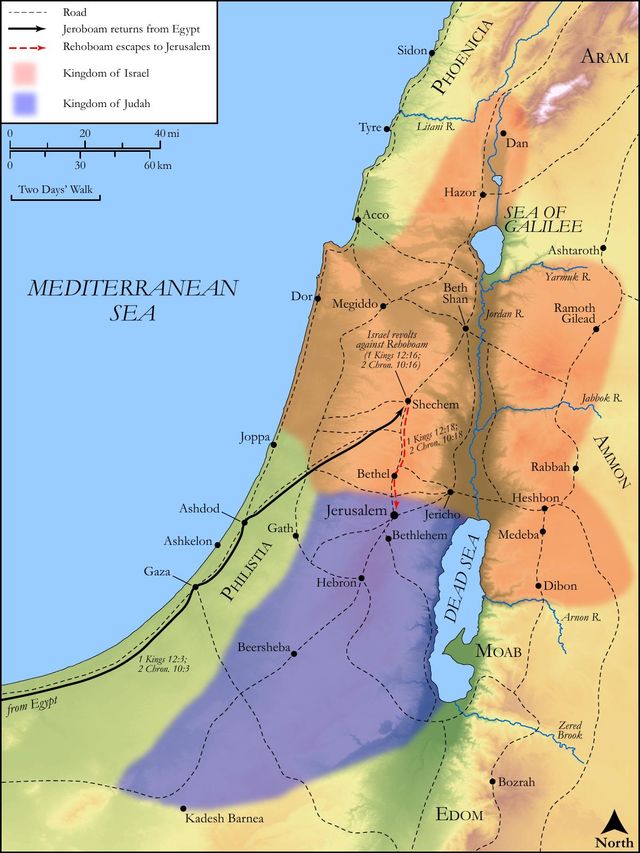
See on the biblical-era map
Study this verse
Public-domain commentary
Matthew Henry
From his Commentary on the Whole Bible. Henry comments on passages, not single verses — this entry covers 2 Chronicles 10:12–19.
We may learn here, 1. That when public affairs are in a ferment violent proceedings do but make bad worse. Rough answers (such as Rehoboam here gave) do but stir up anger and bring oil to the flames. The pilot has need to steer steadily in a storm. Many have been driven to the mischief they did not intend by being too severely dealt with for what they did intend. 2. That, whatever the devices and designs of men are, God is, by all, doing his own work, and fulfilling the word which he has spoken, no iota or tittle of which shall fall to the ground. The cause of the king's obstinacy and thoughtlessness was of God, that he might perform the word which he spoke by Ahijah, Ch2 10:15. This does not at all excuse Rehoboam's folly, nor lessen the guilt of his haughtiness and passion, that God was pleased to serve his own ends by them. 3. That worldly wealth, honour, and dominion, are very uncertain things. Solomon reigned over all Israel, and, one would think, had done enough to secure the monarchy entire to his family for many ages; and yet he is scarcely cold in his grave before ten of the twelve tribes finally revolt from his son. All the good services he had done for Israel were now forgotten: What portion have we in David? Thus is the government of Christ cast off by many, notwithstanding all he has done to bind the children of men for ever to himself; they say, We will not have this man to reign over us. But this rebellion will certainly be their ruin. 4. That God often visits the iniquities of the fathers upon the children. Solomon forsakes God, and therefore not he, but his son after him, is forsaken by the greatest part of his people. Thus God, by making the penal consequences of sin to last long and visibly to continue after the sinner's death, would give an indication of its malignity, and perhaps some intimation of the perpetuity of its punishment. He that sins against God not only wrongs his soul, but perhaps wrongs his seed more than he thinks of. 5. That, when God is fulfilling his threatenings, he will take care of that, at the same time, promises do not fall to the ground. When Solomon's iniquity is remembered, and for it his son loses ten tribes, David's piety is not forgotten, nor the promise made to him; but for the sake of that his grandson had two tribes preserved to him. The failings of the saints shall not frustrate any promise made to Christ their Head. They shall be chastised, but the covenant not broken, Psa 89:31-34.
Continue studying 2 Chronicles 10:13 across the web’s major study libraries — every link below opens this exact verse, chapter, or book on the destination site.
Read & Compare
 BibleGatewayThis verse in more than 200 translations and 70 languages.
 Bible.comThe YouVersion reader — hundreds of translations, reading plans, and highlights.
 ESV.orgCrossway's official English Standard Version reader.
 NET BibleThe NET translation with 60,000+ translators' notes on every rendering decision.
 STEP BibleTyndale House's free study tool — original text, vocabulary, and scholarly resources.
 BibliaLogos Bible Software's free web reader.
 USCCBThe New American Bible (Revised Edition) with the U.S. bishops' study notes.
Commentaries
 BibleHub CommentariesDozens of classic commentaries on this verse, gathered on one page.
 StudyLightMore than 100 commentary sets — the largest collection on the web.
 BibleRefPlain-English commentary on what this verse means, verse by verse.
 Enduring WordDavid Guzik's free commentary on this chapter, widely used by Bible teachers.
 Bible Study ToolsVerse commentary alongside Greek and Hebrew study aids.
Original Language & Research
- BibleHub InterlinearThe verse word by word — original language, transliteration, and English.
- BibleHub LexiconEvery word's original-language definition and Strong's entry.
 Blue Letter BibleDeep-study tools — Strong's numbers, concordance, and word studies.
 SefariaThe Hebrew text with Rashi and centuries of Jewish commentary.
Sermons, Hymns & Audio


TrulyRandomVerse is not affiliated with these sites and doesn’t control their content. They’re linked because they’re genuinely useful.
Summary
Rehoboam's decision, recorded in 2 Chronicles 10:13, marks the definitive point of schism for the united monarchy of Israel. Disregarding the wise and conciliatory counsel of the experienced elders who had faithfully served his father, Solomon, Rehoboam instead embraced the aggressive and self-serving advice of his younger contemporaries. His harsh and unyielding response to the people's legitimate plea for relief from burdensome taxation and labor directly precipitated the rebellion of the northern tribes, forever altering the political and spiritual landscape of God's chosen nation.
Context
ShowHideLiterary Context
This verse is situated at the climax of a critical narrative sequence immediately following the death of King Solomon. The people of Israel, gathered at Shechem, approach Rehoboam with a petition to alleviate the oppressive "heavy yoke" of service and taxation imposed by his father (2 Chronicles 10:3-4). Rehoboam, faced with this significant demand, initially seeks counsel, first from the older, experienced advisors who had served Solomon throughout his reign (2 Chronicles 10:6), and then, crucially, from the young men with whom he had grown up (2 Chronicles 10:8). The elders advocate for a gentle, servant-hearted approach, promising the people's lifelong loyalty if he would speak kindly and serve them (2 Chronicles 10:7). In stark contrast, the young men urge him to declare an even greater burden, asserting his authority with an iron fist and threatening increased oppression (2 Chronicles 10:9-11). Verse 2 Chronicles 10:13 reveals Rehoboam's disastrous choice to publicly embrace the latter, directly setting the stage for the rebellion of the ten northern tribes and the subsequent division of the kingdom, as detailed in the verses immediately following (2 Chronicles 10:16-19).
Historical & Cultural Context
The transition of power from a highly successful monarch like Solomon to his son was a critical juncture in the kingdoms of that day, often fraught with political instability. Shechem was a historically significant location for Israelite assemblies, dating back to the time of Joshua, making it a natural and traditional place for the people to convene and present their grievances to the new king (Joshua 24:1). The "yoke" referred to the forced labor and heavy taxation that Solomon had implemented to fund his vast building projects, including the temple and his palace, which had become a significant burden on the populace (1 Kings 12:4). Culturally, it was generally expected that a new king would listen to his people and address their concerns, often beginning his reign with acts of benevolence or concessions to secure popular support. The role of "elders" (זְקֵנִים, zĕqēnîm) in Israelite society was paramount; they were respected figures of wisdom, experience, and authority, whose counsel was typically highly valued and often sought by leaders. Rehoboam's rejection of their advice, particularly in favor of the counsel of his "young men" (יְלָדִים, yĕlādîm), signifies a profound cultural and political misstep, demonstrating a disregard for established wisdom and a preference for assertive, perhaps even tyrannical, rule.
Key Themes
ShowHideThis verse powerfully contributes to several overarching themes within 2 Chronicles and the broader biblical narrative. Firstly, it highlights the Rejection of Wise Counsel, a recurring motif in wisdom literature, especially in the book of Proverbs, where the pursuit and acceptance of wisdom are consistently lauded as paths to life and prosperity, while its rejection leads to ruin (Proverbs 11:14 and Proverbs 15:22). Rehoboam's actions serve as a stark negative example, illustrating the catastrophic consequences of ignoring sound, experienced advice. Secondly, the narrative underscores the Dangers of Pride and Arrogance in Leadership. Rehoboam's desire to assert absolute control and his unwillingness to humble himself and serve the people ultimately led to the fragmentation of his kingdom, illustrating the biblical principle that "pride goes before destruction, and a haughty spirit before a fall" (Proverbs 16:18). Finally, while Rehoboam's decision was rooted in human folly, the Chronicler, like the author of Kings, emphasizes Divine Sovereignty in the unfolding events. The narrative explicitly states that this turn of events was "from the Lord" (2 Chronicles 10:15), fulfilling the prophecy made to Jeroboam concerning the division of the kingdom (1 Kings 11:29-39), demonstrating that even human sin and foolishness can serve God's ultimate, redemptive purposes.
Exposition and Analysis
ShowHideKey Word Analysis
ShowHideThis adverb describes the manner in which Rehoboam answered the people. From the root meaning "severe," qâsheh conveys an unyielding, ungracious, and confrontational tone. It suggests not merely a firm answer, but one delivered with an intent to dominate and intimidate, lacking any empathy or desire for reconciliation. This word choice immediately signals the king's character and the impending negative outcome, highlighting his obstinate and hard-hearted approach.
This verb signifies a deliberate and conscious abandonment, a turning away from. It is not merely an oversight or a failure to consider, but an active, decisive rejection. Rehoboam "forsook" the counsel of the old men, implying that he weighed both options—the path of wisdom and humility versus the path of power and arrogance—and consciously chose to discard the former. This word emphasizes the intentionality of his destructive choice and his active repudiation of sound advice.
This noun refers to advice or a plan, and by implication, prudence. The "counsel" offered by the old men was rooted in experience and a deep understanding of the people's needs and the dynamics of leadership. It was a plan for peace and unity, based on the king serving his people. Rehoboam's forsaking of this ʻêtsâh demonstrates his rejection of prudence and a well-considered strategy for the kingdom's welfare, opting instead for a self-serving and ultimately destructive agenda.
Verse Breakdown
ShowHide"And the king answered them roughly"
This clause describes Rehoboam's public declaration to the assembled people. His response was not conciliatory or diplomatic, but harsh and confrontational, delivered with a tone of severity and a lack of compassion. This immediate, ungracious tone set the stage for the people's reaction, signaling his intent to rule with an even heavier hand than his father. It was a direct affront to their legitimate plea and a clear indication of his prideful and unyielding disposition.
"and king Rehoboam forsook the counsel of the old men"
This second clause reveals the underlying reason for his rough answer and the core of his fatal error. Rehoboam had been presented with two distinct paths: one of gentle service and wisdom (from the elders), and one of harsh assertion of power (from the young men). By "forsaking" the elders' counsel, he consciously and deliberately rejected the path that would have preserved the unity of the kingdom and fostered loyalty. This act of abandonment highlights his profound lack of discernment and his preference for self-aggrandizement over the well-being and stability of his people.
Literary Devices
ShowHideThe Chronicler masterfully employs several literary devices in this concise verse to convey its profound significance. Juxtaposition is central, as Rehoboam's "rough" answer stands in stark contrast to the "good words" and gentle counsel offered by the elders, which would have ensured the people's lifelong loyalty. This highlights the king's poor judgment and the two divergent paths available to him, one leading to peace, the other to division. The verse also functions as powerful Foreshadowing, as Rehoboam's harshness and explicit rejection of wisdom immediately signal the impending catastrophe of the kingdom's division. His words are not merely a response but a catalyst for the national upheaval that follows. Furthermore, there is a strong element of Irony: Rehoboam's attempt to assert absolute authority and control through a "rough" answer and the threat of increased burdens ultimately results in the loss of the vast majority of his kingdom. His desire for more power leads directly to him having significantly less, demonstrating the self-defeating nature of pride and tyrannical ambition.
Theological and Thematic Connections
ShowHideRehoboam's tragic decision in 2 Chronicles 10:13 serves as a profound theological object lesson, echoing themes woven throughout the biblical narrative concerning leadership, wisdom, and the consequences of pride. His failure to heed the counsel of the elders underscores the divine value placed on wisdom, particularly that which comes from experience and a humble spirit, as opposed to the foolishness that often accompanies arrogance and a desire for unchecked power. This episode reminds us that true authority, especially in God's economy, is often exercised through service and humility, not through domination. Moreover, while Rehoboam's choice was undeniably a product of his own sin and folly, the Chronicler's note that "it was a turn of affairs brought about by God" (2 Chronicles 10:15) highlights God's overarching sovereignty, demonstrating His ability to work even through human sin and foolishness to fulfill His prophetic word and sovereign plan, in this case, the division of the kingdom as a consequence of Solomon's unfaithfulness.
Reflection and Application
ShowHideRehoboam's story is a timeless cautionary tale for all who hold positions of leadership, whether in the church, the home, the workplace, or civic life, and indeed for every individual facing significant decisions. It challenges us to examine our own hearts: are we truly open to wise counsel, especially when it contradicts our preconceived notions or challenges our pride? Do we value the experience and wisdom of those who have walked a longer path, or are we more inclined to listen to voices that affirm our desires for control and self-assertion, perhaps even flattering our ego? Effective leadership, and indeed effective living, requires humility, a willingness to serve, and the discernment to distinguish between sound, selfless advice and self-serving flattery. Before making crucial decisions, particularly those that impact others, we must prayerfully consider the long-term consequences of our words and actions, lest our short-sightedness and pride lead to division, conflict, and profound regret. The path of humility, though often difficult, is ultimately the path of wisdom and lasting fruitfulness.
Questions for Reflection
ShowHideFAQ
ShowHideWhy did Rehoboam reject the elders' counsel in favor of the young men's advice?
ShowHideRehoboam's rejection of the elders' counsel stemmed primarily from a combination of pride, a desire to assert absolute authority, and the influence of his younger, less experienced peers. The elders advised a path of servant leadership and humility, which would have required Rehoboam to "serve" the people and speak "good words" to them (2 Chronicles 10:7). This likely felt like a weakening of his royal power or an affront to his kingly dignity. In contrast, the young men appealed to his desire for strength and control, urging him to declare that he would increase the people's burdens, asserting his dominance from the outset (2 Chronicles 10:10-11). Rehoboam, lacking the wisdom and humility of his father Solomon in his early reign, chose the path that promised immediate, unchallenged power, ultimately leading to his downfall. Moreover, the text explicitly states that this turn of events was "from the Lord" (2 Chronicles 10:15), indicating a divine purpose behind his human folly, fulfilling earlier prophecies.
What was the immediate consequence of Rehoboam's decision to answer the people roughly?
ShowHideThe immediate and devastating consequence of Rehoboam's rough answer and his rejection of wise counsel was the rebellion of the ten northern tribes of Israel. Upon hearing his harsh words and the threat of increased burdens, the people declared, "What portion have we in David? We have no inheritance in the son of Jesse! To your tents, O Israel! Look now to your own house, O David!" (2 Chronicles 10:16). They then made Jeroboam their king, leaving Rehoboam to rule only over the tribes of Judah and Benjamin (2 Chronicles 10:17-19). This pivotal event marked the permanent division of the united monarchy of Israel into the Northern Kingdom (Israel) and the Southern Kingdom (Judah), a schism that profoundly shaped the subsequent history of God's people and led to centuries of conflict and spiritual decline.
Christ-Centered Fulfillment
ShowHideRehoboam's disastrous leadership, characterized by pride, harshness, and the rejection of wise counsel, stands in stark contrast to the perfect leadership of Jesus Christ, the true and eternal King. Where Rehoboam sought to impose a heavier yoke and assert his own power, Jesus invites us to take His "yoke upon you, and learn from me, for I am gentle and lowly in heart, and you will find rest for your souls. For my yoke is easy, and my burden is light" (Matthew 11:28-30). Rehoboam's arrogance led to division and the loss of his kingdom; Christ's profound humility, exemplified in His self-emptying and obedience even to death on a cross, brought about reconciliation and the establishment of an eternal kingdom (Philippians 2:5-8). Unlike Rehoboam, who forsook wisdom and counsel, Jesus is the very embodiment of God's wisdom, "Christ the power of God and the wisdom of God" (1 Corinthians 1:24). He is the true and faithful King who did not come to be served, but to serve, and to give His life as a ransom for many (Mark 10:45). Through His perfect obedience and sacrificial death, Jesus unites those who were once divided, breaking down the dividing wall of hostility and bringing peace between God and humanity, and among people themselves (Ephesians 2:14), offering a stark and glorious contrast to the division wrought by Rehoboam's folly.