


2 Chronicles 10:6
Bible text: King James Version (1769 Blayney text) · Public domain
Bible text: King James Version with Strong's numbers · Public domain
Bible text: Berean Standard Bible · Public domain
Bible text: American Standard Version (1901) · Public domain
Bible text: World English Bible, Messianic edition · Public domain
Bible text: Geneva Bible (1599) · Public domain
Bible text: Young's Literal Translation · Public domain
- וַיִּוָּעַץvai·yi·va·'Atzand he consultedH3289Conj-w ¦ V-Niphal-ConsecImperf-3msVerb Niphal Consecutive Imperfect 3rd Singular Masculineוַandיִּוָּעַץhe consulted
- הַמֶּלֶךְha·Me·lekhthe kingH4428Art ¦ N-msNoun Singular Masculine Absoluteהַtheמֶּלֶךְking
- רְחַבְעָםre·chav·'AmRehoboamH7346N-proper-mNoun Proper Masculine
- אֶת'etwithH854PrepPreposition
- הַזְּקֵנִיםha·ze·ke·Nimthe eldersH2205Art ¦ Adj-mpAdjective Plural Masculine Absoluteהַtheזְּקֵנִיםelders
- אֲשֶׁר'a·SherwhoH834RelParticle Relative
- הָיוּha·Yuthey had beenH1961V-Qal-Perf-3cpVerb Qal Perfect 3rd Plural common gender
- עֹמְדִים'o·me·DimstandingH5975V-Qal-Prtcpl-mpVerb Qal Participle Plural Masculine Absolute
- לִפְנֵיlif·Nei<to> beforeH6440Prep-l ¦ N-mpcNoun Plural Masculine Constructלִ<to>פְנֵיbefore
- שְׁלֹמֹהshe·lo·MohSolomonH8010N-proper-mNoun Proper Masculine
- אָבִיו'a·Vivhis fatherH1N-msc ¦ 3msNoun Singular Masculine Constructאָבִיfatherוhis
- בִּהְיֹתוֹbih·yo·Towhen he wasH1961Prep-b ¦ V-Qal-Inf ¦ 3msVerb Qal Infinitive Constructבִּwhenהְיֹתwasוֹhe
- חַיchaialiveH2416Adj-msAdjective Singular Masculine Absolute
- לֵאמֹרle·Mor<to> sayingH559Prep-l ¦ V-Qal-InfVerb Qal Infinitive Constructלֵ<to>אמֹרsaying
- אֵיךְ'eikhhow?H349InterrogParticle Interrogative
- אַתֶּם'a·Tem[are] youH859Pro-2mpPronoun Personal 2nd Plural Masculine
- נוֹעָצִיםno·'a·TzimcounselingH3289V-Niphal-Prtcpl-mpVerb Niphal Participle Plural Masculine Absolute
- לְהָשִׁיבle·ha·Shivto bring backH7725Prep-l ¦ V-Hiphil-InfVerb Hiphil Infinitive Constructלְtoהָשִׁיבbring back
- לָעָםla·'omto the peopleH5971Prep-l ¦ N-msNoun Singular Masculine Absoluteלָto theעָםpeople
- הַזֶּהha·Zeh<the> thisH2088Art ¦ PrtParticle Demonstrativeהַ<the>זֶּהthis
- דָּבָרda·VarwordH1697N-msNoun Singular Masculine Absolute
English is a literal word-by-word gloss of the Hebrew, not the KJV's wording. Why?
This is the original text the KJV's translators worked from — each Hebrew word with its own literal English meaning in this verse, prepared by scholars at Tyndale House, Cambridge. The KJV translates whole sentences, not word by word, so its wording differs: one Hebrew word can become several English words, and the KJV may choose “the LORD” where the gloss reads “Yahweh”. Both are faithful — they answer different questions. For the KJV's own rendering, switch to the KJV text.
Details
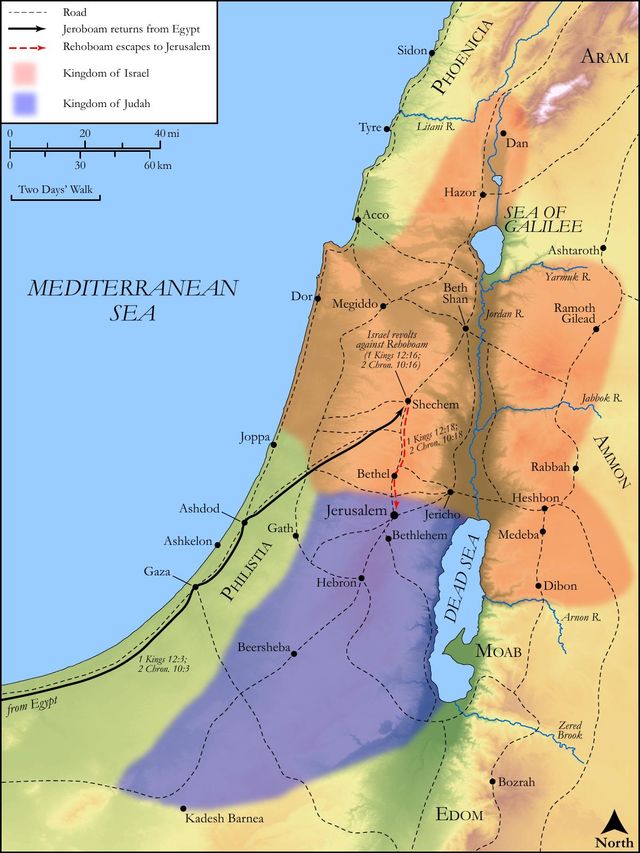
See on the biblical-era map
Study this verse
Public-domain commentary
Matthew Henry
From his Commentary on the Whole Bible. Henry comments on passages, not single verses — this entry covers 2 Chronicles 10:1–11.
We may observe here, 1. The wisest and best cannot give every body content. Solomon enriched and advanced his kingdom, did all (one would think) that could be done to make then happy and easy; and yet either he was indiscreet in burdening them with the imposition of taxes and services, or at least there was some colour of reason to think him so. No man is perfectly wise. It is probable that it was when Solomon had declined from God and his duty that his wisdom failed him, and God left him to himself to act in this impolitic manner. Even Solomon's treasures were exhausted by his love of women; and probably it was to maintain them, and their pride, luxury, and idolatry, that he burdened his subjects. 2. Turbulent and ungrateful spirits will find fault with the government, and complain of grievances, when they have very little reason to do so. Had they not peace in Solomon's time? They were never plundered by invaders, as formerly, never put in fear by the alarms of war, nor obliged to hazard their lives in the high places of the field. Had they not plenty - meat enough, and money enough? What would they more? O fortunatos nimium, sua si bona norint! - O happy, if they knew their happy state! And yet they complain that Solomon made their yoke grievous. If any complain thus of the yoke of Christ, that they might have a pretence to break his bands in sunder and cast away his cords from them, we are sure that he never gave them any cause at all for the complaint, whatever Solomon did. His yoke is easy, and his burden is light. He never made us serve with an offering, nor wearied us with incense. 3. Many ruin themselves and their interests by trampling upon and provoking their inferiors. Rehoboam thought that because he was king he might assume as much authority as his father had done, might have what he would, and do what he would, and carry all before him. But, though he wore his father's crown, he wanted his father's brains, and ought to have considered that, being quite a different man from what his father was, he ought to take other measures. Such a wise man as Solomon may do as we will, but such a fool as Rehoboam must do as he can. The high-mettled horse may be kicked and spurred by him that has the art of managing him; but, if an unskilful horseman do it, it is at his peril. Rehoboam paid dearly for threatening, and talking big, and thinking to carry matters with a high hand. It was Job's wisdom, as well as his virtue, that he despised not the cause of his man-servant or maid-servant, when they argued with him (Job 31:13), but heard them patiently, considered their reasons, and gave them a soft answer. And a similar tender consideration of those in subjection, and a forwardness to make them easy, will be the comfort and praise of all in authority, in the church, in the state, and in families. 4. Moderate counsels are generally wisest and best. Gentleness will do what violence will not do. Most people love to be accosted mildly. Rehoboam's old experienced counsellors directed him to this method (v. 7): "Be kind to this people, and please them, and speak good words to them, and thou art sure of them for ever." Good words cost nothing but a little self-denial, and yet they purchase good things. 5. God often fulfils the counsels of his own wisdom by infatuating men, and giving them up to the counsels of their own folly. No more needs to be done to ruin men than to leave them to themselves, and their own pride and passion.
Continue studying 2 Chronicles 10:6 across the web’s major study libraries — every link below opens this exact verse, chapter, or book on the destination site.
Read & Compare
 BibleGatewayThis verse in more than 200 translations and 70 languages.
 Bible.comThe YouVersion reader — hundreds of translations, reading plans, and highlights.
 ESV.orgCrossway's official English Standard Version reader.
 NET BibleThe NET translation with 60,000+ translators' notes on every rendering decision.
 STEP BibleTyndale House's free study tool — original text, vocabulary, and scholarly resources.
 BibliaLogos Bible Software's free web reader.
 USCCBThe New American Bible (Revised Edition) with the U.S. bishops' study notes.
Commentaries
 BibleHub CommentariesDozens of classic commentaries on this verse, gathered on one page.
 StudyLightMore than 100 commentary sets — the largest collection on the web.
 BibleRefPlain-English commentary on what this verse means, verse by verse.
 Enduring WordDavid Guzik's free commentary on this chapter, widely used by Bible teachers.
 Bible Study ToolsVerse commentary alongside Greek and Hebrew study aids.
Original Language & Research
- BibleHub InterlinearThe verse word by word — original language, transliteration, and English.
- BibleHub LexiconEvery word's original-language definition and Strong's entry.
 Blue Letter BibleDeep-study tools — Strong's numbers, concordance, and word studies.
 SefariaThe Hebrew text with Rashi and centuries of Jewish commentary.
Sermons, Hymns & Audio


TrulyRandomVerse is not affiliated with these sites and doesn’t control their content. They’re linked because they’re genuinely useful.
Summary
2 Chronicles 10:6 initiates the pivotal narrative of King Rehoboam's reign, immediately following the northern tribes' demand for relief from the burdens imposed by his father, Solomon. This verse details Rehoboam's initial, seemingly prudent act of seeking counsel from the seasoned advisors who had served Solomon. It sets the stage for a critical decision that will profoundly determine the future unity and trajectory of the Israelite kingdom, highlighting the immense pressure and responsibility inherent in royal succession.
Context
ShowHideLiterary Context
This verse is the immediate narrative response to the people's petition presented to Rehoboam at Shechem, as detailed in 2 Chronicles 10:1-5. The people, representing the ten northern tribes, approach the newly crowned king with a unified demand to lighten the "heavy yoke" of taxation and forced labor that characterized Solomon's ambitious reign. Rehoboam's decision to consult with his father's elders marks the first step in his response, directly preceding his subsequent, ill-fated consultation with the younger men and his ultimate rejection of wise counsel. This sequence of events directly precipitates the tragic division of the kingdom, making 2 Chronicles 10:6 a crucial turning point that foreshadows the national schism.
Historical & Cultural Context
The transition of power after Solomon's death presented a critical moment for the united monarchy. Solomon's reign, while marked by unparalleled wisdom and prosperity, also involved significant economic strain on the populace due to massive building projects (e.g., the Temple, royal palaces, fortifications). This led to widespread discontent, particularly among the northern tribes who felt disproportionately burdened. Shechem, the location of this confrontation, was a historically significant site for tribal assemblies and covenant renewals (Joshua 24), lending a deep sense of historical and religious gravity to the proceedings. The "old men" (Hebrew: haz'qenim) were not merely aged individuals but held a revered status as experienced, wise counselors, having served in the royal court of King Solomon, whose wisdom was legendary among the nations round about (see 1 Kings 4:29-34). Their presence signifies the availability of established, traditional wisdom at this critical juncture.
Key Themes
ShowHideThis verse introduces and develops several profound themes central to the Chronicler's theological agenda and the broader biblical narrative. Firstly, it highlights the theme of Leadership and Succession, underscoring the immense pressures and moral choices faced by new monarchs. Rehoboam's initial action of seeking counsel, though ultimately undermined by his subsequent choices, sets the stage for a dramatic exploration of how a leader's character, discernment, and humility can determine the fate of an entire nation. Secondly, the passage emphasizes the critical importance of Seeking Wise Counsel, illustrating that true wisdom is often found in the multitude of experienced advisors, a concept echoed throughout the wisdom literature of the Old Testament. This theme stands in stark contrast to the emerging theme of Folly and its Consequences, as Rehoboam's eventual rejection of the elders' prudent advice leads directly to the catastrophic division of the united kingdom, serving as a powerful object lesson on the dangers of pride and a lack of discernment in leadership.
Exposition and Analysis
ShowHideKey Word Analysis
ShowHideThis verb signifies a deliberate and intentional act of seeking advice, deliberating, or consulting. It suggests that Rehoboam, at this initial stage, recognized the gravity of the situation and the necessity of external input to navigate the complex political demands, indicating an ostensibly prudent approach to his new leadership role.
More than simply denoting advanced age, this term refers to individuals who possess wisdom, experience, and authority, often serving as respected elders or advisors within a community or royal court. These were men who had "stood before" King Solomon, implying a long history of trusted service and intimate knowledge of state affairs, making their counsel particularly weighty.
While broadly meaning "word" or "matter," in this context, "answer" specifically refers to the response Rehoboam intends to give to the people's petition. It highlights the critical nature of the communication, as the "word" he speaks will either alleviate or exacerbate the national tension, underscoring the power and consequence of a leader's words.
Verse Breakdown
ShowHide"And king Rehoboam took counsel"
This opening clause immediately establishes Rehoboam's first official action as the newly enthroned king. It highlights his recognition of the need for guidance in addressing the significant challenge presented by the people, indicating an initial, seemingly responsible approach to his leadership.
"with the old men that had stood before Solomon his father while he yet lived"
This specifies the precise source of Rehoboam's initial consultation. He turned to the most experienced and proven advisors available—those who had served his wise father, Solomon. This choice suggests an initial inclination towards prudence, valuing established wisdom and continuity with his father's successful reign.
"saying, What counsel give ye [me] to return answer to this people?"
This direct question reveals the specific nature of Rehoboam's dilemma. He is seeking advice on how to formulate his response to the people's urgent petition for relief from the heavy burdens of Solomon's reign, indicating the high stakes involved in his upcoming decision and the profound impact his "answer" will have on the nation.
Literary Devices
ShowHideThe verse employs several significant literary devices that enrich its meaning and foreshadow future events. Foreshadowing is prominent, as Rehoboam's act of seeking counsel, while initially appearing wise, subtly hints at his eventual tragic failure to heed the sound advice, thereby leading to the kingdom's division. This sets up a powerful Contrast between the accumulated wisdom and experience embodied by the old men and the youthful folly that will later characterize Rehoboam's decision to reject their counsel in favor of his peers' advice. There is also a strong element of Irony in this verse: Rehoboam actively seeks counsel from those best positioned to offer it, yet the subsequent narrative reveals that he ultimately rejects their prudent advice, leading to the very outcome he sought to avoid—the disunity and fracturing of his kingdom.
Theological and Thematic Connections
ShowHide2 Chronicles 10:6 is a foundational text for understanding the biblical emphasis on wisdom, leadership, and the profound consequences of choices. It underscores that while seeking counsel is a mark of prudence and humility, true wisdom lies not merely in the act of consultation but in discerning and applying the right advice, especially when faced with critical decisions that impact many. Rehoboam's initial act of consultation aligns with the wisdom tradition found throughout Scripture, which consistently extols the value of multiple, experienced counselors. However, the subsequent narrative reveals the dangers of pride, self-will, and a lack of discernment, demonstrating that even good intentions can be derailed by a failure to heed sound wisdom. The catastrophic division of the kingdom serves as a stark reminder of the profound spiritual, social, and political consequences of foolish leadership and the rejection of divine wisdom.
Reflection and Application
ShowHideThe account of Rehoboam serves as a timeless and potent lesson for leaders in any sphere—whether in government, business, family, or the church. It underscores the critical importance of seeking advice from those with proven experience, wisdom, and a track record of sound judgment, especially during times of crisis, transition, or when facing decisions with far-reaching implications. While seeking counsel is a necessary first step, the narrative further implies the profound necessity of discerning which counsel to follow. True wisdom often lies in understanding the long-term implications of decisions, prioritizing the well-being and flourishing of those being led over personal pride, immediate gratification, or short-sighted gains. This verse encourages us to cultivate the humility required to accept counsel that may challenge our own inclinations but ultimately leads to a more righteous and beneficial path for all involved.
Questions for Reflection
ShowHideFAQ
ShowHideWhy did Rehoboam seek counsel from two different groups?
ShowHideRehoboam first sought counsel from the "old men" who had served his father, Solomon, likely valuing their extensive experience, deep understanding of state affairs, and traditional wisdom. However, after hearing their advice—which advocated for a compassionate and conciliatory approach—he then consulted with the "young men" with whom he had grown up. While the text doesn't explicitly state his motivation for consulting a second group, it's widely understood that he was either genuinely seeking a broader perspective or, more likely, looking for advice that would align more closely with his own desires for power and a more assertive, less compromising, style of leadership. This act highlights a common leadership pitfall: seeking multiple opinions not for true discernment, but to find validation for a pre-conceived notion or to avoid difficult, but necessary, courses of action. The outcome demonstrates the folly of rejecting seasoned wisdom for rash, self-serving counsel, leading to the division of the kingdom.
What was the "heavy yoke" the people complained about?
ShowHideThe "heavy yoke" refers to the oppressive burdens of forced labor (corvée) and heavy taxation that King Solomon had imposed on the people of Israel throughout his reign. These immense demands were necessary to fund his ambitious and extensive building projects, which included the construction of the magnificent Temple in Jerusalem, his lavish royal palace, and numerous fortifications and cities across the kingdom. While these projects brought glory, wealth, and infrastructure to Israel, they came at a significant human cost, leading to widespread discontent and resentment, particularly among the northern tribes who felt disproportionately burdened by these policies. This "yoke" symbolized the severe demands placed upon the populace, leading to their desperate plea for relief from Rehoboam upon his ascension to the throne. For context on Solomon's administrative structure and labor force, see 1 Kings 4:7 and 1 Kings 5:13.
Christ-Centered Fulfillment
ShowHideRehoboam's tragic failure to heed wise counsel and his subsequent harshness stand in stark contrast to the perfect wisdom and gentle leadership of Jesus Christ, the ultimate King. While Rehoboam sought counsel but ultimately brought division through his oppressive demands, Christ is the quintessential "Wonderful Counselor," as prophesied in Isaiah 9:6. He does not impose a heavy yoke of legalism or unbearable burdens but rather invites all who are weary and burdened to come to Him, promising that His "yoke is easy and His burden is light" (Matthew 11:28-30). Unlike Rehoboam, who sought his own will and brought about schism, Jesus consistently sought only the will of His Father (John 5:30), leading to ultimate unity, reconciliation, and eternal life. Through His sacrificial death on the cross and triumphant resurrection, Christ broke down the dividing wall of hostility between God and humanity, and between Jew and Gentile (Ephesians 2:14-16), gathering a people from every tribe, tongue, and nation into one body, the Church, under His perfect and eternal reign. His leadership is characterized by humility, sacrificial service, and life-giving truth, fulfilling all that earthly kings like Rehoboam failed to embody, and offering a kingdom that will never be divided (Daniel 2:44).