


2 Chronicles 10:7
Bible text: King James Version (1769 Blayney text) · Public domain
Bible text: Berean Standard Bible · Public domain
Bible text: American Standard Version (1901) · Public domain
Bible text: World English Bible, Messianic edition · Public domain
Bible text: Geneva Bible (1599) · Public domain
Bible text: Young's Literal Translation · Public domain
- וַיְדַבְּרוּvay·da·be·Ruand they spokeH1696Conj-w ¦ V-Piel-ConsecImperf-3mpVerb Piel Consecutive Imperfect 3rd Plural Masculineוַandיְדַבְּרוּthey spoke
- אֵלָיו'e·Lavto himH413Prep ¦ 3msPrepositionאֵלָיtoוhim
- לֵאמֹרle·Mor<to> sayingH559Prep-l ¦ V-Qal-InfVerb Qal Infinitive Constructלֵ<to>אמֹרsaying
- אִם'imifH518PrtParticle Conditional
- תִּהְיֶהtih·Yehyou will becomeH1961V-Qal-Imperf-2msVerb Qal Imperfect 2nd Singular Masculine
- לְטוֹבle·Tov<into> goodH2896Prep-l ¦ Adj-msAdjective Singular Masculine Absoluteלְ<into>טוֹבgood
- לְהָעָםle·ha·'Amto the peopleH5971Prep-l ¦ Art ¦ N-msNoun Singular Masculine Absoluteלְtoהָtheעָםpeople
- הַזֶּהha·Zeh<the> thisH2088Art ¦ PrtParticle Demonstrativeהַ<the>זֶּהthis
- וּרְצִיתָםu·re·tzi·Tamand you will be favorable to themH7521Conj-w ¦ V-Qal-ConsecPerf-2ms ¦ 3mpVerb Qal Consecutive Perfect 2nd Singular Masculineוּandרְצִיתָyou will be favorable toםthem
- וְדִבַּרְתָּve·di·bar·Taand you will speakH1696Conj-w ¦ V-Piel-ConsecPerf-2msVerb Piel Consecutive Perfect 2nd Singular Masculineוְandדִבַּרְתָּyou will speak
- אֲלֵהֶם'a·le·Hemto themH413Prep ¦ 3mpPrepositionאֲלֵtoהֶםthem
- דְּבָרִיםde·va·RimwordsH1697N-mpNoun Plural Masculine Absolute
- טוֹבִיםto·VimkindH2896Adj-mpAdjective Plural Masculine Absolute
- וְהָיוּve·ha·Yuand they will beH1961Conj-w ¦ V-Qal-ConsecPerf-3cpVerb Qal Consecutive Perfect 3rd Plural common genderוְandהָיוּthey will be
- לְךָle·Khaof youPrep-l ¦ 2msSuffix Personal 2nd Singular Masculineלְofךָyou
- עֲבָדִים'a·va·DimservantsH5650N-mpNoun Plural Masculine Absolute
- כָּלkolallH3605N-mscNoun Singular Masculine Construct
- הַיָּמִיםhai·ya·Mimthe daysH3117Art ¦ N-mpNoun Plural Masculine Absoluteהַtheיָּמִיםdays
English is a literal word-by-word gloss of the Hebrew, not the KJV's wording. Why?
This is the original text the KJV's translators worked from — each Hebrew word with its own literal English meaning in this verse, prepared by scholars at Tyndale House, Cambridge. The KJV translates whole sentences, not word by word, so its wording differs: one Hebrew word can become several English words, and the KJV may choose “the LORD” where the gloss reads “Yahweh”. Both are faithful — they answer different questions. For the KJV's own rendering, switch to the KJV text.
Details
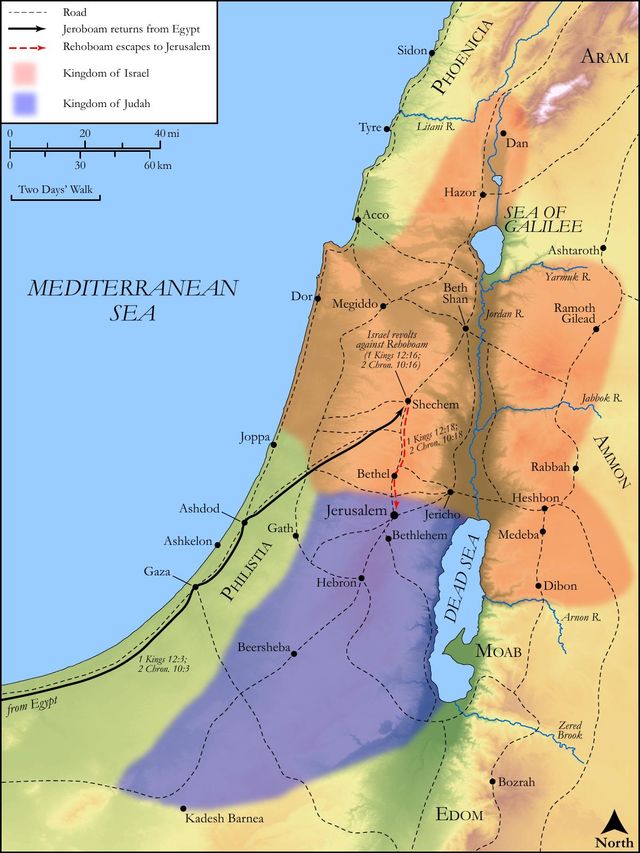
See on the biblical-era map
Study this verse
Public-domain commentary
Matthew Henry
From his Commentary on the Whole Bible. Henry comments on passages, not single verses — this entry covers 2 Chronicles 10:1–11.
We may observe here, 1. The wisest and best cannot give every body content. Solomon enriched and advanced his kingdom, did all (one would think) that could be done to make then happy and easy; and yet either he was indiscreet in burdening them with the imposition of taxes and services, or at least there was some colour of reason to think him so. No man is perfectly wise. It is probable that it was when Solomon had declined from God and his duty that his wisdom failed him, and God left him to himself to act in this impolitic manner. Even Solomon's treasures were exhausted by his love of women; and probably it was to maintain them, and their pride, luxury, and idolatry, that he burdened his subjects. 2. Turbulent and ungrateful spirits will find fault with the government, and complain of grievances, when they have very little reason to do so. Had they not peace in Solomon's time? They were never plundered by invaders, as formerly, never put in fear by the alarms of war, nor obliged to hazard their lives in the high places of the field. Had they not plenty - meat enough, and money enough? What would they more? O fortunatos nimium, sua si bona norint! - O happy, if they knew their happy state! And yet they complain that Solomon made their yoke grievous. If any complain thus of the yoke of Christ, that they might have a pretence to break his bands in sunder and cast away his cords from them, we are sure that he never gave them any cause at all for the complaint, whatever Solomon did. His yoke is easy, and his burden is light. He never made us serve with an offering, nor wearied us with incense. 3. Many ruin themselves and their interests by trampling upon and provoking their inferiors. Rehoboam thought that because he was king he might assume as much authority as his father had done, might have what he would, and do what he would, and carry all before him. But, though he wore his father's crown, he wanted his father's brains, and ought to have considered that, being quite a different man from what his father was, he ought to take other measures. Such a wise man as Solomon may do as we will, but such a fool as Rehoboam must do as he can. The high-mettled horse may be kicked and spurred by him that has the art of managing him; but, if an unskilful horseman do it, it is at his peril. Rehoboam paid dearly for threatening, and talking big, and thinking to carry matters with a high hand. It was Job's wisdom, as well as his virtue, that he despised not the cause of his man-servant or maid-servant, when they argued with him (Job 31:13), but heard them patiently, considered their reasons, and gave them a soft answer. And a similar tender consideration of those in subjection, and a forwardness to make them easy, will be the comfort and praise of all in authority, in the church, in the state, and in families. 4. Moderate counsels are generally wisest and best. Gentleness will do what violence will not do. Most people love to be accosted mildly. Rehoboam's old experienced counsellors directed him to this method (v. 7): "Be kind to this people, and please them, and speak good words to them, and thou art sure of them for ever." Good words cost nothing but a little self-denial, and yet they purchase good things. 5. God often fulfils the counsels of his own wisdom by infatuating men, and giving them up to the counsels of their own folly. No more needs to be done to ruin men than to leave them to themselves, and their own pride and passion.
Continue studying 2 Chronicles 10:7 across the web’s major study libraries — every link below opens this exact verse, chapter, or book on the destination site.
Read & Compare
 BibleGatewayThis verse in more than 200 translations and 70 languages.
 Bible.comThe YouVersion reader — hundreds of translations, reading plans, and highlights.
 ESV.orgCrossway's official English Standard Version reader.
 NET BibleThe NET translation with 60,000+ translators' notes on every rendering decision.
 STEP BibleTyndale House's free study tool — original text, vocabulary, and scholarly resources.
 BibliaLogos Bible Software's free web reader.
 USCCBThe New American Bible (Revised Edition) with the U.S. bishops' study notes.
Commentaries
 BibleHub CommentariesDozens of classic commentaries on this verse, gathered on one page.
 StudyLightMore than 100 commentary sets — the largest collection on the web.
 BibleRefPlain-English commentary on what this verse means, verse by verse.
 Enduring WordDavid Guzik's free commentary on this chapter, widely used by Bible teachers.
 Bible Study ToolsVerse commentary alongside Greek and Hebrew study aids.
Original Language & Research
- BibleHub InterlinearThe verse word by word — original language, transliteration, and English.
- BibleHub LexiconEvery word's original-language definition and Strong's entry.
 Blue Letter BibleDeep-study tools — Strong's numbers, concordance, and word studies.
 SefariaThe Hebrew text with Rashi and centuries of Jewish commentary.
Sermons, Hymns & Audio


TrulyRandomVerse is not affiliated with these sites and doesn’t control their content. They’re linked because they’re genuinely useful.
Summary
This pivotal verse records the astute counsel offered to Rehoboam, King Solomon's successor, by the seasoned elders of Israel. They advised him that if he adopted a posture of benevolence, sought to please his people, and communicated with gracious words, their unwavering loyalty and willing service would be perpetually secured. This sagacious counsel stood in stark opposition to the burdensome policies of his father and tragically foreshadowed the kingdom's division when Rehoboam ultimately spurned this wisdom.
Context
ShowHideLiterary Context
This verse is strategically placed at a critical juncture in the biblical narrative, immediately following the death of King Solomon and preceding the formal enthronement of his son, Rehoboam. The account in 2 Chronicles 10 closely parallels 1 Kings 12, detailing the northern tribes' collective appeal to Rehoboam to alleviate the heavy yoke of taxation and forced labor imposed during Solomon's reign. In response, Rehoboam sought counsel from two distinct groups: the experienced elders who had served his father, and his younger contemporaries. This verse presents the wise, compassionate advice offered by the older, more discerning counselors, serving as a foundational moment that sets the stage for Rehoboam's fateful decision and the subsequent fracturing of the united monarchy.
Historical & Cultural Context
The united monarchy, under the reigns of David and Solomon, had achieved unparalleled glory and expansion, yet this came at a significant cost to the populace. Solomon's ambitious construction projects, including the magnificent Temple and his opulent palace, demanded immense resources and extensive forced labor, particularly from the northern tribes. This created deep-seated resentment and widespread discontent. Upon the accession of a new monarch, it was customary for the people to present petitions, often seeking redress for grievances and a lightening of burdens. The elders' counsel reflects a profound understanding of the delicate balance required for stable governance in a tribal society, where loyalty was not merely inherited but had to be continually earned through just and benevolent rule. The distinct identity and historical grievances of the northern tribes, geographically separate from Judah, also contributed to their collective willingness to challenge the central authority in Jerusalem.
Key Themes
ShowHideThe central theme illuminated by this verse is wise and righteous leadership. The elders' advice champions a model of governance rooted in empathy, a desire to please the people, and gracious communication, standing in stark contrast to the authoritarian and burdensome approach that characterized the latter part of Solomon's reign. It underscores the profound truth that genuine authority and lasting loyalty are cultivated through sincere care for the people's well-being, rather than through coercion or oppressive measures. This passage also powerfully highlights the consequences of leadership choices, as Rehoboam's subsequent rejection of this sound counsel, detailed in 2 Chronicles 10:12-19, directly led to the tragic division of the united kingdom into Israel (the northern kingdom) and Judah (the southern kingdom), a pivotal and devastating event in Israel's history. The transformative power of words, capable of either building up or tearing down, is also a significant underlying theme, echoing principles found throughout the wisdom literature, such as in Proverbs 15:1.
Exposition and Analysis
ShowHideKey Word Analysis
ShowHideThe Hebrew word טוֹב (ṭôwb) functions here as an adjective, meaning "good," "pleasant," or "agreeable." When applied to a ruler's disposition or actions, it signifies a benevolent, favorable, and gracious attitude. The counselors are not merely suggesting superficial pleasantness but a fundamental goodness in Rehoboam's character and his approach to governance, one that genuinely prioritizes the well-being and satisfaction of his subjects.
The Hebrew verb רָצָה (râtsâh) means "to be pleased with," "to be acceptable," or "to find favor." In this context, it suggests that Rehoboam should conduct himself in a manner that elicits the people's approval and satisfaction. It implies a desire to act in ways that are agreeable to them, fostering a sense of contentment and goodwill, rather than imposing his will without regard for their sentiments.
The Hebrew noun דָבָר (dâbâr), derived from the root "to speak," refers to a "word," "matter," or "thing." When used in conjunction with "good" (as in "good words"), it emphasizes the content and quality of communication. "Good words" are not just polite expressions, but words that are favorable, encouraging, affirming, and constructive. They imply a willingness to listen, to understand, and to respond with empathy and wisdom, rather than with dismissiveness or arrogance, thereby building trust and loyalty.
Verse Breakdown
ShowHide"And they spake unto him, saying,"
This introductory phrase highlights that the counsel given to Rehoboam was a deliberate, formal, and weighty transmission of wisdom from the experienced, older advisors.
"If thou be kind to this people,"
This establishes the conditional premise for the elders' advice. Rehoboam's success and the people's loyalty are presented as contingent upon his demonstration of a benevolent, gracious, and favorable character in his rule.
"and please them,"
This clause deepens the nature of the required conduct. It's not just a passive attitude but an active effort to act in ways that are agreeable to the people, to gain their favor, and to ensure their contentment, thereby fostering a willing relationship.
"and speak good words to them,"
This emphasizes the critical role of communication in leadership. The elders advise that gracious, affirming, and empathetic speech is essential for cultivating trust, building rapport, and securing the people's willing allegiance.
"they will be thy servants for ever."
This is the promised outcome, the consequence of following the wise counsel. The people's "servitude" would not be a forced or grudging submission, but a willing, loyal, and perpetual service, born out of respect, gratitude, and a sense of being well-governed and pleased by their king.
Literary Devices
ShowHideThe verse primarily employs a Conditional Statement ("If... then..."), a prevalent rhetorical device in wisdom literature used to articulate clear cause-and-effect relationships. This structure directly links Rehoboam's actions—demonstrating kindness, pleasing the people, and speaking good words—to the desired outcome of their perpetual loyalty. Furthermore, the passage utilizes Contrast and Foreshadowing. The wise counsel itself stands in stark contrast to the oppressive policies of Solomon and, more significantly, to Rehoboam's ultimate rejection of this advice, which dramatically highlights his folly. The elders' words also serve as Foreshadowing, subtly hinting at the dire consequences that will inevitably unfold because Rehoboam chose a different, harsher path, leading directly to the kingdom's division. The simplicity and directness of the language also imbue the counsel with an air of Proverbial Wisdom, aligning it with broader biblical teachings on righteous and effective governance.
Theological and Thematic Connections
ShowHideThe counsel given to Rehoboam in 2 Chronicles 10:7 transcends its immediate historical context, offering profound theological insights into the nature of leadership, the power of words, and the dynamics of human relationships, both within a kingdom and within the covenant community. It implicitly champions the principle of leadership that seeks to find favor with the people, where authority is exercised not through domination but through genuine care and a desire to please those being led. This approach fosters willing submission and lasting loyalty, reflecting a divine pattern of governance where God, though sovereign, relates to His people with kindness and grace, inviting their willing obedience. The verse also underscores the immense power of communication, demonstrating that gentle, affirming words can build up and unite, while harsh words can alienate and destroy. Rehoboam's failure to heed this wisdom led to the fracturing of God's chosen nation, serving as a stark reminder that even divinely appointed leaders must govern with wisdom and humility.
Reflection and Application
ShowHideThe timeless wisdom embedded in 2 Chronicles 10:7 offers profound lessons for all individuals, whether in positions of formal leadership or in daily interactions within families, communities, and workplaces. It challenges us to consider how we exercise influence and how our words and actions impact those around us. True leadership, as modeled here, is less about demanding submission and more about earning trust through genuine care, a desire to please, and empathetic communication. It reminds us that lasting relationships, whether between a king and his subjects or between friends and family members, are built on a foundation of kindness and respectful communication, not on coercion or harshness. Our words, in particular, possess immense power to either build up or tear down, to foster unity or sow discord. This passage calls us to be intentional about speaking "good words"—words that encourage, affirm, and bring life—and to cultivate a heart that seeks to please and serve in all our interactions, recognizing that such an approach not only blesses others but also secures a deeper, more willing connection.
Questions for Reflection
ShowHideFAQ
ShowHideWhy did Rehoboam reject such seemingly wise advice, and what does that tell us about human nature?
ShowHideRehoboam's rejection of the elders' counsel, as detailed in 2 Chronicles 10:8-14, was primarily driven by pride, a desire for unchecked power, and a preference for the "tough" advice of his younger, inexperienced peers. He wanted to assert his authority forcefully rather than earn it through benevolent rule. This tells us much about human nature: the temptation to choose a path of perceived strength and dominance over humility and a desire to please is a recurring theme. It illustrates the danger of surrounding oneself with "yes-men" who validate one's own inclinations, even when those inclinations are detrimental. Furthermore, the biblical narrative often attributes such outcomes to God's sovereign will, allowing events to unfold as part of His larger plan, as seen in 2 Chronicles 10:15.
What is the significance of the Hebrew word râtsâh ("please") in this context for understanding leadership?
ShowHideThe Hebrew word râtsâh (רָצָה), translated as "please them" in the KJV, literally means "to be pleased with," "to be acceptable," or "to find favor." Its use here is profoundly significant because it shifts the understanding of leadership from a position of demanding submission to one of earning the people's favor and contentment. The elders were not suggesting that Rehoboam merely appease the people, but that he genuinely conduct himself in a manner that would be agreeable and acceptable to them. This aligns with the concept of servant leadership, a principle later exemplified by Jesus Christ, who taught that true greatness is found in serving others (e.g., Matthew 20:26-28). It suggests that legitimate authority and lasting loyalty are earned when leaders prioritize the welfare and satisfaction of those under their charge, rather than their own power or comfort.
Christ-Centered Fulfillment
ShowHideThe wise counsel given to Rehoboam in 2 Chronicles 10:7 finds its ultimate and perfect fulfillment in the person and ministry of Jesus Christ. While Rehoboam chose a path of harshness and oppression, leading to the division of an earthly kingdom, Jesus, the true King of Israel, established an eternal kingdom built entirely on the principles of divine kindness, humble service, and life-giving words. He is the quintessential servant leader, who came "not to be served but to serve, and to give his life as a ransom for many" (Mark 10:45). Unlike Rehoboam, whose words were "harsher than his father's" (2 Chronicles 10:14), Jesus spoke "words of eternal life" (John 6:68), and "no one ever spoke like this man!" (John 7:46). He promised that His "yoke is easy and [His] burden is light" (Matthew 11:30), inviting willing discipleship through grace and love, not through heavy burdens or forced labor. Thus, the loyalty and eternal "servitude" of those who follow Christ are secured forever, not by the threat of a whip, but by the overwhelming kindness, sacrificial service, and good words of the Lamb of God (John 1:29) who laid down His life for His people.