


Job 8:8
Bible text: King James Version (1769 Blayney text) · Public domain
Bible text: Berean Standard Bible · Public domain
Bible text: American Standard Version (1901) · Public domain
Bible text: World English Bible, Messianic edition · Public domain
Bible text: Geneva Bible (1599) · Public domain
Bible text: Young's Literal Translation · Public domain
- כִּיkiforH3588PrtParticle Conditional
- שְׁאַלshe·'alaskH7592V-Qal-Imp-2msVerb Qal Imperative 2nd Singular Masculine
- נָאna'pleaseH4994PrtParticle Interjection
- לְדֹרle·Dorof a generationH1755Prep-l ¦ N-msNoun Singular Masculine Absoluteלְofדֹרa generation
- רִישׁוֹןri·ShonformerH7223Adj-msAdjective Numerical Position Singular Masculine Absolute
- וְכוֹנֵןve·kho·Nenand give attentionH3559Conj-w ¦ V-Piel-Imp-2msVerb Piel Imperative 2nd Singular Masculineוְandכוֹנֵןgive attention
- לְחֵקֶרle·Che·kerto [the] searching ofH2714Prep-l ¦ N-mscNoun Singular Masculine Constructלְtoחֵקֶר[the] searching of
- אֲבוֹתָם'a·vo·Tamtheir ancestorsH1N-fpc ¦ 3mpNoun Plural Feminine Constructאֲבוֹתָancestorsםtheir
English is a literal word-by-word gloss of the Hebrew, not the KJV's wording. Why?
This is the original text the KJV's translators worked from — each Hebrew word with its own literal English meaning in this verse, prepared by scholars at Tyndale House, Cambridge. The KJV translates whole sentences, not word by word, so its wording differs: one Hebrew word can become several English words, and the KJV may choose “the LORD” where the gloss reads “Yahweh”. Both are faithful — they answer different questions. For the KJV's own rendering, switch to the KJV text.
Details
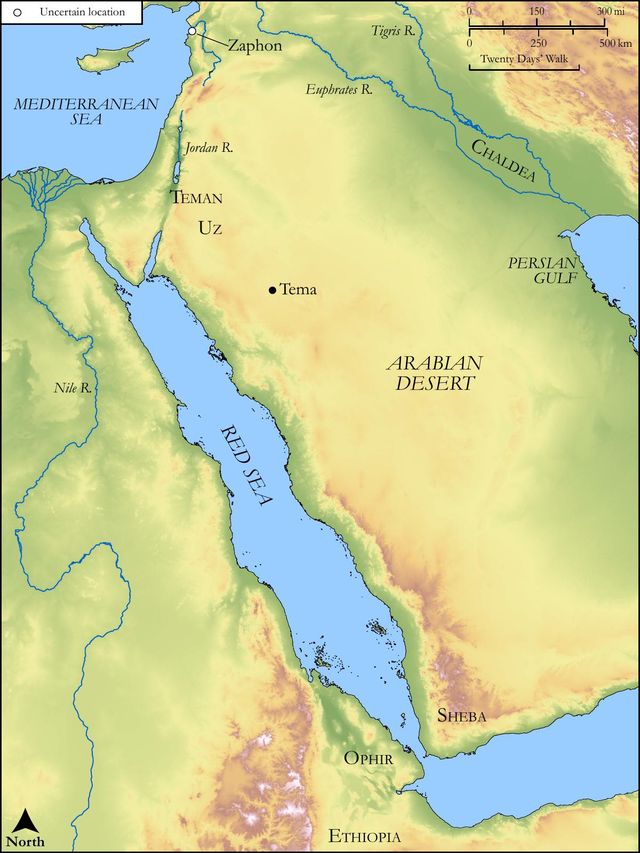
See on the biblical-era map
Study this verse
Public-domain commentary
Matthew Henry
From his Commentary on the Whole Bible. Henry comments on passages, not single verses — this entry covers Job 8:8–19. His four-level outline is real structure in the source text, so it is rendered as structure.
Bildad here discourses very well on the sad catastrophe of hypocrites and evil-doers and the fatal period of all their hopes and joys. He will not be so bold as to say with Eliphaz that none that were righteous were ever cut off thus (Job 4:7); yet he takes it for granted that God, in the course of his providence, does ordinarily bring wicked men, who seemed pious and were prosperous, to shame and ruin in this world, and that, by making their prosperity short, he discovers their piety to be counterfeit. Whether this will certainly prove that all who are thus ruined must be concluded to have been hypocrites he will not say, but rather suspect, and thinks the application is easy.
I.He proves this truth, of the certain destruction of all the hopes and joys of hypocrites, by an appeal to antiquity and the concurring sentiment and observation of all wise and good men; and an undoubted truth it is, if we take in the other world, that, if not in this life, yet in the life to come, hypocrites will be deprived of all their trusts and all their triumphs: whether Bildad so meant or no, we must so take it. Let us observe the method of his proof, Job 8:8-10.
1.He insists not on his own judgment and that of his companions: We are but of yesterday, and know nothing, Job 8:9. He perceived that Job had no opinion of their abilities, but thought they knew little. "We will own," says Bildad, "that we know nothing, are as ready to confess our ignorance as thou art to condemn it; for we are but of yesterday in comparison, and our days upon earth are short and transient, and hastening away as a shadow. And hence," (1.) "We are not so near the fountain-head of divine revelation" (which then for aught that appears, was conveyed by tradition) "as the former age was; and therefore we must enquire what they said and recount what we have been told of their sentiments." Blessed be God, now that we have the word of God in writing, and are directed to search that, we need not enquire of the former age, nor prepare ourselves to the search of their fathers; for, though we ourselves are but of yesterday, the word of God in the scripture is as nigh to us as it was to them (Rom 10:8), and it is the more sure word of prophecy, to which we must take heed. If we study and keep God's precepts, we may by them understand more than the ancients, Psa 119:99,Psa 119:100. (2.) "We do not live so long as those of the former age did, to make observations upon the methods of divine providence, and therefore cannot be such competent judges as they in a cause of this nature." Note, The shortness of our lives is a great hindrance to the improvement of our knowledge, and so are the frailty and weakness of our bodies. Vita brevis, ars longa - life is short, the progress of art boundless.
2.He refers to the testimony of the ancients and to the knowledge which Job himself had of their sentiments. "Do thou enquire of the former age, and let them tell thee, not only their own judgment in this matter, but the judgment also of their fathers, Job 8:8. They will teach thee, and inform thee (Job 8:10), that all along, in their time, the judgments of God followed wicked men. This they will utter out of their hearts, that is, as that which they firmly believe themselves, which they are greatly affected with and desirous to acquaint and affect others with." Note,
(1.)For the right understanding of divine Providence, and the unfolding of the difficulties of it, it will be of use to compare the observations and experiences of former ages with the events of our own day; and, in order thereto, to consult history, especially the sacred history, which is the most ancient, infallibly true, and written designedly for our learning.
(2.)Those that would fetch knowledge from the former ages must search diligently, prepare for the search, and take pains for the search.
(3.)Those words are most likely to reach to the hearts of the learners that come from the hearts of the teachers. Those shall teach thee best that utter words out of their heart, that speak by experience, and not by rote, of spiritual and divine things. The learned bishop Patrick suggests that Bildad being a Shuhite, descended from Shuah one of Abraham's sons by Keturah (Gen 25:2), in this appeal which he makes to history he has a particular respect to the rewards which the blessing of God secured to the posterity of faithful Abraham (who hitherto, and long after, continued in his religion) and to the extirpation of those eastern people, neighbours to Job (in whose country they were settled), for their wickedness, whence he infers that it is God's usual way to prosper the just and root out the wicked, though for a while they may flourish.
II.He illustrates this truth by some similitudes.
1.The hopes and joys of the hypocrite are here compared to a rush or flag, v. 11-13.
(1.)It grows up out of the mire and water. The hypocrite cannot gain his hope without some false rotten ground or other out of which to raise it, and with which to support it and keep it alive, any more than the rush can grow without mire. He grounds it on his worldly prosperity, the plausible profession he makes of religion, the good opinion of his neighbours, and his own good conceit of himself, which are no solid foundation on which to build his confidence. It is all but mire and water; and the hope that grows out of it is but rush and flag.
(2.)It may look green and gay for a while (the rush outgrows the grass), but it is light and hollow, and empty, and good for nothing. It is green for show, but of no use.
(3.)It withers presently, before any other herb, v. 12. Even while it is in its greenness it is dried away and gone in a little time. Note, The best state of hypocrites and evil-doers borders upon withering; even when it is green it is going. The grass is cut down and withers (Psa 90:6); but the rush is not cut down and yet withers, withers before it grows up (Psa 129:6): as it has no use, so it has no continuance. So are the paths of all that forget God (v. 13); they take the same way that the rush does, for the hypocrite's hope shall perish. Note,
[1.]Forgetfulness of God is at the bottom of men's hypocrisy, and of the vain hopes with which they flatter and deceive themselves in their hypocrisy. Men would not be hypocrites if they did not forget that the God with whom they have to do searches the heart and requires truth there, that he is a Spirit and has his eye on our spirits; and hypocrites would have no hope if they did not forget that God is righteous, and will not be mocked with the torn and the lame.
[2.]The hope of hypocrites is a great cheat upon themselves, and, though it may flourish for a while, it will certainly perish at last, and they with it.
2.They are here compared to a spider's web, or a spider's house (as it is in the margin), a cobweb, Job 8:14, Job 8:15. The hope of the hypocrite,
(1.)Is woven out of his own bowels; it is the creature of his own fancy, and arises merely from a conceit of his own merit and sufficiency. There is a great deal of difference between the work of the bee and that of the spider. A diligent Christian, like the laborious bee, fetches in all his comfort from the heavenly dews of God's word; but the hypocrite, like the subtle spider, weaves his out of a false hypothesis of his own concerning God, as if he were altogether such a one as himself.
(2.)He is very fond of it, as the spider of her web; pleases himself with it, wraps himself in it, calls it his house, leans upon it, and holds it fast. It is said of the spider that she takes hold with her hands, and is in kings' palaces, Pro 30:28. So does a carnal worldling hug himself in the fulness and firmness of his outward prosperity; he prides himself in that house as his palace, fortifies himself in it as his castle, and makes use of it as the spider of her web, to ensnare those he has a mind to prey upon. So does a formal professor; he flatters himself in his own eyes, doubts not of his salvation, is secure of heaven, and cheats the world with his vain confidences.
(3.)It will easily and certainly be swept away, as the cobweb with the besom, when God shall come to purge his house. The prosperity of worldly people will fail them when they expect to find safety and happiness in it. They seek to hold fast their estates, but God is plucking them out of their hands; and whose shall all those things be, which they have provided? or what the better they will be for them? The confidences of hypocrites will fail them. I tell you, I know you not. The house built on the sand will fall in the storm, when the builder most needs it and promised himself the benefit of it. When a wicked man dies his expectation perishes. The ground of his hopes will prove false; he will be disappointed of the thing he hoped for, and his foolish hope with which he buoyed himself up will be turned into endless despair; and thus his hope will be cut off, his web, that refuge of lies, swept away, and he crushed in it.
3.The hypocrite is here compared to a flourishing and well-rooted tree, which, though it do not wither of itself, yet will easily be cut down and its place no it no more. The secure and prosperous sinner may think himself wronged when he is compared to a rush and a flag; he thinks he has a better root. "We will allow him his conceit," says Bildad, "and give him all the advantage he can desire, and bring him in suddenly cut off." He is here represented as Nebuchadnezzar was in his own dream (Dan 4:10) by a great tree.
(1.)See this tree fair and flourishing (Job 8:16) like a green bay-tree (Psa 37:35), green before the sun, it keeps its greenness in defiance of the scorching sun-beams, and his branch shoots forth under the protection of his garden-wall and with the benefit of his garden-soil. See it fixed, and taking deep root, never likely to be overthrown by stormy winds, for his roots are interwoven with the stones (Job 8:17); it grows in firm ground, not, as the rush, of mire and water. Thus does a wicked man, when he prospers in the world, think himself secure; his wealth is a high wall in his own conceit.
(2.)See this tree felled and forgotten notwithstanding, destroyed from his place (Job 8:18), and so entirely extirpated that there shall remain no sign or token where it grew. The very place say, I have not seen thee; and the standers by shall say the same. I sought him, but he could not be found, Psa 37:36. He made a great show and a great noise for a time, but he is gone of a sudden, and neither root nor branch is left him, Mal 4:1. This is the joy (that is, this is the end and conclusion) of the wicked man's way (Job 8:19); this is that which all his joy comes to. The way of the ungodly shall perish, Psa 1:6. His hope, he thought, would in the issue be turned into joy; but this is the issue, this is the joy. The harvest shall be a heap in the day of grief and of desperate sorrow, Isa 17:11. This is the best of it; and what then is the worst of it? But shall he not leave a family behind him to enjoy what he has? No, out of the earth (not out of his roots) shall others grow, that are nothing akin to him, and shall fill up his place, and rule over that for which he labored. Others (that is, others of the same spirit and disposition) shall grow up in his place, and be as secure as ever he was, not warned by his fall. The way of worldlings is their folly, and yet there is a race of those that approve their sayings, Psa 49:13.
Historical interpretation
Historical reception
2 surviving comments on this verse. Each one is dated, so this reads as a timeline rather than a list.
Select a marker to jump to its quote. Markers stagger vertically where authors wrote within a few decades of each other.
In order to give authority to his words, Bildad calls the venerable past as a witness, so that he may appear to know through long experience what he has said or is about to say. In a different sense, Bildad wants Job to learn from ancient examples what he had said before, that is, that God is appeased by the prayers of the righteous. Through God’s support not only are calamities dissolved but also prosperity and happiness are returned. Thus God, whom they had invoked, protected Abraham and his descendants in their distress. Observe a third sense in Bildad’s words: “I want you to consider the ancient examples, so that you may not despise my advice because of my youth.”
63. They give us notice that ‘the former generation’ and ‘the memory of the fathers’ are not seen but ‘searched,’ because they will not have that to be seen therein, which lies open before the eyes of all men. But sometimes, like good men, they give some instruction of a moral kind, and show how the present may be gathered from the past; and from the things which are even now withdrawn from our eyes by passing away, they show how little there is in the things that are seen before our eyes.
Continue studying Job 8:8 across the web’s major study libraries — every link below opens this exact verse, chapter, or book on the destination site.
Read & Compare
 BibleGatewayThis verse in more than 200 translations and 70 languages.
 Bible.comThe YouVersion reader — hundreds of translations, reading plans, and highlights.
 ESV.orgCrossway's official English Standard Version reader.
 NET BibleThe NET translation with 60,000+ translators' notes on every rendering decision.
 STEP BibleTyndale House's free study tool — original text, vocabulary, and scholarly resources.
 BibliaLogos Bible Software's free web reader.
 USCCBThe New American Bible (Revised Edition) with the U.S. bishops' study notes.
Commentaries
 BibleHub CommentariesDozens of classic commentaries on this verse, gathered on one page.
 StudyLightMore than 100 commentary sets — the largest collection on the web.
 BibleRefPlain-English commentary on what this verse means, verse by verse.
 Enduring WordDavid Guzik's free commentary on this chapter, widely used by Bible teachers.
 Bible Study ToolsVerse commentary alongside Greek and Hebrew study aids.
Original Language & Research
- BibleHub InterlinearThe verse word by word — original language, transliteration, and English.
- BibleHub LexiconEvery word's original-language definition and Strong's entry.
 Blue Letter BibleDeep-study tools — Strong's numbers, concordance, and word studies.
 SefariaThe Hebrew text with Rashi and centuries of Jewish commentary.
Sermons, Hymns & Audio


TrulyRandomVerse is not affiliated with these sites and doesn’t control their content. They’re linked because they’re genuinely useful.
Summary
In Job 8:8, Bildad the Shuhite, one of Job's three friends, passionately urges Job to consult the accumulated wisdom of previous generations and their ancestors. This counsel reveals Bildad's unwavering commitment to the traditional retribution theology, which posits that suffering is a direct consequence of sin. His advice reflects a deep-seated reverence for ancestral knowledge and established customs as the definitive source of truth regarding divine justice and the world's order, standing in stark contrast to Job's inexplicable experience of innocent suffering.
Context
ShowHideLiterary Context
Job 8:8 is strategically placed early in Bildad's initial discourse, immediately following Job's profound lament in which he asserts his innocence and even challenges God's justice (Job 6-7). Like Eliphaz before him (Job 4-5), Bildad operates from the prevailing theological framework of their era: the righteous flourish, while the wicked suffer. Bildad opens by accusing Job of speaking "a mighty wind" (Job 8:2) and, after implying Job's children sinned (Job 8:4), he exhorts Job to "seek unto God betimes" (Job 8:5). The appeal to "the former age" and "their fathers" in verse 8 serves as the intellectual cornerstone of Bildad's argument, providing an external, seemingly irrefutable authority for his rigid understanding of divine justice, which he believes Job has undeniably violated. This appeal is a direct counter to Job's personal experience, asserting the supremacy of inherited tradition over individual suffering.
Historical & Cultural Context
In the days of the patriarchs, ancestral wisdom, the teachings of elders, and established traditions held immense and often sacred authority. Societies were predominantly oral, and knowledge was meticulously transmitted across generations, frequently codified in proverbs, legal statutes, and religious practices. The "fathers" or "ancients" were revered as living repositories of accumulated experience, divine insight, and foundational understanding of the world, including the ways of the gods. To "enquire of the former age" was far more than an academic exercise; it was an appeal to a sacred, immutable, and universally accepted order. This pervasive cultural reverence for tradition explains why Bildad, in his earnest attempt to counsel Job, immediately turns to this deep wellspring of accepted truth, rather than contemplating the unique, unprecedented, and seemingly unjust nature of Job's suffering.
Key Themes
ShowHideThis verse contributes significantly to several overarching themes within the book of Job. Firstly, it powerfully illustrates The Authority of Tradition, showcasing how deeply Bildad and his friends rely on inherited wisdom as the ultimate arbiter of truth, particularly concerning divine retribution. Secondly, it underscores the theme of Seeking Understanding, as Bildad implores Job to diligently investigate established knowledge to comprehend his dire situation. While seemingly noble, this search is inherently constrained within a limited, human-centric theological system. Finally, and most crucially, the verse implicitly foreshadows the book's profound overarching theme of the Inadequacy of Human Wisdom to fully grasp God's complex nature and inscrutable purposes. The friends' unwavering reliance on conventional wisdom leads them to fundamentally misinterpret Job's situation and, more gravely, God's character, a flaw for which God later directly rebukes them in Job 42:7, explicitly stating they have not spoken what is right about Him.
Exposition and Analysis
ShowHideKey Word Analysis
ShowHideThis primitive root verb signifies "to inquire," "to request," "to consult," or "to demand." It implies a diligent, purposeful investigation, often carrying a religious or legal connotation, seeking knowledge or a divine oracle. Here, it is an imperative, a command from Bildad to Job, urging him to actively and thoroughly delve into established wisdom, not merely to passively receive it.
From the root dwr, meaning "to revolve," this word properly refers to a "revolution of time," hence an "age" or "generation." It can also denote a dwelling. In this context, it emphasizes a distinct period of time, specifically an ancient or past generation, highlighting the temporal distance and accumulated experience of the wisdom being sought.
A primitive word referring to a "father," whether in a literal, immediate sense or a figurative, remote application. It also extends to mean a chief or forefather. Among the men of the east, the "fathers" were the revered source of inherited wisdom, traditions, and laws. Their accumulated experience and teachings were often considered infallible and binding. Bildad's appeal to "their fathers" reinforces the idea that the truth he presents is not his own invention but a venerable, time-tested heritage.
Verse Breakdown
ShowHide"For enquire, I pray thee, of the former age"
Bildad initiates his counsel by urging Job to consult the wisdom of antiquity. The introductory "For" (Hebrew kî) indicates that what follows is the basis or reason for his argument, suggesting that the wisdom of the past will validate his claims. The phrase "I pray thee" (Hebrew nā') functions as a polite but firm request, conveying an earnest desire for Job to heed this crucial advice. This opening clause sets the stage for Bildad's argument from authority, positing that the answers to Job's profound suffering lie not in his personal experience but in the collective, established understanding of generations long past.
"and prepare thyself to the search of their fathers"
This second clause powerfully reinforces and expands upon the first. "Prepare thyself" (Hebrew kûn) implies a deliberate, intentional effort, a mental and spiritual readiness for a serious and rigorous investigation. The "search of their fathers" refers to the diligent, exhaustive examination of the teachings, experiences, and traditions handed down by preceding generations. It is not a casual glance but a deep, committed dive into the established body of knowledge. This strong parallelism emphasizes the profound importance Bildad places on tradition as the ultimate and infallible guide for understanding God's ways and the fundamental principles governing life.
Literary Devices
ShowHideBildad's speech in Job 8:8 effectively employs several significant literary devices to convey his message. The most prominent is the Argument from Authority, where Bildad appeals to the established wisdom of "the former age" and "their fathers" as an irrefutable and foundational source of truth. This device is central to his rhetorical strategy, attempting to silence Job's personal lament and unique experience with the overwhelming weight of communal, time-honored understanding. The verse also exhibits clear Parallelism in its two clauses ("enquire...of the former age" and "prepare thyself to the search of their fathers"), which effectively reiterates and intensifies the call for diligent investigation into ancestral wisdom, reinforcing the singular importance of tradition. Furthermore, Bildad utilizes Apostrophe, directly addressing Job with the imperative "enquire, I pray thee," making his counsel personal and direct, albeit ultimately unhelpful in Job's specific situation. The entire verse functions implicitly as a Rhetorical Question, implying that if Job would only consult this ancient wisdom, he would find the clear, self-evident answer to his suffering, namely, his unconfessed sin.
Theological and Thematic Connections
ShowHideBildad's counsel in Job 8:8 brings into sharp focus a fundamental tension within biblical theology: the relationship between inherited tradition and direct divine revelation. While the Bible frequently commends learning from the past, honoring the wisdom of elders, and valuing historical precedent, it also consistently critiques human traditions when they contradict, supersede, or rigidly define God's revealed truth. Bildad's error lies not in valuing ancestral wisdom per se, but in elevating a specific, rigid interpretation of that wisdom (retribution theology) to an infallible standard that presumptuously defines and thereby limits God's sovereignty and complex character. His theology, though deeply ingrained in ancient thought, proved utterly inadequate to explain Job's unique suffering, powerfully demonstrating that even long-held beliefs must ultimately yield to God's greater, often mysterious, and always sovereign purposes. This verse thus serves as a profound theological warning against allowing human systems of thought, no matter how ancient, respected, or seemingly logical, to constrain or misrepresent our understanding of God.
Reflection and Application
ShowHideJob 8:8 challenges us to critically examine the sources of our understanding, particularly when grappling with life's most profound mysteries such as suffering, justice, and the very character of God. While there is undeniable value in learning from the wisdom of those who have preceded us—whether through historical accounts, theological traditions, or the testimonies of our spiritual ancestors—this verse also subtly but powerfully cautions us against an uncritical, absolute acceptance of all inherited wisdom. We are called to diligently discern between valuable human tradition and ultimate divine truth, recognizing that not all conventional explanations or theological systems are infallible, especially when they attempt to definitively explain God's intricate ways or limit His freedom. For believers, the ultimate and supreme source of truth is God's revealed Word, which often challenges and transcends human-made theological frameworks. This passage calls us to maintain a posture of diligent search for understanding, but always with an open mind and humble heart towards God's greater, often surprising, and always sovereign revelation, rather than relying solely on conventional explanations that may not fully capture the breadth of His nature or His work in our lives.
Questions for Reflection
ShowHideFAQ
ShowHideIs Bildad's advice to consult the "former age" inherently wrong or always to be avoided?
ShowHideNot inherently wrong, but crucially incomplete and misapplied in Job's specific context. The Bible frequently commends learning from history, honoring the wisdom of elders, and valuing the testimonies of past generations (e.g., Deuteronomy 32:7 or Psalm 78:3-4). The fundamental error of Bildad and his friends was not in valuing tradition itself, but in allowing a specific, rigid interpretation of that tradition (the retribution theology) to become the sole and infallible lens through which they viewed God and Job's suffering. They failed to recognize that God's ways are often far beyond human comprehension and that unique circumstances, like Job's, might defy conventional explanations. Their unwavering reliance on tradition ultimately led them to misrepresent God's character and purposes, for which they were later directly rebuked by God Himself (Job 42:7).
Christ-Centered Fulfillment
ShowHideBildad's earnest appeal to the "former age" and the "search of their fathers" in Job 8:8 represents humanity's sincere, yet ultimately insufficient, attempt to discover ultimate truth and comprehensive understanding through accumulated human wisdom and historical precedent. While the Old Testament prophets, wise men, and ancestral traditions offered profound insights into God's character and His ways, the full, complete, and final revelation of God's character and His redemptive plan for humanity could not be contained or fully grasped within the traditions of any single age or generation. This universal human quest for wisdom and truth finds its ultimate fulfillment, transcendence, and perfect embodiment in the person of Jesus Christ. He is not merely a wise teacher from a "former age," but the eternal Word made flesh, the very Wisdom of God personified. In Christ, all the immeasurable treasures of wisdom and knowledge are hidden and fully revealed (Colossians 2:3). He is the true and complete revelation of God, far surpassing all ancestral teachings, human philosophies, and limited theological systems (Hebrews 1:1-3). The rigid retribution theology espoused by Bildad, which failed to account for innocent suffering, is powerfully overturned and reinterpreted by the cross of Christ, where the innocent Lamb of God willingly suffers for the guilty, thereby revealing a depth of divine love, grace, and justice far beyond the wisdom of any human age. Through Christ, we gain access to a wisdom that is "not of this world, nor of the rulers of this age" (1 Corinthians 2:6), a wisdom that truly explains the mysteries of God's sovereign purposes and offers profound solace and hope in the midst of suffering.