


1 Corinthians 2:6
Bible text: King James Version (1769 Blayney text) · Public domain
Bible text: King James Version with Strong's numbers · Public domain
Bible text: Berean Standard Bible · Public domain
Bible text: American Standard Version (1901) · Public domain
Bible text: World English Bible, Messianic edition · Public domain
Bible text: Geneva Bible (1599) · Public domain
Bible text: Young's Literal Translation · Public domain
- ΣοφίανSophianWisdomG4678N-ASFNoun Accusative Singular Feminine
- δὲdehoweverG1161CONJConjunction
- λαλοῦμενlaloumenwe speakG2980V-PAI-1PVerb Present Active Indicative 1st Plural
- ἐνenamongG1722PREPPreposition
- τοῖςtoistheG3588T-DPMDefinite article Dative Plural Masculine
- τελείοιςteleioismatureG5046A-DPMAdjective Dative Plural Masculine
- σοφίανsophianwisdomG4678N-ASFNoun Accusative Singular Feminine
- δὲdehoweverG1161CONJConjunction
- οὐounotG3756PRT-NNegative Particle Negative
- τοῦtou<the>G3588T-GSMDefinite article Genitive Singular Masculine
- αἰῶνοςaiōnosageG165N-GSMNoun Genitive Singular Masculine
- τούτουtoutouof thisG3778D-GSMDemonstrative pronoun Genitive Singular Masculine
- οὐδὲoudenorG3761CONJ-NConjunction Negative
- τῶνtōnof theG3588T-GPMDefinite article Genitive Plural Masculine
- ἀρχόντωνarchontōnrulersG758N-GPMNoun Genitive Plural Masculine
- τοῦtou<the>G3588T-GSMDefinite article Genitive Singular Masculine
- αἰῶνοςaiōnosageG165N-GSMNoun Genitive Singular Masculine
- τούτουtoutouof thisG3778D-GSMDemonstrative pronoun Genitive Singular Masculine
- τῶνtōnwhoG3588T-GPMDefinite article Genitive Plural Masculine
- καταργουμένων·katargoumenōnare coming to naughtG2673V-PPP-GPMVerb Present Passive Participle Genitive Plural Masculine
English is a literal word-by-word gloss of the Greek, not the KJV's wording. Why?
This is the original text the KJV's translators worked from — each Greek word with its own literal English meaning in this verse, prepared by scholars at Tyndale House, Cambridge. The KJV translates whole sentences, not word by word, so its wording differs: one Greek word can become several English words, and the KJV may choose “charity” where the gloss reads “love”. Both are faithful — they answer different questions. For the KJV's own rendering, switch to the KJV text.
Details
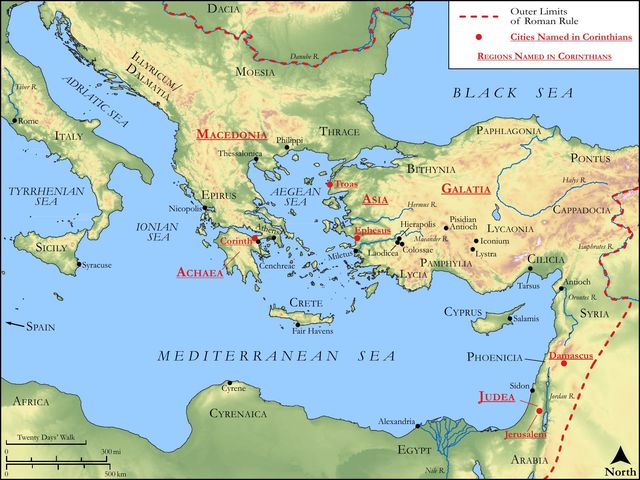
See on the biblical-era maps

Study this verse
Public-domain commentary
Matthew Henry
From his Commentary on the Whole Bible. Henry comments on passages, not single verses — this entry covers 1 Corinthians 2:6–16. His three-level outline is real structure in the source text, so it is rendered as structure.
In this part of the chapter the apostle shows them that though he had not come to them with the excellency of human wisdom, with any of the boasted knowledge and literature of the Jews or Greeks, yet he had communicated to them a treasure of the truest and the highest wisdom: We speak wisdom among those who are perfect (Co1 2:6), among those who are well instructed in Christianity, and come to some maturity in the things of God. Those that receive the doctrine as divine, and, having been illuminated by the Holy Spirit, have looked well into it, discover true wisdom in it. They not only understand the plain history of Christ, and him crucified, but discern the deep and admirable designs of the divine wisdom therein. Though what we preach is foolishness to the world, it is wisdom to them. They are made wise by it, and can discern wisdom in it. Note, Those who are wise themselves are the only proper judges of what is wisdom; not indeed the wisdom of this world, nor of the princes of this world, but the wisdom of God in a mystery (Co1 2:6, Co1 2:7); not worldly wisdom, but divine; not such as the men of this world could have discovered, nor such as worldly men, under the direction of pride, and passion, and appetite, and worldly interest, and destitute of the Spirit of God, can receive. Note, How different is the judgment of God from that of the world! He seeth not as man seeth. The wisdom he teaches is of a quite different kind from what passes under that notion in the world. It is not the wisdom of politicians, nor philosophers, nor rabbis (see Co1 2:6), not such as they teach nor such as they relish; but the wisdom of God in a mystery, the hidden wisdom of God - what he had a long time kept to himself, and concealed from the world, and the depth of which, now it is revealed, none but himself can fathom. It is the mystery which hath been hid from ages and generations, though now made manifest to the saints (Col 1:26), hid in a manner entirely from the heathen world, and made mysterious to the Jews, by being wrapped up in dark types and distant prophecies, but revealed and made known to us by the Spirit of God. Note, See the privilege of those who enjoy the gospel revelation: to them types are unveiled, mysteries made plain, prophecies interpreted, and the secret counsels of God published and laid open. The wisdom of God in a mystery is now made manifest to the saints. Now, concerning this wisdom, observe,
I.The rise and origin of it:
It was ordained of God, before the world, to our glory, Co1 2:7. It was ordained of God; he had determined long ago to reveal and make it known, from many ages past, from the beginning, nay, from eternity; and that to our glory, the glory of us, either us apostles or us Christians. It was a great honour put upon the apostles, to be entrusted with the revelation of this wisdom. It was a great and honourable privilege for Christians to have this glorious wisdom discovered to them. And the wisdom of God discovered to them. And the wisdom of God discovered in the gospel, the divine wisdom taught by the gospel, prepares for our everlasting glory and happiness in the world to come. The counsels of God concerning our redemption are dated from eternity, and designed for the glory and happiness of the saints. And what deep wisdom was in these counsels! Note, The wisdom of God is both employed and displayed for the honour of the saints-employed from eternity, and displayed in time, to make them glorious both here and hereafter, in time and to eternity. What honour does he put on his saints!
II.The ignorance of the great men of the world about it:
Which none of the princes of this world knew (Co1 2:8), the principal men in authority and power, or in wisdom and learning. The Roman governor, and the guides and rulers of the Jewish church and nation, seem to be the persons here chiefly meant. These were the princes of this world, or this age, who, had they known this true and heavenly wisdom, would not have crucified the Lord of glory. This Pilate and the Jewish rulers literally did when our Redeemer was crucified upon the sentence of the one and the clamorous demands of the other. Observe, Jesus Christ is the Lord of Glory, a title much too great for any creature to bear: and the reason why he was hated was because he was not known. Had his crucifiers known him, known who and what he was, they would have withheld their impious hands, and not have taken and slain him. This he pleaded with his Father for their pardon: Father, forgive them, for they know not what they do, Luk 23:34. Note, There are many things which people would not do if they knew the wisdom of God in the great work of redemption. They act as they do because they are blind or heedless. They know not the truth, or will not attend to it.
III.It is such wisdom as could not have been discovered without a revelation, according to what the prophet Isaiah says (Isa 64:4), Eye hath not seen, nor ear heard, nor have entered into the heart of man the things which God hath prepared for those that love him - for him that waiteth for him, that waiteth for his mercy, so the Septuagint. It was a testimony of love to God in the Jewish believers to live in expectation of the accomplishment o evangelical promises. Waiting upon God is an evidence of love to him. Lo, this is our God, we have waited for him, Isa 25:9. Observe, There are things which God hath prepared for those that love him, and wait for him. There are such things prepared in a future life for them, things which sense cannot discover, no present information can convey to our ears, nor can yet enter our hearts. Life and immortality are brought to light through the gospel, Ti2 1:10. But the apostle speaks here of the subject-matter of the divine revelation under the gospel. These are such as eye hath not seen nor ear heard. Observe, The great truths of the gospel are things lying out of the sphere of human discovery: Eye hath not seen, nor ear heard them, nor have they entered into the heart of man. Were they objects of sense, could they be discovered by an eye of reason, and communicated by the ear to the mind, as matters of common human knowledge may, there had been no need of a revelation. But, lying out of the sphere of nature, we cannot discover them but by the light of revelation. And therefore we must take them as they lie in the scriptures, and as God has been pleased to reveal them.
IV.We here see by whom this wisdom is discovered to us:
God hath revealed them to us by his Spirit, Co1 2:10. The scripture is given by inspiration of God. Holy men spoke of old as they were moved by the Holy Ghost, Pe2 1:21. And the apostles spoke by inspiration of the same Spirit, as he taught them, and gave them utterance. Here is a proof of the divine authority of the holy scriptures. Paul wrote what he taught: and what he taught was revealed of God by his Spirit, that Spirit that searches all things, yea, the deep things of God, and knows the things of God, as the spirit of a man that is in him knows the things of a man, Co1 2:11. A double argument is drawn from these words in proof of the divinity of the Holy Ghost: - 1. Omniscience is attributed to him: He searches all things, even the deep things of God. He has exact knowledge of all things, and enters into the very depths of God, penetrates into his most secret counsels. Now who can have such a thorough knowledge of God but God? 2. This allusion seems to imply that the Holy Spirit is as much in God as a man's mind is in himself. Now the mind of the man is plainly essential to him. He cannot be without his mind. Now can God be without his Spirit. He is as much and as intimately one with God as the man's mind is with the man. The man knows his own mind because his mind is one with himself. The Spirit of God knows the things of God because he is one with God. And as no man can come at the knowledge of what is in another man's mind till he communicates and reveals it, so neither can we know the secret counsels and purposes of God till they are made known to us by his Holy Spirit. We cannot know them at all till he had proposed them objectively (as it is called) in the external revelation; we cannot know or believe them to salvation till he enlightens the faculty, opens the eye of the mind, and gives us such a knowledge and faith of them. And it was by this Spirit that the apostles had received the wisdom of God in a mystery, which they spoke. "Now we have received not the spirit of the world, but the Spirit which is of God, that we might know the things freely given to us of God (Co1 2:12); not the spirit which is in the wise men of the world (Co1 2:6), nor in the rulers of the world (Co1 2:8), but the Spirit which is of God, or proceedeth from God. We have what we deliver in the name of God by inspiration from him; and it is by his gracious illumination and influence that we know the things freely given to us of God unto salvation" - that is, "the great privileges of the gospel, which are the free gift of God, distributions of mere and rich grace." Though these things are given to us, and the revelation of this gift is made to us, we cannot know them to any saving purpose till we have the Spirit. The apostles had the revelation of these things from the Spirit of God, and the saving impression of them from the same Spirit.
V.We see here in what manner this wisdom was taught or communicated:
Which things we speak, not in the words which man's wisdom teaches, but which the Holy Ghost teaches, Co1 2:13. They had received the wisdom they taught, not from the wise men of the world, but from the Spirit of God. Nor did they put a human dress on it, but plainly declared the doctrine of Christ, in terms also taught them by the Holy Spirit. He not only gave them the knowledge of these things, but gave them utterance. Observe, The truths of God need no garnishing by human skill or eloquence, but look best in the words which the Holy Ghost teaches. The Spirit of God knows much better how to speak of the things of God than the best critics, orators, or philosophers. Comparing spiritual things with spiritual - one part of revelation with another, the revelation of the gospel with that of the Jews, the discoveries of the New Testament with the types and prophecies of the Old. The comparing of matters of revelation with matters of science, things supernatural with things natural and common, is going by a wrong measure. Spiritual things, when brought together, will help to illustrate one another; but, if the principles of human art and science are to be made a test of revelation, we shall certainly judge amiss concerning it, and the things contained in it. Or, adapting spiritual things to spiritual - speaking of spiritual matters, matters of revelation, and the spiritual life, in language that is proper and plain. The language of the Spirit of God is the most proper to convey his meaning.
VI.We have an account how this wisdom is received.
1.The natural man receiveth not the things of God, for they are foolishness to him, neither can he know them, because they are spiritually discerned, Co1 2:14. The natural man, the animal man. Either,
(1.)The man under the power of corruption, and never yet illuminated by the Spirit of God, such as Jude calls sensual, not having the Spirit, Jde 1:19. Men unsanctified receive not the things of God. The understanding, through the corruption of nature by the fall, and through the confirmation of this disorder by customary sin, is utterly unapt to receive the rays of divine light; it is prejudiced against them. The truths of God are foolishness to such a mind. The man looks on them as trifling and impertinent things, not worth his minding. The light shineth in darkness, and the darkness comprehendeth it not, Joh 1:5. Not that the natural faculty of discerning is lost, but evil inclinations and wicked principles render the man unwilling to enter into the mind of God, in the spiritual matters of his kingdom, and yield to their force and power. It is the quickening beams of the Spirit of truth and holiness that must help the mind to discern their excellency, and to so thorough a conviction of their truth as heartily to receive and embrace them. Thus the natural man, the man destitute of the Spirit of God, cannot know them, because they are spiritually discerned. Or,
(2.)The natural man, that is, the wise man of the world (Co1 1:19, Co1 1:20), the wise man after the flesh, or according to the flesh (v. 26), one who hath the wisdom of the world, man's wisdom (Co1 2:4-6), a man, as some of the ancients, that would learn all truth by his own ratiocinations, receive nothing by faith, nor own any need of supernatural assistance. This was very much the character of the pretenders to philosophy and the Grecian learning and wisdom in that day. Such a man receives not the things of the Spirit of God. Revelation is not with him a principle of science; he looks upon it as delirium and dotage, the extravagant thought of some deluded dreamer. It is no way to wisdom among the famous masters of the world; and for that reason he can have no knowledge of things revealed, because they are only spiritually discerned, or made known by the revelation of the Spirit, which is a principle of science or knowledge that he will not admit.
2.But he that is spiritual judgeth all things, yet he himself is judged, or discerned, of no man, Co1 2:15. Either,
(1.)He who is sanctified and made spiritually-minded (Rom 8:6) judgeth all things, or discerneth all things - he is capable of judging about matters of human wisdom, and has also a relish and savour of divine truths; he sees divine wisdom, and experiences divine power, in gospel revelations and mysteries, which the carnal and unsanctified mind looks upon as weakness and folly, as things destitute of all power and not worthy any regard. It is the sanctified mind that must discern the real beauties of holiness; but, by the refinement of its facilities, they do not lose their power of discerning and judging about common and natural things. The spiritual man may judge of all things, natural and supernatural, human and divine, the deductions of reason and the discoveries of revelation. But he himself is judged or discerned of NO MAN. God's saints are his hidden ones, Psa 83:3. Their life is hid with Christ in God, Col 3:3. The carnal man knows no more of a spiritual man than he does of other spiritual things. He is a stranger to the principles, pleasures, and actings, of the divine life. The spiritual man does not lie open to his observation. Or,
(2.)He that is spiritual (who has had divine revelations made to him, receives them as such, and founds his faith and religion upon them) can judge both of common things and things divine; he can discern what is, and what is not, the doctrine of the gospel and of salvation, and whether a man preaches the truths of God or not. He does not lose the power of reasoning, nor renounce the principles of it, by founding his faith and religion on revelation. But he himself is judged of no man - can be judged, so as to be confuted, by no man; nor can any man who is not spiritual, not under a divine afflatus himself (see Co1 14:37), or not founding his faith on a divine revelation, discern or judge whether what he speaks be true or divine, or not. In short, he who founds all his knowledge upon principles of science, and the mere light of reason, can never be a judge of the truth or falsehood of what is received by revelation. For who hath known the mind of the Lord, that he may instruct him (Co1 2:16), that is, the spiritual man? Who can enter so far into the mind of God as to instruct him who has the Spirit of God, and is under his inspiration? He only is the person to whom God immediately communicates the knowledge of his will. And who can inform or instruct him in the mind of God who is so immediately under the conduct of his own Spirit? Very few have known any thing of the mind of God by a natural power. But, adds the apostle, we have the mind of Christ; and the mind of Christ is the mind of God. He is God, and the principal messenger and prophet of God. And the apostles were empowered by his Spirit to make known his mind to us. And in the holy scriptures the mind of Christ, and the mind of God in Christ, are fully revealed to us. Observe, It is the great privilege of Christians that they have the mind of Christ revealed to them by his Spirit.
Historical interpretation
Two Centuries of Reception
11 surviving comments on this verse. Each one is dated, so this reads as a timeline rather than a list.
Select a marker to jump to its quote. Markers stagger vertically where authors wrote within a few decades of each other.
They also assert that by Anna, who is spoken of in the gospel [Luke 2:36] as a prophetess, and who, after living seven years with her husband, passed all the rest of her life in widowhood until she saw the Saviour, and recognised Him, and spoke of Him to all, was most plainly indicated Achamoth, who, having for a little while looked upon the Saviour with His associates, and dwelling all the rest of the time in the intermediate place, waited for Him till He should come again, and restore her to her proper consort. Her name, too, was indicated by the Saviour, when He said, "Yet wisdom is justified by her children." [Luke 7:35] This, too, was done by Paul in these words, "But we speak wisdom among them that are perfect." [1 Corinthians 2:6]
When, however, they are confuted from the Scriptures, they turn round and accuse these same Scriptures, as if they were not correct, nor of authority, and [assert] that they are ambiguous, and that the truth cannot be extracted from them by those who are ignorant of tradition. For [they allege] that the truth was not delivered by means of written documents, but vivâ voce: wherefore also Paul declared, "But we speak wisdom among those that are perfect, but not the wisdom of this world." [1 Corinthians 2:6] And this wisdom each one of them alleges to be the fiction of his own inventing, forsooth; so that, according to their idea, the truth properly resides at one time in Valentinus, at another in Marcion, at another in Cerinthus, then afterwards in Basilides, or has even been indifferently in any other opponent, who could speak nothing pertaining to salvation. For every one of these men, being altogether of a perverse disposition, depraving the system of truth, is not ashamed to preach himself.
Now God shall be glorified in His handiwork, fitting it so as to be conformable to, and modelled after, His own Son. For by the hands of the Father, that is, by the Son and the Holy Spirit, man, and not [merely] a part of man, was made in the likeness of God. Now the soul and the spirit are certainly a part of the man, but certainly not the man; for the perfect man consists in the commingling and the union of the soul receiving the spirit of the Father, and the admixture of that fleshly nature which was moulded after the image of God. For this reason does the apostle declare, "We speak wisdom among them that are perfect," [1 Corinthians 2:6] terming those persons "perfect" who have received the Spirit of God, and who through the Spirit of God do speak in all languages, as he used Himself also to speak.
But we speak the wisdom of God hidden in a mystery; which none of the princes of this world knew. For had they known it, they would not have crucified the Lord of glory.".
Akin to this is what the holy Apostle Paul says, preserving the prophetic and truly ancient secret from which the teachings that were good were derived by the Greeks: "Howbeit we speak wisdom among them who are perfect; but not the wisdom of this world, or of the princes of this world, that come to nought; but we speak the wisdom of God hidden in a mystery.".
to be made, intimating that the truly sacred mystic word, respecting the unbegotten and His powers, ought to be concealed? In confirmation of these things, in the Epistle to the Corinthians the apostle plainly says: "Howbeit we speak wisdom among those who are perfect, but not the wisdom of this world, or of the princes of this world, that come to nought. But we speak the wisdom of God hidden in a mystery."
And accordingly the Jew at the present day, no less than the younger son, having squandered God's substance, is a beggar in alien territory, serving even until now its princes, that is, the princes of this world. Seek, therefore, the Christians some other as their brother; for the Jew the parable does not admit.
When this Mantle itself, arranged with more rigorous care, and sandals after the Greek model, serve to flatter Aesculapius, how much more should you then accuse and assail it with your eyes, as being guilty of superstition-albeit superstition simple and unaffected? Certainly, when first it clothes this wisdom which renounces superstitions with all their vanities, then most assuredly is the Mantle, above all the garments in which you array your gods and goddesses, an august robe; and, above all the caps and tufts of your Salii and Flamines, a sacerdotal attire.
By all these statements, therefore, does he show us what God he means, when he says, "We speak the wisdom of God among them that are perfect." It is that God who has confounded the wisdom of the wise, who has brought to nought the understanding of the prudent, who has reduced to folly the world's wisdom, by choosing its foolish things, and disposing them to the attainment of salvation.
When Paul talks about the wisdom of the rulers of this world he seems to be talking not about one wisdom common to them all but about different kinds of wisdom which are peculiar to each.
The mature are those who preach the cross as wisdom because of the witness of Christ’s power at work. They know that actions speak louder than words. Their wisdom is not of this age but of the age to come, when the truth of God will be manifested to those who now deny it.
"Howbeit we speak wisdom among the perfect:" for when I, accounted foolish and a preacher of follies, get the better of the wise, I overcome wisdom, not by foolishness but by a more perfect wisdom; a wisdom, too, so ample and so much greater, that the other appears foolishness. Wherefore having before called it by a name such as they named it at that time, and having both proved his victory from the facts, and shewn the extreme foolishness of the other side: he thenceforth bestows upon it its right name, saying, "Howbeit we speak wisdom among the perfect." "Wisdom" is the name he gives to the Gospel, to the method of salvation, the being saved by the Cross. "The perfect," are those who believe. For indeed they are "perfect," who know all human things to be utterly helpless, and who overlook them from the conviction that by such they are profited nothing: such were the true believers.
"But not a wisdom of this world." For where is the use of the wisdom which is without, terminating here and proceeding no further, and not even here able to profit its possessors?
Now by the "rulers of the world," here, he means not certain demons, as some suspect, but those in authority, those in power, those who esteem the thing worth contending about, philosophers, rhetoricians and writers of speeches. For these were the dominant sort and often became leaders of the people.
"Rulers of the world" he calls them, because beyond the present world their dominion extends not. Wherefore, he adds further, "which are coming to nought;" disparaging it both on its own account, and from those who wield it. For having shewn that it is false, that it is foolish, that it can discover nothing, that it is weak, he shews moreover that it is but of short duration.
[Daniel 10:13] "But the prince of the kingdom of Persia withstood me for twenty-one days." In my opinion this was the angel to whose charge Persia was committed, in accordance with what we read in Deuteronomy: "When the Most High divided the nations and distributed the children of Adam abroad, then He established the bounds of the nations according to the number of the angels of God" (Deuteronomy 32:8). These are the princes of whom Paul also says: "We speak forth among the perfect a wisdom which none of the princes of this world knew. For if they had known it, they would never have crucified the Lord of Glory" (1 Corinthians 2:6-8). And so the prince or angel of the Persians offered resistance, acting on behalf of the province entrusted to him, in order that the entire captive nation might not be released. And it may well be that although the prophet was graciously heard by God from the day when he set his heart to understand, the angel was nevertheless not sent to proclaim to him God's gracious decision, for the reason that the prince of Persia opposed him for twenty-one days, enumerating the sins of the Jewish people as a ground for their justly being kept in captivity and as proof that they ought not to be released.
"And behold, Michael, one of the chief princes, came to my assistance." That is, while the angel of the Persians was resisting thy petitions and my representations on thy behalf as I presented thy prayers to God, then there came to my assistance the angel Michael, who has oversight of the people of Israel. By chief princes we are of course to understand archangels.
"And I remained there close by the king of the Persians." He designates the angel or prince by the term "king of the Persians," and shows that he had tarried with Michael for a little as he spoke in opposition to the prince of the Persians.
Continue studying 1 Corinthians 2:6 across the web’s major study libraries — every link below opens this exact verse, chapter, or book on the destination site.
Read & Compare
 BibleGatewayThis verse in more than 200 translations and 70 languages.
 Bible.comThe YouVersion reader — hundreds of translations, reading plans, and highlights.
 ESV.orgCrossway's official English Standard Version reader.
 NET BibleThe NET translation with 60,000+ translators' notes on every rendering decision.
 STEP BibleTyndale House's free study tool — original text, vocabulary, and scholarly resources.
 BibliaLogos Bible Software's free web reader.
 USCCBThe New American Bible (Revised Edition) with the U.S. bishops' study notes.
Commentaries
 BibleHub CommentariesDozens of classic commentaries on this verse, gathered on one page.
 StudyLightMore than 100 commentary sets — the largest collection on the web.
 BibleRefPlain-English commentary on what this verse means, verse by verse.
 Enduring WordDavid Guzik's free commentary on this chapter, widely used by Bible teachers.
 Bible Study ToolsVerse commentary alongside Greek and Hebrew study aids.
Original Language & Research
- BibleHub InterlinearThe verse word by word — original language, transliteration, and English.
- BibleHub LexiconEvery word's original-language definition and Strong's entry.
 Blue Letter BibleDeep-study tools — Strong's numbers, concordance, and word studies.
 CNTR CollationThe earliest Greek manuscripts of this verse, collated letter by letter.
Sermons, Hymns & Audio


TrulyRandomVerse is not affiliated with these sites and doesn’t control their content. They’re linked because they’re genuinely useful.
Summary
In 1 Corinthians 2:6, the Apostle Paul clarifies that while he does indeed speak a profound wisdom, it is fundamentally distinct from the transient, human-centric wisdom valued by the world and its influential leaders. This divine wisdom, revealed by God, is reserved for those who are spiritually mature, standing in stark contrast to the worldly philosophies and powers that are ultimately destined for obsolescence and futility.
Context
ShowHideLiterary Context
This verse is a crucial pivot in Paul's argument, building directly on the preceding chapters where he establishes the "foolishness" of the cross to the perishing and its "power" to believers (1 Corinthians 1:18). Having asserted that he did not come with "excellency of speech or of wisdom" (1 Corinthians 2:1), Paul now introduces a nuance: there is a wisdom he speaks, but it is not of human origin. This sets the stage for his subsequent discussion of the Spirit's role in revealing God's profound truths, which are beyond human comprehension (1 Corinthians 2:9-10). The broader context of chapters 1-3 addresses the Corinthian church's divisions, spiritual pride, and their tendency to value human eloquence and status over the simplicity and power of the Gospel.
Historical & Cultural Context
Corinth was a thriving, cosmopolitan Roman city, renowned for its wealth, trade, and diverse philosophical schools (e.g., Stoicism, Epicureanism). Rhetoric and eloquent speech were highly prized, and intellectual prowess was a significant marker of status. In this environment, the message of a crucified Messiah, preached by a seemingly unimpressive Paul, would have appeared utterly foolish and scandalous to many. The "princes of this world" (Greek: archontes tou aiōnos toutou) would have included the Roman political authorities, local civic leaders, and the influential intellectual elites and philosophers whose worldly wisdom shaped public discourse. Paul's audience, both Jewish and Gentile, would have been deeply ingrained in cultural systems that valued human achievement, power, and philosophical sophistication, making his counter-cultural message all the more challenging yet vital.
Key Themes
ShowHideThe central theme is the profound contrast between divine wisdom and worldly wisdom. Paul consistently elevates God's wisdom, which is rooted in the cross, as superior to any human philosophy or intellectual construct. Another key theme is spiritual maturity and discernment, as Paul states this deeper wisdom is spoken "among them that are perfect," implying a capacity for spiritual understanding beyond basic truths. This theme continues into 1 Corinthians 3:1-3 where he addresses the Corinthians as "carnal" and "babes in Christ." Finally, the verse underscores the transience and ultimate futility of worldly power and intellect. The "princes of this world" and their wisdom "come to nought," highlighting the impermanence of all human systems and authorities that operate apart from or in opposition to God's eternal plan.
Exposition and Analysis
ShowHideKey Word Analysis
ShowHideThis term, used twice in the verse, denotes intellectual insight, skill, or practical knowledge. Paul distinguishes between two kinds: the sophía of God, which is profound, revealed, and salvific, and the sophía of this world, which is human-derived, transient, and ultimately futile. The contrast is central to Paul's argument against the Corinthians' overvaluation of human intellect.
Derived from télos (end, goal), this word signifies "complete," "mature," or "fully developed." In this context, it does not imply sinless perfection but rather spiritual maturity. Paul speaks this deeper wisdom to those believers who have progressed beyond elementary truths and possess the spiritual capacity to receive and discern more profound spiritual realities, contrasting with the "babes" or "carnal" believers he addresses elsewhere.
This powerful verb means "to make idle," "to render ineffective," "to abolish," or "to bring to nothing." It emphasizes the ultimate futility and impermanence of the wisdom and power of this world and its rulers. Their influence, systems, and philosophies, no matter how impressive or dominant in the present age, are destined to be completely annulled and rendered powerless in the face of God's eternal purposes.
Verse Breakdown
ShowHide"Howbeit we speak wisdom among them that are perfect"
Paul asserts that he does indeed communicate a form of wisdom, but it is not for everyone. This wisdom is shared "among them that are perfect," referring to spiritually mature believers who possess the spiritual discernment to grasp deeper truths, unlike those who remain spiritually immature or "carnal."
"yet not the wisdom of this world"
This clause immediately clarifies the nature of the wisdom Paul speaks. It is explicitly not the wisdom that originates from human philosophy, intellectual prowess, or the prevailing thought systems of the current age. It stands in direct opposition to the values and intellectual pride prevalent in Corinth.
"nor of the princes of this world"
Paul further distinguishes his message from the wisdom of the world's rulers or authorities. These "princes" can refer to human political leaders, intellectual elites, or even spiritual powers that influence worldly systems. Their wisdom, like the world's, is rejected as the source of Paul's message.
"that come to nought"
This final phrase delivers a decisive judgment on both "the wisdom of this world" and "the princes of this world." Both are temporary, destined to be abolished, rendered ineffective, and ultimately brought to nothing. This highlights the transient and futile nature of all human systems and powers that stand apart from God's eternal plan.
Literary Devices
ShowHidePaul employs several potent literary devices in this verse. The most prominent is Contrast, as he sharply distinguishes between two types of wisdom: divine wisdom and worldly wisdom, and implicitly, between two types of people: the "perfect" (mature believers) and the "princes of this world." This antithesis highlights the irreconcilable differences between God's perspective and humanity's fallen perspective. There is also an element of Irony in Paul's broader argument (from 1 Corinthians 1), where God's ultimate wisdom (the cross) appears as "foolishness" to the world, while the world's esteemed wisdom is ultimately "brought to nothing." The phrase "come to nought" functions as a powerful Hyperbole or Understatement to emphasize the absolute and inevitable demise of all worldly power and wisdom in the face of God's eternal sovereignty.
Theological and Thematic Connections
ShowHidePaul's declaration in 1 Corinthians 2:6 profoundly impacts our understanding of divine revelation, spiritual growth, and God's ultimate triumph over all earthly opposition. It asserts that God's truth is not discovered through human intellectual striving or philosophical speculation, but is divinely revealed and spiritually discerned. This wisdom is not simplistic, but rather profound, accessible only to those whose spiritual senses have been trained. The transient nature of worldly power and wisdom serves as a theological anchor, reminding believers that all human systems, no matter how influential, are temporary and will ultimately yield to God's eternal kingdom. This perspective fosters a humble reliance on God's revelation and a steadfast hope in His sovereign plan, rather than being swayed by the fleeting trends or dominant ideologies of any given age.
Reflection and Application
ShowHide1 Corinthians 2:6 calls us to a radical reorientation of our values, challenging us to prioritize divine wisdom over the fleeting, often deceptive, wisdom of the world. In an age saturated with information and diverse ideologies, we are constantly bombarded with "wisdom" from various sources – media, academia, political leaders, and cultural influencers. This verse serves as a critical filter, urging us to discern the origin and ultimate end of such wisdom. Are we seeking the profound, eternal truths revealed by God, or are we chasing after the temporary, human-centric ideas that will eventually "come to nought"? Furthermore, the passage encourages spiritual growth; the "perfect" are not flawless, but mature believers who have cultivated a deeper relationship with God and His Word, enabling them to grasp spiritual realities. This means committing to consistent study of Scripture, prayer, and fellowship, allowing the Holy Spirit to illuminate our understanding. By maintaining an eternal perspective, we are freed from the intimidation or allure of worldly power and intellect, anchoring our hope and identity firmly in God's unchanging truth.
Questions for Reflection
ShowHideFAQ
ShowHideWho are the "princes of this world" that Paul refers to?
ShowHideThe "princes of this world" (Greek: archontes tou aiōnos toutou) primarily refer to the human authorities and influential figures of Paul's time – political rulers, intellectual elites, and philosophical leaders (like the Roman governors, Jewish Sanhedrin, or Greek philosophers) whose power and wisdom were earthly and temporary. These were the ones who, in their worldly wisdom, condemned Jesus to the cross. Some commentators also interpret this phrase to include spiritual powers or demonic forces that operate behind worldly systems and influence human affairs, as suggested by passages like Ephesians 6:12. Regardless of the precise interpretation, Paul emphasizes that their authority and wisdom are ultimately transient and powerless in the face of God's eternal plan.
What does Paul mean by "perfect" in this context? Does it imply sinless perfection?
ShowHideNo, "perfect" (Greek: téleios) in this context does not mean sinless perfection. Instead, it signifies spiritual maturity, completeness, or full development. Paul is addressing believers who have progressed beyond the elementary truths of the Gospel and are capable of understanding deeper spiritual realities. He contrasts them with "babes in Christ" or "carnal" believers who are still reliant on milk and not ready for solid food (1 Corinthians 3:1-2). The wisdom Paul speaks is for those who are spiritually discerning and have grown in their faith, not for those who are morally flawless.
Christ-Centered Fulfillment
ShowHide1 Corinthians 2:6 finds its ultimate fulfillment and most profound meaning in Jesus Christ. He is not merely a speaker of God's wisdom; He is the very embodiment of God's wisdom. As Colossians 2:3 declares, "in whom are hid all the treasures of wisdom and knowledge." The "wisdom" Paul speaks among the "perfect" is the wisdom of God revealed in Christ, particularly in His crucifixion. While the "princes of this world" and their worldly wisdom deemed the cross foolish and a sign of weakness, it was precisely through Christ's death and resurrection that God's ultimate wisdom and power were displayed, bringing their schemes to "nought" (1 Corinthians 1:24). The "princes of this world" – whether human rulers or spiritual powers – were ultimately defeated by Christ's triumph on the cross, disarming them and making a public spectacle of them (Colossians 2:15). Thus, the wisdom Paul proclaims is the Gospel of Christ crucified, the very power and wisdom of God that dismantles all human pride and worldly authority, establishing an eternal kingdom that will never "come to nought."