


2 Chronicles 10:12
Bible text: King James Version (1769 Blayney text) · Public domain
Bible text: Berean Standard Bible · Public domain
Bible text: American Standard Version (1901) · Public domain
Bible text: World English Bible, Messianic edition · Public domain
Bible text: Geneva Bible (1599) · Public domain
Bible text: Young's Literal Translation · Public domain
- וַיָּבֹאvai·ya·Vo'and he cameH935Conj-w ¦ V-Qal-ConsecImperf-3msVerb Qal Consecutive Imperfect 3rd Singular Masculineוַandיָּבֹאhe came
- יָרָבְעָםya·ra·ve·'AmJeroboamH3379N-proper-mNoun Proper Masculine
- וְכָלve·kholand allH3605Conj-w ¦ N-mscNoun Singular Masculine Constructוְandכָלall
- הָעָםha·'Amthe peopleH5971Art ¦ N-msNoun Singular Masculine Absoluteהָtheעָםpeople
- אֶל'eltoH413PrepPreposition
- רְחַבְעָםre·chav·'AmRehoboamH7346N-proper-mNoun Proper Masculine
- בַּיּוֹםbai·Yomon the dayH3117Prep-b ¦ N-msNoun Singular Masculine Absoluteבַּon theיּוֹםday
- הַשְּׁלִשִׁיha·she·li·Shi<the> thirdH7992Art ¦ Adj-msAdjective Numerical Position Singular Masculine Absoluteהַ<the>שְּׁלִשִׁיthird
- כַּאֲשֶׁרka·'a·Sherjust asH834Prep-k ¦ RelParticle Relativeכַּjustאֲשֶׁרas
- דִּבֶּרdi·Berhe had spokenH1696V-Piel-Perf-3msVerb Piel Perfect 3rd Singular Masculine
- הַמֶּלֶךְha·Me·lekhthe kingH4428Art ¦ N-msNoun Singular Masculine Absoluteהַtheמֶּלֶךְking
- לֵאמֹרle·Mor<to> sayingH559Prep-l ¦ V-Qal-InfVerb Qal Infinitive Constructלֵ<to>אמֹרsaying
- שׁוּבוּShu·vureturnH7725V-Qal-Imp-2mpVerb Qal Imperative 2nd Plural Masculine
- אֵלַי'e·Laito meH413Prep ¦ 1csPrepositionאֵלַtoיme
- בַּיּוֹםbai·Yomon the dayH3117Prep-b ¦ N-msNoun Singular Masculine Absoluteבַּon theיּוֹםday
- הַשְּׁלִשִׁיha·she·li·Shi<the> thirdH7992Art ¦ Adj-msAdjective Numerical Position Singular Masculine Absoluteהַ<the>שְּׁלִשִׁיthird
English is a literal word-by-word gloss of the Hebrew, not the KJV's wording. Why?
This is the original text the KJV's translators worked from — each Hebrew word with its own literal English meaning in this verse, prepared by scholars at Tyndale House, Cambridge. The KJV translates whole sentences, not word by word, so its wording differs: one Hebrew word can become several English words, and the KJV may choose “the LORD” where the gloss reads “Yahweh”. Both are faithful — they answer different questions. For the KJV's own rendering, switch to the KJV text.
Details
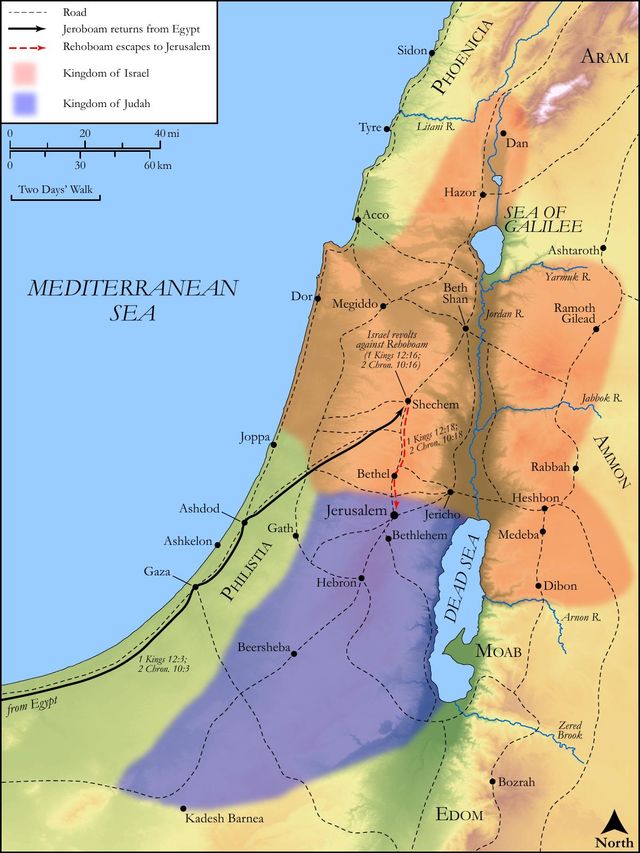
See on the biblical-era map
Study this verse
Public-domain commentary
Matthew Henry
From his Commentary on the Whole Bible. Henry comments on passages, not single verses — this entry covers 2 Chronicles 10:12–19.
We may learn here, 1. That when public affairs are in a ferment violent proceedings do but make bad worse. Rough answers (such as Rehoboam here gave) do but stir up anger and bring oil to the flames. The pilot has need to steer steadily in a storm. Many have been driven to the mischief they did not intend by being too severely dealt with for what they did intend. 2. That, whatever the devices and designs of men are, God is, by all, doing his own work, and fulfilling the word which he has spoken, no iota or tittle of which shall fall to the ground. The cause of the king's obstinacy and thoughtlessness was of God, that he might perform the word which he spoke by Ahijah, Ch2 10:15. This does not at all excuse Rehoboam's folly, nor lessen the guilt of his haughtiness and passion, that God was pleased to serve his own ends by them. 3. That worldly wealth, honour, and dominion, are very uncertain things. Solomon reigned over all Israel, and, one would think, had done enough to secure the monarchy entire to his family for many ages; and yet he is scarcely cold in his grave before ten of the twelve tribes finally revolt from his son. All the good services he had done for Israel were now forgotten: What portion have we in David? Thus is the government of Christ cast off by many, notwithstanding all he has done to bind the children of men for ever to himself; they say, We will not have this man to reign over us. But this rebellion will certainly be their ruin. 4. That God often visits the iniquities of the fathers upon the children. Solomon forsakes God, and therefore not he, but his son after him, is forsaken by the greatest part of his people. Thus God, by making the penal consequences of sin to last long and visibly to continue after the sinner's death, would give an indication of its malignity, and perhaps some intimation of the perpetuity of its punishment. He that sins against God not only wrongs his soul, but perhaps wrongs his seed more than he thinks of. 5. That, when God is fulfilling his threatenings, he will take care of that, at the same time, promises do not fall to the ground. When Solomon's iniquity is remembered, and for it his son loses ten tribes, David's piety is not forgotten, nor the promise made to him; but for the sake of that his grandson had two tribes preserved to him. The failings of the saints shall not frustrate any promise made to Christ their Head. They shall be chastised, but the covenant not broken, Psa 89:31-34.
Continue studying 2 Chronicles 10:12 across the web’s major study libraries — every link below opens this exact verse, chapter, or book on the destination site.
Read & Compare
 BibleGatewayThis verse in more than 200 translations and 70 languages.
 Bible.comThe YouVersion reader — hundreds of translations, reading plans, and highlights.
 ESV.orgCrossway's official English Standard Version reader.
 NET BibleThe NET translation with 60,000+ translators' notes on every rendering decision.
 STEP BibleTyndale House's free study tool — original text, vocabulary, and scholarly resources.
 BibliaLogos Bible Software's free web reader.
 USCCBThe New American Bible (Revised Edition) with the U.S. bishops' study notes.
Commentaries
 BibleHub CommentariesDozens of classic commentaries on this verse, gathered on one page.
 StudyLightMore than 100 commentary sets — the largest collection on the web.
 BibleRefPlain-English commentary on what this verse means, verse by verse.
 Enduring WordDavid Guzik's free commentary on this chapter, widely used by Bible teachers.
 Bible Study ToolsVerse commentary alongside Greek and Hebrew study aids.
Original Language & Research
- BibleHub InterlinearThe verse word by word — original language, transliteration, and English.
- BibleHub LexiconEvery word's original-language definition and Strong's entry.
 Blue Letter BibleDeep-study tools — Strong's numbers, concordance, and word studies.
 SefariaThe Hebrew text with Rashi and centuries of Jewish commentary.
Sermons, Hymns & Audio


TrulyRandomVerse is not affiliated with these sites and doesn’t control their content. They’re linked because they’re genuinely useful.
Summary
This pivotal verse marks the highly anticipated return of Jeroboam and the people of Israel to King Rehoboam. After a three-day delay granted by the new monarch to consider their petition for relief from the heavy burdens of Solomon's reign, the people faithfully reassembled. Their punctual arrival signifies the profound tension and expectation surrounding Rehoboam's impending decision, which would ultimately determine the unity or division of the Israelite kingdom, setting the stage for one of the most significant schisms in Israel's history.
Context
ShowHideLiterary Context
This verse is strategically placed at a critical juncture in the historical narrative of Israel, immediately following the death of King Solomon and the succession of his son, Rehoboam. The preceding verses 2 Chronicles 10:1-5 detail the assembly of all Israel at Shechem to make Rehoboam king, and their collective plea, led by Jeroboam, for the new king to lighten the oppressive yoke of taxation and forced labor imposed by Solomon. Rehoboam's initial response was a request for three days to deliberate before giving his answer. Thus, 2 Chronicles 10:12 serves as the precise moment of the people's return, fulfilling the king's command and setting the stage for Rehoboam's fateful pronouncement in 2 Chronicles 10:13-14 and the subsequent, tragic division of the united monarchy. This narrative is also paralleled in 1 Kings 12, underscoring its immense historical and theological significance.
Historical & Cultural Context
The backdrop to this verse is the immense wealth and grand building projects undertaken during Solomon's reign, including the magnificent Temple and his own lavish palace, which were financed through heavy taxation and a system of forced labor (corvée). While these projects brought glory and infrastructure, they also created significant economic and social strain on the populace, particularly the northern tribes who felt disproportionately burdened. Jeroboam, a former overseer of forced labor under Solomon, had previously rebelled and fled to Egypt 1 Kings 11:26-40, making his return and leadership of the delegation highly significant, as he embodied the northern tribes' discontent. The "third day" was a common, though not exclusively symbolic, period for significant events or decisions in Scripture, as at Sinai, where the LORD came down on the third day, adding an element of suspense and anticipation to the king's impending declaration. The people's expectation was that a new king would usher in an era of relief and justice, a common hope at the start of a new reign, especially given the burdens of the previous one.
Key Themes
ShowHideThe central themes converging in this verse include Anticipation and Expectation, as the people's prompt return underscores their earnest hope for a compassionate and favorable response from their new king, signaling their readiness for change and their desire for a more equitable rule. It highlights a Pivotal Leadership Moment for Rehoboam, where his decision would either unite or irrevocably divide the nation, demonstrating the immense weight of choices made by those in authority and the profound impact of wise versus foolish counsel. Furthermore, this verse subtly points to Divine Sovereignty in Human Affairs. Although not explicitly stated within this single verse, the unfolding events, including Rehoboam's poor decision, are presented in the broader narrative as part of God's larger plan, precisely as prophesied through the prophet Ahijah concerning the division of the kingdom. This illustrates how God works through human choices and failures to bring about His purposes, even the challenging ones, as seen in the subsequent account of the kingdom's split recorded in 2 Chronicles 10:16-19.
Exposition and Analysis
ShowHideKey Word Analysis
ShowHideThis primitive root signifies a purposeful and direct movement, encompassing a wide variety of applications from simply "to go" or "to come" to "to enter" or "to attain." In this context, it emphasizes the unified and determined approach of Jeroboam and "all the people" to Rehoboam. It's not a casual gathering but a formal, expectant assembly, highlighting the gravity of the occasion and the people's compliance with the king's command. The verb implies a deliberate act of presenting themselves before the king, signifying their readiness for his response.
This root means "to speak" or "to arrange," often used figuratively for words, commands, or declarations. Here, it indicates that the king had issued a specific instruction or command. While seemingly straightforward, it underscores Rehoboam's initial exercise of royal authority in setting the terms of their next meeting. The people's compliance ("as the king bade") demonstrates their respect for the royal prerogative and their willingness to follow the established protocol, at least at this critical stage before the king's decision was revealed.
This phrase combines yôwm (H3117), meaning "day" (as a warm period, or a defined space of time), and shᵉlîyshîy (H7992), the ordinal "third." Together, they denote a literal passage of time, a period of approximately 72 hours. While the "third day" can carry profound symbolic weight in other biblical contexts (e.g., resurrection, divine appearance), here it primarily serves as a practical timeframe for deliberation. It effectively builds narrative suspense, allowing Rehoboam to consult his advisors and for the tension to mount among the waiting populace, making the eventual decision and its consequences all the more impactful.
Verse Breakdown
ShowHide"So Jeroboam and all the people came to Rehoboam on the third day"
This clause describes the fulfillment of Rehoboam's earlier command, emphasizing the people's prompt and unified return. The inclusion of "Jeroboam and all the people" signifies a united front, with Jeroboam acting as the primary spokesman and leader of the northern tribes. Their punctuality "on the third day" underscores their earnestness, their compliance with the royal decree, and the high stakes involved in the awaited decision. It highlights the collective anticipation of a resolution to their grievances, demonstrating their respect for the king's authority and the established process.
"as the king bade, saying, Come again to me on the third day"
This parenthetical phrase serves as a direct reminder of the king's previous instruction, reinforcing the people's obedience to his command. It reiterates the specific timeframe that Rehoboam himself had set, emphasizing that the people were merely fulfilling his request. This detail builds narrative tension by drawing attention to the king's responsibility to deliver on his promise of a considered response, setting up the dramatic reveal of his decision and its immediate consequences.
Literary Devices
ShowHideThe verse, though concise, is rich in Foreshadowing and Dramatic Irony. The very act of the people's punctual return on the "third day" creates a palpable sense of anticipation, subtly foreshadowing the momentous and ultimately tragic decision that is about to unfold. The narrative tension built by the three-day wait sets the stage for the dramatic division of the kingdom, a historical outcome that the audience, knowing the broader biblical history, is keenly aware of, thereby creating Dramatic Irony. The people's hopeful and compliant return contrasts sharply with the disastrous outcome that awaits them due to Rehoboam's prideful and foolish choice. Furthermore, the verse functions as a Pivotal Moment in the narrative, marking the culmination of the waiting period and the precipice of a major historical shift for Israel. The phrase "as the king bade" also serves as a form of Repetition or Echo, reminding the reader of the king's earlier instruction and highlighting the people's adherence to it, thereby intensifying the focus on Rehoboam's impending verdict and his ultimate accountability.
Theological and Thematic Connections
ShowHideThis verse, though seemingly a simple statement of fact, is profoundly significant in its theological implications. It underscores the principle that human decisions, even those driven by pride or folly, operate within the overarching framework of divine sovereignty. While Rehoboam's request for a three-day delay and his subsequent rejection of wise counsel were entirely his own choices, the biblical narrative explicitly states that these events were "from the Lord, that he might perform his word, which the LORD spake by the hand of Ahijah the Shilonite to Jeroboam the son of Nebat" 2 Chronicles 10:15. This demonstrates God's ability to orchestrate His purposes through the free will and even the sin of humanity, turning human rebellion into an instrument of His larger redemptive plan. The people's patient return also highlights the theme of expectation and the desire for righteous leadership, a longing that ultimately points to the need for a perfect King who will truly bear their burdens.
Reflection and Application
ShowHideThe return of Jeroboam and the people on the third day, full of anticipation, offers profound lessons for contemporary life, particularly concerning leadership, counsel, and the consequences of our choices. Like Rehoboam, we often face critical decisions that require careful deliberation and the seeking of wise counsel. This verse reminds us of the importance of truly listening to the concerns of those we lead or interact with, rather than dismissing their legitimate grievances or prioritizing our own desires for power, comfort, or personal gain. Rehoboam's eventual rejection of the experienced elders' advice in favor of his youthful peers' harsh counsel serves as a timeless warning against pride, arrogance, and the folly of surrounding ourselves only with those who affirm our preconceived notions. For the people, their patient waiting on the third day, despite their burdens, speaks to the need for perseverance and trust, even when the outcome is uncertain. We are called to exercise discernment in our own decision-making processes, understanding that our choices have far-reaching impacts, not just on ourselves but on our communities, families, and those under our influence. True leadership, as contrasted with Rehoboam's failure, involves humility, empathy, and a willingness to serve rather than dominate.
Questions for Reflection
ShowHideFAQ
ShowHideWhy did Rehoboam ask for three days to respond to the people's petition?
ShowHideRehoboam requested a three-day delay (as seen in 2 Chronicles 10:5) primarily to consult with his advisors. He first sought counsel from the older, experienced elders who had served his father Solomon, and then, crucially, from the younger men with whom he had grown up. This period of deliberation was intended to allow him to formulate a response to the people's demand for relief from the heavy burdens of Solomon's reign, though his ultimate choice of counsel proved disastrous.
Who was Jeroboam, and why was he leading the people's delegation?
ShowHideJeroboam was a capable and ambitious Ephraimite, a former servant of King Solomon whom Solomon had put in charge of all the forced labor of the house of Joseph 1 Kings 11:28. He had previously been prophesied by the prophet Ahijah to receive ten tribes of Israel as king 1 Kings 11:29-39. Due to Solomon's attempt to kill him, Jeroboam had fled to Egypt, returning only after Solomon's death. His leadership of the delegation to Rehoboam was highly significant because he represented the strong grievances of the northern tribes and was already divinely appointed to play a key role in the kingdom's impending division.
Does the "third day" in this verse carry any symbolic meaning, as it does in other biblical contexts?
ShowHideWhile the "third day" often signifies a significant turning point, divine intervention, or resurrection in other biblical narratives (e.g., Jonah in the fish, Jesus' resurrection), in 2 Chronicles 10:12, it primarily functions as a literal timeframe for deliberation. It serves to build narrative tension and highlights the king's request for time to consider his response. Any symbolic weight would be secondary to its primary function of marking the passage of time for a crucial human decision that would have monumental consequences.
Christ-Centered Fulfillment
ShowHideThe narrative of Rehoboam's failure and the division of the kingdom, set in motion by the events of 2 Chronicles 10:12 and the verses that follow, powerfully points to the necessity of a perfect King, Jesus Christ. Rehoboam, burdened by pride and poor counsel, chose to increase the people's burdens, leading to rebellion and schism. This stands in stark contrast to the reign of Christ, who declares, "Come to me, all who labor and are heavy laden, and I will give you rest" Matthew 11:28. Unlike Rehoboam, who sought to assert oppressive power and dominion, Jesus, our true King, came not to be served but to serve and to give His life as a ransom for many Mark 10:45. His counsel is always perfect and leads to life, truth, and genuine freedom John 14:6, never to division or destruction. The fractured kingdom under Rehoboam foreshadows humanity's inherent brokenness and our inability to achieve lasting unity and peace under human leadership. Christ, however, unites all who believe in Him into one spiritual body, the Church, tearing down dividing walls and bringing reconciliation between God and humanity, and among people themselves Ephesians 2:14-16. He is the ultimate fulfillment of the Davidic covenant, the King whose reign brings true justice, everlasting peace, and an eternal kingdom that will never be divided Luke 1:32-33.