


2 Chronicles 10:11
Bible text: King James Version (1769 Blayney text) · Public domain
Bible text: King James Version with Strong's numbers · Public domain
Bible text: Berean Standard Bible · Public domain
Bible text: American Standard Version (1901) · Public domain
Bible text: World English Bible, Messianic edition · Public domain
Bible text: Geneva Bible (1599) · Public domain
Bible text: Young's Literal Translation · Public domain
- וְעַתָּהve·'a·Tahand thereforeH6258Conj-w ¦ AdvAdverbוְandעַתָּהtherefore
- אָבִי'a·Vimy fatherH1N-msc ¦ 1csNoun Singular Masculine Constructאָבִfatherיmy
- הֶעְמִיסhe'·Mishe loadedH6006V-Hiphil-Perf-3msVerb Hiphil Perfect 3rd Singular Masculine
- עֲלֵיכֶם'a·lei·Khemon youH5921Prep ¦ 2mpPrepositionעֲלֵיonכֶםyou
- עֹל'ola yokeH5923N-msNoun Singular Masculine Absolute
- כָּבֵדka·VedheavyH3515Adj-msAdjective Singular Masculine Absolute
- וַאֲנִיva·'a·Niand IH589Conj-w ¦ Pro-1csPronoun Personal 1st Singular common genderוַandאֲנִיI
- אֹסִיף'o·SifI will addH3254V-Hiphil-Imperf-1csVerb Hiphil Imperfect 1st Singular common gender
- עַל'altoH5921PrepPreposition
- עֻלְּכֶם'u·le·Khemyour yokeH5923N-msc ¦ 2mpNoun Singular Masculine Constructעֻלְּyokeכֶםyour
- אָבִי'a·Vimy fatherH1N-msc ¦ 1csNoun Singular Masculine Constructאָבִfatherיmy
- יִסַּרyi·Sarhe disciplinedH3256V-Piel-Perf-3msVerb Piel Perfect 3rd Singular Masculine
- אֶתְכֶם'et·Khem<obj.> youH853DirObjM ¦ 2mpParticle Object Indicatorאֶתְ<obj.>כֶםyou
- בַּשּׁוֹטִיםba·sho·Timwith <the> whipsH7752Prep-b ¦ N-mpNoun Plural Masculine Absoluteבַּwith <the>שּׁוֹטִיםwhips
- וַאֲנִיva·'a·Niand IH589Conj-w ¦ Pro-1csPronoun Personal 1st Singular common genderוַandאֲנִיI
- בָּעֲקְרַבִּיםBa·'ak·ra·Bimwith <the> scorpionsH6137Prep-b ¦ N-mpNoun Plural Masculine Absoluteבָּwith <the>עֲקְרַבִּיםscorpions
English is a literal word-by-word gloss of the Hebrew, not the KJV's wording. Why?
This is the original text the KJV's translators worked from — each Hebrew word with its own literal English meaning in this verse, prepared by scholars at Tyndale House, Cambridge. The KJV translates whole sentences, not word by word, so its wording differs: one Hebrew word can become several English words, and the KJV may choose “the LORD” where the gloss reads “Yahweh”. Both are faithful — they answer different questions. For the KJV's own rendering, switch to the KJV text.
Details
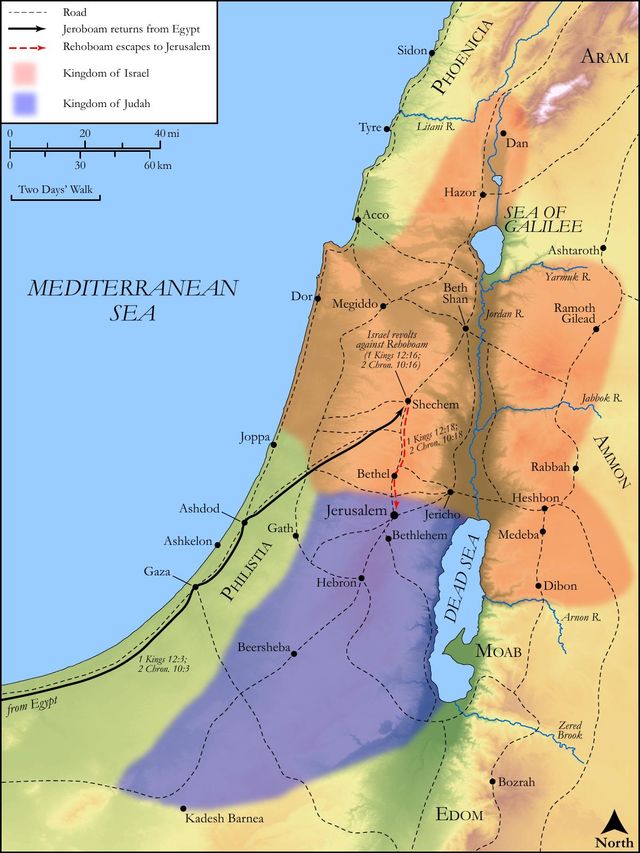
See on the biblical-era map
Study this verse
Public-domain commentary
Matthew Henry
From his Commentary on the Whole Bible. Henry comments on passages, not single verses — this entry covers 2 Chronicles 10:1–11.
We may observe here, 1. The wisest and best cannot give every body content. Solomon enriched and advanced his kingdom, did all (one would think) that could be done to make then happy and easy; and yet either he was indiscreet in burdening them with the imposition of taxes and services, or at least there was some colour of reason to think him so. No man is perfectly wise. It is probable that it was when Solomon had declined from God and his duty that his wisdom failed him, and God left him to himself to act in this impolitic manner. Even Solomon's treasures were exhausted by his love of women; and probably it was to maintain them, and their pride, luxury, and idolatry, that he burdened his subjects. 2. Turbulent and ungrateful spirits will find fault with the government, and complain of grievances, when they have very little reason to do so. Had they not peace in Solomon's time? They were never plundered by invaders, as formerly, never put in fear by the alarms of war, nor obliged to hazard their lives in the high places of the field. Had they not plenty - meat enough, and money enough? What would they more? O fortunatos nimium, sua si bona norint! - O happy, if they knew their happy state! And yet they complain that Solomon made their yoke grievous. If any complain thus of the yoke of Christ, that they might have a pretence to break his bands in sunder and cast away his cords from them, we are sure that he never gave them any cause at all for the complaint, whatever Solomon did. His yoke is easy, and his burden is light. He never made us serve with an offering, nor wearied us with incense. 3. Many ruin themselves and their interests by trampling upon and provoking their inferiors. Rehoboam thought that because he was king he might assume as much authority as his father had done, might have what he would, and do what he would, and carry all before him. But, though he wore his father's crown, he wanted his father's brains, and ought to have considered that, being quite a different man from what his father was, he ought to take other measures. Such a wise man as Solomon may do as we will, but such a fool as Rehoboam must do as he can. The high-mettled horse may be kicked and spurred by him that has the art of managing him; but, if an unskilful horseman do it, it is at his peril. Rehoboam paid dearly for threatening, and talking big, and thinking to carry matters with a high hand. It was Job's wisdom, as well as his virtue, that he despised not the cause of his man-servant or maid-servant, when they argued with him (Job 31:13), but heard them patiently, considered their reasons, and gave them a soft answer. And a similar tender consideration of those in subjection, and a forwardness to make them easy, will be the comfort and praise of all in authority, in the church, in the state, and in families. 4. Moderate counsels are generally wisest and best. Gentleness will do what violence will not do. Most people love to be accosted mildly. Rehoboam's old experienced counsellors directed him to this method (v. 7): "Be kind to this people, and please them, and speak good words to them, and thou art sure of them for ever." Good words cost nothing but a little self-denial, and yet they purchase good things. 5. God often fulfils the counsels of his own wisdom by infatuating men, and giving them up to the counsels of their own folly. No more needs to be done to ruin men than to leave them to themselves, and their own pride and passion.
Continue studying 2 Chronicles 10:11 across the web’s major study libraries — every link below opens this exact verse, chapter, or book on the destination site.
Read & Compare
 BibleGatewayThis verse in more than 200 translations and 70 languages.
 Bible.comThe YouVersion reader — hundreds of translations, reading plans, and highlights.
 ESV.orgCrossway's official English Standard Version reader.
 NET BibleThe NET translation with 60,000+ translators' notes on every rendering decision.
 STEP BibleTyndale House's free study tool — original text, vocabulary, and scholarly resources.
 BibliaLogos Bible Software's free web reader.
 USCCBThe New American Bible (Revised Edition) with the U.S. bishops' study notes.
Commentaries
 BibleHub CommentariesDozens of classic commentaries on this verse, gathered on one page.
 StudyLightMore than 100 commentary sets — the largest collection on the web.
 BibleRefPlain-English commentary on what this verse means, verse by verse.
 Enduring WordDavid Guzik's free commentary on this chapter, widely used by Bible teachers.
 Bible Study ToolsVerse commentary alongside Greek and Hebrew study aids.
Original Language & Research
- BibleHub InterlinearThe verse word by word — original language, transliteration, and English.
- BibleHub LexiconEvery word's original-language definition and Strong's entry.
 Blue Letter BibleDeep-study tools — Strong's numbers, concordance, and word studies.
 SefariaThe Hebrew text with Rashi and centuries of Jewish commentary.
Sermons, Hymns & Audio


TrulyRandomVerse is not affiliated with these sites and doesn’t control their content. They’re linked because they’re genuinely useful.
Summary
Rehoboam's defiant declaration in 2 Chronicles 10:11, promising to intensify the burdens imposed by his father Solomon rather than alleviate them, marks the pivotal moment leading to the catastrophic division of the united kingdom of Israel. This arrogant rejection of wise counsel, delivered in harsh and unyielding terms, directly provoked the northern tribes to secede, demonstrating the devastating consequences of prideful and oppressive leadership.
Context
ShowHideLiterary Context
This verse is the climactic moment in the narrative of Rehoboam's ascension to the throne and his fateful decision. It immediately follows the people's plea for lighter burdens (see 2 Chronicles 10:3-4) and Rehoboam's consultations with both the seasoned elders and his youthful peers (as recounted in 2 Chronicles 10:6-8). Rehoboam's harsh response in this verse directly precipitates the rebellion of the ten northern tribes (2 Chronicles 10:16-17) and the subsequent division of the kingdom, which forms a major turning point in the Chronicler's narrative, shifting the focus primarily to the kingdom of Judah.
Historical & Cultural Context
Following King Solomon's extensive and costly building projects, including the magnificent Temple and his own palace, the populace, particularly the northern tribes, had endured significant burdens of forced labor (corvée) and heavy taxation. The "yoke" metaphor was a common symbol for servitude or oppressive rule, often literally involving beasts of burden. Kings were expected to be benevolent providers, but also strong rulers. Rehoboam's youth and inexperience, coupled with the influence of his similarly inexperienced peers, led him to severely misjudge the political climate and the people's breaking point. The assembly took place in Shechem, a historically significant site for Israelite covenant renewal and tribal gatherings, underscoring the gravity and public nature of Rehoboam's decision.
Key Themes
ShowHideThis verse powerfully illustrates themes of leadership and governance, contrasting wise, empathetic rule with arrogant, tyrannical authority. It underscores the profound consequences of disobedience and pride, as Rehoboam's actions directly lead to the fragmentation of David's kingdom, a direct fulfillment of God's earlier prophecy against Solomon for his idolatry (as seen in 1 Kings 11:11-13). The Chronicler also subtly weaves in the theme of divine sovereignty, noting that this division, though brought about by human folly, was ultimately "from God" (as stated in 2 Chronicles 10:15), demonstrating how God uses even human sin and error to accomplish His overarching purposes and judgments.
Exposition and Analysis
ShowHideKey Word Analysis
ShowHideA wooden frame fitted over the necks of two animals (or a single animal) for drawing a plow or cart. Biblically, it is a powerful and pervasive metaphor for servitude, burden, oppression, or submission to authority. Rehoboam's promise to "put more to your yoke" signifies a deliberate increase in forced labor, taxation, and overall oppressive rule, explicitly stating his intent to make life harder for the people than it had been under his father.
This primitive root means "to chastise, literally (with blows) or figuratively (with words); hence, to instruct." In this context, it refers to the disciplinary action or punishment meted out by Solomon, implying a form of governance that, while burdensome, was seen as a form of "correction" by the king. Rehoboam's intention is to escalate this disciplinary action to a far more severe degree.
This term refers literally to the arachnid, but figuratively, as used here, it denotes a particularly severe and cruel type of whip, often described as having knots or pieces of metal/bone embedded to tear flesh. The imagery is hyperbole, emphasizing Rehoboam's intent to impose a far more brutal and merciless form of oppression, signaling a tenfold increase in severity compared to his father's rule and his complete disregard for the people's well-being.
Verse Breakdown
ShowHide"For whereas my father put a heavy yoke upon you, I will put more to your yoke"
Rehoboam begins by acknowledging the people's complaint about Solomon's heavy rule ("heavy yoke"), thereby validating their grievance. However, he immediately follows this with a defiant declaration of his intention to not only maintain but intensify the burden. This statement is a direct rejection of the elders' counsel to speak kindly and serve the people, revealing his arrogant, unyielding, and ultimately self-destructive nature.
"my father chastised you with whips, but I [will chastise you] with scorpions"
This parallel statement escalates the threat, using vivid and violent imagery. "Chastised" (Hebrew: yasar) implies discipline or punishment. By contrasting "whips" with "scorpions," Rehoboam vividly communicates his plan for a far more severe, cruel, and painful form of governance. He promises to rule with an iron fist, inflicting extreme hardship and demonstrating his absolute, tyrannical authority, which he believes will quell any dissent.
Literary Devices
ShowHideRehoboam's statement is rich in Metaphor and Hyperbole. The "heavy yoke" is a well-established metaphor for oppressive rule and forced labor, instantly conveying the burden on the people. The stark contrast between "whips" and "scorpions" functions as both a powerful Metaphor for degrees of severity in punishment and a striking Hyperbole, exaggerating the intended harshness of Rehoboam's reign to instill fear and demonstrate his absolute, unchallengeable authority. This clear Antithesis between Solomon's rule and Rehoboam's promised rule ("whereas... but I...") emphasizes the dramatic and tragic shift in leadership philosophy. The entire pronouncement also serves as a potent Foreshadowing of the kingdom's imminent division, as Rehoboam's words directly provoke the rebellion. There is also a strong element of Irony, as Rehoboam's attempt to assert absolute power through intimidation ultimately leads to the loss of most of his kingdom.
Theological and Thematic Connections
ShowHideRehoboam's declaration is a profound theological statement on the nature of power and the devastating consequences of its misuse. It demonstrates that human arrogance, a refusal to heed wise counsel, and a desire for tyrannical control can directly lead to divine judgment and the unraveling of established order. While Rehoboam acted out of pride and folly, the Chronicler emphasizes God's sovereign hand, fulfilling earlier prophecies regarding the division of the kingdom. This event underscores the biblical principle that leaders are accountable not only to the people but ultimately to God, and that the oppression of the vulnerable is an affront to His justice. It also highlights the fragility of unity when leadership lacks empathy and wisdom, serving as a cautionary tale for all who hold positions of authority.
Reflection and Application
ShowHideRehoboam's disastrous pronouncement in 2 Chronicles 10:11 offers timeless lessons for leadership and personal conduct in any sphere of influence. It challenges us to examine our own responses when confronted with grievances, requests for change, or the needs of those under our care. Do we listen with genuine empathy and humility, seeking wise and compassionate counsel, or do we react with pride, defensiveness, and a desire to assert our own power or will? This passage reminds us that genuine strength in leadership is found not in oppressive force or harsh rhetoric, but in compassionate service and a willingness to lighten burdens rather than increase them. It calls us to consider the long-term consequences of our words and actions, recognizing that harshness often alienates and divides, while grace, understanding, and a servant's heart foster unity, trust, and flourishing. Ultimately, it invites us to reflect on the kind of "yoke" we impose on others, whether in our families, workplaces, churches, or communities, and to strive for leadership that reflects the wisdom and compassion of God.
Questions for Reflection
ShowHideFAQ
ShowHideWas Rehoboam's decision purely his own, or was God involved?
ShowHideWhile Rehoboam made a conscious choice stemming from his own pride, inexperience, and poor judgment, the Chronicler explicitly states that this division was "from God" (2 Chronicles 10:15). This highlights the biblical concept of divine sovereignty, where God can use even human sin and folly to accomplish His purposes, in this case, the fulfillment of a prophecy made to Solomon concerning the division of his kingdom due to his unfaithfulness and idolatry (as detailed in 1 Kings 11:11-13). So, it was both Rehoboam's culpable choice and God's sovereign plan working in concert.
What is the significance of "scorpions" in this context?
ShowHideIn 2 Chronicles 10:11, "scorpions" (Hebrew: ʻaqrâb) does not refer to the arachnid, but to a particularly cruel and severe type of whip. It was likely a whip studded with sharp metal or bone pieces, designed to inflict maximum pain and lacerations. Rehoboam's use of this imagery was a deliberate rhetorical device to convey his intent to rule with far greater brutality and oppression than his father Solomon. It was a promise of a reign of terror that would make the previous burdens seem light by comparison, signaling his complete disregard for the people's well-being and his determination to crush any dissent.
Christ-Centered Fulfillment
ShowHideRehoboam's oppressive "yoke" and promise of "scorpions" stand in stark contrast to the liberating and gracious "yoke" offered by Jesus Christ, the true and ultimate King. While Rehoboam sought to increase burdens and assert tyrannical power through intimidation, Jesus invites all who are weary and burdened to come to Him, promising not more oppression but rest for their souls. He declares, "Take my yoke upon you, and learn from me, for I am gentle and lowly in heart, and you will find rest for your souls. For my yoke is easy, and my burden is light" (Matthew 11:28-30). Unlike Rehoboam, who ruled with whips and scorpions, Jesus, the Lamb of God, governs with love, compassion, and ultimate self-sacrifice, ultimately bearing the heavy yoke of humanity's sin on the cross (Isaiah 53:4-6), freeing us from the crushing weight of legalism and condemnation. His leadership is characterized by humility and service (Philippians 2:5-8), not by the arrogance and oppression that led to the division of Rehoboam's kingdom, offering a perfect model of the benevolent, just, and unifying rule of God.