


2 Chronicles 10:10
Bible text: King James Version (1769 Blayney text) · Public domain
Bible text: King James Version with Strong's numbers · Public domain
Bible text: Berean Standard Bible · Public domain
Bible text: American Standard Version (1901) · Public domain
Bible text: World English Bible, Messianic edition · Public domain
Bible text: Geneva Bible (1599) · Public domain
Bible text: Young's Literal Translation · Public domain
- וַיְדַבְּרוּvay·da·be·Ruand they spokeH1696Conj-w ¦ V-Piel-ConsecImperf-3mpVerb Piel Consecutive Imperfect 3rd Plural Masculineוַandיְדַבְּרוּthey spoke
- אִתּוֹ'i·Towith himH854Prep ¦ 3msPrepositionאִתּwithוֹhim
- הַיְלָדִיםhay·la·Dimthe youthsH3206Art ¦ N-mpNoun Plural Masculine Absoluteהַtheיְלָדִיםyouths
- אֲשֶׁר'a·SherwhoH834RelParticle Relative
- גָּדְלוּga·de·Luthey had grown upH1431V-Qal-Perf-3cpVerb Qal Perfect 3rd Plural common gender
- אִתּוֹ'i·Towith himH854Prep ¦ 3msPrepositionאִתּwithוֹhim
- לֵאמֹרle·Mor<to> sayingH559Prep-l ¦ V-Qal-InfVerb Qal Infinitive Constructלֵ<to>אמֹרsaying
- כֹּהkohthusH3541AdvAdverb
- תֹאמַרto·Maryou will sayH559V-Qal-Imperf-2msVerb Qal Imperfect 2nd Singular Masculine
- לָעָםla·'Amto the peopleH5971Prep-l ¦ N-msNoun Singular Masculine Absoluteלָto theעָםpeople
- אֲשֶׁר'a·SherwhichH834RelParticle Relative
- דִּבְּרוּdi·be·Ruthey have spokenH1696V-Piel-Perf-3cpVerb Piel Perfect 3rd Plural common gender
- אֵלֶיךָ'e·Lei·khato youH413Prep ¦ 2msPrepositionאֵלֶיtoךָyou
- לֵאמֹרle·Mor<to> sayingH559Prep-l ¦ V-Qal-InfVerb Qal Infinitive Constructלֵ<to>אמֹרsaying
- אָבִיךָ'a·Vi·khayour fatherH1N-msc ¦ 2msNoun Singular Masculine Constructאָבִיfatherךָyour
- הִכְבִּידhikh·Bidhe made heavyH3513V-Hiphil-Perf-3msVerb Hiphil Perfect 3rd Singular Masculine
- אֶת'et<obj.>H853DirObjMParticle Object Indicator
- עֻלֵּנוּ'u·Le·nuour yokeH5923N-msc ¦ 1cpNoun Singular Masculine Constructעֻלֵּyokeנוּour
- וְאַתָּהve·'a·Tahand youH859Conj-w ¦ Pro-2msPronoun Personal 2nd Singular Masculineוְandאַתָּהyou
- הָקֵלha·KellightenH7043V-Hiphil-Imp-2msVerb Hiphil Imperative 2nd Singular Masculine
- מֵעָלֵינוּme·'a·Lei·nufrom on <the> usH5921Prep-m ¦ Prep ¦ 1cpPreposition Definiteמֵfromעָלֵיon <the>נוּus
- כֹּהkohthusH3541AdvAdverb
- תֹּאמַרto·Maryou will sayH559V-Qal-Imperf-2msVerb Qal Imperfect 2nd Singular Masculine
- אֲלֵהֶם'a·le·Hemto themH413Prep ¦ 3mpPrepositionאֲלֵtoהֶםthem
- קָטָנִּיka·ta·Nimy little fingerH6995N-msc ¦ 1csNoun Singular Masculine Constructקָטָנִּlittle fingerיmy
- עָבָה'a·Vahit is thickH5666V-Qal-Perf-3msVerb Qal Perfect 3rd Singular Masculine
- מִמָּתְנֵיmi·ma·te·Neimore than [the] loins ofH4975Prep-m ¦ N-mdcNoun Dual Masculine Constructמִmore thanמָּתְנֵי[the] loins of
- אָבִי'a·Vimy fatherH1N-msc ¦ 1csNoun Singular Masculine Constructאָבִfatherיmy
English is a literal word-by-word gloss of the Hebrew, not the KJV's wording. Why?
This is the original text the KJV's translators worked from — each Hebrew word with its own literal English meaning in this verse, prepared by scholars at Tyndale House, Cambridge. The KJV translates whole sentences, not word by word, so its wording differs: one Hebrew word can become several English words, and the KJV may choose “the LORD” where the gloss reads “Yahweh”. Both are faithful — they answer different questions. For the KJV's own rendering, switch to the KJV text.
Details
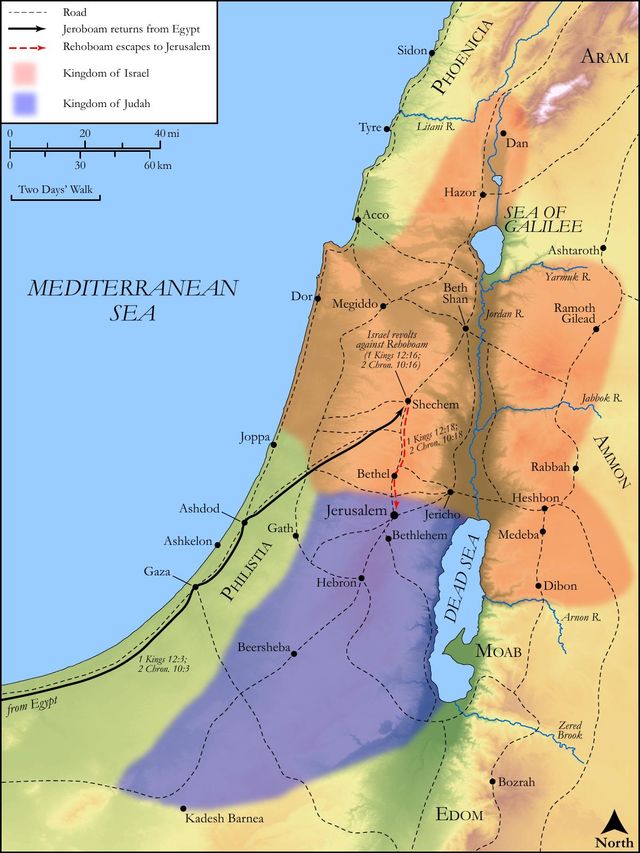
See on the biblical-era map
Study this verse
Public-domain commentary
Matthew Henry
From his Commentary on the Whole Bible. Henry comments on passages, not single verses — this entry covers 2 Chronicles 10:1–11.
We may observe here, 1. The wisest and best cannot give every body content. Solomon enriched and advanced his kingdom, did all (one would think) that could be done to make then happy and easy; and yet either he was indiscreet in burdening them with the imposition of taxes and services, or at least there was some colour of reason to think him so. No man is perfectly wise. It is probable that it was when Solomon had declined from God and his duty that his wisdom failed him, and God left him to himself to act in this impolitic manner. Even Solomon's treasures were exhausted by his love of women; and probably it was to maintain them, and their pride, luxury, and idolatry, that he burdened his subjects. 2. Turbulent and ungrateful spirits will find fault with the government, and complain of grievances, when they have very little reason to do so. Had they not peace in Solomon's time? They were never plundered by invaders, as formerly, never put in fear by the alarms of war, nor obliged to hazard their lives in the high places of the field. Had they not plenty - meat enough, and money enough? What would they more? O fortunatos nimium, sua si bona norint! - O happy, if they knew their happy state! And yet they complain that Solomon made their yoke grievous. If any complain thus of the yoke of Christ, that they might have a pretence to break his bands in sunder and cast away his cords from them, we are sure that he never gave them any cause at all for the complaint, whatever Solomon did. His yoke is easy, and his burden is light. He never made us serve with an offering, nor wearied us with incense. 3. Many ruin themselves and their interests by trampling upon and provoking their inferiors. Rehoboam thought that because he was king he might assume as much authority as his father had done, might have what he would, and do what he would, and carry all before him. But, though he wore his father's crown, he wanted his father's brains, and ought to have considered that, being quite a different man from what his father was, he ought to take other measures. Such a wise man as Solomon may do as we will, but such a fool as Rehoboam must do as he can. The high-mettled horse may be kicked and spurred by him that has the art of managing him; but, if an unskilful horseman do it, it is at his peril. Rehoboam paid dearly for threatening, and talking big, and thinking to carry matters with a high hand. It was Job's wisdom, as well as his virtue, that he despised not the cause of his man-servant or maid-servant, when they argued with him (Job 31:13), but heard them patiently, considered their reasons, and gave them a soft answer. And a similar tender consideration of those in subjection, and a forwardness to make them easy, will be the comfort and praise of all in authority, in the church, in the state, and in families. 4. Moderate counsels are generally wisest and best. Gentleness will do what violence will not do. Most people love to be accosted mildly. Rehoboam's old experienced counsellors directed him to this method (v. 7): "Be kind to this people, and please them, and speak good words to them, and thou art sure of them for ever." Good words cost nothing but a little self-denial, and yet they purchase good things. 5. God often fulfils the counsels of his own wisdom by infatuating men, and giving them up to the counsels of their own folly. No more needs to be done to ruin men than to leave them to themselves, and their own pride and passion.
Continue studying 2 Chronicles 10:10 across the web’s major study libraries — every link below opens this exact verse, chapter, or book on the destination site.
Read & Compare
 BibleGatewayThis verse in more than 200 translations and 70 languages.
 Bible.comThe YouVersion reader — hundreds of translations, reading plans, and highlights.
 ESV.orgCrossway's official English Standard Version reader.
 NET BibleThe NET translation with 60,000+ translators' notes on every rendering decision.
 STEP BibleTyndale House's free study tool — original text, vocabulary, and scholarly resources.
 BibliaLogos Bible Software's free web reader.
 USCCBThe New American Bible (Revised Edition) with the U.S. bishops' study notes.
Commentaries
 BibleHub CommentariesDozens of classic commentaries on this verse, gathered on one page.
 StudyLightMore than 100 commentary sets — the largest collection on the web.
 BibleRefPlain-English commentary on what this verse means, verse by verse.
 Enduring WordDavid Guzik's free commentary on this chapter, widely used by Bible teachers.
 Bible Study ToolsVerse commentary alongside Greek and Hebrew study aids.
Original Language & Research
- BibleHub InterlinearThe verse word by word — original language, transliteration, and English.
- BibleHub LexiconEvery word's original-language definition and Strong's entry.
 Blue Letter BibleDeep-study tools — Strong's numbers, concordance, and word studies.
 SefariaThe Hebrew text with Rashi and centuries of Jewish commentary.
Sermons, Hymns & Audio


TrulyRandomVerse is not affiliated with these sites and doesn’t control their content. They’re linked because they’re genuinely useful.
Summary
2 Chronicles 10:10 captures the moment of disastrous counsel given to Rehoboam, Solomon's successor, by his young advisors. Confronted by the northern tribes' plea to alleviate the heavy burdens of taxation and forced labor imposed by his father, Rehoboam is urged to respond with an arrogant declaration: that his rule would be exponentially more severe, boasting that his "little finger" would be thicker than his father's "loins." This prideful and unyielding advice, which Rehoboam ultimately embraced, directly triggered the catastrophic schism that divided the united kingdom of Israel.
Context
ShowHideLiterary Context
This verse serves as the critical turning point in the narrative of Rehoboam's accession to the throne, immediately following the people's collective petition for relief from Solomon's oppressive policies (2 Chronicles 10:3-4). It is juxtaposed with the wise, conciliatory counsel offered by the seasoned elders who had served King Solomon, advice that Rehoboam ultimately rejected (2 Chronicles 10:6-7). Having dismissed the elders, Rehoboam then consulted the young men with whom he had grown up (2 Chronicles 10:8), and verse 10 presents their specific, profoundly ill-advised recommendation. This counsel, and Rehoboam's subsequent adoption of it, directly precipitates the kingdom's irreparable division, a pivotal event detailed in the concluding verses of 2 Chronicles 10. The Chronicler's account closely parallels the narrative found in 1 Kings 12.
Historical & Cultural Context
The historical setting is the immediate aftermath of King Solomon's long and prosperous reign, which, despite its grandeur (including the construction of the Temple and extensive building projects), was financed through heavy taxation and a system of forced labor known as corvée. The "yoke" (Hebrew: 'ol) was a widely understood metaphor for oppressive servitude, tribute, or taxation, as in the "yoke of iron upon thy neck" of the covenant curses, often literally a wooden bar placed on the necks of draft animals. The assembly at Shechem, where these events unfold, was a site of profound historical and covenantal significance for Israel, associated with covenant renewal under Joshua (Joshua 24) and tribal gatherings, lending immense gravity and legitimacy to the people's demands. Culturally, it was common for a new monarch to begin their reign with acts of benevolence or a reduction of burdens to secure the loyalty and support of their subjects. Rehoboam's advisors' counsel, therefore, was not only politically inept but also culturally insensitive and provocative, challenging the very foundation of royal legitimacy rooted in the people's consent and well-being. The idiom of the "little finger" being thicker than the "loins" was a culturally potent image signifying an overwhelming increase in power and severity.
Key Themes
ShowHide2 Chronicles 10:10 powerfully illustrates several critical themes within the broader biblical narrative. Firstly, it highlights Rehoboam's Folly and Lack of Discernment, a stark contrast to the wisdom for which his father Solomon was initially renowned (though Solomon's later moral failings and idolatry ultimately contributed to this very crisis, as prophesied in 1 Kings 11:11-13). Secondly, the verse serves as a profound warning about The Danger of Bad Counsel, demonstrating how listening to inexperienced, prideful, and self-serving advisors can lead to catastrophic consequences, particularly when wise counsel from seasoned individuals is rejected (Proverbs 11:14). Thirdly, it reveals a Spirit of Increased Oppression and Tyranny in leadership, as the proposed response signifies a deliberate intention not merely to maintain but to drastically escalate the burden on the populace, exposing a hard-hearted and arrogant attitude. Finally, and most significantly, this counsel and Rehoboam's subsequent adoption of it are the direct Seeds of Division, leading to the irreparable fracturing of the united kingdom of Israel into the northern kingdom (Israel) and the southern kingdom (Judah), a pivotal and tragic moment in Israel's history detailed in 2 Chronicles 10:16-19).
Exposition and Analysis
ShowHideKey Word Analysis
ShowHideThis term, derived from a root meaning "to be born," refers to a lad or offspring, specifically a boy, child, or young man. In this context, it emphasizes the immaturity and inexperience of Rehoboam's advisors, highlighting their lack of seasoned judgment and their tendency toward youthful bravado rather than practical wisdom in matters of governance.
This word, used by the people in their complaint ("Thy father made our yoke heavy"), means to be burdensome, severe, or weighty. It conveys the immense pressure and hardship the people experienced under Solomon's reign, encompassing both the physical toil of forced labor and the economic strain of taxation. Their plea was for a reduction of this severe burden.
This term specifically refers to a "pettiness" or the "little finger," implying the smallest or weakest digit. When Rehoboam's advisors declare his "little finger" will be "thicker" than his father's "loins," they are using this seemingly insignificant digit to boast of an exponentially greater, more severe, and unyielding power than that exercised by Solomon, whose authority was already considered immense.
Verse Breakdown
ShowHide"And the young men that were brought up with him spake unto him, saying"
This clause identifies the source of the devastating advice: Rehoboam's contemporaries, those with whom he had shared his formative years. This shared background suggests a bond of familiarity and perhaps a susceptibility to groupthink, but crucially, it underscores their lack of practical experience in statecraft and their inability to offer objective, wise counsel, contrasting sharply with the elders' seasoned perspective.
"Thus shalt thou answer the people that spake unto thee, saying, Thy father made our yoke heavy, but make thou [it] somewhat lighter for us"
This section reiterates the people's legitimate and humble petition. They acknowledge the oppressive nature of Solomon's rule, metaphorically described as a "heavy yoke," and respectfully request a reduction in their burdens. This plea, which includes a conditional promise of loyalty ("so will we serve thee"), sets the stage for Rehoboam's harsh and unyielding response, highlighting the stark contrast between the people's reasonable request and the king's impending tyrannical declaration.
"thus shalt thou say unto them, My little [finger] shall be thicker than my father's loins"
This is the core of the young men's destructive counsel and Rehoboam's adopted stance. It is a statement of extreme arrogance, defiance, and deliberate provocation. Far from offering relief, it explicitly threatens an increase in oppression. The vivid imagery conveys an exponential escalation of severity, implying that even Solomon's burdensome reign would pale in comparison to the crushing weight of Rehoboam's rule, signifying a complete rejection of the people's plea and an embrace of absolute, unmerciful power.
Literary Devices
ShowHideThe verse is rich with potent literary devices that amplify its dramatic and tragic impact. Most prominent is Hyperbole, evident in the exaggerated claim that Rehoboam's "little finger" would be "thick" than his father's "loins." This is a deliberate overstatement, designed to project an image of overwhelming, unyielding power and severity far beyond Solomon's already heavy rule. This statement also functions as a powerful Metaphor, where "yoke" represents oppressive rule, "little finger" signifies even the slightest exertion of Rehoboam's authority, and "loins" symbolize the full extent of Solomon's strength and power. The entire phrase, "My little finger shall be thicker than my father's loins," operates as a vivid Idiom or Proverbial Statement of extreme, escalating oppression. Furthermore, there is a profound sense of Irony woven into the narrative: the son of Solomon, renowned for wisdom, demonstrates an utter lack of it, and the counsel intended to project strength and deter rebellion ironically leads directly to the kingdom's catastrophic division and the loss of the vast majority of his subjects.
Theological and Thematic Connections
ShowHideThe counsel given to Rehoboam in 2 Chronicles 10:10 serves as a profound theological object lesson on the nature of righteous leadership, the perilous consequences of pride, and the overarching sovereignty of God. It starkly illustrates that true strength in governance is not found in the assertion of raw power or the imposition of heavy burdens, but rather in humility, wisdom, and a genuine willingness to serve the people. Rehoboam's arrogant rejection of sound counsel and his embrace of oppressive rhetoric directly led to the fracturing of God's chosen people, a significant event that the Chronicler presents as a divine judgment for Solomon's earlier idolatry and the people's own spiritual failings. Yet, even amidst this human folly and sin, the narrative emphasizes God's sovereign hand, demonstrating how He orchestrates events and fulfills His prophetic word through the choices and actions of individuals. The division of the kingdom was not merely a political accident but an integral part of God's overarching plan, a direct consequence of covenant disobedience.
Reflection and Application
ShowHide2 Chronicles 10:10 stands as a timeless and poignant cautionary tale, extending its relevance far beyond the ancient monarchy to every sphere of human interaction and leadership. It profoundly underscores the critical importance of the counsel we seek, the advice we heed, and the spirit in which we exercise any form of authority. Rehoboam's decision, driven by an inflated sense of self and a desire for absolute control rather than a heart for genuine service, resulted in immediate and devastating consequences that tore apart a nation. For us today, this narrative compels us to introspect: Do we actively seek counsel that challenges our biases and offers sober, often uncomfortable, wisdom, or do we gravitate towards voices that merely affirm our pride and desires? In our families, workplaces, churches, and communities, are we tempted to impose a "heavy yoke" of demands, control, or rigid expectations, or do we strive to lead with humility, empathy, and a servant's heart? The tragic outcome of Rehoboam's choice reminds us that true strength and lasting influence are often cultivated through listening, serving, and leading with a gentle spirit, recognizing that even seemingly minor acts of arrogance or oppression can have far-reaching, destructive effects on relationships and the fabric of community.
Questions for Reflection
ShowHideFAQ
ShowHideWhy did Rehoboam listen to the young men instead of the elders?
ShowHideRehoboam chose to listen to the young men primarily because their counsel appealed directly to his pride and his desire for absolute, unchallenged power. The seasoned elders, who had served his father Solomon, advised him to adopt a humble, servant-hearted approach, speaking kindly to the people and lightening their burdens (2 Chronicles 10:7). This path would have required humility and a willingness to concede some power. In contrast, the young men encouraged him to assert his dominance, increase the people's burdens, and project an image of unyielding strength, which resonated with Rehoboam's ego and likely his fear of appearing weak. This choice reflected a fundamental misunderstanding of righteous leadership, prioritizing personal power and a tyrannical image over the welfare and unity of the kingdom, ultimately leading to his downfall and the division of Israel (2 Chronicles 10:8-11).
Was the division of the kingdom God's will?
ShowHideYes, the division of the kingdom was indeed God's will, even though it came about through the foolish and prideful choices of Rehoboam. God had previously prophesied this very division to King Solomon through the prophet Ahijah, as a direct judgment for Solomon's widespread idolatry and his turning away from the Lord (1 Kings 11:11-13). While Rehoboam's pride and the young men's destructive counsel were the immediate human instruments, the Chronicler explicitly states that "the cause was from the LORD" (2 Chronicles 10:15), indicating that God sovereignly used these events to fulfill His prophetic word and enact His just judgment for Israel's covenant unfaithfulness.
Christ-Centered Fulfillment
ShowHideThe oppressive "yoke" that Rehoboam threatened to impose, boasting that his "little finger" would be thicker than his father's "loins," stands in stark and redemptive contrast to the liberating "yoke" offered by Jesus Christ. While Rehoboam sought to increase burdens and wield power through intimidation and tyranny, Jesus, the true and eternal King of Israel, came not to be served but to serve, and to give His life as a ransom for many (Mark 10:45). Unlike Rehoboam, who was driven by pride and sought to crush his people under a heavier load, Christ embodies perfect humility, willingly emptying Himself and taking the form of a servant, even to the point of death on a cross (Philippians 2:5-8). He extends an invitation to all who are weary and burdened by the heavy yokes of sin, legalism, and worldly oppression, promising genuine rest for their souls, for His "yoke is easy and [His] burden is light" (Matthew 11:28-30). Where Rehoboam's "little finger" signified greater oppression, Christ's gentle touch brings healing, freedom, and liberation from the crushing weight of sin and the demands of a broken law. He is the wise King, the Prince of Peace (Isaiah 9:6-7), whose reign is characterized by perfect justice, unwavering righteousness, and the compassionate lifting of all burdens, thereby fulfilling God's ancient promise of a truly righteous and compassionate ruler for His people.