


1 Samuel 25:11
Bible text: King James Version (1769 Blayney text) · Public domain
Bible text: Berean Standard Bible · Public domain
Bible text: American Standard Version (1901) · Public domain
Bible text: World English Bible, Messianic edition · Public domain
Bible text: Geneva Bible (1599) · Public domain
Bible text: Young's Literal Translation · Public domain
- וְלָקַחְתִּיve·la·kach·Tiand will I takeH3947Conj-w ¦ V-Qal-ConsecPerf-1csVerb Qal Consecutive Perfect 1st Singular common genderוְandלָקַחְתִּיwill I take
- אֶת'et<obj.>H853DirObjMParticle Object Indicator
- לַחְמִיlach·Mimy breadH3899N-csc ¦ 1msNoun Singular common gender Constructלַחְמִbreadיmy
- וְאֶתve·'Etand <obj.>H853Conj-w ¦ DirObjMParticle Object Indicatorוְandאֶת<obj.>
- מֵימַיmei·Maimy waterH4325N-mpc ¦ 1csNoun Plural Masculine Constructמֵימַwaterיmy
- וְאֵתve·'Etand <obj.>H853Conj-w ¦ DirObjMParticle Object Indicatorוְandאֵת<obj.>
- טִבְחָתִיtiv·cha·Timy slaughterH2878N-fsc ¦ 1csNoun Singular Feminine Constructטִבְחָתִslaughterיmy
- אֲשֶׁר'a·SherwhichH834RelParticle Relative
- טָבַחְתִּיta·Vach·tiI have slaughteredH2873V-Qal-Perf-1csVerb Qal Perfect 1st Singular common gender
- לְגֹזְזָיle·go·ze·Zaifor my shearersH1494Prep-l ¦ V-Qal-Prtcpl-mp ¦ 1csVerb Qal Participle Plural Masculine Constructלְforגֹזְזָshearersיmy
- וְנָתַתִּיve·na·ta·Tiand will I give [them]H5414Conj-w ¦ V-Qal-ConsecPerf-1csVerb Qal Consecutive Perfect 1st Singular common genderוְandנָתַתִּיwill I give [them]
- לַאֲנָשִׁיםla·'a·na·Shimto menH582Prep-l ¦ N-mpNoun Plural Masculine Absoluteלַtoאֲנָשִׁיםmen
- אֲשֶׁר'a·SherwhoH834RelParticle Relative
- לֹאlo'notH3808NegParticle Negative
- יָדַעְתִּיya·Da'·tiI knowH3045V-Qal-Perf-1csVerb Qal Perfect 1st Singular common gender
- אֵי'eiwhere?H335InterrogParticle Interrogative
- מִזֶּהmi·Zehfrom thisH2088Prep-m ¦ PrtParticle Demonstrativeמִfromזֶּהthis
- הֵמָּהHe·mah[are] theyH1992Pro-3mpPronoun Personal 3rd Plural Masculine
English is a literal word-by-word gloss of the Hebrew, not the KJV's wording. Why?
This is the original text the KJV's translators worked from — each Hebrew word with its own literal English meaning in this verse, prepared by scholars at Tyndale House, Cambridge. The KJV translates whole sentences, not word by word, so its wording differs: one Hebrew word can become several English words, and the KJV may choose “the LORD” where the gloss reads “Yahweh”. Both are faithful — they answer different questions. For the KJV's own rendering, switch to the KJV text.
Details
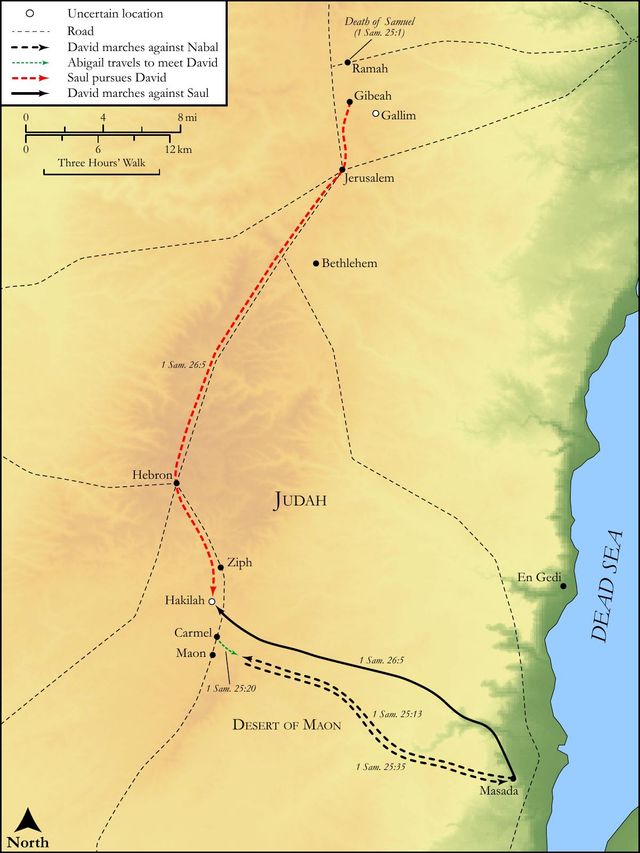
See on the biblical-era map
Study this verse
Public-domain commentary
Matthew Henry
From his Commentary on the Whole Bible. Henry comments on passages, not single verses — this entry covers 1 Samuel 25:2–11. His three-level outline is real structure in the source text, so it is rendered as structure.
Here begins the story of Nabal.
I.A short account of him, who and what he was (Sa1 25:2, Sa1 25:3), a man wee should never have heard of if there had not happened some communication between him and David. Observe,
1.His name: Nabal - a fool; so it signifies. It was a wonder that his parents would give him that name and an ill omen of what proved to be this character. Yet indeed we all of us deserve to be so called when we come into the world, for man is born like the wild ass's colt and foolishness is bound up in our hearts.
2.His family: He was of the house of Caleb, but was indeed of another spirit. He inherited Caleb's estate; for Maon and Carmel lay near Hebron, which was given to Caleb (Jos 15:54, Jos 15:55; Jos 14:14), but he was far from inheriting his virtues. He was a disgrace to his family, and then it was no honour to him. Degeneranti genus opprobrium - A Good extraction is a reproach to him who degenerates from it. The Septuagint, and some other ancient versions, read it appellatively, not, He was a Calebite, but He was a dogged man, of a currish disposition, surly and snappish, and always snarling. He was anthrōpos kunikos - a man that was a cynic.
3.His wealth: He was very great, that is, very rich (for riches make men look great in the eye of the world), otherwise, to one that takes his measures aright, he really looked very mean. Riches are common blessings, which God often gives to Nabals, to whom he gives neither wisdom nor grace.
4.His wife - Abigail, a woman of great understanding. Her name signifies, the joy of her father; yet he could not promise himself much joy of her when he married her to such a husband, enquiring more after his wealth than after his wisdom. Many a child is thrown away upon a great heap of the dirt of worldly wealth, married to that, and to nothing else that is desirable. Wisdom is good with an inheritance, but an inheritance is good for little without wisdom. Many an Abigail is tied to a Nabal; and if it be so, be her understanding, like Abigail's, ever so great, it will be little enough for her exercises.
5.His character. He had no sense either of honour or honesty; not of honour, for he was churlish, cross, and ill-humoured; not of honesty, for he was evil in his doings, hard and oppressive, and a man that cared not what fraud and violence he used in getting and saving, so he could but get and save. This is the character given of Nabal by him who knows what every man is.
II.David's humble request to him, that he would send him some victuals for himself and his men.
1.David, it seems, was in such distress that he would be glad to be beholden to him, and did in effect come a begging to his door. What little reason have we to value the wealth of this world when so great a churl as Nabal abounds and so great a saint as David suffers want! Once before we had David begging his bread, but then it was of Ahimelech the high priest, to whom one would not grudge to stoop. But to send a begging to Napal was what such a spirit as David had could not admit without some reluctancy; yet, if Providence bring him to these straits, he will not say that to beg he is ashamed. Yet see Psa 37:25.
2.He chose a good time to send to Nabal, when he had many hands employed about him in shearing his sheep, for whom he was to make a plentiful entertainment, so that good cheer was stirring. Had he sent at another time, Nabal would have pretended he had nothing to spare, but now he could not have that excuse. It was usual to make feasts at their sheep-shearings, as appears by Absalom's feast on that occasion (Sa2 13:24), for wool was one of the staple commodities of Canaan.
3.David ordered his men to deliver their message to him with a great deal of courtesy and respect: "Go to Nabal, and greet him in my name. Tell him I sent you to present my service to him, and to enquire how he does and his family," Sa1 25:5. He puts words in their mouths (Sa1 25:6): Thus shall you say to him that liveth; our translators add, in prosperity, as if those live indeed that live as Nabal did, with abundance of the wealth of this world about them; whereas, in truth, those that live in pleasure are dead while they live, Ti1 5:6. This was, methinks too high a compliment to pass upon Nabal, to call him the man that liveth. David knew better things, that in God's favour is life, not in the world's smiles; and by the rough answer he was well enough served, for this too smooth address to such a muck-worm. Yet his good wishes were very commendable. "Peace be to thee, all good both to soul and body. Peace be to thy house and to all that thou hast." Tell him I am a hearty well-wisher to his health and prosperity. He bids them call him his son David (Sa1 25:8), intimating that, for his age and estate, David honoured him as a father, and therefore hoped to receive some fatherly kindness from him.
4.He pleaded the kindness which Nabal's shepherds had received from David and his men; and one good turn requires another. He appeals to Nabal's own servants, and shows that when David's soldiers were quartered among Nabal's shepherds,
(1.)They did not hurt them themselves, did them no injury, gave them no disturbance, were not a terror to them, nor took any of the lambs out of the flock. Yet, considering the character of David's men, men in distress, and debt, and discontented, and the scarcity of provisions in his camp, it was not without a great deal of care and good management that they were kept from plundering.
(2.)They protected them from being hurt by others. David himself does but intimate this, for he would not boast of his good offices: Neither was there aught missing to them, Sa1 25:7. But Nabal's servants, to whom he appealed, went further (Sa1 25:16): They were a wall unto us, both by night and day. David's soldiers were a guard to Nabal's shepherds when the bands of the Philistines robbed the threshing-floors (Sa1 23:1) and would have robbed the sheep-folds. From those plunderers Nabal's flocks were protected by David's care, and therefore he says, Let us find favour in thy eyes. Those that have shown kindness may justly expect to receive kindness.
5.He was very modest in his request. Though David was anointed king, he insisted not upon royal dainties, but, "Give whatsoever comes to thy hand, and we will be thankful for it." Beggars must not be choosers. Those that deserved to have been served first will now be glad of what is left. They plead, We come in a good day, a festival, when not only the provision is more plentiful, but the heart and hand are usually more open and free than at other times, when much may be spared and yet not be missed. David demands not what he wanted as a debt, either by way of tribute as he was a king, or by way of contribution as he was a general, but asks it as a boon to a friend, that was his humble servant. David's servants delivered their message faithfully and very handsomely, not doubting but to go back well laden with provisions.
III.Nabal's churlish answer to this modest petition, Sa1 25:10, Sa1 25:11.
One could not have imagined it possible that any man should be so very rude and ill-conditioned as Nabal was. David called himself his son, and asked bread and a fish, but, instead thereof, Nabal gave him a stone and a scorpion; not only denied him, but abused him. If he had not thought fit to send him any supplies for fear of Ahimelech's fate, who paid dearly for his kindness to David; yet he might have given a civil answer, and made the denial as modest as the request was. But, instead of that, he falls into a passion, as covetous men are apt to do when they are asked for any thing, thinking thus to cover one sin with another, and by abusing the poor to excuse themselves from relieving them. But God will not thus be mocked.
1.He speaks scornfully of David as an insignificant man, not worth taking notice of. The Philistines could say of him, This is David the king of the land, that slew his ten thousands (Sa1 21:11), yet Nabal his near neighbour, and one of the same tribe, affects not to know him, or not to know him to be a man of any merit or distinction: Who is David? And who is the son of Jesse? He could not be ignorant how much the country was obliged to David for his public services, but his narrow soul thinks not of paying any part of that debt, nor so much as of acknowledging it; he speaks of David as an inconsiderable man, obscure, and not to be regarded. Think it not strange if great men and great merits be thus disgraced.
2.He upbraids him with his present distress, and takes occasion from it to represent him as a bad man, that was fitter to be set in the stocks for a vagrant than to have any kindness shown him. How naturally does he speak the churlish clownish language of those that hate to give alms! There are many servants now-a-days (as if there had been none such in former days) that break every man from his master, suggesting that David was one of them himself ("He might have kept his place with his master Saul, and then he needed not have sent to me for provisions"), and also that he entertained and harboured those that were fugitives like himself. It would make one's blood rise to hear so great and good a man as David thus vilified and reproached by such a base churl as Nabal. But the vile person will speak villany, Isa 32:5-7. If men bring themselves into straits by their own folly, yet they are to be pitied and helped, and not trampled upon and starved. But David was reduced to this distress, not by any fault, no, nor any indiscretion, of his own, but purely by the good services he had done to his country and the honours which his God had put upon him; and yet he was represented as a fugitive and runagate. Let this help us to bear such reproaches and misrepresentations of us with patience and cheerfulness, and make us easy under them, that it has often been the lot of the excellent ones of the earth. Some of the best men that ever the world was blest with were counted as the off-scouring of all things, Co1 4:13.
3.He insists much upon the property he had in the provisions of his table, and will by no means admit any body to share in them. "It is my bread and my flesh, yes, and my water too (though usus communis aquarum - water is every one's property), and it is prepared for my shearers," priding himself in it that it was all his own; and who denied it? Who offered to dispute his title? But this, he thinks, will justify him in keeping it all to himself, and giving David none; for may he not do what he will with his own? Whereas we mistake if we think we are absolute lords of what we have and may do what we please with it. No, we are but stewards, and must use it as we are directed, remembering it is not our own, but his that entrusted us with it. Riches are ta allotria (Luk 16:12); they are another's, and we ought not to talk too much of their being our own.
Continue studying 1 Samuel 25:11 across the web’s major study libraries — every link below opens this exact verse, chapter, or book on the destination site.
Read & Compare
 BibleGatewayThis verse in more than 200 translations and 70 languages.
 Bible.comThe YouVersion reader — hundreds of translations, reading plans, and highlights.
 ESV.orgCrossway's official English Standard Version reader.
 NET BibleThe NET translation with 60,000+ translators' notes on every rendering decision.
 STEP BibleTyndale House's free study tool — original text, vocabulary, and scholarly resources.
 BibliaLogos Bible Software's free web reader.
 USCCBThe New American Bible (Revised Edition) with the U.S. bishops' study notes.
Commentaries
 BibleHub CommentariesDozens of classic commentaries on this verse, gathered on one page.
 StudyLightMore than 100 commentary sets — the largest collection on the web.
 BibleRefPlain-English commentary on what this verse means, verse by verse.
 Enduring WordDavid Guzik's free commentary on this chapter, widely used by Bible teachers.
 Bible Study ToolsVerse commentary alongside Greek and Hebrew study aids.
Original Language & Research
- BibleHub InterlinearThe verse word by word — original language, transliteration, and English.
- BibleHub LexiconEvery word's original-language definition and Strong's entry.
 Blue Letter BibleDeep-study tools — Strong's numbers, concordance, and word studies.
 SefariaThe Hebrew text with Rashi and centuries of Jewish commentary.
Sermons, Hymns & Audio


TrulyRandomVerse is not affiliated with these sites and doesn’t control their content. They’re linked because they’re genuinely useful.
Summary
1 Samuel 25:11 captures the infamous and contemptuous retort of Nabal, a wealthy but churlish Calebite, to David's polite request for provisions during the sheep-shearing season. This verse starkly illustrates Nabal's profound lack of hospitality, his arrogant disregard for common courtesy, and his disdain for David and his men, whom he dismisses as unknown vagrants. Nabal's self-centered refusal and insulting tone directly precipitate a crisis that nearly results in violent retribution from David, setting the stage for divine judgment and the pivotal intervention of Nabal's wise wife, Abigail.
Context
ShowHideLiterary Context
This verse is a pivotal moment within the larger narrative of 1 Samuel 25, which serves as a significant interlude in David's flight from King Saul. Immediately preceding this, David, having protected Nabal's vast flocks and shepherds in the wilderness, sends ten young men to Nabal to request provisions, a customary expectation during the festive sheep-shearing season. Nabal's harsh and insulting response in this verse directly contrasts with David's respectful appeal and sets the stage for David's furious reaction, where he arms 400 of his men to exact vengeance (1 Samuel 25:13). The subsequent narrative focuses on Abigail's swift and wise intervention, her appeasement of David, and Nabal's ultimate demise, highlighting themes of wisdom versus folly, and divine justice.
Historical & Cultural Context
The setting is the wilderness of Paran and Maon, a semi-arid region where nomadic pastoralism was common. Sheep shearing was a time of celebration and feasting, akin to a harvest festival, where generosity and hospitality were expected, especially towards those who had provided protection. David and his men, though fugitives, had acted as a protective "wall" around Nabal's shepherds and flocks, safeguarding them from raiders (1 Samuel 25:16). In Israel, such protection often warranted a reciprocal payment or gift, making David's request not merely a plea for charity but a legitimate claim based on services rendered. Nabal's refusal thus violated deeply ingrained social norms of patronage, hospitality, and gratitude, making his response not just rude but a profound insult and a dangerous provocation.
Key Themes
ShowHideNabal's words in this verse powerfully articulate several key themes. Firstly, it underscores the theme of Inhospitality and Arrogance. Nabal's character, described as "harsh and evil in his dealings" (1 Samuel 25:3), is fully displayed as he hoards his wealth and shows contempt for those who had guarded his assets. Secondly, the verse highlights Disdain for Others and Lack of Gratitude. Nabal's dismissive question, "whom I know not whence they be," is a scornful rejection of David's legitimate status and a profound insult to his men, revealing his pride and ungratefulness for their protective services. Finally, this episode serves as a vivid illustration of the Consequences of Selfishness and Foolishness. Nabal's actions directly lead to David's wrath and, ultimately, to Nabal's divine judgment and death (1 Samuel 25:38), demonstrating that a lack of generosity and respect can have severe and fatal repercussions.
Exposition and Analysis
ShowHideKey Word Analysis
ShowHideWhile literally meaning "bread," lechem (H3899) often functions as a synecdoche for all provisions or food in general. Nabal's specific mention of "my bread, and my water, and my flesh" emphasizes his proprietary claim over even the most basic necessities, highlighting his covetousness and unwillingness to share anything, even what might be considered "common" or expected hospitality. It underscores his perception of his resources as exclusively his own, rather than a gift from God or a means to extend generosity.
This term (H2878) refers to the meat, specifically from animals, which would have been a significant and valuable commodity, especially during a sheep-shearing feast. Nabal's emphasis on "my flesh that I have killed for my shearers" is a rhetorical flourish designed to emphasize the effort and expense he put into providing for his own workers, thereby justifying his refusal to share with outsiders. It highlights his self-centered focus and his exclusion of David's men from his circle of responsibility or generosity.
The verb yâdaʻ (H3045), meaning "to know," is used here in a dismissive and insulting rhetorical question, "whom I know not whence they [be]." This is not a genuine inquiry but a scornful way of saying, "I don't acknowledge them, and I don't care where they come from; they are nobodies." This phrase encapsulates Nabal's contempt, his refusal to acknowledge David's reputation or legitimate claim, and his arrogant dismissal of anyone he deems beneath him or outside his immediate concern. It reflects his profound lack of respect and his self-inflated sense of importance.
Verse Breakdown
ShowHide"Shall I then take my bread, and my water, and my flesh that I have killed for my shearers"
This opening clause is a rhetorical question, posed by Nabal, designed to justify his refusal. The repeated possessive "my" ("my bread," "my water," "my flesh") strongly emphasizes his sense of ownership and his unwillingness to part with his possessions. The phrase "that I have killed for my shearers" highlights his perceived effort and the intended recipients of his generosity—only those directly in his employ. This demonstrates his narrow, self-serving view of his resources and obligations, revealing a profound lack of understanding regarding reciprocal obligations.
"and give [it] unto men, whom I know not whence they [be]?"
This concluding clause reveals the depth of Nabal's contempt and arrogance. His dismissive characterization of David and his men as "men, whom I know not whence they [be]" is a profound insult. It implies they are vagrants, unknown, and therefore unworthy of his hospitality or resources. This statement is not a genuine question about their origin but a scornful rhetorical device to belittle David's status and dismiss his legitimate request, revealing Nabal's pride and lack of gratitude for the protection David had provided.
Literary Devices
ShowHideThe verse is rich in Rhetorical Question, as Nabal poses a question not to elicit information but to assert his refusal and justify his selfishness. This rhetorical device underscores his arrogance and contempt. There is also strong Irony present; Nabal claims not to "know whence they be," yet David's reputation and his protective services were well-known in the region, making Nabal's feigned ignorance a deliberate insult. The verse also employs Repetition of the possessive pronoun "my" ("my bread," "my water," "my flesh"), which powerfully emphasizes Nabal's covetousness and his self-centered worldview. Finally, Contrast is evident between Nabal's expected generosity during the sheep-shearing feast and his actual, shockingly inhospitable response, setting him apart as a man of profound folly.
Theological and Thematic Connections
ShowHideNabal's contemptuous refusal in 1 Samuel 25:11 serves as a profound theological warning against the dangers of covetousness, pride, and a complete lack of hospitality. His actions reveal a heart that views all possessions as solely his own, rather than as resources entrusted by God for generous stewardship. This self-centeredness not only violates the expectations of hospitality in Israel but also stands in direct opposition to biblical principles of sharing, generosity, and valuing others, especially those who serve or are in need. Nabal's folly highlights the spiritual blindness that accompanies arrogance, preventing him from recognizing legitimate claims or extending grace, ultimately leading to his swift and divinely ordained demise.
Reflection and Application
ShowHideNabal's character and his infamous words in this verse offer a potent mirror for self-examination. His refusal to share, his prideful assertion of ownership, and his dismissive attitude towards those who had served him are stark reminders of the dangers of a self-focused life. In a world that often celebrates accumulation and self-sufficiency, Nabal's story calls us to cultivate a spirit of generosity, recognizing that all we possess is ultimately a gift from God, to be stewarded for His glory and for the good of others. It challenges us to examine our hearts: do we hoard our resources, or do we share them freely? Do we extend hospitality and gratitude, or do we dismiss those we deem "unworthy"? Nabal's folly reminds us that true wealth lies not in what we accumulate, but in how we use our resources to honor God and bless our neighbors, fostering relationships built on respect and generosity rather than contempt and self-interest.
Questions for Reflection
ShowHideFAQ
ShowHideWhy was Nabal's response so offensive to David, beyond just a refusal to share food?
ShowHideNabal's response was deeply offensive because it violated several deeply ingrained cultural and social norms of Israel, transforming a simple refusal into a profound insult. Firstly, David's request was not merely for charity but was a legitimate claim based on the protective services he and his men had provided to Nabal's vast flocks and shepherds in the wilderness (1 Samuel 25:16). This was a form of patronage, and reciprocation was expected. Secondly, the sheep-shearing season was traditionally a time of feasting and widespread generosity, making Nabal's stinginess particularly egregious. Thirdly, Nabal's dismissive question, "whom I know not whence they [be]?" was a direct and public insult to David's status and reputation. David was a well-known figure, a military leader, and a fugitive from King Saul. To pretend ignorance of his identity and to label his men as mere vagrants was a profound act of disrespect and contempt, challenging David's honor and authority. This combination of ingratitude, violation of social custom, and personal insult is what provoked David's furious reaction (1 Samuel 25:13).
Christ-Centered Fulfillment
ShowHideNabal's arrogant self-sufficiency and profound inhospitality stand in stark contrast to the ultimate act of generosity and welcome found in Jesus Christ. Nabal hoarded his "bread, water, and flesh," refusing to share even what was rightfully owed, and dismissing those in need. Conversely, Jesus, the true Bread of Life, freely offers Himself, His very "flesh and blood," for the life of the world (John 6:51). While Nabal scornfully asked, "whom I know not whence they [be]," Jesus welcomes all who come to Him, regardless of their past or origin, proclaiming that "whoever comes to me I will never drive away" (John 6:37). Nabal's story foreshadows the judgment that awaits those who live in selfish disregard for others and for God's call to generosity, echoing the parable of the rich fool who hoarded his wealth for himself (Luke 12:16-21). In Christ, we see the ultimate fulfillment of divine hospitality and selfless love, where God Himself, in His Son, extends an open invitation to a feast of grace, offering eternal provisions to those who were once "strangers and aliens" but are now "fellow citizens with the saints and members of the household of God" (Ephesians 2:19).