


1 Samuel 25:14
Bible text: King James Version (1769 Blayney text) · Public domain
Bible text: King James Version with Strong's numbers · Public domain
Bible text: Berean Standard Bible · Public domain
Bible text: American Standard Version (1901) · Public domain
Bible text: World English Bible, Messianic edition · Public domain
Bible text: Geneva Bible (1599) · Public domain
Bible text: Young's Literal Translation · Public domain
- וְלַאֲבִיגַיִלve·la·'a·vi·Ga·yiland to AbigailH26Conj-w ¦ Prep-l ¦ N-proper-fNoun Proper FeminineוְandלַtoאֲבִיגַיִלAbigail
- אֵשֶׁת'E·shet[the] wife ofH802N-fscNoun Singular Feminine Construct
- נָבָלna·ValNabalH5037N-proper-mNoun Proper Masculine
- הִגִּידhi·Gidhe toldH5046V-Hiphil-Perf-3msVerb Hiphil Perfect 3rd Singular Masculine
- נַעַרna·'ara young manH5288N-msNoun Singular Masculine Absolute
- אֶחָד'e·ChadoneH259N-fsNoun Singular Feminine Absolute
- מֵהַנְּעָרִיםme·ha·ne·'a·Rimfrom the young menH5288Prep-m ¦ Art ¦ N-mpNoun Plural Masculine Absoluteמֵfromהַtheנְּעָרִיםyoung men
- לֵאמֹרle·Mor<to> sayingH559Prep-l ¦ V-Qal-InfVerb Qal Infinitive Constructלֵ<to>אמֹרsaying
- הִנֵּהhi·Nehthere!H2009PrtParticle Interjection
- שָׁלַחsha·Lachhe sentH7971V-Qal-Perf-3msVerb Qal Perfect 3rd Singular Masculine
- דָּוִדda·VidDavidH1732N-proper-mNoun Proper Masculine
- מַלְאָכִיםmal·'a·KhimmessengersH4397N-mpNoun Plural Masculine Absolute
- מֵהַמִּדְבָּרme·ha·mid·Barfrom the wildernessH4057Prep-m ¦ Art ¦ N-msNoun Singular Masculine Absoluteמֵfromהַtheמִּדְבָּרwilderness
- לְבָרֵךְle·va·Rekhto blessH1288Prep-l ¦ V-Piel-InfVerb Piel Infinitive Constructלְtoבָרֵךְbless
- אֶת'et<obj.>H853DirObjMParticle Object Indicator
- אֲדֹנֵינוּ'a·do·Nei·nuour master<s>H113N-mpc ¦ 1cpNoun Plural Masculine Constructאֲדֹנֵיmaster<s>נוּour
- וַיָּעַטvai·Ya·'atand he shoutedH5860Conj-w ¦ V-Qal-ConsecImperf-3msVerb Qal Consecutive Imperfect 3rd Singular Masculineוַandיָּעַטhe shouted
- בָּהֶםba·Hemat themPrep-b ¦ 3mpSuffix Personal 3rd Plural Masculineבָּatהֶםthem
English is a literal word-by-word gloss of the Hebrew, not the KJV's wording. Why?
This is the original text the KJV's translators worked from — each Hebrew word with its own literal English meaning in this verse, prepared by scholars at Tyndale House, Cambridge. The KJV translates whole sentences, not word by word, so its wording differs: one Hebrew word can become several English words, and the KJV may choose “the LORD” where the gloss reads “Yahweh”. Both are faithful — they answer different questions. For the KJV's own rendering, switch to the KJV text.
Details
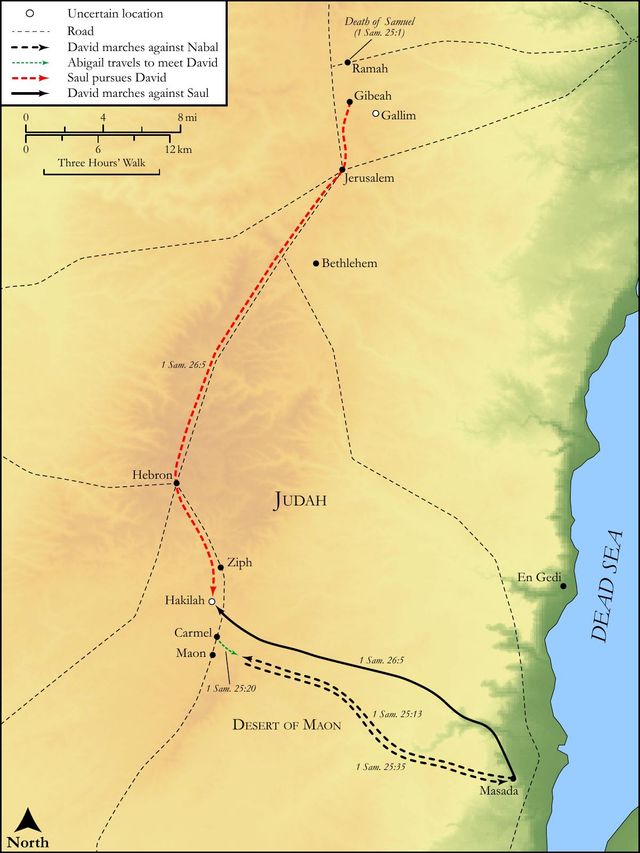
See on the biblical-era map
Study this verse
Public-domain commentary
Matthew Henry
From his Commentary on the Whole Bible. Henry comments on passages, not single verses — this entry covers 1 Samuel 25:12–17. His two-level outline is real structure in the source text, so it is rendered as structure.
Here is, I. The report made to David of the abuse Nabal had given to his messengers (Sa1 25:12): They turned their way. They showed their displeasure, as became them to do, by breaking off abruptly from such a churl, but prudently governed themselves so well as not to render railing for railing, not to call him as he deserved, much less to take by force what ought of right to have been given them, but came and told David that he might do as he thought fit. Christ's servants, when they are thus abused, must leave it to him to plead his own cause and wait till he appear in it. The servant showed his lord what affronts he had received, but did not return them, Luk 14:21.
II.David's hasty resolution hereupon.
He girded on his sword, and ordered his men to do so too, to the number of 400, Sa1 25:13. And what he said we are told, Sa1 25:21, Sa1 25:22.
1.He repented of the kindness he had done to Nabal, and looked upon it as thrown away upon him. He said, "surely in vain have I kept all that this fellow hath in the wilderness. I thought to oblige him and make him my friend, but I see it is to no purpose. He has no sense of gratitude, nor is he capable of receiving the impressions of a good turn, else he could not have used me thus. He hath requited me evil for good." But, when we are thus requited, we should not repent of the good we have done, nor be backward to do good another time. God is kind to the evil and unthankful, and why may not we?
2.He determined to destroy Nabal and all that belonged to him, Sa1 25:22. Here David did not act like himself. His resolution was bloody, to cut off all the males of Nabal's house, and spare none, man nor man-child. The ratification of his resolution was passionate: So, and more also do to God (he was going to say to me, but that would better become Saul's mouth, Sa1 14:44, than David's, and therefore he decently turns it off) to the enemies of David. Is this thy voice, O David? Can the man after God's own heart speak thus unadvisedly with his lips? Has he been so long in the school of affliction, where he should have learned patience, and yet so passionate? Is this he who used to be dumb and deaf when he was reproached (Psa 38:13), who but the other day spared him who sought his life, and yet now will not spare any thing that belongs to him who has only put an affront upon his messengers? He who at other times used to be calm and considerate is now put into such a heat by a few hard words that nothing will atone for them but the blood of a whole family. Lord, what is man! What are the best of men, when God leaves them to themselves, to try them, that they may know what is in their hearts? From Saul David expected injuries, and against those he was prepared and stood upon his guard, and so kept his temper; but from Nabal he expected kindness, and therefore the affront he gave him was a surprise to him, found him off his guard, and, by a sudden and unexpected attack, put him for the present into disorder. What need have we to pray, Lord, lead us not into temptation!
III.The account given of this matter to Abigail by one of the servants, who was more considerate than the rest, Sa1 25:14.
Had this servant spoken to Nabal, and shown him the danger he had exposed himself to by his own rudeness, he would have said, "Servants are now-a-days so saucy, and so apt to prescribe, that there is no enduring them," and, it may be, would have turned him out of doors. But Abigail, being a woman of good understanding, took cognizance of the matter, even from her servant, who,
1.Did David justice in commending him and his men for their civility to Nabal's shepherds, Sa1 25:15, Sa1 25:16. "The men were very good to us, and, though they were themselves exposed, yet they protected us and were a wall unto us." Those who do that which is good shall, one way or other, have the praise of the same. Nabal's own servant will be a witness for David that he is a man of honour and conscience, whatever Nabal himself says of him. And,
2.He did Nabal no wrong in condemning him for his rudeness to David's messengers: He railed on them (Sa1 25:14), he flew upon them (so the word is) with an intolerable rage; "for," say they, "it is his usual practice, Sa1 25:17. He is such a son of Belial, so very morose and intractable, that a man cannot speak to him but he flies into a passion immediately." Abigail knew it too well herself.
3.He did Abigail and the whole family a kindness in making her sensible what was likely to be the consequence. He knew David so well that he had reason to think he would highly resent the affront, and perhaps had had information of David's orders to his men to march that way; for he is very positive evil is determined against our master, and all his household, himself among the rest, would be involved in it. Therefore he desires his mistress to consider what was to be done for their common safety. they could not resist the force David would bring down upon them, nor had they time to send to Saul to protect them; something therefore must be done to pacify David.
Historical interpretation
Historical reception
1 surviving comment on this verse from the historical church.
But one of the young men told Abigail, Nabal's wife, etc. When the chiefs of the Jews scorned the word of faith, the unity of Christ's disciples announced to the synagogue subject to them, saying: Behold, Jesus Christ sent apostles, namely messengers of truth, instructed in the divine Scriptures, to command eternal blessing to our elders, and they rejected them. These men, that is, Christ's apostles, were good apostles, were good enough for us by preaching the heavenly kingdom; and not troublesome, by imposing the burdens of the law on our necks anymore. Nor did anything ever perish of what we established during all the time we lived in their faith, living in deserts from the allurements of the world, and in a quasi-solitary life. At all times, I say, whether observing the rites of the law still, or celebrating the mysteries of the revealed and proclaimed grace, whoever joined themselves to the faith of Christ were saved from all destruction. They were helpful to us in teaching, both in investigating the obscure parts of the Scriptures, and in plainly bringing forth the clear ones, all the days in which we instructed our listeners according to their truly evangelical understanding.
Continue studying 1 Samuel 25:14 across the web’s major study libraries — every link below opens this exact verse, chapter, or book on the destination site.
Read & Compare
 BibleGatewayThis verse in more than 200 translations and 70 languages.
 Bible.comThe YouVersion reader — hundreds of translations, reading plans, and highlights.
 ESV.orgCrossway's official English Standard Version reader.
 NET BibleThe NET translation with 60,000+ translators' notes on every rendering decision.
 STEP BibleTyndale House's free study tool — original text, vocabulary, and scholarly resources.
 BibliaLogos Bible Software's free web reader.
 USCCBThe New American Bible (Revised Edition) with the U.S. bishops' study notes.
Commentaries
 BibleHub CommentariesDozens of classic commentaries on this verse, gathered on one page.
 StudyLightMore than 100 commentary sets — the largest collection on the web.
 BibleRefPlain-English commentary on what this verse means, verse by verse.
 Enduring WordDavid Guzik's free commentary on this chapter, widely used by Bible teachers.
 Bible Study ToolsVerse commentary alongside Greek and Hebrew study aids.
Original Language & Research
- BibleHub InterlinearThe verse word by word — original language, transliteration, and English.
- BibleHub LexiconEvery word's original-language definition and Strong's entry.
 Blue Letter BibleDeep-study tools — Strong's numbers, concordance, and word studies.
 SefariaThe Hebrew text with Rashi and centuries of Jewish commentary.
Sermons, Hymns & Audio


TrulyRandomVerse is not affiliated with these sites and doesn’t control their content. They’re linked because they’re genuinely useful.
Summary
1 Samuel 25:14 marks a pivotal moment in the dramatic encounter between David, Nabal, and Abigail, revealing the immediate and perilous consequences of Nabal's contemptuous rejection of David's messengers. Despite David's prior protection of Nabal's flocks, Nabal's churlish refusal and insulting words ignite David's wrath. This verse highlights the crucial intervention of a discerning young servant who, understanding the dire threat Nabal's foolishness posed to the entire household, discreetly informs Abigail, Nabal's wise wife, of the severity of the situation. This act of foresight and loyalty sets in motion Abigail's swift and strategic intervention, which ultimately averts bloodshed and preserves her household from certain destruction.
Context
ShowHideLiterary Context
This verse is strategically positioned within the unfolding drama of 1 Samuel 25. Immediately preceding it, David, while a fugitive from King Saul, had extended valuable protection to Nabal's shepherds and flocks in the wilderness, effectively acting as a shield against raiders (1 Samuel 25:7-8). As the sheep-shearing season—a time traditionally marked by feasting and generosity—arrived, David sent ten young men to Nabal, requesting provisions as a gesture of goodwill and a reciprocal act of hospitality. Nabal's response, detailed in 1 Samuel 25:10-11, was not merely a refusal but a harsh, insulting dismissal of David and his men, questioning David's identity and authority. Verse 14 then serves as the immediate consequence and catalyst: one of Nabal's own servants, privy to the exchange and understanding the gravity of Nabal's folly, bypasses the master to inform Abigail, setting the stage for her decisive and life-saving intervention that occupies the remainder of the chapter.
Historical & Cultural Context
The narrative is set in the rugged wilderness of Paran and Maon, a semi-arid region where resources were scarce and the protection of livestock was paramount for survival. In Israel, hospitality was a sacred duty, particularly towards those who had provided a service or were in a vulnerable position, such as David's men. Sheep-shearing was a festive occasion, akin to a harvest festival, during which landowners were expected to demonstrate generosity. Nabal's churlishness was not merely a breach of etiquette but a profound insult, especially to a figure like David, who, though an outlaw, was a respected military leader with a growing following. Furthermore, the societal structure was patriarchal, meaning a servant approaching the wife rather than the husband, and a wife acting independently of her husband, were highly unusual and indicative of extreme urgency and Nabal's complete unsuitability for leadership. The servant's action highlights a deep understanding of the potential for violent retribution from a powerful, insulted party, a common feature of tribal societies where honor was fiercely defended.
Key Themes
ShowHideThis verse powerfully contributes to several key themes within 1 Samuel and the broader biblical narrative. Firstly, it underscores the peril of foolishness and pride versus the power of wisdom and discernment. Nabal's name, meaning "fool," is personified by his actions, leading his household to the brink of destruction (Proverbs 16:18). Secondly, it highlights the importance of timely and wise intervention. The servant's foresight and Abigail's subsequent actions demonstrate how prudent and proactive measures can avert disaster, contrasting sharply with Nabal's destructive passivity. Thirdly, it subtly explores leadership and authority. Nabal's failure as a leader is starkly contrasted with David's burgeoning leadership, even in exile, and Abigail's decisive, effective leadership within her own household. Finally, it touches on divine providence; while human agency is central, the narrative ultimately shows God's hand in protecting His anointed (David) and preventing unnecessary bloodshed, often through unexpected means (a servant, a woman).
Exposition and Analysis
ShowHideKey Word Analysis
ShowHideThe Hebrew verb עִיט (ʻîyṭ) literally means "to swoop down upon" or "to fly," and in this context, it conveys a sudden, aggressive, and contemptuous verbal attack. Nabal's "railing" was not merely a refusal but a harsh, demeaning verbal assault, akin to a predatory bird swooping down on its prey. It signifies a deliberate act of scorn, intended to insult, belittle, and dismiss David and his men with utter contempt. This word emphasizes the severity and deliberate provocation of Nabal's actions, escalating the situation from a lack of generosity to a direct affront that demanded a response in the honor-based culture of the time.
The term נַעַר (naʻar), appearing here in its plural form, refers to servants or attendants, often young and capable. In this context, it highlights that the messengers were not just passive observers but active participants in the household's affairs, intimately aware of Nabal's character and the potential consequences of his actions. Their loyalty, in this instance, is not to Nabal's foolishness but to the well-being of the household, leading one of them to take the courageous and discreet step of informing Abigail.
The verb נָגַד (nâgad), appearing here in its Hiphil form (meaning "to make known" or "to declare"), implies a deliberate and urgent communication. The servant didn't just casually mention it; he "told" Abigail, conveying the gravity and urgency of the situation, indicating that the information was critical and required immediate attention. This verb emphasizes the proactive and intentional nature of the servant's disclosure.
Verse Breakdown
ShowHide"But one of the young men told Abigail, Nabal's wife, saying"
This opening clause immediately establishes the turning point in the narrative. The conjunction "but" signals a crucial shift from Nabal's destructive foolishness to a proactive, wise response. The servant's initiative is paramount; recognizing Nabal's suicidal folly, he bypasses the master to appeal to the one person capable of understanding the peril and acting decisively. Abigail is identified as "Nabal's wife," emphasizing her direct connection to the endangered household and her unique position to intervene effectively.
"Behold, David sent messengers out of the wilderness to salute our master;"
The servant provides the necessary background for Abigail, framing David's initial approach as a legitimate, even respectful, request. The phrase "to salute our master" (from the root bârak, to bless) implies a request for provisions as a customary act of hospitality and reciprocal goodwill, not a demand. The mention of "out of the wilderness" subtly reminds Abigail of David's current status as a formidable leader of armed men, operating in a harsh environment where such requests were often backed by implicit power.
"and he railed on them."
This terse concluding statement encapsulates Nabal's egregious offense. The servant's choice of "railed" (as discussed above) conveys the full extent of Nabal's contempt, abusive language, and deliberate provocation. This was not a polite refusal but a direct, public insult, which in that honor-based culture could only lead to one outcome: violent retribution. The servant's concise summary highlights the immediate and severe danger Nabal had brought upon himself and his entire household.
Literary Devices
ShowHideThe verse employs several potent literary devices. Foreshadowing is prominent, as the servant's urgent warning directly anticipates David's furious response and the impending disaster that only Abigail's intervention can avert. The narrative also utilizes contrast, setting the discerning wisdom and loyalty of the unnamed servant and Abigail against the profound foolishness and self-destructive pride of Nabal. There is a strong element of dramatic irony, as the audience, along with the servant, understands the dire consequences of Nabal's actions, while Nabal himself remains oblivious in his arrogance. Furthermore, this verse functions as a crucial plot catalyst, shifting the narrative from Nabal's passive insult to the active, high-stakes drama of Abigail's peacemaking mission. The servant's act of informing Abigail is the hinge upon which the entire chapter's resolution turns.
Theological and Thematic Connections
ShowHideThis verse, though brief, is rich in theological implications, serving as a powerful illustration of the destructive consequences of human folly and the redemptive power of wise intervention. It highlights the biblical principle that pride precedes destruction, as Nabal's arrogance leads him to the brink of ruin, echoing the warnings found throughout Proverbs. Conversely, the servant's discernment and Abigail's subsequent actions demonstrate the life-saving power of humility, wisdom, and proactive peacemaking. The narrative also subtly points to God's providential care for His anointed, David, ensuring that David's path to kingship is not marred by unnecessary bloodshed, even when provoked. It showcases how God can use unexpected agents—a loyal servant and a wise woman—to achieve His purposes and prevent human wrath from overstepping its bounds, demonstrating His sovereignty over human affairs.
Reflection and Application
ShowHideThe account in 1 Samuel 25:14 offers profound lessons for contemporary life, challenging us to consider the destructive power of unchecked pride and foolishness, and urging us to cultivate humility and wisdom in our interactions. Nabal's example serves as a stark warning against dismissing others with contempt, especially those who may hold power or influence, reminding us that our words and actions have consequences that extend beyond ourselves, often impacting those closest to us. Conversely, the servant's courage and discernment in rebuking the powerful (or at least, to the one who could act wisely) underscore the importance of discerning counsel, even when it comes from unexpected sources. It encourages us to be attentive to warnings, to be proactive peacemakers, and to take responsibility for averting conflict rather than escalating it. Ultimately, it calls us to be agents of reconciliation and wisdom in a world often driven by anger and shortsightedness, protecting our "households"—be they families, communities, or workplaces—from unnecessary strife and ensuring that our conduct reflects a spirit of grace and foresight.
Questions for Reflection
ShowHideFAQ
ShowHideWhy did the servant tell Abigail instead of Nabal directly?
ShowHideThe servant chose to inform Abigail because he understood Nabal's character and the futility of reasoning with him. Nabal's name literally means "fool," and the text explicitly portrays him as "churlish and evil in his doings" (1 Samuel 25:3). The servant likely knew that Nabal was too arrogant and stubborn to listen to reason or acknowledge the grave danger he had created. By going to Abigail, the servant demonstrated remarkable discernment and loyalty, not to Nabal's foolishness, but to the well-being and survival of the entire household. He recognized Abigail's wisdom and capacity for decisive action, making her the only viable person to avert the impending disaster that Nabal's actions had provoked.
What exactly did Nabal mean by "railing" on David's messengers?
ShowHideNabal's "railing" (Hebrew: ʻîyṭ) was a severe and contemptuous verbal assault, far more than a simple refusal. In 1 Samuel 25:10-11, Nabal dismisses David as a mere runaway servant, questioning his legitimacy and authority ("Who is David? And who is the son of Jesse?"). He then refuses David's request for provisions, implying that David's men are nothing more than vagrants who have deserted their masters. This was not a polite "no"; it was a public shaming and a profound insult, designed to demean David and his men. In a culture where honor was paramount, such "railing" was a direct challenge and a grave provocation that demanded a response, often violent, from the insulted party. It was an act of deliberate disrespect that directly threatened the lives of Nabal and his entire household.
Christ-Centered Fulfillment
ShowHideThe narrative of 1 Samuel 25:14 and the subsequent intervention of Abigail beautifully foreshadows the ultimate peacemaking and wrath-averting work of Jesus Christ. Nabal's foolishness and pride, which brought his household to the brink of destruction, stand in stark contrast to Christ's humility and divine wisdom, which bring salvation. Just as Abigail, through her intercession and sacrificial offering of provisions, averted David's righteous wrath against Nabal's house, so too does Christ, the ultimate mediator, stand between a holy God and a sinful humanity. He, through His perfect sacrifice on the cross, takes upon Himself the wrath that our spiritual "railing" and rebellion against God justly deserve (Romans 5:8-10). Moreover, Christ is the embodiment of divine wisdom (1 Corinthians 1:30), far surpassing Abigail's earthly discernment, offering guidance that leads to eternal life rather than spiritual death. He is the true King, whose authority is absolute and against whom no "railing" can ultimately prevail, yet who extends boundless grace and mercy to those who humble themselves and seek His protection, fulfilling the shadow of David's eventual mercy. Ultimately, the story points to the "greater Abigail," who is Christ Himself, interceding for us and reconciling us to God, thereby averting the eternal judgment we justly deserved (Colossians 1:19-20).