


1 Samuel 25:15
Bible text: King James Version (1769 Blayney text) · Public domain
Bible text: Berean Standard Bible · Public domain
Bible text: American Standard Version (1901) · Public domain
Bible text: World English Bible, Messianic edition · Public domain
Bible text: Geneva Bible (1599) · Public domain
Bible text: Young's Literal Translation · Public domain
- וְהָאֲנָשִׁיםve·Ha·'a·na·Shimand the menH582Conj-w ¦ Art ¦ N-mpNoun Plural Masculine Absoluteוְandהָtheאֲנָשִׁיםmen
- טֹבִיםto·Vim[were] goodH2896Adj-mpAdjective Plural Masculine Absolute
- לָנוּLa·nuto <the> usPrep-l ¦ 1cpSuffix Personal 1st Plural common genderלָto <the>נוּus
- מְאֹדme·'OdveryH3966Adj-msAdjective Numerical Singular Masculine Absolute
- וְלֹאve·Lo'and notH3808Conj-w ¦ NegParticle Negativeוְandלֹאnot
- הָכְלַמְנוּha·khe·Lam·nuwe were humiliatedH3637V-Hophal-Perf-1cpVerb Hophal Perfect 1st Plural common gender
- וְלֹאve·lo'and notH3808Conj-w ¦ NegParticle Negativeוְandלֹאnot
- פָקַדְנוּfa·Kad·nuwe missedH6485V-Qal-Perf-1cpVerb Qal Perfect 1st Plural common gender
- מְאוּמָהme·'U·mahanythingH3972N-fsNoun Singular Feminine Absolute
- כָּלkolallH3605N-mscNoun Singular Masculine Construct
- יְמֵיye·Mei[the] daysH3117N-mpcNoun Plural Masculine Construct
- הִתְהַלַּכְנוּhit·ha·Lakh·nu<of> [which] we went aboutH1980V-Hithpael-Perf-1cpVerb Hithpael Perfect 1st Plural common gender
- אִתָּם'i·Tamwith themH854Prep ¦ 3mpPreposition Definiteאִתָּwithםthem
- בִּהְיוֹתֵנוּbih·yo·Te·nuwhen we wereH1961Prep-b ¦ V-Qal-Inf ¦ 1cpVerb Qal Infinitive Constructבִּwhenהְיוֹתֵwereנוּwe
- בַּשָּׂדֶהba·sa·Dehin the fieldH7704Prep-b ¦ N-msNoun Singular Masculine Absoluteבַּin theשָּׂדֶהfield
English is a literal word-by-word gloss of the Hebrew, not the KJV's wording. Why?
This is the original text the KJV's translators worked from — each Hebrew word with its own literal English meaning in this verse, prepared by scholars at Tyndale House, Cambridge. The KJV translates whole sentences, not word by word, so its wording differs: one Hebrew word can become several English words, and the KJV may choose “the LORD” where the gloss reads “Yahweh”. Both are faithful — they answer different questions. For the KJV's own rendering, switch to the KJV text.
Details
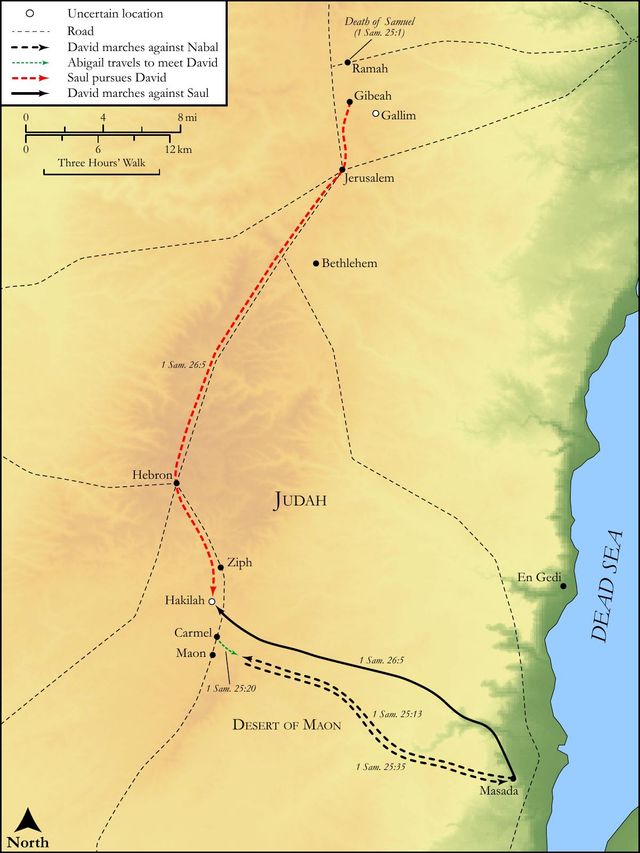
See on the biblical-era map
Study this verse
Public-domain commentary
Matthew Henry
From his Commentary on the Whole Bible. Henry comments on passages, not single verses — this entry covers 1 Samuel 25:12–17. His two-level outline is real structure in the source text, so it is rendered as structure.
Here is, I. The report made to David of the abuse Nabal had given to his messengers (Sa1 25:12): They turned their way. They showed their displeasure, as became them to do, by breaking off abruptly from such a churl, but prudently governed themselves so well as not to render railing for railing, not to call him as he deserved, much less to take by force what ought of right to have been given them, but came and told David that he might do as he thought fit. Christ's servants, when they are thus abused, must leave it to him to plead his own cause and wait till he appear in it. The servant showed his lord what affronts he had received, but did not return them, Luk 14:21.
II.David's hasty resolution hereupon.
He girded on his sword, and ordered his men to do so too, to the number of 400, Sa1 25:13. And what he said we are told, Sa1 25:21, Sa1 25:22.
1.He repented of the kindness he had done to Nabal, and looked upon it as thrown away upon him. He said, "surely in vain have I kept all that this fellow hath in the wilderness. I thought to oblige him and make him my friend, but I see it is to no purpose. He has no sense of gratitude, nor is he capable of receiving the impressions of a good turn, else he could not have used me thus. He hath requited me evil for good." But, when we are thus requited, we should not repent of the good we have done, nor be backward to do good another time. God is kind to the evil and unthankful, and why may not we?
2.He determined to destroy Nabal and all that belonged to him, Sa1 25:22. Here David did not act like himself. His resolution was bloody, to cut off all the males of Nabal's house, and spare none, man nor man-child. The ratification of his resolution was passionate: So, and more also do to God (he was going to say to me, but that would better become Saul's mouth, Sa1 14:44, than David's, and therefore he decently turns it off) to the enemies of David. Is this thy voice, O David? Can the man after God's own heart speak thus unadvisedly with his lips? Has he been so long in the school of affliction, where he should have learned patience, and yet so passionate? Is this he who used to be dumb and deaf when he was reproached (Psa 38:13), who but the other day spared him who sought his life, and yet now will not spare any thing that belongs to him who has only put an affront upon his messengers? He who at other times used to be calm and considerate is now put into such a heat by a few hard words that nothing will atone for them but the blood of a whole family. Lord, what is man! What are the best of men, when God leaves them to themselves, to try them, that they may know what is in their hearts? From Saul David expected injuries, and against those he was prepared and stood upon his guard, and so kept his temper; but from Nabal he expected kindness, and therefore the affront he gave him was a surprise to him, found him off his guard, and, by a sudden and unexpected attack, put him for the present into disorder. What need have we to pray, Lord, lead us not into temptation!
III.The account given of this matter to Abigail by one of the servants, who was more considerate than the rest, Sa1 25:14.
Had this servant spoken to Nabal, and shown him the danger he had exposed himself to by his own rudeness, he would have said, "Servants are now-a-days so saucy, and so apt to prescribe, that there is no enduring them," and, it may be, would have turned him out of doors. But Abigail, being a woman of good understanding, took cognizance of the matter, even from her servant, who,
1.Did David justice in commending him and his men for their civility to Nabal's shepherds, Sa1 25:15, Sa1 25:16. "The men were very good to us, and, though they were themselves exposed, yet they protected us and were a wall unto us." Those who do that which is good shall, one way or other, have the praise of the same. Nabal's own servant will be a witness for David that he is a man of honour and conscience, whatever Nabal himself says of him. And,
2.He did Nabal no wrong in condemning him for his rudeness to David's messengers: He railed on them (Sa1 25:14), he flew upon them (so the word is) with an intolerable rage; "for," say they, "it is his usual practice, Sa1 25:17. He is such a son of Belial, so very morose and intractable, that a man cannot speak to him but he flies into a passion immediately." Abigail knew it too well herself.
3.He did Abigail and the whole family a kindness in making her sensible what was likely to be the consequence. He knew David so well that he had reason to think he would highly resent the affront, and perhaps had had information of David's orders to his men to march that way; for he is very positive evil is determined against our master, and all his household, himself among the rest, would be involved in it. Therefore he desires his mistress to consider what was to be done for their common safety. they could not resist the force David would bring down upon them, nor had they time to send to Saul to protect them; something therefore must be done to pacify David.
Continue studying 1 Samuel 25:15 across the web’s major study libraries — every link below opens this exact verse, chapter, or book on the destination site.
Read & Compare
 BibleGatewayThis verse in more than 200 translations and 70 languages.
 Bible.comThe YouVersion reader — hundreds of translations, reading plans, and highlights.
 ESV.orgCrossway's official English Standard Version reader.
 NET BibleThe NET translation with 60,000+ translators' notes on every rendering decision.
 STEP BibleTyndale House's free study tool — original text, vocabulary, and scholarly resources.
 BibliaLogos Bible Software's free web reader.
 USCCBThe New American Bible (Revised Edition) with the U.S. bishops' study notes.
Commentaries
 BibleHub CommentariesDozens of classic commentaries on this verse, gathered on one page.
 StudyLightMore than 100 commentary sets — the largest collection on the web.
 BibleRefPlain-English commentary on what this verse means, verse by verse.
 Enduring WordDavid Guzik's free commentary on this chapter, widely used by Bible teachers.
 Bible Study ToolsVerse commentary alongside Greek and Hebrew study aids.
Original Language & Research
- BibleHub InterlinearThe verse word by word — original language, transliteration, and English.
- BibleHub LexiconEvery word's original-language definition and Strong's entry.
 Blue Letter BibleDeep-study tools — Strong's numbers, concordance, and word studies.
 SefariaThe Hebrew text with Rashi and centuries of Jewish commentary.
Sermons, Hymns & Audio


TrulyRandomVerse is not affiliated with these sites and doesn’t control their content. They’re linked because they’re genuinely useful.
Summary
1 Samuel 25:15 encapsulates Abigail's compelling argument to David, serving as irrefutable testimony to the consistent benevolence and protective vigilance David's men extended to Nabal's shepherds. This verse powerfully contrasts the selfless care provided by David's company with Nabal's egregious ingratitude and foolishness, thereby validating David's righteous anger while simultaneously laying the essential groundwork for Abigail's masterful intercession and the eventual averting of a devastating reprisal.
Context
ShowHideLiterary Context
This verse is a crucial component of Abigail's eloquent and urgent plea to David, who is en route to exact vengeance upon Nabal and his entire household. It immediately follows the report of Nabal's contemptuous dismissal of David's request for provisions, despite the protective service rendered by David's men. Abigail's speech, which commences in 1 Samuel 25:24, is a strategic masterpiece of diplomacy and intercession, meticulously crafted to de-escalate David's wrath and prevent him from shedding innocent blood. Verse 15 specifically details the undisputed facts of David's men's exemplary conduct, establishing the moral high ground for David's initial, reasonable request and highlighting Nabal's profound culpability. This factual foundation strengthens Abigail's argument for mercy and restraint, demonstrating that Nabal's offense was not merely a social slight but a grave injustice against those who had provided invaluable protection.
Historical & Cultural Context
The narrative unfolds in the rugged and often lawless wilderness of Judah, a perilous frontier where shepherds and their vulnerable flocks were constant targets for marauding bandits, Philistine raiders, and other hostile groups. In such an environment, a large, armed company like David's, though technically operating as outlaws from King Saul's perspective, could inadvertently or intentionally function as a vital, stabilizing, and protective force. The sheep-shearing festival was a period of significant prosperity and communal celebration, traditionally characterized by lavish generosity and reciprocal hospitality. Nabal's outright refusal to reciprocate David's protective service with provisions was far more than mere stinginess; it constituted a profound insult, a blatant breach of customary hospitality, and an act of severe social and economic disrespect. This dynamic often involved an implicit "protection money" arrangement in such regions, making Nabal's denial a direct challenge to David's authority and a dangerous act of defiance.
Key Themes
ShowHideThe verse powerfully underscores the theme of Divine Providence and Protection, as David's men, despite their unconventional status, functioned as instruments of security for Nabal's vulnerable assets in a dangerous landscape, mirroring God's own unfailing protective care for His people (Psalm 121:7-8). It highlights the principle of Kindness and Reciprocity, demonstrating that David's men acted with unmerited favor, expecting a just and customary return for their invaluable service, which Nabal flagrantly failed to provide. This failure introduces the stark theme of Ingratitude and Folly. Nabal's inherently "churlish and evil" nature, as explicitly described in 1 Samuel 25:3, is sharply contrasted with the "very good" conduct of David's men, establishing a clear moral dichotomy within the narrative. Furthermore, Abigail's objective testimony serves as crucial Witness and Truth-Telling, providing an undeniable account that validates David's grievance and underscores Nabal's profound foolishness, ultimately leading to divine judgment (see 1 Samuel 25:38).
Exposition and Analysis
ShowHideKey Word Analysis
ShowHideThis term (H582) refers to a mortal man in general, often used collectively or to denote humanity in its frailty. In this context, it emphasizes the human agents of protection—David's followers—highlighting their tangible presence and actions, distinguishing them from a more dignified or specific title, yet underscoring their role as a collective force.
The Hebrew word "ṭôwb" (H2896) is profoundly rich, extending beyond mere moral uprightness. When Abigail states David's men were "very good unto us," she means they were exceedingly beneficial, advantageous, pleasant, and kind. This denotes an active, positive influence that ensured the well-being, safety, and flourishing of Nabal's shepherds and their flocks, signifying a tangible and impactful contribution to their prosperity.
This is the Hithpael participle of "hâlak" (H1980), meaning "to walk" or "to go." The Hithpael stem indicates a continuous, habitual, or reciprocal action. "As long as we were conversant with them" literally means "as long as we were walking about with them" or "moving around with them." This implies a sustained, close, and daily interaction in the fields, suggesting intimate familiarity with their conduct and a prolonged period of observation, making the shepherds' testimony about David's men's goodness highly credible and undeniable.
Verse Breakdown
ShowHide"But the men [were] very good unto us"
This opening clause immediately establishes the benevolent and beneficial nature of David's company. Abigail, speaking on behalf of the shepherds, emphatically affirms their overwhelmingly positive experience. The superlative "very good" emphasizes the extraordinary and consistent kindness, benefit, and active protection they received, setting a stark and undeniable contrast with Nabal's later actions.
"and we were not hurt"
This phrase directly addresses the physical safety and well-being of the shepherds themselves. In a dangerous and unpredictable wilderness environment, the complete absence of harm was an exceptional blessing. It implies that David's men not only meticulously refrained from causing any trouble but also actively deterred or neutralized potential threats, thereby ensuring the personal security of Nabal's vulnerable workforce.
"neither missed we any thing"
This clause speaks directly to the material security and preservation of Nabal's vast flocks and valuable possessions. It asserts that no livestock was stolen, no equipment was lost, and no property was plundered under the vigilant watch of David's men. This highlights their diligence, effectiveness, and comprehensive nature as an informal protective force, directly contributing to the preservation and increase of Nabal's wealth.
"as long as we were conversant with them, when we were in the fields"
This concluding phrase provides crucial contextualization and lends undeniable credibility to Abigail's testimony. It precisely specifies both the duration and the location of David's men's protective service. "Conversant with them" implies a sustained, close, and observed relationship, underscoring that the shepherds had ample, firsthand experience of David's men's consistent good conduct in the very places where their flocks were most vulnerable. This makes the shepherds' testimony, relayed by Abigail, an objective and irrefutable truth.
Literary Devices
ShowHideThe verse employs several potent literary devices to convey its message. Contrast is foundational, subtly but powerfully pitting the "very good" conduct of David's men against the implied "evil" and "churlishness" of Nabal, which is explicitly detailed elsewhere in the chapter. Abigail's words function as a crucial Testimony or Witness, providing an objective, firsthand account from those directly affected—the shepherds—which lends undeniable credibility and moral weight to her argument. The phrase "neither missed we any thing" serves as Emphasis or even a form of Hyperbole, underscoring the absolute and complete nature of the protection provided, suggesting a remarkable level of security that was exceptional for the time and place. Finally, there is a profound element of Irony in Nabal's ingratitude; he repays the very people who ensured his prosperity and safety with insult and contempt, thereby demonstrating a profound lack of wisdom, foresight, and basic human decency.
Theological and Thematic Connections
ShowHideThis verse resonates with profound theological and thematic truths concerning the nature of service, the expectation of gratitude, and the dire consequences of ingratitude. It illustrates how even seemingly secular acts of protection and provision can profoundly reflect divine principles. David's men, in their wilderness wanderings, became instruments of order and security, mirroring God's own providential and protective care for His people, who often find themselves vulnerable in a hostile and unpredictable world. Nabal's abject failure to recognize and reciprocate this goodness is a theological indictment of his character, demonstrating a heart hardened against generosity, truth, and basic righteousness—a spiritual blindness to the blessings he received. His ingratitude is not merely a social faux pas but a profound moral failing that actively invites divine judgment, underscoring the biblical emphasis on acknowledging and valuing the good deeds of others, recognizing that ultimately all blessings flow from the hand of God.
Reflection and Application
ShowHideAbigail's testimony in 1 Samuel 25:15 offers a powerful and enduring lesson for contemporary believers on the critical importance of gratitude, discernment, and valuing the often-unseen acts of service that protect and sustain us. Nabal's tragic flaw was his profound inability to recognize the immense blessing and tangible protection he received, leading him to repay good with evil and almost bringing utter destruction upon his entire household. For us today, this verse serves as a profound call to cultivate an active and intentional spirit of thankfulness, not just for grand gestures, but for the daily, often unnoticed, acts of kindness, provision, and protection we experience. It challenges us to be discerning, to look beyond superficial appearances and recognize the true value of those who serve, protect, and contribute to our well-being, whether they are family members, colleagues, community leaders, or fellow church members. Furthermore, it issues a solemn warning against the destructive pride and spiritual blindness that inevitably lead to ingratitude, reminding us that such a posture can alienate us from others and, more critically, from God's continued favor. Our response to the goodness of others, and ultimately to the boundless goodness of God, truly reveals the authentic posture of our hearts.
Questions for Reflection
ShowHideFAQ
ShowHideWhat does this verse teach us about Nabal's character and his ultimate fate?
ShowHideThis verse, spoken by Abigail, profoundly illuminates Nabal's character through the stark contrast it presents. By detailing the consistent "good" and protective service of David's men, it underscores Nabal's profound ingratitude and foolishness in repaying such valuable assistance with insult and refusal. Nabal's inability to recognize or appreciate the tangible benefits he received reveals a man who is not only "churlish and evil in his doings" as described in 1 Samuel 25:3, but also spiritually blind and self-destructive. His actions, rooted in pride and a lack of discernment, directly lead to David's wrath and ultimately to divine judgment. As recounted later in 1 Samuel 25:38, the Lord Himself struck Nabal, and he died, demonstrating that his ingratitude was not merely a social offense but a spiritual one, incurring God's righteous displeasure and illustrating the biblical principle that "pride goes before destruction" (Proverbs 16:18).
Christ-Centered Fulfillment
ShowHide1 Samuel 25:15, with its depiction of David's men as selfless protectors and diligent providers in a dangerous wilderness, beautifully foreshadows the ultimate Good Shepherd, Jesus Christ. Just as David's men ensured that Nabal's shepherds "were not hurt, neither missed we any thing," Christ, our Great Shepherd of the sheep, offers perfect, complete, and eternal protection to His flock. He is the one who willingly lays down His life for the sheep (John 10:11), ensuring that none are lost or snatched from His powerful hand (John 10:28). Nabal's profound ingratitude, despite receiving such tangible and life-preserving benefits, mirrors humanity's fallen state, which often rejects the abundant provision, spiritual protection, and glorious salvation freely offered by God in Christ (Romans 1:21). Yet, just as Abigail's intercession averted David's righteous wrath, Christ Himself stands as our perfect Mediator and Advocate before the Father, ensuring that all who trust in Him receive not wrath, but eternal life and a spiritual fullness where they "lack nothing" (Philippians 4:19). The "very good" service of David's men, though commendable, finds its ultimate and infinitely perfect fulfillment in the boundless goodness, sacrificial love, and unwavering protection of Jesus, who provides for every spiritual need, protects from every spiritual foe, and ensures our eternal security and well-being.