


1 Samuel 25:21
Bible text: King James Version (1769 Blayney text) · Public domain
Bible text: King James Version with Strong's numbers · Public domain
Bible text: Berean Standard Bible · Public domain
Bible text: American Standard Version (1901) · Public domain
Bible text: World English Bible, Messianic edition · Public domain
Bible text: Geneva Bible (1599) · Public domain
Bible text: Young's Literal Translation · Public domain
- וְדָוִדve·da·Vidand DavidH1732Conj-w ¦ N-proper-mNoun Proper MasculineוְandדָוִדDavid
- אָמַר'a·Marhe had saidH559V-Qal-Perf-3msVerb Qal Perfect 3rd Singular Masculine
- אַךְ'aKhsurelyH389AdvAdverb
- לַשֶּׁקֶרla·She·kerto <the> deceptionH8267Prep-l ¦ N-msNoun Singular Masculine Absoluteלַto <the>שֶּׁקֶרdeception
- שָׁמַרְתִּיsha·Mar·tiI have guardedH8104V-Qal-Perf-1csVerb Qal Perfect 1st Singular common gender
- אֶת'et<obj.>H853DirObjMParticle Object Indicator
- כָּלkolallH3605N-msNoun Singular Masculine Absolute
- אֲשֶׁר'a·SherthatH834RelParticle Relative
- לָזֶהla·Zeh[belongs] to this [man]H2088Prep-l ¦ PrtParticle Demonstrativeלָ[belongs] toזֶהthis [man]
- בַּמִּדְבָּרba·mid·Barin the wildernessH4057Prep-b ¦ N-msNoun Singular Masculine Absoluteבַּin theמִּדְבָּרwilderness
- וְלֹאve·lo'and notH3808Conj-w ¦ NegParticle Negativeוְandלֹאnot
- נִפְקַדnif·Kadit has been missingH6485V-Niphal-Perf-3msVerb Niphal Perfect 3rd Singular Masculine
- מִכָּלmi·kolany of allH3605Prep-m ¦ N-msNoun Singular Masculine Absoluteמִany ofכָּלall
- אֲשֶׁר'a·SherthatH834RelParticle Relative
- לוֹlo[belongs] to <the> himPrep-l ¦ 3msSuffix Personal 3rd Singular Masculineל[belongs] to <the>וֹhim
- מְאוּמָהme·'U·mahanythingH3972N-fsNoun Singular Feminine Absolute
- וַיָּשֶׁבvai·ya·shevand he has returnedH7725Conj-w ¦ V-Hiphil-ConsecImperf-3msVerb Hiphil Consecutive Imperfect 3rd Singular Masculineוַandיָּשֶׁבhe has returned
- לִיlito <the> mePrep-l ¦ 1csSuffix Personal 1st Singular common genderלִto <the>יme
- רָעָהra·'AhevilH7451N-fsNoun Singular Feminine Absolute
- תַּחַתTa·chatin place ofH8478N-mscNoun Singular Masculine Construct
- טוֹבָהto·VahgoodH2896N-fsNoun Singular Feminine Absolute
English is a literal word-by-word gloss of the Hebrew, not the KJV's wording. Why?
This is the original text the KJV's translators worked from — each Hebrew word with its own literal English meaning in this verse, prepared by scholars at Tyndale House, Cambridge. The KJV translates whole sentences, not word by word, so its wording differs: one Hebrew word can become several English words, and the KJV may choose “the LORD” where the gloss reads “Yahweh”. Both are faithful — they answer different questions. For the KJV's own rendering, switch to the KJV text.
Details
See on the biblical-era map
Study this verse
Public-domain commentary
Matthew Henry
From his Commentary on the Whole Bible. Henry comments on passages, not single verses — this entry covers 1 Samuel 25:18–31. His three-level outline is real structure in the source text, so it is rendered as structure.
We have here an account of Abigail's prudent management for the preserving of her husband and family from the destruction that was just coming upon them; and we find that she did her part admirably well and fully answered her character. The passion of fools often makes those breaches in a little time which the wise, with all their wisdom, have much ado to make up again. It is hard to say whether Abigail was more miserable in such a husband or Nabal happy in such a wife. A virtuous woman is a crown to her husband, to protect as well as adorn, and will do him good and not evil. Wisdom in such a case as this was better than weapons of war. 1. It was her wisdom that what she did she did quickly, and without delay; she made haste, Sa1 25:18. It was no time to trifle or linger when all was in danger. Those that desire conditions of peace must send when the enemy is yet a great way off, Luk 14:32. 2. It was her wisdom that what she did she did herself, because, being a woman of great prudence and very happy address, she knew better how to manage it than any servant she had. The virtuous woman will herself look well to the ways of her household, and not devolve this duty wholly upon others.
Abigail must endeavour to atone for Nabal's faults. Now he had been in two ways rude to David's messengers, and in them to David: He had denied them the provisions they asked for, and he had given them very provoking language. Now,
I.By a most generous present, Abigail atones for his denial of their request.
If Nabal had given them what came next to hand, they would have gone away thankful; but Abigail prepares the very best the house afforded and abundance of it (Sa1 25:18), according to the usual entertainments of those times, not only bread and flesh, but raisins and figs, which were their dried sweet-meats. Nabal grudged them water, but she took two bottles (casks or rundlets) of wine, loaded her asses with these provisions, and sent them before; for a gift pacifieth anger, Pro 21:14. Jacob thus pacified Esau. When the instruments of the churl are evil, the liberal devises liberal things, and loses nothing by it; for by liberal things shall he stand, Isa 32:7, Isa 32:8. Abigail not only lawfully, but laudably, disposed of all these goods of her husband's without his knowledge (even when she had reason to think that if he had known what she did he would not have consented to it), because it was not to gratify her own pride or vanity, but for the necessary defence of him and his family. which otherwise would have been inevitably ruined. Husbands and wives, for their common good and benefit, have a joint-interest in their worldly possessions; but if either waste, or unduly spend in any way, it is a robbing of the other.
II.By a most obliging demeanour, and charming speech, she atones for the abusive language which Nabal had given them.
She met David upon the march, big with resentment, and meditating the destruction of Nabal (Sa1 25:20); but with all possible expressions of complaisance and respect she humbly begs his favour, and solicits him to pass by the offence. Her demeanour was very submissive: She bowed herself to the ground before David (Sa1 25:23) and fell at his feet, Sa1 25:24. Yielding pacifies great offences. She put herself into the place and posture of a penitent and of a petitioner, and was not ashamed to do it, when it was for the good of her house, in the sight both of her own servants and of David's soldiers. She humbly begs of David that he will give her the hearing: Let thy handmaid speak in thy audience. But she needed not thus to bespeak his attention and patience; what she said was sufficient to command it, for certainly nothing could be more fine nor more moving. No topic of argument is left untouched; every thing is well placed and well expressed, most pertinently and pathetically urged, and improved to the best advantage, with such a force of natural rhetoric as cannot easily be paralleled.
1.She speaks to him all along with the deference and respect due to so great and good a man, calls him My lord, over and over, to expiate her husband's crime in saying, "Who is David?" She does not upbraid him with the heat of his passion, though he deserved to be reproved for it; nor does she tell him how ill it became his character; but endeavours to soften him and bring him to a better temper, not doubting but that then his own conscience would upbraid him with it.
2.She takes the blame of the ill-treatment of his messengers upon herself: "Upon me, my lord, upon me, let this iniquity be, Sa1 25:24. If thou wilt be angry, be angry with me, rather than with my poor husband, and look upon it as the trespass of thy handmaid," Sa1 25:28. Sordid spirits care not how much others suffer for their faults, while generous spirits can be content to suffer for the faults of others. Abigail here discovered the sincerity and strength of her conjugal affection and concern for her family: whatever Nabal was, he was her husband.
3.She excuses her husband's fault by imputing it to his natural weakness and want of understanding (Sa1 25:25): "Let not my lord take notice of his rudeness and ill manners, for it is like him; it is not the first time that he has behaved so churlishly; he must be borne with, for it is for want of wit: Nabal is his name" (which signifies a fool), "and folly is with him. It was owing to his folly, not his malice. He is simple, but not spiteful. Forgive him, for he knows not what he does." What she said was too true, and she said it to excuse his fault and prevent his ruin, else she would not have done well to give such a bad character as this of her own husband, whom she ought to make the best of, and not to speak ill of.
4.She pleads her own ignorance of the matter: "I saw not the young men, else they should have had a better answer, and should not have gone without their errand," intimating hereby that though her husband was foolish, and unfit to manage his affairs himself, yet he had so much wisdom as to be ruled by her and take her advice.
5.She takes it for granted that she has gained her point already, perhaps perceiving, by David's countenance, that he began to change his mind (Sa1 25:26): Seeing the Lord hath withholden thee. She depends not upon her own reasonings, but God's grace, to mollify him, and doubts not but that grace would work powerfully upon him; and then, "Let all thy enemies be as Nabal, that is, if thou forbear to avenge thyself, no doubt God will avenge thee on him, as he will on all thy other enemies." Or it intimates that it was below him to take vengeance on so weak and impotent an enemy as Nabal was, who, as he would do him no kindness, so he could do him no hurt, for he needed to wish no more concerning his enemies than that they might be as unable to resist him as Nabal was. Perhaps she refers to his sparing Saul, when, but the other day, he had him at his mercy. "Didst thou forbear to avenge thyself on that lion that would devour thee, and wilt thou shed the blood of this dog that can but bark at thee?" The very mentioning of what he was about to do, to shed blood and to avenge himself, was enough to work upon such a tender gracious spirit as David had; and it should seem, by his replay (Sa1 25:33), that it affected him.
6.She makes a tender of the present she had brought, but speaks of it as unworthy of David's acceptance, and therefore desires it may be given to the young men that followed him (Sa1 25:27), and particularly to those ten that were his messengers to Nabal, and whom he had treated so rudely.
7.She applauds David for the good services he had done against the common enemies of his country, the glory of which great achievements, she hoped, he would not stain by any personal revenge: "My lord fighteth the battles of the Lord against the Philistines, and therefore he will leave it to God to fight his battles against those that affront him, Sa1 25:28. Evil has not been found in thee all thy days. Thou never yet didst wrong to any of thy countrymen (though persecuted as a traitor), and therefore thou wilt not begin now, nor do a thing which Saul will improve for the justifying of his malice against thee."
8.She foretels the glorious issue of his present troubles. "It is true a man pursues thee and seeks thy life" (she names not Saul, out of respect to his present character as king), "but thou needest not look with so sharp and jealous an eye upon every one that affronts thee;" for all these storms that now ruffle thee will be blown over shortly. She speaks it with assurance,
(1.)That God would keep him safe: The soul of my lord shall be bound in the bundle of life with the Lord thy God, that is, God shall hold thy soul in life (as the expression is, Psa 66:9) as we hold those things which are bundled up or which are precious to us, Psa 116:15. Thy soul shall be treasured up in the treasure of lives (so the Chaldee), under lock and key as our treasure is. "Thou shalt abide under the special protection of the divine providence." The bundle of life is with the Lord our God, for in his hand our breath is, and our times. Those are safe, and may be easy, that have him for their protector. The Jews understand this not only of the life that now is, but of that which is to come, even the happiness of separate souls, and therefore use it commonly as an inscription on their gravestones. "Here we have laid the body, but trust that the soul is bound up in the bundle of life, with the Lord our God." There it is safe, while the dust of the body is scattered.
(2.)That God would make him victorious over his enemies. Their souls he shall sling out, Sa1 25:29. The stone is bound up in the sling, but it is in order to be thrown out again; so the souls of the godly shall be bundled as corn for the barn, but the souls of the wicked as tares for the fire.
(3.)That God would settle him in wealth and power: "The Lord will certainly make my lord a sure house, and no enemy thou hast can hinder it; therefore forgive this trespass," that is, "show mercy, as thou hopest to find mercy. God will make thee great, and it is the glory of great men to pass by offences."
9.She desires him to consider how much more comfortable it would be to him in the reflection to have forgiven this affront than to have revenged it, Sa1 25:30, Sa1 25:31. She reserves this argument for the last, as a very powerful one with so good a man, that the less he indulged his passion the more he consulted his peace and the repose of his own conscience, which every wise man will be tender of.
(1.)She cannot but think that if he should avenge himself it would afterwards be a grief and an offence of heart to him, Many have done that in a heat which they have a thousand times wished undone again. The sweetness of revenge is soon turned into bitterness.
(2.)She is confident that if he pass by the offence it will afterwards by no grief to him; but, on the contrary, it would yield him unspeakable satisfaction that his wisdom and grace had got the better of his passion. Note, When we are tempted to sin we should consider how it will appear in the reflection. Let us never do any thing for which our own consciences will afterwards have occasion to upbraid us, and which we shall look back upon with regret: My heart shall not reproach me.
10.She recommends herself to his favour: When the Lord shall have dealt well with my lord, then remember thy handmaid, as one that kept thee from doing that which would have disgraced thy honour, disquieted thy conscience, and made a blot in thy history. We have reason to remember those with respect and gratitude who have been instrumental to keep us from sin.
Historical interpretation
Three Centuries of Reception
3 surviving comments on this verse. Each one is dated, so this reads as a timeline rather than a list.
Select a marker to jump to its quote. Markers stagger vertically where authors wrote within a few decades of each other.
Indeed, because David swore that he would kill Nabal and then in more considerate forbearance did not, shall we say that we should imitate him by swearing rashly that we are going to do what we see later ought not to be done? But, just as fear confounded the one [Lot] so that he was willing to prostitute his daughters, so did anger confound the other [David] so as to swear rashly. In short, if it were permitted us to make inquiry and ask them both why they did these things, the one could reply, “Fear and trembling are come upon me: and darkness has covered me,” and the other also could say, “My eye is troubled through indignation.” And so we would not be surprised that the one in the darkness of fear and the other in the indignation of his eye did not see what ought to have been seen so as not to do what ought not to have been done.Indeed, to the righteous David we might with reasonable justice say that he ought not to have become angry, not even with an ingrate who returned evil for good. Even if anger crept upon him, as it does upon a man, at least it ought not to have prevailed so far that he swore to do what he would either do in rage or not do and be forsworn.
If it should perhaps happen that we swear carelessly to something which, if carried out, would have most unfortunate consequences, we should know that we should willingly change it [in accord with] more salutary counsel. There is an urgent necessity for us to break our oath, rather than turn to another more serious crime in order to avoid breaking our oath. David swore by the Lord to kill Nabal, a stupid and wicked man, and to destroy all his possessions; but at the first entreaty of the prudent woman Abigail, he quickly took back his threats, put back his sword into its scabbard, and did not feel that he had contracted any guilt by thus breaking his oath in this way.
And David said: Truly, in vain have I kept, etc. The Lord said, detesting the long foolishness of the proud Jews: Truly in vain for so long a time have I offered the gifts of my grace to those out of their minds compared to other nations, and in return they gave the evil of faithlessness, persecution, and the cross, for the good of the grace I gave. Therefore, I will take the wicked from the land, so that until the morning of the universal judgment, no one from the perverse lineage may be left immune. This was said not so that all faithless Jews before the day of judgment might be shown to be dying, but so that they may be taught to be deserving of death and damnation in all respects. This is similar to when Korah stirred sedition in the desert, the Lord spoke to Moses and Aaron, Separate yourselves from the congregation of this people, so that I may destroy them suddenly (Num. XVI); and yet by their interceding and saying, Almighty God of the spirits of all flesh, will Your wrath rage against everyone because of one sinner? wrath was suspended, and the grace of mercy was bestowed. And on the following day, when the whole multitude murmured against them, he said, Separate yourselves from among this congregation, I will destroy them now. But what He showed that the wicked deserved by just judgment, He changed by mercy through the intercession of the faithful. Therefore, in this place also, under the figure of David, the Lord defers judging what the faithless have deserved, as the following spiritual interpretation of this reading will show. For it follows:
Continue studying 1 Samuel 25:21 across the web’s major study libraries — every link below opens this exact verse, chapter, or book on the destination site.
Read & Compare
 BibleGatewayThis verse in more than 200 translations and 70 languages.
 Bible.comThe YouVersion reader — hundreds of translations, reading plans, and highlights.
 ESV.orgCrossway's official English Standard Version reader.
 NET BibleThe NET translation with 60,000+ translators' notes on every rendering decision.
 STEP BibleTyndale House's free study tool — original text, vocabulary, and scholarly resources.
 BibliaLogos Bible Software's free web reader.
 USCCBThe New American Bible (Revised Edition) with the U.S. bishops' study notes.
Commentaries
 BibleHub CommentariesDozens of classic commentaries on this verse, gathered on one page.
 StudyLightMore than 100 commentary sets — the largest collection on the web.
 BibleRefPlain-English commentary on what this verse means, verse by verse.
 Enduring WordDavid Guzik's free commentary on this chapter, widely used by Bible teachers.
 Bible Study ToolsVerse commentary alongside Greek and Hebrew study aids.
Original Language & Research
- BibleHub InterlinearThe verse word by word — original language, transliteration, and English.
- BibleHub LexiconEvery word's original-language definition and Strong's entry.
 Blue Letter BibleDeep-study tools — Strong's numbers, concordance, and word studies.
 SefariaThe Hebrew text with Rashi and centuries of Jewish commentary.
Sermons, Hymns & Audio


TrulyRandomVerse is not affiliated with these sites and doesn’t control their content. They’re linked because they’re genuinely useful.
Summary
1 Samuel 25:21 captures David's profound indignation and sense of betrayal following Nabal's contemptuous rejection of his request for provisions. Having diligently provided invaluable protection for Nabal's shepherds and flocks in the wilderness, David feels his extensive efforts were utterly wasted and that Nabal has repaid his benevolent actions with profound ingratitude and evil. This verse marks the peak of David's intense anger, driving him to prepare for swift and severe retribution, believing his good deeds were met with an unjust and ungrateful response that demanded immediate vindication.
Context
ShowHideLiterary Context
This verse is a critical turning point in the dramatic narrative of 1 Samuel 25, immediately following Nabal's insolent and dismissive refusal to provide for David and his men. David had dispatched ten young men to Nabal during the sheep-shearing festival, a time traditionally marked by generosity and feasting, expecting a customary provision in return for the substantial protection his men had afforded Nabal's vast flocks and shepherds (as detailed in 1 Samuel 25:5-8). Nabal's contemptuous dismissal, questioning David's identity and derisively labeling his men "runaway servants" (1 Samuel 25:10-11), directly precipitates David's furious and vengeful reaction expressed in verse 21. The subsequent narrative vividly portrays David's swift decision to march with 400 armed men to exact retribution, a violent course of action that is providentially averted only by the wise, courageous, and timely intervention of Abigail, Nabal's discerning wife, who intercepts David with a generous offering and a powerful appeal to his character and God's future plans for him (1 Samuel 25:18-31).
Historical & Cultural Context
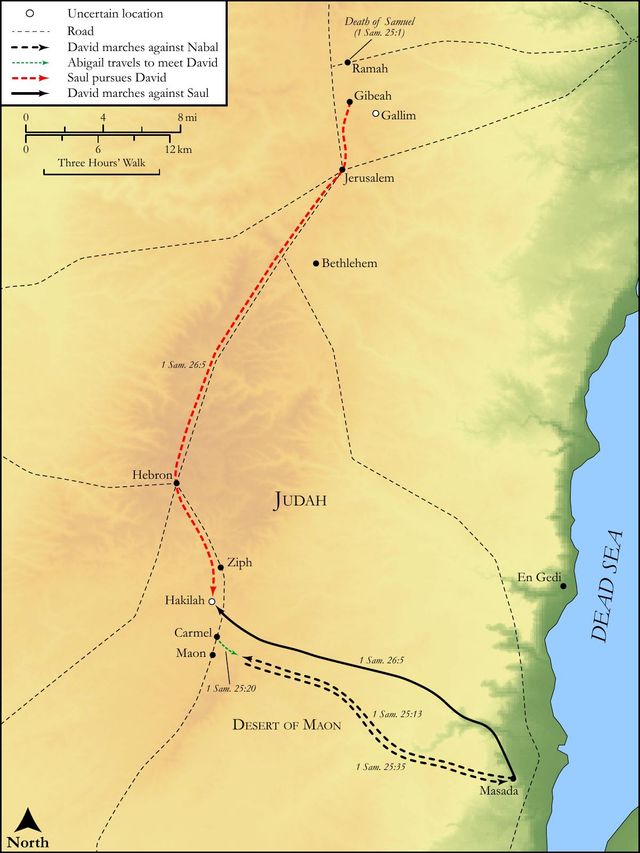
During this tumultuous period, David was living as an outlaw, constantly on the run from King Saul, and had gathered a loyal band of approximately 600 men. They operated in the rugged wilderness regions of Judah, specifically around Maon and Carmel. In such a volatile and lawless environment, providing protection from marauding bands (such as Philistine raiders or other brigands) was an invaluable, often indispensable, service. This protection was typically compensated through established reciprocal arrangements, where those who received security would, in turn, provide provisions or tribute, especially during times of abundance like harvest or sheep-shearing. Wealthy landowners like Nabal, who possessed thousands of sheep and goats, were highly dependent on such informal security networks. Nabal's outright refusal was not merely a breach of hospitality but a profound insult to David's honor and a grave violation of an unwritten social contract, directly challenging David's authority and dignity. His actions were particularly egregious given his immense wealth and the abundance he possessed, underscoring his churlish and foolish character, as explicitly noted in 1 Samuel 25:3.
Key Themes
ShowHideThe central themes embedded within 1 Samuel 25:21 revolve around ingratitude and injustice, powerfully illustrating the deep pain and explosive anger that can erupt when good deeds are met with contempt and betrayal. David's intensely emotional response underscores the universal human struggle with anger and the powerful desire for personal vengeance when one feels wronged, even for a "man after God's own heart," as David is famously described in Acts 13:22. This verse also subtly introduces the profound theme of divine providence and restraint, as David's intended violent retribution is ultimately prevented by God's sovereign intervention through Abigail. This divine intervention foreshadows and reinforces the overarching biblical principle that vengeance ultimately belongs to the Lord, not to humans, a truth powerfully articulated in Romans 12:19. Furthermore, the stark contrast between Nabal's foolishness and Abigail's remarkable wisdom is a prominent and recurring theme throughout the entirety of 1 Samuel 25.
Exposition and Analysis
ShowHideKey Word Analysis
ShowHideThis term, H8267, refers to an untruth, a sham, or something without cause, often implying deceit or falsehood. David's declaration that his efforts were "in vain" (literally "in falsehood" or "in a lie") expresses his profound frustration and bitter disappointment that his genuine and beneficial actions yielded nothing but a deceitful and hostile response. It conveys a sense of having been utterly betrayed and exploited, as if his good deeds were built upon a false premise of reciprocity.
This word, H7725, is a primitive root meaning "to turn back," often with the idea of returning or restoring, but also "to recompense" or "to reward." In this context, David uses it to convey that Nabal has "turned back" or "rendered" evil in direct exchange for the good David had provided. It highlights the perverse and direct reciprocity of Nabal's response, emphasizing that Nabal's actions were a deliberate and negative return for David's positive contribution.
This term, H7451, is broad, encompassing anything bad, wicked, harmful, or morally wrong. In David's perspective, Nabal's "evil" included not only his rude refusal of provisions but also the profound insult to David's honor, the ingratitude for his protective services, and the overall moral offensiveness of Nabal's character and actions. It signifies the profound wrongness and destructive nature of Nabal's response.
Verse Breakdown
ShowHide"Now David had said, Surely in vain have I kept all that this [fellow] hath in the wilderness"
This opening clause reveals David's internal monologue, a bitter lament born of deep frustration. He views his diligent and extensive protection of Nabal's property as utterly wasted, yielding no benefit but rather contempt and insult. The phrase "this [fellow]" (referring to Nabal) conveys David's profound disdain and dehumanization of the man who had so grievously insulted him, highlighting the depth of his anger.
"so that nothing was missed of all that [pertained] unto him"
This clause emphatically underscores the thoroughness and effectiveness of David's protective services. His men had guarded Nabal's vast possessions—his thousands of sheep and goats—so meticulously that not a single item was lost, stolen, or harmed. This detail highlights the magnitude and value of the service David had rendered, making Nabal's ingratitude and contemptuous response appear all the more flagrant, unjust, and infuriating from David's perspective.
"and he hath requited me evil for good"
This is the core of David's grievance, a stark and direct declaration of Nabal's perverse reciprocity. David had offered "good"—protection, security, and respect—but Nabal had returned "evil"—insult, ingratitude, and a blatant refusal of customary hospitality. This perceived profound injustice and the inversion of expected social and moral norms serve as the direct catalyst for David's explosive rage and his subsequent decision to seek immediate and violent retribution.
Literary Devices
ShowHideThe verse employs several literary devices to vividly convey David's intense emotional state and the profound sense of injustice he feels. Irony is subtly present in David's declaration that his efforts were "in vain." While he perceives his actions as futile in that moment of anger, the unfolding narrative reveals that God would indeed use this very situation, through Abigail's intervention, to teach David a crucial lesson about vengeance and divine justice, thus making his efforts far from futile in the grand scheme of God's providential plan for David's kingship. The phrase "requited me evil for good" is a powerful example of antithesis, sharply contrasting David's benevolent and protective actions with Nabal's malevolent and contemptuous response. This stark juxtaposition powerfully underscores the profound sense of betrayal and the inversion of justice David feels. The verse also utilizes hyperbole in David's emphatic expression of his efforts being "in vain" and "nothing was missed," reflecting his immediate, unchecked anger and sense of absolute injustice rather than a measured assessment of the situation's ultimate spiritual or providential outcome.
Theological and Thematic Connections
ShowHideThis verse powerfully illustrates the human tendency towards self-justice when faced with perceived wrongs, even by those committed to God. David, a man chosen by God to be king, initially succumbs to a visceral desire for personal vengeance, believing his good deeds were met with unmerited evil. This highlights the universal struggle to trust God's sovereignty and justice when we feel wronged, rather than taking matters into our own hands. The broader narrative of 1 Samuel 25, however, demonstrates God's providential care in preventing David from committing a grave sin, underscoring that true justice and retribution ultimately belong to Him alone. It is a profound lesson in the dangers of unchecked anger and the necessity of divine restraint.
Reflection and Application
ShowHide1 Samuel 25:21 serves as a potent reminder of our natural, yet often ungodly, inclination to seek immediate retribution when we feel our kindness, generosity, or efforts have been met with ingratitude, contempt, or outright injustice. David's raw anger and sense of betrayal are profoundly relatable; we too can feel that our good deeds have been "in vain" when others respond with coldness, dismissal, or active betrayal. However, the subsequent events in the chapter, particularly Abigail's wise intervention, reveal the profound wisdom of restraint and the inherent dangers of allowing unchecked anger and a desire for personal vengeance to dictate our actions. This passage challenges us to deeply examine our own reactions to slights, wrongs, and perceived injustices. Do we immediately plot revenge, harbor bitterness, or lash out, or do we pause, seek God's counsel in prayer, and trust that He is capable of handling injustice far more perfectly and righteously than we ever could? It calls us to cultivate patience, humility, and a spirit of forgiveness, recognizing that our ultimate vindication, if it is needed, comes from God's sovereign hand, not from our own attempts at self-justice.
Questions for Reflection
ShowHideFAQ
ShowHideWhy was David so angry at Nabal's response?
ShowHideDavid's anger stemmed from a confluence of factors, each contributing to his profound sense of injustice and betrayal. Firstly, Nabal's refusal to provide provisions was not merely a lack of hospitality but a direct insult and a severe breach of the customary reciprocal arrangement for protection prevalent in that era. David and his men had provided invaluable, diligent security for Nabal's vast flocks and shepherds in a dangerous wilderness for an extended period, ensuring "nothing was missed" (1 Samuel 25:7). Secondly, Nabal's words were contemptuous and demeaning, dismissing David as a mere runaway servant and questioning his legitimacy and authority (1 Samuel 25:10-11). This was a profound affront to David's honor, dignity, and his divinely appointed status as the anointed king-in-waiting. David felt his good, protective service was "requited... evil for good," leading to a deep, visceral sense of betrayal and unmerited injustice that ignited his rage.
Christ-Centered Fulfillment
ShowHideWhile David's initial, very human reaction to Nabal's ingratitude was a powerful desire for immediate vengeance, the broader narrative of 1 Samuel 25, and indeed the entire biblical story, points to a greater and more perfect fulfillment in Christ. David's willingness to exact retribution for a perceived wrong stands in stark contrast to the perfect example of Jesus, who, when reviled and suffering, "did not revile in return" and "made no threats, but continued entrusting himself to him who judges righteously" (1 Peter 2:23). Our Lord Jesus Christ, the ultimate Good Shepherd, provided perfect protection and gave His very life, not for those who requited Him with good, but for those who were His enemies, "while we were still sinners" (Romans 5:8). He did not seek His own justice or retribution but willingly endured the cross, entrusting Himself entirely to the Father's righteous judgment. Furthermore, the divine intervention through Abigail, preventing David from shedding innocent blood and acting out of unchecked anger, powerfully foreshadows the ultimate divine intervention in Christ. Through His atoning sacrifice, Jesus prevents God's righteous wrath from being poured out on humanity, thereby "requiting" our profound evil and rebellion with His ultimate, redemptive good. He is the one who truly keeps all that pertains to us, ensuring "nothing was missed" in our salvation and reconciliation with God, even when we, like Nabal, were ungrateful and rebellious, dead in our trespasses (Ephesians 2:4-5).