


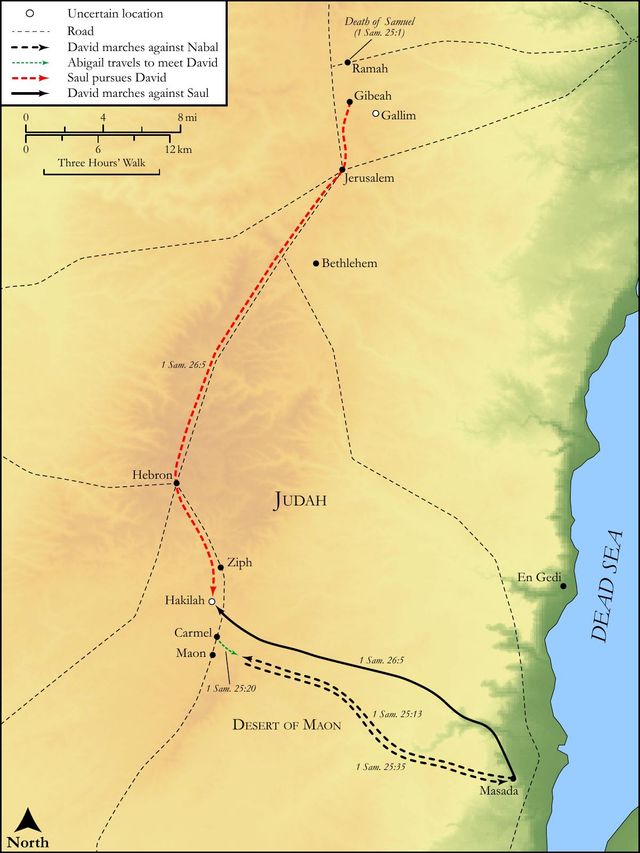
1 Samuel 25:20
- וְהָיָהve·ha·Yahand it wasH1961Conj-w ¦ V-Qal-Perf-3msVerb Qal Perfect 3rd Singular Masculineוְandהָיָהit was
- הִיאhi'sheH1931Pro-3fsPronoun Personal 3rd Singular Feminine
- רֹכֶבֶתro·Khe·vet[was] ridingH7392V-Qal-Prtcpl-fsVerb Qal Participle Singular Feminine Absolute
- עַל'alonH5921PrepPreposition
- הַחֲמוֹרha·cha·Morthe donkeyH2543Art ¦ N-csNoun Singular common gender Absoluteהַtheחֲמוֹרdonkey
- וְיֹרֶדֶתve·yo·Re·detand [was] going downH3381Conj-w ¦ V-Qal-Prtcpl-fsVerb Qal Participle Singular Feminine Absoluteוְandיֹרֶדֶת[was] going down
- בְּסֵתֶרbe·Se·terin [the] cover ofH5643Prep-b ¦ N-mscNoun Singular Masculine Constructבְּinסֵתֶר[the] cover of
- הָהָרha·Harthe mountainH2022Art ¦ N-msNoun Singular Masculine Absoluteהָtheהָרmountain
- וְהִנֵּהve·hi·Nehand there!H2009Conj-w ¦ PrtParticle Interjectionוְandהִנֵּהthere!
- דָוִדda·VidDavidH1732N-proper-mNoun Proper Masculine
- וַאֲנָשָׁיוva·'a·na·Shavand his menH582Conj-w ¦ N-mpc ¦ 3msNoun Plural Masculine Constructוַandאֲנָשָׁיmenוhis
- יֹרְדִיםyo·re·Dim[were] going downH3381V-Qal-Prtcpl-mpVerb Qal Participle Plural Masculine Absolute
- לִקְרָאתָהּlik·ra·Tahto meet herH7122Prep-l ¦ V-Qal-Inf ¦ 3fsVerb Qal Infinitive Constructלִtoקְרָאתָmeetהּher
- וַתִּפְגֹּשׁva·tif·Goshand she metH6298Conj-w ¦ V-Qal-ConsecImperf-3fsVerb Qal Consecutive Imperfect 3rd Singular Feminineוַandתִּפְגֹּשׁshe met
- אֹתָם'o·Tam<obj.> themH853DirObjM ¦ 3mpParticle Object Indicatorאֹתָ<obj.>םthem
English is a literal word-by-word gloss of the Hebrew, not the KJV's wording. Why?
This is the original text the KJV's translators worked from — each Hebrew word with its own literal English meaning in this verse, prepared by scholars at Tyndale House, Cambridge. The KJV translates whole sentences, not word by word, so its wording differs: one Hebrew word can become several English words, and the KJV may choose “the LORD” where the gloss reads “Yahweh”. Both are faithful — they answer different questions. For the KJV's own rendering, switch to the KJV text.
Details
See on the biblical-era map
Study this verse
Public-domain commentary
Matthew Henry
From his Commentary on the Whole Bible. Henry comments on passages, not single verses — this entry covers 1 Samuel 25:18–31. His three-level outline is real structure in the source text, so it is rendered as structure.
We have here an account of Abigail's prudent management for the preserving of her husband and family from the destruction that was just coming upon them; and we find that she did her part admirably well and fully answered her character. The passion of fools often makes those breaches in a little time which the wise, with all their wisdom, have much ado to make up again. It is hard to say whether Abigail was more miserable in such a husband or Nabal happy in such a wife. A virtuous woman is a crown to her husband, to protect as well as adorn, and will do him good and not evil. Wisdom in such a case as this was better than weapons of war. 1. It was her wisdom that what she did she did quickly, and without delay; she made haste, Sa1 25:18. It was no time to trifle or linger when all was in danger. Those that desire conditions of peace must send when the enemy is yet a great way off, Luk 14:32. 2. It was her wisdom that what she did she did herself, because, being a woman of great prudence and very happy address, she knew better how to manage it than any servant she had. The virtuous woman will herself look well to the ways of her household, and not devolve this duty wholly upon others.
Abigail must endeavour to atone for Nabal's faults. Now he had been in two ways rude to David's messengers, and in them to David: He had denied them the provisions they asked for, and he had given them very provoking language. Now,
I.By a most generous present, Abigail atones for his denial of their request.
If Nabal had given them what came next to hand, they would have gone away thankful; but Abigail prepares the very best the house afforded and abundance of it (Sa1 25:18), according to the usual entertainments of those times, not only bread and flesh, but raisins and figs, which were their dried sweet-meats. Nabal grudged them water, but she took two bottles (casks or rundlets) of wine, loaded her asses with these provisions, and sent them before; for a gift pacifieth anger, Pro 21:14. Jacob thus pacified Esau. When the instruments of the churl are evil, the liberal devises liberal things, and loses nothing by it; for by liberal things shall he stand, Isa 32:7, Isa 32:8. Abigail not only lawfully, but laudably, disposed of all these goods of her husband's without his knowledge (even when she had reason to think that if he had known what she did he would not have consented to it), because it was not to gratify her own pride or vanity, but for the necessary defence of him and his family. which otherwise would have been inevitably ruined. Husbands and wives, for their common good and benefit, have a joint-interest in their worldly possessions; but if either waste, or unduly spend in any way, it is a robbing of the other.
II.By a most obliging demeanour, and charming speech, she atones for the abusive language which Nabal had given them.
She met David upon the march, big with resentment, and meditating the destruction of Nabal (Sa1 25:20); but with all possible expressions of complaisance and respect she humbly begs his favour, and solicits him to pass by the offence. Her demeanour was very submissive: She bowed herself to the ground before David (Sa1 25:23) and fell at his feet, Sa1 25:24. Yielding pacifies great offences. She put herself into the place and posture of a penitent and of a petitioner, and was not ashamed to do it, when it was for the good of her house, in the sight both of her own servants and of David's soldiers. She humbly begs of David that he will give her the hearing: Let thy handmaid speak in thy audience. But she needed not thus to bespeak his attention and patience; what she said was sufficient to command it, for certainly nothing could be more fine nor more moving. No topic of argument is left untouched; every thing is well placed and well expressed, most pertinently and pathetically urged, and improved to the best advantage, with such a force of natural rhetoric as cannot easily be paralleled.
1.She speaks to him all along with the deference and respect due to so great and good a man, calls him My lord, over and over, to expiate her husband's crime in saying, "Who is David?" She does not upbraid him with the heat of his passion, though he deserved to be reproved for it; nor does she tell him how ill it became his character; but endeavours to soften him and bring him to a better temper, not doubting but that then his own conscience would upbraid him with it.
2.She takes the blame of the ill-treatment of his messengers upon herself: "Upon me, my lord, upon me, let this iniquity be, Sa1 25:24. If thou wilt be angry, be angry with me, rather than with my poor husband, and look upon it as the trespass of thy handmaid," Sa1 25:28. Sordid spirits care not how much others suffer for their faults, while generous spirits can be content to suffer for the faults of others. Abigail here discovered the sincerity and strength of her conjugal affection and concern for her family: whatever Nabal was, he was her husband.
3.She excuses her husband's fault by imputing it to his natural weakness and want of understanding (Sa1 25:25): "Let not my lord take notice of his rudeness and ill manners, for it is like him; it is not the first time that he has behaved so churlishly; he must be borne with, for it is for want of wit: Nabal is his name" (which signifies a fool), "and folly is with him. It was owing to his folly, not his malice. He is simple, but not spiteful. Forgive him, for he knows not what he does." What she said was too true, and she said it to excuse his fault and prevent his ruin, else she would not have done well to give such a bad character as this of her own husband, whom she ought to make the best of, and not to speak ill of.
4.She pleads her own ignorance of the matter: "I saw not the young men, else they should have had a better answer, and should not have gone without their errand," intimating hereby that though her husband was foolish, and unfit to manage his affairs himself, yet he had so much wisdom as to be ruled by her and take her advice.
5.She takes it for granted that she has gained her point already, perhaps perceiving, by David's countenance, that he began to change his mind (Sa1 25:26): Seeing the Lord hath withholden thee. She depends not upon her own reasonings, but God's grace, to mollify him, and doubts not but that grace would work powerfully upon him; and then, "Let all thy enemies be as Nabal, that is, if thou forbear to avenge thyself, no doubt God will avenge thee on him, as he will on all thy other enemies." Or it intimates that it was below him to take vengeance on so weak and impotent an enemy as Nabal was, who, as he would do him no kindness, so he could do him no hurt, for he needed to wish no more concerning his enemies than that they might be as unable to resist him as Nabal was. Perhaps she refers to his sparing Saul, when, but the other day, he had him at his mercy. "Didst thou forbear to avenge thyself on that lion that would devour thee, and wilt thou shed the blood of this dog that can but bark at thee?" The very mentioning of what he was about to do, to shed blood and to avenge himself, was enough to work upon such a tender gracious spirit as David had; and it should seem, by his replay (Sa1 25:33), that it affected him.
6.She makes a tender of the present she had brought, but speaks of it as unworthy of David's acceptance, and therefore desires it may be given to the young men that followed him (Sa1 25:27), and particularly to those ten that were his messengers to Nabal, and whom he had treated so rudely.
7.She applauds David for the good services he had done against the common enemies of his country, the glory of which great achievements, she hoped, he would not stain by any personal revenge: "My lord fighteth the battles of the Lord against the Philistines, and therefore he will leave it to God to fight his battles against those that affront him, Sa1 25:28. Evil has not been found in thee all thy days. Thou never yet didst wrong to any of thy countrymen (though persecuted as a traitor), and therefore thou wilt not begin now, nor do a thing which Saul will improve for the justifying of his malice against thee."
8.She foretels the glorious issue of his present troubles. "It is true a man pursues thee and seeks thy life" (she names not Saul, out of respect to his present character as king), "but thou needest not look with so sharp and jealous an eye upon every one that affronts thee;" for all these storms that now ruffle thee will be blown over shortly. She speaks it with assurance,
(1.)That God would keep him safe: The soul of my lord shall be bound in the bundle of life with the Lord thy God, that is, God shall hold thy soul in life (as the expression is, Psa 66:9) as we hold those things which are bundled up or which are precious to us, Psa 116:15. Thy soul shall be treasured up in the treasure of lives (so the Chaldee), under lock and key as our treasure is. "Thou shalt abide under the special protection of the divine providence." The bundle of life is with the Lord our God, for in his hand our breath is, and our times. Those are safe, and may be easy, that have him for their protector. The Jews understand this not only of the life that now is, but of that which is to come, even the happiness of separate souls, and therefore use it commonly as an inscription on their gravestones. "Here we have laid the body, but trust that the soul is bound up in the bundle of life, with the Lord our God." There it is safe, while the dust of the body is scattered.
(2.)That God would make him victorious over his enemies. Their souls he shall sling out, Sa1 25:29. The stone is bound up in the sling, but it is in order to be thrown out again; so the souls of the godly shall be bundled as corn for the barn, but the souls of the wicked as tares for the fire.
(3.)That God would settle him in wealth and power: "The Lord will certainly make my lord a sure house, and no enemy thou hast can hinder it; therefore forgive this trespass," that is, "show mercy, as thou hopest to find mercy. God will make thee great, and it is the glory of great men to pass by offences."
9.She desires him to consider how much more comfortable it would be to him in the reflection to have forgiven this affront than to have revenged it, Sa1 25:30, Sa1 25:31. She reserves this argument for the last, as a very powerful one with so good a man, that the less he indulged his passion the more he consulted his peace and the repose of his own conscience, which every wise man will be tender of.
(1.)She cannot but think that if he should avenge himself it would afterwards be a grief and an offence of heart to him, Many have done that in a heat which they have a thousand times wished undone again. The sweetness of revenge is soon turned into bitterness.
(2.)She is confident that if he pass by the offence it will afterwards by no grief to him; but, on the contrary, it would yield him unspeakable satisfaction that his wisdom and grace had got the better of his passion. Note, When we are tempted to sin we should consider how it will appear in the reflection. Let us never do any thing for which our own consciences will afterwards have occasion to upbraid us, and which we shall look back upon with regret: My heart shall not reproach me.
10.She recommends herself to his favour: When the Lord shall have dealt well with my lord, then remember thy handmaid, as one that kept thee from doing that which would have disgraced thy honour, disquieted thy conscience, and made a blot in thy history. We have reason to remember those with respect and gratitude who have been instrumental to keep us from sin.
Historical interpretation
Historical reception
1 surviving comment on this verse from the historical church.
Therefore, when he had ascended the donkey, etc. When the Synagogue confessed to all that it had served a foolish sense until then, and descended to the beginnings of the Christian faith, which starting from the infirmity of the Lord's incarnation, usually leads to the heights of recognizing divinity, Christ and his disciples descended to meet it, so that by preaching they might assist its efforts and, from the mysteries of his humanity with which it was imbued, they might elevate it to the highest summits of Divinity.
Continue studying 1 Samuel 25:20 across the web’s major study libraries — every link below opens this exact verse, chapter, or book on the destination site.
Read & Compare
 BibleGatewayThis verse in more than 200 translations and 70 languages.
 Bible.comThe YouVersion reader — hundreds of translations, reading plans, and highlights.
 ESV.orgCrossway's official English Standard Version reader.
 NET BibleThe NET translation with 60,000+ translators' notes on every rendering decision.
 STEP BibleTyndale House's free study tool — original text, vocabulary, and scholarly resources.
 BibliaLogos Bible Software's free web reader.
 USCCBThe New American Bible (Revised Edition) with the U.S. bishops' study notes.
Commentaries
 BibleHub CommentariesDozens of classic commentaries on this verse, gathered on one page.
 StudyLightMore than 100 commentary sets — the largest collection on the web.
 BibleRefPlain-English commentary on what this verse means, verse by verse.
 Enduring WordDavid Guzik's free commentary on this chapter, widely used by Bible teachers.
 Bible Study ToolsVerse commentary alongside Greek and Hebrew study aids.
Original Language & Research
- BibleHub InterlinearThe verse word by word — original language, transliteration, and English.
- BibleHub LexiconEvery word's original-language definition and Strong's entry.
 Blue Letter BibleDeep-study tools — Strong's numbers, concordance, and word studies.
 SefariaThe Hebrew text with Rashi and centuries of Jewish commentary.
Sermons, Hymns & Audio


TrulyRandomVerse is not affiliated with these sites and doesn’t control their content. They’re linked because they’re genuinely useful.
Summary
1 Samuel 25:20 describes the divinely orchestrated and pivotal moment when Abigail, the discerning wife of Nabal, encountered David and his armed men. This crucial meeting occurred as David, fueled by righteous indignation and a vow of destructive vengeance against Nabal's household for his contemptuous refusal of provisions, was descending with his forces. Abigail's timely interception, marked by profound humility and strategic foresight, set the stage for the dramatic de-escalation of conflict, preventing David from committing a rash act of bloodshed and preserving his integrity.
Context
ShowHideLiterary Context
This verse serves as the dramatic climax and turning point within the narrative of 1 Samuel 25. David, operating as an outlaw in the wilderness, had extended protection to Nabal's shepherds, safeguarding their flocks and men. In return, during the abundant sheep-shearing feast, David, following customary practice, sent messengers to request provisions. However, Nabal, explicitly described as "harsh and evil in his dealings" and a "worthless fellow" (1 Samuel 25:3 and 1 Samuel 25:25), not only refused David's request but contemptuously insulted him, dismissing him as a mere runaway servant. Enraged by this profound disrespect and challenge to his honor, David swore a solemn oath to annihilate Nabal and every male in his household by morning (1 Samuel 25:22). Unbeknownst to Nabal, his wise wife Abigail, upon hearing of her husband's foolish and dangerous actions from a servant, acted swiftly and decisively. She gathered a substantial appeasing gift of food and wine and, without informing Nabal, rode out to intercept David, aiming to avert the impending disaster. Verse 20 precisely describes the critical intersection of their paths, setting the stage for Abigail's masterful intervention.
Historical & Cultural Context
The events unfold in the wilderness of Paran, a rugged and often lawless region where David and his men had established themselves as a protective force, akin to a local militia or mercenary group. In ancient Israel and the broader Near East, hospitality was not merely a courtesy but a sacred social obligation, particularly towards those who provided protection or were in need. Refusing provisions to those who had offered such a service, especially during a time of abundance like sheep-shearing, was a grave offense—a direct affront to honor, a challenge to authority, and an act of extreme disrespect. David's subsequent vow of total destruction reflects the intense honor-shame culture of the ancient Near East, where an insult often demanded a violent, retributive response to restore one's reputation and status. Abigail's proactive intervention, undertaken without her husband's knowledge, is highly significant. It highlights her exceptional wisdom, courage, and discernment, as women typically acted under the direct authority of their husbands. Her actions were a desperate, yet strategically brilliant, attempt to prevent the complete ruin of her household, a common and devastating consequence of such feuds in that cultural context.
Key Themes
ShowHideThis verse powerfully illustrates several major themes within the broader narrative of 1 Samuel. Firstly, Divine Providence and Timing are strikingly evident. The precise timing of Abigail's arrival, her coming "down by the covert of the hill" at the very moment David and his men were descending with vengeful intent, strongly suggests a divinely orchestrated encounter. This providential intervention prevented David from committing a rash and sinful act of bloodshed, a recurring motif in biblical narratives where God often works through human agents and circumstances to achieve His purposes, as seen when God provided manna for Israel in the wilderness. Secondly, Abigail's Proactive Wisdom and Discernment are central. Her foresight, courage, and decisive action stand in stark contrast to Nabal's foolishness, pride, and lack of discernment (1 Samuel 25:25). She did not passively wait for disaster but actively sought to make peace, embodying the biblical principle that "a soft answer turns away wrath" (Proverbs 15:1). Thirdly, the theme of Averted Vengeance and Restraint is paramount. This meeting is the critical turning point where David's intent for violent retribution is challenged. Abigail's humble plea and profound wisdom ultimately persuade David to abandon his vengeful plan, illustrating the power of intercession and the importance of leaving vengeance to God, as emphasized in Deuteronomy 32:35 and Romans 12:19.
Exposition and Analysis
ShowHideKey Word Analysis
ShowHideTranslated "rode," this primitive root signifies the act of mounting and traveling on an animal or in a vehicle. In 1 Samuel 25:20, it highlights Abigail's active and determined movement. She is not passively awaiting fate but purposefully advancing to intercept David. The verb conveys her personal commitment and the urgency of her mission, emphasizing that she directly engaged in the task of averting disaster. Her riding "on the ass" underscores her humility and practicality, prioritizing swift and unpretentious travel over status, given the gravity of the situation.
This word, translated "covert," denotes a hidden, concealed, or secret place, often implying a place of refuge or ambush. In this context, "by the covert of the hill" suggests a winding or obscured path down the hillside, emphasizing the sudden and unexpected nature of the meeting. It implies that the encounter was not openly visible or pre-planned, but rather a discovery that occurred at a crucial, perhaps unseen, juncture. This detail enhances the sense of divine orchestration, as if the terrain itself contributed to the precise timing of their convergence, making the encounter feel less like a coincidence and more like a providential appointment.
This primitive root, rendered "met," describes a direct encounter or confrontation. It can imply a meeting for various purposes, including battle, negotiation, or simply coming together. Here, it signifies the precise moment of intersection between two opposing forces: Abigail, representing peace, intercession, and wisdom, and David, representing wrath, vengeance, and potential sin. The conciseness of "she met them" belies the immense tension and high stakes of this encounter, marking the critical point where the trajectory of events could either lead to widespread bloodshed or a miraculous reconciliation.
Verse Breakdown
ShowHide"And it was [so, as] she rode on the ass"
This opening clause immediately establishes Abigail's active and deliberate movement. She is portrayed as a proactive agent, purposefully journeying towards the impending conflict. Her mode of transport, an ass, suggests both humility and practicality, underscoring the urgency and unpretentiousness of her mission to intercept David before it was too late.
"that she came down by the covert of the hill"
This phrase specifies the precise location and nature of her approach. The "covert of the hill" implies a hidden or winding path, suggesting that the meeting was not in an open, visible area but perhaps around a sharp bend or from behind a natural obstruction. This detail heightens the sense of suddenness and unexpectedness, underscoring the precise, almost miraculous, timing of the encounter, as if divinely arranged.
"and, behold, David and his men came down against her"
This part of the verse shifts focus to David's approach and introduces a dramatic element with the interjection "behold" (וְהִנֵּה, v'hinneh). It draws attention to the sudden appearance and the dramatic nature of their convergence. David and his men are "coming down," indicating their descent from a higher position, likely with the momentum and determined purpose of their vengeful mission. The phrase "against her" underscores the initial adversarial posture of David's company, highlighting the significant danger Abigail was courageously riding into.
"and she met them"
This final, concise clause describes the critical moment of intersection. It is the point of direct confrontation, where Abigail's proactive intervention directly intercepts David's vengeful march. This meeting is the narrative's turning point, where the potential for violence is confronted by the possibility of peace, entirely due to Abigail's courageous, wise, and timely action, preventing a catastrophic outcome.
Literary Devices
ShowHideThe narrative of 1 Samuel 25:20 is rich with literary devices that amplify its dramatic and theological impact. Dramatic Irony is profoundly prominent, as Nabal remains completely oblivious to the imminent danger threatening his entire household and his wife's heroic, life-saving intervention, while the reader is fully aware of David's murderous intent and the high stakes involved. This creates palpable tension and starkly highlights Nabal's profound foolishness and self-absorption. Foreshadowing is also evident; the prevention of bloodshed in this critical moment hints at David's future role as a king who, despite his human flaws, is ultimately guided by God and capable of restraint and mercy, distinguishing him from Saul. The precise timing and location of the meeting, described as happening "by the covert of the hill" at the exact moment David was descending, strongly suggests Divine Providence. This is portrayed not as a random encounter but as an event orchestrated by God to prevent David from committing a grave sin, thereby preserving his character and future kingship. Finally, the entire scene functions as a powerful Juxtaposition of wisdom versus folly, and peace versus vengeance, vividly embodied in Abigail's discerning, courageous actions contrasting sharply with Nabal's arrogant, destructive, and ultimately self-defeating behavior.
Theological and Thematic Connections
ShowHide1 Samuel 25:20 serves as a profound illustration of God's active involvement in human affairs, often working through unexpected agents and circumstances to redirect destructive paths. It demonstrates that divine providence is not merely about grand, miraculous interventions but also about the precise timing and positioning of individuals in critical moments. Abigail's courageous and wise intervention, occurring exactly when David was on the brink of a terrible sin, highlights God's sovereign hand in restraining human wrath and preserving His chosen instruments for His greater purposes. This encounter underscores the theological truth that God can use the wisdom, humility, and proactive action of one person to avert disaster and bring about reconciliation, even when faced with overwhelming anger and injustice. It also teaches the importance of seeking peace, exercising restraint, and trusting God's ultimate justice rather than resorting to personal vengeance, reminding believers that "it is mine to avenge; I will repay" (Deuteronomy 32:35).
Reflection and Application
ShowHide1 Samuel 25:20 offers profound and practical lessons for contemporary believers navigating conflict and injustice in their own lives. Abigail's powerful example challenges us to move beyond passive observation and to actively seek reconciliation and peace, even when others act foolishly, provoke anger, or seem undeserving. Her wisdom, courage, and proactive intervention remind us that sometimes, we are called to be the peacemakers, stepping into volatile situations with humility, strategic action, and a willingness to take personal risk to avert destructive outcomes. This verse encourages us to cultivate discernment and quick thinking, trusting in God's perfect timing and His ability to orchestrate events, even seemingly coincidental ones, to prevent us from making regrettable choices or to protect others from harm. It underscores the immense value of self-sacrificial love and a spirit of intercession in de-escalating conflict and upholding righteousness. Ultimately, this narrative invites us to consider how we might be instruments of God's peace and restraint in a world often driven by vengeance, pride, and reactive anger, choosing instead to embody the wisdom that comes from above.
Questions for Reflection
ShowHideFAQ
ShowHideWhy was Abigail riding an ass, and what does it signify?
ShowHideAbigail was riding an ass (donkey) primarily for practical reasons of travel. In ancient times, donkeys were the most common and reliable beasts of burden and transport, particularly well-suited for navigating rugged, hilly terrain and carrying substantial loads, as Abigail was bringing a significant appeasing gift to David. Symbolically, her choice of an ass also signifies humility and urgency. Unlike a more noble animal like a horse, an ass conveys a sense of unpretentiousness and a focus on the immediate, critical mission rather than status or display. It underscores her desperate and humble approach to intercept David, emphasizing her willingness to do whatever was necessary to save her household from David's wrath, a humility further highlighted by her later prostration before him (1 Samuel 25:23).
What is the significance of the "covert of the hill" in this encounter?
ShowHideThe "covert of the hill" (Hebrew: צֶתֶר, çêther) refers to a concealed or hidden part of the hill, likely a winding path, a natural depression, or a bend in the road that obscured visibility. Its significance lies in emphasizing the sudden and unexpected nature of the meeting. This was not a pre-arranged rendezvous in an open field but a convergence that happened abruptly, around a bend or from behind an obstruction. This detail enhances the sense of divine orchestration and providential timing. It suggests that the encounter was not a mere coincidence but a precisely timed event, where Abigail's path intersected David's at the very moment he was descending with vengeful intent, thereby allowing her to intervene before he could commit bloodshed (1 Samuel 25:32-33).
How does this encounter prevent David from committing a sin?
ShowHideThis encounter is crucial because it directly prevents David from carrying out his rash and sinful vow to destroy Nabal and every male in his household. David had sworn an oath, "May God do so to David, and more also, if by morning I leave to Nabal so much as one male" (1 Samuel 25:22). Abigail's timely intervention, her humble plea, and her wise counsel (1 Samuel 25:26-31) caused David to reflect and realize that shedding innocent blood would have been a grave sin, a stain on his character, and a potential obstacle to his future kingship. David himself acknowledges this, blessing Abigail and the Lord for preventing him from taking vengeance with his own hand and from incurring bloodguilt (1 Samuel 25:32-33). Thus, Abigail's meeting with David served as a divinely appointed means to restrain his anger and preserve his integrity before God.
Christ-Centered Fulfillment
ShowHideThe dramatic encounter in 1 Samuel 25:20, where Abigail's timely intervention averts David's wrath and prevents bloodshed, serves as a profound foreshadowing of Christ's ultimate work of reconciliation and salvation. Just as Abigail rode out to meet David, an angry king-in-waiting intent on vengeance, so too did Jesus Christ, the true and eternal King, "come down" from heaven to meet humanity in its state of rebellion and sin. Humanity, in its foolishness and rejection of God, stood under the just wrath of God, much like Nabal's household faced David's justified fury. However, Christ, through His perfect life, atoning death, and glorious resurrection, became the ultimate intercessor and peacemaker. He did not merely avert human vengeance but absorbed the divine wrath against sin, making peace through the blood of His cross (Colossians 1:20). Where Abigail offered gifts and wise words to turn away a king's anger, Christ offered Himself as the supreme sacrifice, reconciling us to God when we were His enemies (Romans 5:8-10). His meeting with humanity on the cross was the pivotal moment, the "covert of the hill" where divine justice and mercy converged, preventing eternal destruction and ushering in an era of grace and peace with God (2 Corinthians 5:18-19). He is our peace, who has broken down the dividing wall of hostility and created one new humanity in Himself (Ephesians 2:14-16), fulfilling what Abigail's courageous act could only hint at in its temporal scope.