


Daniel 6:7
Bible text: King James Version (1769 Blayney text) · Public domain
Bible text: King James Version with Strong's numbers · Public domain
Bible text: Berean Standard Bible · Public domain
Bible text: American Standard Version (1901) · Public domain
Bible text: World English Bible, Messianic edition · Public domain
Bible text: Geneva Bible (1599) · Public domain
Bible text: Young's Literal Translation · Public domain
- אִתְיָעַטוּ'it·ya·'A·tuthey took counsel togetherH3272V-Pual-Perf-3mpVerb Pual Perfect 3rd Plural Masculine
- כֹּלkolallH3606N-cscNoun Singular common gender Construct
- סָרְכֵיsa·re·Khei[the] overseers ofH5632N-mpcNoun Plural Masculine Construct
- מַלְכוּתָאmal·khu·Ta'kingdom theH4437N-fs ¦ ArtNoun Singular Feminine Definiteמַלְכוּתָkingdomאthe
- סִגְנַיָּאsig·nai·Ya'prefects theH5460N-mp ¦ ArtNoun Plural Masculine Definiteסִגְנַיָּprefectsאthe
- וַאֲחַשְׁדַּרְפְּנַיָּאva·'a·chash·dar·pe·nai·Ya'and satraps theH324Conj-w ¦ N-mp ¦ ArtNoun Plural Masculine Definiteוַandאֲחַשְׁדַּרְפְּנַיָּsatrapsאthe
- הַדָּבְרַיָּאha·da·ve·rai·Ya'counselors theH1907N-mp ¦ ArtNoun Plural Masculine Definiteהַדָּבְרַיָּcounselorsאthe
- וּפַחֲוָתָאu·fa·cha·va·Ta'and governors theH6347Conj-w ¦ N-fp ¦ ArtNoun Plural Feminine Definiteוּandפַחֲוָתָgovernorsאthe
- לְקַיָּמָהle·kai·ya·Mahto establishH6966Prep-l ¦ V-Piel-InfVerb Piel Infinitive Constructלְtoקַיָּמָהestablish
- קְיָםke·Yam[the] statute ofH7010N-cscNoun Singular common gender Construct
- מַלְכָּאmal·Ka'king theH4430N-cs ¦ ArtNoun Singular common gender Definiteמַלְכָּkingאthe
- וּלְתַקָּפָהu·le·ta·ka·Fahand to make stringentH8631Conj-w ¦ Prep-l ¦ V-Piel-InfVerb Piel Infinitive Constructוּandלְtoתַקָּפָהmake stringent
- אֱסָר'e·Sara prohibitionH633N-csNoun Singular common gender Absolute
- דִּיdithatH1768ConjConjunction
- כָלkholeveryH3606N-csNoun Singular common gender Absolute
- דִּיdi[one] whoH1768ConjConjunction
- יִבְעֵהyiv·'Ehhe will askH1156V-Peal-Imperf-3msVerb Peal Imperfect 3rd Singular Masculine
- בָעוּVa·'ua petitionH1159N-csNoun Singular common gender Absolute
- מִןminfromH4481PrepPreposition
- כָּלkolanyH3606N-cscNoun Singular common gender Construct
- אֱלָהּ'e·LahgodH426N-csNoun Singular common gender Absolute
- וֶאֱנָשׁve·'e·Nashand personH606Conj-w ¦ N-csNoun Singular common gender Absoluteוֶandאֱנָשׁperson
- עַד'aduntilH5705PrepPreposition
- יוֹמִיןyo·MindaysH3118N-mpNoun Plural Masculine Absolute
- תְּלָתִיןte·la·TinthirtyH8533Adj-mpAdjective Numerical Plural Masculine Absolute
- לָהֵןla·HenexceptH3861ConjConjunction
- מִנָּךְmi·Nakhfrom youH4481Prep ¦ 2msPreposition Definiteמִנָּfromךְyou
- מַלְכָּאmal·Ka'king OH4430N-cs ¦ ArtNoun Singular common gender DefiniteמַלְכָּkingאO
- יִתְרְמֵאyit·re·Me'he will be thrownH7412V-Hitpael-Imperf-3msVerb Hitpael Imperfect 3rd Singular Masculine
- לְגֹבle·Goto [the] den ofH1358Prep-l ¦ N-cscNoun Singular common gender Constructלְtoגֹב[the] den of
- אַרְיָוָתָא'ar·ya·va·Ta'lions theH744N-fs ¦ ArtNoun Singular Feminine Definiteאַרְיָוָתָlionsאthe
English is a literal word-by-word gloss of the Hebrew, not the KJV's wording. Why?
This is the original text the KJV's translators worked from — each Hebrew word with its own literal English meaning in this verse, prepared by scholars at Tyndale House, Cambridge. The KJV translates whole sentences, not word by word, so its wording differs: one Hebrew word can become several English words, and the KJV may choose “the LORD” where the gloss reads “Yahweh”. Both are faithful — they answer different questions. For the KJV's own rendering, switch to the KJV text.
Details
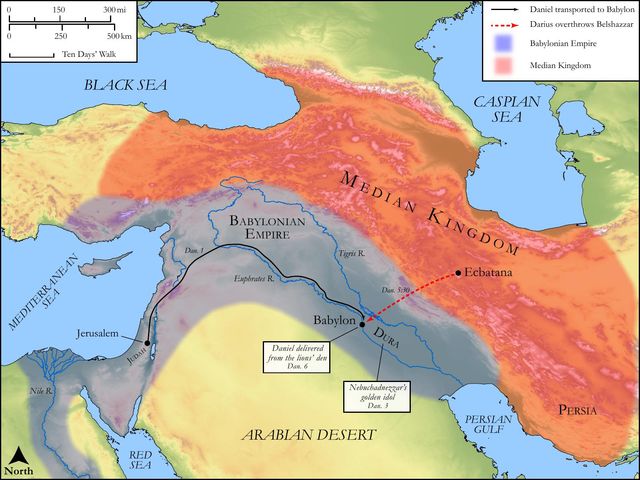
See on the biblical-era map
Study this verse
Public-domain commentary
Matthew Henry
From his Commentary on the Whole Bible. Henry comments on passages, not single verses — this entry covers Daniel 6:6–10. His three-level outline is real structure in the source text, so it is rendered as structure.
Daniel's adversaries could have no advantage against him from any law now in being; they therefore contrive a new law, by which they hope to ensnare him, and in a matter in which they knew they should be sure of him; and such was his fidelity to his God that they gained their point. Here is,
I.Darius's impious law.
I call it Darius's, because he gave the royal assent to it, and otherwise it would not have been of force; but it was not properly his: he contrived it not, and was perfectly wheedled to consent to it. The presidents and princes framed the edict, brought in the bill, and by their management it was agreed to by the convention of the states, who perhaps were met at this time upon some public occasion. It is pretended that this bill which they would have to pass into a law was the result of mature deliberation, that all the presidents of the kingdom, the governors, princes, counsellors, and captains, had consulted together about it, and that they not only agreed to it, but advised it, for divers good causes and considerations, that they had done what they could to establish it for a firm decree; nay, they intimate to the king that it was carried nemine contradicente - unanimously: "All the presidents are of this mind;" and yet we are sure that Daniel, the chief of the three presidents, did not agree to it, and have reason to think that many more of the princes excepted against it as absurd and unreasonable. Note, It is no new thing for that to be represented, and with great assurance too, as the sense of the nation, which is far from being so; and that which few approve of is sometimes confidently said to be that which all agree to. But, O the infelicity of kings, who, being under a necessity of seeing and hearing with other people's eyes and ears, are often wretchedly imposed upon! These designing men, under colour of doing honour to the king, but really intending the ruin of his favourite, press him to pass this into a law, and make it a royal statute, that whosoever shall ask a petition of any god or man for thirty days, save of the king, shall be put to death after the most barbarous manner, shall be cast into the den of lions, Dan 6:7. This is the bill they have been hatching, and they lay it before the king to be signed and passed into a law. Now,
1.There is nothing in it that has the least appearance of good, but that it magnifies the king, and makes him seem both very great and very kind to his subjects, which, they suggest, will be of good service to him now that he has newly come to his throne, and will confirm his interests. All men must be made to believe that the king is so rich, and withal so ready to all petitioners, that none in any want or distress need to apply either to God or man for relief, but to him only. And for thirty days together he will be ready to give audience to all that have any petition to present to him. It is indeed much for the honour of kings to be benefactors to their subjects and to have their ears open to their complaints and requests; but if they pretend to be their sole benefactors, and undertake to be to them instead of God, and challenge that respect from them which is due to God only, it is their disgrace, and not their honour. But,
2.There is a great deal in it that is apparently evil. It is bad enough to forbid asking a petition of any man. Must not a beggar ask an alms, or one neighbour beg a kindness of another? If the child want bread, must he not ask it of his parents, or be cast into the den of lions if he do? Nay, those that have business with the king, may they not petition those about him to introduce them? But it was much worse, and an impudent affront to all religion, to forbid asking a petition of any god. It is by prayer that we give glory to God, fetch in mercy from God; and so keep up our communion with God; and to interdict prayer for thirty days is for so long to rob God of all the tribute he has from man and to rob man of all the comfort he has in God. When the light of nature teaches us that the providence of God has the ordering and disposing of all our affairs does not the law of nature oblige us by prayer to acknowledge God and seek to him? Does not every man's heart direct him, when he is in want or distress, to call upon God, and must this be made high treason? We could not live a day without God; and can men live thirty days without prayer? Will the king himself be tied up for so long from praying to God; or, if it be allowed him, will he undertake to do it for all his subjects? Did ever any nation thus slight their gods? But see what absurdities malice will drive men to. Rather than not bring Daniel into trouble for praying to his God, they will deny themselves and all their friends the satisfaction of praying to theirs. Had they proposed only to prohibit the Jews from praying to their God, Daniel would have been as effectually ensnared; but they knew the king would not pass such a law, and therefore made it thus general. And the king, puffed up with a fancy that this would set him up as a little god, was fond of the feather in his cap (for so it was, and not a flower in his crown) and signed the writing and the decree (Dan 6:9), which, being once done, according to the constitution of the united kingdom of the Medes and Persians, was not upon any pretence whatsoever to be altered or dispensed with, or the breach of it pardoned.
II.Daniel's pious disobedience to this law, Dan 6:10.
He did not retire into the country, nor abscond for some time, though he knew the law was levelled against him; but, because he knew it was so, therefore he stood his ground, knowing that he had now a fair opportunity of honouring God before men, and showing that he preferred his favour, and his duty to him, before life itself. When Daniel knew that the writing was signed he might have gone to the king, and expostulated with him about it; nay, he might have remonstrated against it, as grounded upon a misinformation that all the presidents had consented to it, whereas he that was chief of them had never been consulted about it; but he went to his house, and applied himself to his duty, cheerfully trusting God with the event. Now observe,
1.Daniel's constant practice, which we were not informed of before this occasion, but which we have reason to think was the general practice of the pious Jews.
(1.)He prayed in his house, sometimes alone and sometimes with his family about him, and made a solemn business of it. Cornelius was a man that prayed in his house, Act 10:30. Note, Every house not only may be, but ought to be, a house of prayer; where we have a tent God must have an alter, and on it we must offer spiritual sacrifices.
(2.)In every prayer he gave thanks. When we pray to God for the mercies we want we must praise him for those we have received. Thanksgiving must be a part of every prayer.
(3.)In his prayer and thanksgiving he had an eye to God as his God, his in covenant, and set himself as in his presence. He did this before his God, and with a regard to him.
(4.)When he prayed and gave thanks he kneeled upon his knees, which is the most proper gesture in prayer, and most expressive of humility, and reverence, and submission to God. Kneeling is a begging posture, and we come to God as beggars, beggars for our lives, whom it concerns to be importunate.
(5.)He opened the windows of his chamber, that the sight of the visible heavens might affect his heart with an awe of that God who dwells above the heavens; but that was not all: he opened them towards Jerusalem, the holy city, though now in ruins, to signify the affection he had for its very stones and dust (Psa 102:14) and the remembrance he had of its concerns daily in his prayers. Thus, though he himself lived great in Babylon, yet he testified his concurrence with the meanest of his brethren the captives, in remembering Jerusalem and preferring it before his chief joy, Psa 137:5, Psa 137:6. Jerusalem was the place which God had chosen to put his name there; and, when the temple was dedicated, Solomon's prayer to God was that if his people should in the land of their enemies pray unto him with their eye towards the land which he gave them, and the city he had chosen, and the house which was built to his name, then he would hear and maintain their cause (Kg1 8:48, Kg1 8:49), to which prayer Daniel had reference in this circumstance of his devotions.
(6.)He did this three times a day, three times every day according to the example of David (Psa 55:17), Morning, evening, and at noon, I will pray. It is good to have our hours of prayer, not to bind, but to remind conscience; and, if we think our bodies require refreshment by food thrice a day, can we think seldomer will serve our souls? This is surely as little as may be to answer the command of praying always.
(7.)He did this so openly and avowedly that all who knew him knew it to be his practice; and he thus showed it, not because he was proud of it (in the place where he was there was no room for that temptation, for it was not reputation, but reproach, that attended it), but because he was not ashamed of it. Though Daniel was a great man, he did not think it below him to be thrice a day upon his knees before his Maker and to be his own chaplain; though he was an old man, he did not think himself past it; nor, though it had been his practice from his youth up, was he weary of this well doing. Though he was a man of business, vast business, for the service of the public, he did not think that would excuse him from the daily exercises of devotion. How inexcusable then are those who have but little to do in the world, and yet will not do thus much for God and their souls! Daniel was a man famous for prayer, and for success in it (Eze 14:14), and he came to be so by thus making a conscience of prayer and making a business of it daily; and in thus doing God blessed him wonderfully.
2.Daniel's constant adherence to this practice, even when it was made by the law a capital crime. When he knew that the writing was signed he continued to do as he did aforetime, and altered not one circumstance of the performance. Many a man, yea, and many a good man, would have thought it prudence to omit it for these thirty days, when he could not do it without hazard of his life; he might have prayed so much oftener when those days had expired and the danger was over, or he might have performed the duty at another time, and in another place, so secretly that it should not be possible for his enemies to discover it; and so he might both satisfy his conscience and keep up his communion with God, and yet avoid the law, and continue in his usefulness. But, if he had done so, it would have been thought, both by his friends and by his enemies, that he had thrown up the duty for this time, through cowardice and base fear, which would have tended very much to the dishonour of God and the discouragement of his friends. Others who moved in a lower sphere might well enough act with caution; but Daniel, who had so many eyes upon him, must act with courage; and the rather because he knew that the law, when it was made, was particularly levelled against him. Note, We must not omit duty for fear of suffering, so, nor so much as seems to come short of it. In trying times great stress is laid upon our confessing Christ before men (Mat 10:32), and we must take heed lest, under pretence of discretion, we be found guilty of cowardice in the cause of God. If we do not think that this example of Daniel obliges us to do likewise, yet I am sure it forbids us to censure those that do, for God owned him in it. By his constancy to his duty it now appears that he had never been used to admit any excuse for the omission of it; for, if ever any excuse would serve to put it by, this would have served now,
(1.)That it was forbidden by the king his master, and in honour of the king too; but it is an undoubted maxim, in answer to that, We are to obey God rather than men.
(2.)That it would be the loss of his life, but it is an undoubted maxim, in answer to that, Those who throw away their souls (as those certainly do that live without prayer) to save their lives make but a bad bargain for themselves; and though herein they make themselves, like the king of Tyre, wiser than Daniel, at their end they will be fools.
Historical interpretation
Historical reception
1 surviving comment on this verse from the historical church.
Nothing is more repugnant than envy: it pressured them into committing impiety and caused an impious decree to be published forbidding those intent on offering prayers to God; they prevented not only themselves from doing it but also all others subject to royal control.… In surrendering their mind’s eye to envy, they did not understand that the king could not supply everything to petitioners, like health, life, fathering children, abundance of rain and anything else that we receive when we ask it of God. Losing their senses, however, they ascribed to the king what belongs to God and persuaded the foolish king to reach the same verdict and ratify their request.
Continue studying Daniel 6:7 across the web’s major study libraries — every link below opens this exact verse, chapter, or book on the destination site.
Read & Compare
 BibleGatewayThis verse in more than 200 translations and 70 languages.
 Bible.comThe YouVersion reader — hundreds of translations, reading plans, and highlights.
 ESV.orgCrossway's official English Standard Version reader.
 NET BibleThe NET translation with 60,000+ translators' notes on every rendering decision.
 STEP BibleTyndale House's free study tool — original text, vocabulary, and scholarly resources.
 BibliaLogos Bible Software's free web reader.
 USCCBThe New American Bible (Revised Edition) with the U.S. bishops' study notes.
Commentaries
 BibleHub CommentariesDozens of classic commentaries on this verse, gathered on one page.
 StudyLightMore than 100 commentary sets — the largest collection on the web.
 BibleRefPlain-English commentary on what this verse means, verse by verse.
 Enduring WordDavid Guzik's free commentary on this chapter, widely used by Bible teachers.
 Bible Study ToolsVerse commentary alongside Greek and Hebrew study aids.
Original Language & Research
- BibleHub InterlinearThe verse word by word — original language, transliteration, and English.
- BibleHub LexiconEvery word's original-language definition and Strong's entry.
 Blue Letter BibleDeep-study tools — Strong's numbers, concordance, and word studies.
 SefariaThe Hebrew text with Rashi and centuries of Jewish commentary.
Sermons, Hymns & Audio


TrulyRandomVerse is not affiliated with these sites and doesn’t control their content. They’re linked because they’re genuinely useful.
Summary
Daniel 6:7 meticulously outlines the malicious plot devised by the high-ranking officials of the Medo-Persian kingdom against Daniel. Unable to find any fault in his exemplary administration, this powerful coalition—comprising presidents, governors, princes, counsellors, and captains—conspired to establish a seemingly legitimate royal statute. This firm decree strictly forbade any subject from making a petition to any god or human, save King Darius himself, for a period of thirty days, with the severe and unchangeable penalty of being cast into the den of lions for any transgression.
Context
ShowHideLiterary Context
This verse is strategically positioned within the dramatic narrative of Daniel chapter 6, immediately following Daniel's exceptional elevation as one of the three chief presidents over Darius's vast kingdom. Daniel's "excellent spirit" and administrative integrity led King Darius to consider promoting him over the entire realm, as highlighted in Daniel 6:3. This unparalleled favor, however, ignited intense jealousy and animosity among the other officials. Their subsequent attempts to find grounds for accusation against Daniel concerning his official duties proved futile, leading them to cunningly recognize that his unwavering devotion to God was his only potential vulnerability, as described in Daniel 6:4-5. Thus, Daniel 6:7 details their collaborative effort to craft a law specifically designed to exploit Daniel's religious fidelity, setting the stage for the dramatic confrontation between human authority and divine allegiance that culminates in Daniel's miraculous deliverance.
Historical & Cultural Context
The setting for this narrative is the Medo-Persian Empire, likely under the reign of Darius the Mede, who governed as a viceroy or appointed ruler under Cyrus the Great. A defining characteristic of Medo-Persian law, crucial to this narrative's tension, was its unchangeable nature once signed by the king, a principle explicitly stated in Daniel 6:8 and further exemplified in Esther 1:19. This legal rigidity meant that even the king himself could not revoke a decree once it was enacted. The "den of lions" was a known and brutal form of capital punishment, serving as a terrifying public deterrent and a clear message of absolute power. The decree itself, temporarily elevating the king to an exclusive position as the sole recipient of petitions, reflects ancient monarchical practices where rulers often sought to consolidate power and demand absolute loyalty, sometimes even claiming divine attributes or unique access to the divine realm.
Key Themes
ShowHideDaniel 6:7 introduces and develops several profound theological and narrative themes within the broader Book of Daniel. Firstly, it highlights the perennial conflict between human authority and divine sovereignty, as the decree directly challenges God's exclusive right to receive worship and prayer, attempting to usurp a divine prerogative. Secondly, it powerfully illustrates the theme of persecution for righteousness, demonstrating that Daniel's blameless character and spiritual devotion, rather than any wrongdoing, became the very catalyst for the malicious plot against him. This resonates deeply with the broader biblical truth that those who live godly lives may face opposition, as seen in 2 Timothy 3:12. Thirdly, the verse meticulously sets the stage for a profound test of faith, forcing Daniel to choose between unwavering obedience to God and compliance with a life-threatening human decree. Finally, it exposes the destructive nature of political intrigue and jealousy, revealing how envy can corrupt individuals and lead to elaborate, often cruel, schemes against the innocent.
Exposition and Analysis
ShowHideKey Word Analysis
ShowHideThis term (H3272) signifies a deliberate act of counseling or consulting, often used reflexively to denote a mutual agreement or conspiracy. Its application here emphasizes the premeditated and collaborative nature of the officials' plot. They did not stumble upon this idea; rather, they actively and intentionally planned the decree, highlighting the malicious intent and calculated strategy behind their actions to ensnare Daniel.
Derived from a root meaning "to rise" or "to stand," this word (H7010) refers to an edict or decree that is established or arises in law. It denotes a formal, binding legal instrument. The conspirators ensured it was a "royal statute," underscoring its official and authoritative nature, which would be difficult for even the king to overturn once enacted, thereby making their trap inescapable.
This term (H1358) specifically describes a pit, particularly one dug for wild animals. In the context of Daniel 6, it refers to the deep, inescapable enclosure where lions were kept, serving as a terrifying and public means of execution. Its inclusion in the decree immediately highlights the severity and brutality of the punishment, designed to instill fear and ensure absolute compliance, specifically targeting Daniel's known practice of daily prayer.
Verse Breakdown
ShowHide"All the presidents of the kingdom, the governors, and the princes, the counsellors, and the captains, have consulted together"
This clause vividly portrays the extensive and unified nature of the conspiracy. It was not an isolated act but a collective effort by the highest echelons of the Medo-Persian administration, pointedly excluding Daniel. Their "consultation" implies a strategic, deliberate, and unanimous decision-making process, underscoring the formidable and organized opposition Daniel faced.
"to establish a royal statute, and to make a firm decree"
This segment emphasizes the legal and unalterable character of the proposed law. The officials sought to create a binding royal edict, a "firm decree," leveraging the Medo-Persian legal tradition where royal pronouncements, once sealed, could not be revoked. This detail highlights their cunning in crafting a trap that would bind even the king himself, making Daniel's predicament seem hopeless from a human perspective.
"that whosoever shall ask a petition of any God or man for thirty days, save of thee, O king, he shall be cast into the den of lions"
This is the core of the decree, outlining the forbidden action and its severe consequence. For a limited period of thirty days, all forms of petition, whether to divine beings or other humans, were to be directed exclusively to King Darius. This temporarily elevated the king to a position of supreme authority, directly challenging the ultimate sovereignty of God. The specified penalty, being thrown into a "den of lions," was a public, brutal, and terrifying form of execution, specifically chosen to target Daniel's known and unwavering practice of daily prayer to his God.
Literary Devices
ShowHideThe verse employs several significant literary devices that heighten its dramatic impact and thematic resonance. Irony is powerfully present in the officials' meticulously crafted "firm decree," which, intended to ensnare Daniel, ultimately serves as the very catalyst for God's miraculous intervention and Daniel's vindication, while simultaneously exposing Darius's tragic inability to reverse his own law. The explicit mention of the "den of lions" serves as potent foreshadowing, immediately signaling the impending conflict and the dramatic climax of the narrative, building suspense for the reader. The comprehensive enumeration of officials ("presidents, governors, princes, counsellors, and captains") functions as synecdoche, representing the entire bureaucratic apparatus of the kingdom, thereby emphasizing the overwhelming and unified nature of the opposition against Daniel. This collective action also highlights the stark antagonism between the corrupt human system driven by envy and Daniel's unwavering individual faith and integrity.
Theological and Thematic Connections
ShowHideDaniel 6:7 serves as a profound theological statement on the enduring conflict between human attempts to usurp divine authority and God's ultimate, unchallengeable sovereignty. The decree, demanding exclusive petition to the king, mirrors the practice among the nations of monarchs claiming divine status or unique access to the divine realm, thereby challenging the biblical understanding of God as the sole legitimate recipient of worship and prayer. This directly violates the First Commandment, "You shall have no other gods before me" (Exodus 20:3). The officials' plot, born of jealousy and political ambition, inadvertently sets the stage for God to demonstrate His power to deliver His faithful servant, thereby vindicating His own name and authority over all earthly rulers, laws, and decrees. It underscores that true allegiance belongs to God alone, regardless of the cost or consequence.
Reflection and Application
ShowHideDaniel 6:7 presents a timeless scenario where unwavering faithfulness to God directly confronts the demands of human systems and corrupt power. For believers today, this verse prompts profound self-reflection on the nature of our ultimate allegiances. When societal pressures, political mandates, or even professional expectations conflict with our deepest convictions and our commitment to Christ, where do we stand? Daniel's adversaries sought to create a situation where his spiritual devotion became a criminal act, forcing him to choose between obedience to God and the preservation of his life. This narrative challenges us to cultivate a faith so deeply rooted in God that it can withstand external pressures and internal fears. It reminds us that true integrity is not merely about avoiding wrongdoing but actively living out our convictions, even when it comes at a significant personal cost. The ultimate question posed by this verse is not just if we will obey God, but how we will maintain our devotion when the world demands otherwise, trusting in His sovereign power to deliver.
Questions for Reflection
ShowHideFAQ
ShowHideWhy did the officials specifically choose a 30-day period for the decree?
ShowHideThe 30-day period was likely a calculated strategic choice by the conspirators. It was long enough to ensure that Daniel, with his well-known practice of daily prayer, would inevitably violate the decree, thereby guaranteeing his entrapment. At the same time, it was short enough to appear reasonable and temporary to King Darius, perhaps to avoid a widespread religious revolt or to make the king feel more secure in his temporary, elevated status without permanently alienating his diverse religious subjects. This limited timeframe also emphasized the urgency and exclusivity of the king's temporary, elevated status.
Was this decree truly unchangeable, even by the king himself?
ShowHideYes, according to the established legal tradition of the Medo-Persian Empire, once a decree was signed by the king and sealed with his signet ring, it became an unchangeable "law of the Medes and Persians." This is explicitly stated in Daniel 6:8 and reinforced in Esther 1:19. This legal rigidity is a critical plot point, as it meant King Darius, despite his affection for Daniel, was legally bound to enforce the decree, highlighting the desperate nature of his attempts to rescue Daniel later in the chapter.
What does this verse teach us about the nature of opposition to faith?
ShowHideDaniel 6:7 powerfully illustrates that opposition to faith often stems not from a believer's wrongdoing or incompetence, but precisely from their righteousness, excellence, and unwavering devotion to God. The officials could find no fault in Daniel's administrative work; their only recourse was to target his sincere religious practice. This teaches us that spiritual opposition can be deeply insidious, leveraging sincere piety as a weapon. It also shows that such opposition is frequently rooted in human jealousy, envy, and a desire for power, rather than genuine concern for justice or the common good.
Christ-Centered Fulfillment
ShowHideDaniel 6:7, with its depiction of a righteous man targeted by a malicious, legally binding decree, finds profound Christ-centered fulfillment in the person and work of Jesus Christ. Just as Daniel was blameless yet faced a death sentence orchestrated by jealous authorities, so too was Jesus, the sinless Lamb of God, condemned to death by a conspiracy of religious and political leaders who found no genuine fault in Him (Luke 23:4). The decree against Daniel sought to prohibit petition to any other god or man, attempting to centralize all authority in the earthly king. This foreshadows the ultimate and rightful claim of Christ, who alone is the way, the truth, and the life, through whom all true petitions to God the Father must pass (John 14:13-14). Daniel's miraculous deliverance from the lion's den, an act of divine intervention, powerfully prefigures Christ's ultimate victory over death and the grave, demonstrating that even the ultimate penalty of death cannot hold God's chosen one captive (Acts 2:24). Ultimately, the earthly decree in Daniel 6:7, designed to ensnare and condemn, points to the divine decree of salvation through Christ, where allegiance to Him, rather than leading to a den of lions, leads to eternal life and freedom from the condemnation of sin (Romans 8:1).