


Daniel 3:27
Bible text: King James Version (1769 Blayney text) · Public domain
Bible text: King James Version with Strong's numbers · Public domain
Bible text: Berean Standard Bible · Public domain
Bible text: American Standard Version (1901) · Public domain
Bible text: World English Bible, Messianic edition · Public domain
Bible text: Geneva Bible (1599) · Public domain
Bible text: Young's Literal Translation · Public domain
- וּמִתְכַּנְּשִׁיןU·mit·ka·ne·shinand [were] gatheredH3673Conj-w ¦ V-Hitpaal-Prtcpl-mpVerb Hitpaal Participle Plural Masculine Absoluteוּandמִתְכַּנְּשִׁין[were] gathered
- אֲחַשְׁדַּרְפְּנַיָּא'a·chash·dar·pe·nai·Ya'satraps theH324N-mp ¦ ArtNoun Plural Masculine Definiteאֲחַשְׁדַּרְפְּנַיָּsatrapsאthe
- סִגְנַיָּאsig·nai·Ya'prefects theH5460N-mp ¦ ArtNoun Plural Masculine Definiteסִגְנַיָּprefectsאthe
- וּפַחֲוָתָאu·fa·cha·va·Ta'and governors theH6347Conj-w ¦ N-fp ¦ ArtNoun Plural Feminine Definiteוּandפַחֲוָתָgovernorsאthe
- וְהַדָּבְרֵיve·ha·da·ve·Reiand [the] counselors ofH1907Conj-w ¦ N-mpcNoun Plural Masculine Constructוְandהַדָּבְרֵי[the] counselors of
- מַלְכָּאmal·Ka'king theH4430N-cs ¦ ArtNoun Singular common gender Definiteמַלְכָּkingאthe
- חָזַיִןcha·Za·yin[they were] seeingH2370V-Peal-Prtcpl-mpVerb Peal Participle Plural Masculine Absolute
- לְגֻבְרַיָּאle·guv·rai·Ya'<obj.> men theH1400Prep-l ¦ N-mp ¦ ArtNoun Plural Masculine Definiteלְ<obj.>גֻבְרַיָּmenאthe
- אִלֵּךְ'i·LekhtheseH479PrtParticle Demonstrative
- דִּיdithatH1768ConjConjunction
- לָאla'notH3809NegParticle Negative
- שְׁלֵטshe·Letit had had powerH7981V-Peal-Perf-3msVerb Peal Perfect 3rd Singular Masculine
- נוּרָאnu·Ra'fire theH5135N-cs ¦ ArtNoun Singular common gender Definiteנוּרָfireאthe
- בְּגֶשְׁמְהוֹןbe·gesh·me·Honover their bodyH1655Prep-b ¦ N-csc ¦ 3mpNoun Singular common gender Constructבְּoverגֶשְׁמְbodyהוֹןtheir
- וּשְׂעַרu·se·'Arand [the] hair ofH8177Conj-w ¦ N-cscNoun Singular common gender Constructוּandשְׂעַר[the] hair of
- רֵאשְׁהוֹןre·she·hOntheir headH7217N-csc ¦ 3mpNoun Singular common gender Constructרֵאשְׁheadהוֹןtheir
- לָאla'notH3809NegParticle Negative
- הִתְחָרַךְhit·cha·Rakhit was singedH2761V-Hitpaal-Perf-3msVerb Hitpaal Perfect 3rd Singular Masculine
- וְסָרְבָּלֵיהוֹןve·sa·re·ba·lei·Honand their mantlesH5622Conj-w ¦ N-mpc ¦ 3mpNoun Plural Masculine Constructוְandסָרְבָּלֵיmantlesהוֹןtheir
- לָאla'notH3809NegParticle Negative
- שְׁנוֹshe·Nothey were changedH8133V-Peal-Perf-3mpVerb Peal Perfect 3rd Plural Masculine
- וְרֵיחַve·Rei·achand [the] smell ofH7382Conj-w ¦ N-cscNoun Singular common gender Constructוְandרֵיחַ[the] smell of
- נוּרNurfireH5135N-csNoun Singular common gender Absolute
- לָאla'notH3809NegParticle Negative
- עֲדָת'a·Datit had touchedH5709V-Peal-Perf-3fsVerb Peal Perfect 3rd Singular Feminine
- בְּהוֹןbe·Honon themPrep-b ¦ 3mpSuffix Personal 3rd Plural Masculineבְּonהוֹןthem
English is a literal word-by-word gloss of the Hebrew, not the KJV's wording. Why?
This is the original text the KJV's translators worked from — each Hebrew word with its own literal English meaning in this verse, prepared by scholars at Tyndale House, Cambridge. The KJV translates whole sentences, not word by word, so its wording differs: one Hebrew word can become several English words, and the KJV may choose “the LORD” where the gloss reads “Yahweh”. Both are faithful — they answer different questions. For the KJV's own rendering, switch to the KJV text.
Details
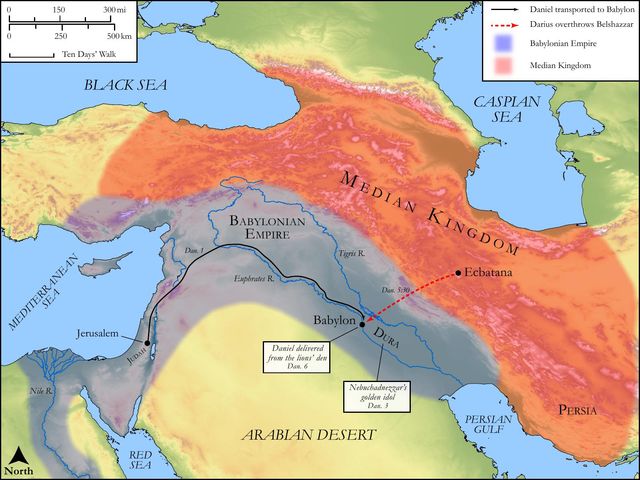
See on the biblical-era map
Study this verse
Public-domain commentary
Matthew Henry
From his Commentary on the Whole Bible. Henry comments on passages, not single verses — this entry covers Daniel 3:19–27. His three-level outline is real structure in the source text, so it is rendered as structure.
In these verses we have,
I.The casting of these three faithful servants of God into the fiery furnace.
Nebuchadnezzar had himself known and owned so much of the true God that, one would have thought, though his pride and vanity induced him to make this golden image, and set it up to be worshipped, yet what these young men now said (whom he had formerly found to be wiser than all his wise men) would revive his convictions, and at least engage him to excuse them; but it proved quite otherwise.
1.Instead of being convinced by what they said, he was exasperated, and made more outrageous, Dan 3:19. It made him full of fury, and the form of his visage was changed against these men. Note, Brutish passions the more they are indulged the more violent they grow, and even change the countenance, to the great reproach of the wisdom and reason of a man. Nebuchadnezzar, in this heat, exchanged the awful majesty of a prince upon his throne, or a judge upon the bench, for the frightful fury of a wild bull in a net. Would men in a passion but view their faces in a glass, they would blush at their own folly and turn all their displeasure against themselves.
2.Instead of mitigating their punishment, in consideration of their quality and the posts of honour they were in, he ordered it to be heightened, that they should heat the furnace seven times more than it was wont to be heated for other malefactors, that is, that they should put seven times more fuel to it, which, though it would not make their death more grievous, but rather dispatch them sooner, was designed to signify that the king looked upon their crime as seven times more heinous than the crimes of others, and so made their death more ignominious. But God brought glory to himself out of this foolish instance of the tyrant's rage; for, though it would not have made their death the more grievous, yet it did make their deliverance much the more illustrious.
3.He ordered them to be bound in their clothes, and cast into the midst of the burning fiery furnace, which was done accordingly, Dan 3:20, Dan 3:21. They were bound, that they might not struggle, or make any resistance, were bound in their clothes, for haste, or that they might be consumed the more slowly and gradually. But God's providence ordered it for the increase of the miracle, in that their clothes were not so much as singed. They were bound in their coats or mantles, their hosen or breeches, and their hats or turbans, as if, in detestation of their crime, they would have their clothes to be burnt with them. What a terrible death was this - to be cast bound into the midst of a burning fiery furnace! Dan 3:23. It makes one's flesh tremble to think of it, and horror to take hold on one. It is amazing that the tyrant was so hard-hearted as to inflict such a punishment, and that the confessors were so stout-hearted as to submit to it rather than sin against God. But what is this to the second death, to that furnace into which the tares shall be cast in bundles, to that lake which burns eternally with fire and brimstone? Let Nebuchadnezzar heat his furnace as hot as he can, a few minutes will finish the torment of those who are cast into it; but hell-fire tortures and does not kill. The pain of damned sinners is more exquisite, and the smoke of their torment ascends for ever and ever, and those have no rest, no intermission, no cessation of their pains, who have worshipped the beast and his image (Rev 14:10, Rev 14:11), whereas their pain would be soon over that were cast into this furnace for not worshipping this Babylonian beast and his image.
4.It was a remarkable providence that the men, the mighty men, that bound them, and threw them into the furnace, were themselves consumed or suffocated by the flame, Dan 3:22. The king's commandment was urgent, that they should dispatch them quickly, and be sure to do it effectually; and therefore they resolved to go to the very mouth of the furnace, that they might throw them into the midst of it, but they were in such haste that they would not take time to arm themselves accordingly. The apocryphal additions to Daniel say that the flame ascended forty-nine cubits above the mouth of the furnace. Probably God ordered it so that the wind blew it directly upon them with such violence that it smothered them. God did thus immediately plead the cause of his injured servants, and take vengeance for them on their persecutors, whom he punished, not only in the very act of their sin, but by it. But these men were only the instruments of cruelty; he that bade them do it had the greater sin; yet they suffered justly for executing an unjust decree, and it is very probable that they did it with pleasure and were glad to be so employed. Nebuchadnezzar himself was reserved for a further reckoning. There is a day coming when proud tyrants will be punished, not only for the cruelties they have been guilty of, but for employing those about them in their cruelties, and so exposing them to the judgments of God.
II.The deliverance of these three faithful servants of God out of the furnace.
When they were cast bound into the midst of that devouring fire we might well conclude that we should hear no more of them, that their very bones would be calcined; but, to our amazement, we here find that Shadrach, Meshach, and Abednego, are yet alive.
1.Nebuchadnezzar finds them walking in the fire. He was astonished, and rose up in haste, Dan 3:24. Perhaps the slaying of the men that executed his sentence was that which astonished him, as well it might, for he had reason to think his own turn would be next; or it was some unaccountable impression upon his own mind that astonished him, and made him rise up in haste, and go to the furnace, to see what had become of those he had cast into it. Note, God can strike those with astonishment whose hearts are most hardened both against him and against his people. He that made the soul can make his sword to approach to it, even to that of the greatest tyrant. In his astonishment he calls his counsellors about him, and appeals to them. Did we not cast three men bound into the fire? It seems, it was done by order, not only of the king, but of the council. They durst not but concur with him, which he forced them to do, that they might share with him in the guilt and odium? "True, O king!" say they; "we did order such an execution to be done and it was done." "But now," says the king, "I have been looking into the furnace, and I see four men, loose, walking in the midst of the fire," Dan 3:25.
(1.)They were loosed from their bonds. The fire that did not so much as singe their clothes burnt the cords wherewith they were bound, and set them at liberty; thus God's people have their hearts enlarged, through the grace of God, by those very troubles with which their enemies designed to straiten and hamper them.
(2.)They had no hurt, made no complaint, felt no pain or uneasiness in the least; the flame did not scorch them; the smoke did not stifle them; they were alive and as well as ever in the midst of the flames. See how God of nature can, when he pleases, control the powers of nature, to make them serve his purposes. Now was fulfilled in the letter gracious promise (Isa 43:2), When thou walkest through the fire thou shalt not be burnt, neither shall the flame kindle upon thee. By faith they quench the violence of the fire, quench the fiery darts of the wicked.
(3.)They walked in the midst of the fire. The furnace was large, so that they had room to walk; they were unhurt, so that they were able to walk; their minds were easy, so that they were disposed to walk, as in a paradise or garden of pleasure. Can a man walk upon hot coals and his feet not be burnt? Pro 6:28. Yes, they did it with as much pleasure as the king of Tyrus walked up and down in the midst of his stones of fire, his precious stones that sparkled as fire, Eze 28:14. They were not striving to get out, finding themselves unhurt; but, leaving it to that God who preserved them in the fire to bring them out of it, they walked up and down in the midst of it unconcerned. One of the apocryphal writings relates at large the prayer which Azariah, one of the three, prayed in the fire (wherein he laments the calamities and iniquities of Israel, and entreats God's favour to his people), and the song of praise which they all three sang in the midst of the flames, in both which there are remarkable strains of devotion; but we have reason to think, with Grotius, that they were composed by some Jew of a later age, not as what were used, but only as what might have been used, on this occasion, and therefore we justly reject them as no part of holy writ.
(4.)There was a fourth seen with them in the fire, whose form, in Nebuchadnezzar's judgment, was like the Son of God; he appeared as a divine person, a messenger from heaven, not as a servant, but as a son. Like an angel (so some); and angels are called sons of God, Job 38:7. In the apocryphal narrative of this story it is said, The angel of the Lord came down into the furnace; and Nebuchadnezzar here says (Dan 3:28), God sent his angel and delivered them; and it was an angel that shut the lions' mouths when Daniel was in the den, Dan 6:22. But some think it was the eternal Son of God, the angel of the covenant, and not a created angel. He appeared often in our nature before he assumed it in his incarnation, and never more seasonable, nor to give a more proper indication and presage of his great errand into the world in the fulness of time, than now, when, to deliver his chosen out of the fire, he came and walked with them in the fire. Note, Those that suffer for Christ have his gracious presence with them in their sufferings, even in the fiery furnace, even in the valley of the shadow of death, and therefore even there they need fear no evil. Hereby Christ showed that what is done against his people he takes as done against himself; whoever throws them into the furnace does, in effect, throw him in. I an Jesus, whom thou persecutest, Isa 63:9.
2.Nebuchadnezzar calls them out of the furnace (Dan 3:26): He comes near to the mouth of the burning fiery furnace, and bids them come forth and come hither. Come forth, come (so some read it); he speaks with a great deal of tenderness and concern, and stands ready to lend them his hand and help them out. He is convinced by their miraculous preservation that he did evil in casting them into the furnace; and therefore he does not thrust them out privily; no verily, but he will come himself and fetch them out, Act 16:37. Observe the respectful title that he gives them. When he was in the heat of his fury and rage against them it is probable that he called them rebels, and traitors, and all the ill names he could invent; but now he owns them for the servants of the most high God, a God who now appears able to deliver them out of his hand. Note, Sooner or later, God will convince the proudest of men that he is the most high God, and above them, and too hard for them, even in those things wherein they deal proudly and presumptuously, Exo 18:11. He will likewise let them know are who his servants, and that he owns them and will stand by them. Elijah prayed (Kg1 18:36), Let it be known that thou art God and that I am thy servant. Nebuchadnezzar now embraces those whom he had abandoned, and is very officious about them, now that he perceives them to be the favourites of Heaven. Note, What persecutors have done against God's servants, when God opens their eyes, they must as far as they can undo again. How the fourth, whose form was like the Son of God, withdrew, and whether he vanished away or visibly ascended, we are not told, but of the other three we are informed,
(1.)That they came forth out of the midst of the fire, as Abraham their father out of Ur (that is, the fire) of the Chaldees, into which, says this tradition of the Jews, he was cast, for refusing to worship idols, and out of which he was delivered, as those his three children were. When they had their discharge they did not tempt God by staying in any longer, but came forth as brands out of the burning.
(2.)That it was made to appear, to the full satisfaction of all the amazed spectators, that they had not received the least damage by the fire, Dan 3:27. All the great men came together to view them, and found that there was not so much as a hair of their head singed. Here that was true in the letter which our Saviour spoke figuratively, for an assurance to his suffering servants that they should sustain no real damage (Luk 21:18), There shall not a hair of your head perish. Their clothes did not so much as change colour, nor smell of fire, much less were their bodies in the least scorched or blistered; no, the fire had no power on them. The Chaldeans worshipped the fire, as a sort of image of the sun, so that, in restraining the fire now, God put contempt, not only upon their king, but upon their god too, and showed that his voice divides the flames of fire as well as the floods of water (Psa 29:7), when he pleases to make a way for his people through the midst of it. It is our God only that is the consuming fire (Heb 12:29); other fire, if he but speak the word, shall not consume.
Historical interpretation
Two Centuries of Reception
4 surviving comments on this verse. Each one is dated, so this reads as a timeline rather than a list.
Select a marker to jump to its quote. Markers stagger vertically where authors wrote within a few decades of each other.
“God shall wipe away all tears from their eyes, and there shall be no more death” and therefore no more corruption, it being chased away by incorruption, even as death is by immortality.… That the raiment and shoes of the children of Israel remained unworn and fresh for the space of forty years … that the fires of Babylon injured neither the cloaks nor the trousers of the three young men … that Jonah was swallowed by the monster of the deep, in whose belly whole ships were devoured and after three days was vomited out safe and sound—to what faith do these notable facts bear witness, if not to that which ought to inspire in us the belief that they are proofs … of our own future integrity and perfect resurrection?… They are written that we may believe both that the Lord is more powerful than all natural laws about the body, and that he shows himself the preserver of the flesh the more emphatically, in that he has preserved for the body even its very clothes and shoes.
The Father’s care and providence neither allowed the garments of the Israelites to perish nor the worthless shoes on their feet to wear out; nor, finally, did he permit the wide trousers of the captive young men to be burned. And this is not without reason, for if he who contains all things embraces all things (all things, however, and the whole sum are made up of individual parts), then it follows logically that his care will be bestowed on every individual part because his providence extends to the whole, whatever it be.
Recall what happened to Ananiah and his companions. From which sources did they make water flow or how many vessels of water did they use to extinguish the fire that rose up forty-nine cubits high? Even when the flame rose a little too high, faith was poured out there to extinguish the fire like a river when all confessed their sin, saying, “You are right, O Lord, in all this that you have made; yes, we have sinned in committing evil.” And their confession dissipated the flames. - "Catechetical Lectures 2.16"
Human weakness uses its acquaintance with things experienced to measure divine works that are beyond its experience and thinks it has made a keen observation when it says, “If there is flame, it is hot; if it is hot, it burns; if it burns, then it burned the bodies of the three men thrown into the fiery furnace by the wicked king.” If then even those who might not understand the idea of divine works still believe that a miracle was wrought on these three men, why should we then not believe that he who prevented those bodies from being consumed by the fire also prevented his body from being consumed by fire or famine or disease or old age or any other of the forces by which corruption usually breaks down human bodies? But if anyone says that incorruption against the fire was not added to the flesh of the three men, but that the power of the destruction was taken away from the fire itself, why do we fear that he who took away the ability of the fire to destroy not make flesh that could not be destroyed?… The divine power is able to remove whatever qualities he wills from that visible and palpable nature of bodies, while some qualities remain unchanged; so he is able to add unwearying strength to mortal members, preserving the characteristic marks of their form, even when they have died because of the corruption of mortality, so that the mortal appearance is there but wasting disease is absent; motion is there, but fatigue is not; the ability to eat is there, but the necessity of hunger is not.
Continue studying Daniel 3:27 across the web’s major study libraries — every link below opens this exact verse, chapter, or book on the destination site.
Read & Compare
 BibleGatewayThis verse in more than 200 translations and 70 languages.
 Bible.comThe YouVersion reader — hundreds of translations, reading plans, and highlights.
 ESV.orgCrossway's official English Standard Version reader.
 NET BibleThe NET translation with 60,000+ translators' notes on every rendering decision.
 STEP BibleTyndale House's free study tool — original text, vocabulary, and scholarly resources.
 BibliaLogos Bible Software's free web reader.
 USCCBThe New American Bible (Revised Edition) with the U.S. bishops' study notes.
Commentaries
 BibleHub CommentariesDozens of classic commentaries on this verse, gathered on one page.
 StudyLightMore than 100 commentary sets — the largest collection on the web.
 BibleRefPlain-English commentary on what this verse means, verse by verse.
 Enduring WordDavid Guzik's free commentary on this chapter, widely used by Bible teachers.
 Bible Study ToolsVerse commentary alongside Greek and Hebrew study aids.
Original Language & Research
- BibleHub InterlinearThe verse word by word — original language, transliteration, and English.
- BibleHub LexiconEvery word's original-language definition and Strong's entry.
 Blue Letter BibleDeep-study tools — Strong's numbers, concordance, and word studies.
 SefariaThe Hebrew text with Rashi and centuries of Jewish commentary.
Sermons, Hymns & Audio


TrulyRandomVerse is not affiliated with these sites and doesn’t control their content. They’re linked because they’re genuinely useful.
Summary
Daniel 3:27 provides the conclusive and irrefutable evidence of God's miraculous preservation of Shadrach, Meshach, and Abednego from the fiery furnace. It meticulously details the inspection by the highest officials of Babylon—princes, governors, captains, and royal counselors—who observed that the three men's bodies were entirely unaffected by the flames, not a single hair was singed, their garments remained unchanged, and remarkably, even the smell of fire was absent from them. This verse serves as a powerful, empirical testament to the absolute power of God to protect His faithful servants against the most extreme threats, leaving no room for doubt among the witnesses and setting the stage for King Nebuchadnezzar's subsequent declaration of praise.
Context
ShowHideLiterary Context
Daniel 3:27 marks the climactic moment of empirical verification following the dramatic account of Shadrach, Meshach, and Abednego's miraculous deliverance. The narrative preceding this verse builds intense suspense, detailing the command to worship the golden image, the three Hebrews' defiant refusal, and Nebuchadnezzar's furious order to heat the furnace seven times hotter than usual, so extreme that its flames instantly killed the mighty men who cast them in Daniel 3:22. King Nebuchadnezzar himself then witnessed the astonishing sight of a fourth figure, "like a son of the gods," walking with them unharmed within the inferno Daniel 3:25. This verse, therefore, serves as the final, undeniable proof of the miracle's reality, observed by the highest echelons of Babylonian society. It transitions the narrative from the miraculous event itself to its profound theological and political ramifications, directly preceding Nebuchadnezzar's decree and praise of God in the subsequent verses Daniel 3:28-30.
Historical & Cultural Context
The events of Daniel 3 are set in the Neo-Babylonian Empire during the reign of Nebuchadnezzar II (c. 605-562 BC), a period of immense imperial power and cultural dominance. Nebuchadnezzar's construction of a colossal golden image Daniel 3:1 was a typical practice for ancient Near Eastern monarchs, who frequently erected grand monuments and idols to assert their authority, religious piety, and the supremacy of their patron deities. Compulsory worship, enforced with severe penalties for non-compliance, was a common method of solidifying political and religious loyalty across the vast empire. The assembly of "princes, governors, and captains, and the king's counsellors" underscores the public and official nature of the event, ensuring that the miraculous preservation was witnessed and verified by the highest-ranking officials, adding immense credibility to the account. The "fiery furnace" was likely a large, industrial kiln used for firing bricks or pottery, common in Mesopotamia, making the men's preservation all the more astounding and inexplicable by natural means.
Key Themes
ShowHideDaniel 3:27 powerfully contributes to several overarching themes central to the book of Daniel and biblical theology. Primarily, it highlights Divine Sovereignty and Omnipotence, demonstrating God's absolute control over natural laws and His unparalleled ability to intervene supernaturally to protect His faithful servants. It profoundly illustrates the Faithfulness of God to His Covenant People, as He honors the unwavering faith of Shadrach, Meshach, and Abednego, who chose to defy the king's decree and risk death rather than compromise their devotion to Yahweh Daniel 3:17-18. The public and undeniable nature of the miracle, witnessed by the highest officials of a pagan empire, emphasizes the theme of God's Witness to the Nations. This event serves as an irrefutable demonstration of the one true God's power to a world steeped in idolatry, directly challenging the supremacy of false gods and asserting the singular authority of Yahweh, a message that permeates the entire book of Daniel.
Exposition and Analysis
ShowHideKey Word Analysis
ShowHideDerived from H2370, this word signifies "to gaze upon," "to behold," or "to see." Its use here emphasizes the deliberate and scrutinizing observation by the assembled high-ranking officials. They did not merely glimpse; they "saw" with intentionality, meticulously verifying the miraculous preservation with their own eyes. This active and focused seeing underscores the irrefutable nature of the evidence, leaving no room for skepticism or misinterpretation of the divine intervention.
This term means "to dominate," "to govern," or "to have mastery." The phrase "the fire had no power" emphatically declares that the fire, despite its inherently destructive nature and immense heat, was utterly unable to exert its dominion or control over the bodies of the three men. This highlights the complete impotence of a natural force in the face of divine intervention, demonstrating God's superior and absolute authority over all creation.
This word (H7382) refers to "odor" or "scent." The detail that "nor the smell of fire had passed on them" serves as the ultimate, subtle yet profound, proof of the miracle's completeness. Even the faintest scent of smoke, which inevitably permeates anything exposed to intense fire, was conspicuously absent. This minute detail eliminates any possibility of a natural explanation or partial preservation, confirming the absolute, perfect, and supernatural nature of God's intervention.
Verse Breakdown
ShowHide"And the princes, governors, and captains, and the king's counsellors, being gathered together, saw these men,"
This opening clause establishes the authoritative and comprehensive nature of the observation. The presence of such a diverse and high-ranking group of officials ensures that the miracle was publicly witnessed and verified by those in positions of power and influence, making their testimony credible and undeniable. Their "gathering together" implies a deliberate assembly for the specific purpose of witnessing the outcome, underscoring the gravity of the situation and the public nature of the miracle.
"upon whose bodies the fire had no power,"
This is the central declaration of the miracle, stating unequivocally that the fire, despite its terrifying intensity (as noted in earlier verses where it killed those who threw them in), was rendered utterly impotent against the physical bodies of Shadrach, Meshach, and Abednego. This signifies a direct, supernatural intervention, defying the natural laws of combustion and destruction, demonstrating God's complete mastery over creation.
"nor was an hair of their head singed,"
This specific detail emphasizes the meticulous and perfect nature of God's preservation. Even the most delicate and easily damaged part of the body, a single hair, remained completely untouched. This level of granular detail removes any lingering doubt about the completeness of their deliverance, highlighting that they were not merely "lucky" or partially protected, but perfectly preserved by divine power.
"neither were their coats changed,"
This further illustrates the absolute nature of the miracle. Their outer garments, typically highly flammable and susceptible to scorching or discoloration, showed no signs of burning, charring, or even alteration. This detail, alongside the un-singed hair, provides compelling visual proof that the fire had no effect on anything they wore, extending the miracle beyond their physical bodies to their attire.
"nor the smell of fire had passed on them."
This final, subtle yet profoundly significant detail provides the ultimate confirmation of the miracle's totality. The absence of any smoky odor, which would inevitably permeate clothes and skin exposed to intense fire, signifies that the fire had absolutely no interaction with them. It implies a divine barrier that not only prevented physical harm but also any residual trace of the destructive element, leaving them as if they had never entered the furnace at all.
Literary Devices
ShowHideDaniel 3:27 masterfully employs several literary devices to amplify the impact and certainty of the miracle. The most prominent is Hyperbole, where the extreme details—no singed hair, no changed coats, and crucially, no smell of fire—are used to emphasize the absolute and perfect nature of God's preservation. This is not mere survival; it is a complete nullification of the fire's effects, pushing the boundaries of natural possibility to underscore divine omnipotence. The verse also utilizes Anaphora and Parallelism through the repeated negative conjunctions ("nor," "neither") which create a rhythmic emphasis on the comprehensive lack of damage. This repetitive structure builds a cumulative effect, reinforcing the idea that nothing about the men or their clothing was affected. Finally, the detailed enumeration of high-ranking officials serves as a form of Witness Testimony, lending irrefutable credibility to the miraculous event by establishing that it was observed and verified by a diverse and authoritative group, leaving no room for skepticism regarding the reality of God's intervention.
Theological and Thematic Connections
ShowHideDaniel 3:27 stands as a monumental testament to God's unparalleled power and His unwavering commitment to those who faithfully serve Him, even in the face of death. This event is not merely a display of raw power but a profound demonstration of divine love and vindication for those who prioritize God's commands over human decrees. It underscores the theological truth that God is sovereign over all creation, including the most destructive forces, and that His protective presence can render them harmless. The complete absence of any trace of fire, down to the smell, signifies a perfect deliverance, a foreshadowing of God's ultimate ability to redeem and purify His people without leaving any stain of sin or judgment. It powerfully illustrates that true faith, even when tested in the "furnace of affliction," is never in vain and always honored by a God who is both able and willing to save.
Reflection and Application
ShowHideThe profound truth of Daniel 3:27 resonates deeply with believers today, offering immense encouragement and a clear call to unwavering faithfulness. In a world fraught with trials, pressures, and temptations to compromise our convictions, this passage reminds us that God is not only capable of delivering us from our "fiery furnaces" but can also preserve us within them, leaving us untouched by their destructive power. It challenges us to examine our own willingness to stand firm for truth, even when it costs us dearly, knowing that our steadfastness can become a powerful testimony to those around us. Just as the Babylonian officials witnessed God's glory through the unharmed youths, our perseverance through hardship, empowered by God's grace, can reveal His faithfulness to a watching world, drawing others to acknowledge His sovereignty and love. This verse inspires us to trust in God's perfect care, even when circumstances seem impossible, and to remember that our ultimate preservation is in His hands, ensuring that even the "smell" of our trials will not cling to us eternally.
Questions for Reflection
ShowHideFAQ
ShowHideWhy was it important that there was "no smell of fire" on them?
ShowHideThe detail that "nor the smell of fire had passed on them" is crucial because it signifies the absolute and perfect nature of the miracle. While surviving the flames was astonishing, the absence of even a smoky odor eliminates any possibility of a natural explanation or a partial preservation. Smoke smell clings tenaciously to everything exposed to fire, permeating clothes and skin. Its absence proves that the fire had no interaction with them whatsoever, indicating a complete supernatural intervention that defied all natural laws. This left no room for the witnesses, particularly the skeptical Babylonian officials, to doubt the divine power at work, underscoring the meticulousness of God's protective care.
Did the "princes, governors, and captains" believe in God after this event?
ShowHideDaniel 3:27 states that these officials "saw these men" and the undeniable evidence of the miracle. While the verse itself doesn't explicitly state their individual conversion, the immediate result was King Nebuchadnezzar's profound acknowledgment of the Most High God. In Daniel 3:28, Nebuchadnezzar praises God for delivering His servants, and in Daniel 3:29, he issues a decree that any people, nation, or language speaking against the God of Shadrach, Meshach, and Abednego would be "cut in pieces." This public decree, issued by the most powerful ruler of the time, would have significantly impacted the religious landscape of Babylon and the views of his officials. While individual faith cannot be mandated, the event certainly compelled public recognition and respect for the God of Israel among the ruling class.
Christ-Centered Fulfillment
ShowHideThe miraculous preservation of Shadrach, Meshach, and Abednego in Daniel 3:27 finds its ultimate and most profound fulfillment in the person and work of Jesus Christ. Just as the three men walked through the fiery furnace untouched, Jesus entered the ultimate furnace of divine wrath and human sin, enduring the cross, yet emerging victorious and undefiled. The fire's inability to have "power" over them foreshadows Christ's triumph over death and the grave, demonstrating that even the most destructive forces have no ultimate dominion over Him. His resurrection is the supreme example of perfect preservation, where death itself had no lasting "smell" or "power" over Him, leaving Him gloriously unblemished Acts 2:24. Furthermore, this narrative points to Christ as the one who delivers His people from the "fire" of judgment and sin. Through His atoning sacrifice, believers are purified and cleansed, not merely surviving but emerging without the "smell" or stain of sin, made righteous in Him 2 Corinthians 5:21. The presence of the "fourth man" in the furnace, often understood as a pre-incarnate appearance of Christ, underscores His active presence with His people in their trials, ensuring their ultimate preservation and victory, leading them through the "fire" of this world into eternal life, perfectly pure and without blemish before God Ephesians 5:27.