


Daniel 3:22
Bible text: King James Version (1769 Blayney text) · Public domain
Bible text: King James Version with Strong's numbers · Public domain
Bible text: Berean Standard Bible · Public domain
Bible text: American Standard Version (1901) · Public domain
Bible text: World English Bible, Messianic edition · Public domain
Bible text: Geneva Bible (1599) · Public domain
Bible text: Young's Literal Translation · Public domain
- כָּלkolas toPrep-k ¦ Prep-lPrepositionכָּasלto
- קֳבֵלko·VelbecauseH6903N-csNoun Singular common gender Absolute
- דְּנָהde·NahthisH1836PrtParticle Demonstrative
- מִןminfromH4481PrepPreposition
- דִּיdithatH1768ConjConjunction
- מִלַּתmi·Lat[the] word ofH4406N-fscNoun Singular Feminine Construct
- מַלְכָּאmal·Ka'king theH4430N-cs ¦ ArtNoun Singular common gender Definiteמַלְכָּkingאthe
- מַחְצְפָהmach·tze·Fahbeing harshH2685V-Haphel-Prtcpl-fsVerb Haphel Participle Singular Feminine Absolute
- וְאַתּוּנָאve·'a·tu·Na'and furnace theH861Conj-w ¦ N-cs ¦ ArtNoun Singular common gender Definiteוְandאַתּוּנָfurnaceאthe
- אֵזֵה'e·Zeh[was] heatedH228V-Peil-Prtcpl-msVerb Peil Participle Singular Masculine Absolute
- יַתִּירָאya·Ti·ra'exceedinglyH3493Adj-fsAdjective Singular Feminine Absolute
- גֻּבְרַיָּאguv·rai·Ya'men theH1400N-mp ¦ ArtNoun Plural Masculine Definiteגֻּבְרַיָּmenאthe
- אִלֵּךְ'i·LekhtheseH479PrtParticle Demonstrative
- דִּיdiwhoH1768ConjConjunction
- הַסִּקוּha·Si·kuthey took upH5267V-Haphel-Perf-3mpVerb Haphel Perfect 3rd Plural Masculine
- לְשַׁדְרַךְle·shad·Rakh<obj.> ShadrachH7715Prep-l ¦ N-proper-mNoun Proper Masculineלְ<obj.>שַׁדְרַךְShadrach
- מֵישַׁךְmei·shaKhMeshachH4336N-proper-mNoun Proper Masculine
- וַעֲבֵדva·'a·Vedand Abed-H5665Conj-w ¦ N-proper-mNoun Proper MasculineוַandעֲבֵדAbed-
- נְגוֹne·Go-negoH5665N-proper-mNoun Proper Masculine
- קַטִּלka·Tilit killedH6992V-Pael-Perf-3msVerb Pael Perfect 3rd Singular Masculine
- הִמּוֹןhi·MonthemH1994Pro-3mpPronoun Personal 3rd Plural Masculine
- שְׁבִיבָאshe·vi·Va'flame theH7631N-cs ¦ ArtNoun Singular common gender Definiteשְׁבִיבָflameאthe
- דִּיdiofH1768ConjConjunction
- נוּרָאnu·Ra'fire theH5135N-cs ¦ ArtNoun Singular common gender Definiteנוּרָfireאthe
English is a literal word-by-word gloss of the Hebrew, not the KJV's wording. Why?
This is the original text the KJV's translators worked from — each Hebrew word with its own literal English meaning in this verse, prepared by scholars at Tyndale House, Cambridge. The KJV translates whole sentences, not word by word, so its wording differs: one Hebrew word can become several English words, and the KJV may choose “the LORD” where the gloss reads “Yahweh”. Both are faithful — they answer different questions. For the KJV's own rendering, switch to the KJV text.
Details
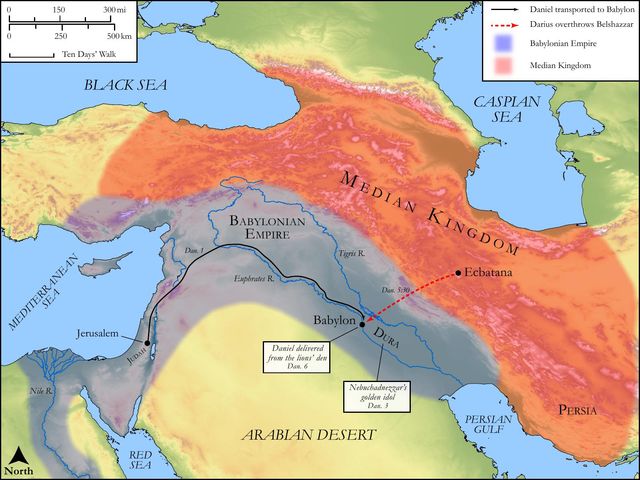
See on the biblical-era map
Study this verse
Public-domain commentary
Matthew Henry
From his Commentary on the Whole Bible. Henry comments on passages, not single verses — this entry covers Daniel 3:19–27. His three-level outline is real structure in the source text, so it is rendered as structure.
In these verses we have,
I.The casting of these three faithful servants of God into the fiery furnace.
Nebuchadnezzar had himself known and owned so much of the true God that, one would have thought, though his pride and vanity induced him to make this golden image, and set it up to be worshipped, yet what these young men now said (whom he had formerly found to be wiser than all his wise men) would revive his convictions, and at least engage him to excuse them; but it proved quite otherwise.
1.Instead of being convinced by what they said, he was exasperated, and made more outrageous, Dan 3:19. It made him full of fury, and the form of his visage was changed against these men. Note, Brutish passions the more they are indulged the more violent they grow, and even change the countenance, to the great reproach of the wisdom and reason of a man. Nebuchadnezzar, in this heat, exchanged the awful majesty of a prince upon his throne, or a judge upon the bench, for the frightful fury of a wild bull in a net. Would men in a passion but view their faces in a glass, they would blush at their own folly and turn all their displeasure against themselves.
2.Instead of mitigating their punishment, in consideration of their quality and the posts of honour they were in, he ordered it to be heightened, that they should heat the furnace seven times more than it was wont to be heated for other malefactors, that is, that they should put seven times more fuel to it, which, though it would not make their death more grievous, but rather dispatch them sooner, was designed to signify that the king looked upon their crime as seven times more heinous than the crimes of others, and so made their death more ignominious. But God brought glory to himself out of this foolish instance of the tyrant's rage; for, though it would not have made their death the more grievous, yet it did make their deliverance much the more illustrious.
3.He ordered them to be bound in their clothes, and cast into the midst of the burning fiery furnace, which was done accordingly, Dan 3:20, Dan 3:21. They were bound, that they might not struggle, or make any resistance, were bound in their clothes, for haste, or that they might be consumed the more slowly and gradually. But God's providence ordered it for the increase of the miracle, in that their clothes were not so much as singed. They were bound in their coats or mantles, their hosen or breeches, and their hats or turbans, as if, in detestation of their crime, they would have their clothes to be burnt with them. What a terrible death was this - to be cast bound into the midst of a burning fiery furnace! Dan 3:23. It makes one's flesh tremble to think of it, and horror to take hold on one. It is amazing that the tyrant was so hard-hearted as to inflict such a punishment, and that the confessors were so stout-hearted as to submit to it rather than sin against God. But what is this to the second death, to that furnace into which the tares shall be cast in bundles, to that lake which burns eternally with fire and brimstone? Let Nebuchadnezzar heat his furnace as hot as he can, a few minutes will finish the torment of those who are cast into it; but hell-fire tortures and does not kill. The pain of damned sinners is more exquisite, and the smoke of their torment ascends for ever and ever, and those have no rest, no intermission, no cessation of their pains, who have worshipped the beast and his image (Rev 14:10, Rev 14:11), whereas their pain would be soon over that were cast into this furnace for not worshipping this Babylonian beast and his image.
4.It was a remarkable providence that the men, the mighty men, that bound them, and threw them into the furnace, were themselves consumed or suffocated by the flame, Dan 3:22. The king's commandment was urgent, that they should dispatch them quickly, and be sure to do it effectually; and therefore they resolved to go to the very mouth of the furnace, that they might throw them into the midst of it, but they were in such haste that they would not take time to arm themselves accordingly. The apocryphal additions to Daniel say that the flame ascended forty-nine cubits above the mouth of the furnace. Probably God ordered it so that the wind blew it directly upon them with such violence that it smothered them. God did thus immediately plead the cause of his injured servants, and take vengeance for them on their persecutors, whom he punished, not only in the very act of their sin, but by it. But these men were only the instruments of cruelty; he that bade them do it had the greater sin; yet they suffered justly for executing an unjust decree, and it is very probable that they did it with pleasure and were glad to be so employed. Nebuchadnezzar himself was reserved for a further reckoning. There is a day coming when proud tyrants will be punished, not only for the cruelties they have been guilty of, but for employing those about them in their cruelties, and so exposing them to the judgments of God.
II.The deliverance of these three faithful servants of God out of the furnace.
When they were cast bound into the midst of that devouring fire we might well conclude that we should hear no more of them, that their very bones would be calcined; but, to our amazement, we here find that Shadrach, Meshach, and Abednego, are yet alive.
1.Nebuchadnezzar finds them walking in the fire. He was astonished, and rose up in haste, Dan 3:24. Perhaps the slaying of the men that executed his sentence was that which astonished him, as well it might, for he had reason to think his own turn would be next; or it was some unaccountable impression upon his own mind that astonished him, and made him rise up in haste, and go to the furnace, to see what had become of those he had cast into it. Note, God can strike those with astonishment whose hearts are most hardened both against him and against his people. He that made the soul can make his sword to approach to it, even to that of the greatest tyrant. In his astonishment he calls his counsellors about him, and appeals to them. Did we not cast three men bound into the fire? It seems, it was done by order, not only of the king, but of the council. They durst not but concur with him, which he forced them to do, that they might share with him in the guilt and odium? "True, O king!" say they; "we did order such an execution to be done and it was done." "But now," says the king, "I have been looking into the furnace, and I see four men, loose, walking in the midst of the fire," Dan 3:25.
(1.)They were loosed from their bonds. The fire that did not so much as singe their clothes burnt the cords wherewith they were bound, and set them at liberty; thus God's people have their hearts enlarged, through the grace of God, by those very troubles with which their enemies designed to straiten and hamper them.
(2.)They had no hurt, made no complaint, felt no pain or uneasiness in the least; the flame did not scorch them; the smoke did not stifle them; they were alive and as well as ever in the midst of the flames. See how God of nature can, when he pleases, control the powers of nature, to make them serve his purposes. Now was fulfilled in the letter gracious promise (Isa 43:2), When thou walkest through the fire thou shalt not be burnt, neither shall the flame kindle upon thee. By faith they quench the violence of the fire, quench the fiery darts of the wicked.
(3.)They walked in the midst of the fire. The furnace was large, so that they had room to walk; they were unhurt, so that they were able to walk; their minds were easy, so that they were disposed to walk, as in a paradise or garden of pleasure. Can a man walk upon hot coals and his feet not be burnt? Pro 6:28. Yes, they did it with as much pleasure as the king of Tyrus walked up and down in the midst of his stones of fire, his precious stones that sparkled as fire, Eze 28:14. They were not striving to get out, finding themselves unhurt; but, leaving it to that God who preserved them in the fire to bring them out of it, they walked up and down in the midst of it unconcerned. One of the apocryphal writings relates at large the prayer which Azariah, one of the three, prayed in the fire (wherein he laments the calamities and iniquities of Israel, and entreats God's favour to his people), and the song of praise which they all three sang in the midst of the flames, in both which there are remarkable strains of devotion; but we have reason to think, with Grotius, that they were composed by some Jew of a later age, not as what were used, but only as what might have been used, on this occasion, and therefore we justly reject them as no part of holy writ.
(4.)There was a fourth seen with them in the fire, whose form, in Nebuchadnezzar's judgment, was like the Son of God; he appeared as a divine person, a messenger from heaven, not as a servant, but as a son. Like an angel (so some); and angels are called sons of God, Job 38:7. In the apocryphal narrative of this story it is said, The angel of the Lord came down into the furnace; and Nebuchadnezzar here says (Dan 3:28), God sent his angel and delivered them; and it was an angel that shut the lions' mouths when Daniel was in the den, Dan 6:22. But some think it was the eternal Son of God, the angel of the covenant, and not a created angel. He appeared often in our nature before he assumed it in his incarnation, and never more seasonable, nor to give a more proper indication and presage of his great errand into the world in the fulness of time, than now, when, to deliver his chosen out of the fire, he came and walked with them in the fire. Note, Those that suffer for Christ have his gracious presence with them in their sufferings, even in the fiery furnace, even in the valley of the shadow of death, and therefore even there they need fear no evil. Hereby Christ showed that what is done against his people he takes as done against himself; whoever throws them into the furnace does, in effect, throw him in. I an Jesus, whom thou persecutest, Isa 63:9.
2.Nebuchadnezzar calls them out of the furnace (Dan 3:26): He comes near to the mouth of the burning fiery furnace, and bids them come forth and come hither. Come forth, come (so some read it); he speaks with a great deal of tenderness and concern, and stands ready to lend them his hand and help them out. He is convinced by their miraculous preservation that he did evil in casting them into the furnace; and therefore he does not thrust them out privily; no verily, but he will come himself and fetch them out, Act 16:37. Observe the respectful title that he gives them. When he was in the heat of his fury and rage against them it is probable that he called them rebels, and traitors, and all the ill names he could invent; but now he owns them for the servants of the most high God, a God who now appears able to deliver them out of his hand. Note, Sooner or later, God will convince the proudest of men that he is the most high God, and above them, and too hard for them, even in those things wherein they deal proudly and presumptuously, Exo 18:11. He will likewise let them know are who his servants, and that he owns them and will stand by them. Elijah prayed (Kg1 18:36), Let it be known that thou art God and that I am thy servant. Nebuchadnezzar now embraces those whom he had abandoned, and is very officious about them, now that he perceives them to be the favourites of Heaven. Note, What persecutors have done against God's servants, when God opens their eyes, they must as far as they can undo again. How the fourth, whose form was like the Son of God, withdrew, and whether he vanished away or visibly ascended, we are not told, but of the other three we are informed,
(1.)That they came forth out of the midst of the fire, as Abraham their father out of Ur (that is, the fire) of the Chaldees, into which, says this tradition of the Jews, he was cast, for refusing to worship idols, and out of which he was delivered, as those his three children were. When they had their discharge they did not tempt God by staying in any longer, but came forth as brands out of the burning.
(2.)That it was made to appear, to the full satisfaction of all the amazed spectators, that they had not received the least damage by the fire, Dan 3:27. All the great men came together to view them, and found that there was not so much as a hair of their head singed. Here that was true in the letter which our Saviour spoke figuratively, for an assurance to his suffering servants that they should sustain no real damage (Luk 21:18), There shall not a hair of your head perish. Their clothes did not so much as change colour, nor smell of fire, much less were their bodies in the least scorched or blistered; no, the fire had no power on them. The Chaldeans worshipped the fire, as a sort of image of the sun, so that, in restraining the fire now, God put contempt, not only upon their king, but upon their god too, and showed that his voice divides the flames of fire as well as the floods of water (Psa 29:7), when he pleases to make a way for his people through the midst of it. It is our God only that is the consuming fire (Heb 12:29); other fire, if he but speak the word, shall not consume.
Historical interpretation
Six Centuries of Reception
3 surviving comments on this verse. Each one is dated, so this reads as a timeline rather than a list.
Select a marker to jump to its quote. Markers stagger vertically where authors wrote within a few decades of each other.
"And the flame streamed forth." The fire, he means, was driven from within by the angel, and burst forth outwardly. See how even the fire appears intelligent, as if it recognised and punished the guilty. For it did not touch the servants of God, but it consumed the unbelieving and impious Chaldeans. Those who were within were besprinkled with a (cooling) dew by the angel, while those who thought they stood in safety outside the furnace were destroyed by the fire. The men who cast in the youths were burned by the flame, which caught them on all sides, as I suppose, when they went to bind the youths.
Verse 22. "Then those same men who had cast Shadrach, Meshach, and Abednego were slain by the fiery flame." Of course this meant the same men of whom it was said above, "And he commanded the strongest men in his army to bind the legs of Shadrach, Meshach and Abednego and cast them into the burning furnace of fire (another reading: into the furnace of flaming fire)." And so they were not any chance servants of his whom Nebuchadnezzar destroyed, but men who of all his army were strong and most ready for war. Not only was it intended that the miracle should strike terror but also that his own army might experience injury.
The flames killed because the slanderers, being carried away by their joy, approached the furnace to observe the burning of their [victims], but through divine intervention they were consumed by the heat of the furnace. So also, in order that the king and the Babylonians might not think that because of a hallucination or illusion those youths made the fire harmless, God caused many of those who had gathered around the furnace to be consumed while the youths felt just like the king in his bedroom.
Continue studying Daniel 3:22 across the web’s major study libraries — every link below opens this exact verse, chapter, or book on the destination site.
Read & Compare
 BibleGatewayThis verse in more than 200 translations and 70 languages.
 Bible.comThe YouVersion reader — hundreds of translations, reading plans, and highlights.
 ESV.orgCrossway's official English Standard Version reader.
 NET BibleThe NET translation with 60,000+ translators' notes on every rendering decision.
 STEP BibleTyndale House's free study tool — original text, vocabulary, and scholarly resources.
 BibliaLogos Bible Software's free web reader.
 USCCBThe New American Bible (Revised Edition) with the U.S. bishops' study notes.
Commentaries
 BibleHub CommentariesDozens of classic commentaries on this verse, gathered on one page.
 StudyLightMore than 100 commentary sets — the largest collection on the web.
 BibleRefPlain-English commentary on what this verse means, verse by verse.
 Enduring WordDavid Guzik's free commentary on this chapter, widely used by Bible teachers.
 Bible Study ToolsVerse commentary alongside Greek and Hebrew study aids.
Original Language & Research
- BibleHub InterlinearThe verse word by word — original language, transliteration, and English.
- BibleHub LexiconEvery word's original-language definition and Strong's entry.
 Blue Letter BibleDeep-study tools — Strong's numbers, concordance, and word studies.
 SefariaThe Hebrew text with Rashi and centuries of Jewish commentary.
Sermons, Hymns & Audio


TrulyRandomVerse is not affiliated with these sites and doesn’t control their content. They’re linked because they’re genuinely useful.
Summary
Daniel 3:22 serves as a stark and pivotal moment, powerfully illustrating the immediate and extreme peril faced by Shadrach, Meshach, and Abednego. It vividly portrays the king's unyielding and urgent decree, coupled with the furnace's unprecedented and lethal intensity. The verse's chilling detail—that the very men tasked with casting the three Hebrews into the flames were themselves instantly consumed by the overwhelming heat—establishes the undeniable reality of the threat. This dramatic confirmation of the furnace's deadliness magnifies the divine intervention that follows, setting the stage for a profound demonstration of God's sovereign power to protect His faithful servants against seemingly insurmountable odds and the most severe human judgment.
Context
ShowHideLiterary Context
Daniel 3:22 is strategically placed at the zenith of King Nebuchadnezzar's escalating fury following Shadrach, Meshach, and Abednego's courageous refusal to worship his golden idol. The preceding verses Daniel 3:13-18 detail their unwavering faith and defiance, which ignites the king's "fury and rage" in Daniel 3:19, leading him to command the furnace to be heated "seven times more than it was wont to be heated." This verse, therefore, acts as a grim, immediate confirmation of that command's lethal execution, directly preceding the casting of the three men into the fire in Daniel 3:23. It masterfully heightens the dramatic tension and authenticates the unparalleled severity of the trial, making the subsequent, astonishing divine intervention described in Daniel 3:24-27 all the more profound and undeniable.
Historical & Cultural Context
The narrative unfolds within the historical framework of the Neo-Babylonian Empire, specifically during the formidable reign of Nebuchadnezzar II (c. 605-562 BC). This era was characterized by an absolute monarchy where the king's word was indisputable law, and any defiance was met with swift, brutal, and often public punishment to assert imperial authority. While execution by fiery furnace is not widely attested as a common Babylonian method, ancient Near Eastern parallels exist (e.g., Jeremiah 29:22 mentions two false prophets being "roasted in the fire by the king of Babylon"). The construction of a colossal golden idol, as detailed in Daniel 3:1, reflects the prevalent syncretistic religious practices and imperial cults common in ancient empires, where the worship of the state's gods or the emperor himself was often enforced as a means of consolidating political loyalty and asserting dominance over conquered peoples. The extreme heating of the furnace underscores the king's unbridled power, his vengeful temperament, and the cultural expectation of immediate, unquestioning obedience.
Key Themes
ShowHideThis verse serves as a crucial linchpin, powerfully contributing to several overarching themes within the book of Daniel and this specific chapter. Firstly, it profoundly emphasizes the theme of Divine Sovereignty and Miraculous Deliverance. By unequivocally establishing the undeniable deadliness of the threat, the text magnifies God's miraculous power to save His faithful servants from certain death, demonstrating His ability to transcend natural laws. Secondly, it starkly highlights the Cost of Unwavering Faithfulness. The extreme peril faced by those who chose obedience to God over compliance with an idolatrous imperial decree illustrates the profound sacrifices demanded by true faith, a theme consistently explored throughout Daniel, from Daniel's refusal to defile himself in Daniel 1:8 to his continued prayer in Daniel 6:10. Thirdly, it reinforces the Absolute Authority of the King, albeit an authority ultimately subordinate to God's. Nebuchadnezzar's urgent and lethal command demonstrates the immediate and fatal consequences of his wrath, setting a stark contrast with the later revelation of God's superior and ultimate power in Daniel 3:28.
Exposition and Analysis
ShowHideKey Word Analysis
ShowHideThis Aramaic word, derived from a root meaning "to shear or cut close," figuratively conveys severity, hastiness, and an unyielding nature. In the context of the king's commandment, it signifies that Nebuchadnezzar's decree was not merely important but intensely pressing, intolerant of any delay, hesitation, or negotiation. It reflects his absolute authority and furious impatience, ensuring immediate and forceful execution.
Corresponding to a word meaning "preeminent" or "surpassing," this Aramaic adverb functions as an intensifier, meaning "very" or "exceedingly." When applied to the furnace's heat, it indicates that the temperature was not merely hot but extraordinarily, dangerously, and unnaturally hot, far beyond its normal operational intensity. This hyperbolic description underscores the deliberate and extreme measures taken to ensure the certain death of the three men, making their subsequent survival all the more astonishing and miraculous.
This Aramaic verb directly translates to "to kill" or "to slay." Its unambiguous use here emphasizes the immediate, decisive, and fatal consequence of the furnace's immense heat. It leaves no doubt about the lethality of the environment, confirming that the men who merely approached it to carry out the king's order were instantly incinerated. This detail authenticates the severity of the trial and underscores the miraculous nature of the deliverance that is about to unfold.
Verse Breakdown
ShowHide"Therefore because the king's commandment was urgent"
This clause establishes the primary causal factor for the tragic event that immediately follows. The "king's commandment" refers to Nebuchadnezzar's furious decree to cast Shadrach, Meshach, and Abednego into the fiery furnace. The term "urgent" highlights the king's unyielding will and the absolute, non-negotiable nature of his order, leaving no room for delay, reconsideration, or mercy. This urgency underscores the perilous situation and the immediate, undeniable danger faced by all involved in executing the command.
"and the furnace exceeding hot"
This clause provides the second, equally critical causal factor, detailing the extreme condition of the instrument of judgment. It describes the furnace's temperature, which had been heated "seven times more than it was wont to be heated" as commanded in Daniel 3:19. The phrase "exceeding hot" emphasizes the extraordinary and lethal intensity of the heat, making it a truly inescapable and instantly fatal environment for anyone exposed to it. This detail is crucial for magnifying the subsequent miracle.
"the flame of the fire slew those men that took up Shadrach, Meshach, and Abednego"
This final clause details the immediate and fatal consequence of the combined factors: the urgent command and the superheated furnace. The "flame of the fire" is depicted as an active, consuming agent, instantly killing the "men that took up" the three Hebrews. These individuals were presumably the strongest, most capable soldiers or officials, specifically chosen for their ability to carry out such a dangerous task. Their instantaneous death serves as irrefutable proof of the furnace's unparalleled heat and the absolute certainty of death for anyone exposed to it, thereby setting a stark and dramatic contrast with the miraculous preservation of Shadrach, Meshach, and Abednego.
Literary Devices
ShowHideDaniel 3:22 employs several powerful literary devices to heighten the drama, underscore the severity of the threat, and emphasize the miraculous nature of the subsequent divine intervention. Hyperbole is prominently used in the description of the furnace as "exceeding hot," building upon the earlier command in Daniel 3:19 to heat it "seven times more than it was wont to be heated." This exaggerated description serves to emphasize the extreme, unnatural temperature and the undeniable lethality of the environment, leaving no doubt about the certainty of death for anyone entering it. Irony is powerfully present in the fact that the very agents of the king's wrath—the strong, chosen men tasked with enforcing his decree—become its first, immediate victims. Their demise serves as a grim and undeniable testament to the furnace's consuming power, inadvertently magnifying the divine protection that will soon be revealed for the three Hebrews. Finally, the verse utilizes Foreshadowing by firmly establishing the absolute certainty of death for anyone entering the furnace, thereby setting up the miraculous and utterly unexpected survival of Shadrach, Meshach, and Abednego as a clear and unambiguous act of divine intervention, rather than a mere coincidence or a less-than-lethal threat.
Theological and Thematic Connections
ShowHideDaniel 3:22 serves as a critical theological anchor, firmly establishing the unparalleled severity of the trial faced by Shadrach, Meshach, and Abednego. By detailing the immediate and fatal consequences for the strong men who merely approached the furnace, the text eliminates any doubt about the furnace's lethality and the certainty of death for those cast into it. This ensures that the subsequent preservation of the three Hebrews is understood as nothing less than a profound and undeniable act of divine intervention, a clear demonstration of God's miraculous power to transcend natural laws and protect His faithful. It powerfully underscores the theme that true faith often calls for radical obedience in the face of overwhelming opposition, trusting implicitly in God's ultimate ability to deliver, even when human logic dictates otherwise. The verse highlights the stark contrast between the finite, albeit immense, power of human rulers and the infinite, omnipotent power of the Most High God, setting the stage for Nebuchadnezzar's eventual recognition and praise of the God of Shadrach, Meshach, and Abednego.
Reflection and Application
ShowHideDaniel 3:22 offers profound and enduring insights for contemporary believers, reminding us that unwavering faithfulness to God can indeed lead to perilous and seemingly insurmountable situations, yet God's power remains eternally supreme. The immediate and fatal consequence for the furnace attendants underscores that the threat was not trivial or symbolic; it was genuinely life-ending, a testament to the absolute power of the king's wrath. This undeniable reality of the danger magnifies the miracle that follows and strengthens our conviction that God's deliverance is real, supernatural, and often beyond human comprehension. In our own lives, we may face "fiery furnaces" – intense pressures, overwhelming challenges, situations where our integrity is tested, or circumstances that threaten our well-being or faith. This verse encourages us to stand firm in our convictions, knowing that even when circumstances seem utterly hopeless and human efforts fail, God is capable of intervening in ways that defy logic, natural law, and human expectation. It calls us to trust in His sovereignty and His presence, even when the path of obedience seems to lead directly into the flames, confident that He is with us in the midst of the fire, just as He was with Shadrach, Meshach, and Abednego.
Questions for Reflection
ShowHideFAQ
ShowHideWhy was the furnace heated "exceeding hot," and what does the death of the men who threw them in signify?
ShowHideThe furnace was commanded to be heated "seven times more than it was wont to be heated" (Daniel 3:19) due to King Nebuchadnezzar's intense rage and his desire for an immediate, undeniable, and utterly devastating execution. The phrase "exceeding hot" in Daniel 3:22 emphasizes this extreme, unnatural temperature. The instantaneous death of the strong men who took up Shadrach, Meshach, and Abednego and merely approached the furnace is profoundly significant. It serves as irrefutable proof of the furnace's lethal intensity, eliminating any possibility that the three Hebrews' survival was due to a less-than-hot fire or a mere coincidence. This chilling detail authenticates the severity of the threat and, by extension, magnificently elevates the miraculous nature of God's subsequent deliverance, demonstrating that their survival was a direct, supernatural act of divine power, not a natural outcome.
Christ-Centered Fulfillment
ShowHideWhile Daniel 3:22 describes a physical deliverance from literal fire, it powerfully foreshadows the ultimate spiritual deliverance offered through Jesus Christ. The immediate and consuming death of the men who merely approached the furnace highlights the absolute deadliness of sin and divine judgment, a spiritual "fiery furnace" from which no human effort, strength, or righteousness can save. Just as God miraculously preserved Shadrach, Meshach, and Abednego in the midst of literal flames, so too does Christ offer salvation from the consuming fire of God's righteous wrath against sin. He is the one who willingly entered the ultimate "furnace" of suffering and death on the cross, not to be consumed by sin's power, but to conquer it entirely, as prophetically declared in Isaiah 53:5. Through His glorious resurrection, Jesus emerged victorious over death and hell, offering eternal life and spiritual preservation to all who believe. The mysterious "fourth man" in the furnace, often understood as a pre-incarnate appearance of Christ (Daniel 3:25), powerfully symbolizes His constant, intimate presence with His people in their deepest trials and His ultimate power to deliver them from all forms of judgment. Believers are now eternally "in Christ" (2 Corinthians 5:17), protected from the consuming fire of sin's penalty, not by their own strength or merit, but by His perfect sacrifice and enduring presence, fulfilling the ancient promise that those who walk through fire "shall not be burned" (Isaiah 43:2).