


Daniel 6:6
Bible text: King James Version (1769 Blayney text) · Public domain
Bible text: Berean Standard Bible · Public domain
Bible text: American Standard Version (1901) · Public domain
Bible text: World English Bible, Messianic edition · Public domain
Bible text: Geneva Bible (1599) · Public domain
Bible text: Young's Literal Translation · Public domain
- אֱדַיִן'E·da·yinthenH116AdvAdverb
- סָרְכַיָּאsa·re·khai·Ya'overseers theH5632N-mp ¦ ArtNoun Plural Masculine Definiteסָרְכַיָּoverseersאthe
- וַאֲחַשְׁדַּרְפְּנַיָּאva·'a·chash·dar·pe·nai·Ya'and satraps theH324Conj-w ¦ N-mp ¦ ArtNoun Plural Masculine Definiteוַandאֲחַשְׁדַּרְפְּנַיָּsatrapsאthe
- אִלֵּן'i·LentheseH459PrtParticle Demonstrative
- הַרְגִּשׁוּhar·Gi·shuthey came as a crowdH7284V-Haphel-Perf-3mpVerb Haphel Perfect 3rd Plural Masculine
- עַל'altoH5922PrepPreposition
- מַלְכָּאmal·Ka'king theH4430N-cs ¦ ArtNoun Singular common gender Definiteמַלְכָּkingאthe
- וְכֵןve·Khenand as followsH3652Conj-w ¦ AdvAdverbוְandכֵןas follows
- אָמְרִין'a·me·Rin[they were] sayingH560V-Peal-Prtcpl-mpVerb Peal Participle Plural Masculine Absolute
- לֵהּLehto himPrep-l ¦ 3msSuffix Personal 3rd Singular Masculineלֵtoהּhim
- דָּרְיָוֶשׁda·re·Ya·veshO DariusH1868N-proper-mNoun Proper Masculine
- מַלְכָּאmal·Ka'king theH4430N-cs ¦ ArtNoun Singular common gender Definiteמַלְכָּkingאthe
- לְעָלְמִיןle·'al·Minfor everH5957Prep-l ¦ N-mpNoun Plural Masculine Absoluteלְforעָלְמִיןever
- חֱיִיche·Yilive!H2418V-Peal-Imp-2msVerb Peal Imperative 2nd Singular Masculine
English is a literal word-by-word gloss of the Hebrew, not the KJV's wording. Why?
This is the original text the KJV's translators worked from — each Hebrew word with its own literal English meaning in this verse, prepared by scholars at Tyndale House, Cambridge. The KJV translates whole sentences, not word by word, so its wording differs: one Hebrew word can become several English words, and the KJV may choose “the LORD” where the gloss reads “Yahweh”. Both are faithful — they answer different questions. For the KJV's own rendering, switch to the KJV text.
Details
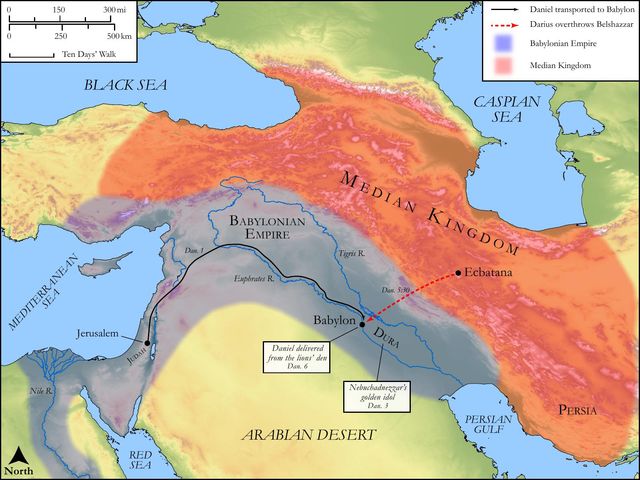
See on the biblical-era map
Study this verse
Public-domain commentary
Matthew Henry
From his Commentary on the Whole Bible. Henry comments on passages, not single verses — this entry covers Daniel 6:6–10. His three-level outline is real structure in the source text, so it is rendered as structure.
Daniel's adversaries could have no advantage against him from any law now in being; they therefore contrive a new law, by which they hope to ensnare him, and in a matter in which they knew they should be sure of him; and such was his fidelity to his God that they gained their point. Here is,
I.Darius's impious law.
I call it Darius's, because he gave the royal assent to it, and otherwise it would not have been of force; but it was not properly his: he contrived it not, and was perfectly wheedled to consent to it. The presidents and princes framed the edict, brought in the bill, and by their management it was agreed to by the convention of the states, who perhaps were met at this time upon some public occasion. It is pretended that this bill which they would have to pass into a law was the result of mature deliberation, that all the presidents of the kingdom, the governors, princes, counsellors, and captains, had consulted together about it, and that they not only agreed to it, but advised it, for divers good causes and considerations, that they had done what they could to establish it for a firm decree; nay, they intimate to the king that it was carried nemine contradicente - unanimously: "All the presidents are of this mind;" and yet we are sure that Daniel, the chief of the three presidents, did not agree to it, and have reason to think that many more of the princes excepted against it as absurd and unreasonable. Note, It is no new thing for that to be represented, and with great assurance too, as the sense of the nation, which is far from being so; and that which few approve of is sometimes confidently said to be that which all agree to. But, O the infelicity of kings, who, being under a necessity of seeing and hearing with other people's eyes and ears, are often wretchedly imposed upon! These designing men, under colour of doing honour to the king, but really intending the ruin of his favourite, press him to pass this into a law, and make it a royal statute, that whosoever shall ask a petition of any god or man for thirty days, save of the king, shall be put to death after the most barbarous manner, shall be cast into the den of lions, Dan 6:7. This is the bill they have been hatching, and they lay it before the king to be signed and passed into a law. Now,
1.There is nothing in it that has the least appearance of good, but that it magnifies the king, and makes him seem both very great and very kind to his subjects, which, they suggest, will be of good service to him now that he has newly come to his throne, and will confirm his interests. All men must be made to believe that the king is so rich, and withal so ready to all petitioners, that none in any want or distress need to apply either to God or man for relief, but to him only. And for thirty days together he will be ready to give audience to all that have any petition to present to him. It is indeed much for the honour of kings to be benefactors to their subjects and to have their ears open to their complaints and requests; but if they pretend to be their sole benefactors, and undertake to be to them instead of God, and challenge that respect from them which is due to God only, it is their disgrace, and not their honour. But,
2.There is a great deal in it that is apparently evil. It is bad enough to forbid asking a petition of any man. Must not a beggar ask an alms, or one neighbour beg a kindness of another? If the child want bread, must he not ask it of his parents, or be cast into the den of lions if he do? Nay, those that have business with the king, may they not petition those about him to introduce them? But it was much worse, and an impudent affront to all religion, to forbid asking a petition of any god. It is by prayer that we give glory to God, fetch in mercy from God; and so keep up our communion with God; and to interdict prayer for thirty days is for so long to rob God of all the tribute he has from man and to rob man of all the comfort he has in God. When the light of nature teaches us that the providence of God has the ordering and disposing of all our affairs does not the law of nature oblige us by prayer to acknowledge God and seek to him? Does not every man's heart direct him, when he is in want or distress, to call upon God, and must this be made high treason? We could not live a day without God; and can men live thirty days without prayer? Will the king himself be tied up for so long from praying to God; or, if it be allowed him, will he undertake to do it for all his subjects? Did ever any nation thus slight their gods? But see what absurdities malice will drive men to. Rather than not bring Daniel into trouble for praying to his God, they will deny themselves and all their friends the satisfaction of praying to theirs. Had they proposed only to prohibit the Jews from praying to their God, Daniel would have been as effectually ensnared; but they knew the king would not pass such a law, and therefore made it thus general. And the king, puffed up with a fancy that this would set him up as a little god, was fond of the feather in his cap (for so it was, and not a flower in his crown) and signed the writing and the decree (Dan 6:9), which, being once done, according to the constitution of the united kingdom of the Medes and Persians, was not upon any pretence whatsoever to be altered or dispensed with, or the breach of it pardoned.
II.Daniel's pious disobedience to this law, Dan 6:10.
He did not retire into the country, nor abscond for some time, though he knew the law was levelled against him; but, because he knew it was so, therefore he stood his ground, knowing that he had now a fair opportunity of honouring God before men, and showing that he preferred his favour, and his duty to him, before life itself. When Daniel knew that the writing was signed he might have gone to the king, and expostulated with him about it; nay, he might have remonstrated against it, as grounded upon a misinformation that all the presidents had consented to it, whereas he that was chief of them had never been consulted about it; but he went to his house, and applied himself to his duty, cheerfully trusting God with the event. Now observe,
1.Daniel's constant practice, which we were not informed of before this occasion, but which we have reason to think was the general practice of the pious Jews.
(1.)He prayed in his house, sometimes alone and sometimes with his family about him, and made a solemn business of it. Cornelius was a man that prayed in his house, Act 10:30. Note, Every house not only may be, but ought to be, a house of prayer; where we have a tent God must have an alter, and on it we must offer spiritual sacrifices.
(2.)In every prayer he gave thanks. When we pray to God for the mercies we want we must praise him for those we have received. Thanksgiving must be a part of every prayer.
(3.)In his prayer and thanksgiving he had an eye to God as his God, his in covenant, and set himself as in his presence. He did this before his God, and with a regard to him.
(4.)When he prayed and gave thanks he kneeled upon his knees, which is the most proper gesture in prayer, and most expressive of humility, and reverence, and submission to God. Kneeling is a begging posture, and we come to God as beggars, beggars for our lives, whom it concerns to be importunate.
(5.)He opened the windows of his chamber, that the sight of the visible heavens might affect his heart with an awe of that God who dwells above the heavens; but that was not all: he opened them towards Jerusalem, the holy city, though now in ruins, to signify the affection he had for its very stones and dust (Psa 102:14) and the remembrance he had of its concerns daily in his prayers. Thus, though he himself lived great in Babylon, yet he testified his concurrence with the meanest of his brethren the captives, in remembering Jerusalem and preferring it before his chief joy, Psa 137:5, Psa 137:6. Jerusalem was the place which God had chosen to put his name there; and, when the temple was dedicated, Solomon's prayer to God was that if his people should in the land of their enemies pray unto him with their eye towards the land which he gave them, and the city he had chosen, and the house which was built to his name, then he would hear and maintain their cause (Kg1 8:48, Kg1 8:49), to which prayer Daniel had reference in this circumstance of his devotions.
(6.)He did this three times a day, three times every day according to the example of David (Psa 55:17), Morning, evening, and at noon, I will pray. It is good to have our hours of prayer, not to bind, but to remind conscience; and, if we think our bodies require refreshment by food thrice a day, can we think seldomer will serve our souls? This is surely as little as may be to answer the command of praying always.
(7.)He did this so openly and avowedly that all who knew him knew it to be his practice; and he thus showed it, not because he was proud of it (in the place where he was there was no room for that temptation, for it was not reputation, but reproach, that attended it), but because he was not ashamed of it. Though Daniel was a great man, he did not think it below him to be thrice a day upon his knees before his Maker and to be his own chaplain; though he was an old man, he did not think himself past it; nor, though it had been his practice from his youth up, was he weary of this well doing. Though he was a man of business, vast business, for the service of the public, he did not think that would excuse him from the daily exercises of devotion. How inexcusable then are those who have but little to do in the world, and yet will not do thus much for God and their souls! Daniel was a man famous for prayer, and for success in it (Eze 14:14), and he came to be so by thus making a conscience of prayer and making a business of it daily; and in thus doing God blessed him wonderfully.
2.Daniel's constant adherence to this practice, even when it was made by the law a capital crime. When he knew that the writing was signed he continued to do as he did aforetime, and altered not one circumstance of the performance. Many a man, yea, and many a good man, would have thought it prudence to omit it for these thirty days, when he could not do it without hazard of his life; he might have prayed so much oftener when those days had expired and the danger was over, or he might have performed the duty at another time, and in another place, so secretly that it should not be possible for his enemies to discover it; and so he might both satisfy his conscience and keep up his communion with God, and yet avoid the law, and continue in his usefulness. But, if he had done so, it would have been thought, both by his friends and by his enemies, that he had thrown up the duty for this time, through cowardice and base fear, which would have tended very much to the dishonour of God and the discouragement of his friends. Others who moved in a lower sphere might well enough act with caution; but Daniel, who had so many eyes upon him, must act with courage; and the rather because he knew that the law, when it was made, was particularly levelled against him. Note, We must not omit duty for fear of suffering, so, nor so much as seems to come short of it. In trying times great stress is laid upon our confessing Christ before men (Mat 10:32), and we must take heed lest, under pretence of discretion, we be found guilty of cowardice in the cause of God. If we do not think that this example of Daniel obliges us to do likewise, yet I am sure it forbids us to censure those that do, for God owned him in it. By his constancy to his duty it now appears that he had never been used to admit any excuse for the omission of it; for, if ever any excuse would serve to put it by, this would have served now,
(1.)That it was forbidden by the king his master, and in honour of the king too; but it is an undoubted maxim, in answer to that, We are to obey God rather than men.
(2.)That it would be the loss of his life, but it is an undoubted maxim, in answer to that, Those who throw away their souls (as those certainly do that live without prayer) to save their lives make but a bad bargain for themselves; and though herein they make themselves, like the king of Tyre, wiser than Daniel, at their end they will be fools.
Historical interpretation
Historical reception
1 surviving comment on this verse from the historical church.
Verse 6. "Then the princes and satraps privily withdrew to the king and thus spoke to him." It was well said that they privily withdrew for they did not come right out with what they were aiming at, but contrived their plot against a private enemy on the pretext of honoring the king.
Continue studying Daniel 6:6 across the web’s major study libraries — every link below opens this exact verse, chapter, or book on the destination site.
Read & Compare
 BibleGatewayThis verse in more than 200 translations and 70 languages.
 Bible.comThe YouVersion reader — hundreds of translations, reading plans, and highlights.
 ESV.orgCrossway's official English Standard Version reader.
 NET BibleThe NET translation with 60,000+ translators' notes on every rendering decision.
 STEP BibleTyndale House's free study tool — original text, vocabulary, and scholarly resources.
 BibliaLogos Bible Software's free web reader.
 USCCBThe New American Bible (Revised Edition) with the U.S. bishops' study notes.
Commentaries
 BibleHub CommentariesDozens of classic commentaries on this verse, gathered on one page.
 StudyLightMore than 100 commentary sets — the largest collection on the web.
 BibleRefPlain-English commentary on what this verse means, verse by verse.
 Enduring WordDavid Guzik's free commentary on this chapter, widely used by Bible teachers.
 Bible Study ToolsVerse commentary alongside Greek and Hebrew study aids.
Original Language & Research
- BibleHub InterlinearThe verse word by word — original language, transliteration, and English.
- BibleHub LexiconEvery word's original-language definition and Strong's entry.
 Blue Letter BibleDeep-study tools — Strong's numbers, concordance, and word studies.
 SefariaThe Hebrew text with Rashi and centuries of Jewish commentary.
Sermons, Hymns & Audio


TrulyRandomVerse is not affiliated with these sites and doesn’t control their content. They’re linked because they’re genuinely useful.
Summary
Daniel 6:6 captures a pivotal moment in the unfolding drama of Daniel's life, depicting the calculated approach of the envious Persian officials to King Darius. Having failed to find any legitimate fault with Daniel's conduct or administration, these high-ranking individuals meticulously assemble before the king. This verse initiates their manipulative scheme, as they begin their address with a seemingly respectful but deeply insincere salutation, designed to disarm the monarch and pave the way for their treacherous decree against Daniel, setting the stage for the dramatic events that follow.
Context
ShowHideLiterary Context
Daniel 6:6 is strategically positioned immediately following Daniel's remarkable elevation by King Darius, who, recognizing Daniel's "excellent spirit," intended to set him over the entire kingdom (Daniel 6:3). This unparalleled promotion ignited intense jealousy and resentment among the other satraps and presidents. The preceding verses, Daniel 6:4-5, meticulously detail their frustrated attempts to uncover any grounds for accusation against Daniel, whether in his administrative duties or personal integrity. Their utter failure to find corruption or negligence leads them to a sinister conclusion: the only way to ensnare Daniel is through his unwavering devotion to his God. Thus, Daniel 6:6 marks their direct, premeditated, and manipulative appeal to the king, forming the crucial first step in their carefully orchestrated conspiracy to exploit Daniel's piety and bring about his downfall.
Historical & Cultural Context
The narrative of Daniel is set against the backdrop of the Babylonian exile and the subsequent rise of the Persian Empire. King Darius, a figure likely representing Cyrus the Great or one of his early successors, presided over a vast and diverse empire that necessitated a complex administrative hierarchy, including "presidents" (satraps) and "princes" (governors). Such an expansive system was inherently susceptible to political intrigue, rivalries, and power struggles, particularly when a foreign official like Daniel ascended to such a prominent position. The traditional salutation, "King Darius, live for ever," was a common and deeply ingrained expression of respect and a wish for a long, prosperous reign addressed to monarchs, as when the Chaldeans spoke to Nebuchadnezzar, "O king, live for ever." However, in this specific context, it is imbued with a chillingly sinister undertone, as it serves as a deceptive prelude to a treacherous proposal, highlighting the cultural practice of employing elaborate courtesy as a sophisticated veneer for malicious intent.
Key Themes
ShowHideThis verse powerfully contributes to several overarching themes woven throughout the book of Daniel and the broader biblical narrative. Firstly, it vividly illustrates the theme of political conspiracy and envy, demonstrating how human ambition, jealousy, and a thirst for power can culminate in destructive plots against the righteous. The officials' assembly is a direct manifestation of their deep-seated malice, driven by their inability to tolerate Daniel's integrity and the king's favor, echoing the broader biblical theme of the wicked plotting against the righteous, as observed in passages like Psalm 37:12. Secondly, it masterfully introduces the theme of deceptive flattery, where outward displays of respect and honor cunningly mask malicious intent. The seemingly innocuous greeting, "King Darius, live for ever," functions as a manipulative tool to disarm the king and prepare him for their harmful proposition, a tactic widely warned against in wisdom literature such as Proverbs 29:5. Finally, it meticulously sets the stage for the overarching theme of unwavering faithfulness in the face of opposition, as Daniel's adversaries specifically target his religious devotion, keenly aware that his unshakeable commitment to God is the very attribute that will lead him directly into their meticulously crafted trap.
Exposition and Analysis
ShowHideKey Word Analysis
ShowHideThis term refers to high-ranking officials or emirs, indicating the chief administrators appointed by the king to oversee the various satrapies. Their collective assembly signifies a concerted effort by the most powerful figures in the kingdom, highlighting the formidable and unified opposition Daniel faced.
These were satraps or governors of major provinces, holding significant authority within the Persian administrative structure. Their inclusion alongside the "presidents" emphasizes the broad and unified nature of the conspiracy against Daniel, representing a powerful coalition of the kingdom's elite, all driven by a common malicious purpose.
This word implies a gathering that is tumultuous or agitated, suggesting a deliberate and perhaps urgent meeting with a specific, calculated purpose. It conveys the sense of a concerted, almost agitated, movement by the officials to confront the king and present their pre-meditated plan, underscoring the intensity of their resolve against Daniel.
Verse Breakdown
ShowHide"¶ Then these presidents and princes assembled together to the king,"
This opening clause precisely establishes the key actors and their decisive, coordinated action. The temporal adverb "Then" signals a direct consequence of their preceding, failed attempts to find fault with Daniel. The "presidents and princes," representing the highest echelons of the Persian administration, are united in their malevolent purpose. Their act of "assembling together" implies a deliberate, coordinated, and conspiratorial approach to the king, indicating the gravity and premeditated nature of their scheme against Daniel.
"and said thus unto him,"
This transitional phrase serves to set up the direct address to King Darius. It highlights the formality and calculated nature of their approach, yet the subsequent content immediately reveals the underlying deceit. The word "thus" anticipates the specific, carefully chosen words they are about to utter, which are meticulously designed to manipulate the king's perception and gain his immediate favor.
"King Darius, live for ever."
This is the traditional, deferential salutation to a monarch, expressing a wish for the king's long life and prosperous reign. However, in this specific context, it is profoundly laden with irony and hypocrisy. The officials, far from genuinely wishing Darius eternal well-being, are about to propose a decree that would profoundly undermine his own authority (by forcing him to condemn an innocent man) and ultimately lead to his later distress and anguish. This flattery is a meticulously calculated move to disarm the king and make him more receptive to their insidious and destructive plan.
Literary Devices
ShowHideDaniel 6:6 masterfully employs several significant literary devices to deepen its impact and convey its underlying tensions. The most prominent is Irony, particularly evident in the officials' opening salutation, "King Darius, live for ever." While a standard and respectful greeting, its use here is profoundly ironic given their malicious intent to manipulate the king into signing a decree that will cause him immense distress and potentially lead to the death of his favored servant, Daniel. Their words of blessing stand in stark contrast to their true, destructive motives. This verse also utilizes Foreshadowing, as the solemn and concerted assembly of these powerful figures, coupled with their calculated flattery, strongly hints at the grave danger Daniel is about to face. The reader is given a palpable sense of impending doom, understanding that such a unified effort by envious and corrupt officials can only lead to a significant and perilous challenge for the protagonist. Furthermore, there is an implicit Contrast drawn between the unwavering integrity and "excellent spirit" of Daniel, which was highlighted in the preceding verses, and the deceitful, conniving, and morally bankrupt nature of his adversaries. This stark moral contrast underscores the fundamental conflict between righteousness and wickedness that forms the central theme of the chapter's narrative.
Theological and Thematic Connections
ShowHideDaniel 6:6 serves as a stark and enduring reminder of the pervasive nature of envy, political intrigue, and human depravity in fallen human affairs, particularly when directed against those who walk in integrity and favor with God. The officials' calculated flattery and deceptive approach to King Darius expose the corrupting influence of jealousy, which blinds individuals to justice, distorts their moral compass, and drives them to malicious and destructive ends. Theologically, this verse highlights the constant spiritual warfare faced by the righteous, where opposition often arises not from direct wrongdoing on their part, but from the very uprightness and moral excellence that challenges the corrupt status quo. This verse meticulously sets the stage for Daniel's unwavering faithfulness and God's ultimate vindication, demonstrating that even the most elaborate and cunning human schemes cannot thwart God's sovereign purposes for His faithful servants. It underscores the profound biblical truth that human power, when unchecked by divine principles and moral integrity, often devolves into manipulation, injustice, and tyranny.
Reflection and Application
ShowHideDaniel 6:6 offers profound and timeless insights into the complexities of human nature and the enduring challenges of living faithfully in a fallen world. It compels us to cultivate acute discernment, recognizing that outward displays of respect, politeness, or flattery can often mask ulterior and even sinister motives, especially when they precede requests that seem to target others or compromise fundamental principles. The passage serves as a powerful and sobering warning against the destructive power of envy, illustrating how this corrosive emotion can corrupt hearts, blind judgment, and lead to elaborate, harmful conspiracies. For believers, Daniel's precarious situation, even before the decree is made, is a poignant call to steadfastness and unwavering commitment. It reminds us that integrity and an "excellent spirit" can indeed provoke opposition from those who resent righteousness, but our ultimate allegiance must remain with God, regardless of the political, social, or professional pressures we face. We are encouraged to stand firm in our convictions, trusting that God will ultimately vindicate His righteous ones, even when facing sophisticated schemes designed to undermine our faith or character.
Questions for Reflection
ShowHideFAQ
ShowHideWhy did the officials use flattery like "King Darius, live for ever" if they intended to harm Daniel?
ShowHideThe officials employed this traditional and highly respectful salutation as a calculated manipulative tactic. Among the nations, such elaborate greetings were a common and expected formality when addressing royalty. By beginning their address with this seemingly benevolent wish, they aimed to disarm King Darius, gain his immediate favor, and create an atmosphere of trust and receptiveness before presenting their true, malicious agenda. It was a strategic move to soften him up and make him more amenable to their deceptive proposal, which would ultimately lead to Daniel's peril. This is a classic example of using outward politeness and culturally appropriate forms of address to mask insidious and destructive intent, a theme found throughout biblical wisdom literature, such as Proverbs 29:5.
Christ-Centered Fulfillment
ShowHideThe political conspiracy and malicious flattery directed at King Darius in Daniel 6:6, meticulously designed to entrap the righteous Daniel, powerfully prefigure the profound opposition faced by Jesus Christ during His earthly ministry. Just as Daniel's enemies sought to exploit his unwavering devotion to God, so too did the religious and political leaders of Jesus' day conspire against Him, driven by profound envy and a desperate desire to maintain their own power and status (Matthew 27:18). They often approached Him with seemingly respectful questions or feigned deference, such as when they asked about paying taxes to Caesar, hoping to trap Him in His words and find a basis for accusation (Matthew 22:15-18). Like Daniel, Jesus was found to be utterly without fault or blemish by even His accusers, yet He faced an elaborate, unjust trial orchestrated by those who envied His light, truth, and divine authority. Ultimately, Daniel's miraculous deliverance from the lions' den serves as a profound foreshadowing of Christ's ultimate triumph over death, sin, and the powers of darkness through His resurrection. It demonstrates that even the most cunning and powerful human schemes cannot thwart God's sovereign and redemptive plan for His beloved Son, who, through His perfect obedience even unto death, secured eternal salvation and deliverance for all who believe (Philippians 2:8).