


Daniel 2:4
Bible text: King James Version (1769 Blayney text) · Public domain
Bible text: Berean Standard Bible · Public domain
Bible text: American Standard Version (1901) · Public domain
Bible text: World English Bible, Messianic edition · Public domain
Bible text: Geneva Bible (1599) · Public domain
Bible text: Young's Literal Translation · Public domain
- וַיְדַבְּרוּvay·da·be·Ruand they spokeH1696Conj-w ¦ V-Piel-ConsecImperf-3mpVerb Piel Consecutive Imperfect 3rd Plural Masculineוַandיְדַבְּרוּthey spoke
- הַכַּשְׂדִּיםha·kas·Dimthe ChaldeansH3778Art ¦ N-mpNoun Gentilic Plural Masculine AbsoluteהַtheכַּשְׂדִּיםChaldeans
- לַמֶּלֶךְla·Me·lekhto the kingH4428Prep-l ¦ N-msNoun Singular Masculine Absoluteלַto theמֶּלֶךְking
- אֲרָמִית'a·ra·MitAramaicH762Adj-fscAdjective Singular Feminine Construct
- מַלְכָּאmal·Ka'king OH4430N-cs ¦ ArtNoun Singular common gender DefiniteמַלְכָּkingאO
- לְעָלְמִיןle·'al·Minfor everH5957Prep-l ¦ N-mpNoun Plural Masculine Absoluteלְforעָלְמִיןever
- חֱיִיche·Yilive!H2418V-Peal-Imp-2msVerb Peal Imperative 2nd Singular Masculine
- אֱמַר'e·Martell!H560V-Peal-Imp-2msVerb Peal Imperative 2nd Singular Masculine
- חֶלְמָאchel·Ma'dream theH2493N-cs ¦ ArtNoun Singular common gender Definiteחֶלְמָdreamאthe
- לְעַבְדָךְle·'av·da·yikhto your servantH5649Prep-l ¦ N-csc ¦ 2msNoun Singular common gender Constructלְtoעַבְדָservantךְyour
- וּפִשְׁרָאu·fish·Ra'and interpretation theH6591Conj-w ¦ N-cs ¦ ArtNoun Singular common gender Definiteוּandפִשְׁרָinterpretationאthe
- נְחַוֵּאne·cha·Ve'we will declareH2324V-Pael-Imperf-1cpVerb Pael Imperfect 1st Plural common gender
English is a literal word-by-word gloss of the Hebrew, not the KJV's wording. Why?
This is the original text the KJV's translators worked from — each Hebrew word with its own literal English meaning in this verse, prepared by scholars at Tyndale House, Cambridge. The KJV translates whole sentences, not word by word, so its wording differs: one Hebrew word can become several English words, and the KJV may choose “the LORD” where the gloss reads “Yahweh”. Both are faithful — they answer different questions. For the KJV's own rendering, switch to the KJV text.
Details
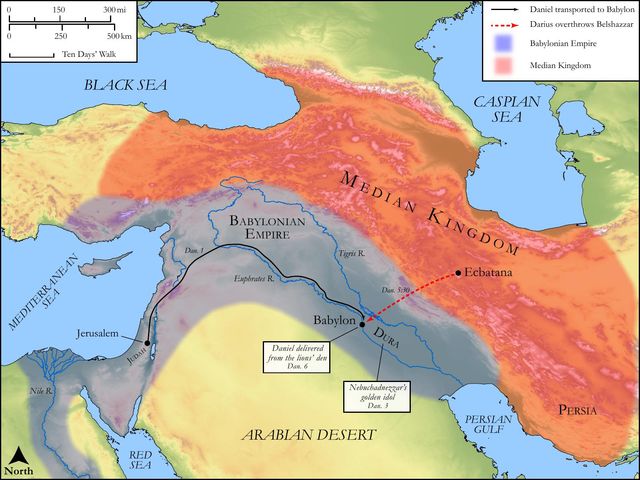
See on the biblical-era map
Study this verse
Public-domain commentary
Matthew Henry
From his Commentary on the Whole Bible. Henry comments on passages, not single verses — this entry covers Daniel 2:1–13. His two-level outline is real structure in the source text, so it is rendered as structure.
We meet with a great difficulty in the date of this story; it is said to be in the second year of the reign of Nebuchadnezzar, Dan 2:1. Now Daniel was carried to Babylon in his first year, and, it should seem, he was three years under tutors and governors before he was presented to the king, Dan 1:5. How then could this happen in the second year? Perhaps, though three years were appointed for the education of other children, yet Daniel was so forward that he was taken into business when he had been but one year at school, and so in the second year he became thus considerable. Some make it to be the second year after he began to reign alone, but the fifth or sixth year since he began to reign in partnership with his father. Some read it, and in the second year, (the second after Daniel and his fellows stood before the king), in the kingdom of Nebuchadnezzar, or in his reign, this happened; as Joseph, in the second year after his skill in dreams, showed and expounded Pharaoh's, so Daniel, in the second year after he commenced master in that art, did this service. I would much rather take it some of these ways than suppose, as some do, that it was in the second year after he had conquered Egypt, which was the thirty-sixth year of his reign, because it appears by what we meet with in Ezekiel, that Daniel was famous both for wisdom and prevalence in prayer long before that; and therefore this passage, or story, which shows how he came to be so eminent for both these must be laid early in Nebuchadnezzar's reign. Now here we may observe,
I.The perplexity that Nebuchadnezzar was in by reason of a dream which he had dreamed but had forgotten (Dan 2:1):
He dreamed dreams, that is, a dream consisting of divers distinct parts, or which filled his head as much as if it had been many dreams. Solomon speaks of a multitude of dreams, strangely incoherent, in which there are divers vanities, Ecc 5:7. This dream of Nebuchadnezzar's had nothing in the thing itself but what might be paralleled in many a common dream, in which are often represented to men things as foreign as are here mentioned; but there was something in the impression it made upon him which carried with it an incontestable evidence of its divine original and its prophetic significancy. Note, The greatest of men are not exempt from, nay, they lie most open to, those cares and troubles of mind which disturb their repose in the night, while the sleep of the labouring man is sweet and sound, and the sleep of the sober temperate man free from confused dreams. The abundance of the rich will not suffer them to sleep at all for care, and the excesses of gluttons and drunkards will not suffer them to sleep quietly for dreaming. But this recorded here was not from natural causes. Nebuchadnezzar was a troubler of God's Israel, but God here troubled him; for he that made the soul can make his sword to approach to it. He had his guards about him, but they could not keep trouble from his spirit. We know not the uneasiness of many that live in great pomp, and, one would think, in pleasure, too. We look into their houses, and are tempted to envy them; but, could we look into their hearts, we should pity them rather. All the treasures and all the delights of the children of men, which this mighty monarch had command of, could not procure him a little repose, when by reason of the trouble of his mind his sleep broke from him. But God gives his beloved sleep, who return to him as their rest.
II.The trial that he made of his magicians and astrologers whether they could tell him what his dream was, which he had forgotten.
They were immediately sent for, to show the king his dreams, Dan 2:2. There are many things which we retain the impressions of, and yet have lost the images of the things; though we cannot tell what the matter was, we know how we were affected with it; so it was with this king. His dream had slipped out of his mind, and he could not possibly recollect it, but he was confident he should know it if he heard it again. God ordered it so that Daniel might have the more honour, and, in him, the God of Daniel. Note, God sometimes serves his own purposes by putting things out of men's minds as well as by putting things into their minds. The magicians, it is likely, were proud of their being sent for into the king's bed-chamber, to give him a taste of their office, not doubting but it would be for their honour. He tells them that he had dreamed a dream, Dan 2:3. They speak to him in the Syriac tongue, which was then the same with the Chaldee, but now they differ much. And henceforward Daniel uses that language, or dialect of the Hebrew, for the same reason that those words, Jer 10:11, are in that language because designed to convince the Chaldeans of the folly of their idolatry and to bring them to the knowledge and worship of the true and living God, which the stories of these chapters have a direct tendency to. But ch. 8 and forward, being intended for the comfort of the Jews, is written in their peculiar language. They, in their answer, complimented the king with their good wishes, desired him to tell his dream, and undertook with all possible assurance to interpret it, Dan 2:4. But the king insisted upon it that they must tell him the dream itself, because he had forgotten it and could not tell it to them. And, if they could not do this, they should all be put to death as deceivers (Dan 2:5), themselves cut to pieces and their houses made a dunghill. If they could, they should be rewarded and preferred, Dan 2:6. And they knew, as Balaam did concerning Balak, that he was able to promote them to great honour, and give them that wages of unrighteousness which, like him, they loved so dearly. No question therefore that they will do their utmost to gratify the king; if they do not, it is not for want of good-will, but for want of power, Providence so ordering it that the magicians of Babylon might now be as much confounded and put to shame as of old the magicians of Egypt had been, that, how much soever his people were both in Egypt and Babylon vilified and made contemptible, his oracles might in both be magnified and made honourable, by the silencing of those that set up in competition with them. The magicians, having reason on their side, insist upon it that the king must tell them the dream, and then, if they do not tell him the interpretation of it, it is their fault, Dan 2:7. But arbitrary power is deaf to reason. The king falls into a passion, gives them hard words, and, without any colour of reason, suspects that they could tell him but would not; and instead of upbraiding them with impotency, and the deficiency of their art, as he might justly have done, he charges them with a combination to affront him: You have prepared lying and corrupt words to speak before me. How unreasonable and absurd is this imputation! If they had undertaken to tell him what his dream was, and had imposed upon him with a sham, he might have charged them with lying and corrupt words; but to say this of them when they honestly confessed their own weakness only shows what senseless things indulged passions are, and how apt great men are to think it is their prerogative to pursue their humour in defiance of reason and equity, and all the dictates of both. When the magicians begged of him to tell them the dream, though the request was highly rational and just, he tells them that they did but dally with him, to gain time (Dan 2:8), till the time be changed (Dan 2:9), either till the king's desire to know his dream be over, and he grown indifferent whether he be told it or no, though now he is so hot upon it, or till they may hope he has so perfectly forgotten his dream (the remaining shades of which are slipping from him apace as he catches at them) that they may tell him what they please and make him believe it was his dream, and, when the thing which is going, is quite gone from him, as it will be in a little time, he will not be able to disprove them. And therefore, without delay, they must tell him the dream. In vain do they plead,
1.That there is no man on earth that can retrieve the king's dream, Dan 2:10. There are settled rules by which to discover what the meaning of the dream was; whether they will hold or no is the question. But never were any rules offered to be given by which to discover what the dream was; they cannot work unless they have something to work upon. They acknowledge that the gods may indeed declare unto man what is his thought (Amo 4:13), for God understands our thoughts afar off (Psa 139:2), what they will be before we think them, what they are when we do not regard them, what they have been when we have forgotten them. But those who can do this are gods, that have not their dwelling with flesh (Dan 2:11), and it is they alone that can do this. As for men, their dwelling is with flesh; the wisest and greatest of men are clouded with a veil of flesh, which quite obstructs and confounds all their acquaintance with spirit, and their powers and operations; but the gods, that are themselves pure spirit, know what is in man. See here an instance of the ignorance of these magicians, that they speak of many gods, whereas there is but one and can be but one infinite; yet see their knowledge of that which even the light of nature teaches and the works of nature prove, that there is a God, who is a Spirit, and perfectly knows the spirits of men and all their thoughts, so as it is not possible that any man should. This confession of the divine omniscience is here extorted from these idolaters, to the honour of God and their own condemnation, who though they knew there is a God in heaven, to whom all hearts are open, all desires known, and from whom no secret is hid, yet offered up their prayers and praises to dumb idols, that have eyes and see not, ears and hear not.
2.That there is no king on earth that would expect or require such a thing, Dan 2:10. This intimates that they were kings, lords, and potentates, not ordinary people, that the magicians had most dealings with, and at whose devotion they were, while the oracles of God and the gospel of Christ are dispensed to the poor. Kings and potentates have often required unreasonable things of their subjects, but they think that never any required so unreasonable a thing as this, and therefore hope his imperial majesty will not insist upon it. But it is all in vain; when passion is in the throne reason is under foot: He was angry and very furious, Dan 2:12. Note, It is very common for those that will not be convinced by reason to be provoked and exasperated by it, and to push on with fury what they cannot support with equity.
III.The doom passed upon all the magicians of Babylon.
There is but one decree for them all (Dan 2:9); they all stand condemned without exception or distinction. The decree has gone forth, they must every man of them be slain (Dan 2:13), Daniel and his fellows (though they knew nothing of the matter) not excepted. See here,
1.What are commonly the unjust proceedings of arbitrary power. Nebuchadnezzar is here a tyrant in true colours, speaking death when he cannot speak sense, and treating those as traitors whose only fault is that they would serve him, but cannot.
2.What is commonly the just punishment of pretenders. How unrighteous soever Nebuchadnezzar was in this sentence, as to the ringleaders in the imposture, God was righteous. Those that imposed upon men, in pretending to do what they could not do, are now sentenced to death for not being able to do what they did not pretend to.
Historical interpretation
Historical reception
1 surviving comment on this verse from the historical church.
Verse 4. "The Chaldeans replied to the king in Syriac." Up to this point what we have read has been recounted in Hebrew. From this point on until the vision of the third year of King Balthasar which Daniel saw in Susa, the account is written in Hebrew characters, to be sure, but in the Chaldee language, which he here calls Syriac.
Continue studying Daniel 2:4 across the web’s major study libraries — every link below opens this exact verse, chapter, or book on the destination site.
Read & Compare
 BibleGatewayThis verse in more than 200 translations and 70 languages.
 Bible.comThe YouVersion reader — hundreds of translations, reading plans, and highlights.
 ESV.orgCrossway's official English Standard Version reader.
 NET BibleThe NET translation with 60,000+ translators' notes on every rendering decision.
 STEP BibleTyndale House's free study tool — original text, vocabulary, and scholarly resources.
 BibliaLogos Bible Software's free web reader.
 USCCBThe New American Bible (Revised Edition) with the U.S. bishops' study notes.
Commentaries
 BibleHub CommentariesDozens of classic commentaries on this verse, gathered on one page.
 StudyLightMore than 100 commentary sets — the largest collection on the web.
 BibleRefPlain-English commentary on what this verse means, verse by verse.
 Enduring WordDavid Guzik's free commentary on this chapter, widely used by Bible teachers.
 Bible Study ToolsVerse commentary alongside Greek and Hebrew study aids.
Original Language & Research
- BibleHub InterlinearThe verse word by word — original language, transliteration, and English.
- BibleHub LexiconEvery word's original-language definition and Strong's entry.
 Blue Letter BibleDeep-study tools — Strong's numbers, concordance, and word studies.
 SefariaThe Hebrew text with Rashi and centuries of Jewish commentary.
Sermons, Hymns & Audio


TrulyRandomVerse is not affiliated with these sites and doesn’t control their content. They’re linked because they’re genuinely useful.
Summary
Daniel 2:4 marks a pivotal moment in the unfolding drama of King Nebuchadnezzar's troubling dream, setting the stage for God's miraculous intervention through Daniel. In this verse, the king's assembled wise men, specifically identified as the Chaldeans, address him in Aramaic, respectfully acknowledging his authority while simultaneously expressing their profound predicament. They plead with the king to reveal the content of his forgotten dream, asserting that only then could they possibly offer an interpretation, thereby highlighting the insurmountable challenge he had placed before them and implicitly confessing the limits of their human wisdom and occult practices.
Context
ShowHideLiterary Context
Daniel 2:4 occurs at a critical juncture following King Nebuchadnezzar's deeply disturbing dream in Daniel 2:1 and his subsequent, unprecedented demand in Daniel 2:2-3 for his wise men not only to interpret but also to reveal the dream itself. The king's insistence on them knowing the dream's content before interpreting it was a deliberate test, designed to expose charlatans and confirm genuine divine insight. The Chaldeans' response in this verse—their respectful but desperate plea—underscores the impossibility of the king's demand from a human perspective, effectively setting the stage for the dramatic failure of all human wisdom and the eventual triumph of God's revelation through Daniel. This verse also marks a significant linguistic shift in the book of Daniel, transitioning from Hebrew to Aramaic, a language that continues until Daniel 7:28.
Historical & Cultural Context
The "Chaldeans" (Aramaic: Kasdîy) in this context refer to a specific, highly esteemed class of Babylonian astrologers, diviners, and wise men who served as the intellectual and spiritual elite of the Neo-Babylonian Empire. They were the king's primary advisors on matters requiring supernatural insight, omens, and mystical knowledge. Their opening salutation, "O king, live for ever," was a standard and deferential formula used when addressing a monarch in Babylon and Persia, signifying profound respect and loyalty. The mention of "Syriack" (Aramaic) is crucial, as Aramaic was the lingua franca of diplomacy, commerce, and administration across the vast Persian and Babylonian empires. The shift to Aramaic in Daniel 2 through Daniel 7 reflects the book's broader audience and God's universal sovereignty, extending beyond Israel to encompass all nations and their rulers. The Chaldeans' predicament highlights the limitations of even the most advanced human wisdom and occult practices of the time when confronted with a truly divine mystery.
Key Themes
ShowHideThis verse powerfully contributes to several overarching themes within Daniel and the broader biblical narrative. Firstly, it starkly highlights the limitations of human wisdom versus divine revelation. The Chaldeans, representing the pinnacle of Babylonian intellectual and spiritual prowess, are utterly helpless before the king's demand, underscoring that true knowledge of hidden things comes only from God. This sets up the contrast with Daniel, who later declares that "there is a God in heaven who reveals secrets" Daniel 2:27-28. Secondly, it emphasizes the sovereignty of God over all earthly powers. By orchestrating a scenario where the most powerful human kingdom's wise men are utterly confounded, God demonstrates His supreme authority and control over human affairs, including the minds of kings Proverbs 21:1. Lastly, the verse serves as a crucial setup for God's glory and Daniel's prophetic role. The impossible situation created by Nebuchadnezzar's test serves to magnify God's power when He alone provides the solution, thereby validating Daniel as His true messenger and revealing God's ultimate plan for the nations Daniel 2:47.
Exposition and Analysis
ShowHideKey Word Analysis
ShowHideThis Aramaic word (H560) signifies "to say (used with great latitude); command, declare, speak, tell." In this context, it denotes the formal address of the Chaldeans to the king, initiating their plea. It implies a deliberate and official communication, underscoring the gravity of the situation and their role as the king's advisors. The act of speaking here is not merely conversational but carries the weight of their professional responsibility and their desperate attempt to navigate an impossible demand.
The term H3778 refers to the inhabitants of Chaldea, a region in southern Mesopotamia, but by implication, it specifically designates a class of astrologers, soothsayers, and magicians who were renowned for their occult knowledge and wisdom. In Daniel, they represent the epitome of pagan wisdom and the king's most trusted advisors in matters of divination. Their inability to discern the dream highlights the futility of human-derived or demonic wisdom when confronted with divine truth.
This Aramaic word (H6591) means "an interpretation," specifically of a dream or a difficult matter. It is the very thing the king demands, yet the Chaldeans confess their inability to provide it without the dream's content. The word underscores the core conflict of the chapter: the search for meaning and understanding, which ultimately only God can provide.
Verse Breakdown
ShowHide"Then spake the Chaldeans to the king in Syriack,"
This clause sets the scene, identifying the speakers (the Chaldeans, the king's wise men) and the recipient of their address (King Nebuchadnezzar). Crucially, it specifies the language of their communication as "Syriack," which is Aramaic, marking the beginning of the Aramaic section of the book of Daniel. This linguistic detail highlights the official and formal nature of their discourse within the royal court.
"O king, live for ever:"
This is a traditional, respectful salutation used when addressing a monarch. It expresses loyalty, reverence, and a wish for the king's long and prosperous reign. While a customary phrase, in this context, it also serves as a polite preamble to their subsequent plea, acknowledging the king's supreme authority before attempting to explain their predicament.
"tell thy servants the dream,"
This is the core of the Chaldeans' request and their confession of inability. They are pleading with the king to reveal the forgotten dream to them. This statement directly contradicts the king's demand that they both reveal and interpret the dream, exposing their complete reliance on the king for the initial piece of information. It signifies their professional limitation and their desperate attempt to gain the necessary data.
"and we will shew the interpretation."
This final clause is the Chaldeans' conditional promise. They assert that if the king provides the dream, then they will be able to provide its meaning. This highlights their conventional method of operation—interpreting known dreams or omens—and their utter bewilderment when faced with the unprecedented demand to discern a forgotten dream without any prior knowledge. It underscores the impossible test the king has set.
Literary Devices
ShowHideDaniel 2:4 employs several potent literary devices. Dramatic Irony is evident, as the Chaldeans, despite their claims of profound wisdom and connection to hidden knowledge, are utterly helpless, unknowingly setting the stage for God's true revelation through Daniel. Their customary salutation, Hyperbole ("O king, live for ever"), while a standard courtly address, serves to emphasize the king's perceived omnipotence, which is about to be challenged by the very situation he has created. There is also a strong Contrast between human wisdom and divine knowledge; the Chaldeans' inability to discern the dream highlights the limitations of all human and occult arts, paving the way for the demonstration of God's unique power to reveal secrets. This moment also functions as Foreshadowing, hinting at the subsequent failure of all the king's wise men and the eventual triumph of God's servant, Daniel, through whom God's true wisdom will be made manifest.
Theological and Thematic Connections
ShowHideDaniel 2:4 serves as a theological linchpin, establishing the profound chasm between finite human wisdom and infinite divine knowledge. The Chaldeans' desperate plea underscores humanity's inherent limitations when confronted with mysteries beyond natural apprehension. It sets the stage for the grand theological truth that true revelation, insight, and understanding of the hidden things of God come solely from Him. This narrative powerfully asserts God's sovereignty over all earthly wisdom and power, demonstrating that He alone holds the keys to the future and the secrets of the heart. The inability of the world's most esteemed wise men to meet the king's demand magnifies the glory of God when He, through His chosen servant, provides the impossible answer, thereby validating His unique power and authority over all creation and all human affairs.
Reflection and Application
ShowHideDaniel 2:4 serves as a powerful and enduring reminder of the stark contrast between human limitation and God's infinite, all-knowing wisdom. In our own lives, we frequently encounter "impossible" situations—personal dilemmas, societal crises, or existential questions—that seem to defy human solutions or understanding. This verse challenges us to recognize that reliance on our own intellect, worldly expertise, or even the most advanced human systems will ultimately fall short when confronted with truly profound mysteries or challenges that require divine insight. It calls us to humility, inviting us to acknowledge our inherent limitations and to seek true wisdom and revelation from God alone. Just as the Chaldeans were forced to confess their inability, we are encouraged to turn to the One who "reveals deep and hidden things; he knows what lies in darkness, and light dwells with him" Daniel 2:22. This passage urges us to cultivate a posture of dependence on God, trusting that He is the ultimate source of truth, guidance, and solutions, especially when the path ahead seems obscured and human efforts prove futile.
Questions for Reflection
ShowHideFAQ
ShowHideWhy did the language of the book of Daniel switch to Aramaic at this point?
ShowHideThe shift from Hebrew to Aramaic in Daniel 2:4 marks a significant linguistic change that continues through Daniel 7:28. This transition is generally understood to reflect the broader scope of God's message in these chapters. Aramaic was the common international language under the Babylonian and Persian empires, serving as the lingua franca for diplomacy, commerce, and administration. By writing these chapters in Aramaic, the author likely intended to communicate God's universal sovereignty and His dealings with Gentile nations to a wider, non-Hebrew speaking audience. This section focuses on God's kingdom and its relationship to the great Gentile empires, underscoring that God's plan extends beyond Israel to encompass all humanity.
Who exactly were the "Chaldeans" mentioned in this verse?
ShowHideIn the context of Daniel, the "Chaldeans" Daniel 2:4 refer not simply to the general inhabitants of Chaldea (southern Mesopotamia) but specifically to a highly educated and influential class of Babylonian wise men. This group comprised astrologers, diviners, soothsayers, magicians, and interpreters of omens, who were considered the intellectual and spiritual elite of the Neo-Babylonian Empire. They served as the king's primary advisors on matters requiring supernatural insight or mystical knowledge. Their prominence in the royal court highlights the king's reliance on pagan wisdom and practices, which are then shown to be utterly inadequate in the face of God's true revelation.
What made the king's demand in Daniel 2 so impossible for the Chaldeans?
ShowHideKing Nebuchadnezzar's demand was unprecedented because he not only required an interpretation of his dream but also insisted that his wise men first reveal the dream's content itself, which he had forgotten Daniel 2:3. The Chaldeans were accustomed to interpreting dreams or omens that were known to them. However, discerning a forgotten dream was beyond any human capacity or occult art. Their plea in Daniel 2:4 and their subsequent confession in Daniel 2:10-11 that "there is no one on earth who can do what the king asks" underscores the truly impossible nature of the task. This impossible demand served to expose the limitations of all human wisdom and to set the stage for God alone to reveal the mystery through Daniel.
Christ-Centered Fulfillment
ShowHideThe predicament of the Chaldeans in Daniel 2:4, unable to discern the king's forgotten dream, profoundly foreshadows humanity's universal inability to comprehend divine mysteries and the ultimate plan of God without divine revelation. Just as the Babylonian wise men, representing the pinnacle of worldly wisdom, were utterly confounded, so too is humanity incapable of knowing God's heart, His will, or the path to salvation through its own intellect or efforts 1 Corinthians 1:21. This impossible situation in Daniel points forward to the ultimate "mystery" of God's redemptive plan, which remained hidden for ages but has now been "revealed to his holy apostles and prophets by the Spirit" Ephesians 3:4-6.
Jesus Christ is the ultimate fulfillment of the divine wisdom and revelation that the Chaldeans so desperately lacked. He is not merely an interpreter of dreams, but the very Word of God made flesh, the one through whom God has perfectly revealed Himself John 1:18. In Christ, "are hidden all the treasures of wisdom and knowledge" Colossians 2:3. He is the divine solution to humanity's deepest spiritual dilemmas, the one who knows the Father and makes Him known Matthew 11:27. Where human wisdom and occult practices fail, Christ, as the "wisdom of God and the power of God" 1 Corinthians 1:24, provides the complete and perfect revelation of God's character, His kingdom, and His eternal purpose, ultimately fulfilling the longing for true insight and understanding that the Chaldeans could never provide.