


Isaiah 36:11
Bible text: King James Version (1769 Blayney text) · Public domain
Bible text: King James Version with Strong's numbers · Public domain
Bible text: Berean Standard Bible · Public domain
Bible text: American Standard Version (1901) · Public domain
Bible text: World English Bible, Messianic edition · Public domain
Bible text: Geneva Bible (1599) · Public domain
Bible text: Young's Literal Translation · Public domain
- וַיֹּאמֶרvai·Yo·merand he saidH559Conj-w ¦ V-Qal-ConsecImperf-3msVerb Qal Consecutive Imperfect 3rd Singular Masculineוַandיֹּאמֶרhe said
- אֶלְיָקִים'el·ya·KimEliakimH471N-proper-mNoun Proper Masculine
- וְשֶׁבְנָאve·shev·Na'and ShebnaH7644Conj-w ¦ N-proper-mNoun Proper MasculineוְandשֶׁבְנָאShebna
- וְיוֹאָחve·yo·'Achand JoahH3098Conj-w ¦ N-proper-mNoun Proper MasculineוְandיוֹאָחJoah
- אֶל'eltoH413PrepPreposition
- רַבrav[the] chiefH7262N-msNoun Title Singular Masculine Absolute
- שָׁקֵהsha·KehcommanderH7262N-msNoun Title Singular Masculine Absolute
- דַּבֶּרda·berspeakH1696V-Piel-Imp-2msVerb Piel Imperative 2nd Singular Masculine
- נָאna'pleaseH4994PrtParticle Interjection
- אֶל'eltoH413PrepPreposition
- עֲבָדֶיךָ'a·va·Dei·khayour servantsH5650N-mpc ¦ 2msNoun Plural Masculine Constructעֲבָדֶיservantsךָyour
- אֲרָמִית'a·ra·MitAramaicH762Adj-fsAdjective Singular Feminine Absolute
- כִּיkiforH3588PrtParticle Conditional
- שֹׁמְעִיםsho·me·'Im[are] understandingH8085V-Qal-Prtcpl-mpVerb Qal Participle Plural Masculine Absolute
- אֲנָחְנוּ'a·Na·che·nuweH587Pro-1cpPronoun Personal 1st Plural common gender
- וְאַלve·'aland may notH408Conj-w ¦ NegParticle Negativeוְandאַלmay not
- תְּדַבֵּרte·da·Beryou speakH1696V-Piel-Imperf-2msVerb Piel Imperfect 2nd Singular Masculine
- אֵלֵינוּ'e·Lei·nuto usH413Prep ¦ 1cpPrepositionאֵלֵיtoנוּus
- יְהוּדִיתye·hu·Dit[in] JudeanH3066N-fsNoun Gentilic Singular Feminine Absolute
- בְּאָזְנֵיbe·'a·ze·Neiin [the] ears ofH241Prep-b ¦ N-fdcNoun Dual Feminine Constructבְּinאָזְנֵי[the] ears of
- הָעָםha·'Amthe peopleH5971Art ¦ N-msNoun Singular Masculine Absoluteהָtheעָםpeople
- אֲשֶׁר'a·SherwhichH834RelParticle Relative
- עַל'al[is] onH5921PrepPreposition
- הַחוֹמָהha·cho·Mahthe city wallH2346Art ¦ N-fsNoun Singular Feminine Absoluteהַtheחוֹמָהcity wall
English is a literal word-by-word gloss of the Hebrew, not the KJV's wording. Why?
This is the original text the KJV's translators worked from — each Hebrew word with its own literal English meaning in this verse, prepared by scholars at Tyndale House, Cambridge. The KJV translates whole sentences, not word by word, so its wording differs: one Hebrew word can become several English words, and the KJV may choose “the LORD” where the gloss reads “Yahweh”. Both are faithful — they answer different questions. For the KJV's own rendering, switch to the KJV text.
Details
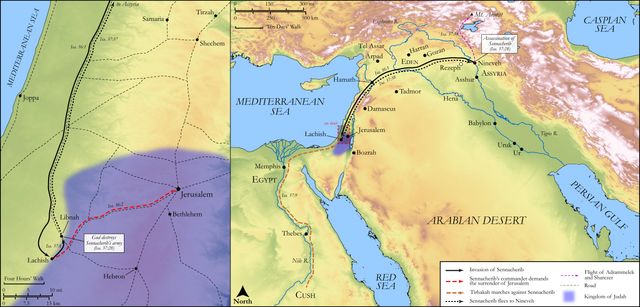
See on the biblical-era map
Study this verse
Public-domain commentary
Matthew Henry
From his Commentary on the Whole Bible. Henry comments on passages, not single verses — this entry covers Isaiah 36:11–22.
We may hence learn these lessons: - 1. That, while princes and counsellors have public matters under debate, it is not fair to appeal to the people. It was a reasonable motion which Hezekiah's plenipotentiaries made, that this parley should be held in a language which the people did not understand (Isa 36:11), because reasons of state are secret things and ought to be kept secret, the vulgar being incompetent judges of them. It is therefore an unfair practice, and not doing as men would be done by, to incense subjects against their rulers by base insinuations. 2. Proud and haughty scorners, the fairer they are spoken to, commonly speak the fouler. Nothing could be said more mildly and respectfully than that which Hezekiah's agents said to Rabshakeh. Besides that the thing itself was just which they desired, they called themselves his servants, they petitioned for it: Speak, we pray thee; but this made him the more spiteful and imperious. To give rough answers to those who give us soft answers is one way of rendering evil for good; and those are wicked indeed, and it is to be feared incurable, with whom that which usually turns away wrath does but make bad worse. 3. When Satan would tempt men from trusting in God, and cleaving to him, he does so by insinuating that in yielding to him they may better their condition; but it is a false suggestion, and grossly absurd, and therefore to be rejected with the utmost abhorrence. When the world and the flesh say to us, "Make an agreement with us and come out to us, submit to our dominion and come into our interests, and you shall eat every one of his own vine," they do but deceive us, promising liberty when they would lead us into the basest captivity and slavery. One might as well take Rabshakeh's word as theirs for kind usage and fair quarter; therefore, when they speak fair, believe them not. Let them say what they will, there is no land like the land of promise, the holy land. 4. Nothing can be more absurd in itself, nor a greater affront to the true and living God, than to compare him with the gods of the heathen; as if he could do no more for the protection of his worshippers than they can for the protection of theirs, and as if the God of Israel could as easily be mastered as the gods of Hamath and Arphad, whereas they are vanity and a lie. They are nothing; he is the great I AM: they are the creatures of men's fancy and the works of men's hands; he is the Creator of all things. 5. Presumptuous sinners are ready to think that, because they have been too hard for their fellow-creatures, they are therefore a match for their Creator. This and the other nation they have subdued, and therefore the Lord himself shall not deliver Jerusalem out of their hand. But, though the potsherds may strive with the potsherds of the earth, let them not strive with the potter. 6. It is sometimes prudent not to answer a fool according to his folly. Hezekiah's command was, "Answer him not; it will but provoke him to rail and blaspheme yet more and more; leave it to God to stop his mouth, for you cannot." They had reason enough on their side, but it would be hard to speak it to such an unreasonable adversary without a mixture of passion; and, if they should fall a railing like him, Rabshakeh would be much too hard for them at that weapon. 7. It becomes the people of God to lay to heart the dishonour done to God by the blasphemies of wicked men, though they do not think it prudent to reply to those blasphemies. Though they answered him not a word, yet they rent their clothes, in a holy zeal for the glory of God's name and a holy indignation at the contempt put upon it. They tore their garments when they heard blasphemy, as taking no pleasure in their own ornaments when God's honour suffered.
Historical interpretation
Historical reception
2 surviving comments on this verse. Each one is dated, so this reads as a timeline rather than a list.
(Verse 11 and following) And Eliakim, Sobna, and Joah said to Rabshakeh, 'Speak to your servants in the Aramaic language, for we understand it. Do not speak to us in Judahite in the hearing of the people who are on the wall.' But Rabshakeh said to them, 'Has my master sent me to your master and to you to speak these words? Has he not sent me to the men who sit on the wall, who will eat their own dung and drink their own urine with you?' And Rabsaces stood and cried with a loud voice in the language of Judah and said, Hear the words of the great king, the king of Assyria. Thus says the king: Let not Hezekiah deceive you, for he will not be able to deliver you out of his hand. Neither let Hezekiah make you trust in the Lord, saying, The Lord will surely deliver us, and this city shall not be given into the hand of the king of Assyria. Do not listen to Hezekiah. For the king of Assyria says: The testimony of Rabshakeh is that he relies on the Lord, who has captured all the cities of Judah and said to the people: Do not be afraid and do not be dismayed before the king of Assyria and all the multitude that is with him, for there are more with us than with him. With him is an arm of flesh; with us is the Lord our God, our helper, who fights for us. And the people were strengthened by the words of Hezekiah, king of Judah. But Sennacherib wants to destroy what Hezekiah has built; and he speaks to the people, 'Do not let Hezekiah deceive you, and do not put your trust in the Lord our God.' And as Eliakim, Shebna, and Joah humbly implore, 'Speak to your servants in the Syrian language, for we understand; and do not speak to us in the language of Judah in the hearing of the people who are on the wall,' it means: 'Why is it necessary to stir up the people with false terrors and boast of empty power?' Speak the language that the people do not understand. For if we have knowledge of your language: and we know the Syrian language, which is common to both. To which Rabshakeh replied arrogantly: Did my master send me to your lord and to you, and not rather to the men who sit on the wall? And he increased the threat, saying that they should eat their own feces and drink the urine of their own feet with them? By these means he showed that they were to be taken by hunger, scarcity, and thirst. At the same time he joins enticement with fear, so that he may deceive those whom he did not conquer with terror, with promises and persuasion, saying from the speech of the king Assyrians.
But what Eliakim and Shebna and Joah humbly requested, namely, “Speak to your servants in the Syrian language [Aramaic], for we understand it, and do not speak to us in Hebrew within the hearing of the people on the wall,” has this sense: Is it really necessary to fill the people with unjustified terror and to spread panic? Speak a language that these people do not understand, for we have knowledge of your tongue and are familiar with the Syrian dialect, which is common to us both. To this the Rabshakeh replied arrogantly: “Did my master send me,” he said, “to your master rather than to the men who sit on the wall?” Then he added, to supply the threat of terror by showing that they would be overtaken by hunger, poverty and thirst: “that they would eat their own dung and drink their own urine with you?”
Continue studying Isaiah 36:11 across the web’s major study libraries — every link below opens this exact verse, chapter, or book on the destination site.
Read & Compare
 BibleGatewayThis verse in more than 200 translations and 70 languages.
 Bible.comThe YouVersion reader — hundreds of translations, reading plans, and highlights.
 ESV.orgCrossway's official English Standard Version reader.
 NET BibleThe NET translation with 60,000+ translators' notes on every rendering decision.
 STEP BibleTyndale House's free study tool — original text, vocabulary, and scholarly resources.
 BibliaLogos Bible Software's free web reader.
 USCCBThe New American Bible (Revised Edition) with the U.S. bishops' study notes.
Commentaries
 BibleHub CommentariesDozens of classic commentaries on this verse, gathered on one page.
 StudyLightMore than 100 commentary sets — the largest collection on the web.
 BibleRefPlain-English commentary on what this verse means, verse by verse.
 Enduring WordDavid Guzik's free commentary on this chapter, widely used by Bible teachers.
 Bible Study ToolsVerse commentary alongside Greek and Hebrew study aids.
Original Language & Research
- BibleHub InterlinearThe verse word by word — original language, transliteration, and English.
- BibleHub LexiconEvery word's original-language definition and Strong's entry.
 Blue Letter BibleDeep-study tools — Strong's numbers, concordance, and word studies.
 SefariaThe Hebrew text with Rashi and centuries of Jewish commentary.
Sermons, Hymns & Audio


TrulyRandomVerse is not affiliated with these sites and doesn’t control their content. They’re linked because they’re genuinely useful.
Summary
Isaiah 36:11 captures a critical juncture during the Assyrian siege of Jerusalem, where King Hezekiah's chief officials—Eliakim, Shebna, and Joah—intervene in the Assyrian field commander Rabshakeh's public address. They implore him to cease speaking in Hebrew, the common tongue of Judah, and instead use Aramaic, the diplomatic language they alone understood. This plea was a strategic maneuver to shield the vulnerable populace on the city wall from Rabshakeh's demoralizing propaganda and psychological warfare, underscoring the profound power of language in ancient conflict and the officials' desperate attempt to protect their people's morale.
Context
ShowHideLiterary Context
This verse is intricately woven into the broader narrative of Sennacherib's invasion of Judah, a pivotal event chronicled in Isaiah 36 and Isaiah 37. Immediately preceding this exchange, Rabshakeh, acting as Sennacherib's envoy, has delivered a scathing and blasphemous speech in Hebrew, deliberately designed to undermine the faith of the Jewish people in King Hezekiah and, more significantly, in the Lord their God (Isaiah 36:4-10). The officials' urgent request in Isaiah 36:11 is a direct, desperate response to this public psychological assault, aiming to contain the spiritual and emotional damage. Rabshakeh's subsequent defiant refusal to comply, detailed in Isaiah 36:12, further highlights his malicious intent to directly target the common people, bypassing the diplomatic channels.
Historical & Cultural Context
The events depicted in Isaiah 36 transpired around 701 BC, a period marked by the formidable expansion of the Neo-Assyrian Empire under King Sennacherib. Having already subjugated numerous fortified cities in Judah, Sennacherib's formidable army had now laid siege to Jerusalem, the capital. Assyrian military doctrine frequently incorporated sophisticated psychological warfare tactics, aiming to shatter the morale of besieged populations and compel surrender without the costly and protracted engagement of direct assault. Aramaic, known here as the "Syrian language," had by this era become the ubiquitous diplomatic and administrative lingua franca across the nations, serving as the standard for inter-state communication. Conversely, Hebrew was the vernacular, the everyday language of the Kingdom of Judah's populace. The vivid scene of the people gathered on the city wall reflects the grim reality of siege warfare, where citizens and defenders would assemble to observe and react to the enemy's pronouncements.
Key Themes
ShowHideIsaiah 36:11 profoundly contributes to several overarching themes within the broader prophetic and historical narrative of Isaiah. It vividly illustrates the concept of psychological warfare, where words are not merely communication but potent weapons wielded to sow fear, confusion, and disunity, aiming to dismantle the will of the defenders. The swift and protective actions of Hezekiah's officials underscore the theme of protection of the vulnerable, as they strategically attempt to shield the ordinary citizens from the demoralizing and blasphemous impact of Rabshakeh's speech. This verse also powerfully highlights language as a strategic tool, demonstrating how the choice of linguistic medium can be meticulously manipulated for political, military, and spiritual advantage. Furthermore, it subtly introduces the theme of discerning leadership and reliance on God, as Hezekiah's representatives recognize the enemy's insidious tactic and attempt to counter it, thereby setting the stage for King Hezekiah's profound and ultimate reliance on divine intervention, a central and redemptive theme that culminates in Isaiah 37.
Exposition and Analysis
ShowHideKey Word Analysis
ShowHideFrom a primitive root, this word signifies more than mere utterance; it implies a deliberate arrangement of words with specific intent, often to declare, command, or tell. In this context, it underscores the performative and intentional nature of Rabshakeh's address. The officials are not simply asking him to alter his message, but to change the medium of his communication, thereby controlling its accessibility and psychological impact on the broader populace.
This term specifically designates the Hebrew language, the native tongue of the people of Judah. Its employment here emphasizes the vernacular, the common language understood by every ordinary citizen on the wall. By demanding Rabshakeh not speak in this language, the officials sought to prevent his demoralizing and blasphemous message from being directly apprehended and internalized by the general populace, who would not understand Aramaic.
While literally referring to the physical organ of hearing, "ears" in the phrase "in the ears of the people" functions metaphorically to signify direct audience, public reception, and full, unmediated comprehension. The officials' profound concern is precisely that Rabshakeh's words, if spoken in Hebrew, would directly penetrate the minds and hearts of the people, fostering debilitating fear, undermining their resolve, and potentially inciting rebellion against their king and God.
Verse Breakdown
ShowHide"Then said Eliakim and Shebna and Joah unto Rabshakeh"
This opening clause meticulously identifies the three key figures representing King Hezekiah—Eliakim, the palace administrator; Shebna, the royal scribe; and Joah, the recorder—and establishes their direct, official confrontation with Rabshakeh, the Assyrian field commander. It immediately sets the scene for a crucial diplomatic and psychological exchange, highlighting the high stakes involved.
"Speak, I pray thee, unto thy servants in the Syrian language; for we understand [it]:"
The officials issue a polite yet firm request for Rabshakeh to utilize Aramaic, referred to as "the Syrian language." This was the established diplomatic language of the era, conventionally employed for international negotiations between empires. Their justification, "for we understand it," subtly implies that they, as the king's representatives, are the appropriate and sole audience for such messages, not the common people. This suggests that Aramaic would effectively confine the message to a limited, discerning group, thus controlling its spread.
"and speak not to us in the Jews' language, in the ears of the people that [are] on the wall."
This explicit negative command forbids Rabshakeh from continuing to speak in Hebrew, "the Jews' language." The poignant phrase "in the ears of the people that are on the wall" reveals the officials' paramount concern: to prevent the demoralizing, fear-inducing, and blasphemous message from reaching the ordinary citizens. These citizens, understanding Hebrew, would be highly susceptible to Rabshakeh's insidious propaganda. This clause powerfully underscores the officials' protective instinct and their acute understanding of the devastating psychological impact of the enemy's words on the vulnerable populace.
Literary Devices
ShowHideThe passage masterfully employs several potent literary devices to convey its dramatic tension and strategic implications. Antithesis is central, starkly contrasting the "Syrian language" (Aramaic) with the "Jews' language" (Hebrew), thereby highlighting the linguistic battleground and the profound strategic implications of each choice. The entire scene is a compelling example of psychological warfare, where Rabshakeh's speech is meticulously designed not for genuine negotiation but for demoralization, aiming to shatter the will of the besieged without a physical confrontation. The officials' plea also subtly demonstrates foreshadowing, as their deep concern about the people's morale anticipates Rabshakeh's continued defiance and the escalating tension that will ultimately necessitate divine intervention. Furthermore, the precise focus on "the ears of the people" utilizes synecdoche, where "ears" represent the entire populace, emphasizing the direct, pervasive, and intended impact of Rabshakeh's insidious words on the vulnerable inhabitants.
Theological and Thematic Connections
ShowHideIsaiah 36:11 offers profound theological insights into the nature of spiritual warfare and the indispensable importance of discernment. Just as Rabshakeh sought to undermine the people's faith and resolve through deceptive and intimidating words, so too does the enemy of our souls, Satan, employ psychological tactics to sow doubt, fear, and division within the hearts of believers. This passage serves as a potent reminder that not all communication is benign; some words are indeed spiritual weapons meticulously designed to demoralize, disempower, and ultimately separate us from God's truth. The officials' desperate attempt to shield the vulnerable populace mirrors the pastoral responsibility to protect those under our spiritual care from harmful influences, false teachings, and discouraging narratives that erode faith. It underscores the critical need for spiritual discernment to identify the source, intent, and content behind messages we encounter, and to diligently guard our hearts and minds against voices that seek to separate us from God's unwavering truth and profound peace.
Reflection and Application
ShowHideIn an age saturated with information and constant communication, where narratives are often weaponized, Isaiah 36:11 remains remarkably relevant for contemporary believers. We are continually exposed to a deluge of voices and messages—through traditional media, social media, and personal interactions—many of which are subtly or overtly designed to instill fear, doubt, or division. This passage profoundly calls us to cultivate a posture of vigilant discernment, critically evaluating the source, intent, and content of everything we hear and consume. Are these messages genuinely building up faith, hope, and love, or are they subtly tearing down confidence, sowing discord, and fostering despair? Are they promoting unity in Christ, or are they sowing seeds of division and suspicion? Just as Hezekiah's officials sought to protect the vulnerable on the wall from demoralizing propaganda, we are called to be vigilant guardians for those within our spheres of influence, especially the young, new believers, or those who are easily swayed by popular or deceptive narratives. This involves not only filtering harmful information but also actively speaking truth, encouragement, and hope into their lives, consistently reminding ourselves and others of God's unchanging character, His sovereign control, and His unfailing promises. Our ultimate and unwavering defense against psychological attacks, whether from the world's anxieties or spiritual adversaries, lies in grounding ourselves firmly in the unwavering truth of God's Word and trusting implicitly in His sovereign, protective care.
Questions for Reflection
ShowHideFAQ
ShowHideWhy was Aramaic referred to as "the Syrian language" in this context?
ShowHideDuring the Neo-Assyrian Empire's dominance, Aramaic had become the established diplomatic and administrative lingua franca across the nations under Assyria's dominion. While not exclusively "Syrian" in its precise origin, it was widely spoken throughout the region of Syria (Aram) and served as the common language for international communication and official negotiations between various peoples and empires. Thus, for the Judahites, it was naturally identified with the broader Syrian region and its pervasive diplomatic use, making "the Syrian language" a common descriptor for Aramaic in this period.
What was Rabshakeh's primary motive for insisting on speaking in "the Jews' language" (Hebrew)?
ShowHideRabshakeh's motive was a calculated act of psychological warfare. By deliberately speaking in Hebrew, he aimed to bypass King Hezekiah's officials and directly address and demoralize the common people of Jerusalem who were listening on the wall. His insidious intent was to sow fear, undermine their trust in King Hezekiah, and, crucially, to erode their faith in the Lord their God, thereby inciting them to surrender without a costly physical battle. His subsequent words in Isaiah 36:12 explicitly confirm this, as he states his desire for the people to hear his message directly.
Did the officials' request to speak in Aramaic succeed in stopping Rabshakeh's psychological attack?
ShowHideNo, the officials' request did not succeed. Rabshakeh defiantly refused to switch to Aramaic, demonstrating his contempt for diplomatic protocol and his unwavering commitment to his psychological strategy. Isaiah 36:12 immediately follows, detailing his scornful response and his deliberate continuation of speaking in Hebrew, directly targeting the people on the wall with even more graphic and demoralizing threats, thus escalating the psychological warfare.
Christ-Centered Fulfillment
ShowHideIsaiah 36:11, though rooted in a specific historical military conflict, resonates profoundly with the spiritual warfare described in the New Testament, finding its ultimate and glorious fulfillment in Christ. Rabshakeh's voice, brimming with lies, intimidation, and blasphemy, serves as a powerful type of the "accuser of the brethren" (Revelation 12:10), whose primary weapons are deceit, fear-mongering, and the sowing of doubt (John 8:44). In stark contrast to the limited, earthly ability of Hezekiah's officials to shield the people, Jesus Christ stands as the ultimate Protector, the perfect Discerner, and the Good Shepherd. He declares, "My sheep hear my voice, and I know them, and they follow me" (John 10:27). Unlike the enemy's voice, which seeks to scatter, demoralize, and destroy, Christ's voice brings life, truth, and eternal security (John 10:28). He does not speak in a foreign tongue that obscures His message, but in words of Spirit and life that are accessible to all who believe and are willing to hear (John 6:63). Furthermore, the very "Jews' language" used by Rabshakeh, though intended for evil, paradoxically foreshadows the universal proclamation of the Gospel. This life-giving message transcends all linguistic and cultural barriers, ensuring that the liberating truth of Christ is heard "in the ears of the people" of every nation, tribe, and tongue, fulfilling God's redemptive plan for all humanity (Revelation 7:9). Through Christ, believers are not left vulnerable but are equipped with the "sword of the Spirit, which is the word of God" (Ephesians 6:17), a divine language that powerfully counters every lie, every intimidation, and every deceptive scheme of the enemy.