


Isaiah 36:12
Bible text: King James Version (1769 Blayney text) · Public domain
Bible text: King James Version with Strong's numbers · Public domain
Bible text: Berean Standard Bible · Public domain
Bible text: American Standard Version (1901) · Public domain
Bible text: World English Bible, Messianic edition · Public domain
Bible text: Geneva Bible (1599) · Public domain
Bible text: Young's Literal Translation · Public domain
- וַיֹּאמֶרvai·Yo·merand he saidH559Conj-w ¦ V-Qal-ConsecImperf-3msVerb Qal Consecutive Imperfect 3rd Singular Masculineוַandיֹּאמֶרhe said
- רַבrav[the] chiefH7262N-msNoun Title Singular Masculine Absolute
- שָׁקֵהsha·KehcommanderH7262N-msNoun Title Singular Masculine Absolute
- הַאֶלha·'El¿ toH413Interrog ¦ PrepPrepositionהַ¿אֶלto
- אֲדֹנֶיךָ'a·do·Nei·khayour master<s>H113N-mpc ¦ 2msNoun Plural Masculine Constructאֲדֹנֶיmaster<s>ךָyour
- וְאֵלֶיךָve·'e·Lei·khaand to youH413Conj-w ¦ Prep ¦ 2msPreposition Definiteוְandאֵלֶיtoךָyou
- שְׁלָחַנִיshe·la·Cha·nihas he sent meH7971V-Qal-Perf-3ms ¦ 1csVerb Qal Perfect 3rd Singular Masculineשְׁלָחַhas he sentנִיme
- אֲדֹנִי'a·do·Nimy masterH113N-msc ¦ 1csNoun Singular Masculine Constructאֲדֹנִmasterיmy
- לְדַבֵּרle·da·Berto speakH1696Prep-l ¦ V-Piel-InfVerb Piel Infinitive Constructלְtoדַבֵּרspeak
- אֶת'et<obj.>H853DirObjMParticle Object Indicator
- הַדְּבָרִיםha·de·va·Rimthe wordsH1697Art ¦ N-mpNoun Plural Masculine Absoluteהַtheדְּבָרִיםwords
- הָאֵלֶּהha·'E·leh<the> theseH428Art ¦ PrtParticle Demonstrativeהָ<the>אֵלֶּהthese
- הֲלֹאha·Lo'¿ notH3808Interrog ¦ NegParticle Negativeהֲ¿לֹאnot
- עַל'altoH5921PrepPreposition
- הָאֲנָשִׁיםha·'a·na·Shimthe peopleH582Art ¦ N-mpNoun Plural Masculine Absoluteהָtheאֲנָשִׁיםpeople
- הַיֹּשְׁבִיםhai·yo·she·Vimwho sitH3427Art ¦ V-Qal-Prtcpl-mpVerb Qal Participle Plural Masculine Absoluteהַwhoיֹּשְׁבִיםsit
- עַל'alonH5921PrepPreposition
- הַחוֹמָהha·cho·Mahthe city wallH2346Art ¦ N-fsNoun Singular Feminine Absoluteהַtheחוֹמָהcity wall
- לֶאֱכֹלle·'e·Kholto eatH398Prep-l ¦ V-Qal-InfVerb Qal Infinitive Constructלֶtoאֱכֹלeat
- אֶת'et<obj.>H853DirObjMParticle Object Indicator
- צוֹאָתָםchar·'ei·hemtheir own excrementH6675N-fsc ¦ 3mpNoun Singular Feminine Constructצוֹאָתָown excrementםtheir
- וְלִשְׁתּוֹתve·lish·Totand to drinkH8354Conj-w ¦ Prep-l ¦ V-Qal-InfVerb Qal Infinitive Constructוְandלִtoשְׁתּוֹתdrink
- אֶת'et<obj.>H853DirObjMParticle Object Indicator
- מֵימֵי רַגְלֵיהֶםmei·mei rag·lei·hem[the] their water of feetH4325N-mpc ¦ N-fdc ¦ 3mpNoun Plural Masculine Constructמֵימֵי[the] water ofרַגְלֵיfeetהֶםtheir
- עִמָּכֶם'i·ma·Khemwith youH5973Prep ¦ 2mpPreposition Definiteעִמָּwithכֶםyou
English is a literal word-by-word gloss of the Hebrew, not the KJV's wording. Why?
This is the original text the KJV's translators worked from — each Hebrew word with its own literal English meaning in this verse, prepared by scholars at Tyndale House, Cambridge. The KJV translates whole sentences, not word by word, so its wording differs: one Hebrew word can become several English words, and the KJV may choose “the LORD” where the gloss reads “Yahweh”. Both are faithful — they answer different questions. For the KJV's own rendering, switch to the KJV text.
Details
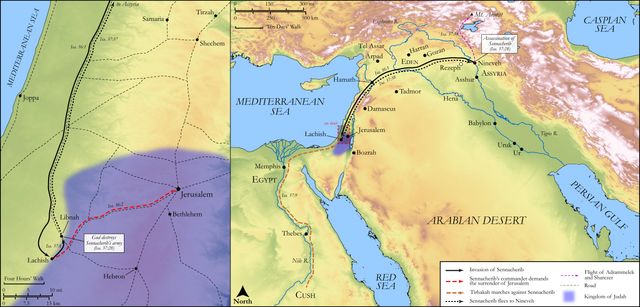
See on the biblical-era map
Study this verse
Public-domain commentary
Matthew Henry
From his Commentary on the Whole Bible. Henry comments on passages, not single verses — this entry covers Isaiah 36:11–22.
We may hence learn these lessons: - 1. That, while princes and counsellors have public matters under debate, it is not fair to appeal to the people. It was a reasonable motion which Hezekiah's plenipotentiaries made, that this parley should be held in a language which the people did not understand (Isa 36:11), because reasons of state are secret things and ought to be kept secret, the vulgar being incompetent judges of them. It is therefore an unfair practice, and not doing as men would be done by, to incense subjects against their rulers by base insinuations. 2. Proud and haughty scorners, the fairer they are spoken to, commonly speak the fouler. Nothing could be said more mildly and respectfully than that which Hezekiah's agents said to Rabshakeh. Besides that the thing itself was just which they desired, they called themselves his servants, they petitioned for it: Speak, we pray thee; but this made him the more spiteful and imperious. To give rough answers to those who give us soft answers is one way of rendering evil for good; and those are wicked indeed, and it is to be feared incurable, with whom that which usually turns away wrath does but make bad worse. 3. When Satan would tempt men from trusting in God, and cleaving to him, he does so by insinuating that in yielding to him they may better their condition; but it is a false suggestion, and grossly absurd, and therefore to be rejected with the utmost abhorrence. When the world and the flesh say to us, "Make an agreement with us and come out to us, submit to our dominion and come into our interests, and you shall eat every one of his own vine," they do but deceive us, promising liberty when they would lead us into the basest captivity and slavery. One might as well take Rabshakeh's word as theirs for kind usage and fair quarter; therefore, when they speak fair, believe them not. Let them say what they will, there is no land like the land of promise, the holy land. 4. Nothing can be more absurd in itself, nor a greater affront to the true and living God, than to compare him with the gods of the heathen; as if he could do no more for the protection of his worshippers than they can for the protection of theirs, and as if the God of Israel could as easily be mastered as the gods of Hamath and Arphad, whereas they are vanity and a lie. They are nothing; he is the great I AM: they are the creatures of men's fancy and the works of men's hands; he is the Creator of all things. 5. Presumptuous sinners are ready to think that, because they have been too hard for their fellow-creatures, they are therefore a match for their Creator. This and the other nation they have subdued, and therefore the Lord himself shall not deliver Jerusalem out of their hand. But, though the potsherds may strive with the potsherds of the earth, let them not strive with the potter. 6. It is sometimes prudent not to answer a fool according to his folly. Hezekiah's command was, "Answer him not; it will but provoke him to rail and blaspheme yet more and more; leave it to God to stop his mouth, for you cannot." They had reason enough on their side, but it would be hard to speak it to such an unreasonable adversary without a mixture of passion; and, if they should fall a railing like him, Rabshakeh would be much too hard for them at that weapon. 7. It becomes the people of God to lay to heart the dishonour done to God by the blasphemies of wicked men, though they do not think it prudent to reply to those blasphemies. Though they answered him not a word, yet they rent their clothes, in a holy zeal for the glory of God's name and a holy indignation at the contempt put upon it. They tore their garments when they heard blasphemy, as taking no pleasure in their own ornaments when God's honour suffered.
Historical interpretation
Historical reception
2 surviving comments on this verse. Each one is dated, so this reads as a timeline rather than a list.
Select a marker to jump to its quote. Markers stagger vertically where authors wrote within a few decades of each other.
In order … that both our houses may be continually open to [the poor] and our ears to [the apostles], we should purge away the filth from the ears of our soul. For as filth and mud close up our fleshly ears, so do the prostitute’s songs, worldly talking, debts and the business of borrowing and paying interest close up the mind’s ear even worse than dirt. Not only do these things close up the ear, but also they make it unclean. Those who cause you to listen to the prostitute’s songs put dung in your ears. They make you endure not just in word but in deeds, what the barbarian threatened: “You shall eat your own dung,” and what follows.
(Verse 11 and following) And Eliakim, Sobna, and Joah said to Rabshakeh, 'Speak to your servants in the Aramaic language, for we understand it. Do not speak to us in Judahite in the hearing of the people who are on the wall.' But Rabshakeh said to them, 'Has my master sent me to your master and to you to speak these words? Has he not sent me to the men who sit on the wall, who will eat their own dung and drink their own urine with you?' And Rabsaces stood and cried with a loud voice in the language of Judah and said, Hear the words of the great king, the king of Assyria. Thus says the king: Let not Hezekiah deceive you, for he will not be able to deliver you out of his hand. Neither let Hezekiah make you trust in the Lord, saying, The Lord will surely deliver us, and this city shall not be given into the hand of the king of Assyria. Do not listen to Hezekiah. For the king of Assyria says: The testimony of Rabshakeh is that he relies on the Lord, who has captured all the cities of Judah and said to the people: Do not be afraid and do not be dismayed before the king of Assyria and all the multitude that is with him, for there are more with us than with him. With him is an arm of flesh; with us is the Lord our God, our helper, who fights for us. And the people were strengthened by the words of Hezekiah, king of Judah. But Sennacherib wants to destroy what Hezekiah has built; and he speaks to the people, 'Do not let Hezekiah deceive you, and do not put your trust in the Lord our God.' And as Eliakim, Shebna, and Joah humbly implore, 'Speak to your servants in the Syrian language, for we understand; and do not speak to us in the language of Judah in the hearing of the people who are on the wall,' it means: 'Why is it necessary to stir up the people with false terrors and boast of empty power?' Speak the language that the people do not understand. For if we have knowledge of your language: and we know the Syrian language, which is common to both. To which Rabshakeh replied arrogantly: Did my master send me to your lord and to you, and not rather to the men who sit on the wall? And he increased the threat, saying that they should eat their own feces and drink the urine of their own feet with them? By these means he showed that they were to be taken by hunger, scarcity, and thirst. At the same time he joins enticement with fear, so that he may deceive those whom he did not conquer with terror, with promises and persuasion, saying from the speech of the king Assyrians.
Continue studying Isaiah 36:12 across the web’s major study libraries — every link below opens this exact verse, chapter, or book on the destination site.
Read & Compare
 BibleGatewayThis verse in more than 200 translations and 70 languages.
 Bible.comThe YouVersion reader — hundreds of translations, reading plans, and highlights.
 ESV.orgCrossway's official English Standard Version reader.
 NET BibleThe NET translation with 60,000+ translators' notes on every rendering decision.
 STEP BibleTyndale House's free study tool — original text, vocabulary, and scholarly resources.
 BibliaLogos Bible Software's free web reader.
 USCCBThe New American Bible (Revised Edition) with the U.S. bishops' study notes.
Commentaries
 BibleHub CommentariesDozens of classic commentaries on this verse, gathered on one page.
 StudyLightMore than 100 commentary sets — the largest collection on the web.
 BibleRefPlain-English commentary on what this verse means, verse by verse.
 Enduring WordDavid Guzik's free commentary on this chapter, widely used by Bible teachers.
 Bible Study ToolsVerse commentary alongside Greek and Hebrew study aids.
Original Language & Research
- BibleHub InterlinearThe verse word by word — original language, transliteration, and English.
- BibleHub LexiconEvery word's original-language definition and Strong's entry.
 Blue Letter BibleDeep-study tools — Strong's numbers, concordance, and word studies.
 SefariaThe Hebrew text with Rashi and centuries of Jewish commentary.
Sermons, Hymns & Audio


TrulyRandomVerse is not affiliated with these sites and doesn’t control their content. They’re linked because they’re genuinely useful.
Summary
Isaiah 36:12 captures a pivotal moment of calculated psychological warfare during the Assyrian siege of Jerusalem. Rabshakeh, the Assyrian field commander, deliberately employs unflinching, vile, and dehumanizing language, speaking directly in Hebrew to the common people gathered on the city walls. His strategic aim is to utterly demoralize the besieged inhabitants by painting a horrific, vivid picture of the extreme degradation and starvation they would face, forcing them to contemplate the unspeakable act of consuming their own waste, thereby shattering their resolve and undermining their trust in King Hezekiah and their God.
Context
ShowHideLiterary Context
Isaiah 36-39 forms a crucial historical interlude within the broader prophetic book of Isaiah, closely paralleling the account found in 2 Kings 18-20. This historical narrative serves to ground Isaiah's profound prophetic messages in a concrete, specific event: the devastating Assyrian invasion of Judah during the reign of King Hezekiah. Chapter 36 meticulously details Sennacherib's relentless military campaign and Rabshakeh's audacious, blasphemous challenge to Jerusalem, setting the dramatic stage for God's miraculous and decisive intervention described in Isaiah 37. This section powerfully contrasts human arrogance, military might, and the futility of relying on earthly alliances with the ultimate power and unwavering faithfulness of the divine, reinforcing Isaiah's overarching themes of judgment for unfaithfulness and salvation for those who place their trust solely in the Lord.
Historical & Cultural Context
The events depicted in Isaiah 36 transpired around 701 BC, a period when the formidable Neo-Assyrian Empire, under the command of King Sennacherib, launched a devastating military campaign against the kingdom of Judah. Having already conquered numerous fortified cities throughout Judah, including the strategically important Lachish, Sennacherib's forces advanced to lay siege to Jerusalem, the capital. Rabshakeh, an influential Assyrian official whose title likely meant "chief cupbearer" or "chief officer," was dispatched to demand Jerusalem's unconditional surrender. It was a common and effective military tactic for besieging armies to employ psychological warfare, aiming to break the will of the defenders through intimidation, displays of overwhelming power, and graphic threats of the horrific consequences of prolonged resistance. Rabshakeh's deliberate choice to address the people in Hebrew, rather than the customary diplomatic language of Aramaic, was a calculated and insidious move designed to bypass the officials and directly terrorize the common populace, exploiting their deep-seated fears of starvation, disease, and the unspeakable indignities inherent in a protracted siege.
Key Themes
ShowHideThis verse powerfully encapsulates several critical themes. Firstly, Psychological Warfare is paramount, as Rabshakeh masterfully employs a calculated strategy of intimidation and disgust, using words as potent weapons to shatter the morale of the Jerusalemites. Secondly, the verse vividly illustrates the Desperation and Degradation of Siege Warfare, painting a horrifying picture of the extreme suffering—unimaginable starvation, agonizing thirst, and the ultimate humiliation of consuming one's own waste—that a prolonged siege would inflict. This grotesque imagery is meticulously crafted to make immediate surrender appear as the only rational and humane choice. Thirdly, it underscores Assyrian Arrogance and Blasphemy, as Rabshakeh's contemptuous words are not merely directed at the people and King Hezekiah but implicitly, and profoundly, challenge the very power and sovereignty of Judah's God. This audacious challenge sets the stage for the dramatic divine confrontation that unfolds in the subsequent chapters, particularly highlighted in Isaiah 37:23. This direct affront to God's authority is a recurring motif throughout the prophetic literature, echoing the broader context of Isaiah's prophecies concerning divine judgment and deliverance.
Exposition and Analysis
ShowHideKey Word Analysis
ShowHideMeaning "sovereign, i.e. controller (human or divine); lord, master, owner." In this context, Rabshakeh refers to his master, King Sennacherib, thereby emphasizing the formidable, hierarchical authority of the Assyrian Empire. The term itself carries significant theological weight, frequently used in the Old Testament to refer to God, which subtly contrasts Sennacherib's earthly dominion with the true divine sovereignty that King Hezekiah and the people of Judah are called to trust.
Meaning "a wall of protection; wall, walled." The city wall represents Jerusalem's primary line of defense, its physical security, and the last bastion of hope for its inhabitants. Rabshakeh's explicit intention to speak directly to "the men that sit upon the wall" underscores his calculated desire to bypass official diplomatic channels and directly assault the morale of those physically defending the city, effectively turning their place of perceived security into a vantage point for their public humiliation and terror.
Meaning "excrement." This term, along with the implied "piss" (H4325, mayim), is exceptionally vulgar and graphically offensive. Its inclusion is designed to shock, disgust, and dehumanize, painting an unbearable picture of the absolute lowest point of human degradation and desperation during a siege, where survival would necessitate consuming the most repulsive and defiling substances. It serves to strip the besieged of their dignity and humanity, making surrender seem like the only escape from such an abhorrent fate.
Verse Breakdown
ShowHide"But Rabshakeh said, Hath my master sent me to thy master and to thee to speak these words?"
This opening rhetorical question immediately establishes Rabshakeh's contemptuous dismissal of diplomatic protocol and the Jewish officials' request for a private conversation in Aramaic. He implies that his message is not for the high-ranking officials (Eliakim, Shebna, and Joah) but for a broader, more vulnerable audience. It challenges the very premise of their current discussion, asserting a different, more direct, and brutally public agenda, designed to undermine their authority.
"[hath he] not [sent me] to the men that sit upon the wall,"
This clause explicitly identifies Rabshakeh's true, intended audience: the common people, soldiers, and citizens who are physically present and visible on the city walls. By directly addressing them in Hebrew, the language of the common people, he aims to bypass King Hezekiah's officials and sow panic, fear, and dissent directly among the populace, knowing that their collective terror and despair could exert immense pressure on the leadership to surrender.
"that they may eat their own dung, and drink their own piss with you?"
This is the horrifying and utterly humiliating core of Rabshakeh's threat. It is a graphic, visceral depiction of the ultimate, degrading consequences of resisting the Assyrians: extreme starvation and thirst leading to the unspeakable act of consuming one's own bodily waste. The chilling phrase "with you" directly implicates the officials, suggesting that they too will inevitably share in this horrific fate, thereby attempting to break their resolve, loyalty to Hezekiah, and any remaining hope.
Literary Devices
ShowHideIsaiah 36:12 is a masterful deployment of Psychological Warfare through the deliberate manipulation of language. Rabshakeh employs profound Shock Value and Hyperbole by using extremely vulgar and graphically repulsive imagery ("dung" and "piss"). This is not merely descriptive but intensely prescriptive, designed to evoke visceral disgust, terror, and a sense of utter hopelessness, making the alternative (surrender) appear as the only rational and merciful choice. The strategic use of a Rhetorical Question ("Hath my master sent me... hath he not sent me...") serves to dismiss the legitimacy of the Jewish officials' diplomatic efforts and to forcefully assert Rabshakeh's own brutal, direct agenda. Furthermore, the language is a potent form of Dehumanization, reducing the besieged inhabitants to desperate, animalistic beings, stripped of all dignity, a common and effective tactic in ancient warfare to utterly break an enemy's spirit and will to resist.
Theological and Thematic Connections
ShowHideThis verse, despite its shocking vulgarity, serves a profound theological purpose within the broader narrative of Isaiah and the biblical canon. It starkly highlights the contrast between human arrogance and divine sovereignty. Rabshakeh's speech is not merely a military taunt but a direct, blasphemous challenge not only to King Hezekiah but, more significantly, to Yahweh Himself. He implicitly suggests that Judah's God is no more capable of delivering His people than the defeated gods of other nations conquered by Assyria. This audacious challenge sets the stage for God's dramatic, miraculous intervention, powerfully demonstrating that His power is not limited by human despair, the overwhelming might of earthly empires, or the most vile threats. The horrifying imagery of degradation underscores humanity's utter helplessness when faced with overwhelming earthly power, thereby magnifying the glory of God's miraculous deliverance. It teaches that true security and hope are found not in fortified walls, human strength, or diplomatic negotiations, but in unwavering, steadfast trust in the Lord, even when confronted with the most vile, terrifying, and seemingly insurmountable threats.
Reflection and Application
ShowHideIn a world that constantly seeks to demoralize, intimidate, and sow seeds of doubt, Rabshakeh's ancient tactics resonate powerfully beyond the context of ancient siege warfare. We, too, can face "spiritual Rabshakehs"—insidious voices of despair, fear, anxiety, or doubt that whisper insidious lies, attempting to break our spirit, undermine our resolve, and erode our trust in God. These voices may manifest through external pressures, pervasive societal narratives that challenge faith, or even internal struggles that paint grim pictures of our future or the perceived futility of our beliefs. This passage serves as a profound call to recognize such psychological warfare for what it is: a calculated attempt to strip us of our dignity, hope, and spiritual vitality. It reminds us that even when confronted with the most repulsive, overwhelming, and seemingly insurmountable threats, our ultimate refuge and inexhaustible source of strength is not in our own resilience or ingenuity, but in the living God. Just as King Hezekiah turned to the Lord in earnest prayer and humility, we are called to bring our deepest fears, anxieties, and seemingly impossible situations before the One who is infinitely greater than any earthly power or spiritual adversary, trusting that His divine deliverance often manifests most gloriously when human strength has utterly failed.
Questions for Reflection
ShowHideFAQ
ShowHideWhy is the language in this verse so vulgar and graphic?
ShowHideThe vulgar and graphic language ("dung" and "piss") is intentionally employed by Rabshakeh to achieve maximum psychological impact. It is a deliberate tactic of psychological warfare designed to shock, disgust, and utterly dehumanize the besieged people of Jerusalem. By painting such a repulsive and visceral picture of the starvation and degradation they would inevitably face if they continued to resist, Rabshakeh aimed to break their morale, instill profound terror, and force their surrender through fear, rather than through a direct, costly military assault. This kind of explicit language was not uncommon in ancient siege rhetoric, used to underscore the horrific desperation of prolonged starvation and to strip the enemy of their dignity, as also seen in the parallel account in 2 Kings 18:27.
Who was Rabshakeh, and what was his role?
ShowHideRabshakeh was a high-ranking Assyrian official, likely a military commander or chief officer, serving under King Sennacherib. His title, "Rabshakeh" (from Akkadian rab shaqe), literally means "chief cupbearer" or "chief officer," indicating a position of significant authority, trust, and influence within the Assyrian court and military hierarchy. In the narrative of Isaiah 36, he served as Sennacherib's primary envoy, dispatched to demand Jerusalem's surrender. His role extended beyond merely delivering a message; he was tasked with employing sophisticated psychological tactics, including public taunting, intimidation, and blasphemy, to demoralize the enemy and secure a surrender without the need for further costly and prolonged military engagement. His speech is a classic example of ancient propaganda, meticulously designed to sow discord, fear, and despair among the besieged population.
What happened immediately after Rabshakeh's speech in the biblical narrative?
ShowHideFollowing Rabshakeh's blasphemous and profoundly demoralizing speech, King Hezekiah's officials returned to him with their clothes torn, a traditional sign of distress and mourning. Hezekiah himself responded by tearing his clothes, covering himself with sackcloth, and entering the house of the Lord to pray. He then sent his officials to the prophet Isaiah to seek the Lord's word and divine guidance. Through Isaiah, God responded with a powerful message of assurance, promising to deliver Jerusalem from the Assyrians and to turn Sennacherib back. True to God's word, the Angel of the Lord miraculously struck down 185,000 Assyrian soldiers in a single night, forcing Sennacherib to retreat in shame to Nineveh, where he was later assassinated by his own sons. This dramatic divine intervention, recorded in Isaiah 37, powerfully vindicated God's name and demonstrated His unwavering faithfulness to His people who trusted in Him.
Christ-Centered Fulfillment
ShowHideIsaiah 36:12, with its grim portrayal of human degradation and the overwhelming power of an earthly enemy, finds profound Christ-centered fulfillment in the ultimate victory of God over sin, death, and all spiritual adversaries. Rabshakeh's horrifying threats symbolize the desperate plight of humanity under the dominion of sin, facing a future of spiritual starvation and ultimate, eternal separation from God. Just as Jerusalem was besieged by a seemingly invincible foe, humanity is besieged by the forces of evil, trapped in a state where spiritual "dung and piss"—the defilement of sin, the futility of self-righteousness, and the emptiness of worldly pursuits—become the only available, yet ultimately defiling, sustenance. However, Christ enters this desperate human condition not as a threatening conqueror, but as the Lamb of God, who takes away the sin of the world. He offers true spiritual nourishment, the living water that quenches eternal thirst, and the bread of life that satisfies the deepest spiritual hunger, standing in stark contrast to the vile sustenance Rabshakeh described. Through His perfect life, atoning sacrifice on the cross, and glorious resurrection, Jesus decisively defeated the spiritual "Rabshakeh"—Satan—who relentlessly seeks to accuse, demoralize, and condemn humanity. The miraculous victory of God over Sennacherib's seemingly invincible army powerfully foreshadows Christ's ultimate triumph over every spiritual principality, power, and dominion, securing for all believers not just physical deliverance, but eternal life and abundant spiritual sustenance. Those who trust in Him will never again face the degradation of spiritual famine, but will feast eternally at His glorious heavenly banquet.