


2 Kings 16:20
- וַיִּשְׁכַּבvai·yish·Kavand he lay downH7901Conj-w ¦ V-Qal-ConsecImperf-3msVerb Qal Consecutive Imperfect 3rd Singular Masculineוַandיִּשְׁכַּבhe lay down
- אָחָז'a·ChazAhazH271N-proper-mNoun Proper Masculine
- עִם'imwithH5973PrepPreposition
- אֲבֹתָיו'a·vo·Tavhis ancestorsH1N-fpc ¦ 3msNoun Plural Feminine Constructאֲבֹתָיancestorsוhis
- וַיִּקָּבֵרvai·yi·ka·Verand he was buriedH6912Conj-w ¦ V-Niphal-ConsecImperf-3msVerb Niphal Consecutive Imperfect 3rd Singular Masculineוַandיִּקָּבֵרhe was buried
- עִם'imwithH5973PrepPreposition
- אֲבֹתָיו'a·vo·Tavhis ancestorsH1N-fpc ¦ 3msNoun Plural Feminine Constructאֲבֹתָיancestorsוhis
- בְּעִירbe·'Irin [the] city ofH5892Prep-b ¦ N-fscNoun Singular Feminine Constructבְּinעִיר[the] city of
- דָּוִדda·VidDavidH1732N-proper-mNoun Proper Masculine
- וַיִּמְלֹךְvai·yim·Lokhand he became kingH4427Conj-w ¦ V-Qal-ConsecImperf-3msVerb Qal Consecutive Imperfect 3rd Singular Masculineוַandיִּמְלֹךְhe became king
- חִזְקִיָּהוּchiz·ki·Ya·huHezekiahH2396N-proper-mNoun Proper Masculine
- בְנוֹve·Nohis sonH1121N-msc ¦ 3msNoun Singular Masculine Constructבְנsonוֹhis
- תַּחְתָּיוtach·Tavin place of himH8478N-mpc ¦ 3msNoun Plural Masculine Constructתַּחְתָּיin place ofוhim
English is a literal word-by-word gloss of the Hebrew, not the KJV's wording. Why?
This is the original text the KJV's translators worked from — each Hebrew word with its own literal English meaning in this verse, prepared by scholars at Tyndale House, Cambridge. The KJV translates whole sentences, not word by word, so its wording differs: one Hebrew word can become several English words, and the KJV may choose “the LORD” where the gloss reads “Yahweh”. Both are faithful — they answer different questions. For the KJV's own rendering, switch to the KJV text.
Details
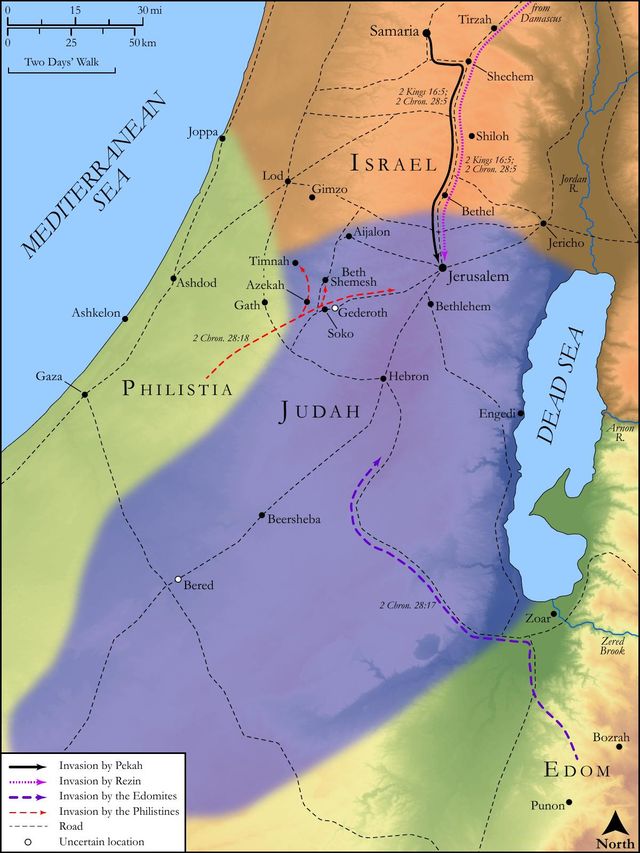
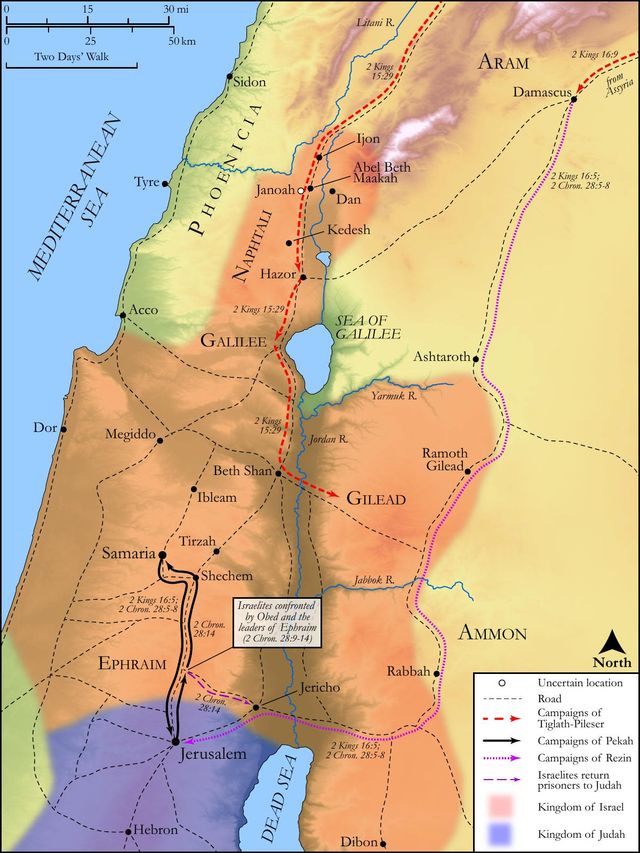
See on the biblical-era map
Study this verse
Public-domain commentary
Matthew Henry
From his Commentary on the Whole Bible. Henry comments on passages, not single verses — this entry covers 2 Kings 16:17–20.
Here is, I. Ahaz abusing the temple, not the building itself, but some of the furniture of it. 1. He defaced the bases on which the lavers were set (Kg1 7:28, Kg1 7:29) and took down the molten sea, Kg2 16:17. These the priests used for washing; against them therefore he seems to have had a particular spite. It is one of the greatest prejudices that can be done to religion to obstruct the purifying of the priests, the Lord's ministers. 2. He removed the covert for the sabbath, erected either in honour of the sabbath or for the conveniency of the priests, when, on the sabbath, they officiated in greater numbers than on other days. Whatever it was, it should seem that in removing it he intended to put a contempt upon the sabbath, and so to open as wide an inlet as any to all manner of impiety. 3. The king's entry, which led to the house of the Lord, for the convenience of the royal family (perhaps that ascent which Solomon had made, and which the queen of Sheba admired, Kg1 10:5), he turned another way, to show that he did not intend to frequent the house of the Lord any more. This he did for the king of Assyria, to oblige him, who perhaps returned his visit, and found fault with this entry, as an inconvenience and disparagement to his palace. When those that have had a ready passage to the house of the Lord, to please their neighbours, turn it another way, they are going down the hill apace towards their ruin.
II.Ahaz resigning his life in the midst of his days, at thirty-six years of age (Kg2 16:19) and leaving his kingdom to a better man, Hezekiah his son (Kg2 16:20), who proved as much a friend to the temple as he had been an enemy to it. Perhaps this very son he had made to pass through the fire, and thereby dedicated him to Moloch; but God, by his grace, snatched him as a brand out of the burning.
Historical interpretation
Historical reception
1 surviving comment on this verse from the historical church.
I certainly do not think that he built [the altar] for the God of all things but just for certain of those who are falsely called gods. This is what the book of Chronicles points out. It reads, “In the time of his distress this king Ahaz became yet more faithless to the Lord. For he sacrificed to the gods of Damascus, which had defeated him, and said, “Because the gods of the kings of Aram helped them, I will sacrifice to them so that they may help me.” But they were the ruin of him and of all Israel.” And this is also signified by the next verse: “Ahaz gathered together the utensils of the house of God and cut in pieces the utensils of the house of God. He shut up the doors of the house of the Lord and made himself altars in every corner of Jerusalem.” He did these and other similar things, as is also confirmed in the book of Chronicles: “When King Ahaz went to Damascus to meet King Tiglath-pileser of Assyria, he saw the altar that was at Damascus. King Ahaz sent to the priest Uriah a model of the altar, and its pattern, exact in all its details.” He removed the genuine altar of bronze, which Solomon had built, and put in its place another one recently made. And what happened to the stands is revealed by what follows: “King Ahaz cut off the frames of the stands,” the text says, “and removed the laver from them.” And he even dared to commit another act of impiety: he moved the entrance of the royal house into the divine temple, transforming the sacred enclosure into a thoroughfare.
Continue studying 2 Kings 16:20 across the web’s major study libraries — every link below opens this exact verse, chapter, or book on the destination site.
Read & Compare
 BibleGatewayThis verse in more than 200 translations and 70 languages.
 Bible.comThe YouVersion reader — hundreds of translations, reading plans, and highlights.
 ESV.orgCrossway's official English Standard Version reader.
 NET BibleThe NET translation with 60,000+ translators' notes on every rendering decision.
 STEP BibleTyndale House's free study tool — original text, vocabulary, and scholarly resources.
 BibliaLogos Bible Software's free web reader.
 USCCBThe New American Bible (Revised Edition) with the U.S. bishops' study notes.
Commentaries
 BibleHub CommentariesDozens of classic commentaries on this verse, gathered on one page.
 StudyLightMore than 100 commentary sets — the largest collection on the web.
 BibleRefPlain-English commentary on what this verse means, verse by verse.
 Enduring WordDavid Guzik's free commentary on this chapter, widely used by Bible teachers.
 Bible Study ToolsVerse commentary alongside Greek and Hebrew study aids.
Original Language & Research
- BibleHub InterlinearThe verse word by word — original language, transliteration, and English.
- BibleHub LexiconEvery word's original-language definition and Strong's entry.
 Blue Letter BibleDeep-study tools — Strong's numbers, concordance, and word studies.
 SefariaThe Hebrew text with Rashi and centuries of Jewish commentary.
Sermons, Hymns & Audio


TrulyRandomVerse is not affiliated with these sites and doesn’t control their content. They’re linked because they’re genuinely useful.
Summary
This pivotal verse in 2 Kings succinctly records the death and burial of King Ahaz of Judah, marking the conclusion of a reign characterized by profound apostasy and national decline. Employing a standard biblical formula for royal succession, it simultaneously announces the ascension of his son, Hezekiah, whose rule would dramatically reverse his father's policies, ushering in a period of significant spiritual reform and renewed faithfulness to the Lord, thereby signaling a crucial transition from darkness to a glimmer of hope for the kingdom of Judah.
Context
ShowHideLiterary Context
This verse serves as the concluding statement of King Ahaz's narrative, which is meticulously detailed throughout 2 Kings 16. The preceding verses paint a grim picture of Ahaz's extreme idolatry, including the horrific act of sacrificing his own son in the fire (2 Kings 16:3), his ill-advised alliance with the powerful Assyrian Empire against God's explicit counsel (2 Kings 16:7-9), and his audacious defilement of the Jerusalem Temple by constructing a pagan altar modeled after a foreign one (2 Kings 16:10-16). The abrupt transition to his death and the immediate announcement of Hezekiah's succession functions as a narrative hinge, dramatically shifting the story from a period of profound spiritual decline to the potential for national revival under new, righteous leadership, a theme that is extensively explored in the subsequent chapters, particularly 2 Kings 18.
Historical & Cultural Context
King Ahaz reigned over the Southern Kingdom of Judah from approximately 735-715 BC, a period of immense geopolitical instability dominated by the burgeoning might of the Neo-Assyrian Empire. During the Syro-Ephraimitic War, when Aram and Israel formed an alliance against Judah, Ahaz, despite the prophet Isaiah's divine counsel to trust in God (Isaiah 7), chose instead to appeal to Tiglath-Pileser III of Assyria for military assistance. This alliance transformed Judah into a vassal state, obligating it to pay tribute and, more critically, to adopt Assyrian religious practices, which Ahaz enthusiastically embraced, even introducing foreign altars and cultic objects into the sacred Temple in Jerusalem. The phrase "slept with his fathers" is a widespread ancient Near Eastern and biblical euphemism for death, signifying the deceased joining their ancestors in the afterlife. The mention of burial "in the city of David" refers to Jerusalem, the traditional burial ground for the Davidic kings, though 2 Chronicles 28:27 adds the crucial detail that Ahaz was not buried in the sepulchres of the kings, indicating a subtle but significant posthumous judgment on his unrighteous reign.
Key Themes
ShowHideThis verse contributes significantly to several overarching theological and narrative themes prevalent in 2 Kings and the broader Deuteronomistic History. Firstly, it powerfully underscores the consequences of unrighteous leadership, as Ahaz's death closes a chapter of severe apostasy that brought Judah to the brink of spiritual and national ruin. His reign serves as a stark warning against syncretism and disobedience to God's covenant. Secondly, the verse highlights divine sovereignty in succession, demonstrating God's continued control over the Davidic line and the destiny of His people, even amidst profound human failure and rebellion. The immediate transition to Hezekiah, who is explicitly described as a righteous king in 2 Kings 18:3, introduces the crucial theme of hope and potential for spiritual renewal. This dramatic shift emphasizes that God, in His faithfulness, can raise up new leaders to reverse national decline and restore faithfulness, offering a glimmer of light and a pathway to repentance after the deep darkness of Ahaz's rule.
Exposition and Analysis
ShowHideKey Word Analysis
ShowHideA primitive root meaning "to lie down (for rest, sexual connection, decease or any other purpose)." In this context, "slept" is a common biblical euphemism for death, particularly when applied to kings and patriarchs. It signifies a peaceful passing and the cessation of earthly life. For Ahaz, it marks the formal end of his reign and life, concluding a period of intense wickedness and national decline.
A primitive word meaning "father, in a literal and immediate, or figurative and remote application; chief, (fore-) father(-less), [idiom] patrimony, principal." The phrase "slept with his fathers" signifies that Ahaz joined his ancestors in death. This idiom emphasizes the continuity of lineage and the natural progression of generations, even for a king whose reign was marked by profound deviation from his righteous forebears like David.
A primitive root meaning "to reign; inceptively, to ascend the throne; causatively, to induct into royalty." This term denotes the formal act of assuming kingship and exercising royal authority. Its immediate use after Ahaz's death emphasizes the seamless and legitimate transfer of power to Hezekiah, ensuring the continuity of the Davidic dynasty despite the moral and spiritual chasm between the two kings.
Verse Breakdown
ShowHide"And Ahaz slept with his fathers,"
This clause formally announces the death of King Ahaz, concluding his twenty-year reign over Judah. The phrase "slept with his fathers" is a standard euphemism for death in the biblical narrative, particularly for monarchs. For Ahaz, this marks the end of a period characterized by profound idolatry, political subservience to Assyria, and severe spiritual decline for the kingdom of Judah, as extensively detailed in the preceding verses of 2 Kings 16.
"and was buried with his fathers in the city of David:"
This part of the verse records Ahaz's burial in Jerusalem, which is referred to as "the city of David," the traditional burial ground for the kings of Judah. While this superficially indicates a standard royal burial, it subtly contrasts with the more detailed account in 2 Chronicles 28:27, which explicitly states that he was not placed in the "sepulchres of the kings of Israel." This omission, though not directly stated here, implies a posthumous dishonor due to his egregious sins, even as his physical resting place remained within the royal city.
"and Hezekiah his son reigned in his stead."
This final clause announces the immediate and legitimate succession of Hezekiah to the throne of Judah. This is a standard formula for royal transitions found throughout the books of Kings. However, in this specific context, Hezekiah's ascension carries profound theological weight, as he is portrayed as a righteous king who would initiate sweeping religious reforms and restore the worship of Yahweh, providing a stark and hopeful contrast to his father's wickedness and ushering in a new era for Judah, as elaborated in 2 Kings 18.
Literary Devices
ShowHide2 Kings 16:20 employs several literary devices to convey its profound message. The most prominent is Euphemism, evident in the phrase "slept with his fathers," which softens the stark reality of death while simultaneously connecting the deceased to their ancestral line. This formulaic language is also a form of Repetition or Formulaic Expression, commonly used throughout the books of Kings to mark the beginning and end of each monarch's reign, thereby providing structural coherence and a sense of historical progression. However, the seemingly neutral tone of this formula is imbued with Irony when considering Ahaz's wicked reign; while he "slept with his fathers," the Chronicler's account (2 Chronicles 28:27) subtly reveals he was denied full royal burial honors, hinting at divine judgment. Furthermore, the verse utilizes Juxtaposition by placing the end of Ahaz's dark reign immediately before the beginning of Hezekiah's, a king renowned for his righteousness. This sharp contrast serves as a powerful form of Foreshadowing, hinting at the dramatic spiritual reversal and renewed hope that Hezekiah's rule would bring to Judah, effectively setting the stage for the narratives in 2 Kings 18.
Theological and Thematic Connections
ShowHide2 Kings 16:20, though concise, is pregnant with profound theological significance, primarily highlighting God's unwavering sovereignty over human history and His steadfast covenant faithfulness, even in the face of profound human unrighteousness. The seamless transition from Ahaz's apostate reign to Hezekiah's righteous rule powerfully underscores the principle that God retains ultimate control over the Davidic dynasty and the destiny of His people. Despite Ahaz's deliberate attempts to lead Judah into paganism and political subservience to foreign powers, God's plan for a righteous king to emerge from David's line remained intact. This verse serves as a potent reminder that periods of spiritual darkness and national decline are not beyond God's redemptive purposes, and that He is fully capable of raising up new leadership to bring about renewal and restoration, demonstrating His enduring commitment to His covenant promises, especially the Davidic covenant.
Reflection and Application
ShowHideThe transition recorded in 2 Kings 16:20 offers profound and enduring lessons for believers today. It serves as a stark reminder that leadership, whether in nations, communities, or churches, wields immense influence over the spiritual health and moral direction of the people. Ahaz's destructive choices plunged Judah into deep apostasy and national peril, whereas Hezekiah's righteous reign brought about a remarkable spiritual revival and national restoration. This highlights the critical importance of discerning, praying for, and supporting righteous leaders who honor God and lead with integrity, for their influence can shape generations. Furthermore, the verse powerfully underscores the enduring truth of God's unshakeable faithfulness. Even when human leaders fail spectacularly, leading their people astray, God's overarching plan and promises remain secure. He is sovereignly able to bring about change and renewal, often through unexpected transitions, turning periods of spiritual decline into opportunities for repentance, reformation, and restoration. For us, this means maintaining unwavering hope in God's ultimate control, actively participating in His redemptive work, and knowing that His purposes will ultimately prevail, and that He can use anyone, even the son of a wicked king, to bring about His good and perfect will.
Questions for Reflection
ShowHideFAQ
ShowHideWhat is the significance of Ahaz being buried "in the city of David" but not "in the sepulchres of the kings"?
ShowHideThe phrase "in the city of David" refers to Jerusalem, the capital and traditional burial place for Davidic kings. However, 2 Chronicles 28:27 clarifies that Ahaz was "not brought into the sepulchres of the kings of Israel." This distinction is highly significant and carries a strong theological implication. The "sepulchres of the kings" were the most honorable and revered burial sites, typically reserved for kings who largely walked in the ways of the Lord and upheld the Mosaic covenant. Ahaz, due to his extreme idolatry, child sacrifice, and deliberate defilement of the Temple, was deemed unworthy of this highest royal honor. His burial within Jerusalem but outside the main royal tombs served as a posthumous mark of divine disapproval and a subtle, yet powerful, judgment on his unrighteous reign, even as his lineage to David was acknowledged.
How did Hezekiah's reign dramatically differ from his father Ahaz's?
ShowHideHezekiah's reign represented a dramatic and intentional reversal of his father Ahaz's apostate policies. While Ahaz actively promoted idolatry, stripped the Temple of its sacred vessels, and became a subservient vassal to Assyria, Hezekiah "did what was right in the eyes of the Lord, according to all that David his father had done" (2 Kings 18:3). Hezekiah immediately initiated sweeping religious reforms, including destroying pagan altars and idols throughout the land, breaking the bronze serpent Nehushtan (which had become an object of worship) (2 Kings 18:4), cleansing and reopening the Temple for proper worship, and restoring the celebration of the Passover (2 Chronicles 29-30). Furthermore, he rebelled against Assyria, demonstrating a profound trust in the Lord for deliverance (2 Kings 18:7). His reign marked a period of significant spiritual revival, national purification, and restoration for Judah.
Christ-Centered Fulfillment
ShowHideThe transition from the wicked King Ahaz to the righteous King Hezekiah, as recorded in 2 Kings 16:20, profoundly foreshadows the ultimate hope and perfect reign found in Jesus Christ. Ahaz's reign represents the depths of human sin, the failure of earthly kings to uphold God's covenant, and the resulting spiritual darkness and national decline. Yet, even in this bleak context, God's unwavering faithfulness to His promise of a perpetual Davidic dynasty (2 Samuel 7:12-16) is powerfully evident in the seamless succession of Hezekiah. This continuity, despite the unworthiness of some kings, points forward to the coming of the true and perfect King from David's line: Jesus Christ. Unlike Ahaz, whose reign brought judgment and defilement, or even Hezekiah, whose reforms were temporary and imperfect, Jesus is the perfectly righteous King who brings eternal spiritual renewal and perfect restoration. He is the Lamb of God who takes away the sin of the world, the one who truly cleanses the temple of our hearts and bodies, for He is the true temple (John 2:19-21). His kingdom is not of this world, yet it is eternal, a reign of grace and truth that knows no end (Luke 1:32-33). His death and resurrection mark the ultimate transition, not merely from one human reign to another, but from the dominion of sin and death to the glorious reign of grace and life for all who believe in Him (Romans 5:21).