


2 Chronicles 28:27
Bible text: King James Version (1769 Blayney text) · Public domain
Bible text: King James Version with Strong's numbers · Public domain
Bible text: Berean Standard Bible · Public domain
Bible text: American Standard Version (1901) · Public domain
Bible text: World English Bible, Messianic edition · Public domain
Bible text: Geneva Bible (1599) · Public domain
Bible text: Young's Literal Translation · Public domain
- וַיִּשְׁכַּבvai·yish·Kavand he lay downH7901Conj-w ¦ V-Qal-ConsecImperf-3msVerb Qal Consecutive Imperfect 3rd Singular Masculineוַandיִּשְׁכַּבhe lay down
- אָחָז'a·ChazAhazH271N-proper-mNoun Proper Masculine
- עִם'imwithH5973PrepPreposition
- אֲבֹתָיו'a·vo·Tavhis ancestorsH1N-fpc ¦ 3msNoun Plural Feminine Constructאֲבֹתָיancestorsוhis
- וַיִּקְבְּרֻהוּvai·yik·be·Ru·huand people buried himH6912Conj-w ¦ V-Qal-ConsecImperf-3mp ¦ 3msVerb Qal Consecutive Imperfect 3rd Plural Masculineוַandיִּקְבְּרֻpeople buriedהוּhim
- בָעִירva·'Irin the cityH5892Prep-b ¦ N-fsNoun Singular Feminine Absoluteבָin theעִירcity
- בִּירוּשָׁלִַםbi·Ru·sha·Limin JerusalemH3389Prep-b ¦ N-properNoun Proper LocationבִּinירוּשָׁלִַםJerusalem
- כִּיkiforH3588PrtParticle Conditional
- לֹאlo'notH3808NegParticle Negative
- הֱבִיאֻהוּhe·vi·'U·huthey brought himH935V-Hiphil-Perf-3cp ¦ 3msVerb Hiphil Perfect 3rd Plural common genderהֱבִיאֻthey broughtהוּhim
- לְקִבְרֵיle·kiv·Reito [the] graves ofH6913Prep-l ¦ N-mpcNoun Plural Masculine Constructלְtoקִבְרֵי[the] graves of
- מַלְכֵיmal·Khei[the] kings ofH4428N-mpcNoun Plural Masculine Construct
- יִשְׂרָאֵלYis·ra·'ElIsraelH3478N-properNoun Proper Location
- וַיִּמְלֹךְvai·yim·Lokhand he became kingH4427Conj-w ¦ V-Qal-ConsecImperf-3msVerb Qal Consecutive Imperfect 3rd Singular Masculineוַandיִּמְלֹךְhe became king
- יְחִזְקִיָּהוּye·chiz·ki·Ya·huHezekiahH2396N-proper-mNoun Proper Masculine
- בְנוֹve·Nohis sonH1121N-msc ¦ 3msNoun Singular Masculine Constructבְנsonוֹhis
- תַּחְתָּיוtach·Tavin place of himH8478N-mpc ¦ 3msNoun Plural Masculine Constructתַּחְתָּיin place ofוhim
English is a literal word-by-word gloss of the Hebrew, not the KJV's wording. Why?
This is the original text the KJV's translators worked from — each Hebrew word with its own literal English meaning in this verse, prepared by scholars at Tyndale House, Cambridge. The KJV translates whole sentences, not word by word, so its wording differs: one Hebrew word can become several English words, and the KJV may choose “the LORD” where the gloss reads “Yahweh”. Both are faithful — they answer different questions. For the KJV's own rendering, switch to the KJV text.
Details
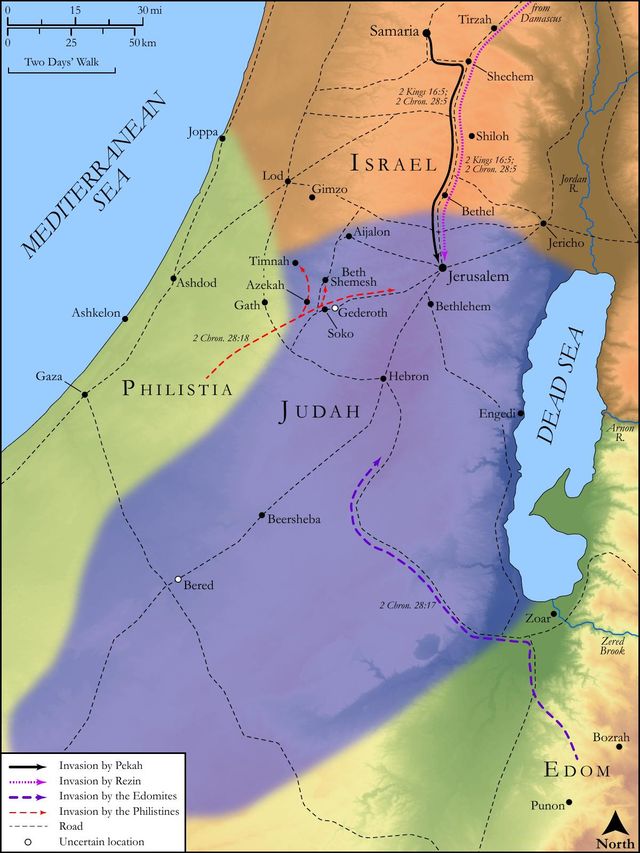
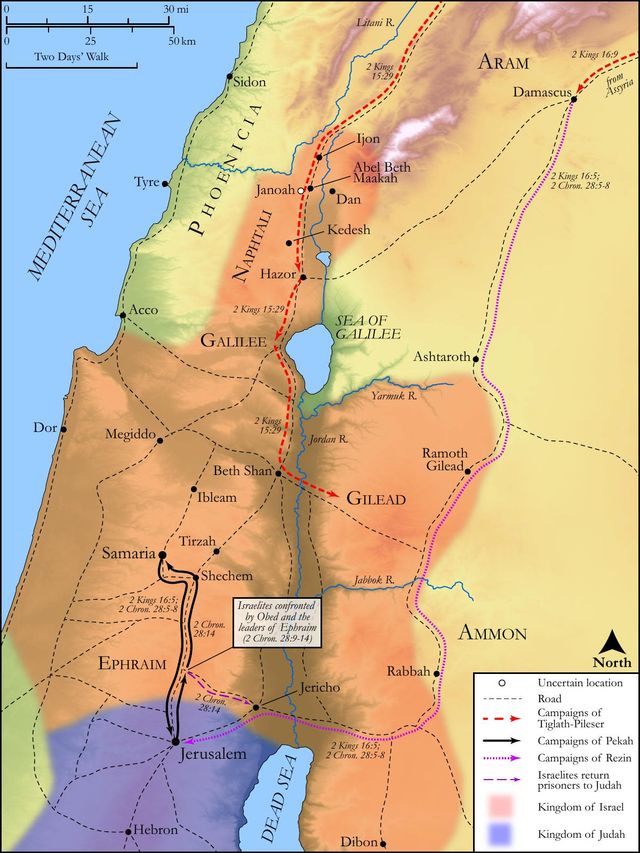
See on the biblical-era maps
Study this verse
Public-domain commentary
Matthew Henry
From his Commentary on the Whole Bible. Henry comments on passages, not single verses — this entry covers 2 Chronicles 28:16–27. His three-level outline is real structure in the source text, so it is rendered as structure.
Here is, I. The great distress which the kingdom of Ahaz was reduced to for his sin. In general, 1. The Lord brought Judah low, Ch2 28:19. They had lately been very high in wealth and power; but God found means to bring them down, and make them as despicable as they had been formidable. Those that will not humble themselves under the word of God will justly be humbled by his judgments. Iniquity brings men low, Psa 106:43. 2. Ahaz made Judah naked. As his sin debased them, so it exposed them. It made them naked to their shame; for it exposed them to contempt, as a man unclothed. It made them naked to their danger; for it exposed them to assaults, as a man unarmed, Exo 32:25. Sin strips men. In particular, the Edomites, to be revenged for Amaziah's cruel treatment of them (Ch2 25:12), smote Judah, and carried off many captives, Ch2 28:17. The Philistines also insulted them, took and kept possession of several cities and villages that lay near them (Ch2 28:18), and so they were revenged for the incursions which Uzziah had made upon them, Ch2 26:6. And, to show that it was purely the sin of Ahaz that brought the Philistines upon his country, in the very year that he died the prophet Isaiah foretold the destruction of the Philistines by his son, Isa 14:28, Isa 14:29.
II.The addition which Ahaz made both to the national distress and the national guilt.
1.He added to the distress, by making court to strange kings, in hopes they would relieve him. When the Edomites and Philistines were vexatious to him, he sent to the kings of Assyria to help him (Ch2 28:16); for he found his own kingdom weakened and made naked, and he could not put any confidence in God, and therefore was at a vast expense to get an interest in the king of Assyria. He pillaged the house of God, and the king's house, and squeezed the princes for money to hire these foreign forces into his service, Ch2 28:21. Though he had conformed to the idolatry of the heathen nations, his neighbours, they did not value him for that, nor love him the better, nor did his compliance, by which he lost God, gain them, nor could he make any interest in them, but with his money. It is often found that wicked men themselves have no real affection for those that revolt to them, nor do they care to do them a kindness. A degenerate branch is looked upon, on all sides, as an abominable branch, Isa 14:19. But what did Ahaz get by the king of Assyria? Why, he came to him, but he distressed him, and strengthened him not (Ch2 28:20), helped him not, Ch2 28:21. The forces of the Assyrian quartered upon his country, and so impoverished and weakened it; they grew insolent and imperious, and created him a great deal of vexation, like a broken reed, which not only fails, but pierces the hand.
2.He added to the guilt, by making court to strange gods, in hopes they would relieve him. In his distress, instead of repenting of his idolatry, which he had reason enough to see the folly of, he trespassed yet more (Ch2 28:22), was more mad than ever upon his idols. A brand of infamy is here set upon him for it: This is that king Ahaz, that wretched man, who was the scandal of the house of David and the curse and plague of his generation. Note, Those are wicked and vile indeed that are made worse by their afflictions, instead of being made better by them, who in their distress trespass yet more, have their corruptions exasperated by that which should mollify them, and their hearts more fully set in them to do evil. Let us see what his trespass was.
(1.)He abused the house of God; for he cut in pieces the vessels of it, that the priests might not perform the service of the temple, or not as it should be performed, for want of vessels; and, at length, he shut up the doors, that the people might not attend it, Ch2 28:24. This was worse than the worst of the kings before him had done.
(2.)He confronted the altar of God, for he made himself altars in every corner of Jerusalem; so that, as the prophet speaks, they were like heaps in the furrows of the fields, Hos 12:11. And in the cities of Judah, either by his power or by his purse, perhaps by both, he erected high places for the people to burn incense to what idols they pleased, as if on purpose to provoke the God of his fathers, Ch2 28:25.
(3.)He cast off God himself; for he sacrificed to the gods of Damascus (Ch2 28:23), not because he loved them, for he thought they smote him; but because he feared them, thinking that they helped his enemies, and that, if he could bring them into his interest, they would help him. Foolish man! It was his own God that smote him and strengthened the Syrians against him, not the gods of Damascus; had he sacrificed to him, and to him only, he would have helped him. But no marvel that men's affections and devotions are misplaced when they mistake the author of their trouble and their help. And what comes of it? The gods of Syria befriend Ahaz no more than the kings of Assyria did; they were the ruin of him and of all Israel. This sin provoked God to bring judgments upon them, to cut him off in the midst of his days, when he was but thirty-six years old; and it debauched the people so that the reformation of the next reign could not prevail to cure them of their inclination to idolatry, but they retained that root of bitterness till the captivity in Babylon plucked it up.
The chapter concludes with the conclusion of the reign of Ahaz, Ch2 28:26, Ch2 28:27. For aught that appears, he died impenitent, and therefore died inglorious; for he was not buried in the sepulchres of the kings. Justly was he thought unworthy to be laid among them who was so unlike them - to be buried with kings who had used his kingly power for the destruction of the church and not for its protection or edification.
Continue studying 2 Chronicles 28:27 across the web’s major study libraries — every link below opens this exact verse, chapter, or book on the destination site.
Read & Compare
 BibleGatewayThis verse in more than 200 translations and 70 languages.
 Bible.comThe YouVersion reader — hundreds of translations, reading plans, and highlights.
 ESV.orgCrossway's official English Standard Version reader.
 NET BibleThe NET translation with 60,000+ translators' notes on every rendering decision.
 STEP BibleTyndale House's free study tool — original text, vocabulary, and scholarly resources.
 BibliaLogos Bible Software's free web reader.
 USCCBThe New American Bible (Revised Edition) with the U.S. bishops' study notes.
Commentaries
 BibleHub CommentariesDozens of classic commentaries on this verse, gathered on one page.
 StudyLightMore than 100 commentary sets — the largest collection on the web.
 BibleRefPlain-English commentary on what this verse means, verse by verse.
 Enduring WordDavid Guzik's free commentary on this chapter, widely used by Bible teachers.
 Bible Study ToolsVerse commentary alongside Greek and Hebrew study aids.
Original Language & Research
- BibleHub InterlinearThe verse word by word — original language, transliteration, and English.
- BibleHub LexiconEvery word's original-language definition and Strong's entry.
 Blue Letter BibleDeep-study tools — Strong's numbers, concordance, and word studies.
 SefariaThe Hebrew text with Rashi and centuries of Jewish commentary.
Sermons, Hymns & Audio


TrulyRandomVerse is not affiliated with these sites and doesn’t control their content. They’re linked because they’re genuinely useful.
Summary
2 Chronicles 28:27 succinctly concludes the tumultuous reign of King Ahaz, detailing his death and a burial that conspicuously excluded him from the traditional royal sepulchres in Jerusalem, a profound and deliberate symbol of divine disfavor and national condemnation. This pivotal verse simultaneously announces the immediate accession of his son, Hezekiah, whose subsequent righteous rule would usher in a period of significant spiritual reform and restoration for Judah, thereby starkly juxtaposing the ignominious end of a wicked era with the dawn of a new, hopeful chapter.
Context
ShowHideLiterary Context
This verse serves as the concluding summary of King Ahaz's reign, which is extensively detailed in 2 Chronicles 28. The preceding narrative meticulously chronicles Ahaz's profound wickedness, including his adoption of abhorrent pagan worship practices, the horrific sacrifice of his own children, and his defiant closing of the doors of the temple of the Lord. His reign was marked by severe military defeats and national humiliation, which the Chronicler directly attributes to his apostasy and covenant disobedience. Verse 27, therefore, acts as a crucial transitional point, definitively closing the chapter on one of Judah's most ungodly kings and immediately preceding the account of Hezekiah's righteous reign, which commences with a dramatic call to spiritual renewal in 2 Chronicles 29. This stark contrast is central to the Chronicler's theological agenda, which consistently highlights the direct consequences of covenant disobedience (judgment) and the blessings that flow from faithfulness (restoration).
Historical & Cultural Context
King Ahaz ruled Judah from approximately 735-715 BC, a period of immense geopolitical instability dominated by the burgeoning power of the Neo-Assyrian Empire. In a profound display of fear and lack of faith, Ahaz chose to seek alliance with Assyria against the Syro-Ephraimite coalition, rather than placing his trust in the Lord, a decision famously recounted in Isaiah 7. This ill-advised political alignment led directly to the pervasive adoption of Assyrian religious practices and widespread idolatry within Judah, including the construction of pagan altars throughout Jerusalem and Judah, and even the detestable practice of child sacrifice, as explicitly noted in 2 Kings 16:3. The burial customs of Judean kings carried immense symbolic weight; most were interred in the revered royal sepulchres located on the Ophel hill in Jerusalem. Exclusion from these tombs, as seen with Ahaz and previously with King Jehoram, constituted a public and severe mark of dishonor, unequivocally signifying divine judgment and the people's condemnation of a king's unrighteous and destructive reign.
Key Themes
ShowHideThe primary theme powerfully underscored by Ahaz's death and burial is the consequences of unrighteous leadership and the certainty of divine judgment. Ahaz's deliberate rejection of the Mosaic covenant and his aggressive promotion of idolatry brought severe national distress, military defeat, and ultimately, profound personal disgrace even in death. His explicit exclusion from the royal tombs serves as a potent visual testament to God's disfavor and the immutable principle that leaders are held uniquely accountable for their actions and their pervasive influence on the spiritual trajectory of the nation. Conversely, the immediate mention of Hezekiah's succession introduces a profound theme of hope and divine faithfulness despite pervasive human failure. The Chronicler frequently emphasizes the cyclical pattern of apostasy leading to judgment and repentance leading to restoration, and Hezekiah's reign would dramatically embody this latter aspect, signaling a tangible potential for national renewal and a decisive return to covenant loyalty.
Exposition and Analysis
ShowHideKey Word Analysis
ShowHideThis primitive root signifies "to lie down," encompassing various purposes including rest, sexual connection, and significantly, decease. In the context of royalty, "slept with his fathers" is a common biblical euphemism for death, often implying a peaceful passing and joining one's ancestors. However, in Ahaz's case, the subsequent qualification regarding his burial place immediately negates any implication of an honorable or blessed end, underscoring the divine judgment upon his reign despite the common idiom.
This primitive word refers to a "father" in both literal and figurative senses, encompassing ancestors, chiefs, and progenitors. When a king "slept with his fathers," it typically denoted his death and integration into the royal lineage in the afterlife. For Ahaz, while he physically died and was succeeded by his son, the subsequent denial of burial in the royal sepulchres profoundly qualified this traditional phrase, indicating a severance from the honorable legacy of his righteous predecessors, despite his familial connection.
This term refers specifically to a "sepulchre," "burying place," or "grave." In the context of Judean kings, "the sepulchres of the kings of Israel" (or Judah) denotes the revered royal burial grounds, typically located on the Ophel ridge in Jerusalem. This was the customary and honorable resting place for most of Judah's monarchs, symbolizing their legitimate claim to the throne and their esteemed place in the dynastic line. Ahaz's explicit exclusion from these specific, hallowed tombs highlights the unique severity of the dishonor bestowed upon him, far beyond a mere burial within the city.
Verse Breakdown
ShowHide"And Ahaz slept with his fathers"
This standard biblical idiom marks the natural end of King Ahaz's life and reign. It serves as a conventional transition formula used for many monarchs in the books of Kings and Chronicles, setting the stage for the transfer of power.
"and they buried him in the city, [even] in Jerusalem"
This clause confirms that Ahaz received a burial within the capital city, which was a common practice for kings. It indicates that he was accorded a burial location befitting a monarch in terms of geography, but the subsequent clause immediately introduces a critical qualification.
"but they brought him not into the sepulchres of the kings of Israel"
This is the most crucial and distinctive element of the verse, signifying a deliberate and profound act of exclusion and dishonor. Unlike many of his predecessors and successors, Ahaz was explicitly denied burial in the revered royal tombs. This act was a public declaration of his unworthiness, a tangible manifestation of the divine judgment against his profound wickedness and apostasy, and a clear symbol of the nation's condemnation of his reign.
"and Hezekiah his son reigned in his stead"
This final clause signals the immediate and divinely ordained succession. The transition from Ahaz to Hezekiah is presented as seamless in terms of lineage, yet profoundly significant in terms of spiritual direction. It decisively closes the chapter on Ahaz's disastrous reign and simultaneously opens the door to the hopeful, righteous rule of Hezekiah, setting the stage for the major spiritual reforms and national restoration detailed in the subsequent chapters.
Literary Devices
ShowHideThe verse effectively employs several potent literary devices to convey its powerful and multifaceted message. Euphemism is evident in the phrase "slept with his fathers," which softens the harsh reality of death while simultaneously implying a continuity with the ancestral line. However, this traditional euphemism is immediately and powerfully undercut by a stark Contrast: Ahaz is buried "in the city" but pointedly not in "the sepulchres of the kings of Israel." This sharp juxtaposition highlights the unique and severe dishonor meted out to him. The burial site itself functions as profound Symbolism, where exclusion from the royal tombs becomes a powerful and public symbol of divine judgment and national condemnation, signifying a king deemed utterly unworthy of the honorable resting place of his righteous predecessors. Furthermore, the verse employs Foreshadowing by immediately introducing Hezekiah's succession. Given the Chronicler's overarching theological perspective, this swift transition from a wicked king to a righteous one implicitly foreshadows a period of spiritual revival and national restoration, offering a glimmer of hope after the pervasive darkness and apostasy of Ahaz's reign.
Theological and Thematic Connections
ShowHideThe account of Ahaz's death and burial in 2 Chronicles 28:27 powerfully underscores the immutable biblical principle of divine justice and accountability, particularly for those entrusted with positions of leadership. It unequivocally demonstrates that God holds rulers responsible for their actions, their faithfulness to His covenant, and their profound influence on the spiritual well-being of the nation. Ahaz's dishonorable burial serves as a tangible, public manifestation of God's severe disfavor and the dire consequences of persistent rebellion and idolatry. This theological truth resonates throughout the entirety of Scripture, emphasizing that true honor and a lasting legacy are not determined by earthly power or status, but by one's relationship with God and unwavering obedience to His divine commands. The immediate transition to Hezekiah's reign also highlights God's sovereign hand in raising up leaders and His enduring faithfulness to His covenant people, even when they have strayed far from His path.
Reflection and Application
ShowHideThe narrative of King Ahaz's ignominious end serves as a profound and sobering reminder that our choices, especially those made from positions of influence, carry immense and often lasting consequences. Ahaz's legacy was one of profound disgrace, not merely because of his personal failures, but because his unrighteous leadership led an entire nation astray, resulting in widespread suffering and divine judgment. For us today, this calls for a sober reflection on the kind of legacy we are actively building, not just for ourselves, but for all those we influence—whether within our families, communities, workplaces, or churches. Are our lives characterized by unwavering faithfulness to God's truth, or by compromise, self-serving ambition, or a casual disregard for spiritual principles? The stark contrast between Ahaz's shameful end and the hopeful beginning of Hezekiah's righteous reign also offers a powerful message of redemption and the transformative possibility of a fresh start. Even after periods of profound spiritual decline, God, in His boundless mercy, can raise up new leadership and bring about genuine renewal. This encourages us to continually examine our own hearts, repent sincerely of our sins, and actively pursue righteousness, trusting in God's sovereign grace to transform our lives and our influence for His ultimate glory.
Questions for Reflection
ShowHideFAQ
ShowHideWhy was Ahaz denied burial with the kings?
ShowHideAhaz was denied burial in the traditional sepulchres of the kings of Israel (Judah) due to his extreme wickedness and profound apostasy, which brought immense suffering and spiritual corruption upon the nation. Unlike many of his predecessors, Ahaz actively promoted pagan worship, including the horrific practice of child sacrifice (2 Chronicles 28:3), defiantly closed the temple of the Lord, and adopted the idolatrous practices of foreign nations, particularly Assyria (2 Chronicles 28:22-25). This exclusion from the royal tombs was a severe public dishonor, symbolizing divine judgment and the nation's profound condemnation of a king who had utterly failed in his covenant responsibilities and led his people far astray from God. It was a tangible mark of his disgrace, contrasting sharply with the honorable burials typically accorded to righteous kings.
What is the significance of Hezekiah's ascension immediately following Ahaz's death?
ShowHideThe immediate mention of Hezekiah's ascension is highly significant as it marks a pivotal turning point in Judah's history. Following Ahaz's profoundly unrighteous and destructive reign, Hezekiah's rule brought a dramatic and divinely orchestrated shift towards spiritual revival and national restoration. Hezekiah is consistently portrayed as one of Judah's most righteous kings, who, unlike his father, "did what was right in the eyes of the Lord, just as his father David had done" (2 Chronicles 29:2). His reign began with extensive and immediate religious reforms, including the reopening and cleansing of the temple, the restoration of proper worship, and the widespread breaking down of idolatrous altars and symbols throughout the land (2 Chronicles 29-31). Therefore, the swift transition from Ahaz to Hezekiah signifies God's enduring faithfulness to His covenant and His sovereign ability to raise up righteous leaders to bring about profound renewal, even after periods of profound national apostasy. It immediately introduces a powerful sense of hope and the promise of a fresh start for Judah.
Christ-Centered Fulfillment
ShowHideThe ignominious end of King Ahaz and the hopeful transition to Hezekiah's righteous reign in 2 Chronicles 28:27 beautifully foreshadow the ultimate contrast between the reign of sin and the perfect, eternal kingship of Jesus Christ. Ahaz, a king who tragically led his people into idolatry and brought about national disgrace and divine judgment, stands as a stark example of humanity's fallen leadership and the devastating consequences of rejecting God's covenant. His exclusion from the royal sepulchres symbolizes the ultimate spiritual alienation and eternal judgment that awaits all who persist in rebellion against God. In profound contrast, the hope that immediately emerges with Hezekiah, a king who initiated significant reforms and faithfully sought the Lord, points forward to the true and perfect King, Jesus Christ. Unlike Ahaz, whose reign ended in shame and dishonor, Jesus, the Son of David, came not to lead His people into sin, but to powerfully deliver them from its dominion. His perfect obedience, sinless life, and sacrificial death on the cross secured for us a place in the true "sepulchre" of eternal life, a spiritual inheritance infinitely greater than any earthly tomb. While Ahaz's physical burial was marked by profound dishonor, Christ's burial was temporary, leading to His glorious resurrection and triumphant ascension, signifying His complete and decisive victory over sin, death, and the grave (Romans 6:9-10). He is the King who truly reigns in perfect righteousness, establishing an everlasting kingdom where His followers will never be excluded but will dwell securely in His glorious presence forever (Revelation 11:15). Thus, Ahaz's story, ending in judgment and disgrace, serves to amplify the profound grace, perfect reign, and eternal glory of our Lord Jesus Christ, the King who secures an honorable and eternal resting place for all who believe in Him and follow His righteous path (John 14:2-3).