


2 Chronicles 29:1
Bible text: King James Version (1769 Blayney text) · Public domain
Bible text: King James Version with Strong's numbers · Public domain
Bible text: Berean Standard Bible · Public domain
Bible text: American Standard Version (1901) · Public domain
Bible text: World English Bible, Messianic edition · Public domain
Bible text: Geneva Bible (1599) · Public domain
Bible text: Young's Literal Translation · Public domain
- יְחִזְקִיָּהוּye·chiz·ki·Ya·huHezekiahH2396N-proper-mNoun Proper Masculine
- מָלַךְma·Lakhhe became kingH4427V-Qal-Perf-3msVerb Qal Perfect 3rd Singular Masculine
- בֶּןbena son ofH1121N-mscNoun Singular Masculine Construct
- עֶשְׂרִים'es·RimtwentyH6242N-mpNoun Plural Masculine Absolute
- וְחָמֵשׁve·cha·Meshand fiveH2568Conj-w ¦ N-csNoun Singular common gender Absoluteוְandחָמֵשׁfive
- שָׁנָהsha·Nahyear[s]H8141N-fsNoun Singular Feminine Absolute
- וְעֶשְׂרִיםve·'es·Rimand twentyH6242Conj-w ¦ N-mpNoun Plural Masculine Absoluteוְandעֶשְׂרִיםtwenty
- וָתֵשַׁעva·Te·sha'and nineH8672Conj-w ¦ N-csNoun Singular common gender Absoluteוָandתֵשַׁעnine
- שָׁנָהsha·Nahyear[s]H8141N-fsNoun Singular Feminine Absolute
- מָלַךְma·Lakhhe reignedH4427V-Qal-Perf-3msVerb Qal Perfect 3rd Singular Masculine
- בִּירוּשָׁלִָםbi·ru·sha·Limin JerusalemH3389Prep-b ¦ N-properNoun Proper LocationבִּinירוּשָׁלִָםJerusalem
- וְשֵׁםve·Shemand [the] name ofH8034Conj-w ¦ N-mscNoun Singular Masculine Constructוְandשֵׁם[the] name of
- אִמּוֹ'i·Mohis motherH517N-fsc ¦ 3msNoun Singular Feminine Constructאִמּmotherוֹhis
- אֲבִיָּה'a·vi·Yah[was] AbijahH29N-proper-mNoun Proper Masculine
- בַּתbat[the] daughter ofH1323N-fscNoun Singular Feminine Construct
- זְכַרְיָהוּze·khar·Ya·huZechariahH2148N-proper-mNoun Proper Masculine
English is a literal word-by-word gloss of the Hebrew, not the KJV's wording. Why?
This is the original text the KJV's translators worked from — each Hebrew word with its own literal English meaning in this verse, prepared by scholars at Tyndale House, Cambridge. The KJV translates whole sentences, not word by word, so its wording differs: one Hebrew word can become several English words, and the KJV may choose “the LORD” where the gloss reads “Yahweh”. Both are faithful — they answer different questions. For the KJV's own rendering, switch to the KJV text.
Details
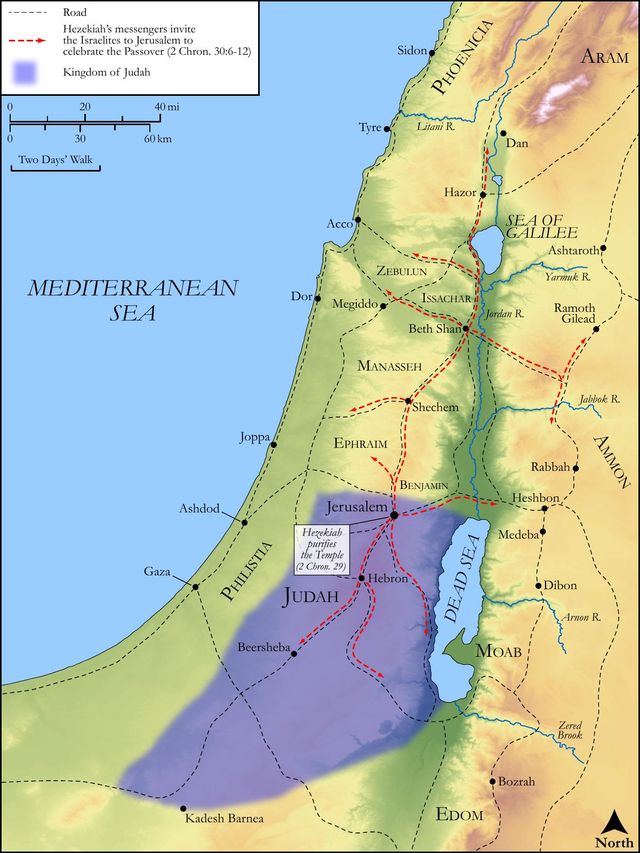
See on the biblical-era map
Study this verse
Public-domain commentary
Matthew Henry
From his Commentary on the Whole Bible. Henry comments on passages, not single verses — this entry covers 2 Chronicles 29:1–11. His three-level outline is real structure in the source text, so it is rendered as structure.
Here is, I. Hezekiah's age when he came to the crown. He was twenty-five years old. Joash, who came to the crown after two bad reigns, was but seven years old; Josiah, who came after two bad reigns, was but eight, which occasioned the delay of the reformation; but Hezekiah had come to years, and so applied himself immediately to it. We may well think with what a sorrowful heart he beheld his father's idolatry and profaneness, how it troubled him to see the doors of the temple shut, though, while his father lived, he durst not open them. His soul no doubt wept in secret for it, and he vowed that when he should receive the congregation he would redress these grievances, which made him do it with more readiness and resolution.
II.His general character.
He did that which was right like David, Ch2 29:2. Of several of his predecessors it had been said that they did that which was right, but not like David, not with David's integrity and zeal. But here was one that had as hearty an affection for the ark and law of God as ever David had.
III.His speedy application to the great work of restoring religion.
The first thing he did was to open the doors of the house of the Lord, Ch2 29:3. We are willing to hope his father had not quite suppressed the temple service; for then the holy fire on the altar must have gone out, and we do not read of the re-kindling of it; but he had hindered the people from attending it, and the priests, except such of them as were of his own party, Kg2 16:15. But Hezekiah immediately threw the church doors open, and brought in the priests and Levites. He found Judah low and naked, yet did not make it his first business to revive the civil interests of his kingdom, but to restore religion to its good posture again. Those that begin with God begin at the right end of their work, and it will prosper accordingly.
IV.His speech to the priests and Levites.
It was well known, no doubt, that he had a real kindness for religion and was disaffected to the corruptions of the last reign; yet we do not find the priests and Levites making application to him for the restoration of the temple service but he calls upon them, which, I doubt, bespeaks their coldness as much as his zeal; and perhaps, if they had done their part with vigour, things would not have been brought into so very bad a posture as Hezekiah found them in. Hezekiah's exhortation to the Levites is very pathetic.
1.He laid before them the desolations of religion and the deplorable state to which it was brought among them (Ch2 29:6, Ch2 29:7): Our fathers have trespassed. He said not "My father," because it became him, as a son, to be as tender as might be of his father's name, and because his father would not have done all this if their fathers had not neglected their duty. Urijah the priest had joined with Ahaz in setting up an idolatrous altar. He complained,
(1.)That the house of God had been deserted: They have forsaken God, and turned their backs upon his habitation. Note, Those that turn their backs upon God's ordinances may truly be said to forsake God himself.
(2.)That the instituted worship of God there had been let fall. The lamps were not lighted, and incense was not burnt. There are still such neglects as these, and they are no less culpable, when the word is not duly read and opened (for that was signified by the lighting of the lamps) and when prayers and praises are not duly offered up, for that was signified by the burning of incense.
2.He showed the sad consequences of the neglect and decay of religion among them, Ch2 29:8. 9. This was the cause of all the calamities they had lain under. God had in anger delivered them to trouble, to the sword, and to captivity. When we are under the rebukes of God's providence it is good for us to enquire whether we have not neglected God's ordinances and whether the controversy he has with us may not be traced to this neglect.
3.He declared his own full purpose and resolution to revive religion and make it his business to promote it (Ch2 29:10): "It is in my heart (that is, I am fully resolved) to make a covenant with the Lord God of Israel (that is, to worship him only, and in that way which he has appointed); for I am sure that, otherwise, his fierce anger will not turn away from us." This covenant he would not only make himself, but bring his people into the bond of.
4.He engaged and excited the Levites and priests to do their duty on this occasion. This he begins with (Ch2 29:5); this he ends with, Ch2 29:11. He called them Levites to remind them of their obligation to God, called them his sons to remind them of the relation to himself, that he expected that, as a son with the father, they should serve with him in the reformation of the land. (1.) he told them what was their duty, to sanctify themselves first (by repenting of their neglects, reforming their own hearts and lives, and renewing their covenants with God to do their duty better for the time to come), and then to sanctify the house of God, as his servants, to make it clean from every thing that was disagreeable, either through the disuse or the profanation of it, and to set it up for the purposes for which it was made. (2.) He stirred them up to do it (Ch2 29:11): "Be not now negligent, or remiss, in your duty. Let not this good work be retarded through your carelessness." Be not deceived, so the margin. Note, Those that by their negligence in the service of God think to mock God, and put a cheat upon him, do but deceive themselves, and put a damning cheat upon their own souls. Be not secure (so some), as if there were no urgent call to do it or no danger in not doing it. Note, Men's negligence in religion is owing to their carnal security. The consideration he quickens them with is derived from their office. God had herein put honour upon them: He has chosen you to stand before him. God therefore expected work from them. They were not chosen to be idle, to enjoy the dignity and leave the duty to be done by others, but to serve him and to minister to him. They must therefore be ashamed of their late remissness, and, now that the doors of the temple were opened again, must set about their work with double diligence.
Continue studying 2 Chronicles 29:1 across the web’s major study libraries — every link below opens this exact verse, chapter, or book on the destination site.
Read & Compare
 BibleGatewayThis verse in more than 200 translations and 70 languages.
 Bible.comThe YouVersion reader — hundreds of translations, reading plans, and highlights.
 ESV.orgCrossway's official English Standard Version reader.
 NET BibleThe NET translation with 60,000+ translators' notes on every rendering decision.
 STEP BibleTyndale House's free study tool — original text, vocabulary, and scholarly resources.
 BibliaLogos Bible Software's free web reader.
 USCCBThe New American Bible (Revised Edition) with the U.S. bishops' study notes.
Commentaries
 BibleHub CommentariesDozens of classic commentaries on this verse, gathered on one page.
 StudyLightMore than 100 commentary sets — the largest collection on the web.
 BibleRefPlain-English commentary on what this verse means, verse by verse.
 Enduring WordDavid Guzik's free commentary on this chapter, widely used by Bible teachers.
 Bible Study ToolsVerse commentary alongside Greek and Hebrew study aids.
Original Language & Research
- BibleHub InterlinearThe verse word by word — original language, transliteration, and English.
- BibleHub LexiconEvery word's original-language definition and Strong's entry.
 Blue Letter BibleDeep-study tools — Strong's numbers, concordance, and word studies.
 SefariaThe Hebrew text with Rashi and centuries of Jewish commentary.
Sermons, Hymns & Audio


TrulyRandomVerse is not affiliated with these sites and doesn’t control their content. They’re linked because they’re genuinely useful.
Summary
Second Chronicles 29:1 serves as the formal introduction to King Hezekiah, marking the commencement of his reign over Judah. This foundational verse establishes his age at ascension, the duration and location of his rule, and the identity of his mother, Abijah, daughter of Zechariah. It subtly signals a pivotal transition in the kingdom's history, moving from the profound apostasy of his father, Ahaz, towards a period of significant spiritual revival and reform under a king who would largely walk in the ways of the Lord.
Context
ShowHideLiterary Context
This verse immediately follows the bleak account of King Ahaz's wicked reign in 2 Chronicles 28, a period characterized by idolatry, child sacrifice, and the desecration of the temple. The abrupt shift to Hezekiah's introduction in 2 Chronicles 29:1 creates a stark contrast, signaling a new era. The subsequent verses in 2 Chronicles 29 detail Hezekiah's immediate and decisive actions to cleanse and reopen the temple, re-establish proper worship, and restore the Levitical priesthood, demonstrating his commitment to reversing the spiritual decline. This introductory verse, therefore, functions as a narrative hinge, pivoting the story from national apostasy to national revival.
Historical & Cultural Context
Hezekiah ascended the throne of Judah around 715 BC, a tumultuous period among the nations round about. The powerful Assyrian Empire was at its zenith, exerting significant influence and often demanding tribute from smaller nations like Judah. His father, Ahaz, had sought Assyrian protection, leading to the introduction of pagan altars and practices into Jerusalem, even within the temple precincts (2 Kings 16:10-18). Culturally, the mention of the king's mother and her father was a common practice in biblical accounts of Judahite kings, providing legitimacy and sometimes hinting at the queen mother's influence or the family's spiritual standing. Abijah's father, Zechariah, is not otherwise identified, but the mention suggests a lineage that might have been more faithful than Ahaz's.
Key Themes
ShowHideThe introduction of Hezekiah immediately ushers in several crucial themes that will dominate his reign. Primarily, it highlights the theme of righteous leadership as a catalyst for national spiritual renewal, contrasting sharply with the destructive leadership of Ahaz. His reign embodies the possibility of restoration and reform after periods of profound apostasy, demonstrating God's faithfulness to His covenant people even when they stray. The emphasis on his age and the duration of his reign underscores the sovereignty of God in raising up individuals at specific times to fulfill His purposes, providing a beacon of hope for Judah amidst the encroaching shadows of Assyrian power and internal spiritual decay. This verse sets the stage for the dramatic spiritual awakening detailed in 2 Chronicles 29-31.
Exposition and Analysis
ShowHideKey Word Analysis
ShowHideThe name means "strengthened of Jah" (Yahweh). This is profoundly significant, as it foreshadows the divine enablement that would empower Hezekiah to undertake massive spiritual reforms and successfully resist the formidable Assyrian Empire. His very name declares the source of his strength and the providential hand of God in his reign.
This verb signifies "to reign," "to ascend the throne," or "to be inducted into royalty." Its use here formally marks the commencement of Hezekiah's divinely appointed kingship, emphasizing the transfer of authority and the beginning of his official duties as Judah's monarch. It underscores his role as the next leader in the Davidic line, called to rule God's people.
This name, likely meaning "founded peaceful," identifies the capital city where Hezekiah's reign was centered. Jerusalem was not merely a political hub but the spiritual heart of Judah, housing the temple. Hezekiah's reforms would specifically target the spiritual health of this city, aiming to restore its foundational peace through renewed covenant faithfulness to Yahweh.
Verse Breakdown
ShowHide"Hezekiah began to reign [when he was] five and twenty years old"
This clause establishes Hezekiah's age at the commencement of his rule. At 25, he was a relatively young man, yet he immediately demonstrated maturity and conviction by embarking on radical reforms. His youth highlights the remarkable spiritual courage and initiative he possessed, especially in light of his father's destructive legacy. It suggests that age is not a barrier to righteous leadership and decisive action for God.
"and he reigned nine and twenty years in Jerusalem"
This provides the duration and location of his reign. Twenty-nine years is a substantial period, allowing for significant impact and sustained reform. The specification "in Jerusalem" underscores the centralized nature of the Judahite monarchy and the spiritual significance of the city as the dwelling place of God's temple. His reign would be centered on restoring the spiritual integrity of the capital.
"And his mother's name [was] Abijah, the daughter of Zechariah"
The inclusion of the queen mother's name and her father's lineage is a standard feature in the Chronicler's account of Judahite kings. It serves to legitimate the king's claim to the throne and sometimes provides insight into potential influences on the king. In Hezekiah's case, while his father Ahaz was wicked, his mother's lineage, "daughter of Zechariah," might hint at a more godly influence, perhaps from a priestly or prophetic background, which could have shaped Hezekiah's early spiritual development and commitment to Yahweh.
Literary Devices
ShowHideThe verse primarily employs Genealogical Marker and Foreshadowing. The mention of Hezekiah's age, reign duration, and his mother's lineage is a standard Genealogical Marker common in the books of Kings and Chronicles, serving to formally introduce a new monarch and establish their place within the historical record. This seemingly simple introduction also functions as a powerful act of Foreshadowing. By immediately following the dismal account of Ahaz, Hezekiah's introduction, especially with his name meaning "Yahweh strengthens," subtly foreshadows the dramatic and positive shift in Judah's spiritual trajectory that his reign will bring. It sets the expectation for a king who will be radically different from his predecessor, hinting at the coming spiritual revival and the Lord's intervention.
Theological and Thematic Connections
ShowHide2 Chronicles 29:1, while a simple introduction, carries profound theological weight. It demonstrates God's enduring faithfulness to His covenant with David, even when the human kings fail spectacularly. Despite the deep spiritual apostasy under Ahaz, God, in His sovereign providence, raises up a righteous successor in Hezekiah. This highlights the theme of divine grace and the possibility of national repentance and renewal. It underscores that God's plans are not thwarted by human sin but that He can always raise up agents of change to call His people back to Himself. The verse sets the stage for a narrative that will powerfully illustrate the blessings of obedience and the transformative power of a leader committed to God's ways.
Reflection and Application
ShowHideThe introduction of King Hezekiah in this verse serves as a powerful reminder that even in the darkest of times, when spiritual and moral decay seem pervasive, God can raise up individuals to initiate profound change. Hezekiah inherited a kingdom steeped in idolatry and spiritual compromise, yet he did not succumb to the inertia of the past. Instead, his immediate actions, detailed in the subsequent verses, demonstrate a courageous commitment to reversing the tide of ungodliness. For believers today, this story encourages us not to be paralyzed by the challenges or the negative legacies we might inherit, whether in our families, communities, or broader society. It calls us to be agents of reform and renewal, to seek God's strength, and to act decisively in accordance with His will, trusting that even one righteous individual can spark a spiritual awakening and lead others back to the true worship of God.
Questions for Reflection
ShowHideFAQ
ShowHideWhy is the king's mother's name mentioned in biblical accounts?
ShowHideThe mention of the king's mother's name, especially in the books of Kings and Chronicles, serves several purposes. Firstly, it was a standard genealogical practice, establishing the king's lineage and legitimacy within the royal house, particularly important for the Davidic dynasty. Secondly, the queen mother often held a significant and influential position in the royal court, sometimes even acting as a regent or advisor. Her identity could therefore shed light on the king's background, upbringing, or potential influences. In Hezekiah's case, while his father Ahaz was notoriously wicked (2 Chronicles 28:1-5), the mention of his mother Abijah, daughter of Zechariah, might subtly suggest a more godly influence from her side of the family, perhaps contributing to Hezekiah's own righteous character and his immediate commitment to Yahweh.
Christ-Centered Fulfillment
ShowHideHezekiah's introduction as a righteous king who brings about spiritual renewal serves as a powerful type and shadow of Jesus Christ. Just as Hezekiah ascended the throne to reverse the spiritual decay of Judah and cleanse the temple, so Jesus, the ultimate King from the line of David, came to cleanse the spiritual temple of humanity and establish a new covenant of righteousness. Hezekiah's name, "Yahweh strengthens," points to the divine strength that empowered his reforms, a strength fully embodied in Christ, who is God Himself. While Hezekiah's reforms were temporal and limited, Jesus's work on the cross achieved eternal redemption and spiritual cleansing for all who believe, ushering in a reign of true and lasting righteousness (Hebrews 9:11-14). Hezekiah's zeal for God's house (2 Chronicles 29:3-5) foreshadows Christ's own zeal in cleansing the temple, declaring it a house of prayer for all nations (Mark 11:15-17). Ultimately, Hezekiah's reign, marked by a return to covenant faithfulness and a period of peace, points forward to the perfect and eternal reign of Jesus, the King of kings, who truly takes away the sin of the world and establishes His kingdom of righteousness and peace forever (Revelation 19:16 and Isaiah 9:6-7).