


2 Chronicles 29:5
Bible text: King James Version (1769 Blayney text) · Public domain
Bible text: King James Version with Strong's numbers · Public domain
Bible text: Berean Standard Bible · Public domain
Bible text: American Standard Version (1901) · Public domain
Bible text: World English Bible, Messianic edition · Public domain
Bible text: Geneva Bible (1599) · Public domain
Bible text: Young's Literal Translation · Public domain
- וַיֹּאמֶרvai·Yo·merand he saidH559Conj-w ¦ V-Qal-ConsecImperf-3msVerb Qal Consecutive Imperfect 3rd Singular Masculineוַandיֹּאמֶרhe said
- לָהֶםla·Hemto themPrep-l ¦ 3mpSuffix Personal 3rd Plural Masculineלָtoהֶםthem
- שְׁמָעוּנִיshe·ma·'U·nilisten to meH8085V-Qal-Imp-2mp ¦ 1csVerb Qal Imperative 2nd Plural Masculineשְׁמָעוּlisten toנִיme
- הַלְוִיִּםhal·vi·YimO LevitesH3881Art ¦ N-mpNoun Gentilic Plural Masculine AbsoluteהַOלְוִיִּםLevites
- עַתָּה'a·TahnowH6258AdvAdverb
- הִתְקַדְּשׁוּhit·ka·de·Shuconsecrate yourselvesH6942V-Hithpael-Imp-2mpVerb Hithpael Imperative 2nd Plural Masculine
- וְקַדְּשׁוּve·ka·de·Shuand consecrateH6942Conj-w ¦ V-Piel-Imp-2mpVerb Piel Imperative 2nd Plural Masculineוְandקַדְּשׁוּconsecrate
- אֶת'et<obj.>H853DirObjMParticle Object Indicator
- בֵּיתbeit[the] house ofH1004N-mscNoun Singular Masculine Construct
- יְהוָהYah·wehYahwehH3068N-properNoun Proper Title
- אֱלֹהֵי'e·lo·Hei[the] God ofH430N-mpcNoun Plural Masculine Construct
- אֲבֹתֵיכֶם'a·vo·tei·Khemyour ancestorsH1N-fpc ¦ 2mpNoun Plural Feminine Constructאֲבֹתֵיancestorsכֶםyour
- וְהוֹצִיאוּve·ho·Tzi·'uand bring outH3318Conj-w ¦ V-Hiphil-Imp-2mpVerb Hiphil Imperative 2nd Plural Masculineוְandהוֹצִיאוּbring out
- אֶת'et<obj.>H853DirObjMParticle Object Indicator
- הַנִּדָּהha·ni·Dahthe impurityH5079Art ¦ N-fsNoun Singular Feminine Absoluteהַtheנִּדָּהimpurity
- מִןminfromH4480PrepPreposition
- הַקֹּדֶשׁha·Ko·deshthe holy placeH6944Art ¦ N-msNoun Title Singular Masculine Absoluteהַtheקֹּדֶשׁholy place
English is a literal word-by-word gloss of the Hebrew, not the KJV's wording. Why?
This is the original text the KJV's translators worked from — each Hebrew word with its own literal English meaning in this verse, prepared by scholars at Tyndale House, Cambridge. The KJV translates whole sentences, not word by word, so its wording differs: one Hebrew word can become several English words, and the KJV may choose “the LORD” where the gloss reads “Yahweh”. Both are faithful — they answer different questions. For the KJV's own rendering, switch to the KJV text.
Details
See on the biblical-era map
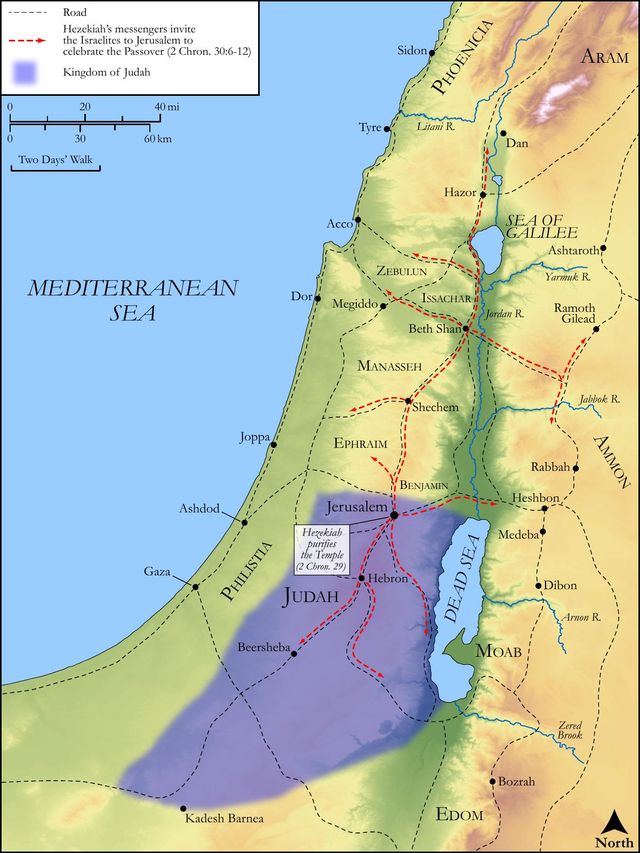
Study this verse
Public-domain commentary
Matthew Henry
From his Commentary on the Whole Bible. Henry comments on passages, not single verses — this entry covers 2 Chronicles 29:1–11. His three-level outline is real structure in the source text, so it is rendered as structure.
Here is, I. Hezekiah's age when he came to the crown. He was twenty-five years old. Joash, who came to the crown after two bad reigns, was but seven years old; Josiah, who came after two bad reigns, was but eight, which occasioned the delay of the reformation; but Hezekiah had come to years, and so applied himself immediately to it. We may well think with what a sorrowful heart he beheld his father's idolatry and profaneness, how it troubled him to see the doors of the temple shut, though, while his father lived, he durst not open them. His soul no doubt wept in secret for it, and he vowed that when he should receive the congregation he would redress these grievances, which made him do it with more readiness and resolution.
II.His general character.
He did that which was right like David, Ch2 29:2. Of several of his predecessors it had been said that they did that which was right, but not like David, not with David's integrity and zeal. But here was one that had as hearty an affection for the ark and law of God as ever David had.
III.His speedy application to the great work of restoring religion.
The first thing he did was to open the doors of the house of the Lord, Ch2 29:3. We are willing to hope his father had not quite suppressed the temple service; for then the holy fire on the altar must have gone out, and we do not read of the re-kindling of it; but he had hindered the people from attending it, and the priests, except such of them as were of his own party, Kg2 16:15. But Hezekiah immediately threw the church doors open, and brought in the priests and Levites. He found Judah low and naked, yet did not make it his first business to revive the civil interests of his kingdom, but to restore religion to its good posture again. Those that begin with God begin at the right end of their work, and it will prosper accordingly.
IV.His speech to the priests and Levites.
It was well known, no doubt, that he had a real kindness for religion and was disaffected to the corruptions of the last reign; yet we do not find the priests and Levites making application to him for the restoration of the temple service but he calls upon them, which, I doubt, bespeaks their coldness as much as his zeal; and perhaps, if they had done their part with vigour, things would not have been brought into so very bad a posture as Hezekiah found them in. Hezekiah's exhortation to the Levites is very pathetic.
1.He laid before them the desolations of religion and the deplorable state to which it was brought among them (Ch2 29:6, Ch2 29:7): Our fathers have trespassed. He said not "My father," because it became him, as a son, to be as tender as might be of his father's name, and because his father would not have done all this if their fathers had not neglected their duty. Urijah the priest had joined with Ahaz in setting up an idolatrous altar. He complained,
(1.)That the house of God had been deserted: They have forsaken God, and turned their backs upon his habitation. Note, Those that turn their backs upon God's ordinances may truly be said to forsake God himself.
(2.)That the instituted worship of God there had been let fall. The lamps were not lighted, and incense was not burnt. There are still such neglects as these, and they are no less culpable, when the word is not duly read and opened (for that was signified by the lighting of the lamps) and when prayers and praises are not duly offered up, for that was signified by the burning of incense.
2.He showed the sad consequences of the neglect and decay of religion among them, Ch2 29:8. 9. This was the cause of all the calamities they had lain under. God had in anger delivered them to trouble, to the sword, and to captivity. When we are under the rebukes of God's providence it is good for us to enquire whether we have not neglected God's ordinances and whether the controversy he has with us may not be traced to this neglect.
3.He declared his own full purpose and resolution to revive religion and make it his business to promote it (Ch2 29:10): "It is in my heart (that is, I am fully resolved) to make a covenant with the Lord God of Israel (that is, to worship him only, and in that way which he has appointed); for I am sure that, otherwise, his fierce anger will not turn away from us." This covenant he would not only make himself, but bring his people into the bond of.
4.He engaged and excited the Levites and priests to do their duty on this occasion. This he begins with (Ch2 29:5); this he ends with, Ch2 29:11. He called them Levites to remind them of their obligation to God, called them his sons to remind them of the relation to himself, that he expected that, as a son with the father, they should serve with him in the reformation of the land. (1.) he told them what was their duty, to sanctify themselves first (by repenting of their neglects, reforming their own hearts and lives, and renewing their covenants with God to do their duty better for the time to come), and then to sanctify the house of God, as his servants, to make it clean from every thing that was disagreeable, either through the disuse or the profanation of it, and to set it up for the purposes for which it was made. (2.) He stirred them up to do it (Ch2 29:11): "Be not now negligent, or remiss, in your duty. Let not this good work be retarded through your carelessness." Be not deceived, so the margin. Note, Those that by their negligence in the service of God think to mock God, and put a cheat upon him, do but deceive themselves, and put a damning cheat upon their own souls. Be not secure (so some), as if there were no urgent call to do it or no danger in not doing it. Note, Men's negligence in religion is owing to their carnal security. The consideration he quickens them with is derived from their office. God had herein put honour upon them: He has chosen you to stand before him. God therefore expected work from them. They were not chosen to be idle, to enjoy the dignity and leave the duty to be done by others, but to serve him and to minister to him. They must therefore be ashamed of their late remissness, and, now that the doors of the temple were opened again, must set about their work with double diligence.
Continue studying 2 Chronicles 29:5 across the web’s major study libraries — every link below opens this exact verse, chapter, or book on the destination site.
Read & Compare
 BibleGatewayThis verse in more than 200 translations and 70 languages.
 Bible.comThe YouVersion reader — hundreds of translations, reading plans, and highlights.
 ESV.orgCrossway's official English Standard Version reader.
 NET BibleThe NET translation with 60,000+ translators' notes on every rendering decision.
 STEP BibleTyndale House's free study tool — original text, vocabulary, and scholarly resources.
 BibliaLogos Bible Software's free web reader.
 USCCBThe New American Bible (Revised Edition) with the U.S. bishops' study notes.
Commentaries
 BibleHub CommentariesDozens of classic commentaries on this verse, gathered on one page.
 StudyLightMore than 100 commentary sets — the largest collection on the web.
 BibleRefPlain-English commentary on what this verse means, verse by verse.
 Enduring WordDavid Guzik's free commentary on this chapter, widely used by Bible teachers.
 Bible Study ToolsVerse commentary alongside Greek and Hebrew study aids.
Original Language & Research
- BibleHub InterlinearThe verse word by word — original language, transliteration, and English.
- BibleHub LexiconEvery word's original-language definition and Strong's entry.
 Blue Letter BibleDeep-study tools — Strong's numbers, concordance, and word studies.
 SefariaThe Hebrew text with Rashi and centuries of Jewish commentary.
Sermons, Hymns & Audio


TrulyRandomVerse is not affiliated with these sites and doesn’t control their content. They’re linked because they’re genuinely useful.
Summary
King Hezekiah, in the nascent stages of his reign, issues a foundational decree to the Levites, initiating a sweeping spiritual revival across Judah. This pivotal command underscores his immediate and paramount objective: to meticulously purify and restore the Temple of the LORD, which had been egregiously defiled and neglected under his predecessor, thereby re-establishing proper worship and covenant fidelity.
Context
ShowHideLiterary Context
This verse marks a critical turning point in the narrative of Judah's spiritual decline and subsequent restoration. It immediately follows the declaration that Hezekiah began his reign by opening and repairing the doors of the house of the LORD in the very first month of his first year, as recorded in 2 Chronicles 29:3. The preceding chapters, particularly 2 Chronicles 28, vividly depict the apostasy of Hezekiah's father, King Ahaz, who not only shut the Temple doors but also erected altars to foreign gods throughout Jerusalem and Judah, leading to widespread idolatry and national humiliation, as detailed in 2 Chronicles 28:24-25. Hezekiah's command to the Levites in verse 5 is therefore not merely a directive but a clarion call to reverse generations of spiritual decay, setting the stage for the comprehensive cleansing and rededication of the Temple described in the subsequent verses of 2 Chronicles 29.
Historical & Cultural Context
The historical backdrop is one of profound national crisis and spiritual compromise. Judah, under Ahaz, had become a servant of Assyria, adopting foreign religious practices in a desperate attempt to secure political alliances. This syncretism led to the desecration of the Temple, the heart of Israelite worship and the symbol of God's dwelling among His people. Culturally, the Levites held a hereditary and divinely appointed role as ministers of the Temple, responsible for its upkeep, sacrificial rites, and the teaching of the Law. Their defilement or neglect of duty was tantamount to national spiritual sickness. Hezekiah's immediate summoning of them underscores his understanding of their crucial role in mediating between God and the people, and his recognition that the spiritual health of the nation was inextricably linked to the purity of its worship space and its ministers. The concept of "sanctify" (Hebrew: qadash) was deeply embedded in Israelite thought, signifying a separation from the profane and a dedication to the sacred, essential for maintaining covenant fidelity and God's presence.
Key Themes
ShowHideThis verse encapsulates several major themes central to the book of Chronicles and the broader Old Testament narrative. Firstly, it highlights the theme of Restoration and Revival, demonstrating Hezekiah's commitment to reversing the spiritual decline of his father's reign and re-establishing proper worship according to the Mosaic Law. His actions initiate one of the most significant revivals in Judah's history, emphasizing that genuine national renewal begins with a return to God. Secondly, the verse underscores the critical importance of Sanctification and Purity, both personal and corporate. The command for the Levites to "sanctify yourselves" before sanctifying the Temple emphasizes that inward purity is a prerequisite for outward service and worship. This principle is foundational to biblical ethics, asserting that God demands holiness from those who approach Him. Thirdly, it illustrates the Responsibility of Leadership and Priesthood. Hezekiah, as king, takes decisive action, while the Levites, as spiritual leaders, are held accountable for their sacred duty to maintain the sanctity of God's house and guide the people in worship. Their obedience or disobedience directly impacts the spiritual well-being of the nation, as seen throughout the history of Israel in 1 and 2 Kings and 1 and 2 Chronicles. Finally, the "filthiness" in the Temple serves as a stark reminder of the Consequences of Apostasy and Neglect, demonstrating how spiritual compromise inevitably leads to defilement and separation from God's blessing.
Exposition and Analysis
ShowHideKey Word Analysis
ShowHideThis verb (H6942), used twice in the verse ("sanctify now yourselves, and sanctify the house"), means "to make holy," "to consecrate," "to set apart for sacred use," or "to purify." Its repetition emphasizes the comprehensive nature of the required cleansing. For the Levites, it meant ritual purification (e.g., washing, abstaining from defilement) and spiritual dedication, ensuring they were ceremonially and morally fit to approach God and handle sacred objects. For the Temple, it meant removing all defiling elements and rededicating it exclusively for the worship of Yahweh, restoring its sacred status.
This noun (H5079) specifically refers to ritual impurity, often associated with menstrual uncleanness, but broadly encompassing anything considered abhorrent, abominable, or defiling in a religious sense. Its use here vividly portrays the severe spiritual and physical defilement of the Temple under Ahaz. It suggests not merely dirt and disrepair, but the presence of idols, pagan altars, and the lingering spiritual pollution from idolatrous practices, rendering the sacred space unfit for God's holy presence.
Verse Breakdown
ShowHide"And said unto them, Hear me, ye Levites"
Hezekiah directly addresses the Levites, emphasizing their specific role and responsibility. The imperative "Hear me" (literally, "Listen to me") is a call for immediate and serious attention, highlighting the urgency and authority of the king's command. It sets a tone of direct communication and accountability, recognizing their unique position as hereditary ministers of the Temple.
"sanctify now yourselves"
This is the crucial first step in the process of restoration. Before they could purify the Temple, the Levites themselves, as the appointed ministers, had to undergo a process of personal consecration. This involved not only ritual purification (e.g., washing, changing clothes, abstaining from defilement) but also a spiritual readiness, demonstrating that outward service must flow from inward purity and dedication to God. It underscores the principle that holiness begins with the individual.
"and sanctify the house of the LORD God of your fathers"
Following their personal sanctification, the Levites were commanded to consecrate the Temple itself. This involved a thorough cleansing, removal of all defiling objects (such as idols, pagan altars, and accumulated debris from years of neglect), and the restoration of the sacred space to its intended purpose as the exclusive dwelling place for the God of Israel, the covenant God of their ancestors. This act was essential for re-establishing proper worship.
"and carry forth the filthiness out of the holy [place]"
This final clause specifies the practical action required to achieve the Temple's sanctification. The "filthiness" (niddâh) refers to all the abominable and defiling elements that had accumulated in the Temple due to Ahaz's apostasy and the neglect of the Levites. The Levites were tasked with physically removing these impurities from the "holy place," the inner sanctuary of the Temple, thereby restoring its sanctity and making it fit for God's holy presence once more.
Literary Devices
ShowHideThe verse employs several potent literary devices to convey its urgent message. The prominent use of the Imperative Mood ("Hear me," "sanctify yourselves," "sanctify the house," "carry forth") creates a sense of direct command and immediate necessity, reflecting Hezekiah's decisive leadership and the critical nature of the task. The Repetition of the verb "sanctify" (qâdash) underscores the pervasive need for purity, first personally, then corporately, highlighting the thoroughness required for true spiritual restoration. There is a clear Contrast between the "filthiness" (niddâh) that had defiled the Temple and the desired state of "holy [place]," emphasizing the dramatic shift from desecration to consecration. Finally, the "filthiness" itself functions as Symbolism, representing not just physical debris but the spiritual pollution and moral decay that had permeated the nation under Ahaz's idolatrous reign, a defilement that required active removal.
Theological and Thematic Connections
ShowHideHezekiah's command in 2 Chronicles 29:5 resonates deeply with the enduring biblical principle that genuine worship and service to God necessitate purity and separation from defilement. This call to sanctification, beginning with the individual before extending to the corporate body or sacred space, is a recurring theme throughout Scripture. It underscores God's unchanging nature as holy and His demand for holiness from those who would approach Him. The removal of "filthiness" is a physical manifestation of a spiritual imperative: to purge all that is anathema to God's character and presence. This act of cleansing is not merely ritualistic but foundational to restoring a right relationship with the divine, paving the way for God's blessings and renewed covenant fellowship.
Reflection and Application
ShowHideFor believers today, 2 Chronicles 29:5 serves as a powerful reminder that spiritual renewal, whether personal or corporate, must always begin with a commitment to purity. Just as the Levites were called to "sanctify yourselves" before they could cleanse the Temple, we are called to personal holiness as a prerequisite for effective service and authentic worship. This involves a continuous process of self-examination, confession, and repentance, allowing the Holy Spirit to reveal and remove any "filthiness"—whether it be unconfessed sin, ungodly attitudes, worldly attachments, or spiritual apathy—that hinders our relationship with God. Furthermore, recognizing that believers are now the temple of the Holy Spirit, as stated in 1 Corinthians 6:19, Hezekiah's zeal for the physical Temple translates into a spiritual urgency for us to maintain the sanctity of our own lives and our churches. We are challenged to actively remove anything that defiles our "holy place," fostering environments where God's presence can dwell unhindered and true worship can flourish.
Questions for Reflection
ShowHideFAQ
ShowHideWhy did Hezekiah address the Levites specifically?
ShowHideHezekiah addressed the Levites specifically because they were divinely appointed for the service of the Temple. According to the Mosaic Law, the Levites were responsible for the care, maintenance, and ritual purity of the Tabernacle and later the Temple. They were the hereditary ministers of God's house, charged with carrying out the sacrifices, maintaining the sacred vessels, and ensuring the proper order of worship. Under King Ahaz, these duties had been neglected, and the Temple had fallen into disrepair and defilement, as seen in 2 Chronicles 28:24-25. Hezekiah, in his wisdom, recognized that the restoration of true worship had to begin with those who were divinely ordained to facilitate it, emphasizing their unique responsibility and the urgency of their task.
What was the "filthiness" in the temple?
ShowHideThe "filthiness" (Hebrew: niddâh) in the Temple referred to both physical and spiritual defilement. Physically, it would have included the accumulated debris from years of neglect, disuse, and the shutting of the Temple doors, as mentioned in 2 Chronicles 29:3. Spiritually, and more significantly, it encompassed the pagan altars, idols, and implements of foreign worship that King Ahaz had introduced into the Temple courts and even within Jerusalem itself, as detailed in 2 Chronicles 28:24-25. This "filthiness" represented the abominable practices that violated God's covenant and rendered the Temple unfit for the presence of the holy God of Israel. Its removal was essential for the restoration of pure worship and God's favor.
How does this account relate to spiritual revival today?
ShowHideThis account in 2 Chronicles 29:5 offers profound parallels for spiritual revival today. It teaches that genuine revival often begins with a courageous leader who recognizes the spiritual decay and takes decisive action. It highlights that personal sanctification ("sanctify now yourselves") is a prerequisite for corporate renewal and effective service. Just as the Temple had to be cleansed of "filthiness," so too must individuals and churches identify and remove anything that hinders their relationship with God—whether it be sin, worldliness, or spiritual apathy. True revival involves a return to God's standards, a purging of impurities, and a renewed dedication to authentic worship and obedience, leading to God's presence and blessing being restored among His people.
Christ-Centered Fulfillment
ShowHideThe imperative for the Levites to "sanctify yourselves, and sanctify the house of the LORD" in 2 Chronicles 29:5 finds its ultimate fulfillment and deeper meaning in the person and work of Jesus Christ. The earthly Temple, with its need for constant cleansing and the Levitical priesthood, served as a shadow of a greater reality. Jesus Himself declared, "Destroy this temple, and in three days I will raise it up," speaking of the temple of His body, as recorded in John 2:19-21. He is the ultimate and perfect Temple, in whom the fullness of God dwells, requiring no physical cleansing because He is inherently pure and without sin, as affirmed in Colossians 2:9. Furthermore, Christ is the great High Priest who, unlike the Levites, offered Himself as the perfect sacrifice, once for all, to "sanctify us through the offering of the body of Jesus Christ once for all," as explained in Hebrews 10:10. He is the Lamb of God who takes away the sin of the world, as proclaimed in John 1:29, effectively carrying forth all "filthiness" and impurity through His atoning work on the cross. Through His sacrifice, believers are not merely ritually purified but spiritually cleansed and made holy, becoming living temples of the Holy Spirit, as taught in 1 Corinthians 6:19-20, called to live lives of ongoing sanctification in response to His perfect work.