


2 Chronicles 29:2
Bible text: King James Version (1769 Blayney text) · Public domain
Bible text: Berean Standard Bible · Public domain
Bible text: American Standard Version (1901) · Public domain
Bible text: World English Bible, Messianic edition · Public domain
Bible text: Geneva Bible (1599) · Public domain
Bible text: Young's Literal Translation · Public domain
- וַיַּעַשׂvai·Ya·'asand he didH6213Conj-w ¦ V-Qal-ConsecImperf-3msVerb Qal Consecutive Imperfect 3rd Singular Masculineוַandיַּעַשׂhe did
- הַיָּשָׁרhai·ya·Sharthe rightH3477Art ¦ Adj-msAdjective Singular Masculine Absoluteהַtheיָּשָׁרright
- בְּעֵינֵיbe·'ei·Neiin [the] eyes ofH5869Prep-b ¦ N-fdcNoun Dual Feminine Constructבְּinעֵינֵי[the] eyes of
- יְהוָהYah·wehYahwehH3068N-properNoun Proper Title
- כְּכֹלke·Kholaccording to allH3605Prep-k ¦ N-msNoun Singular Masculine Absoluteכְּaccording toכֹלall
- אֲשֶׁר'a·SherthatH834RelParticle Relative
- עָשָׂה'a·Sahhe had doneH6213V-Qal-Perf-3msVerb Qal Perfect 3rd Singular Masculine
- דָּוִידda·VidDavidH1732N-proper-mNoun Proper Masculine
- אָבִיו'a·Vivhis ancestorH1N-msc ¦ 3msNoun Singular Masculine Constructאָבִיancestorוhis
English is a literal word-by-word gloss of the Hebrew, not the KJV's wording. Why?
This is the original text the KJV's translators worked from — each Hebrew word with its own literal English meaning in this verse, prepared by scholars at Tyndale House, Cambridge. The KJV translates whole sentences, not word by word, so its wording differs: one Hebrew word can become several English words, and the KJV may choose “the LORD” where the gloss reads “Yahweh”. Both are faithful — they answer different questions. For the KJV's own rendering, switch to the KJV text.
Details
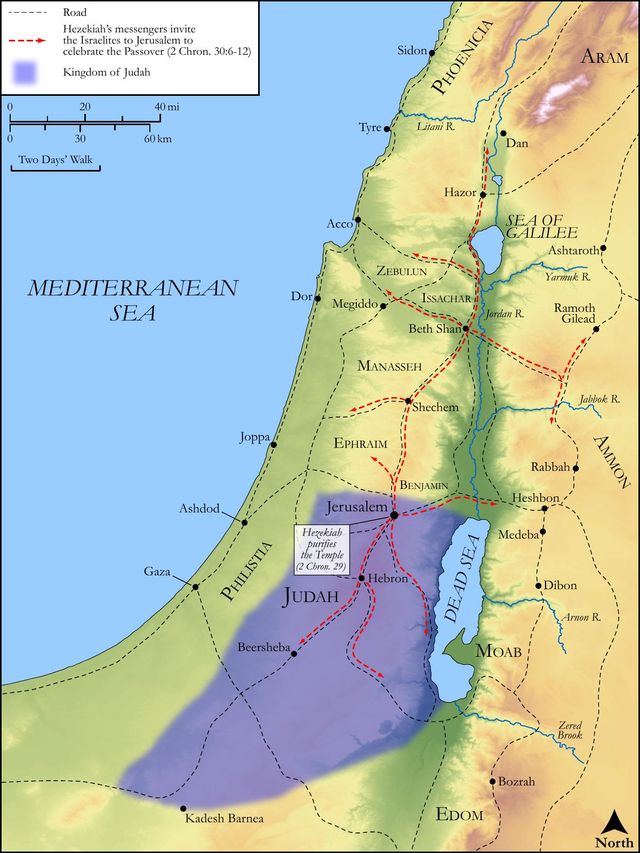
See on the biblical-era map
Study this verse
Public-domain commentary
Matthew Henry
From his Commentary on the Whole Bible. Henry comments on passages, not single verses — this entry covers 2 Chronicles 29:1–11. His three-level outline is real structure in the source text, so it is rendered as structure.
Here is, I. Hezekiah's age when he came to the crown. He was twenty-five years old. Joash, who came to the crown after two bad reigns, was but seven years old; Josiah, who came after two bad reigns, was but eight, which occasioned the delay of the reformation; but Hezekiah had come to years, and so applied himself immediately to it. We may well think with what a sorrowful heart he beheld his father's idolatry and profaneness, how it troubled him to see the doors of the temple shut, though, while his father lived, he durst not open them. His soul no doubt wept in secret for it, and he vowed that when he should receive the congregation he would redress these grievances, which made him do it with more readiness and resolution.
II.His general character.
He did that which was right like David, Ch2 29:2. Of several of his predecessors it had been said that they did that which was right, but not like David, not with David's integrity and zeal. But here was one that had as hearty an affection for the ark and law of God as ever David had.
III.His speedy application to the great work of restoring religion.
The first thing he did was to open the doors of the house of the Lord, Ch2 29:3. We are willing to hope his father had not quite suppressed the temple service; for then the holy fire on the altar must have gone out, and we do not read of the re-kindling of it; but he had hindered the people from attending it, and the priests, except such of them as were of his own party, Kg2 16:15. But Hezekiah immediately threw the church doors open, and brought in the priests and Levites. He found Judah low and naked, yet did not make it his first business to revive the civil interests of his kingdom, but to restore religion to its good posture again. Those that begin with God begin at the right end of their work, and it will prosper accordingly.
IV.His speech to the priests and Levites.
It was well known, no doubt, that he had a real kindness for religion and was disaffected to the corruptions of the last reign; yet we do not find the priests and Levites making application to him for the restoration of the temple service but he calls upon them, which, I doubt, bespeaks their coldness as much as his zeal; and perhaps, if they had done their part with vigour, things would not have been brought into so very bad a posture as Hezekiah found them in. Hezekiah's exhortation to the Levites is very pathetic.
1.He laid before them the desolations of religion and the deplorable state to which it was brought among them (Ch2 29:6, Ch2 29:7): Our fathers have trespassed. He said not "My father," because it became him, as a son, to be as tender as might be of his father's name, and because his father would not have done all this if their fathers had not neglected their duty. Urijah the priest had joined with Ahaz in setting up an idolatrous altar. He complained,
(1.)That the house of God had been deserted: They have forsaken God, and turned their backs upon his habitation. Note, Those that turn their backs upon God's ordinances may truly be said to forsake God himself.
(2.)That the instituted worship of God there had been let fall. The lamps were not lighted, and incense was not burnt. There are still such neglects as these, and they are no less culpable, when the word is not duly read and opened (for that was signified by the lighting of the lamps) and when prayers and praises are not duly offered up, for that was signified by the burning of incense.
2.He showed the sad consequences of the neglect and decay of religion among them, Ch2 29:8. 9. This was the cause of all the calamities they had lain under. God had in anger delivered them to trouble, to the sword, and to captivity. When we are under the rebukes of God's providence it is good for us to enquire whether we have not neglected God's ordinances and whether the controversy he has with us may not be traced to this neglect.
3.He declared his own full purpose and resolution to revive religion and make it his business to promote it (Ch2 29:10): "It is in my heart (that is, I am fully resolved) to make a covenant with the Lord God of Israel (that is, to worship him only, and in that way which he has appointed); for I am sure that, otherwise, his fierce anger will not turn away from us." This covenant he would not only make himself, but bring his people into the bond of.
4.He engaged and excited the Levites and priests to do their duty on this occasion. This he begins with (Ch2 29:5); this he ends with, Ch2 29:11. He called them Levites to remind them of their obligation to God, called them his sons to remind them of the relation to himself, that he expected that, as a son with the father, they should serve with him in the reformation of the land. (1.) he told them what was their duty, to sanctify themselves first (by repenting of their neglects, reforming their own hearts and lives, and renewing their covenants with God to do their duty better for the time to come), and then to sanctify the house of God, as his servants, to make it clean from every thing that was disagreeable, either through the disuse or the profanation of it, and to set it up for the purposes for which it was made. (2.) He stirred them up to do it (Ch2 29:11): "Be not now negligent, or remiss, in your duty. Let not this good work be retarded through your carelessness." Be not deceived, so the margin. Note, Those that by their negligence in the service of God think to mock God, and put a cheat upon him, do but deceive themselves, and put a damning cheat upon their own souls. Be not secure (so some), as if there were no urgent call to do it or no danger in not doing it. Note, Men's negligence in religion is owing to their carnal security. The consideration he quickens them with is derived from their office. God had herein put honour upon them: He has chosen you to stand before him. God therefore expected work from them. They were not chosen to be idle, to enjoy the dignity and leave the duty to be done by others, but to serve him and to minister to him. They must therefore be ashamed of their late remissness, and, now that the doors of the temple were opened again, must set about their work with double diligence.
Continue studying 2 Chronicles 29:2 across the web’s major study libraries — every link below opens this exact verse, chapter, or book on the destination site.
Read & Compare
 BibleGatewayThis verse in more than 200 translations and 70 languages.
 Bible.comThe YouVersion reader — hundreds of translations, reading plans, and highlights.
 ESV.orgCrossway's official English Standard Version reader.
 NET BibleThe NET translation with 60,000+ translators' notes on every rendering decision.
 STEP BibleTyndale House's free study tool — original text, vocabulary, and scholarly resources.
 BibliaLogos Bible Software's free web reader.
 USCCBThe New American Bible (Revised Edition) with the U.S. bishops' study notes.
Commentaries
 BibleHub CommentariesDozens of classic commentaries on this verse, gathered on one page.
 StudyLightMore than 100 commentary sets — the largest collection on the web.
 BibleRefPlain-English commentary on what this verse means, verse by verse.
 Enduring WordDavid Guzik's free commentary on this chapter, widely used by Bible teachers.
 Bible Study ToolsVerse commentary alongside Greek and Hebrew study aids.
Original Language & Research
- BibleHub InterlinearThe verse word by word — original language, transliteration, and English.
- BibleHub LexiconEvery word's original-language definition and Strong's entry.
 Blue Letter BibleDeep-study tools — Strong's numbers, concordance, and word studies.
 SefariaThe Hebrew text with Rashi and centuries of Jewish commentary.
Sermons, Hymns & Audio


TrulyRandomVerse is not affiliated with these sites and doesn’t control their content. They’re linked because they’re genuinely useful.
Summary
2 Chronicles 29:2 introduces King Hezekiah of Judah as a monarch who decisively broke from his father's apostasy, choosing instead to align his reign with the divine standard of righteousness established by his ancestor King David. This foundational verse immediately frames Hezekiah's character and sets the theological stage for the comprehensive spiritual reforms, the restoration of Temple worship, and the profound national renewal that would define his reign, marking a critical turning point for Judah after a period of deep spiritual decline.
Context
ShowHideLiterary Context
This verse functions as the Chronicler's immediate and crucial evaluation of King Hezekiah, initiating the narrative of his reign. It stands in stark contrast to the preceding chapter, which meticulously details the profound wickedness and idolatry of Hezekiah's father, King Ahaz, who "did not do what was right in the sight of the LORD" 2 Chronicles 28:1. The Chronicler consistently employs this evaluative formula ("did what was right/evil in the sight of the LORD") to assess each king's fidelity to the Mosaic covenant and their commitment to Yahweh worship, with David serving as the ultimate benchmark. By explicitly linking Hezekiah's actions to "all that David his father had done," the text signals a dramatic and divinely approved reversal of Judah's spiritual trajectory, preparing the reader for the extensive religious reforms and Temple cleansing that immediately follow, beginning with Hezekiah's resolute opening of the Temple doors and the call for purification in 2 Chronicles 29:3-19.
Historical & Cultural Context
Hezekiah ascended the throne of Judah around 715 BC, inheriting a kingdom that had been plunged into spiritual and political disarray under the oppressive and idolatrous reign of his father, Ahaz. Ahaz had not only promoted pagan worship, including child sacrifice, but also closed the doors of the Jerusalem Temple, effectively severing the nation's formal relationship with Yahweh, as detailed in 2 Chronicles 28:22-25. Among the nations of that day, kings were typically seen as the embodiment of their nation's relationship with its deities, and their actions had direct implications for national prosperity or calamity. For Judah, this meant upholding the unique covenant with Yahweh. Hezekiah's immediate and radical turn to righteousness, therefore, was not merely a personal moral choice but a profound act of national repentance and a reassertion of Judah's unique identity as God's chosen people, particularly vital in an era dominated by the expansionist and polytheistic Assyrian Empire. His reforms were a deliberate counter-cultural movement, re-establishing the foundational principles of Israelite faith.
Key Themes
ShowHideThis verse powerfully introduces and reinforces several central themes prevalent throughout 2 Chronicles and the broader biblical narrative. The theme of Righteous Leadership is paramount, as Hezekiah is presented as a king whose actions receive divine commendation, standing in stark contrast to his immediate predecessor. This highlights the Chronicler's emphasis on the king's spiritual responsibility as integral to the nation's well-being and covenant faithfulness. The concept of Following Godly Examples is central, with King David serving as the enduring and idealized benchmark for faithful kingship. This underscores the profound importance of spiritual heritage, the deliberate choice to emulate righteous predecessors, and adherence to established divine principles, even when immediate family examples are negative. Finally, the verse clearly foreshadows Spiritual Revival and Restoration, signaling a period of national cleansing, a renewal of true worship, and a re-establishment of the covenant relationship with God after a period of deep national apostasy. This sets the stage for Hezekiah's extensive reforms, which brought hope and healing to a broken nation, echoing the prophetic calls for return and restoration found in passages like Deuteronomy 30:1-10 and Isaiah 1:26-27.
Exposition and Analysis
ShowHideKey Word Analysis
ShowHideThis term (H3477) signifies "straight," "upright," "just," or "pleasing." When used in the context of actions or character "in the sight of the LORD," it denotes a profound alignment with God's revealed will, moral standards, and covenant requirements. It implies a life lived without deviation into idolatry, injustice, or rebellion. For Hezekiah, this means his reign was not merely deemed "good" by human standards but was specifically approved and affirmed by God, reflecting a heart and actions that were true and loyal to Yahweh.
Literally meaning "eye" (H5869), this term in the phrase "in the sight of the LORD" profoundly emphasizes divine observation, scrutiny, and ultimate judgment. It underscores that true righteousness is not measured by human opinion, public acclaim, or political expediency, but by God's omniscient gaze and His absolute authority. Hezekiah's actions were not performed for human approval but with a conscious awareness of God's constant presence and ultimate standard.
More than just a name (H1732), "David" here represents the quintessential, divinely appointed standard of righteous kingship in Judah. Despite his personal failings, David's heart was characterized by a fundamental devotion to the LORD 1 Kings 15:5, making him the ideal against whom all subsequent kings were measured. For Hezekiah to act "according to all that David his father had done" is the highest commendation, indicating a deliberate, comprehensive, and zealous emulation of David's commitment to God, the Temple, and the covenant.
Verse Breakdown
ShowHide"And he did [that which was] right in the sight of the LORD"
This opening clause immediately establishes Hezekiah's character and the divine assessment of his reign. In stark contrast to his father Ahaz, who "did not do what was right in the sight of the LORD" 2 Chronicles 28:1, Hezekiah's actions and policies were in perfect alignment with God's revealed will and covenant demands. This phrase is a standard theological evaluative formula used throughout Kings and Chronicles, signifying divine approval, covenant faithfulness, and a commitment to pure worship.
"according to all that David his father had done"
This second clause provides the specific, exemplary benchmark for Hezekiah's righteousness. While Ahaz was his biological father, "David his father" refers to his ancestral and spiritual lineage, highlighting Hezekiah's conscious and deliberate choice to reject the immediate, wicked example of his biological father and instead follow the exemplary path of the founder of the Davidic dynasty. This indicates a comprehensive commitment, not just to specific actions, but to the overall spirit of devotion, obedience, and zeal for Yahweh and His Temple that characterized David's reign.
Literary Devices
ShowHideThe verse primarily employs Characterization and Contrast to immediately establish Hezekiah's moral and spiritual standing. Hezekiah is swiftly characterized as a righteous king, setting him apart from his immediate predecessor, Ahaz, through the Chronicler's consistent use of the evaluative formula ("did what was right/evil in the sight of the LORD"). This creates a clear binary opposition between the two reigns, emphasizing Hezekiah's radical departure from apostasy. The explicit comparison to "David his father" serves as a powerful Allusion or Intertextuality, drawing upon the well-established ideal of Davidic kingship in Israel's history. This immediate connection to David not only conveys Hezekiah's exceptional godliness and commitment to the covenant but also functions as a form of Foreshadowing, hinting at the extensive religious reforms, the restoration of legitimate Temple worship, and the national revival that will define his reign, as Hezekiah embodies the very ideal of a faithful Davidic king.
Theological and Thematic Connections
ShowHide2 Chronicles 29:2 is a foundational statement for understanding the Chronicler's theology of righteous leadership and its direct impact on national well-being. It powerfully asserts that a nation's spiritual health, prosperity, and deliverance are intrinsically tied to the faithfulness of its leaders to God's covenant. Hezekiah's immediate and decisive turn to righteousness, despite the profound wickedness of his immediate father, underscores the transformative principle that personal and national revival begins with a deliberate return to God's standards, rather than pragmatic human expediency. The verse also highlights the enduring significance of the Davidic covenant and the ideal of a king who governs under God's authority, serving as a beacon of hope for restoration even in times of deep apostasy. This commitment to God's ways is presented as the only true path to divine blessing, protection, and national flourishing.
Reflection and Application
ShowHideHezekiah's example in 2 Chronicles 29:2 provides a profound challenge and immense encouragement for believers today. His resolute choice to do "that which was right in the sight of the LORD," despite having grown up under the deeply corrupting influence of his father, Ahaz, powerfully demonstrates the transformative power of individual conviction and the possibility of breaking negative generational cycles. It serves as a potent reminder that our spiritual trajectory is not solely determined by our immediate environment, family heritage, or past circumstances, but by our personal and deliberate decision to align our lives with God's revealed will. Just as Hezekiah consciously looked to David as his spiritual blueprint and standard, we are called to intentionally emulate the faithful examples found in Scripture and in the lives of godly mentors, prioritizing God's approval above all else. This verse inspires us to be proactive agents of positive change, courageously pursuing righteousness and initiating spiritual renewal in our own lives, families, churches, and communities, rather than passively accepting spiritual decline or conforming to ungodly patterns. True transformation, both personal and communal, begins with such a deliberate, God-centered choice.
Questions for Reflection
ShowHideFAQ
ShowHideWhat does it mean for Hezekiah to have done "that which was right in the sight of the LORD"?
ShowHideThis phrase is a crucial theological evaluation, not merely a moral or historical observation. It signifies that Hezekiah's actions, policies, and the overall direction of his reign were in full and deliberate alignment with God's revealed will, as expressed in the Mosaic Law and the covenant established with Israel. Unlike many kings who "did evil in the sight of the LORD," Hezekiah actively sought God's approval and obeyed His commands, particularly concerning the exclusive worship of Yahweh, the eradication of idolatry, and the proper functioning of the Temple. This divine approval is the ultimate standard of righteousness in the biblical narrative, emphasizing that true goodness is defined by conformity to God's character and commands, as encouraged in passages like Deuteronomy 6:18.
Why is David mentioned as the standard for Hezekiah, especially since Ahaz was his biological father?
ShowHideThe mention of David is profoundly significant because David represents the quintessential ideal king in Judah's history, the one through whom God established an eternal covenant and promised a perpetual dynasty 2 Samuel 7:12-16. While Ahaz was Hezekiah's biological father, his reign was characterized by extreme wickedness, idolatry, and a direct rejection of God's commands, leading Judah into deep apostasy. By stating that Hezekiah acted "according to all that David his father had done," the Chronicler emphasizes that Hezekiah consciously and deliberately rejected the wicked path of his immediate biological father. Instead, he chose to embrace and emulate the righteous spiritual heritage of his revered ancestor David, thereby reaffirming the covenant and the true identity of Judah as God's chosen people. This highlights the powerful biblical principle that one's spiritual lineage and chosen examples can transcend immediate familial influences.
Christ-Centered Fulfillment
ShowHideHezekiah's righteous reign, initiated by his resolute decision to do "that which was right in the sight of the LORD, according to all that David his father had done," serves as a powerful Old Testament type pointing to the ultimate, perfect King, Jesus Christ. While Hezekiah was indeed a good king, his righteousness was still humanly imperfect, and his reforms, though significant, were ultimately temporary and limited. Jesus, however, is the true and eternal Son of David, who perfectly fulfilled all righteousness, not merely "in the sight of the LORD" but inherently, being fully God and fully man Hebrews 4:15. He is the one who perfectly embodies and transcends the Davidic ideal, establishing an eternal kingdom that will never end Luke 1:32-33. Unlike Hezekiah, who cleansed a physical temple from defilement, Christ's work brought about a profound spiritual cleansing, purifying His people from the defilement of sin through His atoning sacrifice on the cross Ephesians 5:25-27. He is the ultimate spiritual reformer, inaugurating a new covenant and bringing about true and lasting spiritual revival in the hearts of all who believe, making them part of His eternal, spiritual kingdom Jeremiah 31:31-34. In Christ, the righteous reign foreshadowed by Hezekiah finds its complete and everlasting fulfillment.