


2 Chronicles 28:1
- בֶּןben[was] a son ofH1121N-mscNoun Singular Masculine Construct
- עֶשְׂרִים'es·RimtwentyH6242N-mpNoun Plural Masculine Absolute
- שָׁנָהsha·Nahyear[s]H8141N-fsNoun Singular Feminine Absolute
- אָחָז'a·ChazAhazH271N-proper-mNoun Proper Masculine
- בְּמָלְכוֹbe·ma·le·Khowhen he became kingH4427Prep-b ¦ V-Qal-Inf ¦ 3msVerb Qal Infinitive Constructבְּwhenמָלְכbecame kingוֹhe
- וְשֵׁשׁve·sheshand six-H8337Conj-w ¦ N-csNoun Singular common gender Absoluteוְandשֵׁשׁsix-
- עֶשְׂרֵה'es·RehteenH6240N-csNoun Singular common gender Absolute
- שָׁנָהsha·Nahyear[s]H8141N-fsNoun Singular Feminine Absolute
- מָלַךְma·Lakhhe reignedH4427V-Qal-Perf-3msVerb Qal Perfect 3rd Singular Masculine
- בִּירוּשָׁלִָםbi·ru·sha·Limin JerusalemH3389Prep-b ¦ N-properNoun Proper LocationבִּinירוּשָׁלִָםJerusalem
- וְלֹאve·lo'and notH3808Conj-w ¦ NegParticle Negativeוְandלֹאnot
- עָשָׂה'a·Sahhe didH6213V-Qal-Perf-3msVerb Qal Perfect 3rd Singular Masculine
- הַיָּשָׁרhai·ya·Sharthe rightH3477Art ¦ Adj-msAdjective Singular Masculine Absoluteהַtheיָּשָׁרright
- בְּעֵינֵיbe·'ei·Neiin [the] eyes ofH5869Prep-b ¦ N-fdcNoun Dual Feminine Constructבְּinעֵינֵי[the] eyes of
- יְהוָהYah·wehYahwehH3068N-properNoun Proper Title
- כְּדָוִידke·da·Vidlike DavidH1732Prep-k ¦ N-proper-mNoun Proper MasculineכְּlikeדָוִידDavid
- אָבִיו'a·Vivhis ancestorH1N-msc ¦ 3msNoun Singular Masculine Constructאָבִיancestorוhis
English is a literal word-by-word gloss of the Hebrew, not the KJV's wording. Why?
This is the original text the KJV's translators worked from — each Hebrew word with its own literal English meaning in this verse, prepared by scholars at Tyndale House, Cambridge. The KJV translates whole sentences, not word by word, so its wording differs: one Hebrew word can become several English words, and the KJV may choose “the LORD” where the gloss reads “Yahweh”. Both are faithful — they answer different questions. For the KJV's own rendering, switch to the KJV text.
Details
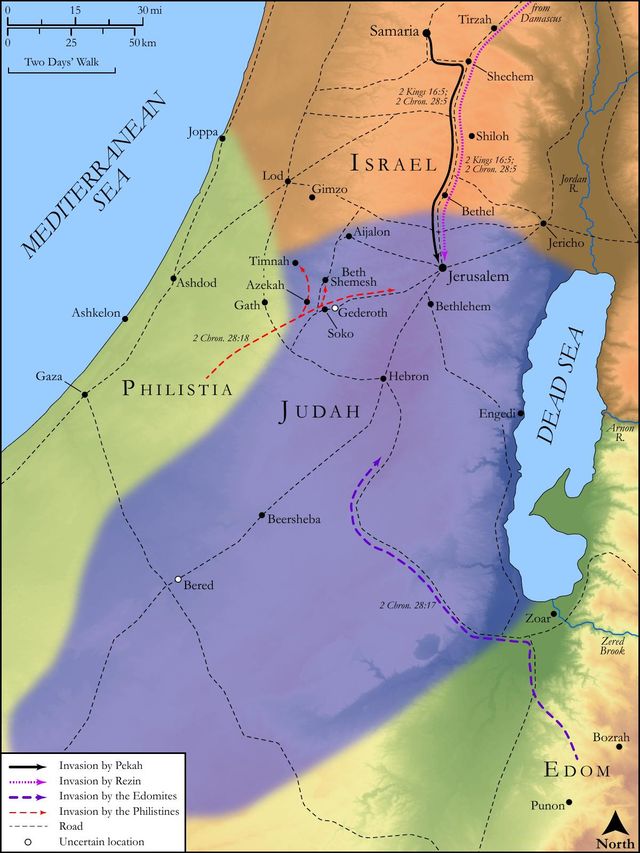
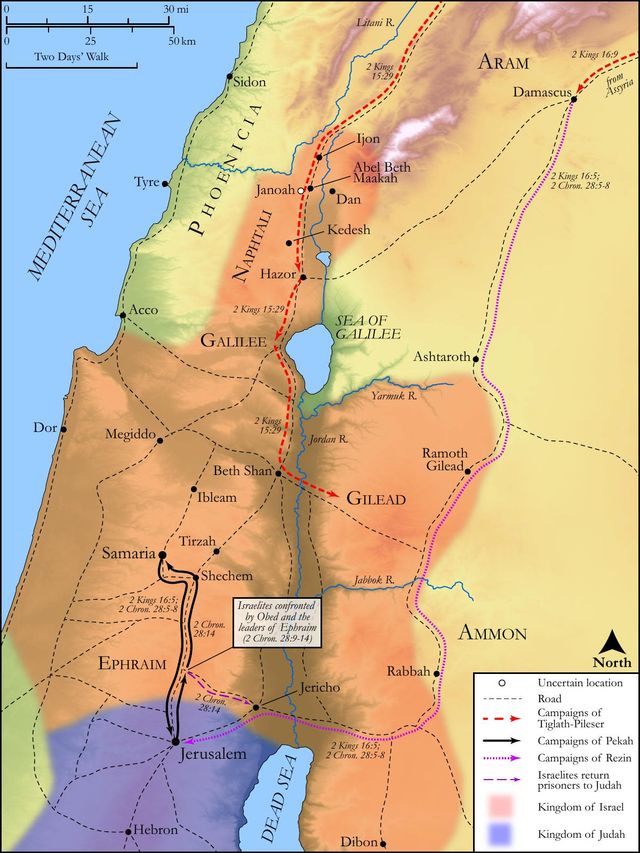
See on the biblical-era map
Study this verse
Public-domain commentary
Matthew Henry
From his Commentary on the Whole Bible. Henry comments on passages, not single verses — this entry covers 2 Chronicles 28:1–5.
Never surely had a man greater opportunity of doing well than Ahaz had, finding things in a good posture, the kingdom rich and strong and religion established; and yet here we have him in these few verses, 1. Wretchedly corrupted and debauched. He had had a good education given him and a good example set him: but parents cannot give grace to their children. All the instructions he had were lost upon him: He did not that which was right in the sight of the Lord (Ch2 28:1), nay, he did a great deal that was wrong, a wrong to God, to his own soul, and to his people; he walked in the way of the revolted Israelites and the devoted Canaanites, made molten images and worshipped them, contrary to the second commandment; nay, he made them for Baalim, contrary to the first commandment. he forsook the temple of the Lord and sacrificed and burnt incense on the hills, as if they would place him nearer heaven, and under every green tree, as if they would signify the protection and influence of heaven by their shade and dropping. To complete his wickedness, as one perfectly divested of all natural affection as well as religion and perfectly devoted to the service and interest of the great enemy of mankind, he burnt his children in the fire to Moloch (Ch2 28:3), not thinking it enough to dedicate them to that infernal fiend by causing them to pass through the fire. See what an absolute sway the prince of the power of the air bears among the children of disobedience. 2. Wretchedly spoiled and made a prey of. When he forsook God, and at a vast expense put himself under the protection of false gods, God, who of right was his God, delivered him into the hands of his enemies, Ch2 28:5. (1.) The Syrians insulted him and triumphed over him, beat him in the field and carried away a great many of his people into captivity. (2.) The king of Israel, though an idolater too, was made a scourge to him, and smote him with a great slaughter. The people suffered by these judgments: their blood was shed, their country wasted, their families ruined; for when they had a good king, though they did corruptly (Ch2 27:2), yet then his goodness sheltered them; but now that they had a bad one all the defence had departed from them and an inundation of judgments broke in upon them. Those that knew not their happiness in the foregoing reign were taught to value it by the miseries of this reign.
Continue studying 2 Chronicles 28:1 across the web’s major study libraries — every link below opens this exact verse, chapter, or book on the destination site.
Read & Compare
 BibleGatewayThis verse in more than 200 translations and 70 languages.
 Bible.comThe YouVersion reader — hundreds of translations, reading plans, and highlights.
 ESV.orgCrossway's official English Standard Version reader.
 NET BibleThe NET translation with 60,000+ translators' notes on every rendering decision.
 STEP BibleTyndale House's free study tool — original text, vocabulary, and scholarly resources.
 BibliaLogos Bible Software's free web reader.
 USCCBThe New American Bible (Revised Edition) with the U.S. bishops' study notes.
Commentaries
 BibleHub CommentariesDozens of classic commentaries on this verse, gathered on one page.
 StudyLightMore than 100 commentary sets — the largest collection on the web.
 BibleRefPlain-English commentary on what this verse means, verse by verse.
 Enduring WordDavid Guzik's free commentary on this chapter, widely used by Bible teachers.
 Bible Study ToolsVerse commentary alongside Greek and Hebrew study aids.
Original Language & Research
- BibleHub InterlinearThe verse word by word — original language, transliteration, and English.
- BibleHub LexiconEvery word's original-language definition and Strong's entry.
 Blue Letter BibleDeep-study tools — Strong's numbers, concordance, and word studies.
 SefariaThe Hebrew text with Rashi and centuries of Jewish commentary.
Sermons, Hymns & Audio


TrulyRandomVerse is not affiliated with these sites and doesn’t control their content. They’re linked because they’re genuinely useful.
Summary
Second Chronicles 28:1 introduces King Ahaz of Judah, marking a profound and tragic turning point in the nation's spiritual trajectory. Though he ascended the throne at the young age of twenty and reigned for sixteen years in Jerusalem, his rule was characterized by a stark and deliberate deviation from the righteous path established by his revered ancestor, King David. This opening verse immediately sets a somber tone, signaling a period of significant spiritual decline and national distress for the Southern Kingdom, directly attributable to the king's unrighteous choices and his blatant disregard for the LORD's covenant.
Context
ShowHideLiterary Context
This verse serves as the immediate successor to the positive assessment of King Jotham's reign in 2 Chronicles 27, which concludes with Jotham doing "that which was right in the sight of the LORD" (2 Chronicles 27:2). The Chronicler's introduction of Ahaz, therefore, creates a sharp and intentional contrast, highlighting the swift deterioration of Judah's spiritual leadership. It initiates a detailed account in 2 Chronicles 28 of Ahaz's profound idolatry, his disastrous political alliances, and the severe divine judgment that followed, including significant military defeats and national humiliation. This verse is the thematic gateway to one of the darkest periods for the Davidic dynasty before the Babylonian exile, emphasizing the Chronicler's consistent theme of divine retribution for covenant unfaithfulness.
Historical & Cultural Context
Ahaz's reign (c. 735-715 BC) occurred during a tumultuous period in the ancient Near East, dominated by the rising power of the Neo-Assyrian Empire. Judah found itself caught between powerful regional forces, particularly the Syro-Ephraimite coalition (Syria and Israel) to the north, which sought to compel Judah to join their anti-Assyrian alliance. Culturally, this era saw increasing syncretism, with foreign religious practices infiltrating Judah. Ahaz, unlike many of his predecessors, actively promoted and participated in these pagan rituals, including the horrific practice of child sacrifice (2 Chronicles 28:3). His actions represent a deliberate rejection of the Mosaic covenant and the exclusive worship of Yahweh, embracing instead the idolatry of surrounding nations and seeking security in human alliances rather than divine protection.
Key Themes
ShowHideThe introduction of Ahaz immediately brings several key themes to the forefront of the Chronicler's narrative. Firstly, the failure of righteous leadership is paramount; Ahaz's reign exemplifies a king who deliberately turned away from God's commands, leading his nation into deep apostasy. This contrasts sharply with the Chronicler's ideal of a covenant-keeping king, frequently measured against the standard of David. Secondly, the theme of divine judgment and consequences is powerfully foreshadowed; Ahaz's unrighteousness directly precipitates national disaster, demonstrating God's unwavering commitment to His covenant and His readiness to discipline His people when they stray. Thirdly, the verse subtly introduces the theme of spiritual heritage and personal accountability; despite being in the lineage of David and following a relatively righteous father, Ahaz made his own destructive choices, underscoring that spiritual standing is not inherited but individually chosen and maintained. The Chronicler emphasizes that even a king's reign is ultimately evaluated "in the sight of the LORD," a consistent theological lens applied throughout the books of Kings and Chronicles.
Exposition and Analysis
ShowHideKey Word Analysis
ShowHideThe name ʼĀḥāz means "possessor" or "he has grasped." This name ironically highlights Ahaz's spiritual failure. Instead of grasping hold of the LORD and His covenant, he grasped at foreign alliances and idolatrous practices, leading Judah into spiritual and political ruin. His very name becomes a tragic commentary on his reign, signifying a king who possessed power but lacked spiritual integrity and true spiritual possession.
The Hebrew word yâshâr denotes what is "straight," "upright," or "just." In the biblical context, to "do what is right in the sight of the LORD" signifies living in full conformity with God's revealed will, commandments, and covenantal standards. It implies a moral rectitude that aligns with divine righteousness, far exceeding mere human ethics or political expediency. Ahaz's failure to do yâshâr indicates a fundamental perversion of his kingly duty and a deliberate rejection of God's moral order.
David, the progenitor of the royal line, serves as the normative standard for kingship in Judah. Despite his personal failings, David was remembered as the ideal king who sought God's heart and established the worship of Yahweh as the sole God of Israel. The phrase "like David his father" (referencing H1, ʼâb, father) is a recurring evaluative formula throughout Kings and Chronicles, signifying the highest benchmark for covenant faithfulness and righteous leadership. Ahaz's failure to emulate David meant he did not uphold the covenant, prioritize God's law, or lead his people in true worship, marking a profound spiritual and covenantal breach.
Verse Breakdown
ShowHide"Ahaz [was] twenty years old when he began to reign, and he reigned sixteen years in Jerusalem:"
This clause provides the essential chronological and geographical details of Ahaz's rule. His age at ascension (twenty) suggests a period of potential youthful vigor and opportunity for righteous leadership, yet his reign of sixteen years in Jerusalem (the spiritual and political capital of Judah) would be marked by deep apostasy. The duration of his reign, though not exceptionally long, was sufficient to inflict significant spiritual and political damage upon Judah, setting the stage for the subsequent narrative of decline.
"but he did not [that which was] right in the sight of the LORD,"
This is the central theological judgment of the verse and the pivotal statement concerning Ahaz's character. The conjunction "but" (וְלֹא, wə-lōʼ) sharply contrasts Ahaz's rule with that of his righteous predecessors, particularly Jotham, and sets the negative tone for the entire chapter. The phrase "did not that which was right" is a standard formula in the Chronicler's evaluation of kings, indicating a deliberate and severe deviation from God's covenant demands and a rejection of true worship. It implies a conscious choice to act contrary to divine will, leading directly to spiritual and national consequences.
"like David his father:"
This final phrase provides the ultimate benchmark against which Ahaz is measured and found profoundly wanting. David, the progenitor of the royal line, represented the ideal of a king devoted to Yahweh, who sought God's heart and upheld His covenant. Ahaz's failure to emulate David means he did not uphold the covenant, did not prioritize God's law, and did not lead his people in true worship. This comparison underscores the profound spiritual failure of Ahaz and the tragic departure from the righteous heritage of the Davidic dynasty, signaling a deep breach in the covenantal relationship between king, people, and God.
Literary Devices
ShowHideThe Chronicler employs several potent literary devices in 2 Chronicles 28:1 to convey its profound theological message. The most prominent is Contrast, specifically between Ahaz and his righteous ancestor, David, and implicitly with his more righteous father, Jotham. The phrase "but he did not that which was right... like David his father" immediately establishes a stark moral and spiritual dichotomy, highlighting Ahaz's failure by juxtaposing it against the ideal standard of Davidic kingship. This contrast serves to emphasize the severity of Ahaz's apostasy and the tragic nature of his reign. Furthermore, the verse uses Foreshadowing, as this initial negative assessment of Ahaz's character immediately signals the impending spiritual and national calamities that will unfold throughout the rest of 2 Chronicles 28, including military defeats, the promotion of idolatry, and national humiliation. Finally, the use of a Formulaic Expression ("did not that which was right in the sight of the LORD") is a characteristic feature of the Chronicler's historical writing. This repetitive phrase provides a consistent divine evaluation of Judah's kings, reinforcing the theological framework that obedience brings blessing and disobedience brings judgment, making Ahaz's reign a clear and devastating example of the latter.
Theological and Thematic Connections
ShowHideThe introduction of King Ahaz in 2 Chronicles 28:1 powerfully underscores the Chronicler's overarching theological agenda: the paramount importance of covenant faithfulness and the direct correlation between a king's righteousness and the nation's well-being. Ahaz's deliberate rejection of "that which was right in the sight of the LORD" demonstrates that divine favor is not automatically granted by lineage or position, but is conditional upon obedience and spiritual integrity. His failure to live "like David his father" highlights the enduring significance of the Davidic covenant, yet also its conditional application to the individual king's reign and the subsequent national prosperity. This verse serves as a stark reminder that leadership, particularly spiritual leadership, carries immense responsibility before God, and that deviation from His standards inevitably leads to severe consequences, both personal and national. It speaks to the sovereignty of God in evaluating human actions and the principle that true prosperity and security are rooted in spiritual integrity and faithfulness to the divine will, not political maneuvering or worldly power.
Reflection and Application
ShowHideThe tragic account of King Ahaz serves as a timeless and potent warning for all who hold positions of influence, and indeed, for every individual. It profoundly illustrates that a noble heritage or a position of power does not guarantee spiritual integrity; rather, each person is individually accountable to God for their choices and actions. Ahaz's failure to do "that which was right in the sight of the LORD" reminds us that God's standards are absolute and unchanging, transcending human expediency or cultural trends. For us today, this means that our lives, decisions, and leadership (whether in family, church, or community) are continually evaluated by divine principles. We are called not to merely avoid overt sin, but to actively pursue "that which is right"—to seek justice, love mercy, and walk humbly with our God, as Micah 6:8 exhorts. Our true success is not measured by worldly achievements or longevity, but by our faithfulness to God's revealed will. Ahaz's story compels us to examine our own hearts: are we truly seeking to please the LORD in all things, or are we, like Ahaz, compromising our faith for perceived security, worldly gain, or cultural conformity?
Questions for Reflection
ShowHideFAQ
ShowHideWhat was the significance of Ahaz's age and length of reign mentioned in this verse?
ShowHideThe mention of Ahaz being twenty years old when he began to reign and ruling for sixteen years provides crucial chronological context. His youth at ascension suggests a period of potential for a long and impactful reign, either for good or ill. Unfortunately, for Ahaz, it was for ill. The sixteen years signify a substantial period during which he actively led Judah into deep apostasy and political disaster, rather than turning the nation back to God. This duration allowed his wicked influence to permeate the kingdom, leading to the severe judgments detailed later in 2 Chronicles 28 and 2 Kings 16. It underscores that even a relatively short reign can have devastating spiritual consequences if marked by unrighteousness.
Why is the comparison to "David his father" so critical for understanding Ahaz's failure?
ShowHideThe comparison to "David his father" is critical because King David served as the theological and historical benchmark for all subsequent kings of Judah. David was the recipient of the unconditional Davidic Covenant (2 Samuel 7:12-16), promising an eternal dynasty. However, the individual king's prosperity and the nation's well-being were conditional upon their obedience to God's law, as seen in David's charge to Solomon in 1 Kings 2:3-4. To say Ahaz "did not that which was right... like David his father" is the Chronicler's ultimate indictment. It signifies a profound failure to uphold the covenantal responsibilities of a Davidic king and a complete departure from the spiritual legacy expected of his lineage, demonstrating a deliberate rejection of the very foundation of Judah's national identity and divine favor.
Christ-Centered Fulfillment
ShowHideThe tragic failure of King Ahaz, who "did not that which was right in the sight of the LORD, like David his father," powerfully highlights humanity's desperate need for a perfect King. Ahaz's reign, marked by idolatry, unrighteousness, and national decline, stands in stark contrast to the ideal Davidic king who would perfectly embody righteousness and lead his people in unwavering covenant faithfulness. This prophetic longing for a truly righteous ruler finds its ultimate and complete fulfillment in Jesus Christ. He is the true Son of David, the one who perfectly "always did the things that are pleasing to Him" (John 8:29). Unlike Ahaz, who led his people into spiritual darkness and earthly defeat, Jesus, the Lamb of God, perfectly fulfilled all righteousness, not for His own benefit, but to redeem His people from their sins (Matthew 3:15). His reign is not sixteen years of decline, but an eternal kingdom of justice, peace, and unwavering righteousness (Isaiah 9:6-7). Where Ahaz failed to uphold the covenant, Christ established a new and better covenant through His blood (Hebrews 8:6), ensuring that all who are in Him are made righteous in God's sight (2 Corinthians 5:21). Jesus is the King who perfectly does what is right, securing eternal blessing and true spiritual prosperity for His people.