


2 Chronicles 34:2
Bible text: King James Version (1769 Blayney text) · Public domain
Bible text: King James Version with Strong's numbers · Public domain
Bible text: Berean Standard Bible · Public domain
Bible text: American Standard Version (1901) · Public domain
Bible text: World English Bible, Messianic edition · Public domain
Bible text: Geneva Bible (1599) · Public domain
Bible text: Young's Literal Translation · Public domain
- וַיַּעַשׂvai·Ya·'asand he didH6213Conj-w ¦ V-Qal-ConsecImperf-3msVerb Qal Consecutive Imperfect 3rd Singular Masculineוַandיַּעַשׂhe did
- הַיָּשָׁרhai·ya·Sharthe rightH3477Art ¦ Adj-msAdjective Singular Masculine Absoluteהַtheיָּשָׁרright
- בְּעֵינֵיbe·'ei·Neiin [the] eyes ofH5869Prep-b ¦ N-fdcNoun Dual Feminine Constructבְּinעֵינֵי[the] eyes of
- יְהוָהYah·wehYahwehH3068N-properNoun Proper Title
- וַיֵּלֶךְvai·Ye·lekhand he walkedH1980Conj-w ¦ V-Qal-ConsecImperf-3msVerb Qal Consecutive Imperfect 3rd Singular Masculineוַandיֵּלֶךְhe walked
- בְּדַרְכֵיbe·dar·Kheiin [the] ways ofH1870Prep-b ¦ N-cpcNoun Plural common gender Constructבְּinדַרְכֵי[the] ways of
- דָּוִידda·VidDavidH1732N-proper-mNoun Proper Masculine
- אָבִיו'a·Vivhis ancestorH1N-msc ¦ 3msNoun Singular Masculine Constructאָבִיancestorוhis
- וְלֹאve·lo'and notH3808Conj-w ¦ NegParticle Negativeוְandלֹאnot
- סָרsarhe turned asideH5493V-Qal-Perf-3msVerb Qal Perfect 3rd Singular Masculine
- יָמִיןya·MinrightH3225N-fsNoun Singular Feminine Absolute
- וּשְׂמֹאולu·se·Moland leftH8040Conj-w ¦ N-msNoun Singular Masculine Absoluteוּandשְׂמֹאולleft
English is a literal word-by-word gloss of the Hebrew, not the KJV's wording. Why?
This is the original text the KJV's translators worked from — each Hebrew word with its own literal English meaning in this verse, prepared by scholars at Tyndale House, Cambridge. The KJV translates whole sentences, not word by word, so its wording differs: one Hebrew word can become several English words, and the KJV may choose “the LORD” where the gloss reads “Yahweh”. Both are faithful — they answer different questions. For the KJV's own rendering, switch to the KJV text.
Details
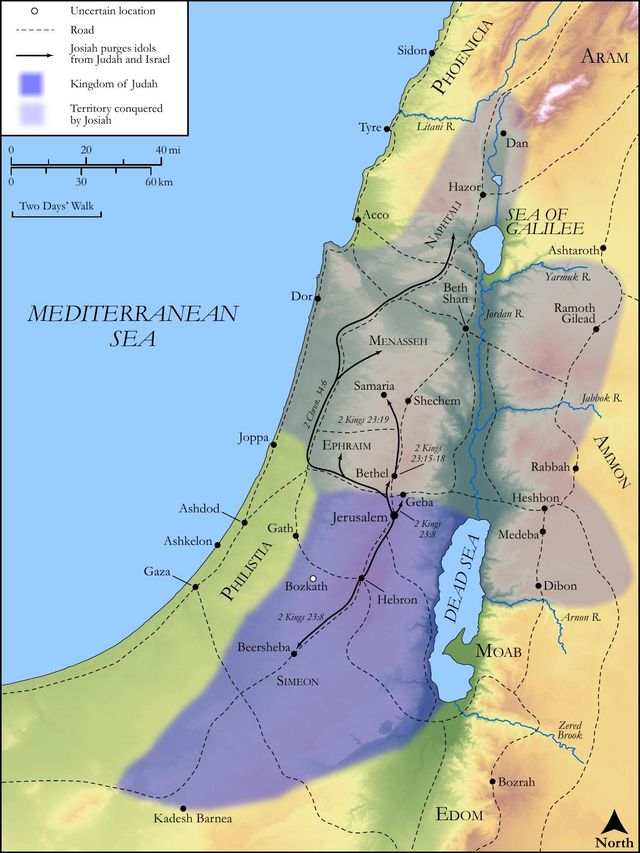
See on the biblical-era map
Study this verse
Public-domain commentary
Matthew Henry
From his Commentary on the Whole Bible. Henry comments on passages, not single verses — this entry covers 2 Chronicles 34:1–7.
Concerning Josiah we are here told, 1. That he came to the crown when he was very young, only eight years old (yet his infancy did not debar him from his right), and he reigned thirty-one years (Ch2 34:1), a considerable time. I fear, however, that in the beginning of his reign things went much as they had done in his father's time, because, being a child, he must have left the management of them to others; so that it was not till his twelfth year, which goes far in the number of his years, that the reformation began, Ch2 34:3. He could not, as Hezekiah did, fall about it immediately. 2. That he reigned very well (Ch2 34:2), approved himself to God, trod in the steps of David, and did not decline either to the right hand of to the left: for there are errors on both hands. 3. That while he was young, about sixteen years old, he began to seek after God, Ch2 34:3. We have reason to think he had not so good an education as Manasseh had (it is well if those about him did not endeavour to corrupt and debauch him); yet he thus sought God when he was young. It is the duty and interest of young people, and will particularly be the honour of young gentlemen, as soon as they come to years of understanding, to begin to seek God; for those that seek him early shall find him. 4. That in the twelfth year of his reign, when it is probable he took the administration of the government entirely into his own hands, he began to purge his kingdom from the remains of idolatry; he destroyed the high places, groves, images, altars, all the utensils of idolatry, v. 3, 4. He not only cast them out as Manasseh did, but broke them to pieces, and made dust of them. This destruction of idolatry is here said to be in his twelfth year, but it was said (Kg2 23:23) to be in his eighteenth year. Something was probably done towards it in his twelfth year; then he began to purge out idolatry, but that good work met with opposition, so that it was not thoroughly done till they had found the book of the law six years afterwards. But here the whole work is laid together briefly which was much more largely and particularly related in the Kings. His zeal carried him out to do this, not only in Judah and Jerusalem, but in the cities of Israel too, as far as he had any influence upon them.
Historical interpretation
Historical reception
1 surviving comment on this verse from the historical church.
With zeal immense, Josiah,
Himself a prince, acted in such a way
As no one before or after him had ever done!—Idols he
Dethroned; destroyed unhallowed temples; burned
With fire priests on their altars; all the bones
Of false prophets were dug up; the altars burned,
The carcasses to be consumed did serve
For fuel!
Continue studying 2 Chronicles 34:2 across the web’s major study libraries — every link below opens this exact verse, chapter, or book on the destination site.
Read & Compare
 BibleGatewayThis verse in more than 200 translations and 70 languages.
 Bible.comThe YouVersion reader — hundreds of translations, reading plans, and highlights.
 ESV.orgCrossway's official English Standard Version reader.
 NET BibleThe NET translation with 60,000+ translators' notes on every rendering decision.
 STEP BibleTyndale House's free study tool — original text, vocabulary, and scholarly resources.
 BibliaLogos Bible Software's free web reader.
 USCCBThe New American Bible (Revised Edition) with the U.S. bishops' study notes.
Commentaries
 BibleHub CommentariesDozens of classic commentaries on this verse, gathered on one page.
 StudyLightMore than 100 commentary sets — the largest collection on the web.
 BibleRefPlain-English commentary on what this verse means, verse by verse.
 Enduring WordDavid Guzik's free commentary on this chapter, widely used by Bible teachers.
 Bible Study ToolsVerse commentary alongside Greek and Hebrew study aids.
Original Language & Research
- BibleHub InterlinearThe verse word by word — original language, transliteration, and English.
- BibleHub LexiconEvery word's original-language definition and Strong's entry.
 Blue Letter BibleDeep-study tools — Strong's numbers, concordance, and word studies.
 SefariaThe Hebrew text with Rashi and centuries of Jewish commentary.
Sermons, Hymns & Audio


TrulyRandomVerse is not affiliated with these sites and doesn’t control their content. They’re linked because they’re genuinely useful.
Summary
King Josiah's reign, as introduced in 2 Chronicles 34:2, stands as a profound testament to righteous leadership and unwavering devotion in the face of widespread apostasy. Ascending the throne of Judah at a tender age, Josiah distinguished himself by consistently doing "that which was right in the sight of the LORD." His commitment was characterized by a faithful adherence to the spiritual legacy of King David, demonstrating a steadfast obedience that neither deviated to the right nor to the left, setting the stage for significant national reform and a return to covenant faithfulness.
Context
ShowHideLiterary Context
Verse 2 immediately follows the brief introduction of Josiah's ascension to the throne at eight years old in 2 Chronicles 34:1. This quick transition from his age to his character is highly significant, establishing his moral and spiritual integrity from the outset of his reign. It starkly contrasts with the preceding accounts of his father Amon (2 Chronicles 33:21-25) and grandfather Manasseh (2 Chronicles 33:1-20), both of whom "did that which was evil in the sight of the LORD." By immediately declaring Josiah's righteousness, the Chronicler signals a dramatic shift in Judah's spiritual trajectory, positioning Josiah as a beacon of hope and a catalyst for profound national repentance and reform, which unfolds in the subsequent verses of 2 Chronicles 34.
Historical & Cultural Context
Josiah inherited a kingdom deeply entrenched in idolatry and syncretism, largely due to the prolonged and wicked reign of his grandfather Manasseh. Manasseh had actively promoted Baal worship, Asherah poles, and astral cults, even building altars to pagan deities within the temple precincts (2 Chronicles 33:3-7). His father Amon continued this apostasy (2 Chronicles 33:22). Culturally, Judah had become accustomed to a blend of Yahwism and pagan practices, making Josiah's commitment to pure monotheism and covenant fidelity a radical departure from the norm. Historically, the Assyrian Empire, which had long dominated the region, was in decline, creating a political vacuum that allowed Judah a degree of autonomy. This geopolitical shift provided Josiah with a unique opportunity to implement far-reaching religious reforms without significant external interference, enabling him to dismantle pagan altars and restore the temple, as detailed later in 2 Chronicles 34.
Key Themes
ShowHideThe verse powerfully introduces several key themes that permeate the narrative of Josiah's reign and the broader book of Chronicles. First, Righteous Leadership is paramount, as Josiah's actions are explicitly deemed "right in the sight of the LORD," signifying divine approval and his adherence to God's moral and spiritual standards. This foundational characteristic is presented as the prerequisite for his later extensive spiritual reforms. Second, the Davidic Ideal is highlighted by his walking "in the ways of David his father." This phrase connects Josiah directly to King David, the benchmark for righteous kingship in Israel, signifying a return to the covenant loyalty and pure worship that many of Judah's preceding kings had abandoned. Third, Steadfast Obedience is powerfully conveyed by the phrase "declined neither to the right hand, nor to the left." This idiom, rooted in Deuteronomic law (e.g., Deuteronomy 5:32), speaks to a life of strict adherence to God's commands without deviation or compromise, reflecting a deep personal integrity and devotion that would enable him to lead Judah back to the Lord.
Exposition and Analysis
ShowHideKey Word Analysis
ShowHideThis adjective denotes that which is straight, upright, just, or pleasing. When applied to actions done "in the sight of the LORD," it signifies alignment with God's moral and ethical standards, indicating divine approval. Josiah's conduct was not merely socially acceptable but divinely affirmed as righteous.
This verb, commonly used in biblical literature, serves as a metaphor for one's conduct, lifestyle, or course of life. To "walk in the ways of David" means to pattern one's life and reign after David's example of covenant faithfulness and devotion to God, rather than merely following his physical footsteps.
This verb means to turn aside, deviate, or depart. In the context of "neither to the right hand, nor to the left," it emphasizes an unwavering commitment and strict adherence to a prescribed path, without any deviation or compromise. It signifies precision and steadfastness in obedience.
Verse Breakdown
ShowHide"And he did [that which was] right in the sight of the LORD"
This clause establishes Josiah's fundamental character and the divine perspective on his rule. Unlike his immediate predecessors, Josiah's actions were not self-serving or idolatrous but aligned with God's will and standards. This divine approval is the foundation for his legitimacy as a godly king and the success of his reforms. It implies a personal commitment to Yahweh and His covenant.
"and walked in the ways of David his father"
This phrase links Josiah directly to the ideal of kingship established by King David. David was remembered as a man after God's own heart, despite his flaws, because of his foundational loyalty to Yahweh and the covenant. By walking in David's ways, Josiah committed to upholding the Mosaic Law, promoting true worship, and rejecting idolatry, thus restoring the spiritual integrity of the Davidic line, which had been severely compromised by kings like Manasseh.
"and declined [neither] to the right hand, nor to the left"
This powerful idiom, echoing the language of the Torah, emphasizes Josiah's unwavering and precise obedience to God's commands. It signifies a life lived in strict adherence to the divine path, without any deviation, compromise, or pursuit of alternative ways. It speaks to a singular focus on God's will, rejecting both the allure of worldly temptations (turning to the right) and the pressures of cultural conformity (turning to the left).
Literary Devices
ShowHideThe verse employs several significant literary devices to convey Josiah's character and the nature of his reign. Allusion is prominent in the phrase "walked in the ways of David his father," which directly references the foundational covenant and ideal kingship established through King David, setting a standard against which all subsequent kings were measured. The most striking device is the idiom "declined neither to the right hand, nor to the left." This phrase is a direct echo of the Deuteronomic law (e.g., Deuteronomy 5:32, Deuteronomy 17:11, Deuteronomy 28:14), serving as a powerful intertextual reference that immediately communicates Josiah's commitment to the precise and full observance of God's statutes, without adding to or subtracting from them. Furthermore, the verse employs juxtaposition, implicitly contrasting Josiah's righteous conduct with the wicked reigns of his immediate predecessors, Amon and Manasseh, thereby highlighting the exceptional nature of his early devotion and signaling a turning point for Judah.
Theological and Thematic Connections
ShowHideJosiah's unwavering commitment to doing "that which was right in the sight of the LORD" and his refusal to "decline neither to the right hand, nor to the left" articulate a profound theological truth about the nature of true obedience and covenant faithfulness. His reign exemplifies the principle that genuine spiritual reform and national blessing stem from a leadership that prioritizes God's commands above all else, regardless of surrounding cultural or familial pressures. This verse underscores the biblical emphasis on wholehearted devotion and the dangers of syncretism or partial obedience. Josiah's adherence to the "ways of David" also highlights the enduring significance of the Davidic covenant and the ideal of a king who faithfully represents God's rule on earth, serving as a beacon of hope for a return to the Lord. His life demonstrates that even in the darkest spiritual times, a single individual committed to God can initiate widespread transformation.
Reflection and Application
ShowHideKing Josiah's early and steadfast devotion, described in 2 Chronicles 34:2, serves as a powerful and enduring example for all believers today. His life demonstrates that true righteousness is found in unwavering obedience to God's will, regardless of surrounding influences or inherited circumstances. Josiah ascended the throne in an environment steeped in idolatry and spiritual compromise, yet he chose a path of uncompromising faithfulness. This challenges us to consider our own environments and whether we are truly "doing what is right in the sight of the LORD" even when it goes against the prevailing culture or personal comfort. For leaders, Josiah's reign highlights the profound impact of prioritizing God's approval above all else, showing how one person's integrity can catalyze national or communal transformation. For individuals, his example encourages unwavering trust and obedience to God's Word, not deviating from the path He has set. It reminds us that consistency in following God's ways leads to a life that is truly "right in the sight of the LORD" and can bring about significant positive change, starting with our own hearts and extending to our spheres of influence.
Questions for Reflection
ShowHideFAQ
ShowHideWhy is Josiah's age at ascension significant?
ShowHideJosiah's ascension to the throne at just eight years old (2 Chronicles 34:1) is highly significant because it highlights the profound nature of his commitment to God from such a young age. Despite inheriting a kingdom deeply steeped in idolatry from his wicked grandfather Manasseh and father Amon, Josiah immediately chose to "do what was right in the sight of the LORD." This demonstrates that true devotion is not dependent on age or past circumstances but on a genuine heart for God, showcasing divine grace and the potential for early, profound spiritual integrity.
What does "walked in the ways of David his father" imply?
ShowHideThis phrase is a powerful theological statement. It implies that Josiah patterned his reign and personal conduct after the ideal of kingship established by King David. David, despite his personal failings, was remembered as a king who was fundamentally loyal to Yahweh and the Mosaic covenant. By walking in David's ways, Josiah committed to upholding true worship, rejecting idolatry, and administering justice according to God's law, thereby signifying a return to covenant faithfulness and righteous rule, unlike many intervening kings who had strayed far from this ideal.
How does "declined neither to the right hand, nor to the left" relate to other biblical texts?
ShowHideThis idiom is a direct echo of the instructions given in the Torah, particularly in the book of Deuteronomy. It emphasizes strict, unwavering adherence to God's commands without any deviation or compromise. For example, Deuteronomy 5:32 states, "Ye shall observe to do therefore as the LORD your God hath commanded you: ye shall not turn aside to the right hand or to the left." Similarly, Joshua 1:7 commands Joshua to "turn not from it to the right hand or to the left, that thou mayest prosper whithersoever thou goest." This phrase underscores Josiah's commitment to the precise and full observance of God's statutes, without adding to or subtracting from them, embodying the ideal of perfect obedience.
Christ-Centered Fulfillment
ShowHideWhile King Josiah stands as a remarkable example of righteous kingship and unwavering obedience, his life ultimately points to the perfect fulfillment found in Jesus Christ. Josiah, in his commitment to "do that which was right in the sight of the LORD" and to "decline neither to the right hand, nor to the left," serves as a type of the ultimate King who would perfectly embody these ideals. Jesus Christ is the true Son of David who perfectly "walked in the ways of David his father," not merely by adhering to the Law but by fulfilling its every demand and intention (Matthew 5:17). Unlike Josiah, who, despite his reforms, could not ultimately prevent Judah's downfall due to the people's hardened hearts, Christ's obedience was absolute and redemptive. He never "declined to the right hand, nor to the left" in His mission, even to the point of death on a cross (Philippians 2:8), perfectly accomplishing the will of His Father. He is the sinless High Priest who was "in all points tempted like as we are, yet without sin" (Hebrews 4:15), demonstrating the perfect righteousness that Josiah strived for. Thus, Josiah's reign, with its commitment to purity and obedience, foreshadows the reign of Christ, who brings about not merely temporary reform but eternal salvation and a new covenant based on His perfect righteousness and unwavering faithfulness.