


2 Chronicles 34:1
Bible text: King James Version (1769 Blayney text) · Public domain
Bible text: Berean Standard Bible · Public domain
Bible text: American Standard Version (1901) · Public domain
Bible text: World English Bible, Messianic edition · Public domain
Bible text: Geneva Bible (1599) · Public domain
Bible text: Young's Literal Translation · Public domain
- בֶּןben[was] a son ofH1121N-mscNoun Singular Masculine Construct
- שְׁמוֹנֶהshe·mo·NeheightH8083N-csNoun Singular common gender Absolute
- שָׁנִיםsha·NimyearsH8141N-mpNoun Plural Masculine Absolute
- יֹאשִׁיָּהוּyo·shi·Ya·huJosiahH2977N-proper-mNoun Proper Masculine
- בְמָלְכוֹve·ma·le·Khowhen he became kingH4427Prep-b ¦ V-Qal-Inf ¦ 3msVerb Qal Infinitive Constructבְwhenמָלְכbecame kingוֹhe
- וּשְׁלֹשִׁיםu·she·lo·Shimand thirtyH7970Conj-w ¦ N-mpNoun Plural Masculine Absoluteוּandשְׁלֹשִׁיםthirty
- וְאַחַתve·'a·Chatand oneH259Conj-w ¦ N-fscNoun Singular Feminine Constructוְandאַחַתone
- שָׁנָהsha·Nahyear[s]H8141N-fsNoun Singular Feminine Absolute
- מָלַךְma·Lakhhe reignedH4427V-Qal-Perf-3msVerb Qal Perfect 3rd Singular Masculine
- בִּירוּשָׁלִָםbi·ru·sha·Limin JerusalemH3389Prep-b ¦ N-properNoun Proper LocationבִּinירוּשָׁלִָםJerusalem
English is a literal word-by-word gloss of the Hebrew, not the KJV's wording. Why?
This is the original text the KJV's translators worked from — each Hebrew word with its own literal English meaning in this verse, prepared by scholars at Tyndale House, Cambridge. The KJV translates whole sentences, not word by word, so its wording differs: one Hebrew word can become several English words, and the KJV may choose “the LORD” where the gloss reads “Yahweh”. Both are faithful — they answer different questions. For the KJV's own rendering, switch to the KJV text.
Details
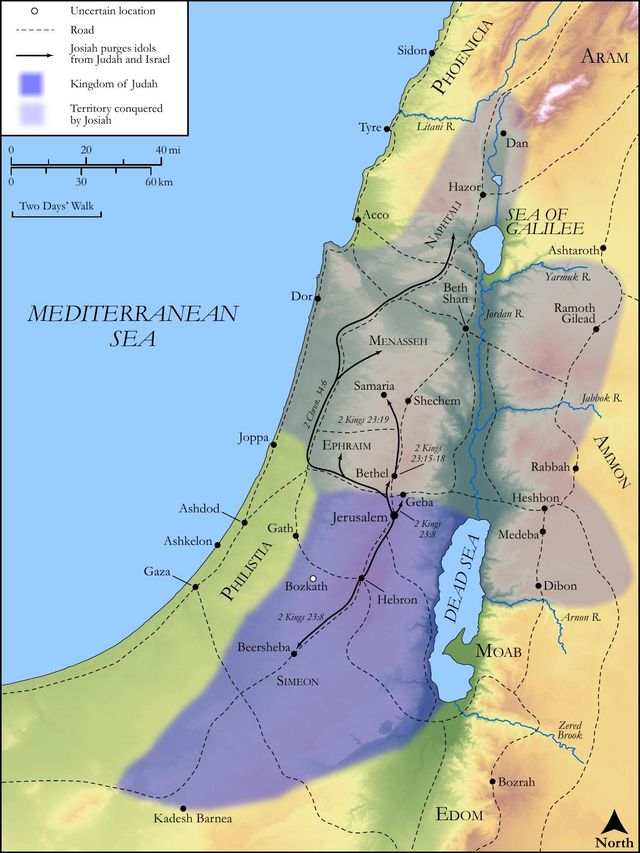
See on the biblical-era map
Study this verse
Public-domain commentary
Matthew Henry
From his Commentary on the Whole Bible. Henry comments on passages, not single verses — this entry covers 2 Chronicles 34:1–7.
Concerning Josiah we are here told, 1. That he came to the crown when he was very young, only eight years old (yet his infancy did not debar him from his right), and he reigned thirty-one years (Ch2 34:1), a considerable time. I fear, however, that in the beginning of his reign things went much as they had done in his father's time, because, being a child, he must have left the management of them to others; so that it was not till his twelfth year, which goes far in the number of his years, that the reformation began, Ch2 34:3. He could not, as Hezekiah did, fall about it immediately. 2. That he reigned very well (Ch2 34:2), approved himself to God, trod in the steps of David, and did not decline either to the right hand of to the left: for there are errors on both hands. 3. That while he was young, about sixteen years old, he began to seek after God, Ch2 34:3. We have reason to think he had not so good an education as Manasseh had (it is well if those about him did not endeavour to corrupt and debauch him); yet he thus sought God when he was young. It is the duty and interest of young people, and will particularly be the honour of young gentlemen, as soon as they come to years of understanding, to begin to seek God; for those that seek him early shall find him. 4. That in the twelfth year of his reign, when it is probable he took the administration of the government entirely into his own hands, he began to purge his kingdom from the remains of idolatry; he destroyed the high places, groves, images, altars, all the utensils of idolatry, v. 3, 4. He not only cast them out as Manasseh did, but broke them to pieces, and made dust of them. This destruction of idolatry is here said to be in his twelfth year, but it was said (Kg2 23:23) to be in his eighteenth year. Something was probably done towards it in his twelfth year; then he began to purge out idolatry, but that good work met with opposition, so that it was not thoroughly done till they had found the book of the law six years afterwards. But here the whole work is laid together briefly which was much more largely and particularly related in the Kings. His zeal carried him out to do this, not only in Judah and Jerusalem, but in the cities of Israel too, as far as he had any influence upon them.
Historical interpretation
Historical reception
1 surviving comment on this verse from the historical church.
With zeal immense, Josiah,
Himself a prince, acted in such a way
As no one before or after him had ever done!—Idols he
Dethroned; destroyed unhallowed temples; burned
With fire priests on their altars; all the bones
Of false prophets were dug up; the altars burned,
The carcasses to be consumed did serve
For fuel!
Continue studying 2 Chronicles 34:1 across the web’s major study libraries — every link below opens this exact verse, chapter, or book on the destination site.
Read & Compare
 BibleGatewayThis verse in more than 200 translations and 70 languages.
 Bible.comThe YouVersion reader — hundreds of translations, reading plans, and highlights.
 ESV.orgCrossway's official English Standard Version reader.
 NET BibleThe NET translation with 60,000+ translators' notes on every rendering decision.
 STEP BibleTyndale House's free study tool — original text, vocabulary, and scholarly resources.
 BibliaLogos Bible Software's free web reader.
 USCCBThe New American Bible (Revised Edition) with the U.S. bishops' study notes.
Commentaries
 BibleHub CommentariesDozens of classic commentaries on this verse, gathered on one page.
 StudyLightMore than 100 commentary sets — the largest collection on the web.
 BibleRefPlain-English commentary on what this verse means, verse by verse.
 Enduring WordDavid Guzik's free commentary on this chapter, widely used by Bible teachers.
 Bible Study ToolsVerse commentary alongside Greek and Hebrew study aids.
Original Language & Research
- BibleHub InterlinearThe verse word by word — original language, transliteration, and English.
- BibleHub LexiconEvery word's original-language definition and Strong's entry.
 Blue Letter BibleDeep-study tools — Strong's numbers, concordance, and word studies.
 SefariaThe Hebrew text with Rashi and centuries of Jewish commentary.
Sermons, Hymns & Audio


TrulyRandomVerse is not affiliated with these sites and doesn’t control their content. They’re linked because they’re genuinely useful.
Summary
Second Chronicles 34:1 serves as the foundational introduction to King Josiah, a monarch whose reign marked a profound turning point in Judah's spiritual history. This verse concisely establishes his tender age at ascension and the significant duration of his rule, immediately setting the stage for a period of remarkable spiritual reformation and national renewal. It highlights the extraordinary truth that such a transformative era was divinely initiated and sustained through a leader who began his kingship at the remarkably young age of eight, underscoring God's sovereign ability to raise up and empower unexpected vessels for His redemptive purposes, even amidst deep national apostasy.
Context
ShowHideLiterary Context
This verse provides the immediate and crucial introduction to Josiah's reign, strategically positioned after the accounts of his grandfather, Manasseh's long and deeply idolatrous rule, and his father, Amon's brief but equally wicked tenure. The Chronicler deliberately uses this opening statement to create a stark and hopeful contrast, signaling a dramatic shift from generations of apostasy to a period of unprecedented righteousness and divine intervention. This initial verse sets the narrative trajectory for the entirety of 2 Chronicles 34, which meticulously details Josiah's early purges of idolatry, the pivotal discovery of the Book of the Law, and the subsequent national covenant renewal, all stemming from the righteous character and divinely appointed rule introduced here. A parallel and complementary account of Josiah's reign is also extensively recorded in 2 Kings 22-23.
Historical & Cultural Context
Josiah ascended the throne during a period of significant geopolitical instability and shifting power dynamics among the nations. The once-dominant Assyrian Empire, which had exerted considerable influence over Judah and often encouraged its idolatrous practices, was in a state of rapid decline. This weakening of Assyrian hegemony provided Josiah with a unique window of opportunity, allowing him greater autonomy to implement his sweeping religious reforms without immediate external interference. Internally, Judah was steeped in profound spiritual decay; pagan altars, Asherah poles, and various idolatrous practices, including child sacrifice, had become pervasive, even desecrating the sacred precincts of the Temple itself, largely due to Manasseh's influence. The nation was morally bankrupt and spiritually estranged from its covenant with Yahweh, teetering on the brink of divine judgment that would eventually culminate in the Babylonian exile. Against this backdrop of national corruption and impending doom, Josiah's youthful and remarkably righteous reign stands as a divinely appointed interlude of grace, offering a final, profound opportunity for repentance and national restoration before the inevitable judgment.
Key Themes
ShowHideThe introduction of Josiah at the tender age of eight immediately foregrounds the theme of Divine Calling and Early Piety. His subsequent actions, detailed in 2 Chronicles 34:2, unequivocally demonstrate a profound personal commitment to the Lord from his formative years, a stark and divinely orchestrated deviation from the spiritual trajectory of his immediate predecessors. This also powerfully underscores God's Sovereignty in Leadership, illustrating His absolute ability to raise up leaders, even those who defy conventional expectations of age or experience, to fulfill His divine purposes and instigate necessary spiritual and societal change. Furthermore, Josiah's reign, inaugurated in this verse, embodies the profound theme of Hope for National Transformation. Despite Judah's deep-seated idolatry and spiritual depravity, Josiah's relatively long reign of thirty-one years allowed for the implementation of extensive and deeply rooted reforms, including the discovery of the Book of the Law and a zealous, widespread purging of idolatry from the land, offering a compelling testament to the enduring possibility of repentance and revival, even on a national scale.
Exposition and Analysis
ShowHideKey Word Analysis
ShowHideFrom the Hebrew H2977, this name literally means "Yahweh supports" or "Yahweh heals/saves." The very name of the king serves as a profound theological statement, foreshadowing his divinely-supported mission to bring spiritual healing, cleansing, and restoration to a nation deeply afflicted by generations of idolatry and moral decay. It powerfully suggests that his remarkable and transformative reign was not merely a human endeavor but one specifically empowered, sustained, and guided by God Himself.
From the Hebrew H8083, meaning "eight." This numerical detail, combined with "years" (H8141, shâneh) and "old" (H1121, bên, meaning "son" or "child of"), emphasizes Josiah's remarkably tender age at the commencement of his reign. In the line of Judah's kings, it was highly unusual for a monarch to ascend the throne at such a young age, typically indicating a regency or a period of severe instability, as when Joash began to reign at seven years old. This detail immediately signals the extraordinary nature of Josiah's kingship, suggesting a divine appointment that transcends conventional expectations of maturity or political experience. It highlights God's ability to use the young and seemingly inexperienced for His grand purposes, setting Josiah apart from the norm and underscoring the miraculous element of his righteous rule amidst a corrupt environment.
From the Hebrew H4427, a primitive root meaning "to reign" or "to ascend the throne." While a standard verb for exercising kingship, in the Chronicler's theological narrative, Josiah's "reigning" signifies far more than mere political rule. It implies a restoration of proper covenantal governance, a return to the righteous and God-centered rule that God intended for His people. This term, in Josiah's context, points to a period where the king actively and zealously led the nation back into alignment with divine law and covenant obligations, contrasting sharply with the destructive and idolatrous reigns of his immediate predecessors.
Verse Breakdown
ShowHide"¶ Josiah [was] eight years old when he began to reign"
This opening clause immediately captures the reader's attention by stating the remarkably young age of the new king. The "¶" symbol in the KJV often denotes a new paragraph or section, emphasizing the significance of this introduction. The tender age of eight underscores the divine hand in his unexpected appointment and sets up the dramatic contrast with the deep wickedness that preceded him. It implies that Josiah's subsequent righteousness and zeal were not a product of worldly influence or political maneuvering but a divinely instilled inclination from an exceptionally early age, marking him as a unique instrument of God's will.
"and he reigned in Jerusalem"
This phrase explicitly confirms Jerusalem as the capital and seat of Josiah's authority. As the city where the Temple, central to Judah's spiritual and national life, was located, this detail grounds his reign historically and geographically. It signifies that his comprehensive reforms would emanate directly from the heart of the kingdom, impacting its religious, political, and social center, and thus the entire nation.
"one and thirty years"
The duration of Josiah's reign, thirty-one years, is a significant detail. This relatively long period allowed ample time for his extensive and thorough reforms—including the purging of idolatry, the repair of the Temple, and the national covenant renewal—to take root and profoundly impact the land and its people. It indicates that his reign was not a fleeting moment of revival but a sustained effort that provided a substantial window of opportunity for genuine repentance and a return to the Lord before the impending and inevitable Babylonian exile.
Literary Devices
ShowHideThe verse employs several effective literary devices that enhance its impact and convey deeper meaning. Juxtaposition is subtly yet powerfully present, as Josiah's youthful and righteous beginning is implicitly contrasted with the long, wicked reigns of his grandfather Manasseh and father Amon, which immediately precede this account in the Chronicler's narrative. This sharp contrast highlights the dramatic shift in leadership and divine favor that Josiah's ascension represents. There is also a strong element of Foreshadowing, particularly through Josiah's name, "Yahweh supports," which hints at the divine backing and empowerment for his future, extensive reforms. His remarkably young age also foreshadows the extraordinary nature of his piety and zeal, suggesting a divinely appointed leader who would defy conventional expectations and bring about miraculous change. Finally, the verse exhibits remarkable Conciseness, packing significant biographical and historical information—his identity, age, and reign duration—into a single, brief statement. This brevity makes these foundational details stand out, emphasizing their critical importance for understanding the profound impact and unique character of Josiah's kingship.
Theological and Thematic Connections
ShowHideJosiah's introduction in 2 Chronicles 34:1 serves as a profound theological statement about God's sovereign choice and His enduring faithfulness to His covenant people, even in their deepest apostasy. Despite generations of spiritual decline and the pervasive idolatry under Manasseh and Amon, God, in His unfathomable grace, raises up a righteous king, even at a remarkably young age, to initiate a period of genuine repentance and reform. This demonstrates unequivocally that God's redemptive plan is not thwarted by human sin but continues to unfold through chosen vessels, often in unexpected ways. Josiah's reign underscores the biblical principle that true spiritual transformation, whether individual or national, begins with a heart devoted wholeheartedly to the Lord, regardless of age or external circumstances. It also powerfully highlights the transformative power of righteous leadership to turn a nation back to God, even if temporarily, before the full weight of judgment falls.
Reflection and Application
ShowHideJosiah's story, commencing with his remarkably youthful ascension to the throne, offers a powerful and enduring message for believers across all generations. It challenges our often-limited perceptions of who God can use and at what stage of life. Josiah's early piety and unwavering commitment to the Lord, despite his wicked upbringing and the widespread apostasy of his time, serve as a profound testament to the importance of personal conviction and the transformative power of a heart fully devoted to God. His reign reminds us that age is never a barrier to being used by God for significant impact, nor is a challenging or corrupt environment an excuse for spiritual compromise. Instead, it calls us to cultivate a radical dependence on God, trusting that He can equip and empower us, regardless of our perceived limitations or lack of experience, to be agents of His truth and righteousness in our spheres of influence. We are encouraged to seek the Lord early and wholeheartedly, knowing that even in times of deep spiritual decline, God can raise up individuals to lead movements of repentance and reform, bringing hope and renewal where it is most desperately needed.
Questions for Reflection
ShowHideFAQ
ShowHideWhy is Josiah's age at ascension highlighted in this verse?
ShowHideJosiah's age of eight years old when he began to reign is highlighted to emphasize several crucial points. First, it underscores the divine choice and appointment of Josiah, as such a young age for a monarch was highly unusual and suggests God's direct hand in raising him up as a unique instrument. Second, it creates a stark contrast with his immediate predecessors, Manasseh and Amon, who led Judah into deep idolatry. Josiah's early piety and righteous character, detailed in 2 Chronicles 34:2, become even more remarkable when considering his youth and the corrupt environment in which he was raised. This detail sets the stage for understanding the extraordinary nature of his subsequent reforms and his unwavering commitment to the Lord from an early age, marking him as a divinely-appointed anomaly.
What was the spiritual state of Judah when Josiah became king?
ShowHideWhen Josiah ascended the throne, Judah was in a state of profound spiritual and moral decay, bordering on complete apostasy. Under his grandfather Manasseh's long and wicked reign, idolatry had become rampant, with pagan altars, Asherah poles, and various foreign cults established even within the sacred precincts of the Temple itself. Practices such as astral worship, child sacrifice, and divination were widespread throughout the land. His father, Amon, continued this path of wickedness. The nation had largely abandoned the covenant with Yahweh, embracing the detestable practices of the surrounding nations. Josiah inherited a kingdom steeped in spiritual depravity, making his subsequent reforms, as described in 2 Chronicles 34:3-7, all the more miraculous and indicative of God's enduring grace to His people.
Is there a parallel account of Josiah's reign in another biblical book?
ShowHideYes, a significant parallel account of Josiah's reign is found in the book of 2 Kings, specifically chapters 22 and 23. While both accounts cover the same historical period and major events, such as the discovery of the Book of the Law and the extensive reforms, they often offer slightly different emphases or additional details. The Chronicler, writing from a post-exilic perspective, tends to highlight the spiritual and cultic aspects of Josiah's reign, emphasizing his adherence to the Law and his role in restoring proper worship, which aligns with the Chronicler's broader theological agenda of encouraging faithfulness to God and the Temple. The Kings account provides more detail on the political aspects and the fulfillment of prophecy.
Christ-Centered Fulfillment
ShowHideJosiah, introduced in 2 Chronicles 34:1 as a remarkably young and righteous king, serves as a powerful type of Christ, foreshadowing the ultimate King who would bring true spiritual healing and an eternal restoration. Just as Josiah arose in a time of profound national apostasy to cleanse the land and restore the Law, so too does Christ emerge as the perfectly righteous King, ushering in a new covenant and a profound spiritual reformation for all humanity. Josiah's zealous pursuit of the Lord, leading him to meticulously purge idolatry from the land and repair the Temple (as detailed in 2 Chronicles 34:3-7), powerfully points to Jesus's own zealous cleansing of the Temple (recorded in John 2:13-17) and, more profoundly, His mission to purify the hearts of His people from the idolatry of sin and self. The pivotal discovery of the Book of the Law under Josiah's reign (2 Chronicles 34:14) led to a national covenant renewal, mirroring how Christ, as the living Word of God, fully reveals God's will and establishes a new and superior covenant through His atoning sacrifice (Jeremiah 31:31-34 and Hebrews 8:6-13). Ultimately, while Josiah's reign was significant and brought temporary relief, it was finite and tragically ended in his death (2 Chronicles 35:20-24), highlighting the inherent limitations of even the best human kings and the enduring need for a perfect and eternal King. Christ, the true Son of David, reigns eternally, bringing not just a temporary reform but eternal salvation and an everlasting kingdom of righteousness and peace that will never end (Isaiah 9:6-7 and Luke 1:32-33).