


2 Chronicles 29:4
Bible text: King James Version (1769 Blayney text) · Public domain
Bible text: Berean Standard Bible · Public domain
Bible text: American Standard Version (1901) · Public domain
Bible text: World English Bible, Messianic edition · Public domain
Bible text: Geneva Bible (1599) · Public domain
Bible text: Young's Literal Translation · Public domain
- וַיָּבֵאvai·ya·Ve'and he broughtH935Conj-w ¦ V-Hiphil-ConsecImperf-3msVerb Hiphil Consecutive Imperfect 3rd Singular Masculineוַandיָּבֵאhe brought
- אֶת'et<obj.>H853DirObjMParticle Object Indicator
- הַכֹּהֲנִיםha·ko·ha·Nimthe priestsH3548Art ¦ N-mpNoun Plural Masculine Absoluteהַtheכֹּהֲנִיםpriests
- וְאֶתve·'Etand <obj.>H853Conj-w ¦ DirObjMParticle Object Indicatorוְandאֶת<obj.>
- הַלְוִיִּםhal·vi·Yimthe LevitesH3881Art ¦ N-mpNoun Gentilic Plural Masculine AbsoluteהַtheלְוִיִּםLevites
- וַיַּאַסְפֵםvai·ya·'as·Femand he gathered themH622Conj-w ¦ V-Qal-ConsecImperf-3ms ¦ 3mpVerb Qal Consecutive Imperfect 3rd Singular Masculineוַandיַּאַסְפֵhe gatheredםthem
- לִרְחוֹבlir·Chovto [the] open place ofH7339Prep-l ¦ N-fscNoun Singular Feminine Constructלִtoרְחוֹב[the] open place of
- הַמִּזְרָחha·miz·Rachthe eastH4217Art ¦ N-msNoun Singular Masculine Absoluteהַtheמִּזְרָחeast
English is a literal word-by-word gloss of the Hebrew, not the KJV's wording. Why?
This is the original text the KJV's translators worked from — each Hebrew word with its own literal English meaning in this verse, prepared by scholars at Tyndale House, Cambridge. The KJV translates whole sentences, not word by word, so its wording differs: one Hebrew word can become several English words, and the KJV may choose “the LORD” where the gloss reads “Yahweh”. Both are faithful — they answer different questions. For the KJV's own rendering, switch to the KJV text.
Details
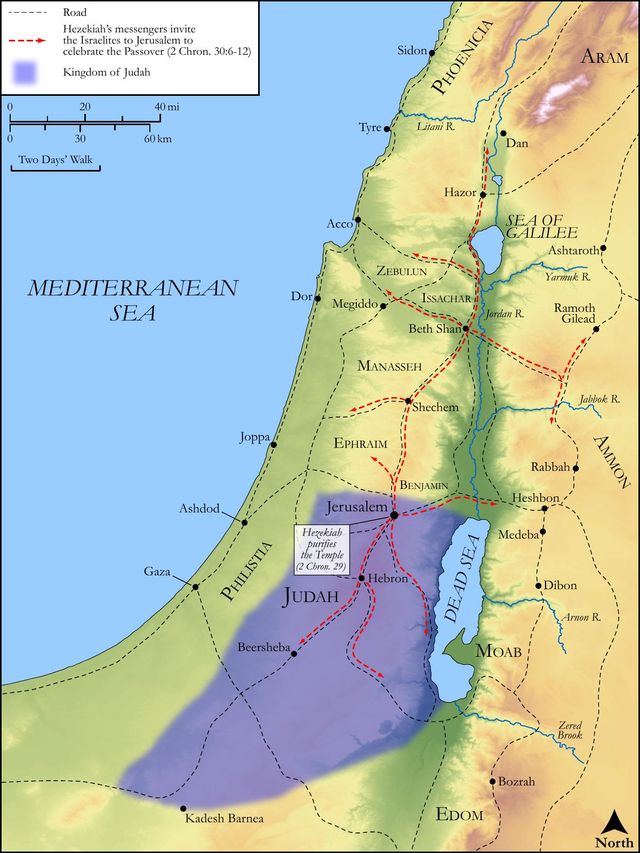
See on the biblical-era map
Study this verse
Public-domain commentary
Matthew Henry
From his Commentary on the Whole Bible. Henry comments on passages, not single verses — this entry covers 2 Chronicles 29:1–11. His three-level outline is real structure in the source text, so it is rendered as structure.
Here is, I. Hezekiah's age when he came to the crown. He was twenty-five years old. Joash, who came to the crown after two bad reigns, was but seven years old; Josiah, who came after two bad reigns, was but eight, which occasioned the delay of the reformation; but Hezekiah had come to years, and so applied himself immediately to it. We may well think with what a sorrowful heart he beheld his father's idolatry and profaneness, how it troubled him to see the doors of the temple shut, though, while his father lived, he durst not open them. His soul no doubt wept in secret for it, and he vowed that when he should receive the congregation he would redress these grievances, which made him do it with more readiness and resolution.
II.His general character.
He did that which was right like David, Ch2 29:2. Of several of his predecessors it had been said that they did that which was right, but not like David, not with David's integrity and zeal. But here was one that had as hearty an affection for the ark and law of God as ever David had.
III.His speedy application to the great work of restoring religion.
The first thing he did was to open the doors of the house of the Lord, Ch2 29:3. We are willing to hope his father had not quite suppressed the temple service; for then the holy fire on the altar must have gone out, and we do not read of the re-kindling of it; but he had hindered the people from attending it, and the priests, except such of them as were of his own party, Kg2 16:15. But Hezekiah immediately threw the church doors open, and brought in the priests and Levites. He found Judah low and naked, yet did not make it his first business to revive the civil interests of his kingdom, but to restore religion to its good posture again. Those that begin with God begin at the right end of their work, and it will prosper accordingly.
IV.His speech to the priests and Levites.
It was well known, no doubt, that he had a real kindness for religion and was disaffected to the corruptions of the last reign; yet we do not find the priests and Levites making application to him for the restoration of the temple service but he calls upon them, which, I doubt, bespeaks their coldness as much as his zeal; and perhaps, if they had done their part with vigour, things would not have been brought into so very bad a posture as Hezekiah found them in. Hezekiah's exhortation to the Levites is very pathetic.
1.He laid before them the desolations of religion and the deplorable state to which it was brought among them (Ch2 29:6, Ch2 29:7): Our fathers have trespassed. He said not "My father," because it became him, as a son, to be as tender as might be of his father's name, and because his father would not have done all this if their fathers had not neglected their duty. Urijah the priest had joined with Ahaz in setting up an idolatrous altar. He complained,
(1.)That the house of God had been deserted: They have forsaken God, and turned their backs upon his habitation. Note, Those that turn their backs upon God's ordinances may truly be said to forsake God himself.
(2.)That the instituted worship of God there had been let fall. The lamps were not lighted, and incense was not burnt. There are still such neglects as these, and they are no less culpable, when the word is not duly read and opened (for that was signified by the lighting of the lamps) and when prayers and praises are not duly offered up, for that was signified by the burning of incense.
2.He showed the sad consequences of the neglect and decay of religion among them, Ch2 29:8. 9. This was the cause of all the calamities they had lain under. God had in anger delivered them to trouble, to the sword, and to captivity. When we are under the rebukes of God's providence it is good for us to enquire whether we have not neglected God's ordinances and whether the controversy he has with us may not be traced to this neglect.
3.He declared his own full purpose and resolution to revive religion and make it his business to promote it (Ch2 29:10): "It is in my heart (that is, I am fully resolved) to make a covenant with the Lord God of Israel (that is, to worship him only, and in that way which he has appointed); for I am sure that, otherwise, his fierce anger will not turn away from us." This covenant he would not only make himself, but bring his people into the bond of.
4.He engaged and excited the Levites and priests to do their duty on this occasion. This he begins with (Ch2 29:5); this he ends with, Ch2 29:11. He called them Levites to remind them of their obligation to God, called them his sons to remind them of the relation to himself, that he expected that, as a son with the father, they should serve with him in the reformation of the land. (1.) he told them what was their duty, to sanctify themselves first (by repenting of their neglects, reforming their own hearts and lives, and renewing their covenants with God to do their duty better for the time to come), and then to sanctify the house of God, as his servants, to make it clean from every thing that was disagreeable, either through the disuse or the profanation of it, and to set it up for the purposes for which it was made. (2.) He stirred them up to do it (Ch2 29:11): "Be not now negligent, or remiss, in your duty. Let not this good work be retarded through your carelessness." Be not deceived, so the margin. Note, Those that by their negligence in the service of God think to mock God, and put a cheat upon him, do but deceive themselves, and put a damning cheat upon their own souls. Be not secure (so some), as if there were no urgent call to do it or no danger in not doing it. Note, Men's negligence in religion is owing to their carnal security. The consideration he quickens them with is derived from their office. God had herein put honour upon them: He has chosen you to stand before him. God therefore expected work from them. They were not chosen to be idle, to enjoy the dignity and leave the duty to be done by others, but to serve him and to minister to him. They must therefore be ashamed of their late remissness, and, now that the doors of the temple were opened again, must set about their work with double diligence.
Continue studying 2 Chronicles 29:4 across the web’s major study libraries — every link below opens this exact verse, chapter, or book on the destination site.
Read & Compare
 BibleGatewayThis verse in more than 200 translations and 70 languages.
 Bible.comThe YouVersion reader — hundreds of translations, reading plans, and highlights.
 ESV.orgCrossway's official English Standard Version reader.
 NET BibleThe NET translation with 60,000+ translators' notes on every rendering decision.
 STEP BibleTyndale House's free study tool — original text, vocabulary, and scholarly resources.
 BibliaLogos Bible Software's free web reader.
 USCCBThe New American Bible (Revised Edition) with the U.S. bishops' study notes.
Commentaries
 BibleHub CommentariesDozens of classic commentaries on this verse, gathered on one page.
 StudyLightMore than 100 commentary sets — the largest collection on the web.
 BibleRefPlain-English commentary on what this verse means, verse by verse.
 Enduring WordDavid Guzik's free commentary on this chapter, widely used by Bible teachers.
 Bible Study ToolsVerse commentary alongside Greek and Hebrew study aids.
Original Language & Research
- BibleHub InterlinearThe verse word by word — original language, transliteration, and English.
- BibleHub LexiconEvery word's original-language definition and Strong's entry.
 Blue Letter BibleDeep-study tools — Strong's numbers, concordance, and word studies.
 SefariaThe Hebrew text with Rashi and centuries of Jewish commentary.
Sermons, Hymns & Audio


TrulyRandomVerse is not affiliated with these sites and doesn’t control their content. They’re linked because they’re genuinely useful.
Summary
King Hezekiah's immediate and decisive action upon ascending the throne of Judah is powerfully encapsulated. This verse marks the pivotal commencement of his reign, highlighting his unwavering commitment to spiritual reform and the urgent restoration of true worship, which had been severely neglected and defiled under his idolatrous father, King Ahaz. By gathering the divinely appointed priests and Levites into a public assembly, Hezekiah initiated the essential first step in a comprehensive process of cleansing, reconsecration, and rededication of the Temple and the nation to the Lord, setting the stage for a profound spiritual revival.
Context
ShowHideLiterary Context
This verse is strategically placed at the very outset of King Hezekiah's reign, immediately following the brief introduction of his age and righteous character in 2 Chronicles 29:1-2. It directly follows the statement in 2 Chronicles 29:3 that "In the first year of his reign, in the first month, he opened the doors of the house of the Lord, and repaired them." Verse 4 then details how Hezekiah began this repair and restoration: by assembling the divinely appointed spiritual leaders. This immediate action sets the tone for the entire chapter, which meticulously describes the extensive cleansing of the Temple (e.g., 2 Chronicles 29:16-19) and the subsequent re-establishment of proper sacrifices and worship (e.g., 2 Chronicles 29:20-36). The verse serves as the foundational act upon which all subsequent reforms are built, emphasizing the necessity of proper spiritual leadership for national renewal.
Historical & Cultural Context
King Hezekiah inherited a kingdom in profound spiritual and moral decay. His father, King Ahaz, had not only tolerated but actively promoted idolatry, even going so far as to shut up the doors of the temple of the Lord and erect altars to false gods throughout Jerusalem and Judah. Ahaz had embraced Assyrian religious practices and sought foreign alliances, leading the nation into deep apostasy and divine judgment. In this context, Hezekiah's actions were revolutionary. The priests and Levites, who were divinely appointed for the service of the Temple, teaching the Law, and mediating sacrifices (as outlined in Numbers 3:5-10 and Deuteronomy 33:10), had either become corrupted themselves or were rendered inactive due to Ahaz's policies. Their gathering was a critical step in re-establishing the proper order of worship and national covenant fidelity. The "east street" likely refers to a significant open plaza or courtyard on the eastern side of the Temple complex, a suitable and public location for a large, formal assembly, perhaps near the East Gate, symbolizing a new beginning.
Key Themes
ShowHideThis verse powerfully introduces several key themes that permeate the narrative of Hezekiah's reign and the book of Chronicles. Firstly, it underscores Proactive and Godly Leadership. Hezekiah did not delay in confronting the spiritual crisis but immediately prioritized the restoration of God's worship, setting a powerful example in stark contrast to the spiritual negligence of many previous kings, particularly his father. Secondly, it highlights the Restoration of Proper Worship. The act of gathering the priests and Levites was fundamental, as these individuals were the divinely appointed conduits for the prescribed forms of worship that had been abandoned or corrupted. Their re-engagement signified a return to Mosaic covenant practices. Thirdly, it emphasizes Preparation for Holiness. The assembly in the "east street" was not merely a meeting but a formal summons for instruction, purification, and preparation before they could undertake the monumental task of cleansing and reconsecrating the Temple. This underscores the principle that spiritual service requires readiness and purity, a theme that resonates throughout the subsequent verses detailing the Levites' self-purification in 2 Chronicles 29:15. This immediate action signifies a profound commitment to national spiritual renewal.
Exposition and Analysis
ShowHideKey Word Analysis
ShowHideThis verb (H935) signifies a deliberate, authoritative act of summoning or causing to come. It is not a casual invitation but a kingly command, indicating Hezekiah's decisive leadership and his understanding of the urgency and importance of gathering these specific individuals who held the keys to spiritual restoration. It implies a forceful and intentional act of re-engagement.
This term (H3548) refers to those literally officiating, the direct descendants of Aaron, set apart for the most sacred duties within the Temple. Their responsibilities included offering sacrifices, burning incense, and ministering before the altar. Their presence was essential for the legitimate performance of Temple rituals and the re-establishment of covenant worship.
Members of the tribe of Levi (H3881), distinct from the Aaronic priests, who served as assistants in various Temple functions such as music, gatekeeping, cleaning, preparing sacrifices, and teaching the Law. Their inclusion signifies a comprehensive restoration of all aspects of Temple service, acknowledging the vital support role they played in the spiritual life of the nation.
Verse Breakdown
ShowHide"And he brought in the priests and the Levites"
This opening clause immediately establishes King Hezekiah's initiative and authority. The pronoun "he" refers to Hezekiah, emphasizing his personal commitment and leadership in this spiritual revival. The specific mention of "priests and the Levites" highlights that the reform began with those divinely ordained for Temple service, acknowledging their crucial, indispensable role in mediating between God and the people. Their prior neglect or corruption under Ahaz made their re-engagement a foundational and non-negotiable step for any true spiritual renewal.
"and gathered them together"
This phrase underscores the formal, deliberate, and unifying nature of the assembly. It implies a purposeful collection of these scattered or inactive groups, uniting them for a common, sacred purpose. This gathering was for instruction, exhortation, and preparation, signifying a collective commitment to the monumental task ahead. It was not merely a summons but an act of re-organizing and re-mobilizing the spiritual workforce of the nation, bringing order out of the chaos of Ahaz's reign.
"into the east street"
This specifies the location of the gathering. The "east street" (or "east open space/plaza," from H7339 rᵉchôb for "street" and H4217 mizrâch for "east") was a public, accessible area likely near the eastern gate of the Temple complex. This choice of location suggests transparency and the public nature of Hezekiah's intentions. It was a place suitable for a large assembly, indicating the scale and importance of the impending spiritual reformation. It also implicitly contrasts with the hidden or illicit idolatry that had previously taken place, marking a public turning point for the nation.
Literary Devices
ShowHideThe verse employs several significant literary devices that enrich its meaning and impact. Contrast is immediately evident, as Hezekiah's swift and decisive action stands in stark opposition to the idolatry, neglect, and spiritual decay fostered by his father, King Ahaz. This creates a dramatic shift in the narrative, signaling a new era of righteousness and a profound break from the past. Foreshadowing is also powerfully present, as this initial gathering of the priests and Levites clearly anticipates the extensive and detailed account of the Temple cleansing and re-dedication that meticulously follows in the rest of the chapter. It sets the stage for a major, divinely-ordained spiritual undertaking, hinting at the magnitude of the restoration to come. Furthermore, Symbolism is at play: the very act of "gathering" the scattered or inactive spiritual leaders symbolizes the re-establishment of divine order, the restoration of proper protocol in worship, and the reunification of a fragmented spiritual body. The "east street" itself, as a public and prominent location, symbolizes the openness, legitimacy, and national scope of Hezekiah's reform, moving from the hidden shame of idolatry to a public declaration of repentance and renewal before God and the people.
Theological and Thematic Connections
ShowHideThis verse is profoundly significant for understanding the theology of spiritual leadership and national repentance. It teaches that true spiritual revival often begins with the intentional gathering and purification of those called to lead in worship and instruction. Hezekiah's immediate focus on the priests and Levites demonstrates an understanding that the spiritual health of the nation was inextricably linked to the faithfulness and purity of its designated spiritual servants. Their re-engagement was not merely administrative but a theological necessity for the restoration of the covenant relationship between God and His people. It highlights God's enduring commitment to His covenant, even when His people stray, and His willingness to work through righteous leaders to bring about restoration. The act of bringing them together in a public space emphasizes the corporate nature of worship and the necessity of unity in pursuing holiness, underscoring that spiritual renewal is a communal endeavor requiring collective commitment and purified leadership.
Reflection and Application
ShowHideHezekiah's immediate and decisive action in 2 Chronicles 29:4 offers timeless lessons for both corporate and individual spiritual life. For leaders, it underscores the profound importance of prioritizing spiritual health and actively addressing spiritual decline within their spheres of influence, whether in a family, church, or community. There is an urgency to confronting spiritual decay, not delaying in the face of widespread compromise. This verse calls for courageous, God-centered leadership that initiates necessary reforms without hesitation. For individuals, this verse highlights the need for personal spiritual renewal, recognizing that just as the physical Temple needed cleansing, so too does the believer's life, as a "temple of the Holy Spirit" (1 Corinthians 6:19). We are called to examine our lives and remove anything that hinders true worship and fellowship with God, actively pursuing purity and obedience. The act of "gathering" also reminds us of the importance of corporate assembly for spiritual purposes—for instruction, encouragement, and unified action in God's service. It emphasizes that spiritual service requires readiness and purity, a process that often begins with intentional self-examination and a return to foundational truths, fostering a collective pursuit of God's will.
Questions for Reflection
ShowHideFAQ
ShowHideWhy was the "east street" significant for this gathering?
ShowHideThe "east street" (or "east open space/plaza," from the Hebrew rᵉchôb and mizrâch) was significant because it was a large, public, and accessible area likely located near the eastern gate of the Temple complex. This choice of location for gathering the priests and Levites was deliberate. It signified that King Hezekiah's reform was not a secret or private endeavor but a public declaration of his intent to restore true worship. It provided ample space for a large assembly and underscored the transparency and legitimacy of the impending spiritual cleansing, contrasting sharply with the hidden idolatry that had previously taken place in Judah under King Ahaz. It symbolized a public turning away from past apostasy and a visible commitment to national repentance and renewal.
Why were the priests and Levites specifically gathered by King Hezekiah?
ShowHideThe priests and Levites were specifically gathered because they were the divinely appointed and hereditary servants of the Lord, responsible for all aspects of Temple worship, sacrifices, and the teaching of God's Law. Under King Ahaz, the Temple had been shut and defiled, rendering these spiritual leaders inactive or corrupted. For any true spiritual reform to occur, it had to begin with those who were ordained to facilitate the nation's relationship with God. Hezekiah understood that the spiritual health of Judah depended on the restoration and purification of its spiritual leadership, making their gathering the essential first step in re-establishing proper worship and covenant fidelity. Their re-engagement was crucial for the legitimate performance of all subsequent Temple services and the spiritual instruction of the people.
Christ-Centered Fulfillment
ShowHideKing Hezekiah's actions in 2 Chronicles 29:4 serve as a powerful Old Testament type, foreshadowing the ultimate spiritual cleansing and restoration brought about by Jesus Christ. Hezekiah, a righteous king, initiates the purification of the earthly temple and the re-establishment of proper worship, much as Jesus, the true King and ultimate High Priest (Hebrews 4:14), came to cleanse not just a physical temple (John 2:13-17), but the hearts of His people. Just as Hezekiah "brought in" and "gathered" the priests and Levites to prepare them for service, so Christ "gathers" His disciples (Matthew 28:19-20) and establishes a new covenant community, the Church, which is the true spiritual temple of God, indwelt by the Holy Spirit (1 Corinthians 3:16; Ephesians 2:19-22). His work of purification is not merely external but internal, making His people holy and blameless, presenting the Church to Himself "without stain or wrinkle or any other blemish, but holy and blameless" (Ephesians 5:25-27). Thus, Hezekiah's reform points to the more profound and lasting work of Christ, who perfectly fulfills the role of the one who gathers, purifies, and empowers His people for eternal worship and service, establishing a kingdom of priests (Revelation 1:6) who serve Him in spirit and truth.