


2 Chronicles 12:16
Bible text: King James Version (1769 Blayney text) · Public domain
Bible text: Berean Standard Bible · Public domain
Bible text: American Standard Version (1901) · Public domain
Bible text: World English Bible, Messianic edition · Public domain
Bible text: Geneva Bible (1599) · Public domain
Bible text: Young's Literal Translation · Public domain
- וַיִּשְׁכַּבvai·yish·Kavand he lay downH7901Conj-w ¦ V-Qal-ConsecImperf-3msVerb Qal Consecutive Imperfect 3rd Singular Masculineוַandיִּשְׁכַּבhe lay down
- רְחַבְעָםre·chav·'AmRehoboamH7346N-proper-mNoun Proper Masculine
- עִם'imwithH5973PrepPreposition
- אֲבֹתָיו'a·vo·Tavhis ancestorsH1N-fpc ¦ 3msNoun Plural Feminine Constructאֲבֹתָיancestorsוhis
- וַיִּקָּבֵרvai·yi·ka·Verand he was buriedH6912Conj-w ¦ V-Niphal-ConsecImperf-3msVerb Niphal Consecutive Imperfect 3rd Singular Masculineוַandיִּקָּבֵרhe was buried
- בְּעִירbe·'Irin [the] city ofH5892Prep-b ¦ N-fscNoun Singular Feminine Constructבְּinעִיר[the] city of
- דָּוִידda·VidDavidH1732N-proper-mNoun Proper Masculine
- וַיִּמְלֹךְvai·yim·Lokhand he became kingH4427Conj-w ¦ V-Qal-ConsecImperf-3msVerb Qal Consecutive Imperfect 3rd Singular Masculineוַandיִּמְלֹךְhe became king
- אֲבִיָּה'a·vi·YahAbijahH29N-proper-mNoun Proper Masculine
- בְנוֹve·Nohis sonH1121N-msc ¦ 3msNoun Singular Masculine Constructבְנsonוֹhis
- תַּחְתָּיוtach·Tavin place of himH8478N-mpc ¦ 3msNoun Plural Masculine Constructתַּחְתָּיin place ofוhim
English is a literal word-by-word gloss of the Hebrew, not the KJV's wording. Why?
This is the original text the KJV's translators worked from — each Hebrew word with its own literal English meaning in this verse, prepared by scholars at Tyndale House, Cambridge. The KJV translates whole sentences, not word by word, so its wording differs: one Hebrew word can become several English words, and the KJV may choose “the LORD” where the gloss reads “Yahweh”. Both are faithful — they answer different questions. For the KJV's own rendering, switch to the KJV text.
Details
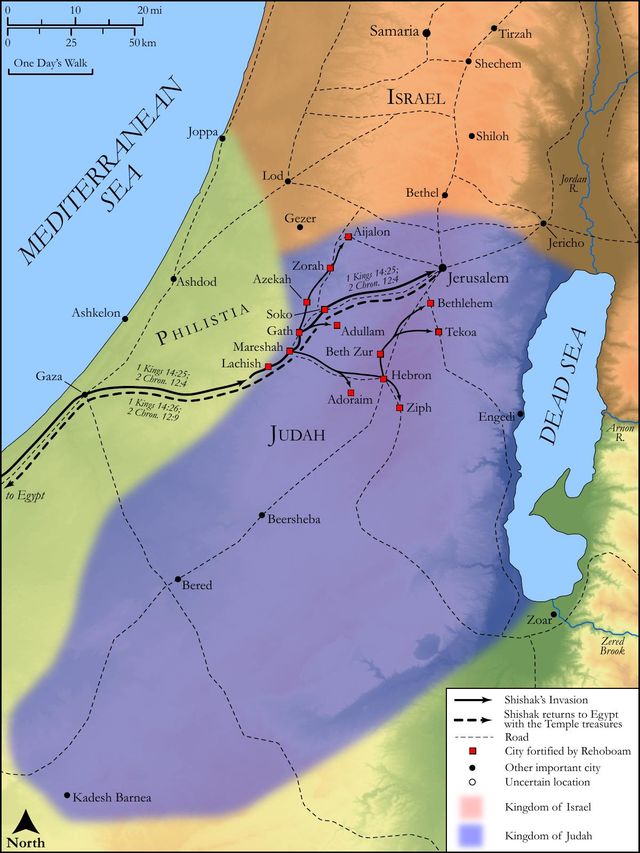
See on the biblical-era map
Study this verse
Public-domain commentary
Matthew Henry
From his Commentary on the Whole Bible. Henry comments on passages, not single verses — this entry covers 2 Chronicles 12:13–16.
The story of Rehoboam's reign is here concluded, much as the story of the other reigns concludes. Two things especially are observable here: - 1. That he was at length pretty well fixed in his kingdom, Ch2 12:13. His fenced cities in Judah did not answer his expectation, so he now strengthened himself in Jerusalem, which he made it his business to fortify, and there he reigned seventeen years, in the city which the Lord had chosen to put his name there. This intimates his honour and privilege, that he had his royal seat in the holy city, which yet was but an aggravation of his impiety - near the temple, but far from God. Frequent skirmishes there were between his subjects and Jeroboam's, such as amounted to continual wars, (Ch2 12:15), but he held his own, and reigned, and, as it should seem, did not so grossly forsake the law of God as he had done (Ch2 12:1) in his fourth year. 2. That he was never rightly fixed in his religion, Ch2 12:14. He never quite cast off God; and yet in this he did evil, that he prepared not, he engaged not, his heart to seek the Lord. See what the fault is laid upon. (1.) He did not serve the Lord because he did not seek the Lord. He did not pray, as Solomon did, for wisdom and grace. If we prayed better, we should be every way better. Or he did not consult the word of God, did not seek to that as his oracle, nor take directions from it. (2.) He made nothing of his religion because he did not set his heart to it, never minded it with any closeness of application, and never any hearty disposition to it, nor ever came up to a steady resolution in it. What little goodness he had was transient and passed away like the morning cloud. He did evil because he was never determined for that which is good. Those are easily drawn by Satan to any evil who are wavering and inconstant in that which is good and are never persuaded to make religion their business.
Continue studying 2 Chronicles 12:16 across the web’s major study libraries — every link below opens this exact verse, chapter, or book on the destination site.
Read & Compare
 BibleGatewayThis verse in more than 200 translations and 70 languages.
 Bible.comThe YouVersion reader — hundreds of translations, reading plans, and highlights.
 ESV.orgCrossway's official English Standard Version reader.
 NET BibleThe NET translation with 60,000+ translators' notes on every rendering decision.
 STEP BibleTyndale House's free study tool — original text, vocabulary, and scholarly resources.
 BibliaLogos Bible Software's free web reader.
 USCCBThe New American Bible (Revised Edition) with the U.S. bishops' study notes.
Commentaries
 BibleHub CommentariesDozens of classic commentaries on this verse, gathered on one page.
 StudyLightMore than 100 commentary sets — the largest collection on the web.
 BibleRefPlain-English commentary on what this verse means, verse by verse.
 Enduring WordDavid Guzik's free commentary on this chapter, widely used by Bible teachers.
 Bible Study ToolsVerse commentary alongside Greek and Hebrew study aids.
Original Language & Research
- BibleHub InterlinearThe verse word by word — original language, transliteration, and English.
- BibleHub LexiconEvery word's original-language definition and Strong's entry.
 Blue Letter BibleDeep-study tools — Strong's numbers, concordance, and word studies.
 SefariaThe Hebrew text with Rashi and centuries of Jewish commentary.
Sermons, Hymns & Audio


TrulyRandomVerse is not affiliated with these sites and doesn’t control their content. They’re linked because they’re genuinely useful.
Summary
This verse succinctly concludes the seventeen-year reign of King Rehoboam over Judah, marking his death and burial in Jerusalem, the revered "city of David." It serves as a formulaic transition, signaling the end of one monarch's rule—a reign characterized by a significant departure from God's commands and subsequent national humbling—and the immediate succession of his son, Abijah, thereby affirming the continuing, albeit often troubled, lineage of the Davidic dynasty.
Context
ShowHideLiterary Context
2 Chronicles 12:16 stands as the concluding verse of the twelfth chapter, which meticulously details the latter half of King Rehoboam's reign. The preceding verses (2 Chronicles 12:13-15) summarize his rule, highlighting his age at accession, the duration of his reign, his mother's identity, and a general assessment of his character, notably that "he did evil, because he prepared not his heart to seek the LORD" (2 Chronicles 12:14). This final verse provides the customary closing statement for a king's account in the books of Kings and Chronicles, formally marking the end of his life and the transfer of power. It serves as a narrative bridge, setting the stage for the account of Abijah's reign, which immediately follows in 2 Chronicles 13.
Historical & Cultural Context
Rehoboam's reign (c. 931-913 BC) immediately followed the glorious united monarchy of his father, Solomon. Historically, it was a period of immense national upheaval, marked by the seismic division of the kingdom into Israel (north) and Judah (south), a direct consequence of Rehoboam's harsh policies and the Lord's judgment upon Solomon's idolatry, as prophesied in 1 Kings 11:29-39. Culturally, the practice of burying kings in the "city of David" (Jerusalem) was a significant honor, signifying their legitimate place within the Davidic lineage and their connection to the sacred capital. The phrase "slept with his fathers" was a common, respectful euphemism for death, indicating a natural passing and joining one's ancestors, often implying a peaceful end, regardless of the quality of the reign.
Key Themes
ShowHideThis verse encapsulates several recurring themes central to the Chronicler's theological agenda. Firstly, it underscores the transience of human leadership; all earthly kings, regardless of their power or legacy, are mortal and their reigns finite. Secondly, it highlights the continuity of the Davidic covenant, as the succession from Rehoboam to Abijah ensures the perpetuation of the promised royal line, despite Rehoboam's personal failings and the nation's spiritual decline (compare with God's enduring promise in 2 Samuel 7:12-16). Thirdly, the mention of burial in the "city of David" reinforces the theme of legitimate kingship and divine appointment, affirming Rehoboam's rightful, albeit flawed, place within the divinely ordained dynasty. Finally, it subtly points to the sovereignty of God over history and human affairs, as the divine plan unfolds through successive generations of kings, even amidst human frailty and rebellion, as seen in the broader narrative of 2 Chronicles.
Exposition and Analysis
ShowHideKey Word Analysis
ShowHideA primitive root meaning "to lie down" for various purposes, including rest, sexual connection, or decease. In this context, it is a widely used biblical euphemism for death, particularly for kings and patriarchs, implying a peaceful, natural passing and joining one's ancestors.
A primitive root meaning "to inter" or "to bury." This term signifies the formal act of interment, which for kings in ancient Judah, particularly within the "city of David," was a mark of honor, legitimacy, and a testament to their established place within the royal lineage.
A primitive root meaning "to reign" or, inceptively, "to ascend the throne." It can also causatively mean "to induct into royalty." Here, it signifies the formal transfer of royal authority and the commencement of the successor's rule, emphasizing the unbroken continuity of the monarchy.
Verse Breakdown
ShowHide"And Rehoboam slept with his fathers"
This clause formally announces the death of King Rehoboam. The use of the euphemism "slept with his fathers" is a standard formula in biblical historiography, signaling the end of a king's earthly life and reign. It conveys a sense of finality and the natural course of mortality, irrespective of the king's accomplishments or failures, placing him within the lineage of his predecessors.
"and was buried in the city of David"
This part specifies the location of Rehoboam's burial. Being interred in the "city of David" (Jerusalem) was a privilege reserved for legitimate kings of Judah, affirming his royal status and his connection to the Davidic lineage. It underscores his established place within the succession of kings ruling from Jerusalem, the divinely chosen capital, despite the mixed assessment of his reign.
"and Abijah his son reigned in his stead"
This final clause announces the immediate and legitimate succession of Rehoboam's son, Abijah. It highlights the continuity of the Davidic dynasty, emphasizing that even with the passing of one king, the throne was not left vacant but was immediately filled by the rightful heir. This continuity is crucial for the Chronicler's theological narrative, demonstrating God's unwavering faithfulness to His covenantal promises regarding David's lineage.
Literary Devices
ShowHideThe verse employs several key literary devices that contribute to its function within the biblical narrative. The most prominent is Euphemism, specifically "slept with his fathers," which serves as a gentle and respectful way to refer to death, avoiding the harshness of a direct statement. This phrase is part of a larger Formulaic Language or Regnal Formula common in Kings and Chronicles, used to conclude the account of a king's reign (typically including age at accession, length of reign, mother's name, general assessment, death, burial, and successor). This formula provides structural consistency and predictability to the historical narrative, allowing the reader to easily track the succession of kings. Furthermore, the verse utilizes Juxtaposition, placing the end of Rehoboam's reign ("slept with his fathers") immediately alongside the beginning of Abijah's ("reigned in his stead"). This rapid transition emphasizes the seamless continuity of the Davidic monarchy, even in the face of individual mortality and the challenges faced by the kingdom, thereby underscoring God's faithfulness to His covenant.
Theological and Thematic Connections
ShowHideThis seemingly simple concluding verse carries profound theological weight, underscoring the sovereignty of God over human history and the enduring nature of His covenantal promises. It reminds us that while human leaders are mortal and their reigns temporary, God's plan unfolds across generations, transcending the imperfections and failures of individual kings. The continuity of the Davidic line, even through a flawed king like Rehoboam, serves as a powerful testament to God's faithfulness to His covenant with David, ensuring that a descendant would always sit on the throne. This historical record, therefore, points beyond the immediate succession to the ultimate King whose reign would be eternal and perfect, one who would not "sleep with his fathers" in a permanent sense.
Reflection and Application
ShowHideThe conclusion of Rehoboam's reign, marked by his death and the succession of his son, offers a powerful reminder of the transient nature of all earthly power and authority. For us today, this verse calls for humility in leadership, recognizing that our time and influence are finite. It encourages us to consider the legacy we are building, not just for ourselves, but for those who will follow. Just as the Davidic line continued despite Rehoboam's shortcomings, so too does God's work persist through generations, often despite human imperfections. This should inspire us to invest intentionally in the next generation, preparing and empowering them to carry forward the torch of faith and service with integrity and wisdom. Ultimately, this passage directs our gaze from the temporary reigns of human kings to the eternal, unchanging reign of God, in whom our true hope and security lie, reminding us that true impact is measured not by duration of rule, but by faithfulness to the divine King.
Questions for Reflection
ShowHideFAQ
ShowHideWhat does "slept with his fathers" mean in the Bible?
ShowHide"Slept with his fathers" is a common biblical euphemism for death, particularly used for kings and patriarchs. It signifies a natural, peaceful passing, implying that the deceased has joined their ancestors in the realm of the dead. It's a respectful way of stating that a person's earthly life has ended and their reign (if a king) has concluded. This phrase is part of a standard formula used to close the accounts of kings in books like 1 Kings and 2 Chronicles, providing a consistent narrative structure.
Why was it significant for Rehoboam to be buried in the "city of David"?
ShowHideBeing buried in the "city of David" (Jerusalem) was a significant honor and a mark of legitimate kingship for the kings of Judah. It affirmed Rehoboam's rightful place within the Davidic dynasty and his connection to the sacred capital established by King David. Not all kings were granted burial in this specific location, making its mention an indicator of his recognized royal status, despite the mixed assessment of his reign. It underscored the continuity of the royal line in the divinely chosen city, symbolizing the enduring covenant with David.
How does this verse relate to the broader narrative of the Davidic covenant?
ShowHideThis verse, by stating that Abijah "reigned in his stead," directly relates to the Davidic covenant. Despite Rehoboam's failures and the division of the kingdom, the promise that a descendant of David would always sit on the throne (as found in 2 Samuel 7:12-16) continued to be fulfilled. The succession from father to son, even through imperfect kings, demonstrates God's unwavering faithfulness to His covenant, ensuring the preservation of the royal line until the ultimate Son of David, Jesus Christ, would come. This continuity highlights God's sovereignty over human history and His commitment to His divine plan.
Christ-Centered Fulfillment
ShowHideThe formulaic conclusion of Rehoboam's reign in 2 Chronicles 12:16 serves as a poignant reminder of the temporary and flawed nature of all earthly kings, pointing ultimately to the eternal and perfect reign of Jesus Christ. Rehoboam "slept with his fathers" and was buried, a common fate for all humanity, signifying the finality of his earthly authority. In stark contrast, Jesus, the true Son of David, also "slept" in death, but His sleep was not final. He conquered death and the grave, rising on the third day, as prophesied in Psalm 16:10 and affirmed in the New Testament (Acts 2:24). His burial was not merely in a "city of David" but in a tomb from which He emerged victorious, demonstrating His power over sin and death, a power no earthly king could ever possess. Furthermore, while Abijah "reigned in his stead," signaling a continuation of a human dynasty, Jesus' reign is not merely a succession but an eternal, unbroken dominion. The angel Gabriel declared that Jesus "will reign over Jacob's descendants forever; his kingdom will never end" (Luke 1:32-33). Thus, the passing of Rehoboam and the succession of Abijah foreshadow the ultimate King whose kingdom is not of this world, whose death was a victory, and whose reign is forevermore, fulfilling the Davidic covenant in a way no human monarch ever could (Acts 2:29-36). He is the King who truly "reigns in his stead," establishing an everlasting kingdom that will never pass away (Daniel 7:14).