


1 Kings 14:31
Bible text: King James Version (1769 Blayney text) · Public domain
Bible text: King James Version with Strong's numbers · Public domain
Bible text: Berean Standard Bible · Public domain
Bible text: American Standard Version (1901) · Public domain
Bible text: World English Bible, Messianic edition · Public domain
Bible text: Geneva Bible (1599) · Public domain
Bible text: Young's Literal Translation · Public domain
- וַיִּשְׁכַּבvai·yish·Kavand he lay downH7901Conj-w ¦ V-Qal-ConsecImperf-3msVerb Qal Consecutive Imperfect 3rd Singular Masculineוַandיִּשְׁכַּבhe lay down
- רְחַבְעָםre·chav·'AmRehoboamH7346N-proper-mNoun Proper Masculine
- עִם'imwithH5973PrepPreposition
- אֲבֹתָיו'a·vo·Tavhis ancestorsH1N-fpc ¦ 3msNoun Plural Feminine Constructאֲבֹתָיancestorsוhis
- וַיִּקָּבֵרvai·yi·ka·Verand he was buriedH6912Conj-w ¦ V-Niphal-ConsecImperf-3msVerb Niphal Consecutive Imperfect 3rd Singular Masculineוַandיִּקָּבֵרhe was buried
- עִם'imwithH5973PrepPreposition
- אֲבֹתָיו'a·vo·Tavhis ancestorsH1N-fpc ¦ 3msNoun Plural Feminine Constructאֲבֹתָיancestorsוhis
- בְּעִירbe·'Irin [the] city ofH5892Prep-b ¦ N-fscNoun Singular Feminine Constructבְּinעִיר[the] city of
- דָּוִדda·VidDavidH1732N-proper-mNoun Proper Masculine
- וְשֵׁםve·Shemand [the] name ofH8034Conj-w ¦ N-mscNoun Singular Masculine Constructוְandשֵׁם[the] name of
- אִמּוֹ'i·Mohis motherH517N-fsc ¦ 3msNoun Singular Feminine Constructאִמּmotherוֹhis
- נַעֲמָהna·'a·Mah[was] NaamahH5279N-proper-fNoun Proper Feminine
- הָעַמֹּנִיתha·'a·mo·Nitthe Ammonite [woman]H5984Art ¦ N-fsNoun Gentilic Singular Feminine AbsoluteהָtheעַמֹּנִיתAmmonite [woman]
- וַיִּמְלֹךְvai·yim·Lokhand he became kingH4427Conj-w ¦ V-Qal-ConsecImperf-3msVerb Qal Consecutive Imperfect 3rd Singular Masculineוַandיִּמְלֹךְhe became king
- אֲבִיָּם'a·vi·YamAbijamH38N-proper-mNoun Proper Masculine
- בְּנוֹbe·Nohis sonH1121N-msc ¦ 3msNoun Singular Masculine Constructבְּנsonוֹhis
- תַּחְתָּיוtach·Tavin place of himH8478N-mpc ¦ 3msNoun Plural Masculine Constructתַּחְתָּיin place ofוhim
English is a literal word-by-word gloss of the Hebrew, not the KJV's wording. Why?
This is the original text the KJV's translators worked from — each Hebrew word with its own literal English meaning in this verse, prepared by scholars at Tyndale House, Cambridge. The KJV translates whole sentences, not word by word, so its wording differs: one Hebrew word can become several English words, and the KJV may choose “the LORD” where the gloss reads “Yahweh”. Both are faithful — they answer different questions. For the KJV's own rendering, switch to the KJV text.
Details
See on the biblical-era maps
Study this verse
Public-domain commentary
Matthew Henry
From his Commentary on the Whole Bible. Henry comments on passages, not single verses — this entry covers 1 Kings 14:21–31. His three-level outline is real structure in the source text, so it is rendered as structure.
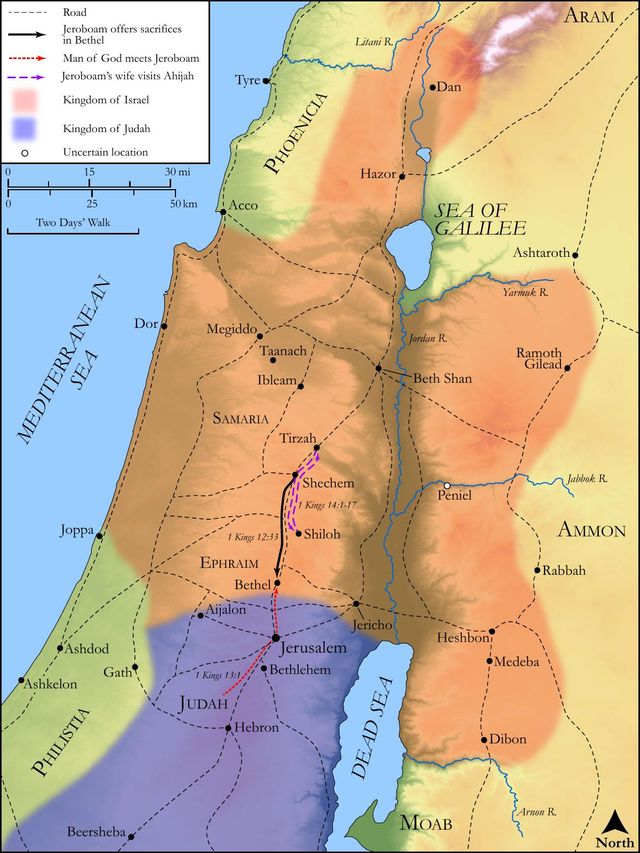
Judah's story and Israel's are intermixed in this book. Jeroboam out-lived Rehoboam, four or five years, yet his history is despatched first, that the account of Rehoboam's reign may be laid together; and a sad account it is.
I.Here is no good said of the king. All the account we have of him here is,
1.That he was forty-one years old when he began to reign, by which reckoning he was born in the last year of David, and had his education, and the forming of his mind, in the best days of Solomon; yet he lived not up to these advantages. Solomon's defection at last did more to corrupt him than his wisdom and devotion had done to give him good principles.
2.That he reigned seventeen years in Jerusalem, the city where God put his name, where he had opportunity enough to know his duty, if he had but had a heart to do it.
3.That his mother was Naamah, an Ammonitess; this is twice mentioned, Kg1 14:21, Kg1 14:31. It was strange that David would marry his son Solomon to an Ammonitess (for it was done while he lived), but it is probable that Solomon was in love with her, because she was Naamah, a beauty (so it signifies), and his father was loth to cross him, but it proved to have a very bad influence upon posterity. Probably she was daughter to Shobi the Ammonite, who was kind to David (Sa2 17:27), and David was too willing to requite him by matching his son into his family. None can imagine how lasting and how fatal the consequences may be of being unequally yoked with unbelievers.
4.That he had continual war with Jeroboam (Kg1 14:30), which could not but be a perpetual uneasiness to him.
5.That when he had reigned but seventeen years he died, and left his throne to his son. His father, and grandfather, and grandson, that reigned well, reigned long, forty years apiece. But sin often shortens men's lives and comforts.
II.Here is much evil said of the subjects, both as to their character and their condition.
1.See here how wicked and profane they were. It is a most sad account that is here given of their apostasy from God, Kg1 14:22-24. Judah, the only professing people God had in the world, did evil in his sight, in contempt and defiance of him and the tokens of his special presence with them; they provoked him to jealousy, as the adulterous wife provokes her husband by breaking the marriage-covenant. Their fathers had been bad enough, especially in the times of the judges, but they did abominable things, above all that their fathers had done. The magnificence of their temple, the pomp of their priesthood, and all the secular advantages with which their religion was attended, could not prevail to keep them to it. Nothing less than the pouring out of the Spirit from on high will keep God's Israel in their allegiance to him. The account here given of the wickedness of the Jews agrees with that which the apostle gives of the wickedness of the Gentile world (Rom 1:21, Rom 1:24), so that both Jew and Gentile are alike under sin, Rom 3:9.
(1.)They became vain in their imaginations concerning God, and changed his glory into an image, for they built themselves high places, images, and groves (Kg1 14:23), profaning God's name by affixing to it their images, and God's ordinances by serving their idols with them. They foolishly fancies that they exalted God when they worshipped him on high hills and pleased him when they worshipped him under the pleasant shadow of green trees.
(2.)They were given up to vile affections (as those idolaters Rom 1:26, Rom 1:27), for there were sodomites in the land (Kg1 14:24), men with men working that which is unseemly, and not to be thought of, much less mentioned, without abhorrence and indignation. They dishonoured God by one sin and then God left them to dishonour themselves by another. They profaned the privileges of a holy nation, therefore God gave them up to their own hearts' lusts, to imitate the abominations of the accursed Canaanites; and herein the Lord was righteous. And, when they did like those that were cast out, how could they expect any other than to be cast out like them?
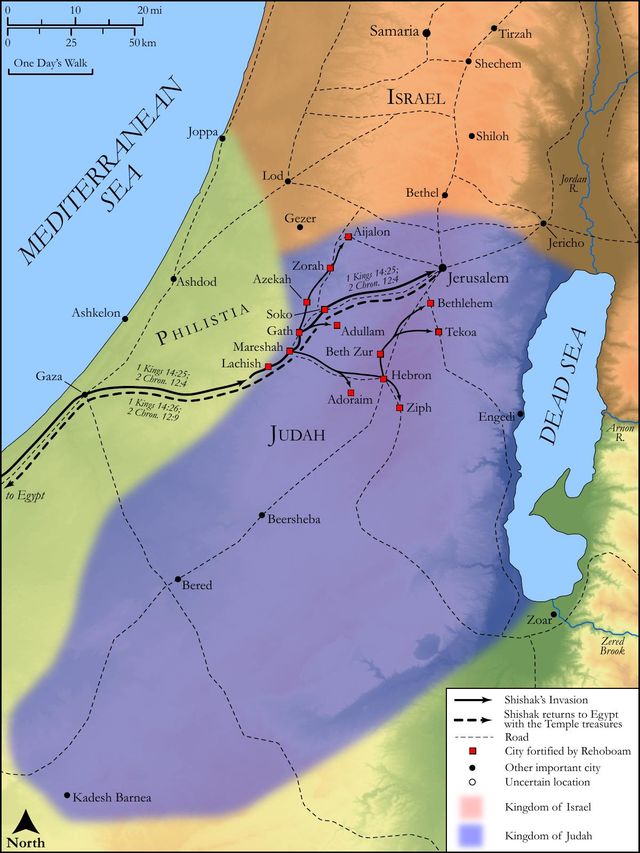
2.See here how weak and poor they were; and this was the consequence of the former. Sin exposes, impoverishes, and weakens any people. Shishak, king of Egypt, came against them, and so far, either by force or surrender, made himself master of Jerusalem itself that he took away the treasures both of the temple and of the exchequer, of the house of the Lord and of the king's house, which David and Solomon had amassed, Kg1 14:25, Kg1 14:26. These, it is likely, tempted him to make his descent; and, to save the rest, Rehoboam perhaps tamely surrendered them, as Ahab, Kg1 20:4. He also took away the golden shields that were made but in his father's time, Kg1 14:26. These the king of Egypt carried off as trophies of his victory; and, instead of them, Rehoboam made brazen shields, which the life-guard carried before him when he went to church in state, Kg1 14:27, Kg1 14:28. This was an emblem of the diminution of his glory. Sin makes the gold become dim, changes the most fine gold, and turns it into brass. We commend Rehoboam for going to the house of the Lord, perhaps the oftener for the rebuke he had been under, and do not condemn him for going in pomp. Great men should honour God with their honour, and then they are themselves most honoured by it.
Continue studying 1 Kings 14:31 across the web’s major study libraries — every link below opens this exact verse, chapter, or book on the destination site.
Read & Compare
 BibleGatewayThis verse in more than 200 translations and 70 languages.
 Bible.comThe YouVersion reader — hundreds of translations, reading plans, and highlights.
 ESV.orgCrossway's official English Standard Version reader.
 NET BibleThe NET translation with 60,000+ translators' notes on every rendering decision.
 STEP BibleTyndale House's free study tool — original text, vocabulary, and scholarly resources.
 BibliaLogos Bible Software's free web reader.
 USCCBThe New American Bible (Revised Edition) with the U.S. bishops' study notes.
Commentaries
 BibleHub CommentariesDozens of classic commentaries on this verse, gathered on one page.
 StudyLightMore than 100 commentary sets — the largest collection on the web.
 BibleRefPlain-English commentary on what this verse means, verse by verse.
 Enduring WordDavid Guzik's free commentary on this chapter, widely used by Bible teachers.
 Bible Study ToolsVerse commentary alongside Greek and Hebrew study aids.
Original Language & Research
- BibleHub InterlinearThe verse word by word — original language, transliteration, and English.
- BibleHub LexiconEvery word's original-language definition and Strong's entry.
 Blue Letter BibleDeep-study tools — Strong's numbers, concordance, and word studies.
 SefariaThe Hebrew text with Rashi and centuries of Jewish commentary.
Sermons, Hymns & Audio


TrulyRandomVerse is not affiliated with these sites and doesn’t control their content. They’re linked because they’re genuinely useful.
Summary
1 Kings 14:31 serves as the concluding summary of Rehoboam's reign, the first king of Judah following the tumultuous division of the united monarchy. This concise verse records his death, his burial in the royal necropolis within the City of David, and notably highlights the identity of his mother, Naamah, an Ammonitess. The passage then seamlessly transitions the narrative by announcing the succession of his son, Abijam, to the throne, thereby ensuring the continuity of the Davidic lineage despite the kingdom's fragmentation and the moral compromises that plagued the royal house.
Context
ShowHideLiterary Context
This verse functions as the standard regnal formula, marking the end of a king's rule in the Deuteronomistic History, a pattern observed throughout the books of Kings (e.g., 1 Kings 15:8). It immediately follows a detailed account of Rehoboam's reign, which began with the catastrophic division of the kingdom in 1 Kings 12 and continued with a period marked by spiritual apostasy and foreign invasion. The preceding verses (1 Kings 14:21-30) specifically detail Judah's widespread idolatry under Rehoboam, including the construction of high places and Asherah poles, and the subsequent invasion by Shishak, the king of Egypt. The specific mention of Naamah in this concluding summary subtly yet powerfully connects back to the broader narrative of Solomon's foreign wives and their detrimental influence, which initiated the kingdom's spiritual decline and eventual division (1 Kings 11:1-8). The verse then sets the stage for the subsequent narrative, transitioning to the reign of Abijam in 1 Kings 15.
Historical & Cultural Context
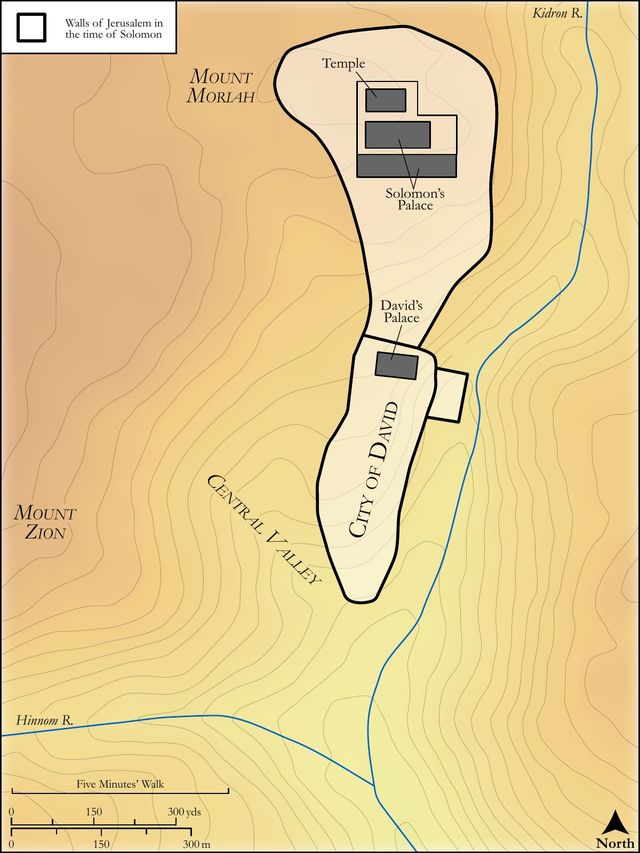
The phrase "slept with his fathers" is a widely recognized biblical euphemism for death, signifying a natural, peaceful passing and often implying burial in an ancestral tomb. For the kings of Judah, this typically meant interment in the "city of David," a designation for Jerusalem, specifically the royal necropolis located on the Ophel ridge. This burial location was crucial, affirming Rehoboam's legitimate status as a king of the Davidic dynasty, despite the internal divisions and external pressures his reign faced. The explicit identification of Naamah as an "Ammonitess" carries profound historical and cultural weight. The Ammonites were a neighboring people, frequently hostile to Israel, descended from Lot (Genesis 19:38). Intermarriage with foreign women, particularly those from nations not devoted to Yahweh, was strictly prohibited by the Mosaic Law (Deuteronomy 7:3-4). Solomon's extensive foreign marriages, including Naamah, directly violated this divine command and were explicitly identified as a primary cause for God's judgment and the subsequent division of the kingdom (1 Kings 11:1-13). Thus, Naamah's identity serves as a stark and enduring reminder of the long-term consequences of royal disobedience and spiritual compromise.
Key Themes
ShowHideThis verse contributes significantly to several overarching themes prevalent in the book of Kings. Firstly, it underscores the theme of divine faithfulness and covenant continuity within the Davidic covenant. Despite the political fragmentation of Israel and Rehoboam's flawed reign, the line of Davidic kings in Judah remains unbroken, a testament to God's enduring promise to David found in 2 Samuel 7. Secondly, the explicit mention of Naamah, an Ammonitess, powerfully highlights the theme of the consequences of disobedience and spiritual compromise. Her foreign origin is not a mere genealogical detail but a subtle yet potent reminder of Solomon's foundational sin in marrying foreign women who led his heart astray from God, directly contributing to the kingdom's troubles and the spiritual decline that continued under Rehoboam. This emphasizes the ripple effect of sin across generations and the persistent danger of syncretism. Finally, the verse subtly points to divine sovereignty even amidst human failings. Despite Rehoboam's problematic rule and the kingdom's turmoil, God's overarching plan for the Davidic dynasty perseveres, ensuring a successor to the throne of Judah, thereby demonstrating God's unwavering commitment to His covenant promises.
Exposition and Analysis
ShowHideKey Word Analysis
ShowHideA primitive root meaning "to lie down (for rest, sexual connection, decease or any other purpose)." In this context, it is a respectful euphemism for death, indicating a natural, peaceful passing. This phrase is commonly used for kings in the Deuteronomistic History, often implying a legitimate and honorable end to their reign, in contrast to those who suffered violent or ignominious deaths.
The feminine form of Ammonite, referring to a woman from the nation of Ammon. This specific ethnic designation for Naamah is profoundly significant. The Ammonites were a people often hostile to Israel, and intermarriage with them was explicitly forbidden by Mosaic Law. Her identity here serves as a potent, concise reminder of Solomon's disobedience in marrying foreign women who led him to idolatry, directly contributing to the divine judgment of kingdom division. It highlights the deep-seated spiritual compromise within the Davidic royal line.
Meaning "a city (a place guarded by waking or a watch) in the widest sense (even of a mere encampment or post)." When used in the phrase "city of David," it specifically refers to Jerusalem, particularly the royal burial grounds for the kings of Judah. Being buried "in the city of David" signifies legitimacy, continuity of the Davidic dynasty, and a proper, honorable burial for a king of Judah, even one whose reign was marked by significant failures.
Verse Breakdown
ShowHide"And Rehoboam slept with his fathers"
This initial clause marks the definitive end of Rehoboam's life and reign. The use of the euphemism "slept with his fathers" indicates a natural death, bringing to a close his 17-year rule over the southern kingdom of Judah. It adheres to the standard formula employed in the books of Kings to summarize the conclusion of a monarch's life, implying a peaceful and legitimate end.
"and was buried with his fathers in the city of David."
This segment specifies Rehoboam's burial location, confirming his status as a legitimate king within the Davidic lineage. His interment in the royal necropolis within Jerusalem, known as the "city of David," underscores the unbroken continuity of the dynasty, despite the significant political and spiritual turmoil that characterized his reign and the broader division of the kingdom. This act reinforces his rightful place among the kings of Judah.
"And his mother's name [was] Naamah an Ammonitess."
This seemingly parenthetical detail is, in fact, profoundly significant and serves as a crucial theological commentary. It identifies Rehoboam's mother as a foreign woman from a people historically hostile to Israel, whose intermarriage with Israelites was explicitly forbidden by divine law. This detail subtly yet powerfully links Rehoboam's problematic reign and the kingdom's spiritual decline directly back to the foundational sin of his father, Solomon, who married foreign wives and allowed them to introduce idolatry into Israel, leading to God's judgment and the kingdom's division. It highlights the deep-seated spiritual compromise within the royal family.
"And Abijam his son reigned in his stead."
This final clause announces the immediate and legitimate succession of Rehoboam's son, Abijam (also known as Abijah in other biblical texts), to the throne of Judah. This statement emphasizes the unbroken continuity of the Davidic line, a critical theological point that affirms God's faithfulness to His covenant promise to David, ensuring a perpetual successor to the throne, even amidst the profound failures of human kings.
Literary Devices
ShowHideThe verse employs several key literary devices that enrich its meaning and impact. Euphemism is prominently featured in the phrase "slept with his fathers," which is a gentle and respectful way to describe death, common throughout biblical narratives. This choice of language contrasts with more direct or harsh descriptions of demise, subtly affirming Rehoboam's legitimate, albeit flawed, reign. There is a powerful juxtaposition between Rehoboam's proper burial in the "city of David," which signifies his royal legitimacy and connection to the covenant, and the immediate, stark mention of his mother, Naamah, an Ammonitess. This contrast implicitly highlights the tension between the divinely ordained Davidic line and the corrupting influence of foreign alliances and idolatry that persistently plagued it. The inclusion of Naamah's ethnicity serves as a form of retrospective commentary or subtle foreshadowing, reminding the reader of the ongoing consequences of Solomon's sin (1 Kings 11:1-8) and hinting at the continued spiritual struggles and compromises of subsequent kings. The overall conciseness of this regnal summary is characteristic of the Deuteronomistic History, efficiently conveying essential information while allowing key details, like Naamah's identity, to carry significant theological weight and underscore the narrative's moral and spiritual lessons.
Theological and Thematic Connections
ShowHide1 Kings 14:31, though brief, is replete with profound theological implications. It powerfully underscores God's unwavering faithfulness to His covenant with David, guaranteeing a continuous lineage on the throne of Judah despite the profound moral and spiritual failures of individual kings like Rehoboam. However, it also serves as a stark illustration of the principle of sowing and reaping, demonstrating how the sins of one generation, particularly those of leadership, can have lasting and detrimental consequences for subsequent generations and the entire nation. The explicit mention of Naamah, the Ammonitess, functions as a poignant reminder that compromise with pagan influences, even seemingly minor deviations from God's commands, can lead to pervasive spiritual decay and ultimately invite divine judgment, echoing the stern warnings throughout the Pentateuch against intermarriage and idolatry. The verse subtly teaches that while God's promises endure eternally, human choices profoundly impact the experience and manifestation of those promises, highlighting the delicate tension between divine sovereignty and human responsibility.
Reflection and Application
ShowHideRehoboam's story, culminating in this concise verse, offers profound and timeless lessons for contemporary believers. It serves as a powerful reminder that leadership, whether exercised in the home, the church, or the broader community, carries immense responsibility, and our choices have ripple effects that can extend far beyond our immediate circumstances, impacting future generations. The subtle but profoundly significant detail about Naamah, the Ammonitess, functions as a potent cautionary tale against spiritual compromise. It challenges us to critically examine our own lives for "foreign influences" – whether they be unbiblical beliefs, worldly practices, or compromising relationships – that might subtly erode our devotion to God and lead us astray from His clear commands. Just as Solomon's choices directly impacted Rehoboam's spiritual trajectory and the kingdom's fate, our decisions today contribute significantly to the spiritual legacy we leave for those who follow us. This verse calls us to intentional discipleship, unwavering commitment to God's truth, and a vigilant guarding of our hearts against anything that would compromise our walk with Christ, recognizing that faithfulness in the present builds a strong, blessed foundation for a godly future.
Questions for Reflection
ShowHideFAQ
ShowHideWhy is Naamah's ethnicity as an Ammonitess specifically mentioned in this verse?
ShowHideThe mention of Naamah as an Ammonitess is highly significant and far more than a mere genealogical detail; it serves as a profound theological commentary. It directly links Rehoboam's problematic reign and the kingdom's spiritual decline back to the foundational sin of his father, Solomon. Solomon's extensive foreign marriages, including with women from nations like Ammon, directly violated God's explicit command against intermarriage with pagan peoples (Deuteronomy 7:3-4), a prohibition intended to prevent the introduction of idolatry and spiritual compromise into Israel. 1 Kings 11:1-8 explicitly states that Solomon's foreign wives turned his heart away from God, leading directly to the divine judgment of the kingdom's division. Therefore, Naamah's identity highlights the insidious and ongoing spiritual compromise within the Davidic royal line and underscores the long-term, generational consequences of disobedience to God's covenant.
What does the phrase "slept with his fathers" mean in this context?
ShowHide"Slept with his fathers" is a common biblical euphemism for death, particularly for kings in the books of Kings and Chronicles. It signifies a natural, peaceful passing, as opposed to a violent or untimely death. Crucially, it also implies that the deceased was afforded a proper burial in the ancestral tomb, typically in the royal burial grounds. For the kings of Judah, this meant interment in the "city of David" (Jerusalem), which affirmed their legitimate status and continuity within the Davidic dynasty, even if their reign was marked by significant failures.
Is Abijam the same person as Abijah?
ShowHideYes, Abijam (as he is called in 1 Kings) is indeed the same person as Abijah (as he is called in 2 Chronicles). The slight variation in spelling is a common phenomenon in biblical texts and does not indicate a different individual. 2 Chronicles 13:1-22 provides a more detailed and often more positive account of his reign, including a significant military victory against Jeroboam, the king of the northern kingdom of Israel.
Christ-Centered Fulfillment
ShowHideThe seemingly mundane summary of Rehoboam's death and succession in 1 Kings 14:31 finds its ultimate and profound significance in the person and redemptive work of Jesus Christ. This verse, like all regnal summaries in the books of Kings, underscores the continuity of the Davidic line, a lineage that, despite the consistent failures and compromises of kings like Rehoboam (whose mother, Naamah, an Ammonitess, points to the very sin that plagued the dynasty), God faithfully preserved. This unbroken succession was not for the sake of flawed human kings, but for the promised "seed" of David, through whom God would establish an eternal and righteous kingdom (2 Samuel 7:12-16). Jesus, as the true and perfect Son of David, is the ultimate fulfillment of this divine promise. His impeccable life and righteous reign stand in stark contrast to the flawed and compromised rule of Rehoboam, who led Judah into widespread idolatry and weakness (1 Kings 14:22-24). While Rehoboam "slept with his fathers" in death, succumbing to the common fate of humanity, Jesus conquered death, rising again to establish a kingdom that will never end and whose dominion is everlasting (Revelation 11:15). Furthermore, the mention of Naamah's foreign origin, a poignant reminder of the sin that led to the kingdom's division, ironically foreshadows God's expansive redemptive plan to include Gentiles in the lineage of Christ (as seen in Matthew's genealogy, which includes foreign women like Rahab and Ruth) and ultimately in His universal kingdom (Matthew 1:1-17). Thus, 1 Kings 14:31, though detailing the end of a flawed earthly king, powerfully points forward to the perfect, eternal King who would finally fulfill all God's promises and establish a kingdom of righteousness, peace, and everlasting dominion.