


1 Kings 15:24
- וַיִּשְׁכַּבvai·yish·Kavand he lay downH7901Conj-w ¦ V-Qal-ConsecImperf-3msVerb Qal Consecutive Imperfect 3rd Singular Masculineוַandיִּשְׁכַּבhe lay down
- אָסָא'a·Sa'AsaH609N-proper-mNoun Proper Masculine
- עִם'imwithH5973PrepPreposition
- אֲבֹתָיו'a·vo·Tavhis ancestorsH1N-fpc ¦ 3msNoun Plural Feminine Constructאֲבֹתָיancestorsוhis
- וַיִּקָּבֵרvai·yi·ka·Verand he was buriedH6912Conj-w ¦ V-Niphal-ConsecImperf-3msVerb Niphal Consecutive Imperfect 3rd Singular Masculineוַandיִּקָּבֵרhe was buried
- עִם'imwithH5973PrepPreposition
- אֲבֹתָיו'a·vo·Tavhis ancestorsH1N-fpc ¦ 3msNoun Plural Feminine Constructאֲבֹתָיancestorsוhis
- בְּעִירbe·'Irin [the] city ofH5892Prep-b ¦ N-fscNoun Singular Feminine Constructבְּinעִיר[the] city of
- דָּוִדda·VidDavidH1732N-proper-mNoun Proper Masculine
- אָבִיו'a·Vivhis ancestorH1N-msc ¦ 3msNoun Singular Masculine Constructאָבִיancestorוhis
- וַיִּמְלֹךְvai·yim·Lokhand he became kingH4427Conj-w ¦ V-Qal-ConsecImperf-3msVerb Qal Consecutive Imperfect 3rd Singular Masculineוַandיִּמְלֹךְhe became king
- יְהוֹשָׁפָטye·ho·sha·FatJehoshaphatH3092N-proper-mNoun Proper Masculine
- בְּנוֹbe·Nohis sonH1121N-msc ¦ 3msNoun Singular Masculine Constructבְּנsonוֹhis
- תַּחְתָּיוtach·Tavin place of himH8478N-mpc ¦ 3msNoun Plural Masculine Constructתַּחְתָּיin place ofוhim
English is a literal word-by-word gloss of the Hebrew, not the KJV's wording. Why?
This is the original text the KJV's translators worked from — each Hebrew word with its own literal English meaning in this verse, prepared by scholars at Tyndale House, Cambridge. The KJV translates whole sentences, not word by word, so its wording differs: one Hebrew word can become several English words, and the KJV may choose “the LORD” where the gloss reads “Yahweh”. Both are faithful — they answer different questions. For the KJV's own rendering, switch to the KJV text.
Details
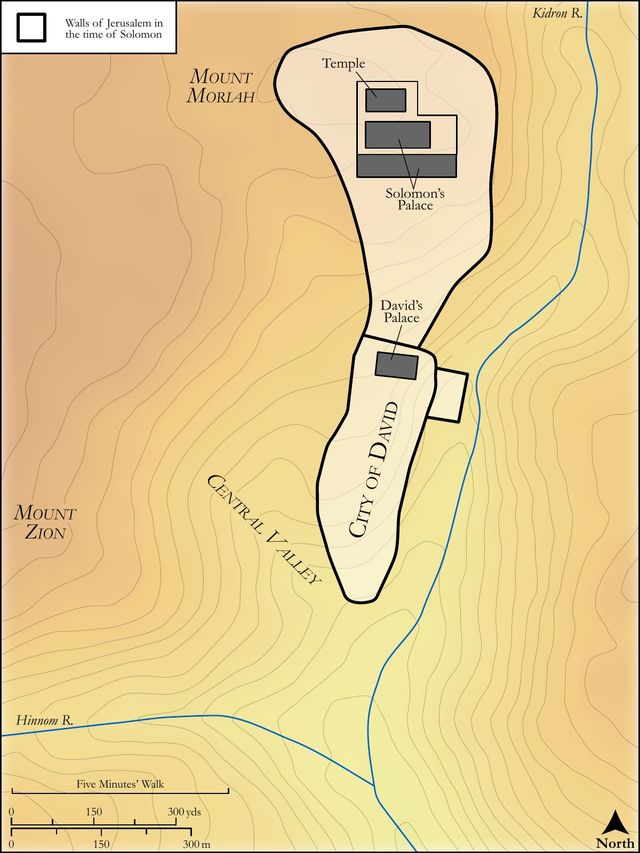
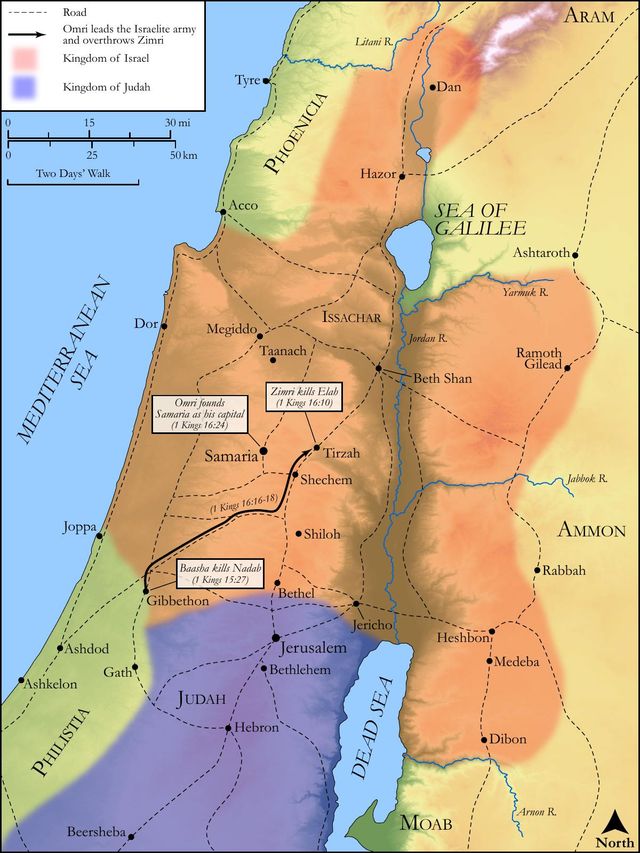
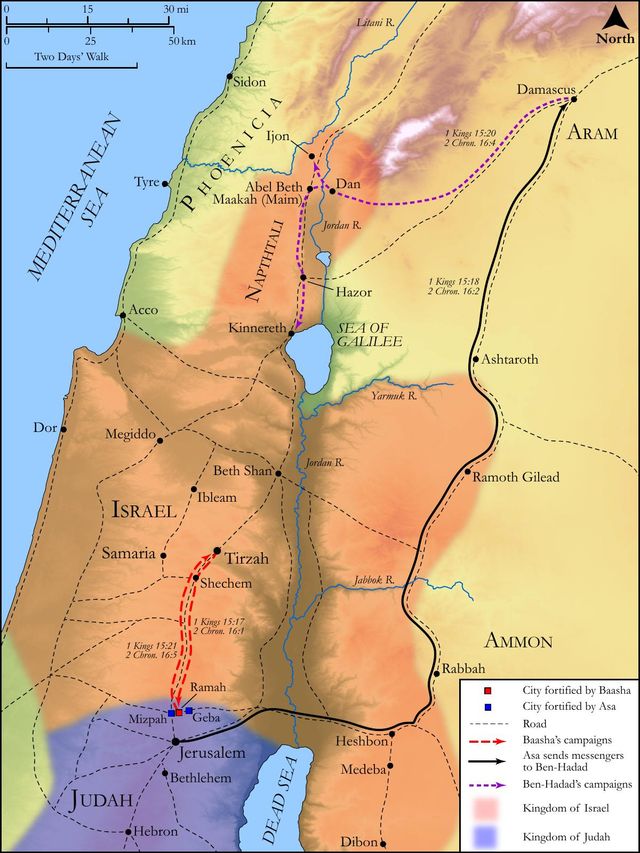
See on the biblical-era maps
Study this verse
Public-domain commentary
Matthew Henry
From his Commentary on the Whole Bible. Henry comments on passages, not single verses — this entry covers 1 Kings 15:9–24. His three-level outline is real structure in the source text, so it is rendered as structure.
We have here a short account of the reign of Asa; we shall find a more copious history of it Ch2 14:1-15, 15, and Ch2 16:1-14. Here is,
I.The length of it:
He reigned forty-one years in Jerusalem, Kg1 15:10. In the account we have of the kings of Judah we find the number of the good kings and the bad ones nearly equal; but then we may observe, to our comfort, that the reign of the good kings was generally long, but that of the bad kings short, the consideration of which will make the state of God's church not altogether so bad within that period as it appears at first sight. Length of days is in Wisdom's right hand. Honour thy father, much more thy heavenly Father, that thy days may be long.
II.The general good character of it (Kg1 15:11):
Asa did that which was right in the eyes of the Lord, and that is right indeed which is so in God's eyes; those are approved whom he commends. He did as did David his father, kept close to God, and to his instituted worship, was hearty and zealous for that, which gave him this honourable character, that he was like David, though he was not a prophet, or psalmist, as David was. If we come up to the graces of those that have gone before us it will be our praise with God, though we come short of their gifts. Asa was like David, though he was neither such a conqueror nor such an author; for his heart was perfect with the Lord all his days (Kg1 15:14), that is, he was both cordial and constant in his religion. What he did for God he was sincere in, steady and uniform, and did it from a good principle, with a single eye to the glory of God.
III.The particular instances of Asa's piety. His times were times of reformation. For,
1.He removed that which was evil. There reformation begins; and a great deal of work of that kind his hand found to do. For, though it was but twenty years after the death of Solomon that he began to reign, yet very gross corruption had spread far and taken deep root. Immorality he first struck at: He took away the sodomites out of the land, suppressed the brothels; for how can either prince or people prosper while those cages of unclean and filthy birds, more dangerous than pest-houses, are suffered to remain? Then he proceeded against idolatry: He removed all the idols, even those that his father had made, Kg1 15:12. His father having made them, he was the more concerned to remove them, that he might cut off the entail of the curse, and prevent the visiting of that iniquity upon him and his. Nay (which redounds much to his honour, and shows his heart was perfect with God), when he found idolatry in the court, he rooted it out thence, Kg1 15:13. When it appeared that Maachah his mother, or rather his grandmother (but called his mother because she had the educating of him in his childhood), had an idol in a grove, though she was his mother, his grandmother, - though, it is likely, she had a particular fondness for it, - though, being old, she could not live long to patronise it, - though she kept it for her own use only, yet he would by no means connive at her idolatry. Reformation must begin at home. Bad practices will never be suppressed in the country while they are supported in the court. Asa, in every thing else, will honour and respect his mother; he loves her well, but he loves God better, and (like the Levite, Deu 33:9) readily forgets the relation when it comes in competition with his duty. If she be an idolater,
(1.)Her idol shall be destroyed, publicly exposed to contempt, defaced, and burnt to ashes by the brook Kidron, on which, it is probable, he strewed the ashes, in imitation of Moses (Exo 32:20) and in token of his detestation of idolatry and his indignation at it wherever he found it. Let no remains of a court-idol appear.
(2.)She shall be deposed, He removed her from being queen, or from the queen, that is, from conversing with his wife; he banished her from the court, and confined her to an obscure and private life. Those that have power are happy when thus they have hearts to use it well.
2.He re-established that which was good (Kg1 15:15): He brought into the house of God the dedicated things which he himself had vowed out of the spoils of the Ethiopians he had conquered, and which his father had vowed, but lived not to bring in pursuant to his vow. We must not only cease to do evil, but learn to do well, not only cast away the idols of our iniquity, but dedicate ourselves and our all to God's honour and glory. When those who, in their infancy, were by baptism devoted to God, make it their own act and deed to join themselves to him and vigorously employ themselves in his service, this is bringing in the dedicated things which they and their fathers have dedicated: it is necessary justice - rendering to God the things that are his.
VI.The policy of his reign.
He built cities himself, to encourage the increase of his people (Kg1 15:23) and to invite others to him by the conveniences of habitation; and he was very zealous to hinder Baasha from building Ramah, because he designed it for the cutting off of communication between his people and Jerusalem and to hinder those who in obedience to God would come to worship there. An enemy must by no means be suffered to fortify a frontier town.
V.The faults of his reign.
In both the things for which he was praised he was found defective. The fairest characters are not without some but or other in them.
1.Did he take away the idols? That was well; but the high places were not removed (Kg1 15:14); therein his reformation fell short. He removed all images which were rivals with the true God or false representations of him; but the altars which were set up in high places, and to which those sacrifices were brought which should have been offered on the altar in the temple, those he suffered to stand, thinking there was no great harm in them, they having been used by good men before the temple was built, and being loth to disoblige the people, who had a kindness to them and were wedded to them both by custom and convenience; whereas in Judah and Benjamin, the only tribes under Asa's government which lay so near Jerusalem and the altars there, there was less pretence for them than in those tribes which lay more remote. They were against the law, which obliged them to worship at one place, Deu 12:11. They lessened men's esteem of the temple and the altars there, and were an open gap for idolatry to enter in at, while the people were so much addicted to it. It was not well that Asa, when his hand was in, did not remove these. Nevertheless his heart was perfect with the Lord. This affords us a comfortable note, That those may be found honest and upright with God, and be accepted of him, who yet, in some instances, come short of doing the good they might and should do. The perfection which is made the indispensable condition of the new covenant is not to be understood of sinlessness (then we were all undone), but sincerity.
2.Did he bring in the dedicated things? That was well; but he afterwards alienated the dedicated things, when he took the gold and silver out of the house of God and sent them as a bribe to Benhadad, to hire him to break his league with Baasha, and, by making an inroad upon his country, to give him a diversion from the building of Ramah, Kg1 15:18, Kg1 15:19. Here he sinned,
(1.)In tempting Benhadad to break his league, and so to violate the public faith. If he did wrong in doing it, as certainly he did, Asa did wrong in persuading him to do it.
(2.)In that he could not trust God, who had done so much for him, to free him out of this strait, without using such indirect means to help himself.
(3.)In taking the gold out of the treasury of the temple, which was not to be made use of but on extraordinary occasions. The project succeeded. Benhadad made a descent upon the land of Israel, which obliged Baasha to retire with his whole force from Ramah (Kg1 15:20, Kg1 15:21), which gave Asa a fair opportunity to demolish his works there, and the timber and stones served him for the building of some cities of his own, Kg1 15:22. But, though the design prospered, we find it was displeasing to God; and though Asa valued himself upon the policy of it, and promised himself that it would effectually secure his peace, he was told by the prophet that he had done foolishly, and that thenceforth he should have wars; see Ch2 16:7-9.
VI.The troubles of his reign. For the most part he prospered; but,
1.Baasha king of Israel was a very troublesome neighbour to him. He reigned twenty-four years, and all his days had war, more or less, with Asa, Kg1 15:16. This was the effect of the division of the kingdoms, that they were continually vexing one another, and so weakened one another, which made them both an easier prey to the common enemy.
2.In his old age he was himself afflicted with the gout: He was diseased in his feet, which made him less fit for business and peevish towards those about him.
VII.The conclusion of his reign.
The acts of it were more largely recorded in the common history (to which reference is here had, Kg1 15:23) than in this sacred one. He reigned long, but finished at last with honour, and left his throne to a successor no way inferior to him.
Continue studying 1 Kings 15:24 across the web’s major study libraries — every link below opens this exact verse, chapter, or book on the destination site.
Read & Compare
 BibleGatewayThis verse in more than 200 translations and 70 languages.
 Bible.comThe YouVersion reader — hundreds of translations, reading plans, and highlights.
 ESV.orgCrossway's official English Standard Version reader.
 NET BibleThe NET translation with 60,000+ translators' notes on every rendering decision.
 STEP BibleTyndale House's free study tool — original text, vocabulary, and scholarly resources.
 BibliaLogos Bible Software's free web reader.
 USCCBThe New American Bible (Revised Edition) with the U.S. bishops' study notes.
Commentaries
 BibleHub CommentariesDozens of classic commentaries on this verse, gathered on one page.
 StudyLightMore than 100 commentary sets — the largest collection on the web.
 BibleRefPlain-English commentary on what this verse means, verse by verse.
 Enduring WordDavid Guzik's free commentary on this chapter, widely used by Bible teachers.
 Bible Study ToolsVerse commentary alongside Greek and Hebrew study aids.
Original Language & Research
- BibleHub InterlinearThe verse word by word — original language, transliteration, and English.
- BibleHub LexiconEvery word's original-language definition and Strong's entry.
 Blue Letter BibleDeep-study tools — Strong's numbers, concordance, and word studies.
 SefariaThe Hebrew text with Rashi and centuries of Jewish commentary.
Sermons, Hymns & Audio


TrulyRandomVerse is not affiliated with these sites and doesn’t control their content. They’re linked because they’re genuinely useful.
Summary
1 Kings 15:24 meticulously chronicles the peaceful conclusion of King Asa's impactful forty-one-year reign over the southern kingdom of Judah and the seamless, divinely ordained transition of the throne to his son, Jehoshaphat. This verse functions as a pivotal summary statement within the Deuteronomistic History, marking the end of a significant era characterized by both faithfulness and human frailty, while simultaneously inaugurating a new one, thereby emphasizing the unbroken continuity of the Davidic monarchy through burial in the royal tombs within Jerusalem.
Context
ShowHideLiterary Context
This verse serves as the concluding statement for the narrative of King Asa's reign (1 Kings 15:9-24), a common formulaic ending found throughout the books of Kings. It immediately follows a brief summary of his later life, including his extensive building projects and his affliction with a foot disease (1 Kings 15:23). The preceding verses meticulously detail Asa's initial devoutness and the sweeping religious reforms he instituted, such as the eradication of idolatry, the removal of cult prostitutes, and the restoration of proper worship (e.g., 1 Kings 15:11-15). However, the narrative also candidly presents his later strategic missteps, particularly his reliance on the king of Aram (Syria) rather than the Lord during a conflict with Baasha of Israel (1 Kings 15:16-22), a decision for which he was rebuked by the prophet Hanani (recorded in 2 Chronicles 16:7-10). The verse then transitions directly into the account of Jehoshaphat's reign, which is introduced in 1 Kings 15:25 (for the northern kingdom) but fully developed for Jehoshaphat in 1 Kings 22 and more extensively in 2 Chronicles 17-20. This standard royal obituary formula provides structural cohesion and emphasizes the dynastic continuity essential to the biblical narrative of Judah.
Historical & Cultural Context
King Asa's reign (c. 913-873 BC) was one of the longest and most pivotal in the early history of the divided monarchy, marked by persistent tension and occasional conflict with the northern kingdom of Israel. His rule was largely characterized by a concerted effort to re-establish adherence to the Mosaic covenant principles after a period of syncretism and idolatry. The idiom "slept with his fathers" is a deeply ingrained biblical and ancient Near Eastern euphemism for death, particularly for monarchs, signifying their peaceful passing and joining their ancestors in the grave. This phrase does not carry a specific theological implication about the afterlife but rather emphasizes the finality of earthly life and the continuity of the dynastic line. The burial in "the city of David" refers to Jerusalem, specifically the royal necropolis within the ancient fortified section of the city. This practice was a profound mark of honor and legitimacy, reinforcing the king's rightful place within the Davidic dynasty and connecting him physically and symbolically to the foundational covenant promises given to David regarding an enduring throne (2 Samuel 7:12-16). The orderly succession from father to son, as depicted here, was crucial for maintaining political stability in a region often plagued by coups and violent transitions, particularly contrasting with the turbulent successions frequently seen in the northern kingdom of Israel.
Key Themes
ShowHideThis concise verse encapsulates several profound theological and narrative themes central to the books of Kings. Firstly, it highlights the theme of dynastic continuity and divine faithfulness within the Davidic monarchy. Despite the individual failings of kings, God faithfully preserves the royal line through which the Messiah would ultimately come, demonstrating His unwavering commitment to His covenant promises. The smooth transfer of power from Asa to Jehoshaphat underscores the stability of the kingdom of Judah under God's watchful eye. Secondly, the verse powerfully underscores the mortality of kings and the transience of earthly power. Even a long-reigning and largely righteous monarch like Asa is subject to the universal human experience of death, a truth consistently emphasized throughout Scripture (e.g., Psalm 146:3-4). This serves as a theological reminder that ultimate trust should be placed in the eternal God, not in fallible human leaders or institutions. Finally, the verse implicitly speaks to the concept of legacy and accountability. As Asa's reign concludes and his son's begins, the reader is invited to reflect on the enduring impact of Asa's life and leadership, both his commendable faithfulness and his regrettable shortcomings, contributing to the broader narrative of Judah's spiritual journey under the Davidic kings.
Exposition and Analysis
ShowHideKey Word Analysis
ShowHideA primitive root meaning "to lie down," often used as a euphemism for death, particularly in the context of kings. It signifies the peaceful cessation of life and the resting of the body. In this context, it emphasizes the finality of Asa's earthly reign and his passing, without necessarily conveying a specific theological state of the soul after death. It is a common and gentle way to express the act of dying.
A primitive word meaning "father," used here in a collective sense to refer to one's ancestors or predecessors. In the phrase "slept with his fathers," it signifies that Asa has joined the company of his deceased royal ancestors, likely buried in the same dynastic tomb or burial ground. This highlights his legitimate place within the Davidic lineage and the continuity of the royal succession.
A primitive root meaning "to reign" or, inceptively, "to ascend the throne." This word denotes the formal assumption of royal authority and the exercise of kingship. Its use here signifies the legitimate and immediate transfer of sovereign power from Asa to Jehoshaphat, emphasizing the orderly and unbroken succession within the Davidic dynasty, which was a hallmark of Judah's monarchy compared to the often tumultuous successions in Israel.
Verse Breakdown
ShowHide"And Asa slept with his fathers"
This opening clause formally announces the death of King Asa. The use of the euphemism "slept with his fathers" is a standard and respectful literary device in the biblical historical books, signifying the peaceful and legitimate end of a king's earthly life and his passing into the realm of his ancestors. It marks the definitive conclusion of his reign and earthly responsibilities, preparing the reader for the transition of power.
"and was buried with his fathers in the city of David his father"
This part specifies the location and context of Asa's burial. Being buried "with his fathers" reinforces his lineage and his integral connection to the royal dynasty, emphasizing that he was laid to rest alongside his royal predecessors. The specific mention of "the city of David his father" (referring to King David, the progenitor of the dynasty and founder of Jerusalem as the capital) underscores Jerusalem as the sacred and legitimate burial ground for the Davidic kings. This detail serves to validate Asa's rightful place within the royal line and highlights the enduring continuity of the monarchy in Judah, rooted in the Davidic covenant.
"and Jehoshaphat his son reigned in his stead"
This final clause announces the immediate and orderly succession of power. Jehoshaphat, Asa's legitimate son, assumes the throne, indicating a smooth and uncontested transition without any interregnum or dispute. This highlights the stability and divine favor upon the Davidic monarchy, sharply contrasting with the often violent and unstable successions that plagued the northern kingdom of Israel. It also points to God's continued faithfulness in preserving the Davidic line, a crucial element in the unfolding of His redemptive plan for humanity.
Literary Devices
ShowHideThe verse employs several key literary devices to convey its historical and theological significance. Most prominent is Euphemism, specifically in the phrase "slept with his fathers," which is a gentle and common biblical way of referring to death without explicitly stating it. This softens the stark reality of mortality while conveying the definitive end of the king's life and reign. The verse also utilizes Formulaic Language, as the pattern of "slept with his fathers, and was buried... and [son] reigned in his stead" is a recurring literary formula used consistently throughout 1 and 2 Kings to mark the transition between reigns. This formula provides structural cohesion to the historical narrative, emphasizing the cyclical nature of royal succession and the ongoing flow of history. Furthermore, there is a strong element of Emphasis on the Davidic lineage through the repeated mention of "his fathers" and "the city of David his father." This repetition reinforces Asa's legitimate place within the divinely established dynasty and highlights the covenantal significance of Jerusalem as the royal capital and sacred burial site, underscoring the enduring nature of God's promises to David.
Theological and Thematic Connections
ShowHideThis brief verse, though a simple historical record, carries profound theological weight, serving as a powerful reminder of human mortality and the transient nature of earthly power, even for a king who largely walked in righteousness. Despite Asa's long and impactful reign, his life, like all human lives, came to an end, underscoring the universal reality that "it is appointed for man to die once" (Hebrews 9:27). Yet, the smooth transition to Jehoshaphat simultaneously underscores God's unwavering sovereignty and faithfulness in maintaining the Davidic covenant, ensuring the continuity of the royal line. This continuity was not merely political but profoundly theological, as it preserved the lineage through which the promised Messiah would eventually come, fulfilling the divine promise to David of an enduring house and kingdom (2 Samuel 7:12-16). The burial in the "city of David" further reaffirms the enduring significance of Jerusalem as the spiritual and political heart of Judah, intrinsically linked to God's covenant promises to His chosen people and the future hope of the Messiah's reign.
Reflection and Application
ShowHideThe conclusion of King Asa's reign in 1 Kings 15:24 offers a timeless and profound reflection on the universal truth of human mortality and the enduring importance of legacy. No matter one's power, influence, or achievements, earthly life is finite, and all human endeavors eventually yield to the passage of time and the reality of death. This verse invites us to consider not just the end of a life, but the quality of the life lived and the spiritual legacy left behind. Asa's reign, though marked by significant reforms and commendable devotion to the Lord, also included moments of reliance on human strength and political maneuvering rather than unwavering divine providence. His death reminds us that our ultimate security, hope, and trust must rest in God alone, not in earthly leaders, institutions, or even our own accomplishments. For believers today, it prompts crucial introspection: How are we stewarding the time, talents, and positions God has entrusted to us? Are we living in a way that truly honors Him, seeks His glory, and leaves a spiritual legacy that points others to Christ, or are we primarily focused on temporary earthly achievements and self-reliance? The seamless transition to Jehoshaphat also speaks powerfully to God's faithfulness in continuing His work through new generations, encouraging us to invest intentionally in and prepare those who will follow us in ministry, family, and society, ensuring the continuity of God's purposes.
Questions for Reflection
ShowHideFAQ
ShowHideWhat does "slept with his fathers" truly mean in this context?
ShowHideThe phrase "slept with his fathers" is a common biblical euphemism for death, particularly for kings in the books of Kings and Chronicles. It does not imply a specific theological doctrine about the state of the soul after death (e.g., unconsciousness) but simply means that the king has died and has been gathered to his ancestors, often buried in the same royal burial ground or family tomb. It emphasizes the peaceful and legitimate end of his earthly reign and his joining the long line of his predecessors, as seen in the accounts of David's death or Moses' passing.
Why is the burial in "the city of David" significant?
ShowHideBeing buried in "the city of David" (Jerusalem) was highly significant for the kings of Judah. It indicated that the king was a legitimate successor within the Davidic dynasty and was being laid to rest in the traditional royal burial grounds established by King David himself. This practice reinforced the stability and continuity of the Davidic monarchy, which was divinely promised to endure (e.g., 2 Samuel 7:16). It also connected the deceased king to the very heart of the kingdom and its covenantal heritage, affirming his place in the sacred history of God's chosen people and the ongoing fulfillment of God's promises.
What was King Asa's reign generally known for?
ShowHideKing Asa's reign, which lasted 41 years, is generally characterized by significant religious reforms and a strong commitment to purging idolatry from Judah. He actively removed pagan altars, Asherah poles, and cult prostitutes from the land, and even courageously deposed his own grandmother, Maacah, for her idolatry (see 1 Kings 15:12-13). He also fortified cities and led Judah to a decisive victory over a massive Cushite army, demonstrating his initial strong trust in the Lord (recorded in 2 Chronicles 14). While largely righteous, the biblical account also notes his later failings, such as relying on the king of Syria instead of the Lord during a conflict with Baasha and imprisoning the prophet Hanani for rebuking him (2 Chronicles 16:7-10). Despite these shortcomings, his reign is generally viewed positively in the biblical narrative, especially in comparison to many other kings of both Judah and Israel.
Christ-Centered Fulfillment
ShowHideThe seemingly simple record of King Asa's death and succession in 1 Kings 15:24 finds profound Christ-centered fulfillment in the ultimate King, Jesus Christ. The verse highlights the continuity of the Davidic line, a lineage that, despite the mortality of its kings and their human failings, was divinely preserved for centuries to bring forth the Messiah. Asa, like all earthly kings, "slept with his fathers," succumbing to death, a universal consequence of sin and the curse upon humanity. However, Jesus, the true Son of David, also "slept" in death, but His sleep was not the end; it was a temporary state before His glorious triumph. He conquered death, rising victoriously from the grave, thereby establishing a kingdom that is not subject to the mortality, succession, or imperfections seen in human monarchies (as majestically prophesied in Isaiah 9:6-7). Unlike Asa, whose reign concluded and was passed to a son, Jesus' reign is eternal, and His kingdom has no end (Luke 1:32-33). Furthermore, while Asa was honorably buried in the "city of David," Jesus' burial and resurrection transformed the very meaning of death and burial for believers, offering the glorious promise that those who "sleep in Him" will also rise to eternal life because He is "the resurrection and the life" (John 11:25-26). Thus, 1 Kings 15:24, in its quiet affirmation of dynastic continuity and the stark reality of death, ultimately points forward to the one King who would overcome death forever and reign eternally, the "Root and the Offspring of David" (Revelation 22:16).