


1 Kings 15:25
- וְנָדָבve·na·Davand NadabH5070Conj-w ¦ N-proper-mNoun Proper MasculineוְandנָדָבNadab
- בֶּןben[the] son ofH1121N-mscNoun Singular Masculine Construct
- יָרָבְעָםya·ra·ve·'AmJeroboamH3379N-proper-mNoun Proper Masculine
- מָלַךְma·laKhhe became kingH4427V-Qal-Perf-3msVerb Qal Perfect 3rd Singular Masculine
- עַל'aloverH5921PrepPreposition
- יִשְׂרָאֵלYis·ra·'ElIsraelH3478N-properNoun Proper Location
- בִּשְׁנַתbish·Natin yearH8141Prep-b ¦ N-fscNoun Singular Feminine Constructבִּinשְׁנַתyear
- שְׁתַּיִםshe·Ta·yimtwoH8147N-fdNoun Dual Feminine Absolute
- לְאָסָאle·'a·Sa'of AsaH609Prep-l ¦ N-proper-mNoun Proper MasculineלְofאָסָאAsa
- מֶלֶךְMe·lekh[the] king ofH4428N-mscNoun Singular Masculine Construct
- יְהוּדָהye·hu·DahJudahH3063N-properNoun Proper Location
- וַיִּמְלֹךְvai·yim·Lokhand he reignedH4427Conj-w ¦ V-Qal-ConsecImperf-3msVerb Qal Consecutive Imperfect 3rd Singular Masculineוַandיִּמְלֹךְhe reigned
- עַל'aloverH5921PrepPreposition
- יִשְׂרָאֵלYis·ra·'ElIsraelH3478N-properNoun Proper Location
- שְׁנָתָיִםshe·na·Ta·yimtwo yearsH8141N-fdNoun Dual Feminine Absolute
English is a literal word-by-word gloss of the Hebrew, not the KJV's wording. Why?
This is the original text the KJV's translators worked from — each Hebrew word with its own literal English meaning in this verse, prepared by scholars at Tyndale House, Cambridge. The KJV translates whole sentences, not word by word, so its wording differs: one Hebrew word can become several English words, and the KJV may choose “the LORD” where the gloss reads “Yahweh”. Both are faithful — they answer different questions. For the KJV's own rendering, switch to the KJV text.
Details
See on the biblical-era map

Study this verse
Public-domain commentary
Matthew Henry
From his Commentary on the Whole Bible. Henry comments on passages, not single verses — this entry covers 1 Kings 15:25–34.
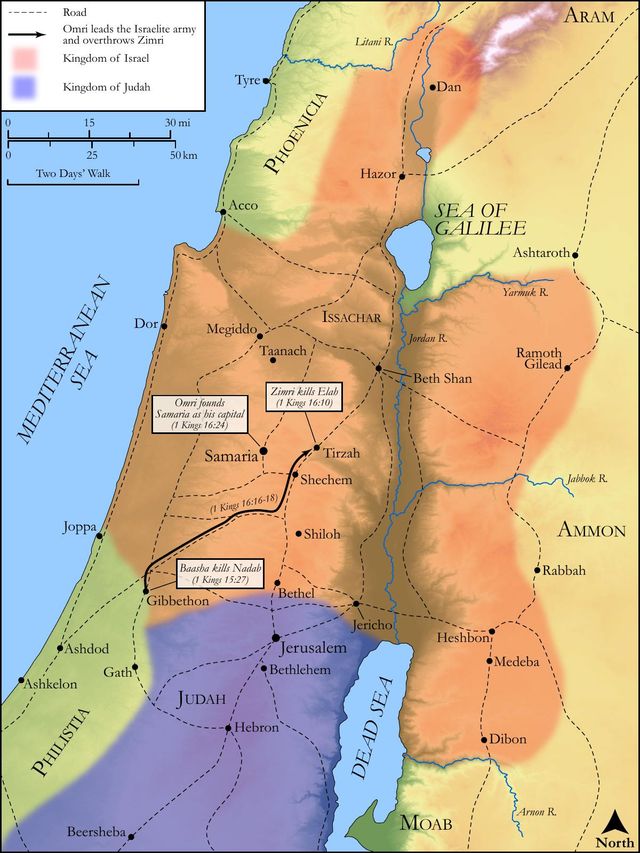
We are now to take a view of the miserable state of Israel, while the kingdom of Judah was happy under Asa's good government. It was threatened that they should be as a reed shaken in the water (Kg1 14:15), and so they were, when, during the single reign of Asa, the government of their kingdom was in six or seven different hands, as we find in this and the following chapter. Jeroboam was upon the throne in the beginning of his reign and Ahab at the end of it, and between them were Nadab, Baasha, Elah, Zimri, Tibni, and Omri, undermining and destroying one another. This they got by deserting the house both of God and of David. Here we have, 1. The ruin and extirpation of the family of Jeroboam, according to the word of the Lord by Ahijah. His son Nadab succeeded him. If the death of his brother Abijah had had a due influence upon him to make him religious, and the honour done him at his death had engaged him to follow his good example, his reign might have been long and glorious; but he walked in the way of his father (Kg1 15:26), kept up the worship of his calves, and forbade his subjects to go up to Jerusalem to worship, sinned and made Israel to sin, and therefore God brought ruin upon him quickly, in the second year of his reign. He was besieging Gibbethon, a city which the Philistines had taken from the Danites, and was endeavouring to re-take it; and there, in the midst of his army, did Baasha, with others, conspire against him and kill him, (Kg1 15:27), and so little interest had he in the affections of his people that his army did not only not avenge his death, but chose his murderer for his successor. Whether Baasha did it upon a personal pique against Nadab, or to be avenged on the house of Jeroboam for some affront received from them, or whether under pretence of freeing his country from the tyranny of a bad prince, or whether merely from a principle of ambition, to make way for himself to the throne, does not appear; but he slew him and reigned in his stead, Kg1 15:28. And the first thing he did when he came to the crown was to cut off all the house of Jeroboam, that he might the better secure himself and his own usurped government. He thought it not enough to imprison or banish them, but he destroyed them, left not only no males (as was foretold, Kg1 14:10), but none that breathed. Herein he was barbarous, but God was righteous. Jeroboam's sin was punished (Kg1 15:30); for those that provoke God do it to their own confusion; see Jer 7:19. Ahijah's prophecy was accomplished (Kg1 15:29); for no word of God shall fall to the ground. Divine threatenings are not bugbears. 2. The elevation of Baasha. He shall be tried awhile, as Jeroboam was. Twenty-four years he reigned (Kg1 15:33), but showed that it was not from any dislike to Jeroboam's sin that he destroyed his family, but from malice and ambition; for, when he had rooted out the sinner, he himself clave to the sin, and walked in the way of Jeroboam (Kg1 15:34), though he had seen the end of that way; so strangely was his heart hardened with the deceitfulness of sin.
Continue studying 1 Kings 15:25 across the web’s major study libraries — every link below opens this exact verse, chapter, or book on the destination site.
Read & Compare
 BibleGatewayThis verse in more than 200 translations and 70 languages.
 Bible.comThe YouVersion reader — hundreds of translations, reading plans, and highlights.
 ESV.orgCrossway's official English Standard Version reader.
 NET BibleThe NET translation with 60,000+ translators' notes on every rendering decision.
 STEP BibleTyndale House's free study tool — original text, vocabulary, and scholarly resources.
 BibliaLogos Bible Software's free web reader.
 USCCBThe New American Bible (Revised Edition) with the U.S. bishops' study notes.
Commentaries
 BibleHub CommentariesDozens of classic commentaries on this verse, gathered on one page.
 StudyLightMore than 100 commentary sets — the largest collection on the web.
 BibleRefPlain-English commentary on what this verse means, verse by verse.
 Enduring WordDavid Guzik's free commentary on this chapter, widely used by Bible teachers.
 Bible Study ToolsVerse commentary alongside Greek and Hebrew study aids.
Original Language & Research
- BibleHub InterlinearThe verse word by word — original language, transliteration, and English.
- BibleHub LexiconEvery word's original-language definition and Strong's entry.
 Blue Letter BibleDeep-study tools — Strong's numbers, concordance, and word studies.
 SefariaThe Hebrew text with Rashi and centuries of Jewish commentary.
Sermons, Hymns & Audio


TrulyRandomVerse is not affiliated with these sites and doesn’t control their content. They’re linked because they’re genuinely useful.
Summary
First Kings 15:25 concisely records the commencement of Nadab's reign over Israel, identifying him as the son and successor of Jeroboam, the first king of the Northern Kingdom. This brief chronological entry, synchronized with the second year of Asa's kingship in Judah, immediately establishes the instability of Israel's monarchy and foreshadows the swift divine judgment that would soon befall Jeroboam's dynasty, a consequence of the widespread idolatry he introduced.
Context
ShowHideLiterary Context
This verse appears immediately after the introduction of King Asa of Judah, whose reign began with a period of significant religious reform and faithfulness to the Lord (see 1 Kings 15:9-15). The abrupt shift in focus back to the Northern Kingdom of Israel, particularly to the succession of Jeroboam's son, serves to highlight the stark contrast between the two kingdoms' spiritual trajectories and the differing nature of their monarchies. Nadab's brief mention sets the stage for the rapid and violent fulfillment of the prophecy against Jeroboam's house, detailed by the prophet Ahijah in 1 Kings 14:10-14, which predicted the utter destruction of his lineage due to his profound apostasy. The brevity of Nadab's two-year reign directly precedes his assassination and the complete eradication of Jeroboam's family by Baasha, an event fully narrated in 1 Kings 15:27-30.
Historical & Cultural Context
The historical backdrop for this verse is the turbulent era of the Divided Monarchy, following the split of Solomon's kingdom into the Northern Kingdom of Israel and the Southern Kingdom of Judah. Jeroboam I, Nadab's father, initiated a policy of religious deviation by establishing golden calf worship centers in Dan and Bethel (see 1 Kings 12:28-30) to prevent his subjects from worshipping in Jerusalem. This institutionalized idolatry became the defining sin of the Northern Kingdom, leading to a recurring pattern of spiritual apostasy, political instability, and frequent dynastic changes through violent coups. In contrast, the Southern Kingdom of Judah, though not without its own periods of unfaithfulness, maintained the continuous Davidic lineage, reflecting God's covenant faithfulness. The inclusion of "the second year of Asa king of Judah" is a vital synchronism, a common literary technique in the books of Kings, which allows the biblical historian to precisely align and track the concurrent reigns and events in both kingdoms, emphasizing their intertwined yet distinct histories.
Key Themes
ShowHideFirst Kings 15:25 contributes significantly to several overarching theological and narrative themes prevalent throughout the books of Kings. Firstly, it powerfully illustrates the theme of Divine Judgment and Retribution, serving as the immediate unfolding of God's severe judgment against Jeroboam's house for his egregious idolatry, as prophesied by Ahijah (see 1 Kings 14:7-16). Secondly, the verse highlights the inherent Instability and Corruption of the Northern Kingdom's Monarchy. Unlike the relatively stable Davidic dynasty in Judah, Israel's throne was frequently seized through assassinations and coups, a destructive pattern initiated here with Nadab's swift overthrow, foreshadowing a succession of short, violent, and unrighteous reigns. Thirdly, it subtly but profoundly emphasizes the Consequences of Inherited Sin and Spiritual Legacy. Nadab, as "the son of Jeroboam," inherits not only the crown but also the spiritual burden of his father's apostasy, which directly contributes to the swift demise of his dynasty, demonstrating how the sins of leaders can have far-reaching and devastating repercussions.
Exposition and Analysis
ShowHideKey Word Analysis
ShowHideThe name means "liberal" or "noble." This etymology creates a poignant irony when contrasted with the reality of his brief, unrighteous, and violently terminated reign. His name suggests a positive quality, yet his life, as presented in the biblical narrative, is marked by failure and divine judgment, serving as a stark reminder that character and actions, rather than mere nomenclature, define a legacy in God's eyes.
Meaning "the people will contend" or "he increases the people." Jeroboam I was the inaugural king of the Northern Kingdom of Israel and is consistently identified in Scripture as the one "who made Israel sin" (e.g., 1 Kings 14:16). His name, therefore, carries immense theological weight, symbolizing the institutionalized spiritual corruption and idolatry that plagued the Northern Kingdom for generations. Nadab's identification as "the son of Jeroboam" immediately links him to this infamous and damning legacy of apostasy.
This primitive root means "to reign," "to ascend the throne," or "to induct into royalty." In the context of Nadab, the act of reigning is immediately qualified by its brevity ("two years"). This short duration is not merely a historical detail but a significant theological statement, signaling divine disfavor and the impending judgment against Jeroboam's dynasty. It underscores the fragility of human power when it stands in opposition to God's will and covenant.
Verse Breakdown
ShowHide"And Nadab the son of Jeroboam began to reign over Israel"
This initial clause introduces the new monarch of the Northern Kingdom, emphatically linking him to his father, Jeroboam I. This lineage is crucial because it immediately connects Nadab to the spiritual and political legacy of Jeroboam's institutionalized idolatry, which was the primary catalyst for God's severe judgment against their house. It establishes the continuation of an ungodly and condemned dynasty in Israel.
"in the second year of Asa king of Judah"
This precise chronological reference functions as a synchronism, a deliberate literary device employed throughout the books of Kings to interweave the parallel histories of the Northern (Israel) and Southern (Judah) kingdoms. By aligning Nadab's accession with a specific point in Asa's reign, the biblical historian provides a clear and verifiable timeline, enabling the reader to track the concurrent unfolding of God's sovereign plan in both nations, highlighting their interconnected yet distinct destinies.
"and reigned over Israel two years"
This concluding clause states the remarkably short duration of Nadab's rule. This brevity is not a mere historical detail but a profound theological declaration. It serves as a direct and immediate foreshadowing of the violent and complete end of Jeroboam's dynasty, signaling God's swift, decisive, and unwavering judgment against the house that led Israel into profound sin and pervasive apostasy. It underscores the transient nature of power apart from divine blessing.
Literary Devices
ShowHideThe verse employs several key literary devices to convey its profound theological and historical message beyond a simple chronological record. Synchronism is prominently featured by cross-referencing Nadab's reign with "the second year of Asa king of Judah." This technique is vital for dating and aligning the parallel narratives of the divided kingdoms, underscoring the interconnectedness of divine judgment and historical events in both Israel and Judah. Furthermore, the extreme brevity of Nadab's reign (two years) serves as potent foreshadowing, hinting at the imminent and violent overthrow of Jeroboam's entire dynasty, as had been prophesied earlier. This short duration is a narrative signal of divine displeasure and impending doom. There is also a subtle irony in Nadab's name, which means "generous" or "noble," contrasting sharply with his ignoble and brief rule, which was marked by the continuation of his father's sin and ended in violent usurpation.
Theological and Thematic Connections
ShowHideThe introduction of Nadab's brief and ill-fated reign in 1 Kings 15:25 serves as a profound theological statement on divine sovereignty, the inescapable consequences of sin, and the nature of earthly kingship. It demonstrates God's active involvement in human history, raising up and casting down rulers according to His righteous will and sovereign plan. Nadab's two-year tenure is a direct and swift fulfillment of the prophetic judgment pronounced against Jeroboam's house for its egregious idolatry, underscoring that God's word is utterly reliable and His justice inevitable. This narrative also highlights the concept of spiritual legacy, showing how the foundational sins of a leader, particularly Jeroboam's institutionalized apostasy, can have devastating and immediate repercussions for their descendants and the nation as a whole. The inherent instability of the Northern Kingdom, epitomized by Nadab's short reign and violent end, stands in stark contrast to the enduring (though not always righteous) Davidic covenant in Judah, emphasizing the critical importance of covenant faithfulness and obedience to the Lord.
Reflection and Application
ShowHideThe account of Nadab's fleeting reign, though concise, offers profound lessons for contemporary believers regarding the nature of leadership, the weight of spiritual legacy, and the transient nature of earthly power. It serves as a potent reminder that positions of authority, whether in civil government, corporate enterprise, or the church, are ultimately held under the sovereign hand of God. He holds all leaders accountable for their actions, their faithfulness to His principles, and their stewardship of influence. Nadab's story stands as a sober warning that power not founded on righteousness, obedience to God, and a commitment to His truth is inherently unstable and ultimately destined for collapse. Furthermore, it powerfully underscores the profound impact of spiritual legacy; the choices and foundational sins of one generation, particularly those in leadership, can set a trajectory for future generations, leading either toward blessing and flourishing or toward judgment and ruin. We are therefore called to soberly consider the spiritual inheritance we are building for those who follow us, striving with intentionality to cultivate a legacy of faith, obedience, and devotion to God rather than one of compromise, apostasy, or self-serving ambition.
Questions for Reflection
ShowHideFAQ
ShowHideWhy was Nadab's reign so short?
ShowHideNadab's reign was exceptionally short, lasting only two years, primarily because it was a direct and swift fulfillment of God's prophetic judgment against his father, Jeroboam I. Due to Jeroboam's egregious sin of leading Israel into widespread idolatry by establishing golden calves in Dan and Bethel, God declared through the prophet Ahijah that He would "utterly sweep away the house of Jeroboam" (see 1 Kings 14:10). Nadab's brief rule and subsequent assassination by Baasha (as recorded in 1 Kings 15:27-29) marked the complete and violent eradication of Jeroboam's dynasty, powerfully demonstrating God's unwavering justice against unfaithfulness and apostasy.
Who was Jeroboam, and what was his significance?
ShowHideJeroboam I was the first king of the Northern Kingdom of Israel after the division of Solomon's united monarchy. His significance lies in his pivotal and destructive role in establishing the foundational sin of the Northern Kingdom. Fearing that the people would return to Jerusalem to worship if they continued to go to the temple, he set up golden calves in Dan and Bethel and instituted an alternative, idolatrous religious system (see 1 Kings 12:28-30). This act of institutionalized idolatry became the defining sin of subsequent Northern Kingdom kings, consistently referred to as "the sin of Jeroboam, which he made Israel to sin," and was the primary cause of God's judgment and the eventual downfall of Israel.
What is the significance of "the second year of Asa king of Judah"?
ShowHideThe mention of "the second year of Asa king of Judah" serves as a crucial chronological synchronism. This literary device, frequently employed in the books of Kings, allows the biblical author to correlate and interweave the parallel histories of the Northern Kingdom (Israel) and the Southern Kingdom (Judah) after the monarchy divided. By linking the beginning of Nadab's reign to a specific year in Asa's reign, the text provides a precise historical anchor, enabling readers to understand the concurrent events and the broader timeline of God's providential dealings with both nations. It highlights the interwoven nature of their histories, even as they operated as separate political entities, and underscores the divine oversight of both.
Christ-Centered Fulfillment
ShowHideThe brief, unstable, and unrighteous reign of Nadab, identified as "the son of Jeroboam," stands in stark and profound contrast to the eternal, righteous, and unwavering kingship of Jesus Christ. Nadab inherited a legacy of idolatry and led a kingdom plagued by spiritual apostasy, ultimately succumbing to a violent overthrow—a testament to the fleeting and fragile nature of human power when it is exercised apart from God's will. In profound contrast, Jesus, the true and ultimate King, inherits a divine and eternal legacy, being the Son of God and the rightful heir to the throne of David, a lineage promised to endure forever (see Luke 1:32-33). Unlike Nadab, whose reign was marked by divine judgment due to the continuation of his father's sin, Christ's reign is characterized by perfect righteousness, bringing salvation, redemption, and eternal life to all who believe. He is not a king whose power is usurped or whose dynasty is cut short by human rebellion or divine judgment; rather, He is the "King of kings and Lord of lords" (see Revelation 19:16), whose dominion is everlasting and whose kingdom will never end (see Hebrews 1:8). The instability, unrighteousness, and swift judgment seen in Nadab's story powerfully underscore humanity's desperate need for a perfect, divine King who can truly deliver His people from the bondage of sin and establish a kingdom of righteousness and peace that will stand for all eternity.