


1 Kings 15:12
Bible text: King James Version (1769 Blayney text) · Public domain
Bible text: Berean Standard Bible · Public domain
Bible text: American Standard Version (1901) · Public domain
Bible text: World English Bible, Messianic edition · Public domain
Bible text: Geneva Bible (1599) · Public domain
Bible text: Young's Literal Translation · Public domain
- וַיַּעֲבֵרvai·ya·'a·Verand he made to pass awayH5674Conj-w ¦ V-Hiphil-ConsecImperf-3msVerb Hiphil Consecutive Imperfect 3rd Singular Masculineוַandיַּעֲבֵרhe made to pass away
- הַקְּדֵשִׁיםha·ke·de·Shimthe male cult prostitutesH6945Art ¦ Adj-mpAdjective Plural Masculine Absoluteהַtheקְּדֵשִׁיםmale cult prostitutes
- מִןminfromH4480PrepPreposition
- הָאָרֶץha·'A·retzthe landH776Art ¦ N-fsNoun Singular Feminine Absoluteהָtheאָרֶץland
- וַיָּסַרvai·Ya·sarand he removedH5493Conj-w ¦ V-Hiphil-ConsecImperf-3msVerb Hiphil Consecutive Imperfect 3rd Singular Masculineוַandיָּסַרhe removed
- אֶת'et<obj.>H853DirObjMParticle Object Indicator
- כָּלkolallH3605N-mscNoun Singular Masculine Construct
- הַגִּלֻּלִיםha·gi·lu·Limthe idolsH1544Art ¦ N-mpNoun Plural Masculine Absoluteהַtheגִּלֻּלִיםidols
- אֲשֶׁר'a·SherwhichH834RelParticle Relative
- עָשׂוּ'a·Suthey had madeH6213V-Qal-Perf-3cpVerb Qal Perfect 3rd Plural common gender
- אֲבֹתָיו'a·vo·Tavhis ancestorsH1N-fpc ¦ 3msNoun Plural Feminine Constructאֲבֹתָיancestorsוhis
English is a literal word-by-word gloss of the Hebrew, not the KJV's wording. Why?
This is the original text the KJV's translators worked from — each Hebrew word with its own literal English meaning in this verse, prepared by scholars at Tyndale House, Cambridge. The KJV translates whole sentences, not word by word, so its wording differs: one Hebrew word can become several English words, and the KJV may choose “the LORD” where the gloss reads “Yahweh”. Both are faithful — they answer different questions. For the KJV's own rendering, switch to the KJV text.
Details
See on the biblical-era maps
Study this verse
Public-domain commentary
Matthew Henry
From his Commentary on the Whole Bible. Henry comments on passages, not single verses — this entry covers 1 Kings 15:9–24. His three-level outline is real structure in the source text, so it is rendered as structure.
We have here a short account of the reign of Asa; we shall find a more copious history of it Ch2 14:1-15, 15, and Ch2 16:1-14. Here is,
I.The length of it:
He reigned forty-one years in Jerusalem, Kg1 15:10. In the account we have of the kings of Judah we find the number of the good kings and the bad ones nearly equal; but then we may observe, to our comfort, that the reign of the good kings was generally long, but that of the bad kings short, the consideration of which will make the state of God's church not altogether so bad within that period as it appears at first sight. Length of days is in Wisdom's right hand. Honour thy father, much more thy heavenly Father, that thy days may be long.
II.The general good character of it (Kg1 15:11):
Asa did that which was right in the eyes of the Lord, and that is right indeed which is so in God's eyes; those are approved whom he commends. He did as did David his father, kept close to God, and to his instituted worship, was hearty and zealous for that, which gave him this honourable character, that he was like David, though he was not a prophet, or psalmist, as David was. If we come up to the graces of those that have gone before us it will be our praise with God, though we come short of their gifts. Asa was like David, though he was neither such a conqueror nor such an author; for his heart was perfect with the Lord all his days (Kg1 15:14), that is, he was both cordial and constant in his religion. What he did for God he was sincere in, steady and uniform, and did it from a good principle, with a single eye to the glory of God.
III.The particular instances of Asa's piety. His times were times of reformation. For,
1.He removed that which was evil. There reformation begins; and a great deal of work of that kind his hand found to do. For, though it was but twenty years after the death of Solomon that he began to reign, yet very gross corruption had spread far and taken deep root. Immorality he first struck at: He took away the sodomites out of the land, suppressed the brothels; for how can either prince or people prosper while those cages of unclean and filthy birds, more dangerous than pest-houses, are suffered to remain? Then he proceeded against idolatry: He removed all the idols, even those that his father had made, Kg1 15:12. His father having made them, he was the more concerned to remove them, that he might cut off the entail of the curse, and prevent the visiting of that iniquity upon him and his. Nay (which redounds much to his honour, and shows his heart was perfect with God), when he found idolatry in the court, he rooted it out thence, Kg1 15:13. When it appeared that Maachah his mother, or rather his grandmother (but called his mother because she had the educating of him in his childhood), had an idol in a grove, though she was his mother, his grandmother, - though, it is likely, she had a particular fondness for it, - though, being old, she could not live long to patronise it, - though she kept it for her own use only, yet he would by no means connive at her idolatry. Reformation must begin at home. Bad practices will never be suppressed in the country while they are supported in the court. Asa, in every thing else, will honour and respect his mother; he loves her well, but he loves God better, and (like the Levite, Deu 33:9) readily forgets the relation when it comes in competition with his duty. If she be an idolater,
(1.)Her idol shall be destroyed, publicly exposed to contempt, defaced, and burnt to ashes by the brook Kidron, on which, it is probable, he strewed the ashes, in imitation of Moses (Exo 32:20) and in token of his detestation of idolatry and his indignation at it wherever he found it. Let no remains of a court-idol appear.
(2.)She shall be deposed, He removed her from being queen, or from the queen, that is, from conversing with his wife; he banished her from the court, and confined her to an obscure and private life. Those that have power are happy when thus they have hearts to use it well.
2.He re-established that which was good (Kg1 15:15): He brought into the house of God the dedicated things which he himself had vowed out of the spoils of the Ethiopians he had conquered, and which his father had vowed, but lived not to bring in pursuant to his vow. We must not only cease to do evil, but learn to do well, not only cast away the idols of our iniquity, but dedicate ourselves and our all to God's honour and glory. When those who, in their infancy, were by baptism devoted to God, make it their own act and deed to join themselves to him and vigorously employ themselves in his service, this is bringing in the dedicated things which they and their fathers have dedicated: it is necessary justice - rendering to God the things that are his.
VI.The policy of his reign.
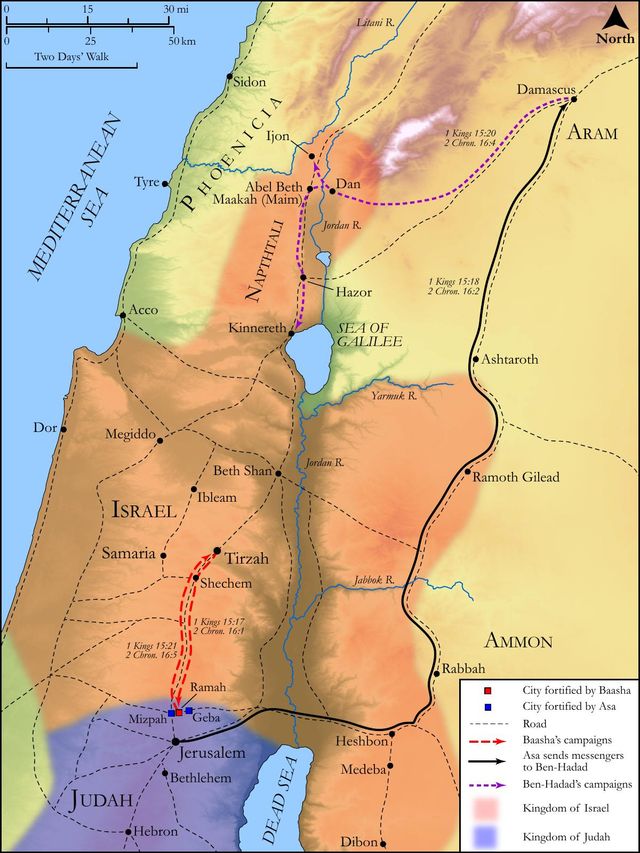
He built cities himself, to encourage the increase of his people (Kg1 15:23) and to invite others to him by the conveniences of habitation; and he was very zealous to hinder Baasha from building Ramah, because he designed it for the cutting off of communication between his people and Jerusalem and to hinder those who in obedience to God would come to worship there. An enemy must by no means be suffered to fortify a frontier town.
V.The faults of his reign.
In both the things for which he was praised he was found defective. The fairest characters are not without some but or other in them.
1.Did he take away the idols? That was well; but the high places were not removed (Kg1 15:14); therein his reformation fell short. He removed all images which were rivals with the true God or false representations of him; but the altars which were set up in high places, and to which those sacrifices were brought which should have been offered on the altar in the temple, those he suffered to stand, thinking there was no great harm in them, they having been used by good men before the temple was built, and being loth to disoblige the people, who had a kindness to them and were wedded to them both by custom and convenience; whereas in Judah and Benjamin, the only tribes under Asa's government which lay so near Jerusalem and the altars there, there was less pretence for them than in those tribes which lay more remote. They were against the law, which obliged them to worship at one place, Deu 12:11. They lessened men's esteem of the temple and the altars there, and were an open gap for idolatry to enter in at, while the people were so much addicted to it. It was not well that Asa, when his hand was in, did not remove these. Nevertheless his heart was perfect with the Lord. This affords us a comfortable note, That those may be found honest and upright with God, and be accepted of him, who yet, in some instances, come short of doing the good they might and should do. The perfection which is made the indispensable condition of the new covenant is not to be understood of sinlessness (then we were all undone), but sincerity.
2.Did he bring in the dedicated things? That was well; but he afterwards alienated the dedicated things, when he took the gold and silver out of the house of God and sent them as a bribe to Benhadad, to hire him to break his league with Baasha, and, by making an inroad upon his country, to give him a diversion from the building of Ramah, Kg1 15:18, Kg1 15:19. Here he sinned,
(1.)In tempting Benhadad to break his league, and so to violate the public faith. If he did wrong in doing it, as certainly he did, Asa did wrong in persuading him to do it.
(2.)In that he could not trust God, who had done so much for him, to free him out of this strait, without using such indirect means to help himself.
(3.)In taking the gold out of the treasury of the temple, which was not to be made use of but on extraordinary occasions. The project succeeded. Benhadad made a descent upon the land of Israel, which obliged Baasha to retire with his whole force from Ramah (Kg1 15:20, Kg1 15:21), which gave Asa a fair opportunity to demolish his works there, and the timber and stones served him for the building of some cities of his own, Kg1 15:22. But, though the design prospered, we find it was displeasing to God; and though Asa valued himself upon the policy of it, and promised himself that it would effectually secure his peace, he was told by the prophet that he had done foolishly, and that thenceforth he should have wars; see Ch2 16:7-9.
VI.The troubles of his reign. For the most part he prospered; but,
1.Baasha king of Israel was a very troublesome neighbour to him. He reigned twenty-four years, and all his days had war, more or less, with Asa, Kg1 15:16. This was the effect of the division of the kingdoms, that they were continually vexing one another, and so weakened one another, which made them both an easier prey to the common enemy.
2.In his old age he was himself afflicted with the gout: He was diseased in his feet, which made him less fit for business and peevish towards those about him.
VII.The conclusion of his reign.
The acts of it were more largely recorded in the common history (to which reference is here had, Kg1 15:23) than in this sacred one. He reigned long, but finished at last with honour, and left his throne to a successor no way inferior to him.
Historical interpretation
Historical reception
3 surviving comments on this verse. Each one is dated, so this reads as a timeline rather than a list.
Select a marker to jump to its quote. Markers stagger vertically where authors wrote within a few decades of each other.
Furthermore, the adversary tempted Job through his children and his possessions, and when he could not prevail over him, he went and brought against him his armor, and he came, bringing with him a daughter of Eve, who had caused Adam to sink, and through her mouth he said to Job, her righteous husband, “Curse God.” But Job rejected her counsel. King Asa also conquered the Accursed-of-life, when he wished to come in against him, through his mother. For Asa knew his craftiness and removed his mother from her high estate and cut in pieces her idol and cast it down.
In the meantime, Asa devoted himself to the reconstruction of the ruins of religion. He destroyed the temples of the idols, smashed the statues, set the sacred woods on fire and removed the ignominy of the effeminate priests. He also drove away Maacah, the mother of his father, Abijam. [She] was the high priestess of that abomination, and he chased her off from that place of honor that she was holding and broke her idols and burned them. Therefore, after removing the worship of the idols in this manner, he restored the holy rites of true religion and constantly protected all the sacred institutions for the forty-one years in which he ruled over the state.
Look for a little at those books on the Republic from which you drew that ideal of the most devoted citizen: that there should be no limit or legitimate restriction on his service. Look, I beg you, and notice with what high praise frugality and temperance are there spoken of, as well as fidelity to the marriage bond, and chaste, honorable and upright conduct. When a state excels in these, it can truly be said to bloom. But in churches in growing numbers all over the world, as in holy gatherings of peoples, these principles are taught and learned; above all, the devotion by which the true and truth-giving God is worshiped, who not only commands these principles to be kept but also gives them fulfillment. It is by these that the human mind is prepared and made fit for the divine society and for its habitation in the eternal heavenly country. Hence he has foretold that the images of the many false gods would be overturned and has commanded them to be overturned.
Continue studying 1 Kings 15:12 across the web’s major study libraries — every link below opens this exact verse, chapter, or book on the destination site.
Read & Compare
 BibleGatewayThis verse in more than 200 translations and 70 languages.
 Bible.comThe YouVersion reader — hundreds of translations, reading plans, and highlights.
 ESV.orgCrossway's official English Standard Version reader.
 NET BibleThe NET translation with 60,000+ translators' notes on every rendering decision.
 STEP BibleTyndale House's free study tool — original text, vocabulary, and scholarly resources.
 BibliaLogos Bible Software's free web reader.
 USCCBThe New American Bible (Revised Edition) with the U.S. bishops' study notes.
Commentaries
 BibleHub CommentariesDozens of classic commentaries on this verse, gathered on one page.
 StudyLightMore than 100 commentary sets — the largest collection on the web.
 BibleRefPlain-English commentary on what this verse means, verse by verse.
 Enduring WordDavid Guzik's free commentary on this chapter, widely used by Bible teachers.
 Bible Study ToolsVerse commentary alongside Greek and Hebrew study aids.
Original Language & Research
- BibleHub InterlinearThe verse word by word — original language, transliteration, and English.
- BibleHub LexiconEvery word's original-language definition and Strong's entry.
 Blue Letter BibleDeep-study tools — Strong's numbers, concordance, and word studies.
 SefariaThe Hebrew text with Rashi and centuries of Jewish commentary.
Sermons, Hymns & Audio


TrulyRandomVerse is not affiliated with these sites and doesn’t control their content. They’re linked because they’re genuinely useful.
Summary
King Asa of Judah initiated a profound spiritual reformation, actively purging the land of deeply entrenched pagan practices and moral abominations. This verse decisively highlights his zealous actions against male cult prostitutes, referred to as "sodomites," and his comprehensive removal of all idols that had been introduced or tolerated by his predecessors. Asa's reign marked a significant turning point in Judah's spiritual history, demonstrating a bold commitment to covenant faithfulness and the restoration of pure worship to the Lord, setting a precedent for righteous leadership in a kingdom often plagued by idolatry and moral decline.
Context
ShowHideLiterary Context
This verse serves as the immediate and concrete evidence of King Asa's faithfulness, directly following the narrator's crucial assessment in 1 Kings 15:11 that "Asa's heart was perfect with the LORD all his days." It contrasts sharply with the spiritual compromises and overt wickedness of his father Abijam (1 Kings 15:3) and grandfather Rehoboam (1 Kings 14:22-24), whose reigns plunged Judah into idolatry and moral depravity. The actions described here are foundational to Asa's reputation as a reforming king, with further details of his extensive efforts, including the removal of his own mother from her position for her idolatry, found in 1 Kings 15:13-15. Thus, 1 Kings 15:12 functions as a powerful opening statement to Asa's unwavering commitment to Yahweh, setting the spiritual tone for the remainder of his long reign.
Historical & Cultural Context
King Asa reigned over the southern kingdom of Judah for approximately 41 years (c. 913-873 BC). During this tumultuous period, the land of Israel was continually susceptible to the pervasive idolatrous practices of surrounding Canaanite nations. Fertility cults, often involving ritualistic prostitution (both male and female) and the worship of various deities like Baal and Asherah, were deeply ingrained in the cultural and religious landscape. The term "sodomites" in the KJV refers to male cult prostitutes (Hebrew: qadesh), who were consecrated not to Yahweh but to these pagan gods, engaging in ritual sexual acts as part of their worship. Such practices, along with the veneration of physical idols, were explicitly and repeatedly forbidden by the Mosaic Law, as seen in Deuteronomy 23:17-18 and the foundational Exodus 20:4-5. Asa's decisive actions represent a direct and courageous confrontation with these deeply entrenched abominations, many of which had been tolerated or even actively promoted by previous generations of Judah's kings, demonstrating a radical break from the spiritual apostasy of his lineage.
Key Themes
ShowHideThis verse powerfully illustrates several crucial themes within the broader narrative of 1 Kings and the overarching biblical story. Firstly, it highlights the theme of Radical Religious Reform, showcasing Asa's bold and decisive leadership in actively purging the kingdom of offensive religious practices. This was not merely passive disapproval but an aggressive, comprehensive removal of elements contrary to God's covenant law. Secondly, it underscores the Rejection of Idolatry, signifying a direct confrontation with false gods and their associated worship, which had consistently compromised Israel's exclusive covenant relationship with the one true God (Deuteronomy 6:4-5). Finally, Asa's expulsion of the "sodomites" speaks to his unwavering commitment to Moral Purity and spiritual cleansing within the kingdom, recognizing that such practices were an abomination in God's sight and a direct violation of His holiness. These actions define Asa's reign as a period of significant spiritual renewal, setting him apart from many of his predecessors and successors.
Exposition and Analysis
ShowHideKey Word Analysis
ShowHideThe KJV translation "sodomites" can be misleading if understood solely in modern terms of homosexuality. The Hebrew word qâdêsh (קָדֵשׁ), derived from a root meaning "to be holy" or "set apart," ironically refers in this context to a (male) devotee to licentious idolatry. These individuals were "set apart" not for Yahweh's service, but for ritualistic sexual acts associated with pagan fertility cults, often performed in temples or high places. This practice was a severe perversion of true worship and was explicitly forbidden by God's law as an abomination (Deuteronomy 23:17-18). Asa's removal of them signifies a purge of deep-seated religious and moral corruption that defiled the land.
The Hebrew word gillûwl (גִּלּוּל), often appearing in the plural gillûlîm, is a highly contemptuous term for idols, frequently translated as "dung-gods," "detestable things," or "blocks." It is derived from a root meaning "to roll," perhaps referring to dung-balls or worthless logs, emphasizing the utter worthlessness, vileness, and abominable nature of these images in God's sight. Unlike more neutral terms for images, gillûwl carries a strong negative connotation, highlighting the disgust God has for these false deities and their worship. Asa's removal of these "detestable things" demonstrates his unwavering commitment to purging the land of everything that defiled the worship of Yahweh.
The Hebrew word ʼâb (אָב) refers to a father, in a literal and immediate sense, or in a figurative and remote application, often denoting ancestors or predecessors. In this context, "his fathers" refers primarily to Asa's immediate predecessors, Abijam and Rehoboam, who had either introduced or tolerated the idols and cultic practices that Asa now confronts. The inclusion of "fathers" highlights the generational nature of the apostasy Asa was breaking, underscoring the depth and courage of his reforms in reversing a long-standing trend of spiritual decline.
Verse Breakdown
ShowHide"And he took away the sodomites out of the land"
This initial clause describes Asa's decisive and active measure against the male cult prostitutes. The verb "took away" (Hebrew: ʻâbar) implies a thorough removal or expulsion, signifying a forceful cleansing rather than mere passive disapproval. This act directly confronted a deeply entrenched form of religious and moral corruption that had permeated the kingdom, violating God's commands for sexual purity and exclusive worship. It demonstrates Asa's immediate focus on eradicating the most egregious forms of pagan worship.
"and removed all the idols that his fathers had made"
This second clause details Asa's comprehensive purge of idolatry. The verb "removed" (Hebrew: çûyr) indicates a turning away or putting away, emphasizing the decisive nature of his actions. The phrase "all the idols" signifies a sweeping and thorough effort to eradicate the physical representations of false gods, leaving no room for compromise. The specific mention "that his fathers had made" is profoundly significant, highlighting that Asa was confronting not just current practices but also the legacy of spiritual compromise and apostasy inherited from previous generations, including his father Abijam and grandfather Rehoboam. This demonstrates his radical commitment to breaking cycles of unfaithfulness and restoring covenant loyalty to Yahweh alone.
Literary Devices
ShowHideThe verse employs several potent literary devices to convey the significance and impact of King Asa's actions. Contrast is a primary device, as Asa's zealous reforms stand in stark opposition to the spiritual apathy, idolatry, and moral decay that characterized the reigns of his predecessors, particularly Abijam and Rehoboam. This highlights Asa as a righteous king, a rare beacon of devotion in a period of pervasive decline. Furthermore, Symbolism is evident in the "sodomites" and "idols" themselves. They are not merely physical entities but potent symbols of the deep spiritual corruption, syncretism, and moral decay that had plagued Judah. Their removal, therefore, symbolizes a profound act of purification and a return to the covenant standards of holiness and exclusive worship of Yahweh, representing a cleansing of the nation's spiritual landscape. The phrase "all the idols" also suggests a degree of Hyperbole or Merism, emphasizing the comprehensive and thorough nature of Asa's efforts to purge the land, rather than a literal accounting of every single idol, underscoring the totality of his commitment.
Theological and Thematic Connections
ShowHideKing Asa's actions in 1 Kings 15:12 resonate deeply with the Old Testament's consistent call for exclusive worship of Yahweh and the pursuit of holiness. His zeal for purging the land of cultic prostitution and idolatry exemplifies the covenant demands laid out in the Torah, particularly the First and Second Commandments against having other gods and making graven images. Asa's willingness to confront deeply entrenched sin, even that inherited from his own family, underscores the principle that true faithfulness requires active and uncompromising obedience, not passive tolerance of evil. His reforms highlight the corrupting influence of idolatry and immorality on a nation's spiritual health and the vital role of righteous leadership in guiding the people back to God. This commitment to purity and truth serves as a powerful example of what it means for a leader's heart to be "perfect with the LORD," demonstrating that genuine devotion necessitates a radical turning away from all that defiles.
Reflection and Application
ShowHideKing Asa's courageous and uncompromising actions in purging Judah of its spiritual defilements offer a profound challenge and enduring model for believers today. His willingness to confront deeply entrenched sinful practices, even those established by his own ancestors, demonstrates immense courage and unwavering devotion to God. For us, this verse underscores the ongoing need for spiritual cleansing in our own lives and communities. It compels us to identify and actively remove any "idols"—anything that takes the place of God in our hearts, demands our ultimate allegiance, or distorts our worship. This could include materialism, self-reliance, comfort, approval from others, or even good things that have become ultimate things, displacing God from His rightful throne. Furthermore, it calls us to reject practices that contradict God's holy standards, pursuing moral purity and integrity in thought, word, and deed, recognizing that compromise with sin inevitably leads to spiritual decay. Asa's example reminds us that genuine fellowship with the Lord requires a clean heart and a purified life, reflecting a commitment to holiness that is active, intentional, and often requires confronting difficult truths within ourselves and our spheres of influence, even when it is unpopular or challenging.
Questions for Reflection
ShowHideFAQ
ShowHideWho were the "sodomites" King Asa removed?
ShowHideIn this context, the "sodomites" (KJV) refers to male cult prostitutes, derived from the Hebrew word qâdêsh (קָדֵשׁ). These individuals were dedicated to pagan deities and participated in ritual sex acts as part of idolatrous fertility cults prevalent among the nations which the LORD cast out before the children of Israel. This practice was considered a severe abomination and was explicitly forbidden by God's law, as detailed in Deuteronomy 23:17-18. Asa's action was a direct response to this widespread religious and moral corruption that defiled the land and violated God's covenant with Israel.
Why is it specifically mentioned that Asa removed "all the idols that his fathers had made"?
ShowHideThis detail highlights the deep-seated, generational nature of the idolatry in Judah and the pervasive cycle of spiritual compromise. Asa's predecessors, including his father Abijam and grandfather Rehoboam, had either introduced or tolerated these pagan practices, allowing them to become entrenched in the national life. By specifically targeting "idols that his fathers had made," Asa demonstrated a radical commitment to breaking this cycle of unfaithfulness and reversing a long-standing pattern of apostasy. It shows that his reforms were not superficial but aimed at purging the inherited spiritual pollution, signaling a profound and comprehensive return to the exclusive worship of Yahweh.
Christ-Centered Fulfillment
ShowHideKing Asa's zealous purification of Judah from idolatry and cultic immorality serves as a powerful Old Testament foreshadowing of the ultimate and perfect spiritual cleansing accomplished by Jesus Christ. While Asa, a human king, could only remove external manifestations of sin and inherited corruption, the Lamb of God, who takes away the sin of the world, came to cleanse hearts and minds from within. Jesus's ministry was marked by a radical call to repentance and purity, challenging not just outward acts but the very intentions and desires of the heart (Matthew 5:27-28). He inaugurated a new covenant where the law is written not on stone tablets but on hearts, transforming desires and empowering obedience (Jeremiah 31:33). Through His sacrificial death and resurrection, Christ purifies us from all unrighteousness (1 John 1:9) and empowers us by His Spirit to live lives of holiness, actively putting off the "old self" with its idolatries and immorality and putting on the "new self" created in righteousness, holiness, and truth (Ephesians 4:22-24). Asa's reign brought a temporary, partial restoration; Christ's kingdom brings eternal, complete purification and enables true worship in spirit and truth (John 4:23-24), making believers temples of the Holy Spirit (1 Corinthians 6:19-20).