


1 Kings 15:16
Bible text: King James Version (1769 Blayney text) · Public domain
Bible text: Berean Standard Bible · Public domain
Bible text: American Standard Version (1901) · Public domain
Bible text: World English Bible, Messianic edition · Public domain
Bible text: Geneva Bible (1599) · Public domain
Bible text: Young's Literal Translation · Public domain
- וּמִלְחָמָהu·mil·cha·Mahand warH4421Conj-w ¦ N-fsNoun Singular Feminine Absoluteוּandמִלְחָמָהwar
- הָיְתָהha·ye·Tahit wasH1961V-Qal-Perf-3fsVerb Qal Perfect 3rd Singular Feminine
- בֵּיןbeinbetweenH996Adj-mscAdjective Numerical Singular Masculine Construct
- אָסָא'a·Sa'AsaH609N-proper-mNoun Proper Masculine
- וּבֵיןu·Veinand betweenH996Conj-w ¦ Adj-mscAdjective Numerical Singular Masculine Constructוּandבֵיןbetween
- בַּעְשָׁאba'·Sha'BaashaH1201N-proper-mNoun Proper Masculine
- מֶלֶךְMe·lekh[the] king ofH4428N-mscNoun Singular Masculine Construct
- יִשְׂרָאֵלYis·ra·'ElIsraelH3478N-properNoun Proper Location
- כָּלkolallH3605N-mscNoun Singular Masculine Construct
- יְמֵיהֶםye·mei·Hemtheir daysH3117N-mpc ¦ 3mpNoun Plural Masculine Constructיְמֵיdaysהֶםtheir
English is a literal word-by-word gloss of the Hebrew, not the KJV's wording. Why?
This is the original text the KJV's translators worked from — each Hebrew word with its own literal English meaning in this verse, prepared by scholars at Tyndale House, Cambridge. The KJV translates whole sentences, not word by word, so its wording differs: one Hebrew word can become several English words, and the KJV may choose “the LORD” where the gloss reads “Yahweh”. Both are faithful — they answer different questions. For the KJV's own rendering, switch to the KJV text.
Details
See on the biblical-era maps
Study this verse
Public-domain commentary
Matthew Henry
From his Commentary on the Whole Bible. Henry comments on passages, not single verses — this entry covers 1 Kings 15:9–24. His three-level outline is real structure in the source text, so it is rendered as structure.
We have here a short account of the reign of Asa; we shall find a more copious history of it Ch2 14:1-15, 15, and Ch2 16:1-14. Here is,
I.The length of it:
He reigned forty-one years in Jerusalem, Kg1 15:10. In the account we have of the kings of Judah we find the number of the good kings and the bad ones nearly equal; but then we may observe, to our comfort, that the reign of the good kings was generally long, but that of the bad kings short, the consideration of which will make the state of God's church not altogether so bad within that period as it appears at first sight. Length of days is in Wisdom's right hand. Honour thy father, much more thy heavenly Father, that thy days may be long.
II.The general good character of it (Kg1 15:11):
Asa did that which was right in the eyes of the Lord, and that is right indeed which is so in God's eyes; those are approved whom he commends. He did as did David his father, kept close to God, and to his instituted worship, was hearty and zealous for that, which gave him this honourable character, that he was like David, though he was not a prophet, or psalmist, as David was. If we come up to the graces of those that have gone before us it will be our praise with God, though we come short of their gifts. Asa was like David, though he was neither such a conqueror nor such an author; for his heart was perfect with the Lord all his days (Kg1 15:14), that is, he was both cordial and constant in his religion. What he did for God he was sincere in, steady and uniform, and did it from a good principle, with a single eye to the glory of God.
III.The particular instances of Asa's piety. His times were times of reformation. For,
1.He removed that which was evil. There reformation begins; and a great deal of work of that kind his hand found to do. For, though it was but twenty years after the death of Solomon that he began to reign, yet very gross corruption had spread far and taken deep root. Immorality he first struck at: He took away the sodomites out of the land, suppressed the brothels; for how can either prince or people prosper while those cages of unclean and filthy birds, more dangerous than pest-houses, are suffered to remain? Then he proceeded against idolatry: He removed all the idols, even those that his father had made, Kg1 15:12. His father having made them, he was the more concerned to remove them, that he might cut off the entail of the curse, and prevent the visiting of that iniquity upon him and his. Nay (which redounds much to his honour, and shows his heart was perfect with God), when he found idolatry in the court, he rooted it out thence, Kg1 15:13. When it appeared that Maachah his mother, or rather his grandmother (but called his mother because she had the educating of him in his childhood), had an idol in a grove, though she was his mother, his grandmother, - though, it is likely, she had a particular fondness for it, - though, being old, she could not live long to patronise it, - though she kept it for her own use only, yet he would by no means connive at her idolatry. Reformation must begin at home. Bad practices will never be suppressed in the country while they are supported in the court. Asa, in every thing else, will honour and respect his mother; he loves her well, but he loves God better, and (like the Levite, Deu 33:9) readily forgets the relation when it comes in competition with his duty. If she be an idolater,
(1.)Her idol shall be destroyed, publicly exposed to contempt, defaced, and burnt to ashes by the brook Kidron, on which, it is probable, he strewed the ashes, in imitation of Moses (Exo 32:20) and in token of his detestation of idolatry and his indignation at it wherever he found it. Let no remains of a court-idol appear.
(2.)She shall be deposed, He removed her from being queen, or from the queen, that is, from conversing with his wife; he banished her from the court, and confined her to an obscure and private life. Those that have power are happy when thus they have hearts to use it well.
2.He re-established that which was good (Kg1 15:15): He brought into the house of God the dedicated things which he himself had vowed out of the spoils of the Ethiopians he had conquered, and which his father had vowed, but lived not to bring in pursuant to his vow. We must not only cease to do evil, but learn to do well, not only cast away the idols of our iniquity, but dedicate ourselves and our all to God's honour and glory. When those who, in their infancy, were by baptism devoted to God, make it their own act and deed to join themselves to him and vigorously employ themselves in his service, this is bringing in the dedicated things which they and their fathers have dedicated: it is necessary justice - rendering to God the things that are his.
VI.The policy of his reign.
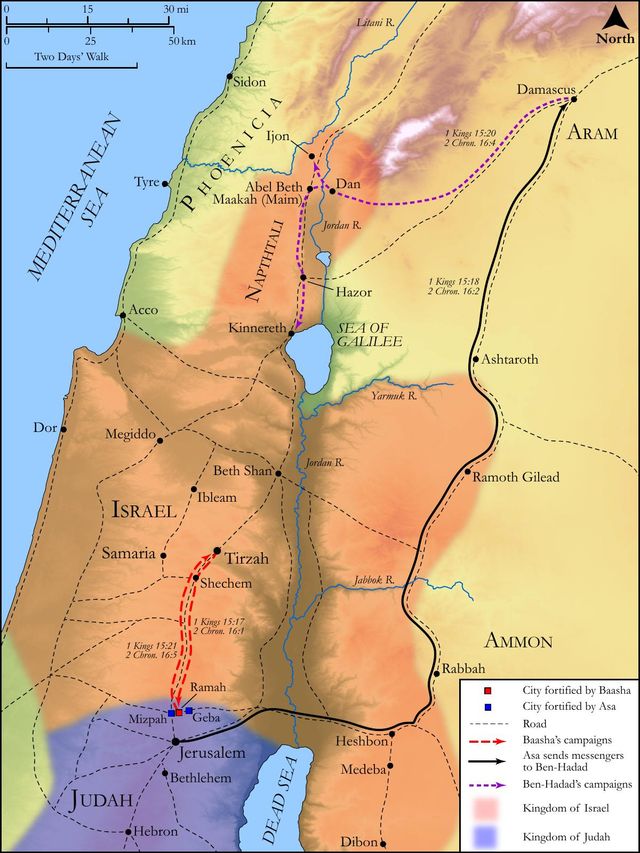
He built cities himself, to encourage the increase of his people (Kg1 15:23) and to invite others to him by the conveniences of habitation; and he was very zealous to hinder Baasha from building Ramah, because he designed it for the cutting off of communication between his people and Jerusalem and to hinder those who in obedience to God would come to worship there. An enemy must by no means be suffered to fortify a frontier town.
V.The faults of his reign.
In both the things for which he was praised he was found defective. The fairest characters are not without some but or other in them.
1.Did he take away the idols? That was well; but the high places were not removed (Kg1 15:14); therein his reformation fell short. He removed all images which were rivals with the true God or false representations of him; but the altars which were set up in high places, and to which those sacrifices were brought which should have been offered on the altar in the temple, those he suffered to stand, thinking there was no great harm in them, they having been used by good men before the temple was built, and being loth to disoblige the people, who had a kindness to them and were wedded to them both by custom and convenience; whereas in Judah and Benjamin, the only tribes under Asa's government which lay so near Jerusalem and the altars there, there was less pretence for them than in those tribes which lay more remote. They were against the law, which obliged them to worship at one place, Deu 12:11. They lessened men's esteem of the temple and the altars there, and were an open gap for idolatry to enter in at, while the people were so much addicted to it. It was not well that Asa, when his hand was in, did not remove these. Nevertheless his heart was perfect with the Lord. This affords us a comfortable note, That those may be found honest and upright with God, and be accepted of him, who yet, in some instances, come short of doing the good they might and should do. The perfection which is made the indispensable condition of the new covenant is not to be understood of sinlessness (then we were all undone), but sincerity.
2.Did he bring in the dedicated things? That was well; but he afterwards alienated the dedicated things, when he took the gold and silver out of the house of God and sent them as a bribe to Benhadad, to hire him to break his league with Baasha, and, by making an inroad upon his country, to give him a diversion from the building of Ramah, Kg1 15:18, Kg1 15:19. Here he sinned,
(1.)In tempting Benhadad to break his league, and so to violate the public faith. If he did wrong in doing it, as certainly he did, Asa did wrong in persuading him to do it.
(2.)In that he could not trust God, who had done so much for him, to free him out of this strait, without using such indirect means to help himself.
(3.)In taking the gold out of the treasury of the temple, which was not to be made use of but on extraordinary occasions. The project succeeded. Benhadad made a descent upon the land of Israel, which obliged Baasha to retire with his whole force from Ramah (Kg1 15:20, Kg1 15:21), which gave Asa a fair opportunity to demolish his works there, and the timber and stones served him for the building of some cities of his own, Kg1 15:22. But, though the design prospered, we find it was displeasing to God; and though Asa valued himself upon the policy of it, and promised himself that it would effectually secure his peace, he was told by the prophet that he had done foolishly, and that thenceforth he should have wars; see Ch2 16:7-9.
VI.The troubles of his reign. For the most part he prospered; but,
1.Baasha king of Israel was a very troublesome neighbour to him. He reigned twenty-four years, and all his days had war, more or less, with Asa, Kg1 15:16. This was the effect of the division of the kingdoms, that they were continually vexing one another, and so weakened one another, which made them both an easier prey to the common enemy.
2.In his old age he was himself afflicted with the gout: He was diseased in his feet, which made him less fit for business and peevish towards those about him.
VII.The conclusion of his reign.
The acts of it were more largely recorded in the common history (to which reference is here had, Kg1 15:23) than in this sacred one. He reigned long, but finished at last with honour, and left his throne to a successor no way inferior to him.
Continue studying 1 Kings 15:16 across the web’s major study libraries — every link below opens this exact verse, chapter, or book on the destination site.
Read & Compare
 BibleGatewayThis verse in more than 200 translations and 70 languages.
 Bible.comThe YouVersion reader — hundreds of translations, reading plans, and highlights.
 ESV.orgCrossway's official English Standard Version reader.
 NET BibleThe NET translation with 60,000+ translators' notes on every rendering decision.
 STEP BibleTyndale House's free study tool — original text, vocabulary, and scholarly resources.
 BibliaLogos Bible Software's free web reader.
 USCCBThe New American Bible (Revised Edition) with the U.S. bishops' study notes.
Commentaries
 BibleHub CommentariesDozens of classic commentaries on this verse, gathered on one page.
 StudyLightMore than 100 commentary sets — the largest collection on the web.
 BibleRefPlain-English commentary on what this verse means, verse by verse.
 Enduring WordDavid Guzik's free commentary on this chapter, widely used by Bible teachers.
 Bible Study ToolsVerse commentary alongside Greek and Hebrew study aids.
Original Language & Research
- BibleHub InterlinearThe verse word by word — original language, transliteration, and English.
- BibleHub LexiconEvery word's original-language definition and Strong's entry.
 Blue Letter BibleDeep-study tools — Strong's numbers, concordance, and word studies.
 SefariaThe Hebrew text with Rashi and centuries of Jewish commentary.
Sermons, Hymns & Audio


TrulyRandomVerse is not affiliated with these sites and doesn’t control their content. They’re linked because they’re genuinely useful.
Summary
1 Kings 15:16 concisely captures the defining and relentless conflict that characterized the concurrent reigns of King Asa of Judah and King Baasha of Israel. This pivotal verse establishes the pervasive state of hostility between the two divided kingdoms, serving as a foundational statement for the specific military engagements, political maneuvers, and strategic alliances that unfold in the subsequent narrative, thereby highlighting the persistent tension born from their historical, political, and spiritual divergence.
Context
ShowHideLiterary Context
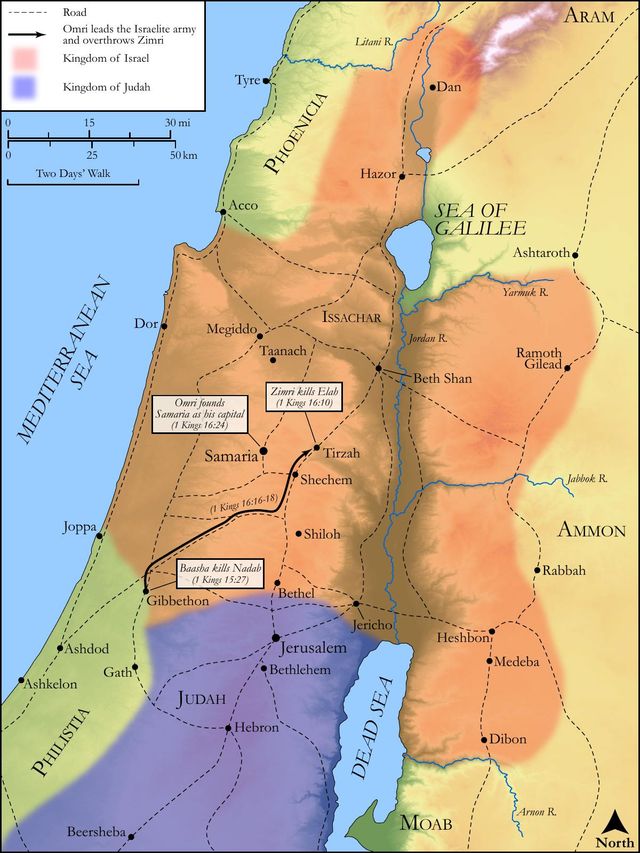
This verse is situated within the book of 1 Kings, which meticulously chronicles the history of the Israelite monarchy from the death of Solomon through the tumultuous period of the divided kingdom. Specifically, 1 Kings 15 details the reigns of Abijam and Asa in Judah, and Nadab and Baasha in Israel. Verse 16 immediately follows a description of Asa's early, generally righteous reign and his earnest efforts to remove idolatry from Judah, a stark contrast to Baasha's continued wickedness in Israel, who "walked in the way of Jeroboam and in his sin" (1 Kings 15:34). The declaration "And there was war between Asa and Baasha king of Israel all their days" functions as an overarching summary statement, setting the stage for the detailed accounts of border disputes, fortifications, and alliances that follow in 1 Kings 15:17-22. It provides the continuous backdrop against which these specific events unfold.
Historical & Cultural Context
Following the catastrophic schism of the united monarchy after Solomon's death (detailed in 1 Kings 12), Israel was divided into the Northern Kingdom (Israel) and the Southern Kingdom (Judah). This division was not merely political but deeply spiritual and ideological. The Northern Kingdom, initiated by Jeroboam, established alternative worship centers at Dan and Bethel and embraced idolatry, fundamentally departing from the Mosaic covenant. Judah, though often faltering, generally maintained a connection to the Temple in Jerusalem and upheld the Davidic covenant. The border between these two kingdoms, particularly in the strategically vital territory of Benjamin, became a frequent flashpoint for conflict. Kings like Asa and Baasha inherited this deeply entrenched rivalry, fueled by theological differences, competing political ambitions, and strategic land claims. The phrase "all their days" underscores that this was not an isolated incident but a continuous, often low-intensity conflict, punctuated by specific military actions, reflecting the deep-seated animosity between two nations with a shared heritage but tragically divergent loyalties.
Key Themes
ShowHideThe persistent conflict described in 1 Kings 15:16 contributes significantly to several overarching themes in the book of Kings. Firstly, it highlights the consequences of disunity, demonstrating how the initial division of the kingdom led to generations of internal strife, weakening both nations and diverting resources from internal development or external defense. This internal conflict stands in stark contrast to the strength of a united people. Secondly, it underscores the spiritual undercurrents of political conflict. While a political rivalry, the war between Asa (who sought to uphold the covenant and remove idolatry, as seen in 1 Kings 15:11-15) and Baasha (who persisted in the idolatry of Jeroboam, as noted in 1 Kings 15:34) was also a reflection of their opposing spiritual allegiances. This ongoing tension also sets the stage for the theme of reliance on God versus human alliances, as Asa's later decision to seek help from Syria against Baasha, rather than fully trusting the Lord, becomes a significant theological point of critique in 2 Chronicles 16.
Exposition and Analysis
ShowHideKey Word Analysis
ShowHideThe Hebrew term מִלְחָמָה (milchâmâh) is a common and broad term encompassing battle, conflict, or warfare. In this context, its use emphasizes not a single, decisive engagement, but rather a persistent state of enmity and armed readiness. It denotes an ongoing condition of hostilities, a chronic state of antagonism that defined the relationship between Judah and Israel under these two kings, rather than merely a series of isolated skirmishes. This suggests a deeply ingrained and continuous animosity.
The name בַּעְשָׁא (Baʻshâʼ), derived from an unused root meaning "to stink" or "offensiveness," is ironically fitting for a king who "did evil in the sight of the Lord" (1 Kings 15:34) and perpetuated the idolatrous sins of Jeroboam. His very name, if understood etymologically by the ancient reader, could subtly foreshadow the moral and spiritual decay associated with his reign and the Northern Kingdom's persistent rebellion against God.
The Hebrew term יוֹם (yôwm), here in the plural "all their days" (kol yemeihem), signifies the entire duration of their concurrent reigns. This temporal marker is crucial, highlighting the continuous and pervasive nature of the conflict. It emphasizes that the hostility was not episodic but a defining characteristic of their respective reigns, a constant backdrop against which all other political and military actions occurred. This underscores the deep-seated and unresolved nature of the division between the two kingdoms.
Verse Breakdown
ShowHide"And there was war"
This opening clause immediately establishes the central theme of the verse: a state of active and enduring hostility. The use of "was" (וַיְהִי, vayhi) indicates a factual, ongoing condition rather than an isolated event. It sets a tone of persistent, pervasive conflict that frames the subsequent narrative, indicating that peace was not the norm but an elusive aspiration.
"between Asa and Baasha king of Israel"
This specifies the primary antagonists: Asa, the king of Judah, representing the Davidic line and the Southern Kingdom, and Baasha, the king of Israel, representing the Northern Kingdom and a new, idolatrous dynasty. This highlights the intense inter-kingdom rivalry that plagued the divided monarchy, often driven by both political ambition and profound spiritual divergence. It underscores the tragic reality of brothers fighting brothers.
"all their days"
This concluding phrase powerfully underscores the duration and intensity of the conflict. It means that throughout the entirety of their co-regency, a state of war, whether active or latent, defined the relationship between these two monarchs and their respective nations. This emphasizes the chronic nature of the division and the inability or unwillingness of either side to achieve lasting peace, reflecting a deep-seated animosity that persisted across their lifetimes.
Literary Devices
ShowHideThe verse employs several literary devices to convey its message effectively. Conciseness is evident in its brief yet impactful statement, summarizing a prolonged period of conflict in a single, declarative sentence. This brevity serves to underscore the pervasive and inescapable nature of the hostility, making the statement feel definitive and absolute. The phrase "all their days" functions as a form of hyperbole or emphasis, highlighting the relentless and enduring quality of the war, suggesting it was a defining characteristic of their entire reigns rather than just occasional skirmishes. This also creates a sense of foreshadowing, hinting at the detailed accounts of specific military actions and strategic maneuvers that will follow, such as Baasha's building of Ramah and Asa's subsequent alliance with Ben-Hadad, as described in 1 Kings 15:17-22. Furthermore, the implicit contrast between Asa's general righteousness and Baasha's persistent wickedness provides a moral and spiritual backdrop to the political conflict, subtly suggesting that the spiritual state of the kings influenced the state of their nations and their capacity for peace.
Theological and Thematic Connections
ShowHideThe persistent warfare between Asa and Baasha serves as a stark biblical illustration of the destructive consequences of disunity, particularly within a people who once shared a covenantal heritage. It underscores how spiritual divergence, political ambition, and unresolved grievances can fester into chronic conflict, weakening both parties and diverting their focus from God's purposes. The narrative subtly highlights God's sovereignty even amidst human strife, as the division itself was part of God's judgment on Solomon's apostasy, yet the ongoing conflict reveals the human cost of disobedience and fractured relationships. It also sets the stage for later theological lessons concerning reliance on God versus human strength, as Asa's subsequent actions in this war ultimately reveal a lapse in his trust in the Lord, leading to prophetic rebuke.
Reflection and Application
ShowHideThe enduring conflict between Asa and Baasha, as concisely stated in 1 Kings 15:16, offers profound lessons for contemporary life. It reminds us that unresolved divisions, whether personal, communal, or national, can lead to prolonged and debilitating strife. The "war all their days" illustrates how deep-seated animosity can consume energy, resources, and focus, hindering progress and fostering bitterness. For believers, this narrative calls for a critical examination of our own relationships and communities. Are there areas of persistent conflict or disunity that drain our spiritual and emotional reserves? The spiritual dimension of this historical conflict also prompts us to consider the underlying causes of our disagreements – are they rooted in differing allegiances, compromises with truth, or simply pride and unforgiveness? Ultimately, this verse serves as a sober reminder of the destructive power of division and the urgent need for reconciliation, forgiveness, and a steadfast commitment to peace, especially among those who claim a common spiritual heritage and the name of Christ.
Questions for Reflection
ShowHideFAQ
ShowHideWhat caused the war between Asa and Baasha to last "all their days"?
ShowHideThe prolonged conflict between Asa and Baasha was a direct symptom of the deep-seated political and spiritual schism that occurred when the united kingdom of Israel split after Solomon's reign. The Northern Kingdom (Israel) under Baasha continued the idolatrous practices initiated by Jeroboam, setting up alternative worship sites and rejecting the true worship of Yahweh in Jerusalem. In contrast, the Southern Kingdom (Judah) under Asa sought to restore true worship to the Lord and remove idolatry. This fundamental spiritual divergence, coupled with strategic border disputes (especially over the territory of Benjamin, as seen in Baasha's fortification of Ramah in 1 Kings 15:17), created an environment of perpetual mistrust and hostility. Neither king was able to decisively defeat the other, leading to a chronic state of low-intensity warfare throughout their concurrent reigns, a constant drain on both nations.
Was Asa a "good" king, despite being involved in this war?
ShowHideYes, Asa is generally portrayed as one of the "good" kings of Judah, particularly in the earlier part of his reign. 1 Kings 15:11 explicitly states that he "did what was right in the eyes of the Lord, as his father David had done." He undertook significant religious reforms, removing idolatrous practices, breaking down Asherah poles, and cleansing the land of cult prostitutes (1 Kings 15:12-13). He even removed his own grandmother, Maacah, from her position because she had made an abominable image for Asherah (1 Kings 15:13). However, his reign was not without blemish. Later in his life, during this very conflict with Baasha, he chose to rely on an alliance with Syria rather than fully trusting God, for which he was rebuked by the prophet Hanani (2 Chronicles 16:7-9). So, while largely righteous and committed to covenant faithfulness, his involvement in the war and his later strategic choices highlight the complexities and moral compromises even faithful leadership can face.
Christ-Centered Fulfillment
ShowHideThe persistent "war all their days" between Asa and Baasha, a tragic consequence of the divided kingdom and humanity's fallen state, ultimately points to the profound need for a true and lasting peace, which is perfectly embodied in Jesus Christ. The Old Testament narrative, filled with cycles of conflict, disunity, and the repeated failure of human kings to bring ultimate reconciliation, sets the stage for the coming of the Prince of Peace. While Asa and Baasha's conflict was rooted in political and spiritual division, Christ's mission was to break down the dividing walls of hostility, not just between nations but fundamentally between humanity and God (Ephesians 2:14-16). The "war all their days" foreshadows the spiritual warfare that humanity faces against sin, death, and the powers of darkness, a battle that no earthly king or military alliance could ever win. Jesus, the true King, conquers these ultimate enemies through His sacrificial death and glorious resurrection, ushering in an eternal reign of peace, justice, and righteousness (Isaiah 9:6-7). He is the one who gathers all things in Himself, reconciling Jew and Gentile, and ultimately, all of creation to God through the blood of His cross (Colossians 1:19-20). Thus, the chronic conflict described in 1 Kings 15:16 serves as a powerful backdrop, highlighting the desperate human need for the comprehensive and redemptive peace offered only through the person and accomplished work of Christ.