


1 Kings 14:27
Bible text: King James Version (1769 Blayney text) · Public domain
Bible text: King James Version with Strong's numbers · Public domain
Bible text: Berean Standard Bible · Public domain
Bible text: American Standard Version (1901) · Public domain
Bible text: World English Bible, Messianic edition · Public domain
Bible text: Geneva Bible (1599) · Public domain
Bible text: Young's Literal Translation · Public domain
- וַיַּעַשׂvai·Ya·'asand he madeH6213Conj-w ¦ V-Qal-ConsecImperf-3msVerb Qal Consecutive Imperfect 3rd Singular Masculineוַandיַּעַשׂhe made
- הַמֶּלֶךְha·Me·lekhthe kingH4428Art ¦ N-msNoun Singular Masculine Absoluteהַtheמֶּלֶךְking
- רְחַבְעָםre·chav·'AmRehoboamH7346N-proper-mNoun Proper Masculine
- תַּחְתָּםtach·Tamin place of themH8478N-msc ¦ 3mpNoun Singular Masculine Constructתַּחְתָּin place ofםthem
- מָגִנֵּיma·gi·Neishields ofH4043N-mpcNoun Plural Masculine Construct
- נְחֹשֶׁתne·Cho·shetbronzeH5178N-fsNoun Singular Feminine Absolute
- וְהִפְקִידve·hif·Kidand he entrusted [them]H6485Conj-w ¦ V-Hiphil-ConsecPerf-3msVerb Hiphil Consecutive Perfect 3rd Singular Masculineוְandהִפְקִידhe entrusted [them]
- עַל'alonH5921PrepPreposition
- יַדyad[the] hand ofH3027N-cscNoun Singular common gender Construct
- שָׂרֵיsa·Rei[the] commanders ofH8269N-mpcNoun Plural Masculine Construct
- הָרָצִיםha·ra·Tzimthe runnersH7323Art ¦ V-Qal-Prtcpl-mpVerb Qal Participle Plural Masculine Absoluteהָtheרָצִיםrunners
- הַשֹּׁמְרִיםha·Sho·me·Rimwho guardedH8104Art ¦ V-Qal-Prtcpl-mpVerb Qal Participle Plural Masculine Absoluteהַwhoשֹּׁמְרִיםguarded
- פֶּתַחPe·tach[the] entrance ofH6607N-mscNoun Singular Masculine Construct
- בֵּיתbeit[the] house ofH1004N-mscNoun Singular Masculine Construct
- הַמֶּלֶךְha·Me·lekhthe kingH4428Art ¦ N-msNoun Singular Masculine Absoluteהַtheמֶּלֶךְking
English is a literal word-by-word gloss of the Hebrew, not the KJV's wording. Why?
This is the original text the KJV's translators worked from — each Hebrew word with its own literal English meaning in this verse, prepared by scholars at Tyndale House, Cambridge. The KJV translates whole sentences, not word by word, so its wording differs: one Hebrew word can become several English words, and the KJV may choose “the LORD” where the gloss reads “Yahweh”. Both are faithful — they answer different questions. For the KJV's own rendering, switch to the KJV text.
Details
See on the biblical-era maps

Study this verse
Public-domain commentary
Matthew Henry
From his Commentary on the Whole Bible. Henry comments on passages, not single verses — this entry covers 1 Kings 14:21–31. His three-level outline is real structure in the source text, so it is rendered as structure.
Judah's story and Israel's are intermixed in this book. Jeroboam out-lived Rehoboam, four or five years, yet his history is despatched first, that the account of Rehoboam's reign may be laid together; and a sad account it is.
I.Here is no good said of the king. All the account we have of him here is,
1.That he was forty-one years old when he began to reign, by which reckoning he was born in the last year of David, and had his education, and the forming of his mind, in the best days of Solomon; yet he lived not up to these advantages. Solomon's defection at last did more to corrupt him than his wisdom and devotion had done to give him good principles.
2.That he reigned seventeen years in Jerusalem, the city where God put his name, where he had opportunity enough to know his duty, if he had but had a heart to do it.
3.That his mother was Naamah, an Ammonitess; this is twice mentioned, Kg1 14:21, Kg1 14:31. It was strange that David would marry his son Solomon to an Ammonitess (for it was done while he lived), but it is probable that Solomon was in love with her, because she was Naamah, a beauty (so it signifies), and his father was loth to cross him, but it proved to have a very bad influence upon posterity. Probably she was daughter to Shobi the Ammonite, who was kind to David (Sa2 17:27), and David was too willing to requite him by matching his son into his family. None can imagine how lasting and how fatal the consequences may be of being unequally yoked with unbelievers.
4.That he had continual war with Jeroboam (Kg1 14:30), which could not but be a perpetual uneasiness to him.
5.That when he had reigned but seventeen years he died, and left his throne to his son. His father, and grandfather, and grandson, that reigned well, reigned long, forty years apiece. But sin often shortens men's lives and comforts.
II.Here is much evil said of the subjects, both as to their character and their condition.
1.See here how wicked and profane they were. It is a most sad account that is here given of their apostasy from God, Kg1 14:22-24. Judah, the only professing people God had in the world, did evil in his sight, in contempt and defiance of him and the tokens of his special presence with them; they provoked him to jealousy, as the adulterous wife provokes her husband by breaking the marriage-covenant. Their fathers had been bad enough, especially in the times of the judges, but they did abominable things, above all that their fathers had done. The magnificence of their temple, the pomp of their priesthood, and all the secular advantages with which their religion was attended, could not prevail to keep them to it. Nothing less than the pouring out of the Spirit from on high will keep God's Israel in their allegiance to him. The account here given of the wickedness of the Jews agrees with that which the apostle gives of the wickedness of the Gentile world (Rom 1:21, Rom 1:24), so that both Jew and Gentile are alike under sin, Rom 3:9.
(1.)They became vain in their imaginations concerning God, and changed his glory into an image, for they built themselves high places, images, and groves (Kg1 14:23), profaning God's name by affixing to it their images, and God's ordinances by serving their idols with them. They foolishly fancies that they exalted God when they worshipped him on high hills and pleased him when they worshipped him under the pleasant shadow of green trees.
(2.)They were given up to vile affections (as those idolaters Rom 1:26, Rom 1:27), for there were sodomites in the land (Kg1 14:24), men with men working that which is unseemly, and not to be thought of, much less mentioned, without abhorrence and indignation. They dishonoured God by one sin and then God left them to dishonour themselves by another. They profaned the privileges of a holy nation, therefore God gave them up to their own hearts' lusts, to imitate the abominations of the accursed Canaanites; and herein the Lord was righteous. And, when they did like those that were cast out, how could they expect any other than to be cast out like them?
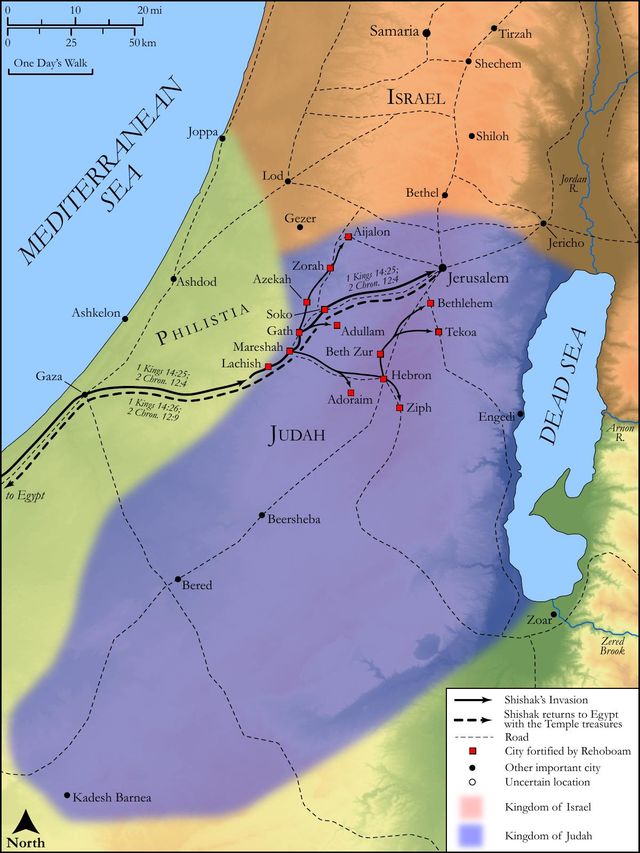
2.See here how weak and poor they were; and this was the consequence of the former. Sin exposes, impoverishes, and weakens any people. Shishak, king of Egypt, came against them, and so far, either by force or surrender, made himself master of Jerusalem itself that he took away the treasures both of the temple and of the exchequer, of the house of the Lord and of the king's house, which David and Solomon had amassed, Kg1 14:25, Kg1 14:26. These, it is likely, tempted him to make his descent; and, to save the rest, Rehoboam perhaps tamely surrendered them, as Ahab, Kg1 20:4. He also took away the golden shields that were made but in his father's time, Kg1 14:26. These the king of Egypt carried off as trophies of his victory; and, instead of them, Rehoboam made brazen shields, which the life-guard carried before him when he went to church in state, Kg1 14:27, Kg1 14:28. This was an emblem of the diminution of his glory. Sin makes the gold become dim, changes the most fine gold, and turns it into brass. We commend Rehoboam for going to the house of the Lord, perhaps the oftener for the rebuke he had been under, and do not condemn him for going in pomp. Great men should honour God with their honour, and then they are themselves most honoured by it.
Continue studying 1 Kings 14:27 across the web’s major study libraries — every link below opens this exact verse, chapter, or book on the destination site.
Read & Compare
 BibleGatewayThis verse in more than 200 translations and 70 languages.
 Bible.comThe YouVersion reader — hundreds of translations, reading plans, and highlights.
 ESV.orgCrossway's official English Standard Version reader.
 NET BibleThe NET translation with 60,000+ translators' notes on every rendering decision.
 STEP BibleTyndale House's free study tool — original text, vocabulary, and scholarly resources.
 BibliaLogos Bible Software's free web reader.
 USCCBThe New American Bible (Revised Edition) with the U.S. bishops' study notes.
Commentaries
 BibleHub CommentariesDozens of classic commentaries on this verse, gathered on one page.
 StudyLightMore than 100 commentary sets — the largest collection on the web.
 BibleRefPlain-English commentary on what this verse means, verse by verse.
 Enduring WordDavid Guzik's free commentary on this chapter, widely used by Bible teachers.
 Bible Study ToolsVerse commentary alongside Greek and Hebrew study aids.
Original Language & Research
- BibleHub InterlinearThe verse word by word — original language, transliteration, and English.
- BibleHub LexiconEvery word's original-language definition and Strong's entry.
 Blue Letter BibleDeep-study tools — Strong's numbers, concordance, and word studies.
 SefariaThe Hebrew text with Rashi and centuries of Jewish commentary.
Sermons, Hymns & Audio


TrulyRandomVerse is not affiliated with these sites and doesn’t control their content. They’re linked because they’re genuinely useful.
Summary
First Kings 14:27 details King Rehoboam's response to the plundering of Jerusalem by Pharaoh Shishak, specifically the theft of Solomon's magnificent golden shields. In a pragmatic yet profoundly symbolic act, Rehoboam commissioned inferior bronze replacements, entrusting them to the royal guard. This action not only underscores the immediate material and national consequences of Judah's spiritual decline but also serves as a poignant illustration of humanity's tendency to substitute divine glory and blessing with diminished, man-made imitations, highlighting a kingdom living in the shadow of its former greatness.
Context
ShowHideLiterary Context
This verse is situated immediately after the devastating account of Pharaoh Shishak's invasion of Jerusalem in the fifth year of Rehoboam's reign, as recorded in 1 Kings 14:25-26. The preceding verses explicitly state that Shishak "took away the treasures of the house of the LORD, and the treasures of the king's house; he even took away all the shields of gold that Solomon had made" (1 Kings 14:26). These golden shields were not mere military accoutrements; they were prominent symbols of Israel's immense wealth and God's favor during the glorious reign of Solomon, as meticulously described in 1 Kings 10:16-17. Rehoboam's subsequent action in 1 Kings 14:27 is a direct, practical, and symbolic consequence of this national humiliation, vividly illustrating the stark contrast between the kingdom's past splendor and its current state of decline. This decline is directly attributed to the spiritual unfaithfulness and idolatry that characterized Judah under Rehoboam, detailed earlier in the chapter (1 Kings 14:22-24).
Historical & Cultural Context
The invasion by Pharaoh Shishak (Sheshonk I), the founder of Egypt's 22nd Dynasty, is a historically verifiable event, corroborated by Egyptian inscriptions such as the relief on the Bubastite Portal at Karnak. His campaign against Judah and Israel marked a significant geopolitical shift, reasserting Egyptian dominance in the Levant after a period of relative weakness. For Judah, the plundering of Jerusalem, particularly the sacred treasures of the Temple and the opulent contents of the royal palace, constituted a profound national humiliation and was understood as a visible manifestation of divine judgment. Shields were indispensable military equipment, but golden shields, especially those of Solomon, transcended mere utility. They functioned as potent symbols of royal power, national prestige, and unparalleled wealth. Their public display communicated the kingdom's strength and prosperity. The replacement of these precious golden artifacts with bronze, a far less valuable and more common metal, would have been immediately perceived by the populace as a significant downgrade, reflecting the diminished status, resources, and overall glory of the kingdom under Rehoboam. This act was not merely a pragmatic measure for defense but a public acknowledgment of loss and a tangible sign of Judah's reduced state.
Key Themes
ShowHideThe central theme underscored by this verse is the loss of glory and the dire consequences of spiritual decline. The dramatic shift from gold to bronze powerfully symbolizes the kingdom's diminished wealth, prestige, and, most significantly, the withdrawal of divine favor due to Judah's widespread idolatry and unfaithfulness. This material downgrade serves as a stark illustration of the biblical principle that disobedience leads to vulnerability and loss, a truth echoed throughout the Deuteronomic curses (e.g., Deuteronomy 28:15-68). Another crucial theme is human substitution and superficiality. Rehoboam's commissioning of bronze shields represents a human attempt to restore outward appearances and maintain a facade of strength without addressing the profound spiritual issues that led to the original loss. Instead of genuine repentance and renewed obedience, which might have brought about authentic restoration, he resorts to a material, inferior replacement. This highlights a kingdom that is content to live in the shadow of its former greatness, demonstrating a focus on outward show rather than inward spiritual health, a pattern frequently critiqued by the prophets (e.g., Isaiah 1:10-17).
Exposition and Analysis
ShowHideKey Word Analysis
ShowHideThis term refers to copper or bronze, a common and durable metal. Its profound significance in this verse lies in its stark contrast to the gold (zahav) of Solomon's original shields (1 Kings 10:17). Gold, the most precious metal, symbolized immense wealth, purity, and divine favor, frequently used in sacred contexts (e.g., the Ark of the Covenant, Exodus 25:10-11). The downgrade from gold to bronze is a powerful visual metaphor for the kingdom's spiritual, political, and economic decline, signifying a clear reduction in status, opulence, and the visible manifestation of divine blessing.
While primarily defensive pieces of armor, in this context, especially referring to Solomon's large ceremonial shields, they also functioned as potent symbols of royal majesty, national strength, and the kingdom's glory. The act of replacing them, even with an inferior material, indicates Rehoboam's desperate desire to maintain some semblance of royal dignity and security, despite the profound loss. The shields represented the kingdom's protective power and its outward display of might.
This verb signifies "to do or make" in a broad sense. Here, it highlights Rehoboam's active role in commissioning these replacement shields. It underscores his pragmatic, albeit superficial, attempt to address the crisis. The choice to "make" inferior shields rather than seeking divine intervention or repentance for the nation's sin reveals a reliance on human effort and material solutions in the face of spiritual judgment.
Verse Breakdown
ShowHide"And king Rehoboam made in their stead brasen shields"
This clause directly attributes the action to King Rehoboam, emphasizing his personal responsibility for this pragmatic response. The phrase "in their stead" (תַּחְתָּם, taḥtām) critically highlights the replacement nature of these new shields, immediately signaling a downgrade. The choice of "brasen" (bronze) over the original gold is the central point of contrast, indicating a diminished capacity, depleted resources, and a palpable loss of national prestige and divine favor. It represents a human, ultimately inferior, solution to a problem that had deep spiritual roots.
"and committed [them] unto the hands of the chief of the guard"
This segment details the delegation of responsibility for the newly forged shields. The "chief of the guard" (literally "chief of the runners" or "chief of the executioners") was a high-ranking official, the commander of the royal bodyguard, tasked with the king's personal security and maintaining order within the palace. Entrusting these bronze shields to their care signifies a shift in their perceived function: from ceremonial displays of opulence to more functional, defensive tools. It underscores the new, harsher reality of a kingdom under threat, where even symbols of power are now primarily for practical protection.
"which kept the door of the king's house"
This final phrase specifies the exact location and primary function of the guard and, by extension, the new shields. The "door of the king's house" represents the entrance to the royal palace, a critical point of both security and public access. The placement of the guards, armed with these shields, at the entrance would have served as a visible deterrent and a symbol, albeit diminished, of the king's authority and the security of his residence. It starkly illustrates that the kingdom's security was now reliant on common materials and human vigilance, rather than the divine favor that once manifested in unparalleled wealth and protection.
Literary Devices
ShowHideThe primary literary device at play in 1 Kings 14:27 is Symbolism. The golden shields of Solomon's era symbolize the zenith of Israel's glory, wealth, and divine blessing, a period of unparalleled prosperity and peace under God's favor. Their plunder and subsequent replacement with "brasen" (bronze) shields serve as a powerful Contrast and a potent symbol of Judah's profound decline. The dramatic shift from gold to bronze metaphorically represents the kingdom's loss of spiritual vitality, national prestige, and material wealth, directly attributable to its unfaithfulness. This material downgrade is a visible manifestation of divine judgment and the consequences of sin. Furthermore, the narrative employs Metonymy, where the shields themselves stand for the entire kingdom's status, security, and the king's diminished authority. The inferior quality of the replacement shields thus signifies the diminished state of the kingdom itself. Rehoboam's action also demonstrates a subtle form of Irony, as he attempts to restore a semblance of glory and security through human means and inferior materials, highlighting the futility of such efforts when the underlying spiritual foundation has crumbled.
Theological and Thematic Connections
ShowHideThe account of Rehoboam's bronze shields serves as a profound theological object lesson on the nature of true glory and the devastating consequences of spiritual compromise. It powerfully illustrates that genuine security, lasting prosperity, and national prestige are not inherent in material possessions or human ingenuity, but flow directly from God's sovereign blessing and His people's faithfulness. When a people or their leaders turn away from God, indulging in idolatry and disobedience, as Judah did under Rehoboam, the outward manifestations of divine favor can be withdrawn, leaving them vulnerable to external threats and forcing them to resort to inferior, human-made substitutes. This passage underscores the timeless biblical principle that superficial fixes cannot address deep-seated spiritual problems. The tangible downgrade from gold to bronze is a stark reminder that sin diminishes, corrupts, and ultimately leads to a loss of what is truly valuable, leaving behind only a shadow of former greatness. It challenges us to critically consider where our true security lies and to prioritize spiritual health and unwavering obedience to God over outward appearances or worldly measures of success.
Reflection and Application
ShowHideThe narrative of Rehoboam's bronze shields offers a timeless and sobering lesson for individuals and communities today. It confronts us with the profound reality that spiritual decline often manifests in tangible, diminished circumstances, whether materially, relationally, or emotionally. We are often prone to seeking superficial replacements for what we have lost through our own unfaithfulness, compromise, or neglect, rather than addressing the root spiritual causes. Just as Rehoboam made bronze shields in place of gold, we might attempt to fill spiritual voids with material possessions, fleeting pleasures, outward religious displays, or human achievements that ultimately lack genuine substance and lasting value. This passage challenges us to engage in honest self-examination: are we living in the shadow of past glories, attempting to replicate them with inferior substitutes, or are we earnestly seeking God for true restoration, humble repentance, and a renewed experience of His presence and blessing? True security, lasting prosperity, and genuine glory are found not in human efforts to maintain appearances, but in humble repentance, renewed obedience, and unwavering reliance on God's unfailing grace and provision.
Questions for Reflection
ShowHideFAQ
ShowHideWhy were the original shields made of gold, and why did Rehoboam replace them with bronze?
ShowHideThe original shields, crafted during King Solomon's reign, were made from pure gold (1 Kings 10:16-17). This reflected the immense wealth, prestige, and divine blessing that characterized Solomon's era, a time when Israel enjoyed unparalleled prosperity and peace under God's favor. Gold was the most precious metal, symbolizing purity, immense value, and divine presence. Rehoboam replaced them with bronze because the golden shields were plundered by Pharaoh Shishak during his invasion of Jerusalem (1 Kings 14:25-26). This act of replacement with an inferior material (bronze) was a practical necessity due to the loss, but it also powerfully symbolized the kingdom's diminished resources, prestige, and the withdrawal of divine favor due to Judah's spiritual decline and unfaithfulness under Rehoboam's leadership.
What does this event tell us about King Rehoboam's reign?
ShowHideThis event highlights the significant decline in Judah's fortunes under King Rehoboam's reign compared to his father Solomon's. It demonstrates Rehoboam's inability to maintain the kingdom's former glory and security. His reign began with the tragic division of the kingdom (1 Kings 12) and quickly descended into spiritual unfaithfulness, including the adoption of idolatrous practices and the toleration of cult prostitution (1 Kings 14:22-24). The necessity of replacing gold with bronze is a tangible sign of the consequences of this unfaithfulness: vulnerability to external enemies, loss of wealth, and a general diminishment of national prestige and divine blessing. It paints a picture of a king who, though attempting to maintain outward appearances, presided over a kingdom in spiritual and material decline, relying on human efforts rather than divine protection.
Is there a spiritual lesson in the downgrade from gold to bronze?
ShowHideAbsolutely. The downgrade from gold to bronze is a powerful spiritual metaphor. Gold represents the ideal, the divine standard, and the full measure of God's blessing and glory when His people are faithful. Bronze, while still functional and useful, represents a lesser, human-made substitute, a diminished reality that results from spiritual compromise and disobedience. The spiritual lesson is that when individuals or nations stray from God's ways, they often experience a "downgrade" in various aspects of life – a loss of true peace, joy, security, or blessing. Attempts to compensate with human efforts or inferior imitations will never truly restore what was lost. It serves as a profound reminder that true value and lasting glory come from God alone, and faithfulness to Him is the only path to genuine prosperity and security, as opposed to superficial appearances or fleeting worldly achievements.
Christ-Centered Fulfillment
ShowHideThe narrative of Rehoboam's bronze shields, replacing the glorious gold of Solomon, provides a poignant Old Testament shadow that finds its ultimate fulfillment and reversal in Jesus Christ. Rehoboam's desperate attempt to restore lost glory through inferior human means stands in stark contrast to Christ, who is the very embodiment of divine glory, "the radiance of God's glory and the exact representation of his being" (Hebrews 1:3). While Judah's glory faded due to sin, culminating in the loss of the golden shields and their replacement with bronze, Jesus, the true Lamb of God who takes away the sin of the world, came not to replace a lost glory with something inferior, but to usher in a new, imperishable glory far surpassing anything of the Old Covenant. He is the one in whom "the Word became flesh and made his dwelling among us. We have seen his glory, the glory of the one and only Son, who came from the Father, full of grace and truth" (John 1:14). Unlike the bronze shields, which were mere human attempts to cover up a profound loss and a symbol of diminished status, Christ's perfect sacrifice on the cross fully atoned for sin, restoring humanity to a relationship with God that offers a glory not dependent on earthly wealth, human effort, or material possessions, but on His divine grace and righteousness. Through Him, believers are transformed "into his image with ever-increasing glory, which comes from the Lord, who is the Spirit" (2 Corinthians 3:18). Ultimately, in the new heavens and new earth, there will be no need for sun or moon, "for the glory of God gives it light, and the Lamb is its lamp" (Revelation 21:23), signifying an eternal, unfading glory that perfectly fulfills and infinitely surpasses any earthly symbol or temporary restoration.